Click covers for info. Copyright (C) Rudy Rucker 2021.


Author Archive

What is Wetware?

Saturday, August 25th, 2007

In its original, intended meaning, wetware is the underlying generative code for an organism, as found in the genetic material, in the biochemistry of the cells, and in the architecture of the body’s tissues.

I was one of the initial popularizers of the word “wetware,” perhaps the third to use it in an SF novel, preceded by Michael Swanwick’s Vacuum Flowers and, I believe, Bruce Sterling’s Schizmatrix. I think I first saw the word in Sterling’s book.

I’m disappointed to see that over the years the meaning of the word is being watered down to mean (a) a human brain or, even worse, (b) a company’s employees.

(a) If “wetware” just meant “brain,” then we wouldn’t even need the word. The whole point of the word “wetware” is that it’s meant to make you look at the world in a new way, and to try and see biological systems from a computational standpoint. An organism is so much more than a brain.

(b) In the sense of employees, wetware might be used in a sentence like: “Yeah, we got the PCs, we got the Office software, now we just gotta hire us some wetware.” When I see people trying to reduce everything to corporate human resources issues, I think of someone giving a monkey in a zoo a crayon, and all he can draw is the bars of his own cage. But, crabbing aside, I can see the appeal to this usage for computer workers. “Why’s this keyboard all sticky?” “Wetware problem. Bill eats lunch at his desk.”
In the Mondo 2000 User’s Guide to the New Edge (Harper-Perennial, New York 1992), I defined “Wetware” as follows. (By the way, I attributed this entry to Max Yukawa, who is in fact a character in my novel Wetware. As a kind of homage, Yukawa’s physical appearance was in fact modeled on William Gibson’s, that is, Yukawa has a long, thin, and somehow flexible-seeming head. When I was starting the book, I’d sent a few pages to Gibson and he’d kindly rewritten them for me, punching them up a bit.):
“Suppose you think of an organism as being like a computer graphic that is generated from some program. Or think of an oak tree as being the output of a program that was contained inside the acorn. The genetic program is in the DNA molecule. Instead of calling it software like a computer program, w call it wetware because it’s in a biological cell where everything is wet. Your software is the abstract information pattern behind your genetic code, but your actual wetware is the physical DNA in a cell. A sperm cell is wetware with a tail, but it’s no good without an ovum’s wetware. A fertilized seed is self-contained wetware, and a plant cutting is wetware, too, as plants can reproduce as clones.”

Rudy Rucker, R. U. Sirius, and Queen Mu, eds., The Mondo 2000 User’s Guide.
Since then, I’ve come to understand that a body’s wetware is more than just its DNA. The autocatalytic system of biochemicals in each cell is a kind of wetware itself. So the seed wetware is really the entire seed cell.

At a higher level, the arrangement of a body’s cells—and the all-important tangling of the cortical neurons—is a kind of wetware as well. The body and its high-level wetware are, of course, implicit in the low-level wetware of the original seed cell which contains the initial DNA and biochemicals. But it can be useful to regard the body as a high-level wetware system on its own, just as one might prefer looking at a program as expressed in some high-level language like Java, rather that trying to decipher it in low-level assembly language or machine code. That is, we can use “wetware” to refer to the underlying initial cell’s patterns, or to the emergent patterns of the body.

(By the way, on May 31, 2007, I made some corrections to the Wikipedia wetware entry. I hadn’t bothered to log in, and was “anonymously” there as an IP code starting with 68.)

All this sounds kind of dry and academic. But the cyberpunk novel Wetware was anything but that. I wrote it at white heat in six weeks in 1986, at the tail end of four years without a formal job—I was a freelance writer working out of a rented office in an abandoned building in the crumbling seedy core of Jerry Falwell’s Lynchburg, Virginia. This was the first of my novels to be written on a word processor—I’d gotten an Epson CPM machine with PeachText software. I didn’t know it then, but I was just about to move to Silicon Valley.

The setup for the book is that humans have built a race of robots called boppers. The boppers live on the moon, where they reproduce by building new robots in factories, often merging two boppers’ codes onto a single new body. Given that they have self-reproduction, “sex,” and mutation, they’ve evolved. But now they want to move from plastic bodies into meat bodies. They’ve figured out how to program human DNA so that a newborn baby might include some particular robot’s personality.
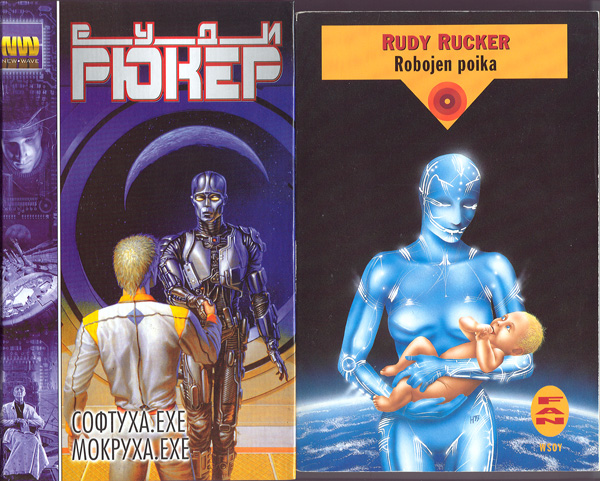
Humans designed the robots, and now they’re turning the tables and designing humans. The first human born with bopper code in his wetware is called Manchile. His sperm carries two tails, one with the human DNA and one with the robot-mind upgrade. He’s starting a Messianic movement on earth, mainly by sleeping with as many women as possible. Like Phil Dick’s precog mutant, the Golden Man, Manchile is irresistibly handsome. I modeled his speech patterns on those of the drummer in our short-lived Lynchburg punk rock band, The Dead Pigs.

“All the boppers really want is access. They admire the hell out of the human meatcomputer. They just want a chance to stir their info into the mix. Look at me—am I human or am I bopper? I’m made of meat, but my software is from … the Moon. Let’s all miscegenate, baby, I got two-tail sperm!”

—Rudy Rucker, Wetware.

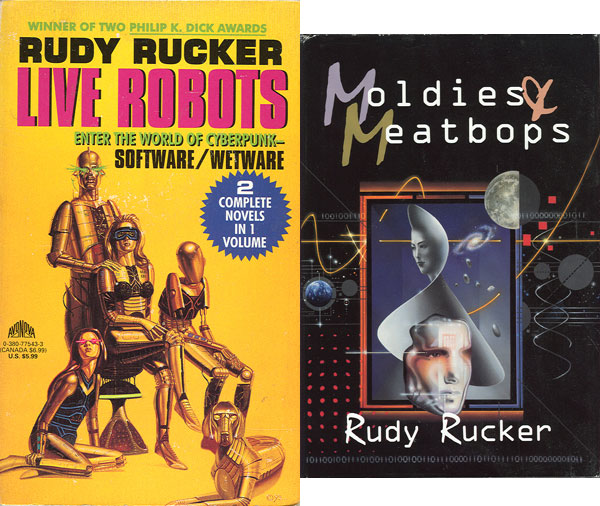
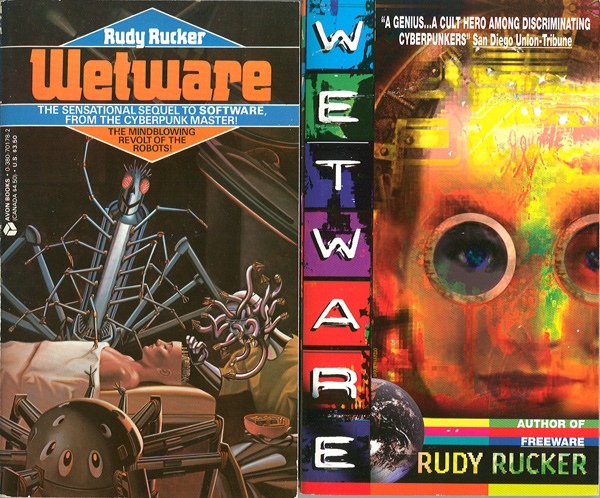
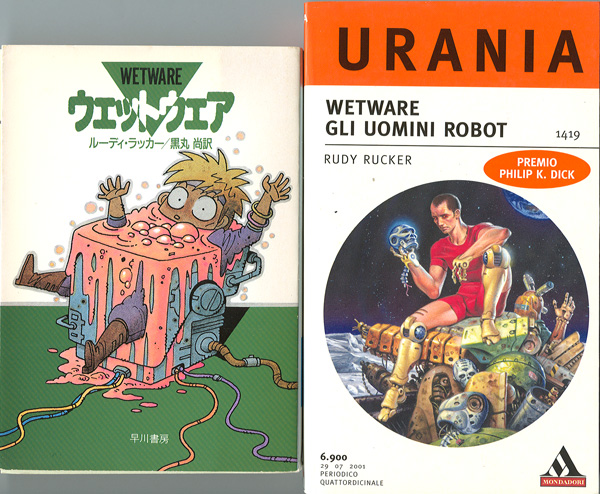
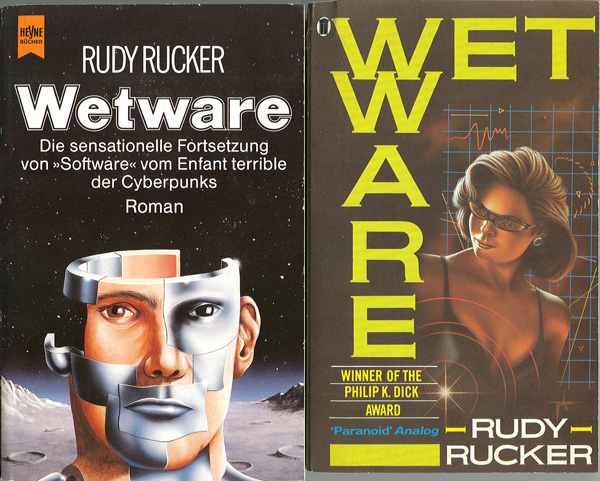
The ten Wetware cover shots above are, left to right and top to bottom, from US Avon (1988 edition), US Avon (1997 edition), Japan, Italy, Germany, the UK, Russia, Finland, Live Robots: the US Avon 1994 double edition including Software, and Moldies and Meatbops: the US Avon Science Fiction Book Club edition including Freeware as well.

Although I suggested the “Moldies and Meatbops,” title, I’ve come to regret it. For some reason I was echoing the sound of the utterly irrelevant title of “Bedknobs and Broomsticks.” I recall another (non-starter) title suggestion I’d made as well, lifted from an S. Clay Wilson one-panel cartoon: “Crazed Junkies Fight It Out With Killer Robots.” Probably just plain Wares would have been best. Note that there never was an omnibus with all four of the novels.

Added October 30, 2016.
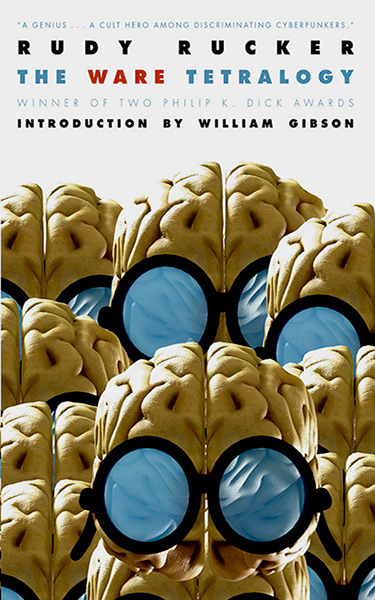
The four-novel omnibus Ware Tetralogy appeared in 2010 from Prime Books with an intro by William Gibson. You can get it as paperback, commercial ebook, or as a free CC ebook.


Zappa, Spook Country

Tuesday, August 21st, 2007

I’m revising the first four chapters of Hylozoic these days, incorporarting all that new aktual stuff that I’ve been blogging about lately. Doing the rewrite feels like coming back to a canvas and adding another layer of painting. It helps the texture.

Last night we saw Dweezil Zappa leading the “Zappa Plays Zappa” band in Berkeley. It was a great show, the band tight and intricate. I still can’t believe Frank is dead. I always related to his mixture of spirituality and vulgarity. He rarely spoke of spiritual things, he let his guitar solos say all that better than words. A master.

Recently I’ve been writing some seriously heavy descriptions of visions or trippy transformation—like where Jayjay gets aktualized—and I was thinking that’s my kind of “guitar solo.”

I’ve been reading William Gibson’s new book Spook Country. The site has a little video of him talking about his book, which makes it more fun to read, as then his voice is fresh in your mind. The book is sheer pleasure: witty, full of great images, wonderful language, and fascinating insights.

I’m heartened to see that Bill has shares a number of my obsessions that I do, not that he and I ever end up writing about something in the same way. He takes more of a sociological and documentary view, and I’m more oriented towards philosophy and romance. I’m happy to see the overlaps, as it gives me a sense of solidarity with a writer I admire. Here’s links into my blog for my takes on some of these topics, along with Gibson quotes on the topics.

* Locative art and the global positioning grid. “ ”˜See-bare-espace,’ Odile pronounced, gnomically, ”˜it is everting.’ … ”˜Turns itself inside out,’ offered Alberto, by way of clarification. ”˜Cyberspace.’” p. 20. “”˜And once it everts, then there isn’t any cyberspace, is there? There never was, if you want to look at it that way. It was a way we had of looking where we were headed, a direction. With the [GPS] grid, we’re here. This is the other side of the screen.’” p. 64.

* Cepahlopods. “Ten feet above the orange tape outline, the glossy, grayish-white form of a giant squid appeared, about ninety feet in total length, its tentacles undulating gracefully … The squid’s eerie surface flooded with light, subcutaneous pixels sliding past in distorted video imagery, stylized kanji, wide eyes of anime characters. It was gorgeous, ridiculous.” p. 55

* Ants. “Another cousin, relocated from New Orleans in the wake of the flood, had spoken of seeing a swarming, glittering ball of red ants in the water. This was how ants avoided drowning, it seemed…” p. 13. “Cultural Marxism was what other people called political correctness, according to Brown … and had come to the US from Germany … in the cunning skulls of a clutch of youngish professors from Frankfurt. The Frankfurt school, as they’d called themselves, had wasted no time in plunging their intellectual ovipostors repeatedly into the unsuspecting body of old-school American academia. Milgrim always enjoyed this part; it had an appealing vintage sci-fi campiness to it, staccato and exciting, with grainy monchrome Euorcommie star-spawn in tweek jackets and knit ties, breeding like Starbucks.” p. 126.

* Hieronymus Bosch. “He saw the IF [a guy they’re spying on], for whatever reason, as a bird-headed Bosch creature, pursued by Brown and Brown’s people, a brown-hooded posse astride heraldic beasts taht weren’t quite horses, their swirling banner inscribed with slogans in the IF’s Volapuk. Sometimes they journeyed for days into the stylized groves bordering that landscape, glimpsing strange creatures in wooded shadow.” p. 48.

* Tulpas. “…the celebrity self is a sort of tulpa … A projected thought-form. A term from Tibetan mysticism. The celebrity self has a life of its own. It can, under the right circumstances, indefinitely survive the death of the subject. That’s what every Elvis sighting is about, literally.” p. 102.

* Spectral beings that live in the woods. “But past Philadelphia, and after taking another tablet, Milgrim began to catch glimpses of spectral others, angels perhaps. The late-afernoon sun dressed the passing woods with Maxfield Parrish foxfire, and perhaps it was that epileptic flicker generated by teh train’s motion that called these beings forth. He found them neutral, if not actually benign. They belonged to this landscape, this hour and time of year, and not to his story.” p. 208.

* Continuous valued cellular automata. “”˜It [a certain computer program] implements finite difference methods for the solution of partial differential equations, on block-structures, adaptively refined rectangular grids.’ Sarah made a brief and probably unconscious face.” p. 273.

On the whole, I found Spook Country humbling. The work is so polished. The dialog, the descriptions and the apercus. Good characterization. Hip.

You’re rooting for all the characters, they aren’t contemptible as my Hylozoic characters, Jayjay and Thuy, threaten to become. There’s a simple clear climax that the whole book builds towards. It’s not a gnarly four hundred pound yam.

Be that as it may, right now my only path is to finish writing Hylozoic to the end, get a rough version, and then go back and polish up the dialog, the descriptions and apercus, and the characterization. There’s no particular reason it actually needs to be like Spook Country. A writer can’t keep changing course. That way likes madness.

Gibson takes about four years to write a book. That’s a lot of polishing Maybe if I polished my book for a couple more years I could make it really shiny. Oh well. Maybe some other time I’ll polish a book for four years. I think I’ll do Hylozoic in about a year and a half, as usual.

The Aktuals and the Peng

Sunday, August 19th, 2007

Q: Why is an aktual able to cast runes and affect matter?

A: Rune mastery results from spanning all the scales; you can teek down into every level of a material region and control the endless (convergent) series that is reality.

After I’m aktualized I can create an object by raising up some Subdee matter. I can, like, spin the wheel of scale in a region. And I can change my size.

I can shrink myself to atomic scale and directly kick an atom. I’m a true quantum mechanic—with a wrench. This is a more powerful interaction than is possible via lazy-eight teek, which lets you move things but doesn’t let you actually change the quantum computations.

When Jayjay is casting ioneer runes, he’s jittering from normal to atomic size at a femtohertz rate—he looks hazy. Maybe he emits some Cerenkov radiation, or grows evanescent transfinitely complex beetle antennae from his head.

Q: What’s the relationship between the transfinite aktuals and the alien Peng?

A: Let’s suppose that the Peng make a practice of parasitizing newly aktualized beings such as Jayjay. The Peng typically try and grab onto newly minted aktuals, using them to cast the runes that will instatiate their ioneers.

Allowing Panpenga to link to Jayjay was a major goof on his part.

The aktuals should have warned Jayjay, but they neglected to. They’re fallible. They apologize. The experienced aktuals know better than to open themselves up to contact with parasitic races like the Peng, but Jayjay was caught unaware, like a newborn antelope attacked by lions.

The Peng prey upon telepathic aktuals, and the Hrull prey upon telepathic humanoids who aren’t aktuals yet. The Hrull like to stunt humanoid races at a lazy eight stage, which is really only a prelude to the full aktualization stage. They infantilize races so as to parasitize them.

Subtextually, the Peng and the Hrull represent two kinds of obstacles to enlightenment: conventionality and decadence.

Peng = Consensus reality, McDonaldsization, TV, lack of imagination.

Hrull = Drug addiction, loveless orgies, gluttony, the “left-handed path” of sensual indulgence.

How Aktualization Feels

Friday, August 17th, 2007

Q: What are the personalities of the harp and the pitchfork?

A: Instead of being like blinding, dull gods, the avatars are somewhat humanized: bumbling and uncertain. The pitchfork and the harp are mates: a he and a she, in love with each other.

The harp has a poor sense of direction, she’s patient and musical. She bosses the pitchfork and she nearly always thinks he’s wrong, even when he’s right. She likes to sing. She likes for the pitchfork to strum her with his tines. She has a beautiful contralto voice.

The pitchfork is pushy and physically clumsy and has difficulty reading the emotions of other beings. He’s less verbal. He likes to jab things with his tines. He loves the vibrations of the harp’s music and voice; he wriggles when he hears them. He himself speaks in a twangy Kentucky accent.

The pitchfork wants to get to ”˜s-Hertogenbosch to be near the harp. But he can’t go straight to her because his and the harp’s human-scale avatars are subject to normal physics. As long as the harp is locked up in Hieronymus Bosch’s studio, the pitchfork can’t get at her.

Q: Why, in general, did the pitchfork and the harp get involved with us?

A: In general, aktuals want more beings to become transfinite aktuals. The aktuals reproduce like crystals, by spreading a particular kind of spacetimescale patterning. Think of the vertical “post pile” crystals within a cooled volcano’s lava plug. Each crystal is the template for the next one.

One might say that the aktuals want all beings to have transfinite consciousness, but this would be a bit too exalted. Basically they want to reproduce.

There might well be an aktual body intersecting with some or all of a person’s life history—indeed if you become part of an aktual, this is the case. This transformation is aktualization; we use the word aktualization to refer to the process of a spacetime region linking up and down to form an aktual.

Any specific spacetimescale being can serve as a crystallization point: a seed that sends a transfinitely rapid cascade of aktualization up and down, linking the entire spectrum of levels and then, in a culminating ecstasy of unification, closing the loop from Absolute Infinity to Zero.

Q: How, specifically, does the pitchfork get involved with Jayjay?

A: The pitchfork appears in the Lobrane time stream shortly before Jayjay has his vision in Chapter One. He and the harp have some hope of actualizing Jayjay. They see an opportunity to work via Jayjay, as Jayjay is so high.

The pitchfork and the harp intended to incarnate themselves together, but an aktual can’t consciously control the patterning of its avatar’s worldline. The whole overall gestalt of the universe comes into play, ensuring that the patterns are consistent.

When the pitchfork appears in the Lobrane, the harp is over in the Hibrane in the medieval village of Hieronymus Bosch. The pitchfork wants to get to the harp, but he finds he’s able to aktualize Jayjay on his own.

Note that it takes the whole book for Jayjay to realize the full import of what’s happened to him in Chapter One. This is, a transreal correlative for my own process of discovering Jayjay’s altered nature via the process of writing the book.

Q: What is aktualization?

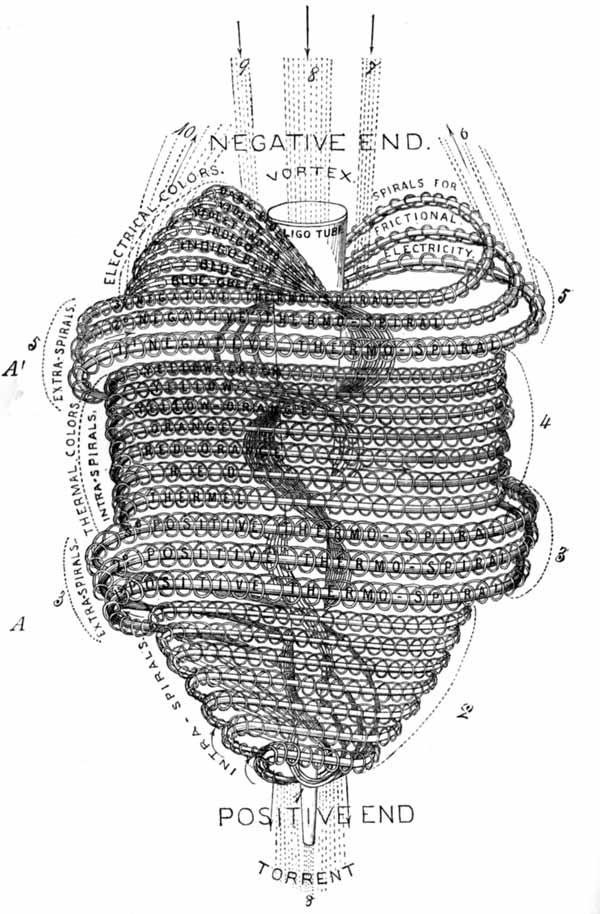
A: In aktualization a helical connection arises among the scale levels. I might say that the scale connectivity is a series of gauge renormalization morphisms. In ordinary words, it works by connecting a series of looped strings of graded sizes: cutting the loops and sewing them together, each loop hooking to a next larger loop and to a next smaller loop.

To make someone an aktual, you snip his knotted loop, and attach one end to an end you get by snipping a loop at the next higher level, and attach the other free end to an end you get by snipping a loop at the next lower level.

For this to work, we need for there to be large string loops as well as little ones—think of cosmic superstrings. And iterate this, cutting further loops up and down to take care of the new free ends you keep producing.

To enrich the range of string loops, we’ll also suppose that consciousness has a physical dark energy correlative of a string-loop nature. As James Clerk Maxwell wrote (if only jestingly):

My soul is an entangled knot,
Upon a liquid vortex wrought
By Intellect in the Unseen residing,
And thine doth like a convict sit,
With marlin-spike untwisting it,
Only to find its knottiness abiding;
Since all the tools for its untying
In four-dimensional space are lying.

Looking downward, when you are aktualized, your body is the same as one of your cells, that cell is the same as a particular atom, and so on. Looking upward, your body is the same as your planet, your planet is the same as your galaxy, and so on upward.

Aktual telepathy works by reaching up in scale to the mind of Gaia and dropping down from there to any other being on the planet. Also note that an aktual has access to all the mass of Earth—and up beyond— and can easily store endless amounts of data.

Q: How does it feel to be aktualized?

A: Jayjay’s awareness of his atomic silps is a partial step towards aktualization; and his vision of our galactic supercluster’s silp, Cronos, is an upward step.

His mind goes into a transfinite regress, like a transfinite sequence of falling dominoes.

He is Earth, the galaxy, a cell, an atom. He even feels sympathy for the subbies now. For everything to fit consistently, he has to give up a certain autonomy, a certain patterning, but he gains as well. Things shift and link.

He sees a collapsing travel cup with endlessly many cylinders being pulled up and up. The cylinders snip join, making a helix. At the end, he can see down the hollow axis of the helix to Absolute Infinity or Absolute Zero—and these two insuperable limits are the same. Like surfing down a glassy tube toward the rising sun. He feels an ecstatic sense of closure when the Absolutely Infinite scale cylinder wraps around and bites its own tail.

Here’s a relevant quote from my first novel, Spacetime Donuts , one of the very first cyberpunk books.

On the one hand, he moved towards Everything by letting his feeling of spatial immediacy expand from his head to include his whole body, then the tree branch and the beehive in the tree, then the garden, the city and the night sky. He expanded his time awareness as well, to include the paths of the rain drops, his last few thoughts, his childhood, the tree’s growth, and the turning of the galaxy.

On the other hand, he was also moving towards Nothing by ceasing to identify himself with any one part of space at all. He contracted his time awareness towards Nothing by letting go of more and more of his individual thoughts and sensations constantly diminishing his mental busyness.

The overall image he had of this activity was of two spheres, one expanding towards infinity, and the other contracting towards zero. The large one grew by continually doubling it size, the smaller shrank by repeatedly halving its size and they seemed to be endlessly drawing apart. But with a sudden feeling of freedom and air, Vernor had the conviction that the two spheres were on a direct collision course—that somehow the expanding and contracting spheres would meet and merge at some attainable point where Zero was Infinity, where Nothing was Everything.

—Rudy Rucker, Spacetime Donuts (Ace Books, 1981)

While were were in Cruz, I had a hypnagogic pre-dream while pondering this; a fabulous rush. I was on rails going out past a vanishing point; this was mixed with the sensation of being in an elevator. I had the ecstasy of transfinite acceleration: more, more, more. And then I was a flat railroad car with two antennae—that’s what my body looked like, seen from the rear. I was looking at myself from a few feet behind, seeing over my own shoulder. I glowed yellow-white against the black/dull-red night sky, a sky stippled with starships, dimensional transporters, and transfinite hoppers.


Rudy's Blog is powered by WordPress