



Rudy’s Blog

Support this blog ... buy Rudy's books!

Postsingular, Mathematicians in Love, Mad Professor, The Hollow Earth,
The Lifebox, The Seashell, And the Soul, and Frek and the Elixir!

Original material on this blog is Copyright (C) Rudy Rucker 2007.


Archive for May, 2007

“What Is Gnarl?” Video. Big Sur.

Thursday, May 31st, 2007

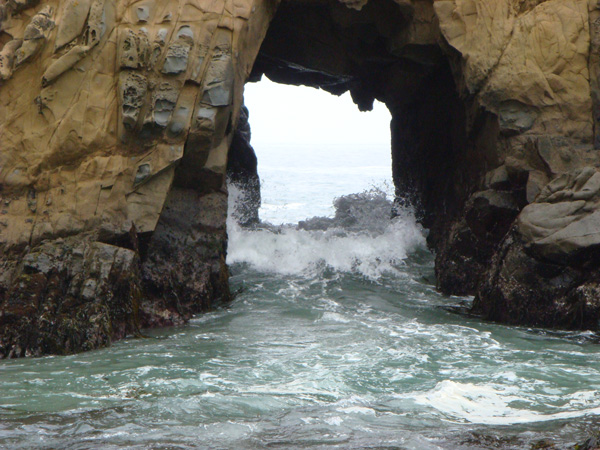
I was at Andrew Molera State Park and Pfeiffer Beach in Big Sur the last couple of days. I put together some videos that I shot there this time plus some Big Sur video from two years ago to make an eight minute You Tube video,“What is Gnarl?” Windows Moviemaker is actually a pretty nice tool. I’d like to clean up the soundtrack, but, hey, it’s gnarly as is.
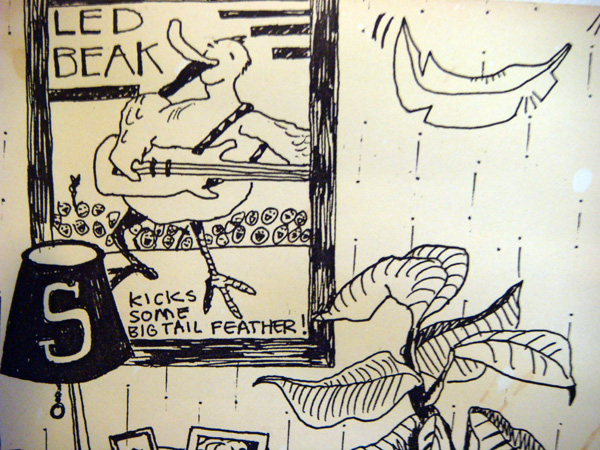
By way of footnote, the bit in “What is Gnarl?” about the seagulls shaking their tailfeathers relates both to Donald Duck in White Light, and to a detail of a drawing that Georgia Rucker did for the Swarthmore College freshman face book, the Cygnet, 1994.
I wrote an essay, “Our Synthetic Futures,” for Newsweek International and it’s online. It describes some possible (fun) outcomes of genomics and synthetic biology. Close students of my work will note that some of these ideas are prefigured in my futurological novel, Saucer Wisdom.
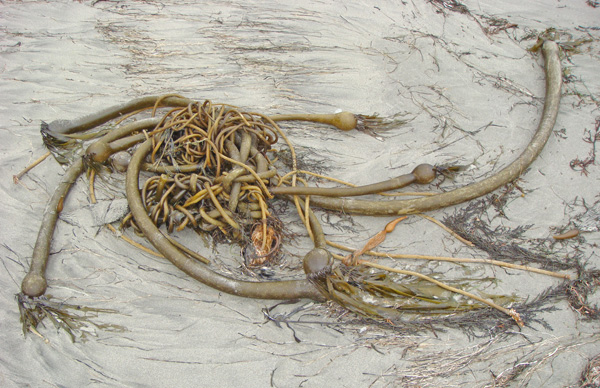
So, like I say, I was in Big Sur the last couple of days. Sitting on a hillock looking at the sea, I had a nice feeling of not thinking. Like what was going on outside didn’t need embellishment. It was exactly what I like. Usually I’m adding ideas, like the little robots watching the bad movies in Mystery Science Theater 3000, or the original Beavis and Butthead commenting on cheesy videos while they play. That’s consciousness, isn’t it, the little comment-bot. But the narrator takes a break when the show is fabulous.

Picture of a ginger root doing yoga from my bottle of Ginger Soother. Here’s a relevant (to not thinking) quote from Pynchon:

“…and now, in the Zone,…after a heavy rain he doesn’t recall, Slothrop sees a very thick rainbow here, a stout rainbow c*ck driven down out of the pubic clouds into Earth, green wet valleyed Earth, and his chest fills and he stand crying, not a thing in his head, just feeling natural… Thomas Pynchon, Gravity’s Rainbow (Penguin 2000 edition), p. 638.
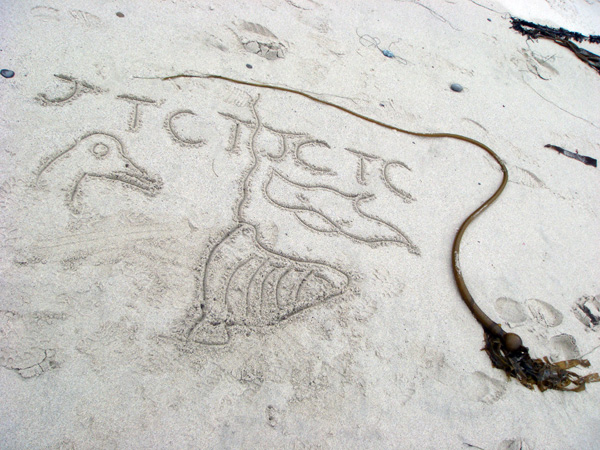
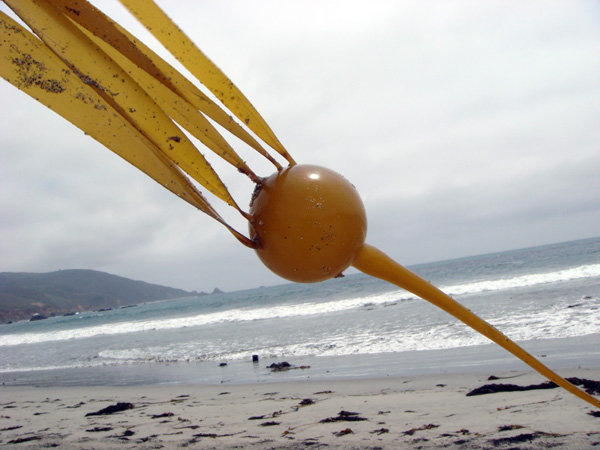
Now I’m trying to get going on Chapter Three again. I thought about the book a certain amount while at the beach. I remembered having a big insight about the story for Mathematicians in Love on Pfeiffer Beach two years ago, and drawing a diagram on the sand. So, for good luck, even though I didn’t have any big insight this time, I drew a diagram of the chapter sequence of POV (points of view) for Hylozoic, along with a picture of a Peng, the Magic Harp, and a Hrull, nicely framed by a kelp stalk. The letters stand for my characters, Jayjay, Thuy and Chu, and I use them to indicate whose point of view I use for the successive chapters. I see the book breaking into two parts, with the sequences J TCT and J CTC.

All these characters appear in my forthcoming novel Postsingular too, by the way. Speaking of Postsingular, I might mention that I got a copy of Word 2007 free from Microsoft for sending in the (apparantly) pirated Word 2003 disk that I’d bought at Fry’s. Word 2007 does a much better job of converting from DOC to PDF than Adobe Reader Professional ever did for me and, hooray, it fixed all the internal links in my three-hundrd page Postsingular Writing Notes PDF document now—you can find the PDF at the Postsingular site.
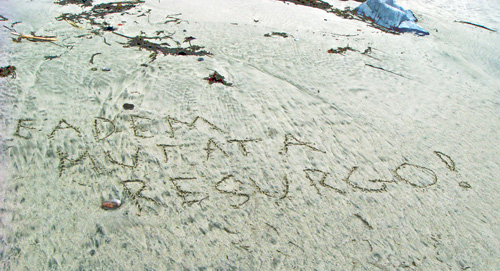
And then I drew the slogan that sparked Frek and the Elixir: “Eadem Mutata Resurgo.” The same, yet changed, I rearise. I wrote this on the beach in 2001. It became Professor Bumby the cuttlefish’s slogan.

Some people walking by decided I really was strange. But everyone expects to see weirdos in Big Sur.
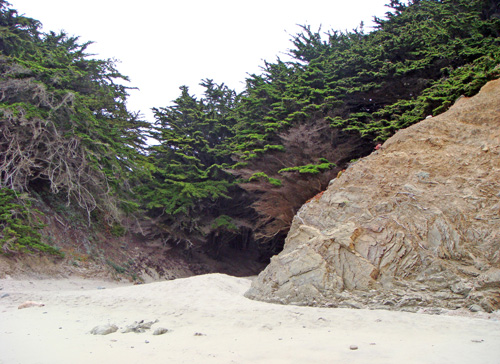
Earlier I’d spent about half an hour rolling crossways on a log, face up, massaging my back in this fashion, groaning with pleasure. I chose the log to be a bit out of the way, in a little gully where I always like to go, the same gully where I filmed the eddy and the plant silp for “What Is Gnarl?”
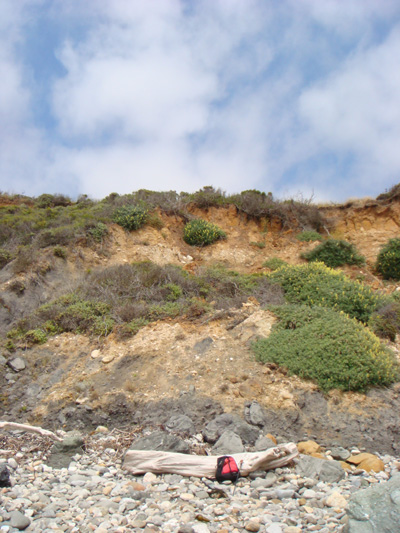
When I was done rolling on the log, and sitting up a bit drunk with chi energy, a couple walked by. The woman said:

“I don’t have my glasses with me and at first when I saw you, I thought you were a mammal.”
“I am a mammal,” I replied.
“I mean like a bobcat or a bear,” she amplified.
“I was getting down to my mammal self,” I said.

Anyway, those were the two who then saw me drawing the Peng’n’Hrull with points-of-view diagram for Hylozoic with my cane.

“Val fisk,” I told them, by way of explanation. But, you know, sometimes it just gets too remote…

By the way, “val fisk” is Swedish for “whale fish,” as “discussed” in my film, “What is Gnarl?”

I just checked on Google, and there are some women actually named Val Fisk, like one is a teaching assistant in Suffolk, England. How great is that?
Tulpa Mediums for Hylozoic

Monday, May 28th, 2007

I’ll refer to the Peng who are emigrating to other worlds as ioneers, a word I made up in grad school and have wanted to use ever since. It’s a goof on pioneers, you understand. A cool word. Ioneer.

I used to visualize the ioneers as sturdy, fit, somewhat Nordic spacemen and women like on a Soviet socialist realism poster. Possibly in the throes of endless sexual stim. But now I’m just gonna have the raggedy-ass ostrich-legged kiwi-bodied Peng use that word for their emigrants. I can say that atomic tulpa computations have to do with dancing ions (charged atoms). And, hey, I can have a Soviet socialist etc. type poster with Peng on it, all gussied up to look more Nordic and less like dirty dust-mops.

How does Panpenga (the planetary oversoul of the Peng’s home world Pengö) reach out to program a Peng’s body code (which the marketeers call “an ioneer soul song”) onto the regions of matter on another world so that the atoms in this far-away matter will begin emanating paired fermion waves to generate a matter hologram or a tulpa of some Peng ioneer whom Panpenga has destructively decoded in order to send said ioneer’s soul song across the void?

So as to involve my character Jayjay, I’m supposing that Panpenga does this by telepathically entangling with a certain receptive individual on a distant world. A host. This person becomes a medium for Panpenga. Via the medium’s body, the ten tridecillion voices of the ioneer’s soul-song, (or the ten tridecillion Fourier terms, if you want to be mundane), are integrated into the ambient quantum computation of the world, fanning out to teach each atom in the full volume of a “Peng ranch” (which is a cubical volume 100 km on a side, in other words, several counties plus the air above them and the dirt below)—and thereby creating a tulpa emulation of the ioneer.

By the way, a “tulpa” is what I was earlier calling a “woogie“.

“Woogie” is a little too comical and lovable and cozy. Misleadingly close to—ugh—wookie. Tulpa sounds more sinister. And I like that it’s like “tulip,” as a tulpa is something that grows up. The origin of the word is that, in Tibetan Buddhism, a tulpa is, as I understand it, a material object or person that an enlightened adept can mentally create. A psychic projection. I think I first read the word in William J. Craddock’s Be Not Content, where the narrator is on a trip, and he imagines the people around him are tulpas of his own creation.

By the way, I updated my Be Not Content post today because I finally found my copy of the book, sitting on a shelf about ten feet from my desk in plain view, sly tulpa that it is.

Possibly I might have a Peng working as a control in the Warm Worlds interstellar Realty office which sends wealthy Peng ioneers out to become tulpas on Earth. She might be called Pekka, in honor of the First Bird Pekka, who miraculously (and paradoxically) laid the very egg that she hatched from.

When installing a tulpa across a Peng ranch, the medium gets into telepathic contact with each and every atom in the ranch. Into each atom, the medium sends a single piece of the ioneer’s soul music, that is, term of the tulpa Fourier series data, plus the Peng control algorithm directing the atom to send a matter-wave at the indicated rate towards the tulpa locator signal. Looked at in another way, the medium is like a conductor, getting a ten tridecillion instrument orchestra to play together.

This is a lot of info to display, and we might suppose that in order to absorb and then deploy the info, the medium needs a very large memory. So the Peng can only send ioneers to lazy eight worlds.

Why doesn’t Panpenga program the Peng ranch atoms directly?

That is, why screw around with an unreliable Earth-side medium? Well, you can’t get the fine tuning from that far away. You need a read-write head on the ground. Also the full info has to be sent in a single chirp. A chunk like a zipped install file. (Cf. Freeware and Saucer Wisdom.)

Why is Jayjay in particular a medium?

For instance, could Chu or Thuy be a medium?

For story purposes, I need for Jayjay’s mediumship to be unique or at least rare, so that the Peng will want to keep in him in a coma and carry him around for channeling more ioneers to Earth. What might make him special was how high he happened to be when he yoo-hooed Panpenga. He was so deeply merged into Gaia that he has become a green god, an earth king, and we can do a reveal of this later on. He doesn’t yet realize his full power. Let’s even say that only one person per planet can be a medium.

I can weave back some mumbo jumbo into his beanstalk trip. During this singular moment he became a divine avatar. He became like a Christ, if you will. What? Jayjay? Christ was a great ethical teacher, not some street kid chasing a high. (Cf. Secret of Life.) Well, maybe Jayjay can grow into his role. He becomes really noble and wise. That would be epic, a nice heavy move for the book. He could even offer up his life as a sacrifice for all mankind at the end. Maybe in this wise he would buy us free of ioneer-invasion forever.

Why can’t the tulpas themselves act as mediums?

Well, a tulpa is physically limited to the confines of his or her ranch, so a tulpa can’t go out into the virgin prairie and bring down the lightning of a new ioneer. But the tulpas can in fact program the atoms of their ranch, which gives them direct matter control. See the next post for more info on this…

QC, SJ, Maker Faire, Las Hormigas

Monday, May 21st, 2007

I had a visit from the young theoretical computer scientist Scott Aaronson this weekend. He pointed me to what looks to be a terrific series of lecture notes by him, about quantum computation. I wish he’d get it published as a book so I don’t have to read it online.

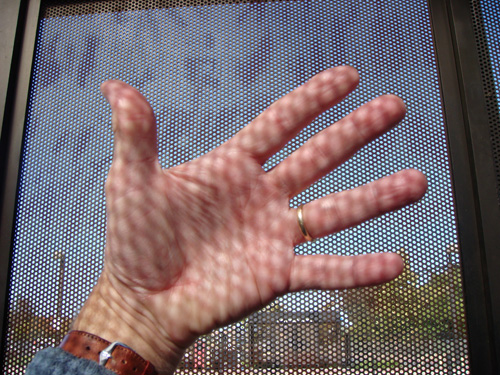
Note the photo of the 2-D shadows on the wall of the Platonic N-D Ru-cave. I used to resist quantum computations, but as an SF writer, it makes more sense to let them into my heart. Quantum computations are as useful to us as radium was for SF writers of the 1930s, and as quarks were in the 1970s!

Speaking of quantum mechanics, Nick Herbert posted an interesting new paper that refutes Bell’s Non-Locality Theorem…for certain kinds of wack worlds.

I was going good on Hylozoic for a few weeks, but now I’m hung up on a bunch of little writing projects. I finished a story with Marc Laidlaw called “The Perfect Wave”, and sidebar article about SynBio biotech futures for the international edition of Newsweek.

And I still have to write an article about cellular automata for Make magazine, and an article about the far future for an anthology called Year Million.

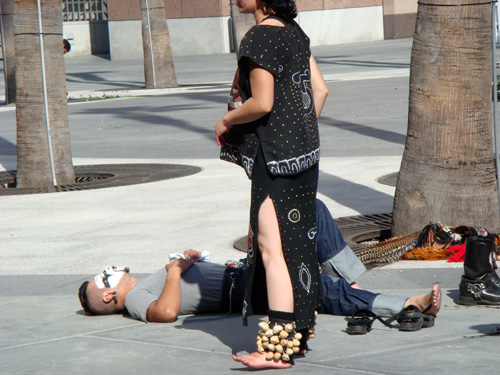
Saturday, Sylvia and I had an all-Mexican day in San Jose. First we saw these great Aztec dancers.

Love the skull.

And then we saw a cool show at the SJ Art Museum by Camille Rose Garcia — not that the main thing about her work is being Latina, she’s totally a California artist from LA. It’s fun to listen to her talk.

To wind up the day we had tacos at Super Taqueria at Tenth and William Street in San Jose. I used to go there a lot when I taught at SJSU. They have the world’s best corn tortillas for their tacos. You get two toritillas, and you leave one in your basket and you can make a second taco out of all the stuff that falls out while you eat your first taco in the first tortilla. The carnitas…ah!

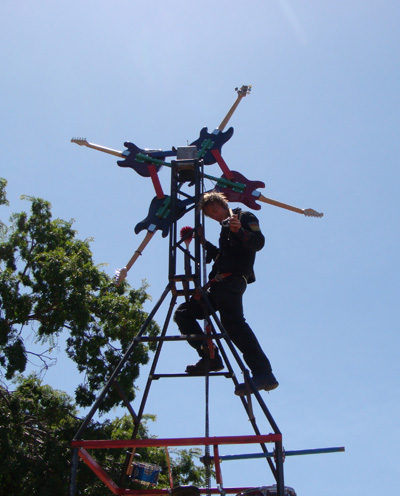
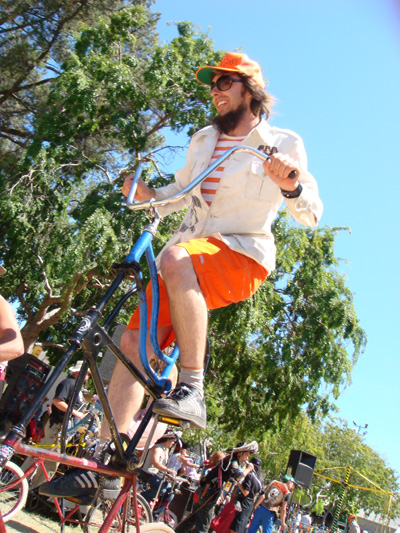
Sunday we went to the Maker Faire near the old racetrack at San Mateo. Rudy Jr.’s gang (he’s a member) Cyclecide was there as a Midway attraction. Jericho was putting up a bicycle driven automatic music tower that plays four electric geetars!

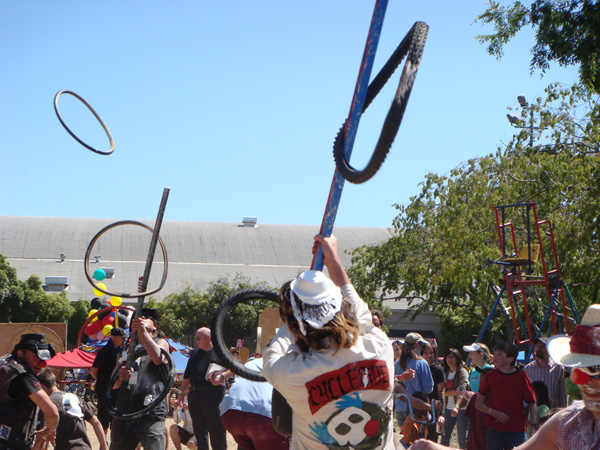
Rudy on a high bike. They had a bullfight and then they had an exciting event where they threw a lot of bicycle tires and pies.

Good, chaotic fun.

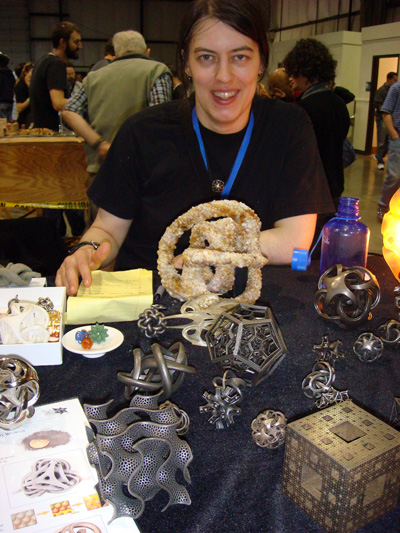
I saw my favorite digital sculptor Bathsheba, whom I’ve met before. That wavy cube shape in front really obsesses me, it’s called a gyroid, which is “explained” in a post by the incomparable popularizer of the impossible, John Baez.

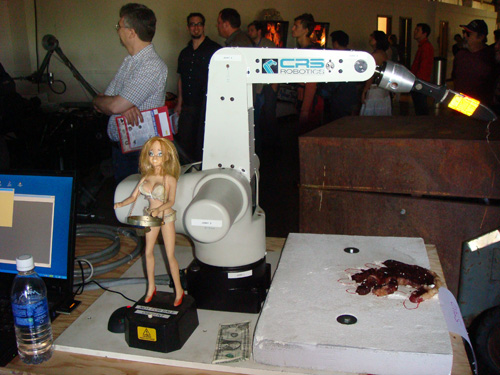
Karen Marcelo showed me a robotic knife stabber she made for SRL (Survival Research Labs). She said one of friends had stuck his hand in while it was still moving and he got cut so bad the blood was spurting, poor guy. So then they put in a piece of steak instead. That’s Survival Research Labs for you: “Producing the most dangerous shows on Earth!”

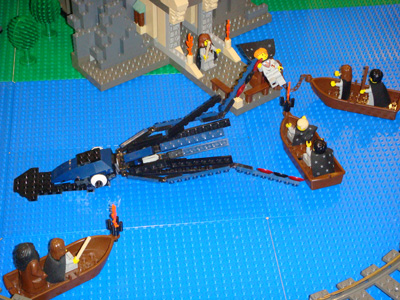
In a kinder, gentler room I saw a giant squid made of Legos.

It was a brutally windy walk to the (wrong) Caltrain station, the world was broken into Lego dots by the wind screen.

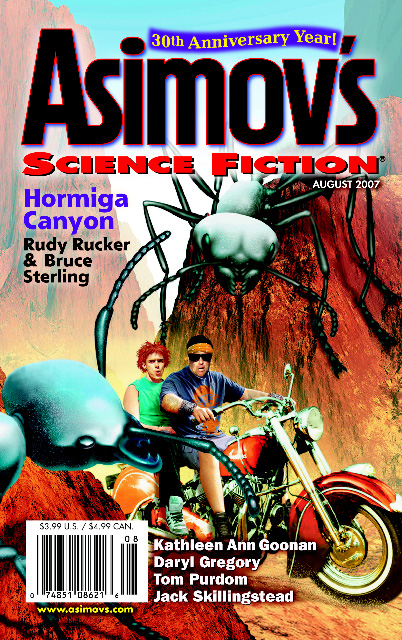
Today I got a preview of the August Asimov’s SF cover, with a story by Bruce and me. Makes me feel like a real science fiction writer, which is very satisying, as being an SF writer was my main life ambition all along, starting at age 13.

My Alan Turing Story

Thursday, May 17th, 2007

I did my reading at the SF in SF series last night. Terry Bisson was the MC, Corey Doctorow read a chapter from his upcoming radical YA SF book Little Brother, and then I read “The Imitation Game,” a short story about the last days of computer pioneeer Alan Turing, and about his persecution by the British secret service. This time, Turing wins… My story will appear in the magazine Interzone this summer or fall.

We had a nice crowd. I recorded my segment of the reading and made it podcast, click the button below to access the MP3 audio file.

Visiting Nick Herbert

Tuesday, May 15th, 2007

I just read an interesting post by Charlie Stross about lifelogging. The ideas overlap a little bit with what I said in my Psipunk talk. Great minds think alike.

Wednesday evening I’ll be reading with Cory Doctorow for Terry Bisson’s SF in SF series at the Variety Theater near 2nd street on Market Street.

I went to see my far-out physicist friend Nick Herbert in Boulder Creek, as I so often do when I’m starting a novel. Nick knows a lot about quantum mechanics; he has this abiding hope/dream that people will some day learn how to communicate directly with matter. He calls this “quantum tantra.” As Nick puts it, our standard scientific experiments are ways of interrogating matter; and our brains are complex quantum-influenced systems; so why not find a way to get it on with matter.

This lies close to my dream of hylozoism and telepathy, so we see eye-to-eye; though for Nick this is more than SF fodder, it’s a serious quest.

Nick has a cactus on his porch looking at itself in a mirror. Collapsing its own wave function.

Nick showed me what he called a Heisentoy, which was a small hand-made fired-clay sculpture that Arne Olafson of Denham Island, British Columbia, had mailed Nick. Nick first opened the box at night, and touched the object without looking at it, and then he got the idea that it would be fun to leave the object’s appearance in a permanently uncertain state.

So he “showed” it to me by handing it to me swathed inside an “anti-viewer” made up of the spandex sleeve of on of his neighbor’s shirts (she liked to cut off her sleeves). It felt like a cube with the edges finger-pinched out like petals, in an irregular pattern.

As we discussed some of the ideas for Hylozoic, we sat in the La Joya cafe in Boulder Creek, formerly the Blue Sun. They were playing the Beatles White Album on the sound system, which I can’t recall having heard played in a public place since the summer of the Manson murders.

As a boy, taking in the info from movies and the comics, I was sure that: I would serve in the army in a war, spend time in a penitentiary, join a lodge. I always liked the sound of IOOF, the International Order of the Odd Fellows, seemingly still flourishing in Boulder Creek.

After lunch we synchronistically ran into a guy on the street who’d worked on the Doubleday Books sales force promoting Billie Craddock’s Be Not Content way back when. The guy said Billie’s editor was Luther Nichols, and that Billie had been under 21 when his early masterpiece was published.

Driving back to Nick’s house, Craddock passed us on the road, on his chopper with the high handelbars. His ghost. A sign. Be Not Content is going to rise again.

Hrull Pusher

Monday, May 14th, 2007

[Posted Monday morning, revised Monday evening.]

The Hrull are slobbering manta-ray-like aliens who are slavers, conscripting humanoids to act as aids to intergalactic trnasport. They fly when in our atmopshere because they’re buoyed by domed hydrogen bladders, or maybe methane bladders. In space they use humanoid pushers to teleport.

I was gonna call these guys the Rull. Years ago, I wrote a story called “Wish Loop” featuring an alien creature resembling a sea skate that is called a Rull. I didn’t realize at the time that A. E. van Vogt wrote a series of stories about humans fighting against nasty worm-like shape-shifting Rull. The War Against the Rull. So I decided I better call them something else this time. I decided to go with Hrull. An element of homage to van Vogt, and an odd-ball spelling, kind of east European, maybe Czech.

Amazing video, it totally changed the way I think of the Hrull. The Hrull aren’t evil, they’re beautiful. Although in Monday morning’s version of this post I speak as if the Hrull will have saucers they travel in, in the evening, after a day with Nick Herbert, I think the Hrull ARE saucers. And maybe, rather than selling engines, they sell freighting. Carrying goods and passengers in ther cavernous mouths.

For the Hrull’s home world, I start with the idea of an ocean world shaped like a water torus encircling a sun—a bit like Ringworld, though not flat. The collection of water-planets is called Hrullwelt; I like the harsh, Teutonic sound of this name. Such a torus would be dynamically unstable. So we can suppose that the torus has broken into giant globs; we have a toroidal archipelago of water globs— like an asteroid belt where all the asteroids are water. And the Hrull leap from one glob to the next.

Their great wings glowing in the empty darkness of space, soaking up solar radiation. Perhaps with pusher-creatures attached to their bellies like remoras. Or perhaps the pushers ride in their enormous mouths like cleaner wrasses. (The Hrull are filter feeders despite their menacing look.) Although the Hrull who visit Earth are only thirty feet across, maybe the big freighter Hrull are a hundred meters across. The littler guys who came here are scouts.

The Hrull conscript humanoids and use them as integrated symbiotes for star travel. The Hrull use humanoids as pushers to power teleportation hops. Practically all of the alien races use Hrull for shipping and for passenger transport. The Hrull come in various sizes, such as interstellar and intergalactic—the power and range of a Hrull depends on how many humanoids are dangling off him or swarming in his mouth. Like cylinders in car engines.

Robert Sheckley wrote a story, “Pusher,” about humanoids as being the only kinds of species which are capable of teleportation. I discuss this in a Feb 24, 2007 blog entry.

As I said before, with Sheckley, I would maintain that we can teleport precisely because we have so much regret, doubt and fear. Why? Having doubt and fear involves creating really good mental models of alternate realities. And being able to create good mental models of alternate realities means the ability to imagine yourself being there rather than here. And this means that we can spread out our wave functions in ways that other beings can’t. We carry out certain delicate kinds of quantum computation.

Perhaps the humanoids that make up a Hrull pusher are surgically and chemically made into pathetic paralytics unable to escape the engine rooms? No, that would be too harsh, as I want my character Chu to be part of a Hrull pusher for awhile and then bounce back. Let’s suppose that when you’re a Hrull pusher, your encased pupa-like in Hrull body-slime, which slowly hardens. The Hrull slime provides full life-support—oxygenation, hydration, nutrition, and waste removal. People call it godslime.

Why? Well, the kicker here is that the humanoids pretty much enjoy being a Hrull pusher—it produces an intoxication of some kind. Perhaps psychedelic ecstasy, but perhaps something cozier and lower-chakra.. Perhaps The Hrull are intensely interested in the infinite, and being swathed in their godslime makes you feel as if the most important part of you is infinite, in heaven. Your body becomes just an attachment point to maintain a presence in the gross material plane. Or maybe the godslime just makes you feel like you’re on a happy date with your best girl. At home with grandma for the family reunion up in heaven.

But working as a Hrull pusher isn’t endlessly pleasurable. After awhile, you notice that you’re hearing a continual hum—like a leaf-blower or a clothes-dryer or a refrigerator—the hum is in some sense driving and owning your thoughts. The hum is the mentation of the Hrull. The pushers get to go off on leave in the Hrulls’ ports of call. But eventually they make their way back to their owner Hrull, as they miss the godslime. I can see an evening of spacers like this, the vibe reminds me of Samuel Delany’s story, “Aye, and Gomorrah.”

The Hrull carry Chu back to Hrullwelt to test and display him as a sample for a new line of Hrull pusher. The Hrull clients also know about Earth, but they leave the use of pushers to the Hrull. The clients aren’t going to be kidnapping humans themselves. Only the Hrull can exude the essential godslime. That’s the Hrully angle for using humanoids as pushers.

Maybe, as a pun on the Sheckey usage of “pusher,” the Hrull pushers also make a little money when in port by selling small amounts of godslime to rubes. “Just a taste. Your heart’s delight.”

Femtotech Weapons

Saturday, May 12th, 2007

I’m thinking about having some direct matter control in Hylozoic. I’ve written about this before, calling it femtotechnology. It was in Freeware first, and then I worked out the science for it in Saucer Wisdom. Here’s a long quote about femtotech from Saucer Wisdom, a scence featuring my old characters Harry Gerber and Joe Fletcher.

[Begin quote from Saucer Wisdom.]

We’re early in the year 3001, looking in on the founder of femtotechnology, a dumpy guy with thick lips and a slobbering way of talking. He’s telling his plans to a tall skinny assistant who has a little tuft of curly hair. Their names are Harry and Joe.

“We’re going to invent femtotechnology now,” sloppy Harry is saying. “To make a long story short.”

“Say what?” says curly-top Joe.

“I’ll explain it again,” says Harry. “First of all, here’s the official prefixes for small numbers.” A radiotelepathically projected chart appears in the minds of Harry, Joe, and the eavesdropping Frank.

Name *** Numerical Symbol *** Prefix

Thousandth *** 0.001 *** Milli-
Millionth *** 0.000001 *** Micro-
Billionth *** 0.000000001 *** Nano-
Trillionth *** 0.000000000001 *** Pico-
Quadrillionth *** 0.000000000000001 *** Femto-
Quintillionth *** 0.000000000000000001 *** Atto-
Sextillionth *** 0.000000000000000000001 *** Zepto-
Septillionth *** 0.000000000000000000000001 *** Yocto-

“Yawn yawn, I’ve seen that,” says Joe.

“Seen but not understood,” says Harry. “To grasp the meaning of the word ‘femtotechnology,’ you should first think about the word ‘nanotechnology.’ A nanometer is a billionth of a meter. An big molecule might be ten or twenty nanometers across, maybe a little more. A water molecule is smaller, about a fifth of a nanometer. Nanometers are a natural size-unit for measuring molecules, so when people developed the technology for manipulating molecules they called it nanotechnology.”

“Then how come the dooks who work with molecules say they’re doing wetware engineering?” asks Joe.

“That’s a historical accident,” says Harry. “The original nanotechnologists — we’re talking about nearly a thousand years ago — thought they were going to be making tiny machines. But that idea turned out to be bogus. Biology has the lock on nanometer-scale fabrication. The word ‘nanotechnology’ died because the first guys to use it had some wrong ideas. It’s sort of like the way the alchemists thought substances had philosophical virtues, and then a few centuries later it turned out they’d been trying to do chemistry. The old-time nanotechnologists thought molecules were like machines, and then a few centuries later it turned out they’d been trying to do wetware engineering. Nobody wants to be branded an alchemist or a nanotechnologist because those original groups were wrong in important ways. But my point, Joe, is that wetware engineering is indeed nanotechnology. It’s what’s going on when you use medi-germs to clean out your arteries. It’s what’s happening when a diamond-spider spins carbon fibers for construction. It’s what happens when a cloth-plant weaves cellular automaton fabric for your shirts.”

“Don’t hurt yourself, man,” says Joe. “You’re explaining too hard. Try this one: according to the chart, picotechnology should come before femtotechnology. Why don’t we do picotechnology first?”

“There isn’t much happening at the picometer size scale,” says Harry. “The next really solid thing below molecules is the nucleus of an atom. And that turns out to be about twenty femtometers. So if we start doing things directly to atomic nuclei we’re talking about femtotechnology. There isn’t going to be any picotechnology because there’s nothing interesting that’s a picometer in size.”

“Very clean,” say Joe. “Femtotechnology. I’m down with it, brah. But what are we going to do to the atoms?”

“Transmute them, Joe. Dirt into gold. Gold into water. Water into air. Air into chicken soup. Making stuff out of ‘thin’ air is quite practical, you know. Air has more mass than people realize. A cubic meter of it weighs a kilogram. The air in your bedroom weighs about as much as your body.”

“But how does transmutation work?”

“Transmutation is mostly a matter of changing protons into neutrons and vice-versa. An atom’s nucleus is a bunch of protons and neutrons. Take oxygen, it’s got eight neutrons and eight protons. And hydrogen has one proton. If you could change protons into neutrons, you could stick sixteen hydrogens together, flip half of their protons to neutrons and you’d have a molecule of oxygen. Like that. And by the way, when you change the nuclei, the electrons take care of themselves.”

[Here's an amazing video of femtotech transmuatation from the far-out video site Flight 404.]

“But how do you change a proton into a neutron? Smash it or something?”

“That’s the crude old nuclear physics way. Instead of that, we femtotechnologists are going to use quark-flipping. Takes much less energy. What’s quark-flipping? A proton is a quark-bag holding two up quarks and one down quark, while a neutron is a quark-bag with two down quarks and one up quark. To change from one to the other, you just need to go into the bag and flip the one quark.”

“Aren’t there other kinds of quarks, too?” asks Joe. “Besides up and down?”

“Strange quarks,” says Harry, smiling wetly. “We’ll get to those later, my man. But first we need to get the femtotechnology matter transmuter working.”

“What do you want to call it?”

“I don’t know,” says Harry. “Horne O’ Planty? Spelled weird to make it a trademark, you understand. Or maybe a Polish Knife? My mother’s people are Polish. Or call it an alef? Or maybe a cradle or a loom?”

“How about an alla,” says Joe.

“I like it,” says Harry after a moment’s thought. “Alla. Fine. Now what’s still missing, Joe?”

“How to make it work is what’s missing.”

“Incommensurable magnitudes,” says Harry. “We’ll use three titanium bars of slightly different irrational lengths. The square root of two, the cube root of three, and the fifth root of five will work. Each bar will have a matter-lens that grows quark whiskers, and the whiskers will embody a one-dimensional nonlinear wave pattern that tells them where to turn. The whiskers will split and grow along all the edges of a parallelopiped control volume. Within this box we’ll use a chaotic cascade to fuse all the nucleons’ quark-bags into a quark-gluon plasma that we’re free to flip, shuffle and regroup. The process will be directed by high-level user request patterns made via a custom-designed radiotelepathic uvvy which incorporates low-level implementation instructions for a few thousand basic substances. You can help with that part, Joe. And in our commercial release, the control uvvy can act as a carrying case. The alla!”

“Wavy,” says Joe. “I’m there, dude.”

[End quote from Saucer Wisdom.]

I want some cool weapons. I need to think of what they do and give them fairly simple names.

The stonker. The target gets cold and frosty then falls apart. Could be that it damps atomic vibrations or, funnier, the atomic silps are too stoned to hold together—Sonic mentions a thing like this in Chap 1. Not sure of the name of this weapon. Devibrilizer looks too much like “devil.” Vibrilizer is backwards. Nuller sound Star Trek. Stonker. I like stonker, it sounds like stoner, stomper, stink and stalk.

The klusper. Amps up atomic vibes, overloads the atoms with Gaian information flow, they heat up and explode into plasma. Klusper like crisper.

The gobble gun. Looks like a hollow barber pole. Is always sucking some air in front and sending it out the back. Crank it up to full power, and it inhales everything in front of it, empties out a cylindrical tube about a kilometer long and a meter wide, turns the matter into a tidy black coil of degenerate-matter in back, like the sh*t-vein of a shrimp. At first I wanted to call it the gomper gun, which sounds funnier, gomper like gopher and Gomer. But gobble gun is so much easier to understand.


Rudy’s Blog is powered by WordPress