

Click covers for info. Copyright (C) Rudy Rucker 2021.


Archive for the ‘Rudy’s Blog’ Category

Gubs and Raths

Friday, November 30th, 2012

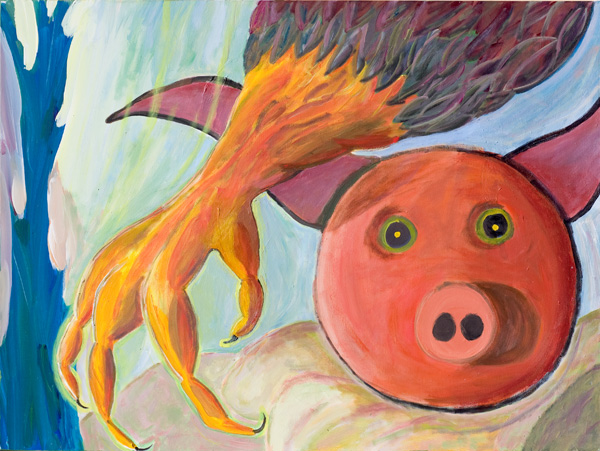
I want to write about some creatures called gubs in my novel The Big Aha. A gub is a small green pig from the Higher World, about the size of a football, with floppy triangular ears, and in place of a curly tail, a writhing bunch of purple tentacles. One of them might appear in your room, go gub-gub-gub-wheenk! Then streak across the room and disappear right before ramming into your wall.

Thinking about the gubs, I remembered that I wrote about small green pigs once before, in the Freeware volume of my Ware Tetralogy, where they were called raths.


[Find paperback, ebook, or CC versions of The Ware Tetralogy]

So today I’m posting a couple of passages from Freeware dealing with the raths. By way of introducing the material, let me give you a little background on Freeware. People have found a way to program lumps of soft intelligent plastic. The stuff can take on all sorts of forms, such as the large, smart descendents of robots who are now known as moldies. My character Corey Rhizome is making small programmed plastic toys that he calls Silly Putters. He’s family friend of a woman named Darla, and her twin daughters Joke and Yoke.

And now let the “reading” begin…

On the girls’ eleventh birthday, Corey showed up with a set of six brand-new Silly Putters. Chuckling and showing his gray teeth, he upended his knapsack to dump the lively plastic creatures out on the floor. “Remember Lewis Carroll’s Jabberwocky, girls?” he cried. “Jokie, can you recite the first two verses?”

“Okay,” said Joke and declaimed the wonderful, time-polished words.

’Twas brillig, and the slithy toves
Did gyre and gimble in the wabe;
All mimsy were the borogoves,
And the mome raths outgrabe.”

Beware the Jabberwock, my son!
The jaws that bite, the claws that catch!
Beware the Jubjub bird, and shun
The frumious Bandersnatch!

As Joke spoke, each of the six new Silly Putters bowed in turn: the tove, a combination badger and lizard with corkscrew-shaped nose and tail; the borogove, a shabby mop-like bird with long legs and a drooping beak; the rath, a small noisy green pig; the Jabberwock, a buck-toothed dragon with bat wings and long fingers; the Jubjub bird with a wide orange beak like a sideways football and a body that was little more than a purple tuft of feathers; and the Bandersnatch, a nasty monkey with a fifth hand at the tip of his grasping tail.

Joke and Yoke shrieked in excitement as the Jabberwocky creatures moved about. The Jubjub bird swallowed the rath and regurgitated it. The freed rath gave an angry squeal that rose into a sneezing whistle. The Jabberwock flapped its wings hard enough to rise a few inches off the floor. The tove alternately tried to drill its nose and its tail into the floor. The borogove stalked this way and that, peering at the others but not getting too close to them. And the Bandersnatch snaked its tail behind Yoke and felt her ass.

“Don’t!” said Yoke, slapping at the Bandersnatch’s extra hand. The Bandersnatch gibbered, rubbed its crotch, capered lewdly, and then seized the back of Joke’s leg, shudderingly hunching against the young girl’s calf.

“I better do some more work on him,” wheezed Corey, grabbing the Bandersnatch and stuffing the struggling Silly Putter back into his knapsack. “I put so much of myself into each of them that I’m never quite sure how they’ll react to new situations. Quit staring at me like that, girls.”

“Uncle Corey’s a frumious Bandersnatch,” giggled Yoke.

“It was so sick how that thing was pushing on my leg?” said Joke.

“Doing it,” whooped Yoke. “Oh, look, the Jubjub bird is going to swallow the rath again and make it outgrabe!”

“The present tense is outgribe,” corrected the literate Joke. “It’s like give and gave.”

[Now we jump to five or ten years later. At this point, a kind of mind-virus is infecting such soft plastic creatures as the larger “moldies” and the small toy Silly Putters. You need to know that an uvvy is a soft plastic telephone. And Corey Rhizome is worried about a Silly-Putter-like toy dog called Rags that some enemies had sent to attack Darla. And now Darla and her daughters phone Corey.]

Joke told her uvvy to call Corey, and moments later Corey picked up. With their uvvies linked, Darla and her daughters could channel Corey together.

“What?” screamed Corey. “Who the f*ck is it?” Instead of using his uvvy, Corey was yelling at an ancient tabletop vizzy phone with a wall-mounted camera and a broken screen. The brah’s only incoming info was audio. The vizzy’s camera showed Corey slumped at a filthy round kitchen table with the rath and Jubjub bird on top of the table, scrabbling over mounds of tattered palimpsest. The table was further cluttered with ceramic dishes of half-eaten food, a clunky Makita piezomorpher, some scraps of imipolex, and, of course, Corey’s vile jury-rigged smoking equipment.

The Jubjub bird opened its mouth hugely and clapped it down on the rath’s curly tail. The rath outgrabe mightily, combining the sound of a bellow, a sneeze, and a whistle. Corey winced and leaned forward into his smoke filter to take a long pull from his filthy hookah.

“Corey,” spoke up Darla before Joke could say anything. “I’ve been worried about you.”

“Darla?” Corey drew his head out of the fume hood and, shocking to see, there was thick gray smoke trickling out of his nose and mouth. “What happened to Rags, Darla? They took my uvvy away. Things are f*cked-up beyond all recognition. How did you deal with Rags?”

“I killed him with the needler, no thanks to you. At least the two Silly Putters that I can see in your place look normal.” The rath extricated its tail from the Jubjub bird’s beak and reared back to drum its green trotters on the Jubjub’s minute, feathered cranium. The Jubjub bird lost its footing and slid off Corey’s table, taking a stress-tuned lava cup with it to clatter about endlessly in the low gravity. The rath outgrabe triumphantly, and the Jubjub bird let out a deep angry caw.

“It’s funny about those two,” said Corey. “Whenever the others try to infect them, they shake it off . They’re stupid, of course, but certainly no stupider than the Jabberwock or the borogove. I think maybe they’re immune because Willy used a cubic homeostasis algorithm on them instead of the usual quadratic one. It’s been a while. I made them for Joke and Yoke’s eleventh birthday, remember?”

“You and your gunjy Bandersnatch,” uvvied Darla nastily.

“The Bandersnatch is bad news,” said Corey. “I admit it.” On the floor, the Jubjub bird and the rath were vigorously playing a game of full-tilt leapfrog; repeatedly smacking into the walls and then bouncing around all over the kitchen floor, cawing and outgribing and biting at each other.

So that’s it for the reading. Check out the whole Ware Tetralogy if you like. And meanwhile I’m looking forward to having fun with my gubs. Raths redux!

Gub-gub-gub-wheeeeeeeeeeenk!

SFictional Higher Realities

Wednesday, November 28th, 2012

I like thinking about a higher or alternate forms of reality. In The Big Aha, I want to give my characters access to a more cosmic or far-out level. And then some of my characters learn to jump bodily into this higher world. And they find some creepy vermin living there. Creatures who do not have humankind’s best interests at heart.

So what is the higher world? So far I’ve thought of seven SFictional possibilities. Let’s start counting at 0.

(0) This is the traditional one. The “other” world is a physical place in our space. Either on our planet, as in mysterious voyage tales, like an island, an undersea cave, in the Antarctic, in a hidden valley. Or off-world, like on another planet. Or sort of on our planet, but not in an obvious place, like inside the hollow earth, or on a cloud.

(1) It could be a parallel sheet of spacetime, perhaps with a different kind of physics. But I used this option in Postsingular and Hylozoic, and I don’t want to recycle it here.

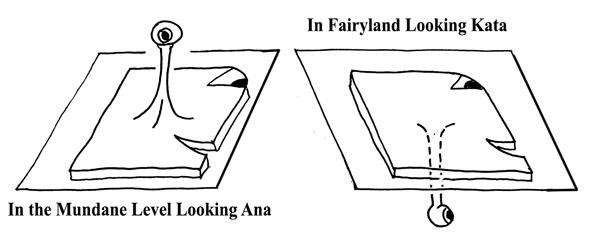
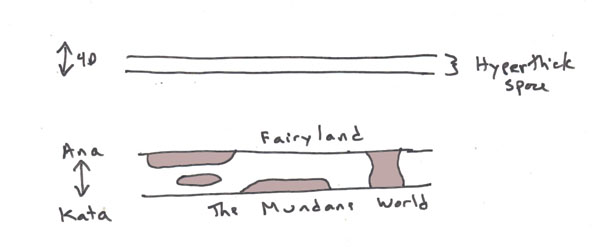
(2) It could be a higher-dimensional hyperspace. And then our world is a sheet inside this hyperspace, and the hyperbeings move about in the higher dimensions at will. They may dip into our world now and then. I used this model in Spaceland.

(2a) The hyperspace model can be adapted to a religious or spiritualist notions of incorporeal beings looking down on our world. Ghosts, spirits, demons, angels, gods, devils. Spaceland works somewhat along these lines.

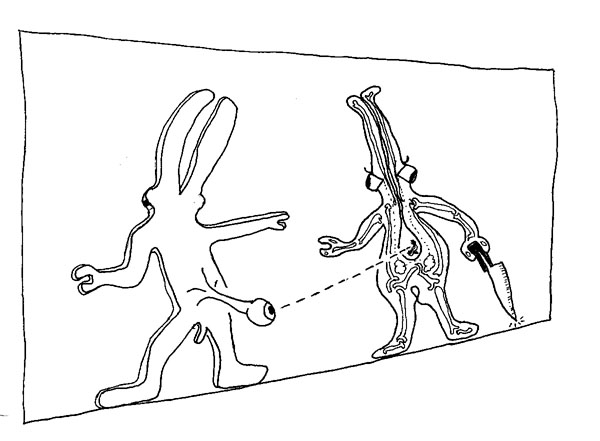
(2b) An alternate use of a higher dimensional level is to suppose that the higher beings aren’t particularly aware of or interested in us, they’re simply rooting like moles or writhing around like lampreys, and if they happen to pass through our world it’s more or less an accident. Although then, of course, they might develop a taste for our hyperflat bodies. And then we’re flank steak. Cold cuts. I might like this. I do like the idea of there being stupid, unaware beings in the higher world.

(3) Another idea is to suppose that the “higher” world exists at very small size scales. In what’s sometimes called the subdimensions. I used this approach in Jim and the Flims, where the higher world could be found inside an electron. Lots of room at the bottom!


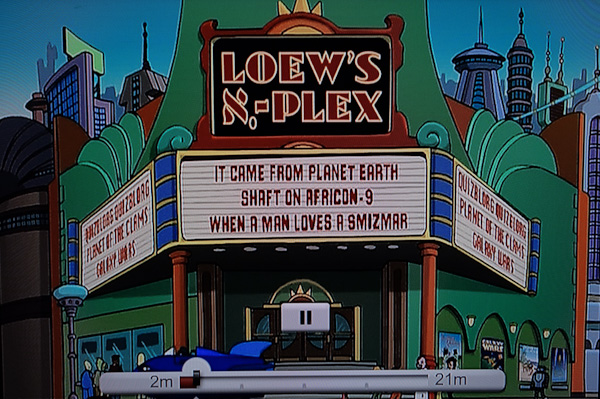
[Lowe’s Alef-Null-Plex from FUTURAMA, episode 19 or so, the “Raging Bender” one where Bender becomes a wrestler.]

(4) Or we can go to the “big” direction. That is, put the higher world at an infinite distance from Earth. Out past aleph-null. I used this move in White Light, and at the very end of Hylozoic.


[Our friend Ronna Schulkin with two of her paintings, one painted on the real level, one appropriated on the subtle level.]

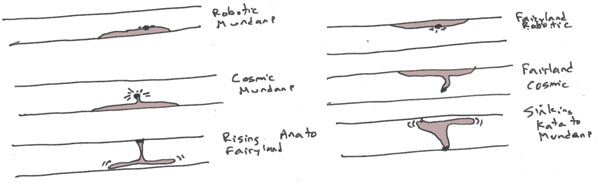
(5a) Another angle is something more vague—a higher world that overlays ours in the same space, but which is, for whatever reason, generally imperceptible. Perhaps their quantum wave functions are perpetually 180 degrees out of phase with ours. Putting this differently, it may be that the creatures in the higher world are made of a “dark” or subtle type of matter which doesn’t interact with us. And it may be that each of does in fact have a subtle matter soul. You can learn to do a hyperdimensional somersault that twists your elementary particles into bits of subtle matter. That is, you can do a “chin-up” that lifts you into the subtle world. I think this one is the one I like best just now.

(5b) A traditional fairy-tale variation on the subtle world is that there’s a secret world right under our noses but we don’t notice it. Elves and fairies that most of us can’t see. What if we can see the subtle world simply by adopting a different way of looking at things? (E.g. by being “high” on some psychedelic chemical or bizarre physical process…such as “qwet teep??) See Joseph Zizy’s comment below and my response comment for a bit more on this idea.

(6) What about virtual reality? Could the higher world be a virtual reality running within—what? Way too boring if it’s in a digital computer, although I did touch on this possiblity at the start of Chapter 12 in Postsingular. It would be more interesting if the “virtual reality” computation was being generated by natural objects in the physical world. Air currents, flames, water waves. And this effectively takes us into Zizys’s variation, that is, (5b).


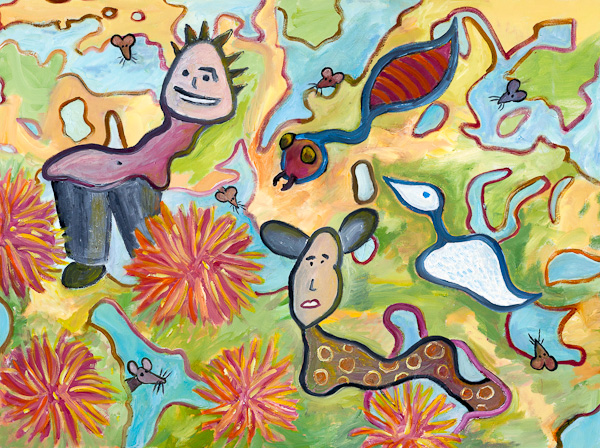
“Night of Telepathy,” oil on canvas, November, 2012, 40” x 30”. Click for a larger version of the image.

One way or another, you end up in the higher world with the archetypes and dreams and thoughts walking around! But! Look out for the subtle rats!

Interviewed by Kelly Burnette for Duckter Yezno’s

Friday, November 23rd, 2012

Today I’m reprinting an email interview that Kelly Burnette of Lakeland, Florida, did with me in October,in order to run it in the first issue of the Duckter Yezno’s webzine—which went public this week, and has a lot of other qrude pieces in it.

Kelly Burnette’s incisive interview centers around my recent novel Turing & Burroughs.

As usual I’ve illustrated this post with “randomly” but perhaps “synchronistically linked” photos from my recent reality gleanings.

The numbers on the questions and answers in the interview relate to my ongoing practice of accumulating all of my email interviews into one giant interview that I keep online as a PDF document called “All the Interviews.”

Here comes the Duckter Yezno’s bus, climb aboard!

Q 368. Your entire family seems to be academically or artistically inclined. You say that you discovered Burroughs, for instance, in a copy of the Evergreen Review that belonged to your older brother. Can you tell us a little about how your family life shaped your interests, what you do today?

A 368. My brother and I grew up in the 1950s in the countryside near Louisville, Kentucky, and our chief form of entertainment was reading books. Our mother encouraged us to read—every Christmas morning there would be a circle of books around the tree, and a fair number of these were science-fiction. A lot of Heinlein. Not that Mom was an SF fan at all, but she’d get advice from the book shop lady. My father had a wood business and then he became an Episcopal priest. He was an independent-minded man, and he encouraged my brother and me to be intellectuals. I met my wife at Swarthmore College; among her attractions were her cultured, intelligent and artistic qualities. Our first conversation involved Pop Art and Andy Warhol. All three of our children are creative types, and all three are self-employed. We have a family tradition of not being cogs in the Big Machine—although admittedly my day job for about thirty years as being a state university professor.


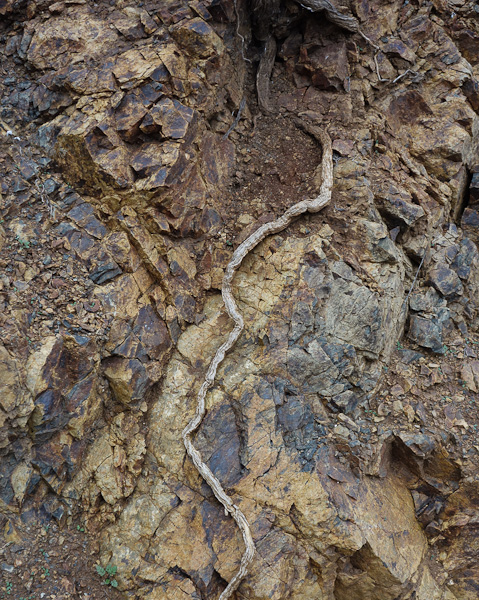
[Right before falling into a Wyoming lake and ruining my camera.]

Q 369. I was really happy to hear you weren’t planning on founding a religion to dominate the world! Oh wait! That might well be a much better world. But to jump ahead a little…Mysticism is a tricky concept. On the one hand, it could just be a fancy name for certain kinds of mental experience. On the other, it could be actual transcendence. You’re fascinated with the idea. Can you talk about your take on mysticism within the context of your novel Turing & Burroughs? Do you believe we have a soul?

A 369. I’m agnostic on the soul question. Maybe we have an afterlife, maybe we don’t. Keep in mind that, whatever its literary qualities, Turing & Burroughs is a science-fiction novel, so I don’t necessarily think that everything in it is true. For the purposes of the story it was useful to suppose that dead people could in fact reappear as ghosts animated by immortal souls. My novels White Light and Jim and the Flims touched upon SFictional afterworlds as well. Mysticism is much less intense type of religious belief. It hinges on the notion that you can get a direct perception of the cosmos as a One. An inner light, a big aha, a cozy goo that you can merge into. If you pay close attention to your mental states, this is almost obvious. All is One, the One is ineffable, we can have a direct perception of the One, and Love is all you need. The secrets of the spoken are shouted in the streets. But esoteric philosophy isn’t something you want to be talking about in a novel. A novel is supposed to be fun. It’s better to talk about ghosts.

Q 370. I noticed some very nice, subtle character descriptions in Turing & Burroughs that reflected the individual’s personality well. For example, when you first describe Alan’s love for vacuum tubes, that definitely had a phallic ring to it. It was sexual subtext on par with D.H. Lawrence. How do you think your prose has improved over the years?

A 370. I don’t really see vacuum tubes as penises, but I guess you could. For people of my or Alan Turing’s generations, vacuum tubes were a magical part of daily life. They glow, they get warm, they’re made of glass, they have lots of little doodads inside them, a zillion weird pins on the bottom, and you used to be able to take them to the drugstore and plug them into a testing machine, possibly buying a replacement tube in a little cardboard box. Even now when I look at a city like New York or Tokyo from the air, I’m reminded of the inside of the vacuum tube radio I had by my bed as a boy. Regarding my prose, I’d like to think that it’s still improving—I polish it a little more than I used to. Five or ten years ago, I read John Gardner’s classic how-to book The Art of Fiction, and it had a good effect on me. He talks about paying attention to the spoken rhythms of your text, and about working on the prose at various levels: word, sentence, action, paragraph, chapter, and so on.

Q 371. How much fun was it for you to write in Burroughs’ voice and did you produce it rather naturally (as he’s such an influence), or did you have to work on it, refine it? The letters were a blast to read. Especially the transition from the letter to Jack to the letter to his parents. That was very funny.

A 371. I’ve read Burroughs’s letters many times, particularly the ones in the Yage Letters book, and the ones written while he was in Tangier. While I was writing my pastiches of his letters, I was looking through the actual letters, keeping that voice fresh in my mind. As I’ve mentioned elsewhere, I find Burroughs’s bad attitude to be appealing. He’s always been such a breath of fresh air in the face of propriety and social constriction. I once got to hear Burroughs give a seminar talk at the Naropa Institute in Boulder, Colorado, and I asked him if he laughed while he was writing. “I might,” he said. “If it’s funny.” I laughed quite a bit while writing my Burroughs routines. But it got serious and heavy when it was time to deal with his slain wife.

Q 372. Road trips are significant for two reasons: they’re symbolic of a journey of self-discovery and they’re almost immediately identifiable with the Beats. Alan’s revelations on the road were significant. Did Alan portend that he was becoming a true Christ typology as opposed to superficially saying it one night in Louisiana? Or ”“ can you take us through the course of Alan’s self-discovery while on the road? When did he realize that his greatest gift was sacrifice?

A 372. You could compare Alan to Christ, given that, at the end of Turing & Burroughs, he sacrifices himself for the good of mankind. And early in the book, Alan does in passing think of himself as Christ with his Apostles. But maybe that was a red herring on my part or even a false step. Really I don’t think Turing is coming at his adventures in terms of a Christian framework. The Christians don’t own the redemption myth. It’s a deeper archetype. More like something from Joseph Campbell’s The Hero With A Thousand Faces. Alan has brought a potentially destructive elixir into the world, and he does something about it by transcending to a higher level of existence. He doesn’t really want to die, it’s more that he’s cornered in a certain situation and makes the best of it—by using the SF toolkit that he’s developed as part of his personal growth during the flow of the novel.

Q 373. Is telepathy a correlative for higher consciousness? And is the next step of evolution a conscious one?

A 373. Telepathy is a concept that’s fascinated me for as long as I can remember. I call it teep in my novels. These days I don’t see teep as being at all like a normal conversation. It’s more that you and someone else get onto the same wavelength. Like a talk in bed with a lover, or a deep rap with a pal, or some heavy conceptual play with a mentor. And an outsider is, like, “So what did they tell you?” And maybe you can’t verbalize the details, maybe it’s easier to talk about how having had the conversation makes you feel. Telepathy represents the dream of being understood. Telepathy relates to the notion of merging your personality into the broader world, and this is, once again, an aspect of a higher mystical consciousness. It’s interesting to wonder, as you suggest, if telepathy is an evolutionary step that we’re coming up on. Kind of a Childhood’s End scenario. It’s an interesting SFictional trope, but in reality I don’t actually see humanity as making an abrupt change. I suspect that we’ll have a whole spectrum of personality types, and some will be evolving towards higher consciousness and some will be devolving away from it just as fast. “The squares you will always have with you,” to paraphrase our Lord.

Q 374. Was the Turing & Burroughs character Susan Green based on anyone real? Are you yourself into musique concrète?

A 374. Even though I call myself a transrealist, I don’t always base my characters on actual people. Susan Green was more like a collage of various women I’ve known. I was looking for a strong and idiosyncratic female character to counterbalance all the men in Turing & Burroughs. A woman who’s every bit as outspoken and independent as any man. I recalled that Burroughs was very interested in the idea of taping ambient sounds and collaging them together, and I thought it would interesting to have a woman composer who’s actually doing this. For research, I read the Tara Rodgers compilation of interviews, Pink Noises: Women on Electronic Music and Sound. I’m not in fact a big fan of electronic music, although I do like the idea of it. I made a point of watching the classic SF movie Forbidden Planet, which has a great electronic soundtrack created by Bebe Barron and her husband Louis.

Q 375. Can you tell us a little bit about why you chose to allude to Henry Kuttner and C. L. Moore’s novel Fury? Was it simply because Burroughs also used it in The Ticket That Exploded? You remark that it’s a seminal urtext. What’s the significance for you here?

A 375. Okay, this is all about the Happy Cloak. It’s a symbiotic or parasitic alien being, a bit like a coat or a scarf, and it plugs into the nerves in your neck and hangs down your back, and you get into an altered and somewhat ecstatic state of consciousness. Kuttner’s 1947 novel introduces this notion, and Burroughs read the novel during one of his drug-kicking treatments in a Tangier clinic. Later Burroughs incorporated material about the Happy Cloak into in his 1962 novel, The Ticket That Exploded. As a teenager I also read Brian Aldiss’s 1962 fascinating novel, Hothouse, where a morel fungus attaches itself to a character’s neck and begins helping him while controlling him. I always loved that expression “Happy Cloak” because of the contrast between the bland, childish name, and the rather sinister nature of the being. I included a Happy Cloak in my Software, both as an homage to Burroughs and because it was very useful thing to have. A Happy Cloak made of computational plastic attaches itself to my character Sta-Hi’s neck on the Moon, and wraps itself around him to function as a space-suit. Happy Cloaks play a part in the later volumes on the Ware Tetralogy as well. I’m always looking for chances to talk about them.

Q 376. Is there any one book of yours that you’d really love to see made into a film? Cronenberg comes to mind, but who do you picture directing your film?

A 376. Oh, man—any of my books, any director. The Hacker and the Ants would be good as a retro 1980s computer scene movie. The Wares could be epic. Hollywood came close to filming them a couple of times. Master of Space and Time would be a fun movie, for awhile Michel Gondry was all set to do do that. Mathematicians in Love would be very cool, with the surfers and the San Francisco scenes and the flying mollusks. The Hollow Earth could become a huge, big budget production, complete with Edgar Allan Poe, giant sea cucumbers, and an intense racial theme. Turing & Burroughs itself would be a good film, given that there’s some interest in movies about the Beats just now. As for directors, Cronenberg did a great job on Naked Lunch, but I’m guessing it would be a younger person who’d want to take on one of my books. I used to think that sooner or later the mass market would catch up with me. But maybe I’m on a divergent timeline. And that’s okay too. I’m glad I got to write my books.

Joey Goes Chimera

Sunday, November 18th, 2012

Most of my writing energy is going into my novel these days, The Big Aha. It’s only when I’m in a special kind of mode that I manage to blog a lot.

Today’s offering? A short uttake from The Big Aha, involving a tool called a “geener” which sends rays into a living organism to change its wetware in real time.

Also I have some pictures. These days I have an oversupply of pictures.

“How I feel about reading minds!” cried Joey, aiming the geener at himself. “I’ll show you!” The geener hissed, and now Joey had a long rat’s tail. Hiss again, and flydino wings sprouted from his back. Another hiss—and his hips were those of a woman’s.

The security guard was almost upon Joey.

Oink,” said Joey, whirling around just in time to zap the man.

Artie the guard dropped to all fours—and became a spotted Gloucestershire pig, which was a breed the Trasks had been fond of farming. Pink with black spots. Calmly the pig rubbed his snout across the ground, maybe sniffing for acorns. Meanwhile Skungy, frightened by the chaos, had clambered back onto my shoulder.

Moving slowly, regally, as if fascinated by his own magnificence, Joey unfurled his leathery wings and made as if to flap into the sky—


Rudy's Blog is powered by WordPress