Click covers for info. Copyright (C) Rudy Rucker 2021.


Archive for the ‘Rudy’s Blog’ Category

Photo Clearance

Tuesday, May 7th, 2013

More photo clearance today with whatever comments come into my head.

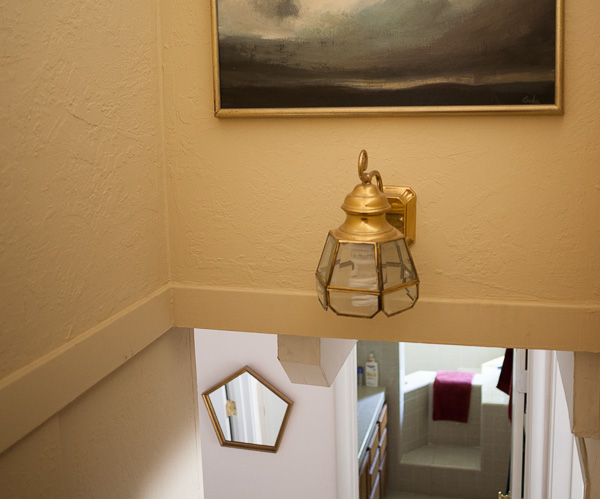
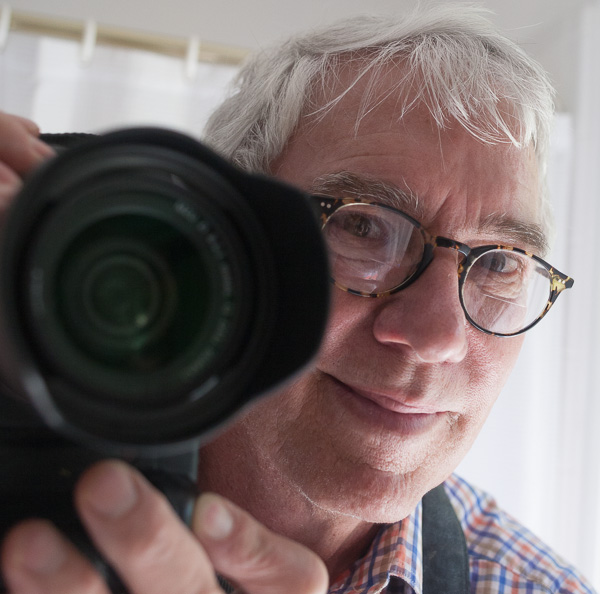
I like how the wideangle lens has so much depth of field. That five-sided mirror has always caught my fancy. Almost like something you’d see in a ghost story. There was a time in high-school when I’d seen too many scary episodes of “Outer Limits” that I was scared of things coming out of mirrors. And of disembodied hands.

This is out past Four Mile beach north of Santa Cruz. Wide open. You walk a ways along this cliff and you see a lot of seals.

A very deserted spot, this cliff north of Four Mile. As soon as the seals heard me taking a picture, a lot of them began humping into the water. Love the babies, the size of dachshunds.

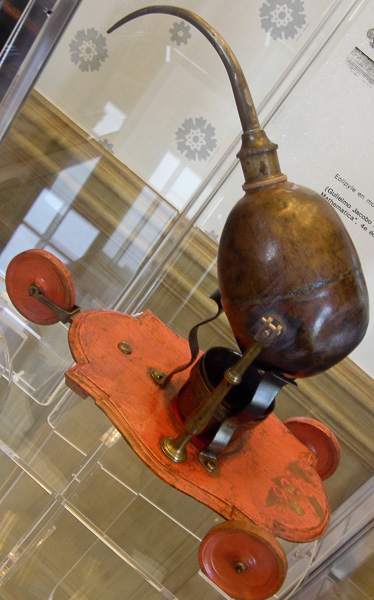
This one is quite an old photo, of a table-top steam engine, built for fun or for teaching, spotted in the wonderful and quaint Museum of the History of Scientific Instruments in the Perle Du Lac park by Lake Geneva in Switzerland.

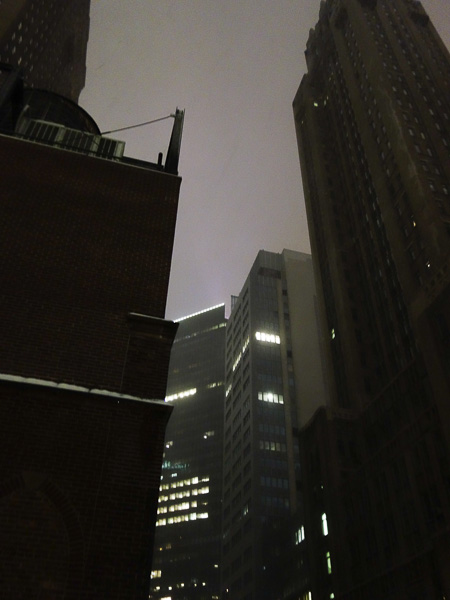
In old Manhattoes in a snowstorm, and the buildings looming.

(This name for Manhattan was in fashion in the late 1880s, see Herman Melville, in Moby Dick: “There now is your insular city of the Manhattoes, belted round by wharves as Indian isles by coral reefs — commerce surrounds it with her surf.”)

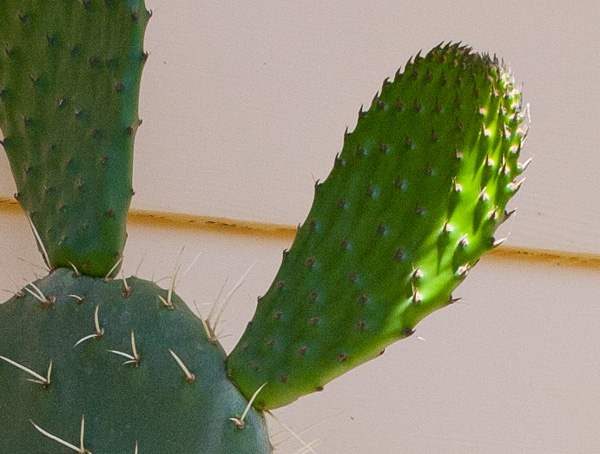
The prickly pear in our backyard cactus garden. I actually brought in a single pad of this cactus after a visit to Maui about eighteen years ago. The pad’s been very slowly growing out new pads, but recently I moved the plant out of a pot and into the garden it’s been going wild. Love that tasty green color in the small pad.

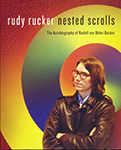
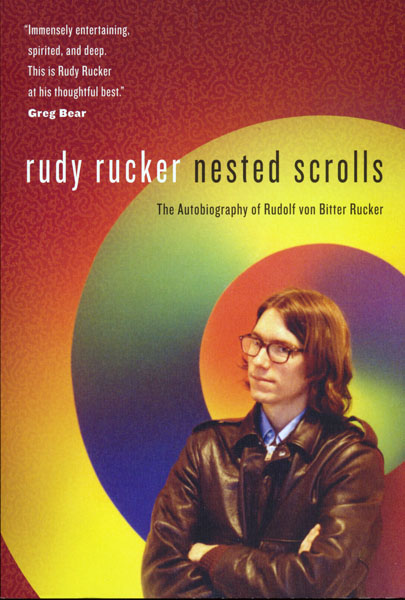
I don’t know if I mentioned that my autobiography, Nested Scrolls, is out in paperback as well as hardback and ebook now. I could use a few more comments on the Amazon page for the book, so if you liked it and have a spare moment…

Just recently I came across a great review of the book by Rob Latham in the LA Review of Books.

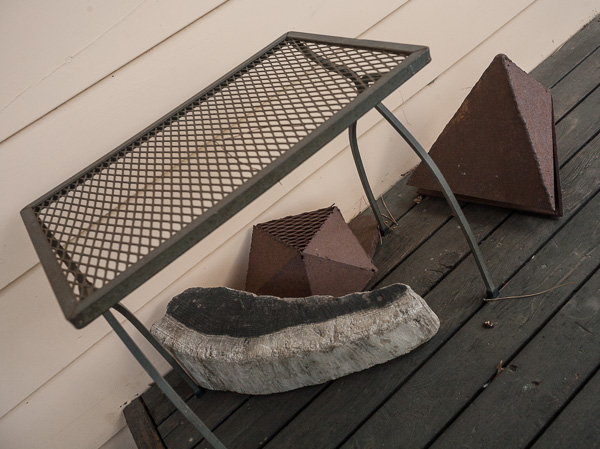
Some of son Rudy’s welded college-days artwork on the back porch. These pieces are old friends by now.

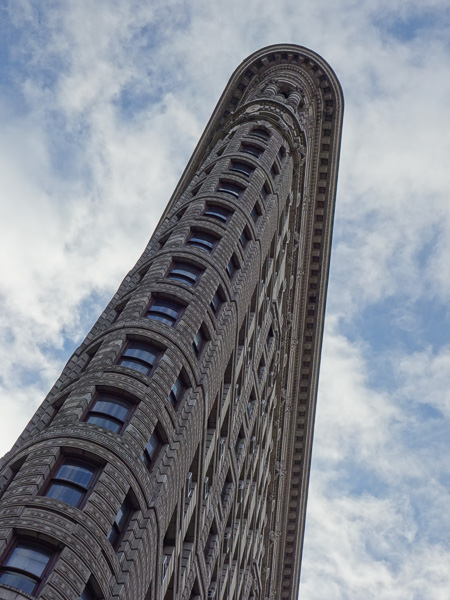
You can’t go wrong photographing the Flatiron Building in old Manhattoes. One of my irregular pilgrimages to the offices of Tor Books.

In certain moods, almost anything I look at seems worth photographing. Especially when I’m playing with a new lens!

Gnarl All Around

Sunday, May 5th, 2013

I’ve accumulated a backlog of photos to blog, but I don’t have any long essay-type thoughts today. All my energy is going into The Big Aha, which is about 80% done. I’m pushing pretty hard on it. During the closing phase of a finishing the first draft of a novel, I sometimes think of a predator who’s wounded his or her prey, and is now crashing through the underbrush, frantic to finish the hunt. Blood-lust writing frenzy.

I got a new wide-angle lens the other day, a Canon 24 mm. I’d been making do with an old Leica lens on my Canon body, but the old lens didn’t have autofocus, nor image stabilization, nor did the automatic metering work with it. I will say that the Leica glass has a certain creamy warm quality that I like. But the Canon lens in incredibly sharp.

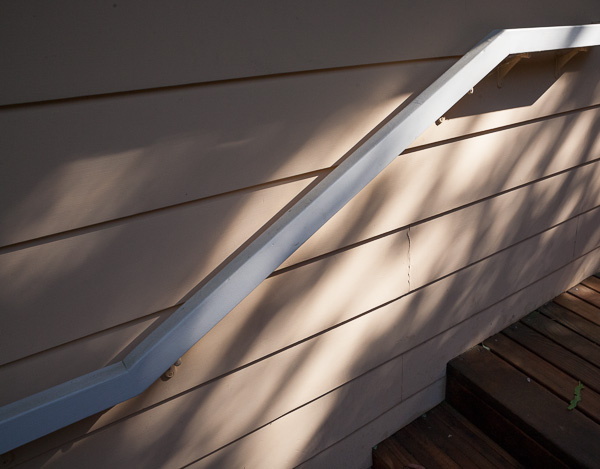
So I walk around my house photographing pieces of it. Like this banister. Not that every photo I’m running today is shot with the wideangle lens.

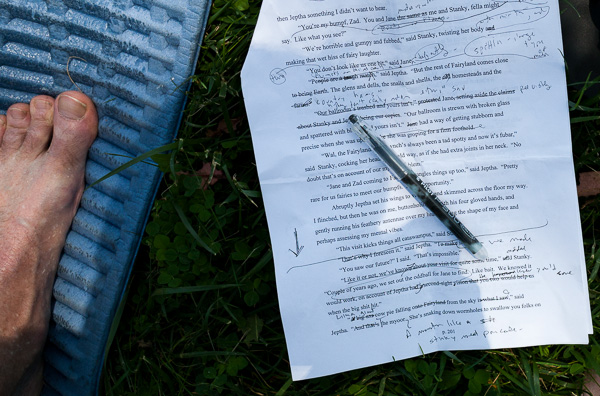
My usual morning regimen, is to do yoga on a mat in the back yard and correct a printout. At full resolution, this text is readable, thanks the new lens’s image stabilization, but maybe not readable in this shrunken rez. Lying in the back yard on a nice morning while crafting some prose is about my favorite activity.

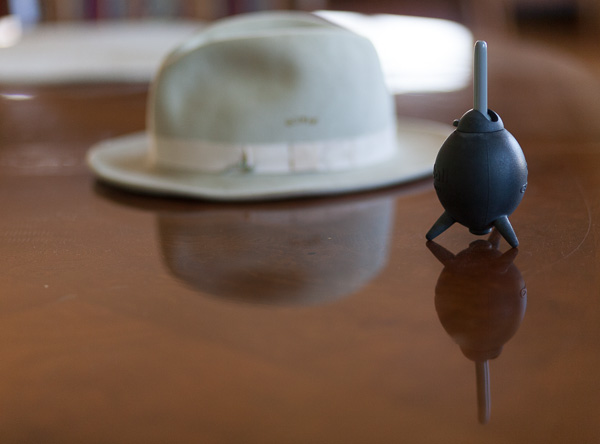
This photo’s taken with the Leica lens, and it has the creamy texture. Every hat is a UFO.

I’m writing all day, and in the evenings I like to get away from the printed word, so we’ve been watching more Netflix than usual, a mixture of streaming and DVD. Finished off the second season of The Hour, a nice BBC show, although I have to turn on subtitles for shows like this, otherwise I miss about 30% of the dialogue. The Lillyhammer series isn’t bad either.

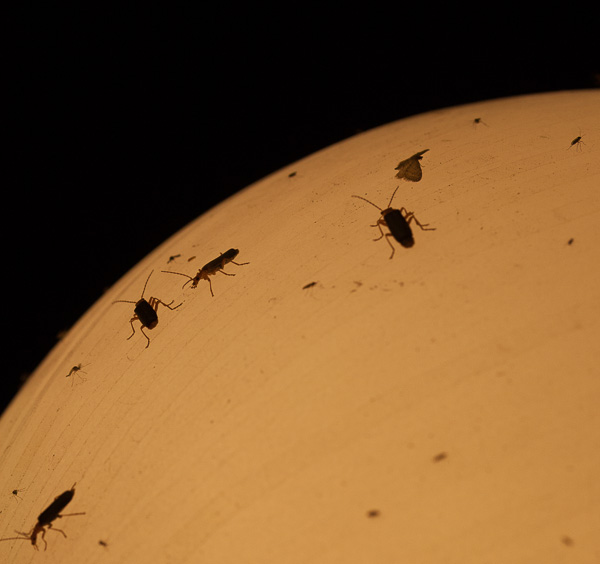
Switched over to a 100 mm zoom lens for this photo last night. As spring rolls on, there’s different cadres of bugs that turn up, all of them hatching at the same time. These guys were on the globes of our street lamp, making me think of astronauts on a moon.

The 100 mm lens is, for reasons I don’t quite understand, categorized as a “macro” lens, meaning you can do super close-ups. Hard to go wrong when you’re shooting a rosebud, although the depth of field is only a few millimeters deep and I have to click at the right moment to catch the image I want, given that my body is never quite still. Love the “bokeh” here, that is, the out-of-focus quality of the background.

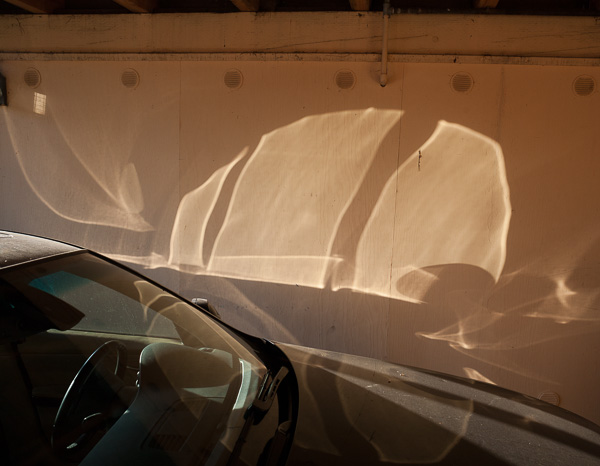
The sun comes up really bright these days, blasting flat across Silicon Valley into my garage and bounces great caustic curve light splashes off my car. I looked up how bright the sun is, viewed as a lightbulb, and it’s said to be about 300 or 400 septillion watts. The prefix for septillion is “yotta,” in the same sense that “tera” means trillion. There’s an official committee that decides these things. So the sun is a 300 yottawatt bulb. Or, as a waggish friend commented, one might shop for a energy-saver 60 yottawatt sun.

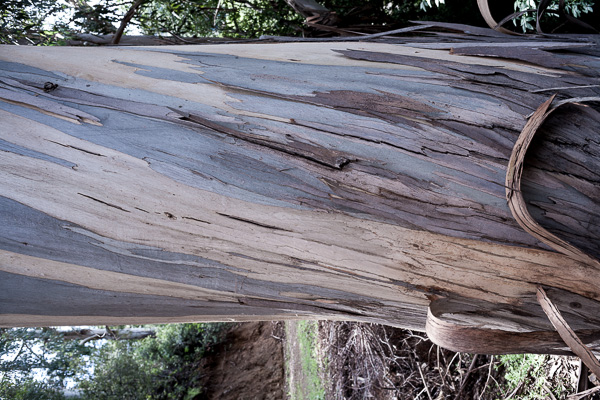
I try to get out into the hills every couple of days, I never get enough of nature. Free gnarl. I think this is a eucalyptus trunk, they grow with a spiral grain, which makes them stronger I think. Last night it was really windy here, and the eucs were waving like seaweed. Always nice to be reminded that we live at the bottom of an ocean of air.

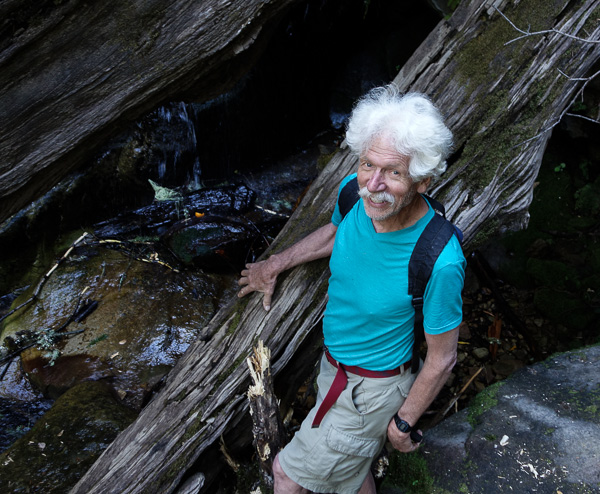
Sometimes I go hiking with my neighbor Gunnar. He’s originally from Norway and still has quite an accent—you have to know him for awhile in order to easily understand what he’s saying. He’s close to eighty, and is livelier and fitter than me. He never goes to what I could call “a real doctor,” preferring various kinds of Indian or Chinese healers. Seems to be working for him.

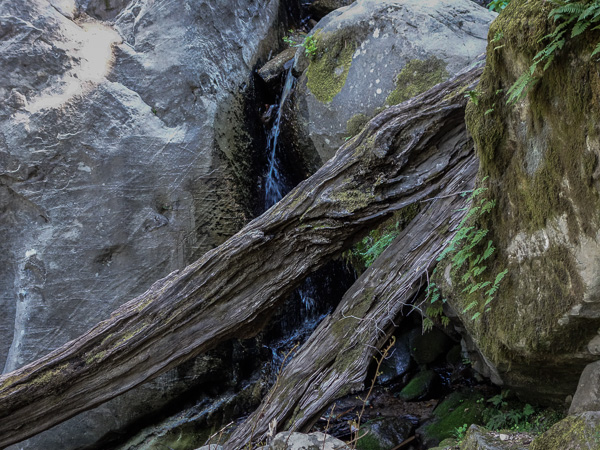
Gunnar and I were down at the foot of a waterfall in Castle Rock park, which is only about s twenty minute drive from my house. Incredible that I only go there once every year or two. It’s such a great place. What do I have to do that’s more important than being in the woods?

Oh, yeah, I have to be at home running my machines.

Converting my gauzy N-dimensional dreams into 2D art.

On the Road, Satori, and The Big Aha

Thursday, April 25th, 2013

I feel like I’m the only person I know who saw the movie version of Kerouac’s On the Road recently. I liked it a lot, I saw it twice—the first time on it’s release date, which was also my 67th birthday.
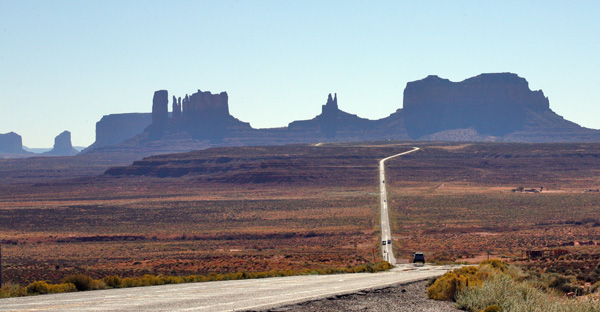

[Photo I took on one of our own Wild West road trips, first posted 2010.]

The movie didn’t get much publicity, and it wasn’t in the theaters very long. Hard as it is for this old geezer to believe, most people in the younger movie-going generation haven’t even heard of On the Road, and they have only a hazy notion, if any notion at all, of who Jack Kerouac was. Father Time plows us under.
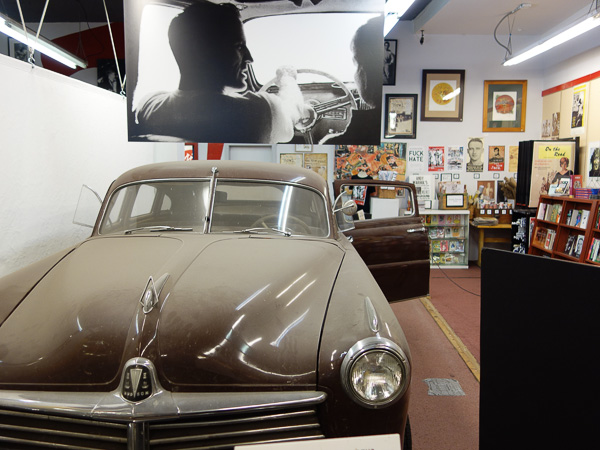
The movie includes a lovely 1949 Hudson car that Jack Kerouac, Neal Cassady, Luanne Henderson and Ed Dunkel drive from NYC to Algiers, Louisiana to visit William Burroughs, and then on to San Francisco.

As it happens, this very car, the one used in the film, is on display in the Beat Museum in San Francisco, just across Columbus Ave from City Lights Books. You can see the car for free, and if you pay a couple of bucks you can go in and see such Shroud-of-Turin level relics as Jack’s plaid coat.

Thinking about On the Road, I happened to recall a great passage in Chapter 11 where Jack describes him and Neal spending a night sleeping in an all-night movie theater in Detroit. I found the book online as one giant webpage, and searched that to find the key word “osmotic.”

For thirty-five cents each we went into the beat-up old movie and sat down in the balcony till morning, when we were shooed downstairs. The people who were in that all-night movie were the end. Beat Negroes who’d come up from Alabama to work in car factories on a rumor; old white bums; young longhaired hipsters who’d reached the end of the road and were drinking wine; whores, ordinary couples, and housewives with nothing to do, nowhere to go, nobody to believe in. If you sifted all Detroit in a wire basket the beater solid core of dregs couldn’t be better gathered. The picture was Singing Cowboy Eddie Dean and his gallant white horse Bloop, that was number one; number two double-feature film was George Raft, Sidney Greenstreet, and Peter Lorre in a picture about Istanbul. We saw both of these things six times each during the night. We saw them waking, we heard them sleeping, we sensed them dreaming, we were permeated completely with the strange Gray Myth of the West and the weird dark Myth of the East when morning came. All my actions since then have been dictated automatically to my subconscious by this horrible osmotic experience.

Love that last sentence.
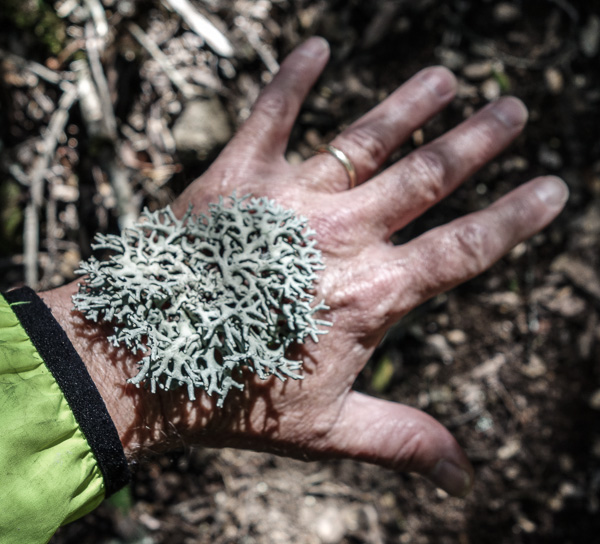
Onward. These days, as I’ve been mentioning, I’m working on a novel called The Big Aha, and I’m nearing the end. And I want to come up with an explanation of what I mean by the psychic state that I call “the Big Aha.”

What I term the “cosmic mode” in the novel is an intuitive, immediate knowledge of the world — what we might call a mystical grasping of the world in its unity. A characteristic feature of cosmic-mode knowledge is that it avoids distinguishing between the knower and the known, the subject and object. You see the world as One.

In what I call the ”robotic mode”, we have a discursive, analytical knowledge of the world — rational thought. In the robotic mode you stand apart from the thing known. You see the world as Many.
The point is not that mystical, all-is-One, cosmic-mode knowledge is preferable. Both the cosmic and robotic modes of knowledge are real, and both are important. But it is very hard — perhaps impossible — for us to see the world in both ways at once. At any instant we see the world either as One or as Many.

Moving from Many to One tends to be a gradual process, the result of some kind of deliberate calming of the mind. But the passage from One to Many is usually sudden. At a given instant you may be sunk into a complete unity with the world. And then an instant later you are talking about your experience, standing outside yourself, making distinctions. The difficult thing is to catch the instant when you are still between One and Many. I sometimes think of this instant as the slash mark in the One/Many problem, that is the problem of how the world can be both One and Many at once.

[World seen through my legs while doing yoga.]

In his essay, “The Meaning of Satori,” which appears in his book The Field of Zen, the author D. T. Suzuki says this instant is the fleeting enlightenment that Zen calls satori. “The oneness dividing itself into subject/object and yet retaining its oneness at the very moment that there is the awakening of a consciousness — this is satori.”

This sort of satori is fleeting, but not rare. One could almost say that the natural rhythm of thought is an oscillation between One and Many. As you look around the room there are constant microlapses of attention. You reach out and merge with the world, then draw back and analyze. At one instant there is only is-ness, at the next there is a person cataloging his perceptions. One-Many-One-Many … at a rate of, say, three cycles per second.
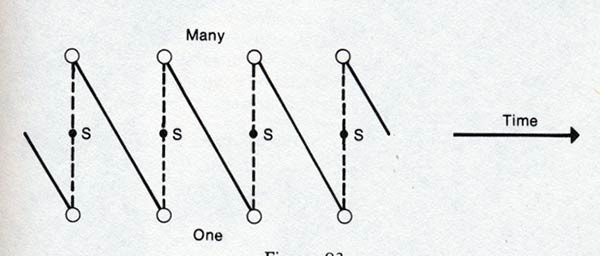
Here’s a picture of this taken from my nonfiction book Infinity and the Mind, my bestselling book ever. It represents the mind of indicating a person who repeatedly sinks down into blissful union with the One, only, each time, to snap back to ordinary rational consciousness. The points labeled “S” might be the satori points.

There is a sense in which waking up each morning is a satori. On a good day (no alarms, no clock to punch) you float up from sleep into an idle state of is-ness, not even thinking who or where you are. But this is too good to last . . . whisk clickety-click, and you’re planning your day Is it possible to notice the moment of switch-over?
When I was doing my research for book Infinity and the Mind, I came across a guy called Benjamin Paul Blood who was, one might say, one of the first-ever drug-mystic’s in the United States. He would equip himself with a handkerchief soaked in ether, hold it to his face, sink into unconsciousness, and then, as his nerveless hand fell away, he would wake back up. The experience of moving abruptly from artificial trance to normal awareness struck him as central, and he wrote something very interesting about it in an 1874 pamphlet, The Anaesthetic Revelation and the Gist of Philosophy. In the long quote below, I added three little clause numbers to make it easier to follow what he’s saying:
I think most persons who shall have tested it will accept this as the central point of the illumination: [i] that sanity is not the basic quality of intelligence, but is a mere condition which is variable, and like the humming of a wheel, goes up or down the musical gamut according to a physical activity; [ii] and that only in sanity is formal or contrasting thought, while the naked life is realized only outside of sanity altogether; [iii] and it is the instant contrast of this tasteless water of souls with formal thought as we “come to” that leaves in the patient an astonishment that the awful mystery of Life is at last but a homely and a common thing, and that aside from mere formality the majestic and the absurd are of equal dignity.

Satori, man.
Up until now I have been describing the interface between One and Many as something that one moves back and forth through in time. This is a bit misleading. In Suzuki’s words, “Satori is no particular experience like other experiences of our daily life. Particular experiences are experiences of particular events while the satori experience is the one that runs through all experiences.”

In other words, the One and the Many run about together in and out of every word ever uttered. The world is One and the world is Many. The One/Many split is the heartbeat of the universe, the charged tension that makes things happen.
What happens in my novel The Big Aha is that my characters find a way to “jam open” the switch between the cosmic and the robotic mode, and they stay in cosmic mode for long periods of time, being One with reality, but without losing their ability to function.

And that’s the Big Aha experience that my book’s title is referring to. The Big Aha is that you can remain in cosmic mode and not be flipping out about it.

In writing my novel, I’d had some faint hope of finding a “higher” Big Aha in an alternate world that my characters visit. But I ended up with more of a D. T. Suzuki or Benjamin Paul Blood routine. Although your knowledge of the Big Aha may be sparked by some a unique and a trippy White Light experience, it ends up being being a part of daily life. You recognize the fact that you’re in the cosmic “All is One” mode a lot of the time.

This is all there is. What was I so excited about? What else did I expect?

Coming at this form of the Big Aha from another angle, think of what the great science writer Martin Gardner calls the “superultimate why question” in his essay, “Science and the Unknowable.” You start with, “Why does anything exist?” And, given any answer to that, you can say, “But where did that come from?” So you might as well short-circuit the process. There is no explanation beyond what we’re experiencing here and now.
So….the Big Aha is? Be here now. Mindful. In the now moment.

You figure out the secret of life—fine. But you still have to go ahead and lead the whole rest of your life. Living in the Big Aha.


Leviathan Eats Us Via 4D Einstein-Rosen Bridges!

Friday, April 5th, 2013

I had a big SF revelation this week, a breakthrough for my story. Today’s post will include some illustratiave drawings, also some semi-relevant or irrelevant (but nice-looking) photos.

I’m still working on my novel, The Big Aha. I’m about 75% done. Ever since the early chapters, I’ve had these two mysterious glass balls hanging around: the oddball and the dollshead. I wasn’t quite sure what they were going to do for me, but I had a sense that thought ought to be Einstein-Rosen (or “ER”) bridges to a parallel world that I call Fairyland. See my recent post “Four-Dimesional Portals to Other Worlds” for the story on ER bridges.
In the morning I wrote a scene at the start of where something like an elephant is pulled into the dollshead and it disappears. The mental image made me laugh: the fat elephant with trunk outstretched, thick legs star-fished out, thin tail trailing. Passing into and through the little Xmas-tree ball. While the elephant is going through, the ball swells up like a wobbly giant soap bubble, then shrinks back.

Then I went for a lovely and revivifying hike up over St. Joseph’s Hill above our house, the meadows green, the trees bosky, the sky adrift with plump sharp clouds. Lying there, fully at ease, I was wondering how some creature could contain an ER bridge and yet be an animal or monster with a body and a skin and so on. How would that work? I mean, an ER bridge is a wormhole connecting two spaces. How do you wrap a body around that?

I’ve been coughing for six weeks, and I’ve been thinking I might have pneumonia. I took a little nap on some soft long green grass and when I awoke, I felt like I was finally well. And, as an additional gift, I now had an aha moment. I had a vision of a largish creature, maybe as big as a whale, or maybe even bigger. Call him a leviathan. He lives in the parallel world. And the creature has a number of ER bridges within his body. They’re like vacuoles in the body of a paramecium.
I scrawled the two preliminary images below on a manuscript page I’d brought along on my outing. And the next day I drew something more elaborate. I’ll show those later in this post, but first here’s the crude ones.

In order to discuss the situation further, I’ll use special names for two worlds. I’ve been calling them the Universe and Fairyland, but now I’d like to employ a more neutral usage that I coined in Postsingular and Hylozoic: Lobrane and Hibrane. We live in Lobrane, and Hibrane is the parallel world.

The two ends of an ER bridge between two 3D branes or worlds will appear to us like spheres. So, as I’m saying, the Hibrane ends of a group of ER bridges could very well be spherical vacuoles within the leviathan’s body, and these vacuoles connect to oddball-like spheres down here in our Lobrane.

I arrived at this image by thinking of a Flatland model. In the Flatland version we have the two planes with one or more ER wormhole throats connecting them. We draw a big dark glob on the upper plane. The leviathan. And the ER throats are within his body. And—crucial point—his dark flesh extends about 30% or even 90% of the way down each of the throats, holding those throats bulged out. But the flesh doesn’t go all the way down as the leviathan wants to be living primarily in the upper plane.

What happens if a Lobrane person sails in through one of the ER mouths? The leviathan is flexible, possibly even jellyfish-like, so the mouth can freely enlarge. Even an elephant can fit through. Fine. But what happens when you encounter the dark flesh of the leviathan drooping down from the Hibrane?

The traditional panic-mongering SF option is that the leviathan dissolves and absorbs you on contact, subsuming you as food. Or he somehow chews you up and swallows you. And this may sometimes happen. Certainly I’d like to see one of my viallains meet his end this way. Possibly the kindly elephant Darby gets eaten in this fashion as well. Maybe a few of Darby’s bones slide back out or are spit out. Grisly effect in the barn there. Maybe just one big, dramatic bone. The ER sphere burps, and out comes a bloody tibia, three feet long and a foot across.

But we’ll suppose that when my hero and heroine go into one of the leviathan’s ER maws, the creature doesn’t invoke its digestive processes. Perhaps our hero and heroine wallow through the jellied leviathan flesh and emerge from its skin in the Hibrane.

The next day I was thinking about the leviathan as soon as I woke up in the morning, and I thought about it all day, off and on, although in the meantime I had to prepare all my tax papers and bring them to the accountant, also go to the dentist. It was good to have the geometry and topology of the leviathan to think about while I was getting my teeth cleaned. It was as if, for once, I wasn’t really there. Dear Mamma Mathematica!

Anyway, the concept I slowly arrived at is that the leviathan flesh that protrudes down into the ER tunnel can have a mouth in it. On the one hand, the mouth can either lead to a toothed-vagina style channel in which you’re ground up, and then moved by peristalsis into one of the leviathan’s stomachs. On the other hand, the mouth may lead through a channel out to the leviathan’s surface, delivering you via a kind of birth canal into the Hibrane world.

I decided that the likeable oddball should be an ER bridge of the “good” latter kind, a channel to the higher world. And the dollhead ER bridge will be a “bad” one, a route to being devoured.

So below I’ve drawn, on the left, the Flatland images of the two ER balls, and on the right the diagrams of the two kinds of ER bridges involved. The tiny lazy-eight infinity signs inside the two images on the left indicate that really that central region contains the whole endless world of the Hibrane. The images on the left are oddly warped perspective images, but they indicate how a Lobraner would actually see the ER bridges.

Now for more details. When my hero and heroine were handling the oddball in their apartment it didn’t feel like it had a mouth or an opening. It felt like a smooth glassy ball—and I’ve draw it that way in the figure above. We can think of the oddball or dollhead as wearing a rind. A clear outer surface over the actual leviathan flesh. Like a cornea. And when they want to get down to business, they split the cornea, and it drops off like a husk. Or with might better think of the transparent cover of the ball as like a nictitating membrane on the eye of a bird or a reptile. When it retracts, it’s covering, say, only the “back” half of the ball.

Alternately the cover gets soft and you can push through it.

The glassy oddball (with shiny rind still intact) will have a golden brownish sphere in the center, with shiny skin. And in this sphere there’s a puckered slit. After the oddball sheds or opens its rind, the mouth is uncovered. It opens up. Looking inside you’re seeing up along a tube that goes through an ER bridge. The tube may open up into Fairland, in which case you’ll “read” that as seeing a lot of tiny objects inside the mouth.

Fabulous! Eureka! Aha!

I’d been waiting for this series of insights and I wasn’t sure they were going to come, but now the Muse has favored me. Thanks in part to logic and math and weeks of butting my head against the wall and, ultimately, taking a nap on a grassy hillock one California spring day.

Okay, now to watch some Futurama on Netflix. 46 episodes done, and nearly as many to go.


Rudy's Blog is powered by WordPress