


Click covers for info. Copyright (C) Rudy Rucker 2021.


Archive for the ‘Rudy’s Blog’ Category

Micronesia 7: War Comes to Yap

Friday, March 11th, 2005

One touching tale. In the local paper, the Yap Networker, I saw a front page story about a Yapese man aged 42 having been killed in Iraq, his name was Steven G. Bayow. Yapese can join the US army, as Micronesia has a loose association with the US. And our last morning we were having breakfast on this floating wooden Indonesian bark that's the restaurant of the Manta Bay Inn, and there were some US soldiers there. Embry said Hi to one of them, and found out they were there from Guam as the honor guard for the fallen Yapese soldier's funeral. It gave me such a turn, to see the winds of global war spinning a little eddy all the way down here to Yap like this. Reminded me of Bruce Sterling's SF novels, with the workings of distant governments filtering into the furthest backwaters, and I had a kind of chill or shock of recognition, thinking that it's actually 2005, and I'm in Yap, and that my life really is science fiction.

We were staying at the Palauan-owned and Yapese-run Hotel ESA (the monogram of a family name), very clean and cheap and pleasant — initially we'd thought it wasn't quaint enough, but after the Pathways we were glad to get back there. In the afternoon I saw a man walking into the restaurant there carrying a huge fresh tuna, its skin peeled away to reveal its luscious-looking purplish flesh. “Is that going to be on the menu?” I asked, and the man and one of the Yapese women working at ESA just kind of waved me off, like “This is for something else.”

And that night as Embry went out to dinner we passed the ESA restaurant, and inside was a long table with the soldiers and some Yapese, two of them near the head, a woman and a man, the man who'd been carrying the fish. And I realized he was the father of the dead Yapese soldier, Steven Bayow. His expression looked so — gently baffled. Nothing makes sense anymore when your son is killed. My heart went out to him and his wife. I wanted to go in and say, “As an American I wanted to say that I really appreciate and honor the sacrifice that your son has made.” I was too shy to say it in person, but now I write this here.

Right before bed I took a last walk down the street near our hotel. One the left was a thin little bay, on the right some shacks, the decaying Pathways hotel compound (7 huts), a store. Then, on both sides some warehouses made out of shipping containers, used for building materials. The stars overhead, brilliant among the scudding clouds, the air moist and palpable. I heard a radio voice coming from a parked car, someone listening to a preacher, who was working to stir up the fear of death in his flock. “Think of Bobby Kennedy and Martin Luther King gunned down in their prime, think of coronary heart attacks, think of cancer, of plague, of terrorism, of death in car accidents, etc.” So odd to here this demented negatory ranting in Eden. The voice of the Serpent. Resist him, oh dear Yap!

Micronesia 6: Yap Caverns, Kaday Village

Thursday, March 10th, 2005

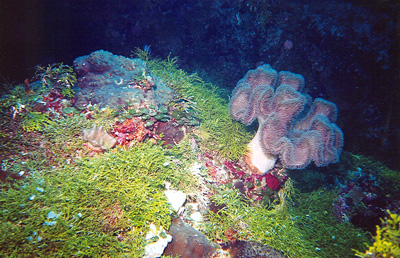
I dove Yap Caverns at the southern tip of Yap, rifts and boulders with huge bumphead parrot fish. Looking up through the rocks at cathedral shafts of light, great fish above me. Saw a memorable nudibranch, a flat sea slug the length of my thumb, iridescent creamy white, with an orange band around his undulating edge. No eyes, instead two white antenna in front, and a bizarre mini-grove of tree-branched antennae in back. These are his gills.

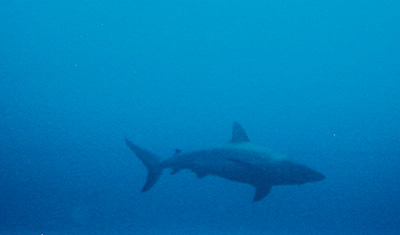
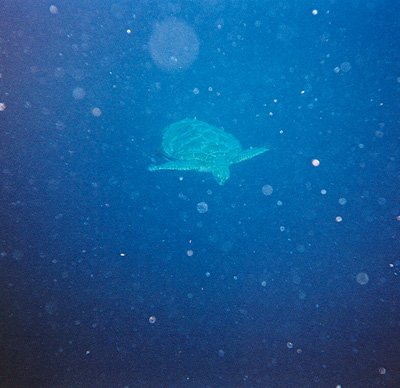
A good model for an alien, as I explained to my two guffawing Yapese guides Gordon and Kintu, having told them that I'm a science fiction writer. [The photo above actually shows two other guys, on the island Pohnpei.] Kintu was sweet, a bit shy, he's from an “out island” called Satawal, at the far east end of the Yapese archipelago, population 500, no airstrip and it takes three days to a week to get there by ship from Yap, depending how many stops the ship makes. Gordon fat and talkative. Gordon wanted to know if UFOs were real or not; he'd seen a couple of episodes of X Files. We agreed that diving is as alien and spacy an experience as one could as for. I saw great clouds of orange fish on the dive, schools of jacks the size of my arm, a shark the size of my daughter, a giant turtle, a carpet-like sea anemone with a father clown fish guarding baby clown fish like tiny specks. The others had all gone to try (successfully) to see the manta again, and the only divers on this southern-most tip of the Yap reef were me, Gordon and Kintu.

The last day, Embry and I rented a car and drove around the island. We went first to the village of Kaday, a bit hard to find our way, as there are so few road markings, the guide book directions were a bit out of date, and only the vaguest maps are available in Yap. But we did find it, and walked into the village along one of the ancient Yapese raised stone paths. Slippery hard rock, wending among patches of taro, palm trees, cassava, bananas, creeks and ponds. The food crops weren't in tidy rows or anything, just patches of them mixed in with the jungle plants. We saw lizards, frogs, land crabs, a bird with a red back, butterflies, a yellow-and-green grasshopper the size of my middle finger, and a black-white-black striped boar with tusks and a long long snout, tied up by a rag knotted around one foot, poor thing. He looked so intelligent and so doomed. The taste of wub.

The dwellings were shacks of corrugated iron, many of them open on two or three or four sides, like pavilions, primarily for keeping off the rain. The temperature is always eighty degrees. In a city we're so hard and pulled-together, in these villages the dwellings seem just on the point of deliquescing back into organic natural life. The path through the village was covered with ground-hugging grass like you see on golf courses. A row of stone money beneath swaying betel nut trees. For some reason the village was deserted.

Embry and I walked to a river and sat there, wondering at the silence, the beauty. Then one of those brief showers of rain struck and we took shelter under the eaves of the men's house, a thatched hut at the middle of the village. There some betel nut fronds on the ground, with all but the tougher, larger nuts gone. The ancient rounds of stone money in front of us. A shared moment to remember, which is, after all, in large measure what we're questing for in this trip, my brother and I.

Later we were looking for the wreck of a WWII Japanese bomber supposedly near the airstrip, and asked some guys doing road construction, and they said, “We don't know, we are out islanders.” There's a real class distinction between the Yapese from the main island group of Wa'ab (pronounced simply “Wob”), and the out islanders. Funny to us mainlanders, who'd already think of Yap as being about as out-of-the-loop as you could get, that there are people even more out of it than the Wa'ab Yapese.

A couple of times we saw older women walking around bare breasted in grass skirts, as casually as bare-chested men in shorts. And everyone carries a little pandanus (a tree with a palmy kind of leaf that grows a hard pineapple-looking fruit that only the fruit bats eat) purse shaped like a miniature Macy's or Bloomingdale's shopping bag, with their stash of betel nut, lime, and cigarettes in the purse. I miss Yap already. Such peace.


Micronesia 5: Stone Money

Wednesday, March 9th, 2005

The story on stone money is that about five hundred years ago some Yapese canoes reached the rock islands of Palau. They were impressed by the crystalline rock of these islands and carved out a disk of it to take home. So that they could carry the disk, they put a hole in the middle so that a group of men could carry the disk threaded onto a log. To get the heavy stone home, they made a little bamboo raft to float it on.

Back in Yap, the money served as a trophy of the men’s adventure. The harder your trip was (storms, sinkings, drownings, attacks by Palau warriors), the more that given piece of stone money was worth — it had more of a story associated with it. What could you “buy” with stone money? Not goods or a house — for those you needed a different kind of money, shell money. But you could give a disk of stone money to a family as the bride-price for taking a daughter as your wife. Or, as my dive guide Gordon explained to me, “If your brother Embry got drunk and made a lot of noise in the village and some family was mad at him, you could give them a piece of stone money to make it alright.” You wouldn’t necessarily have to move the stone money anyplace, you’d just reassign ownership. Often a village’s stone money would be lined up near the central dancing area to make what they call a stone money bank.

It’s scattered all over Yap, you see it in every village, and pieces of it are near most public places as well.

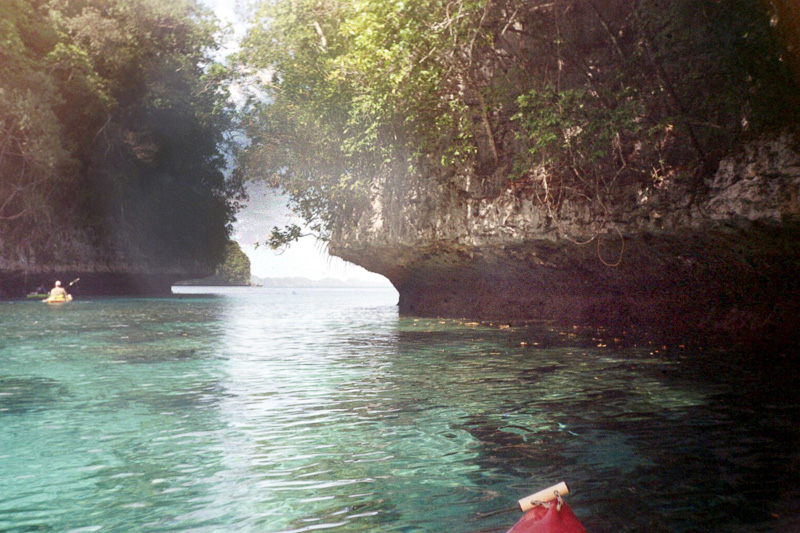
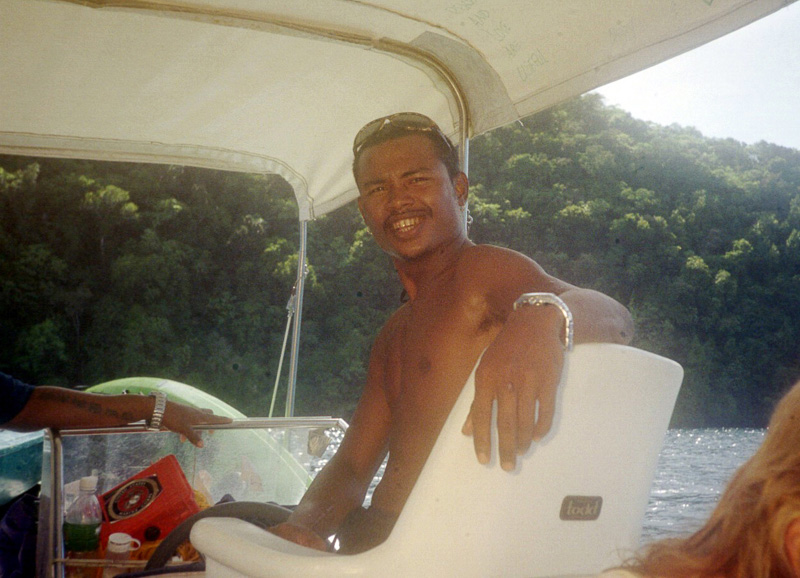
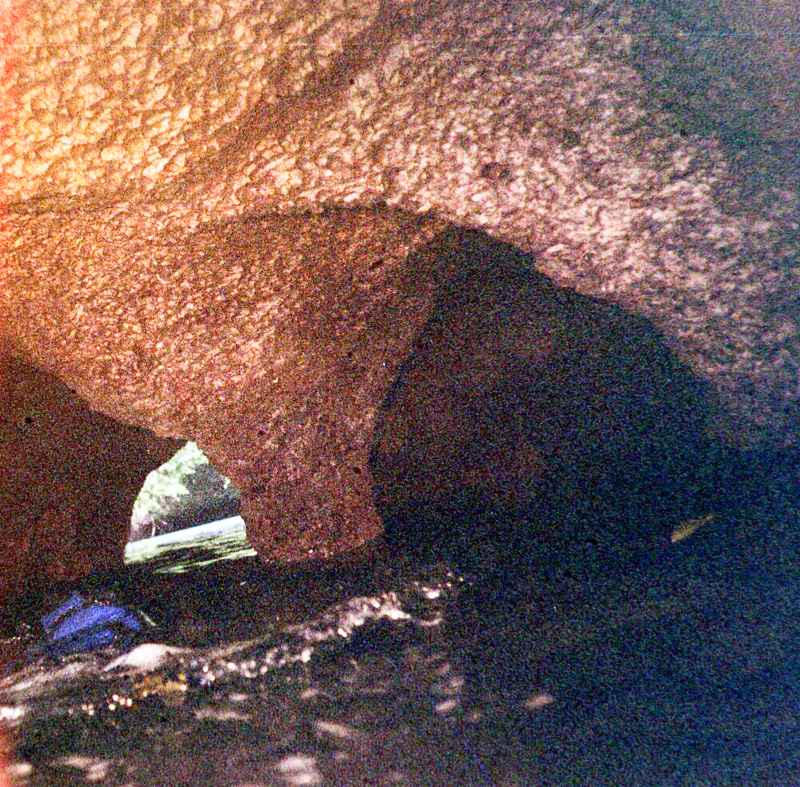
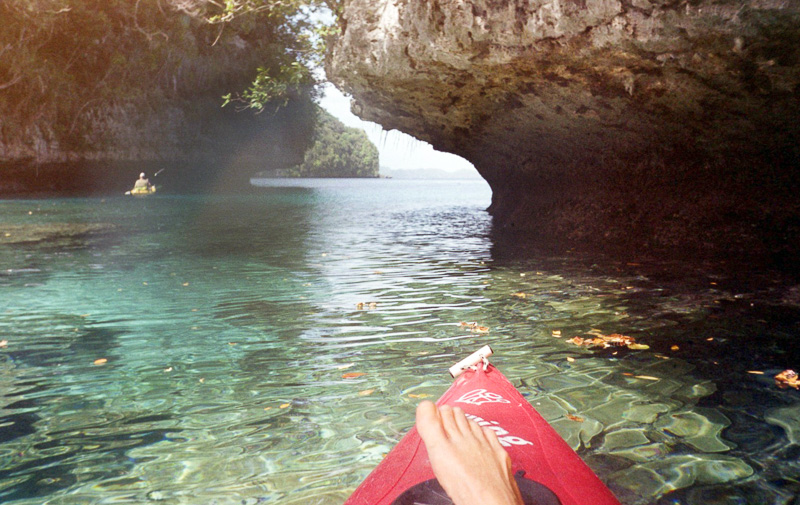
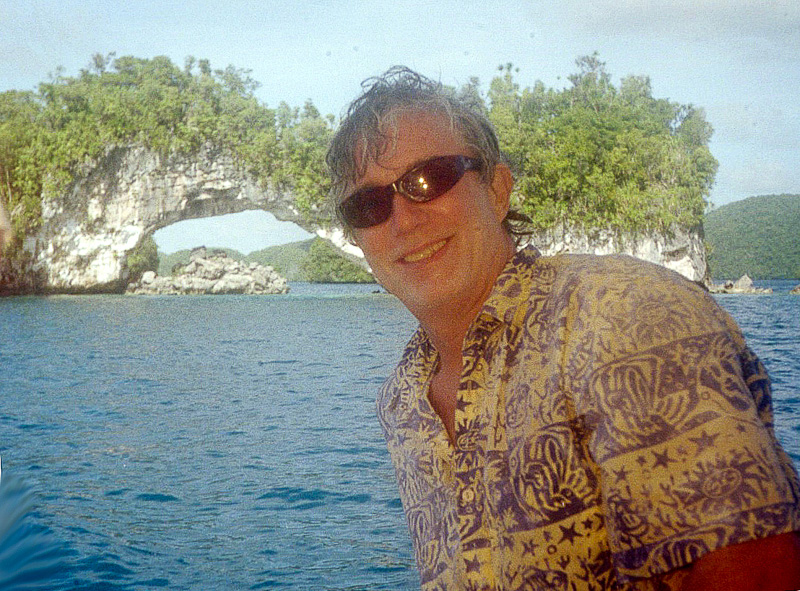
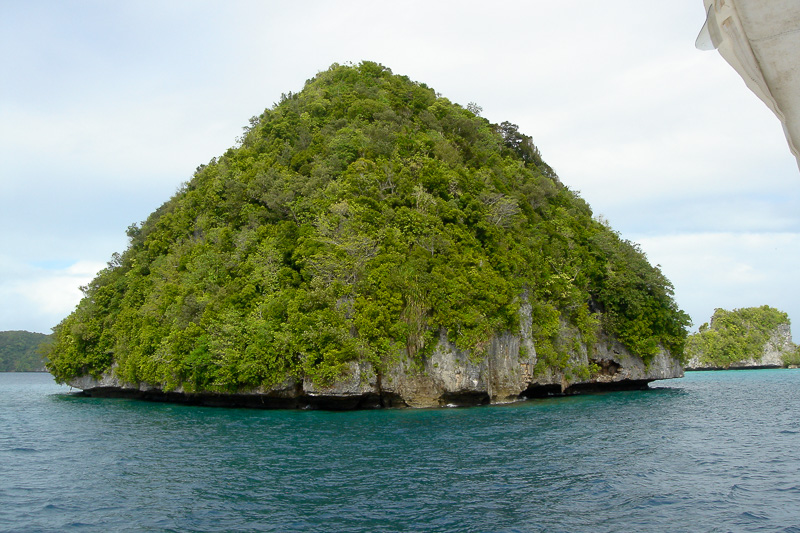
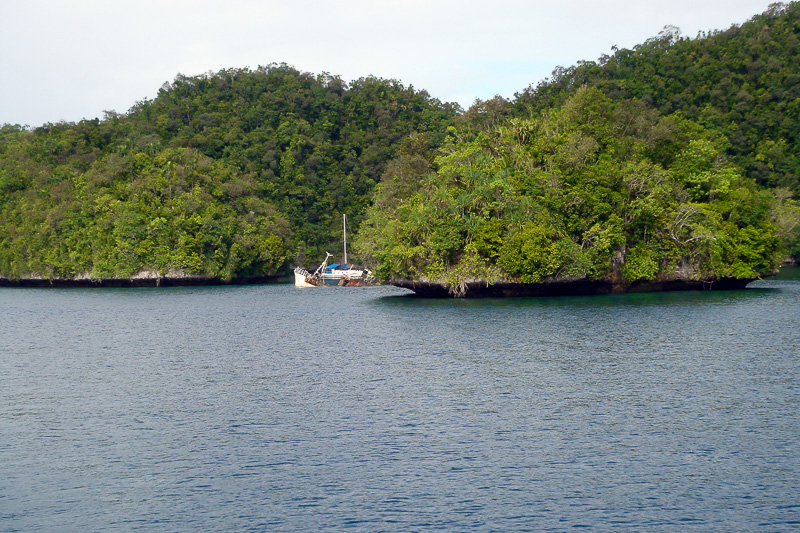
Later when we were on the dive boat in Palau, passing through the rock islands, I was talking with our Palauan boat pilot and I said something like, “The Yapese used to come here and tear off a piece from these islands.” The pilot, high on betel-nut of course, laughed wildly, as if visualizing the folly of those rustic Yapese. [Not actually the same pilot as shown in this picture.] And the next day he returned to the joke, pointing out a natural bridge worn into the rock islands, saying, “That’s where they took away the stone money.”

In a way, taking photos is like taking stone money.

One of my blog-readers asked what kind of camera I used for these pictures. A pocket-sized SONY Cybershot DSC-T1. It has 5 Meg, which is more than enough, and becuase I carry it a lot more than I used to carry my Leica, I get a lot more pictures. The lens is tiny, but it’s okay that the lens is tiny since the “film” is a tiny CCD chip. Also its a Zeiss lens. The only downside with a camera this small is that it’s so lightweight that it tends to shake when you get down to low light long exposures. Would be nice if it has some kind of grabber so you could temporarlily mass-ballast it by fastening it to a handy rock. Just for kicks for the photo mavens, you can click here to see that last cool red,white, and blue stone money picture in larger format, about 2700 pixels across.

Micronesia 4: Topless Women, Pet Bats, In a Gaugin Painting

Tuesday, March 8th, 2005

Before dinner, Embry and I noticed a young girl wearing a grass skirt and a floral lei. Her breasts were bare. She came into the dining area, an open patio of plastic furniture. Invisible insects biting me every second. She was the daughter of the manager lady, a 31 year old woman whose teeth have been dissolved down to tiny black stubs from constant chewing of betel nut. The daughter had just been to an ethnic dance held in their home village twice a week for tourists. There was no embarrassment or self-consciousness over the bare breasts, you see older women walking bare breasted on the streets, it's an old-fashioned family-values thing to do.

After dinner we saw the daughter again, dressed in jeans and T-shirt now, playing with her pet fruit bat. Her grandfather had shot this little bat's mother, to eat, and had found the baby under one wing, and the girl had raised it. She let me play with the bat, it's “play” consisted of biting all my fingers. She had a wad of betel nut in her cheek now too. A regular sweet teenage girl. Thanks to the betel nut, though, her teeth were already a bit worn down; chewing betel eventually erodes the teeth down to blackened stubs.

We ate a grilled parrot fish, lots of firm meat on those colorful reef nibblers.

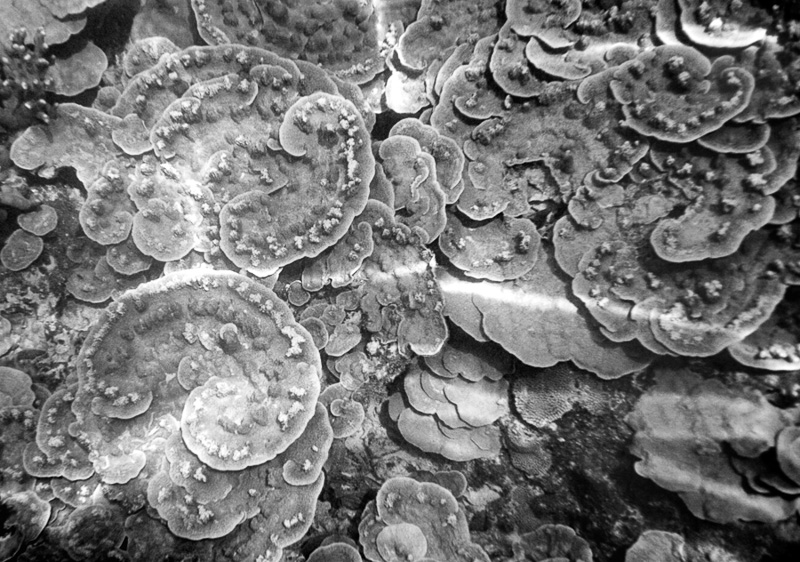
I got the people at the hotel to drive me up to a beach by the village of Wanyan. Yap seems only to have two beaches; the other was even more trashed by the last typhoon. I took my snorkeling gear, and swam out to the reefy deep water twice, looking at fish and coral. Saw some great 3D Zhabotinsky coral. When I'm snorkeling alone, I enjoy the coral more, I can relax and not have the rest of the party being ahead of me or behind me.

All property in Yap is privately owned, even the beaches, so I had to pay someone for permission to use the beach. There's absolutely no signage in Yap. I was in the Pathways van with a beautiful woman and a twelve-year-old boy, both Yapese, the boy the brother of the girl with the bat. They have lovely, rounded features. We pull into a driveway near the beach, and the woman and I get out and she talks in Yapese to the man for a several minutes over my beach fee, and the upshot is that we drive back into the village to discuss it with a different guy. He comes out of his dilapidated house — made of driftwood and corrugated sheet metal — and has an even longer discussion with my Pathways guide. His mouth is red and bulging with betel nut. I get out, ready to pay, but then we get back in the van. “How much does he want?” I ask. “Two dollars.” “Should I pay him?” “No, we'll do it through the hotel with paperwork.” Ah, humanity, and our love of complicating things. I had the idea that this guy doesn't have much action — I am the only person I see coming to the beach this morning — so enjoyed making the most of the deal.

One the beach there actually is another group, a Filipino family of a man, woman, and two daughters, one with Down's syndrome, she runs around with her tongue hanging out. The woman's mother is there too.

The beach is littered with ocean debris, dotted with coconut palms that are very wide at the bottom, I think of women's hips. The water is shallow for about a hundred yards, then there's some dark blue deep water, some turquoise shallow water, and maybe a mile out the breakers where the open sea crashes into the reefy shelf around the island. The sky is changing every minute, fluffy white puff alternating with gray rain clouds, showers of a few minutes, then back to blue and wafting breezes. The coconut palms slant every which way, making a frieze within which the Filipino family and I move.

The man, Julio, comes over and invites me to eat. I join them, they've laid banana leaves on a low table, and he's grilled some fish: tilapia and parrot fish, also there's rice and a bunch of quartered roasted sweet potatoes which were just harvested by the mother-in-law from her garden. They talk about their worries about the one daughter, I sympathize.

And then I put on my shortie wet suit and snorkel way out to the deep water. 3D Zhabotinsky scroll coral. Gemlike blue and aqua fish in tiny staghorn coral heads.

Later I take a talk along the beach and find four major shells, the kinds of shells I'd buy in stores. The beach is filling up with teenagers, boys and girls, playing volleyball, picnicking, playing guitars and, yes, ukuleles. I relax, leaning against a fat coconut palm, admiring the handsome brown people moving through the frieze of trees. Noa noa, I'm in a Gaugin picture. For once I'm utterly content and happy. A long way from writing about death. “Sir,” a Yapese man walks over. “You like some banana?” He gives me a little bunch of three stubby bananas, sweet, firm, thin-skinned, delicious.

Later I snorkel out to the fish again, and then the hotel van picks me up, my posse, two women and a two-year-old this time, also a big guy who'd carried our bags at the airport. All of them chewing betel nut, calm and friendly, enjoying the drive. On the way out through the Wanyan village, an old guy whose mouth is bright red with betel stops us and has a long conversation with the guy in the back seat with me. I think they're discussing the big deal of my beach fee.


Rudy's Blog is powered by WordPress