



Click covers for info. Copyright (C) Rudy Rucker 2021.


Archive for the ‘Rudy’s Blog’ Category

Micronesia 3: Betel Nut

Monday, March 7th, 2005

The first thing I noticed on landing in Yap was that all the guys picking up guests had big wads of stuff in their mouths; and their spit was bright red, redder than blood even. Vermillion. You could see lots of the spit in their mouths, spilling out onto their lips.

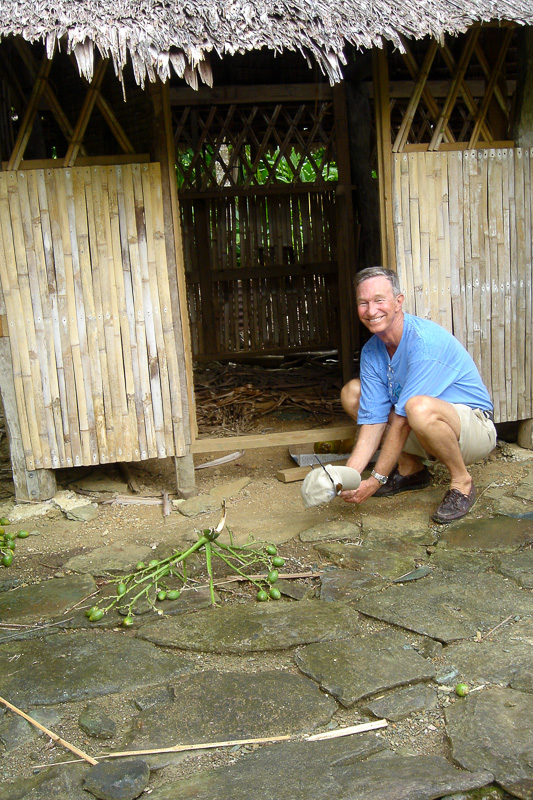
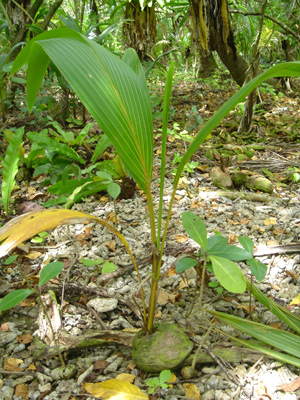
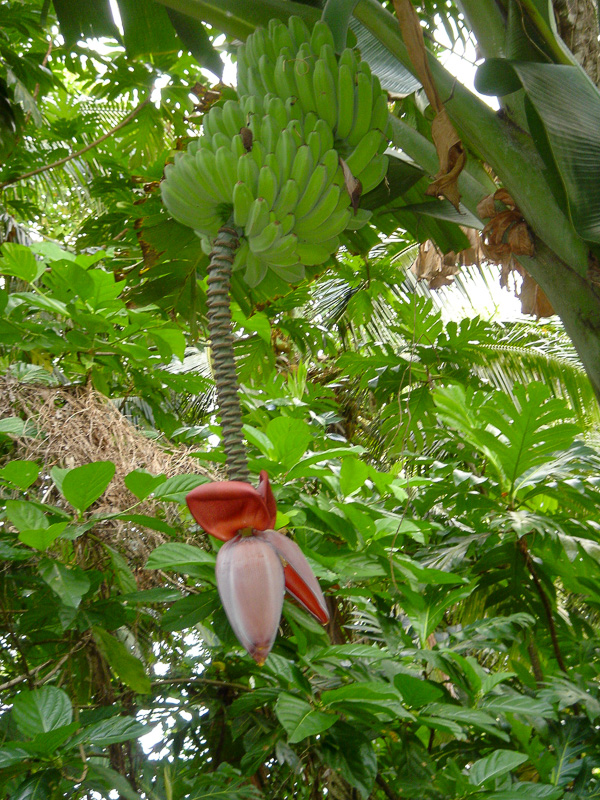
Betel nuts grow all over Yap on trees resembling coconut trees, but with bunches of acorn-sized nuts. They chew the nuts when they're green, if allowed to ripen and get orange they're too hard.

Our first day, we walked into Colonia, the capital of Yap, which has a dozen or two tiny stores and businesses in a modern little shopping complex, also a few shipping buildings, such as the Yap Fresh Tuna Company. Two streets crossing each other. The sidewalk in the main part of the town is red so as not to show the betel nut spit, which otherwise makes a permanent stain that looks as if someone had been stabbed. There's also spittoons in the form of red-painted wood stands with plastic sacks in them.

There's a betel nut stand in town, this is where you see the most people gathered, although you also see bags of betel nuts in the three markets, and in some of the other stores as well. One or two bucks for a bag of fifty or a hundred betel nuts.

I asked a guy running a native crafts gallery about them, and he offered me one and showed me how to use it. You bite it with your back teeth to crack it in half. Then you sprinkle some white powder on it that they call lime, it's ground-up shells or coral, but I think it could equally well be the ground limestone that they sometimes use for fertilizer or for athletic field markings. And then you wrap a piece from a big pepper-plant leaf around the nut and put it in your mouth.

He offered me a nice fresh betel nut, and a lot of bitter clear juice popped out as soon as I bit it. I took it out and sprinkled the lime onto the open halves, wrapped it in pepper, put it back in my mouth. I think the lime mitigates the bitterness, for when I once picked up a betel nut I found under a tree and bit it without lime, the taste was unbearable.

My Yap betel-benefactor advised me that beginners don't swallow the juice, although experienced users do, so as to “get more kick out of it.” Embry declined trying a nut, preferring to observe its effects upon his younger brother — twas ever thus.

Quickly that side of my mouth began feeling a little numb, and shortly after I felt slightly euphoric and relaxed. It's like when you have coffee or tea in the morning, and you feel as if some invisible missing piece of your personality puzzle has just been snapped in. The betel nut juice seemed to fill a hole in me. I felt (as any druggie or former druggie will understand) like you're supposed to feel.

While I was chewing we walked into the office of the Yap legislature. The receptionist was a handsome, dignified older woman with teeth bright red from betel nut spit. We talked for awhile about the building, our conversation slow and relaxed. We were on the same wavelength.

There seems to be absolutely no social opprobrium on betel nut chewing, which is hard for me to grasp, coming as I do from puritan America. I kept thinking there'd be some occupations where you'd be discouraged from chewing, but all the people I encountered were chewing: dive masters, hotel and restaurant people, villagers, secretaries, school teachers, indeed even the white locals here chew. One man said it kept him from going nuts over the leisurely Yapese pace, in other words it put him on their same wavelength.

Funniest was a girl working the computer in a local arts and crafts store, she had a large betel nut in her mouth already, and then while typing in the invoice for the lava-lava (hand-woven cloth intended as a wrap-around skirt but which we'll probably use as a table-runner) that I was buying, she picked up a betel nut the size of a small egg, and crammed that one into her mouth as well, without even bothering to add the lime powder and pepper leaf. She looked so wild and greedy, I had to laugh. Like a kid eating Halloween candy.

I'm not going to push my experimentation with betel nut, but my guess is that chewing a whole of them in a row gives you a cumulative, growing buzz. Certainly some Yapese do seem kind of zonked, but that could also just be the tropical languor and low-stress lifestyle. I haven't seen anyone acting particularly impaired. Well, maybe a little forgetful in some cases.

Betel is definitely a psychoactive drug, though, and seems to be highly addictive. Perhaps on the order of caffeine or tobacco, although the Yapese I asked say the appeal is quite different. It makes them relaxed, one said, and another said he chews just so “something is moving,” something is going on. They also said it's almost impossible to quit, that they'd started when young, and that they know it's bad for them, but they chew up to a hundred nuts a day. Those bulging bags of betel nuts in the market aren't family party-paks, dude, those are one person's daily supply. I didn't see the white powder for sale, that seems to me more in the way of a personal supply, everyone has their own hand-made lime-shaker. Some people use old Tabasco bottles, Tabasco being a favorite spice here.

The effects on their teeth are devastating. A betel-nut chewer's teeth become black and, I believe, are slowly eaten down to stubs. I recently saw an article in Science News to the effect that betel has some dozen known carcinogens. The use of betel has been drastically increasing as some large corporations in Southeast Asia have streamlined and modernized betel, selling packets containing betel, lime, and pepper leaf pre-mixed. Perhaps to remind users of the Pacific Island origins of betel, in Malaysia these betel packs are sold by betel girls who aren't quite topless, but who are wearing bikinis. The betel girls work the traffic jams of cities such as Kuala Lumpur or Hong Kong.

***

Someone asked about why the computer cord is wrapped around the crystal, and the lobster-looking man. Well, those are recycled from earlier blogs, and to find which ones I used the nifty Search box on the right margin of the blog. I searched “crystal” in the blog and find the Computer Holistic Wellness entry.

I remembered the lobster-man was in a show at the Academy of Science in NYC, and searched Adacemy and found SF Art.

Micronesia 2: First Day in Yap, SCUBA.

Saturday, March 5th, 2005

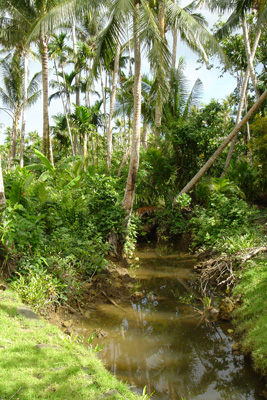
I walked on an ancient raised pathway with stones set along the middle, palm trees all around, hibiscus, vines, banana leaves, dragonflies. Little huts with Yapese sitting there, a fat brown man, nearly naked. I wave, feeling a bit like a trespasser, he waves back. A sudden squall of rain, I huddle against the trunk of a tree to stay dry. Nothing but green plants visible in every direction, the branches lashing furiously in the sudden wind, the rain coming in a sudden torrent, its noise filling the air. It's so warm, that it doesn't matter much if I get wet, but I like being sheltered by the tree, its trunks covered with woody vines. Up against the clouds a pair of slender-winged sea-birds continue circling despite the rain. Red and yellow flowers amid the waving greenery. I'm having an adventure.

***

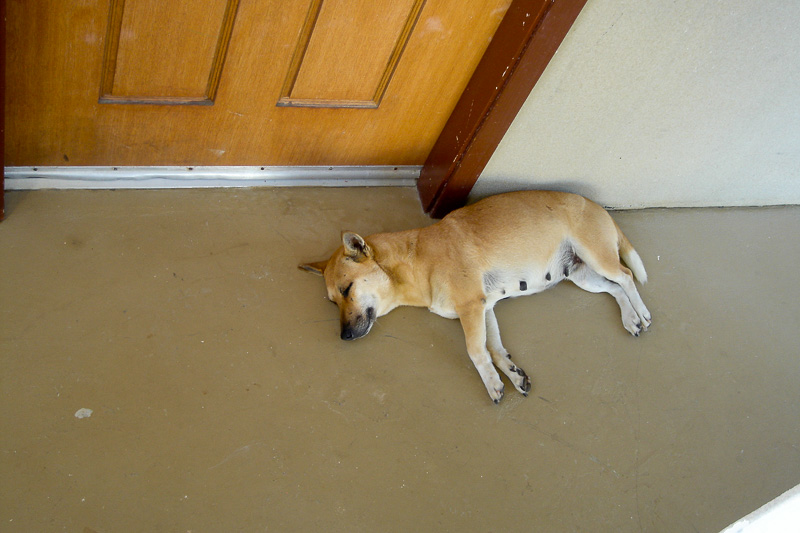
Lots of little yellow dogs here, but they don't yap all that much. They look so intelligent. Yesterday, walking near sunset along the ocean to a village called Badelbob, I passed a trio of little dogs, all of them so exquisitely sensitive to my interloping position and gaze. When there's more of them together, they're more confident.

This street passes through the district of the “outer islanders,” that is, the Yapese who aren't from the closely bunched five central islands, collectively known as Wa'ab. The outer islanders have lower status. Our diving guide Kintu yesterday was an outer islander.

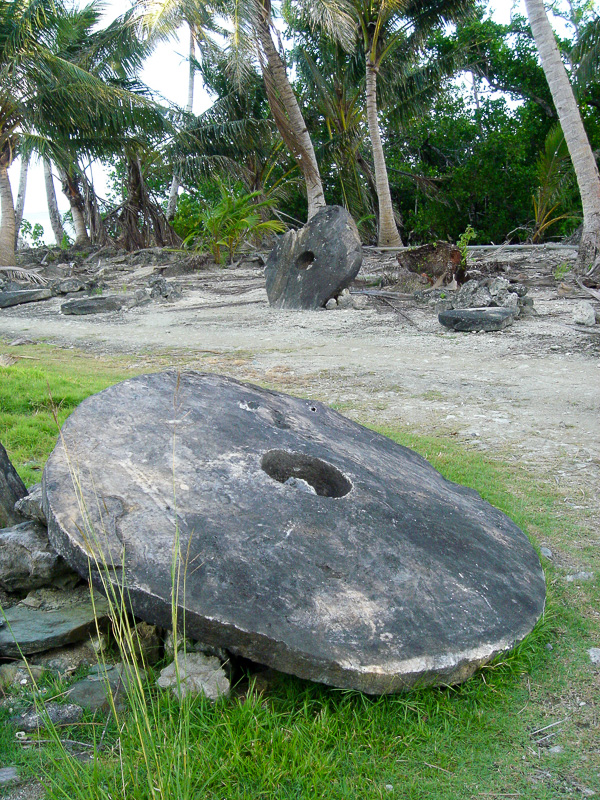
There was a row of stone money in Badelbob, they call this a “bank.” I'll explain about the stone money in a later entry.

On our first dive, we went down to 80 feet and lay on the bottom, hoping for some twenty-foot-wide manta rays to show up. They have a “cleaning station” here, a spot where they visit to have wrasses swim into their gills and eat the parasites. Or maybe it's a mating or feeding spot, the guides aren't sure. I saw one manta, far away, swimming, its cape-like body rippling, like an alien visitor. Then we worked our way along a lovely wall, like a china-shop of coral, plates with Zhabotinsky scrolled edges, staghorns, a school of fish the size of pizza pans, big gray guys, and more brightly colored littler ones, striped, dotted. Brain coral patterned in Turing stripes.

The current got more intense as we rose, like a gale-force wind in a mountain pass. Kintu had us stop and hang onto rocks, the current whipping past us, a liquid hurricane. He gave me a “reef hook,” a little S of metal attached to a cord, we hooked the S under a rock and I held the cord. We were quite near the surface, and I was rather low on air, I thought it must be time to surface and board the boat.

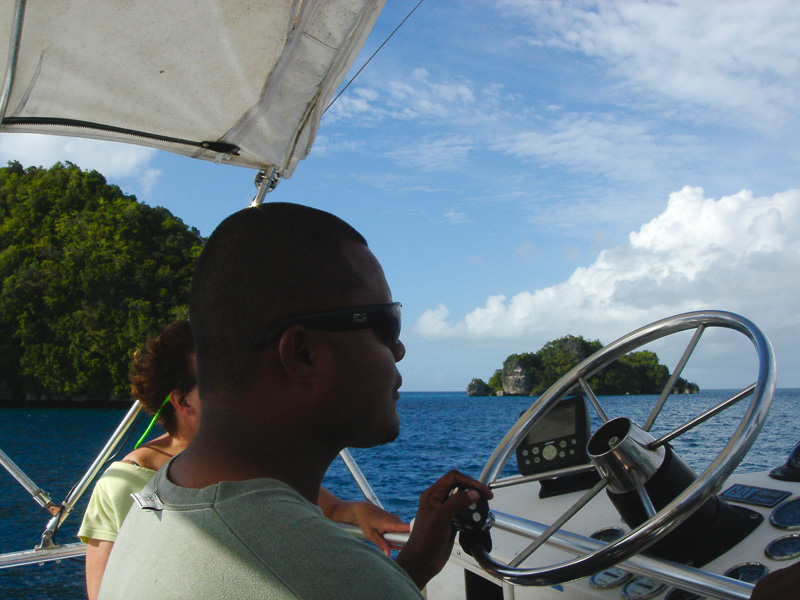
Kintu made a gesture which I took to mean that I should surface, later I found out that he'd meant that he would surface and signal the boat, and that the rest of us should wait beneath the surface dangling from our reef hooks, flapping in the current. So I surfaced with Kintu. He grabbed my hand, and immediately the current swept us away, out towards the open sea, moving very fast, faster than a man could run, faster even than a bicycle. Our dive boats were very distant, the driver, perhaps stoned on betel nut, didn't immediately see us. It occurred to me that if we were washed out to sea we might die. If I'd been alone, it could have been curtains. But eventually the boat picked us up.

In the markets they sell a lot more canned meat than they do fish. Pacific islanders have this thing for canned meat, here's a brand just for them, “Ox and Palm.”

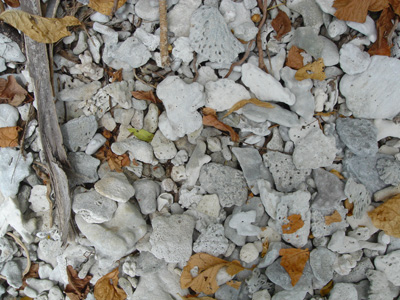
Later I saw Kintu in the supermarket buying beer. The man who saved my life! I felt like hugging him. He was carrying a little rectangular woven purse, kind of like an Easter basket, just big enough to hold his cigarettes and his bag of betel nuts. Here's a picture of some betel nuts lying on the ground.

I saw a Mobil tank station with “No Smoking” signs translated into, I guess, Yapese and maybe Palauan or some outer island dialect: “Dabni Tomogow” and “Haitowni Tamago”.

***

I made a 5 Meg MPG movie of the rainy jungle, click here to see it. (Vlog warning, I still haven't mastered posting movies. When you click on this, you'll get something kind of jerky for awhile until the full file downloads.)

Micronesia 1: Flying to Yap

Friday, March 4th, 2005

''

So where am I going? I'm flying from San Jose, to Los Angeles, to Honolulu, to Guam, to Yap. It'll take about 15 hours. We stay there six days, do a one-hour hop to Palau, stay five days, do a 9 hour trip to Pohnpei, stay a week, and then travel home via connections so obscure they'll take three days.

''

I'm going to meet up with my brother Embry in Honolulu, and be with him for the three weeks of the trip. The idea is that we'll do a lot of snorkeling and SCUBA diving together, the Micronesian islands of Yap, Palau, and Pohnpei being primo spots for this.

Embry's five years older than me, and we haven't spent all that much time together over the years. We weren't very close growing up, and as adults we've lived far apart. But he's my flesh, my brother, we have the same DNA, he's the only other person who remembers where all the furniture was in our childhood home in Louisville, Kentucky. The only other person who remembers my parents when they were in their forties. Fellow veteran of the wonder years.

''

Embry and I have been talking about this trip for months now. In a way, it's a retirement present to myself. My treat. Summer isn't a great time to go to Micronesia, and now I'm free to go at the best season. I really would have liked to bring my wife along, but she has to work.

I was wondering whether to bring my laptop on this trip, but I did. Slight fear of it getting stolen or somehow getting wet — one imagines the Pacific islands as dripping in moisture. But it's five years old, so if I lose it, it's not the end of the world. At one point I was thinking I should leave it at home so as to have a total break from my ordinary life — from the writing and the blogging. Well, okay, I'm not gonna blog during this trip, it wouldn't be practical with, like coconut-shell modems. But, after all, writing is nearly my favorite thing to do. If I enjoy it so much, why feel like I should quash it?

''

I'm thirty thousand words into a satiric cyberpunk novel called Mathematicians in Love that I'm digging a lot. It's coming along in that nice easy way, almost as relaxing a reading someone else's book. I write a few hours a day to find out what comes next. Another reason for bringing the laptop is that the journal is good company, a friendly ear, my favorite form of psychotherapy. When I get back I can of course mine these notes for a series of blog entries — which is what's happening now.

A big trip like this, so far around the asscheek of the globe, I wonder if I'll make it back. What if I just stayed there for good? Hard to visualize me doing that. The last few weeks I've been wondering if I'll even survive: plane crash, drowning, shark-bite, cone-shell envenomation — I'm, like, let it come down, I'm going. I need this break. I'm very stoked.

''

I wonder if they do have cone shells in Micronesia, or if they're just down in the Southern hemisphere. I learned about them from Stephen Wolfram years ago; their shells are decorated with patterns resembling the spacetime trails of gnarly one-dimensional cellular automata. My publishers are putting a cone shell picture on the cover of my non-fiction book, and I have some alien cone shells as characters in my novel in progress. I recently learned quite bit about cone shell venom in articles on “conotoxins” that I found on the web.

***

Now I'm on the plane from Honolulu to Guam, a seven hour flight. Sitting next to a Yapese man from Guam, in fact, an unusual-looking fellow, a cross between Polynesian and Asian, as you'd geographically expect. Like Filipinos, with maybe touches of Latino and Indian and African mixed as well. He tells me that parrot-fish are very good to eat.

''

I'm flying to Micronesia! A place I've wanted to visit for my whole life.

We're over the empty Pacific now. Lots of little clouds down there, like a field of Brussels sprouts or miniature cabbages or bolls of cotton.

Back from Early Spring Break

Thursday, March 3rd, 2005

I took Feb 9 to March 3 off from the blog. I was in Micronesia for three weeks.

''

I'll start up a long and detailed series of Micronesia notes tomorrow.

***

My disk storage ran out while I was gone, which is why the site's began looking a little flaky. The inevitable bit-rot of digital storage media. But that's all fixed for now, thanks to the Head Monkey of Monkeybrains.

In fixing it, I lost the most recent entry and the three comments on it, apologies to those three commenteers, do come back and post again.

***

The muxed entry said this:

If you live near SF, keep in mind the Potlatch Panel on Transrealism on March 5, 2:30 – 3:45.

Transrealism and the Ghost of Philip K. Dick, or, Everyday Life Is Science Fiction

A panel at Potlatch 14 in San Francisco.

Moderated by Rudy Rucker, with Charlie Anders, Terry Bisson, Michael Blumlein, Richard Kadrey, and John Shirley

One of the blurbs on Philip K. Dick's A Scanner Darkly referred to the book as “transcendental autobiography.” Inspired by this, Rucker coined the name “transrealism” for the practice of writing about one's immediate perceptions in a fantastic or science-fictional way. Paraphrasing a remark by Robert Sheckley: “A writer's first problem is how to write. The second problem is how to write a story. And the third is how to write about himself or herself.” Questions to be discussed by the panel may include, “What are some interesting examples of transrealism? “How to I use transrealist methods in my own writing practice?” “Is transrealism a liberation or a limitation?” “Where does transrealism lie vis-a-vis the borders between mainstream literature and Fantasy/SF?” “Does transrealism have an inherent political agenda?”

Date: Saturday afternoon, March 5, 2005

Time: 2:30 PM – 3:45 PM

Venue: The seedily grand Ramada hotel on Market St. near the Civic Center.

Con Website: http://www.potlatch-sf.org/

For background on transrealism see

Rucker's 1983 essay: A Transrealist Manifesto ,

Ruckers' 2003 Readercon talk:Power Chords, Thought Experiments, Transrealism and Monomyths

Damien Broderick's book, Transrealist Fiction: Writing in the Slipstream of Science


Rudy's Blog is powered by WordPress