


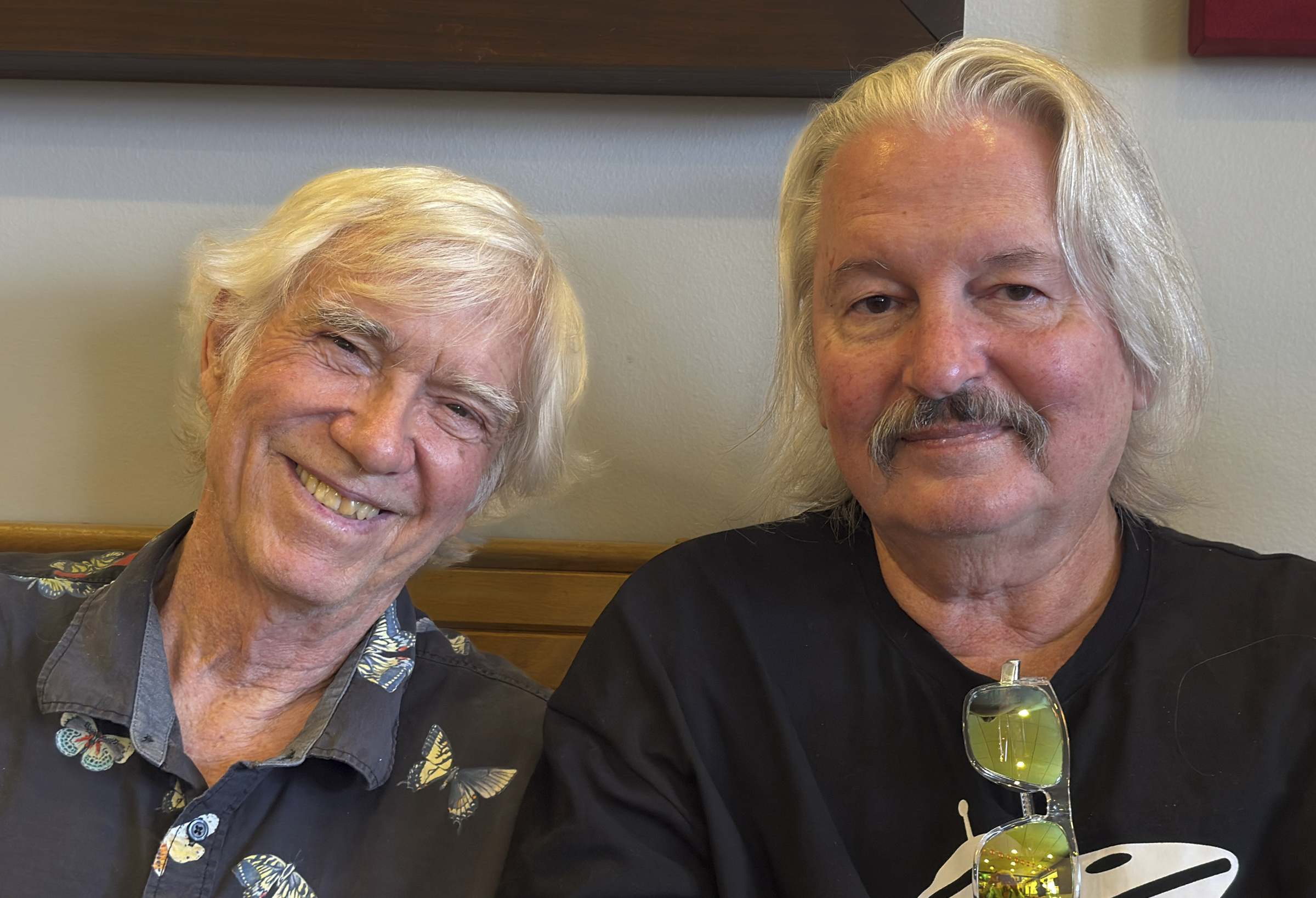
Bruce and Rudy at Armadillocon!
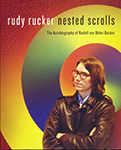
I rarely go to SF cons…in some ways the field has mutated away from my style and interests. When I was starting my career, it seemed important to attend these cons to make contacts. But now I’m eighty, and I have essentially no chance of getting a big publisher to accept up my work anymore. Even so, I am still writing novels, and I manage to keep my work in print via my small press, Transreal Books.
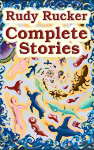
Over the years my two main collaborators have been Marc Laidlaw and Bruce Sterling. I’ve published ten stories with Bruce, with nine of them in our anthology Transreal Cyberpunk. Note that this site also includes links to Bruce and me reading the stories. Regarding my stories with Marc Laidlaw, there are seven of them, to be found in my Complete Stories..
I don’t get to see Bruce very often, and my main motive for accepting the generous invitation to Armadillocon was that I wanted to spend time with him. We were on a two-person panel, and I managed to tape it. What we have in this blog post is a partial transcript, primarily of my sections of the panel. You can hear a somewhat fuller version of it in my podcast of the event.
And now let’s get on with it…and and read what I had to say about one of my early novels, White Light.
I like putting math into my science fiction. There aren’t that many mathematician science fiction writers. That I know of, well, Lewis Carroll wrote Alice in Wonderland in a way that’s mathematical science fiction, and he wrote some interesting books on logic.
One of the first books I wrote was White Light. I was excited about the idea of people taking LSD and seeing the white light, and the white light would be god, the mystic One. And I had in fact taken LSD at that time, also peyote, but just once each. I always liked the idea of God being a white light, as I’d seen it.
If you go outside and you look around and there’s something you see outdoors, what’s the one object that you think, “Well, this must be god,” and that clearly is the sun. I mean, it outshines everything else. White Light was presented as being about infinity. In mathematics, I got my PhD in mathematical logic or, more specifically, in set theory.
And this would be 1968? What I wanted to write about was levels of infinity, and this was the peak of the 60s. So, of course, I was interested in Infinity.
Infinity was, you know, far out stuff. And there’s this wonderful theorem that was proved by George Cantor in 1888 that there are two different levels of infinity. People might just think infinity is infinity. But there are levels.

If you have a set of numbers one, two, three, four, five, all that, how many are there? We say it’s aleph null. And then, what about if I look at the points on a real number line like 0.677… and each real number has an endless tail of an infinite decimal expansion. Cantor proved there’s more real numbers than there are counting numbers. There’s no way to to count them up in a row.
There’s always one that you’re going to miss, and so there’s a second level of infinity, and they call that, well, they call that size of the set of all real numbers c. For continuum. And the infinite number that comes after aleph null is aleph one. So is c equal to aleph one? That’s Cantor’s Continuum problem. It’s such a heavy, cool, science-fictional thing to ask.
The greatest logician who ever lived was Kurt Godel. He was at The Institute to Advanced Study in Princeton, and I was going to Rutgers in grad school near there. And somehow, I don’t even know how, I managed to worm my way in to meet Godel in his office at the Institute for Advanced Study. He was an extremely reclusive man. He was somewhat paranoid. And I was just this hippie grad student who’d taken LSD and seen god, and I was in a seminar with this cool Japanese logician Gaisi Takeuti, and somehow I managed to get in to talk to Kurt Godel and talk about Cantor’s Continuum Problem.

Talking with Godel was like telepathy. He knew everything I knew. He laughed a lot. I told him my big theorem from my Ph.D. thesis and he was like, “Yes, of course.” It was like meeting the guru. The smartest man I’ll ever meet along the long, weary journey of life. Once in a great while you meet a truly intelligent person.
After grad school I got a job teaching in this little village called Geneseo, in upstate New York. All my life, I’ve had trouble getting jobs. I’ve had trouble getting published too. There’s something about me, I’m always too cool for the room. I’ve been too cool for the room for my whole life. But I managed to scrounge out this job in Geneseo. And I’ve gotten my books published.
Geneseo wasn’t bad. I was making ten thousand dollars a year and I had some good courses to teach, in particular History of Math. And I loved teaching Geometry. I made it into a course of my own and wrote notes that became a pop math book from Dover, called Geometry, Relativity, and the Fourth Dimension. I also wrote my first SF novel, Spacetime Donuts.
After a couple of years they fired me, basically for political reasons. I was the only hippie in the math department. I got a grant to go over to Germany to the University of Heidelberg for two years. I went over there with my wife Sylvia, and our kids Georgia, Rudy Jr, and Isabel. We sold our house and went to Heidelberg.
Kind of an Exile on Main Street thing, but all in all we liked being there. I worked on the continuum problem at first, reading all of Cantor’s untranslated essays in German, and publishing a math paper about the problem. But after about about six months, I’m like, you’re never going to solve the full problem.
And then I thought, well, why not write a science fiction novel about it? Yes! There’s this French author called Renee Daumal, sort of a Surrealist although, like cyberpunk, the surrealist movement had competing factions, and he liked to say he did pataphysics. He was a recreational mountaineer and he wrote a little-known posthumously-published novel called Mount Analogue, about somebody who found a mountain that was infinitely high, on Earth.
The mountain was in a place you didn’t usually see. It didn’t show up on the maps, but you could go there. And I thought, okay, I’m going to use that. There’s going to be a mountain that’s infinitely high. So I wrote White Light while I was there on that two-year grant with my little family in Germany. It was a transreal book, and I was the main character, and I set the book mostly in Geneseo, where we’d lived.
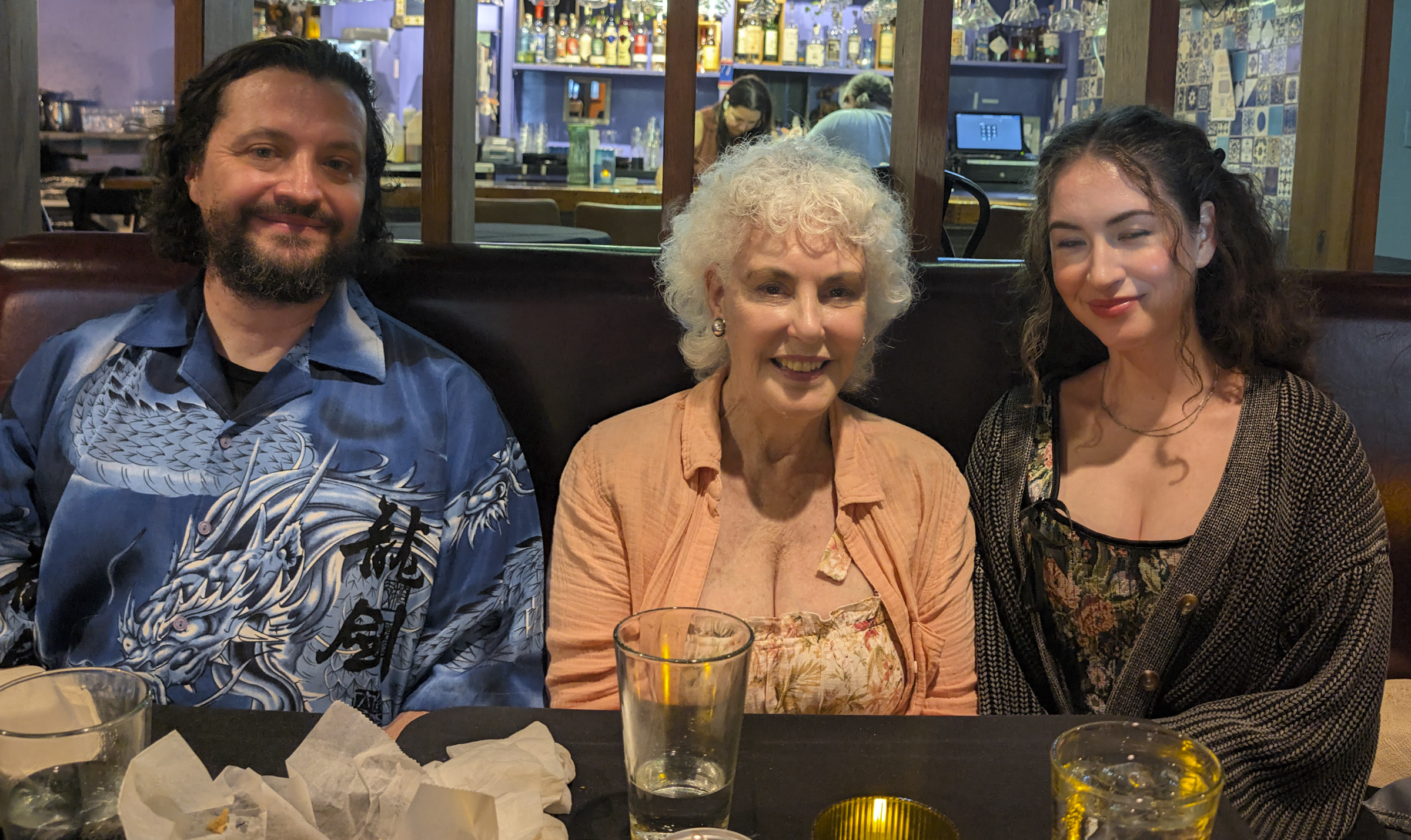
Armadillocon organizers Matt Rifley and Devon Foster , with my girlfriend Barb Ash between them.
I should mention that when I say I write transreal books and I paint transreal paintings, what I mean is that they are always about me and my family and my friends and my problems and my environment. But they’re warped by SF tropes. Instead of nostalgia you have time travel. Instead of love you have telepathy. Instead of a soul you have a memory lifebox in the cloud. Not surreal, but transreal. The same but different.
There was a graveyard in Geneseo that engrossed me. It was very crumbly and old, and, writing about this in Heidelberg, I said, okay, my Rudy character is gonna go there, and he’s gonna get Zapped in some way, and leave his body, and he’s going to fly out far away, infinitely far away, and he’s going to the afterworld, but he won’t be dead. And there’s going to be infinitely high mountain there, like in Mount Analogue. The first range of Peaks goes up to aleph null, and then goes higher up to alef one and on and on and on, and my guy is going there and he’s gonna make friends with a giant cockroach called Franx in honor of Franz Kafka.
And my man starts out at Hilbert’s hotel where there’s always room for another person, because you can just move every guest to the next higher room number. So he goes there, and all kinds of cool things happen. There’s this one chapter, I like, it’s called “Candy Hearts.” And every line of dialog is something you’d see on one of those candy heart that come in bags.
Love You. Stink Pot. Sex Bomb. Too Cool. I’ve always liked these slogans. Everybody in the chapter just says lines with two words. Different ones. It was a great chapter.
As I mentioned, White Light is transreal. The main character is a young professor, and he’s got children and his wife is desperately unhappy because she’s an extremely intelligent woman, and she’s being shackled into this housewife thing and hr husband is unsuccessful and barely employed. A lot of my job is teaching calculus to—well, I wouldn’t call him hillbillies, but they’re upstate New York people. I never learned calculus in college, or paid attention, but they had me teaching it, so I finally had to learn it.
Having a job was fun, but my life was hard. There was the constant threat of being fired because they didn’t like me. And on the transreal front, there’s a whole thing about the guy and his wife. But they together when he when he comes back from infinity.
At the very end, he’s higher and higher up the mountain. I had this vision at one point in grad school that Zero and Infinity are the same thing, and that’s a meditation.
Trick is to be thinkig “and this too, and this too,” and the same time be thinking “not this, not this.” Adding and taking away. Trying to see true nothingness, and trying to see everythingness. And they’re going the same place. It looks like they’re going around away from each other, but they hit each other in the white light, and then you’re there.
And, that’s where it ends, but then my character notices. I don’t know, he notices there’s this. Sort of a manhole on the floor. So, what’s in there? He goes through and he ends up back with his wife on Halloween in Geneseo.
Comment by Bruce Sterling
“Okay, that sounded like a very eccentric recitation there, but you know when you’re reading it, it actually goes along rather well as a science fiction narrative. And maybe if you were going to tell somebody how to write cyberpunk, it’s like, I think what I really need are, like. infinitely tall mountains based on Cantor’s continuum problem, and all the dialogue should be taken off the surface of candy heats!
Those sound like two deal breakers right there. But if you actually are a cyberpunk writer and you’re reading a text of this kind, it feels extremely liberated. The constraints really don’t matter at all. White Light doesn’t have any of the standard kind of cyberpunk visual gaming or movie cliches, like, pretty girls with large weapons, or somebody with one eye that has augmented reality, or there’s no kind of decaying neon cityscapes in it.
It’s just this extremely tippy narrative, right? And people don’t get it about how this works in cyberpunk. Practice it. I opens this up.”
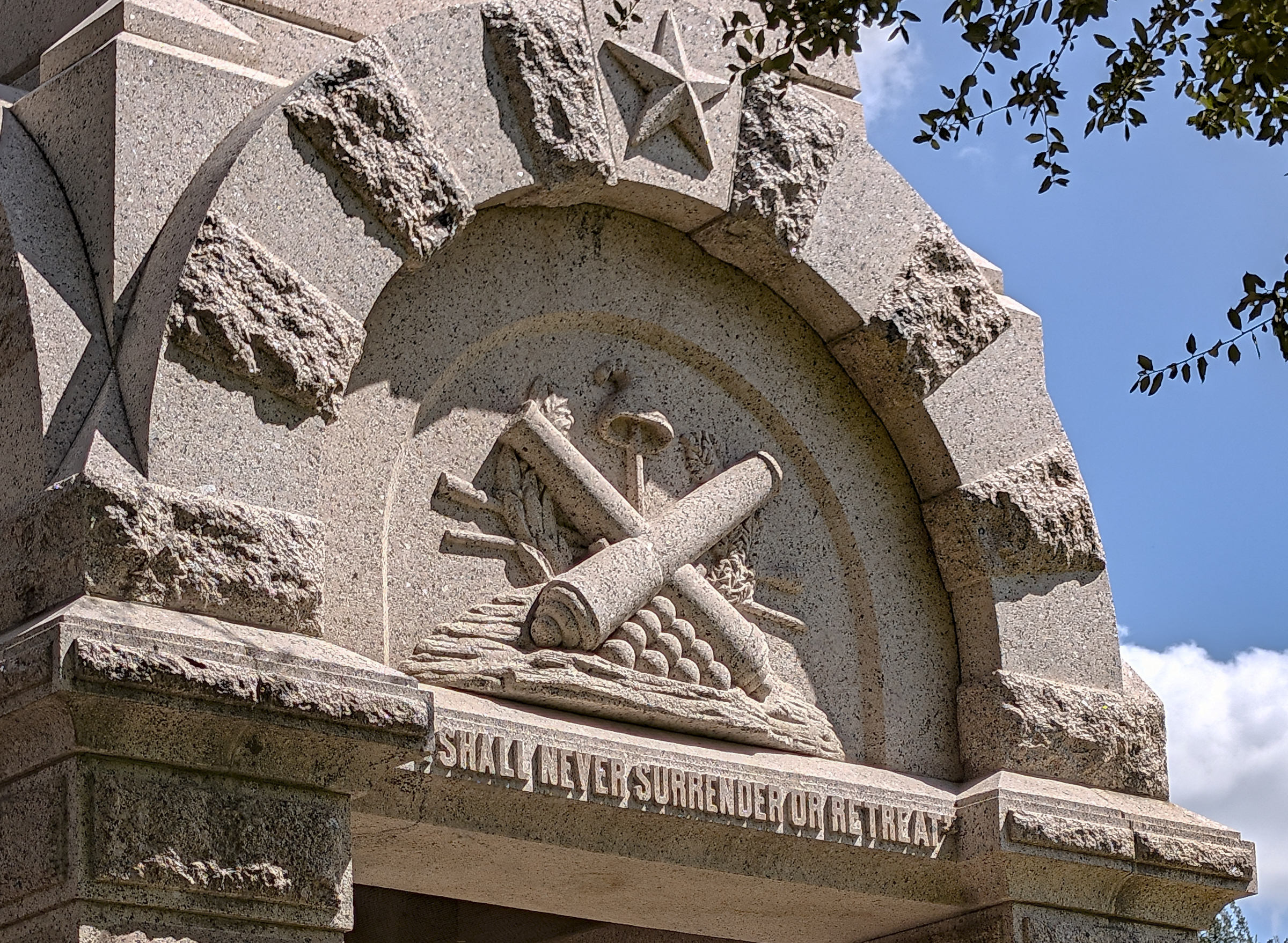
By the Texas Capitol. Men and their weapons. Dick and balls!
Back to Rudy.
Another book I’d like to mention is Saucer Wisdom, a kind of cyberpunk thing I did with a little help from Bruce Sterling. I had a friend at Wired magazine, Mark Frauenfelder of Boing Boing fame, and he said, “Rudy, why don’t you do a book about your visions of the future? I’m trying to figure out how can we I do this. We have to find a way to frame it.”
And then. I thought, all right, there was very popular 1987 book Communion by Whitley Strieber. He claimed he’d been abducted, and they probed his anus and all that. A huge hit. He made abduction a popular thing.
So I’ll do that. I’ll say I have a friend who’s been abducted multiple times, and he comes and tells me what he saw, and they always take him to the future. And each chapter is a different trip than he went on. One of my visions in each chapter. d. My agent and I are excited. Wired has a lot of money, and they don’t know what they’re doing because they hadn’t published any other books yet, so they don’t realize how cheapy I can be had.
So, I drive up to the pitch meeting at Wired in San Francisco — at that time I lived down the peninsula near San Jose.
And I brought along a friend of mine who was supposed to be the abductee. My college friend and old drinking buddy Greg Gibson, he’s visiting me, and he’s he’s got a beard down to his chest, he’s wearing like Good-Will clothes and he’s scowling. Very weathered. We made up the name Greg will use: Frank Shook. Love it. “Frankly, I’m Shook.” When I almost got drafted, the guy in front of me was named Shook. It all fits. Synchronicity.
I bring Greg to the meeting and it’s like, 20 and 30 year old people, and we just lie to them. “My friend Frank Shook was abducted many times. And he told me the things he saw and I want to make a book out of that.”
And they’re interested, they’re excited, and at first they’re not sure if I think Frank Shook is telling the truth or not, but I insist he is, I say we’ve had a lot of intense experiences together. In the books introduction, Bruce says this was, like, very cyberpunk, to be pitching complete and total bullshit to the Masters of the Press. But I’ve got them, and they’re saying we like it, we like it.
And then, about halfway through the meeting, Greg has a fit. They’re asking him him questions, and he goes, “It’s all so… It’s too hard to talk about it… I can’t take anymore.” And he stumbles out of the room. Going out to get a drink—we already picked a bar where we’d meet.

And so then, afterwards, I’m alone with my friend Mark Frauenfelder, and I feel duty bound to tell him the truth: “Actually Greg’s, just a friend of mine, and he’s not really a saucer abductee, and this is just a scam.”
And Mark says, “That’s okay. That’s okay. It’ll be a secret between you and me. We’ll, promote this as actual abductions. It’ll work.”
But I’m a little worried. You know, it might damage my already very questionable reputation. That I’m writing an…an alien abduction book? But my agent gets Marc’s boss to offer us $70K, so what the fuck, I’m writing it. It’s the best advance I’ll ever get in my life.
So I went ahead and wrote it, and it’s great book, great book. I go fully transreal on it. The Rudy character is in fact called “Rudy Rucker” and it’s about him writing this book.
I did have some trouble with my friend Greg, who got maybe a little too far into his role, and he’s phoning me up in character.
I transrealized this pollen by giving the fictional Rudy Rucker a lot of problems with the character Frank Shook. Like, during the book, Frank steals my manuscript and my typewriter. And at the end, I have a heavy alien contact at the foot of the Devil’s Tower — which appears in the canonical Close Encounters of the Third Kind.
I actually travelled out to Wyoming and visited the spot in order to shake loose some images for the book’s end.
Yeah, so, so then I give the manuscript Wired, and the top lady says, “You know? We don’t want to do this book. We don’t want to do books at all. Books aren’t a profitable thing. We can give you a kill fee. Maybe twenty percent.”
And this where my agent Susan Protter came in. Her father was the treasurer of the Communist Party of New Jersey. So this guy knew about business deals, right? It was in the blood. Susan went after Wired, and they paid me the full seventy thousand dollars.
And then Susan sold it to David Harwell at Tor Books, who paid me as well. And he said, “But we’re not going to pretend it’s real.” And I said, “Oh, that’s okay, it’s too much pressure on me if we do that.”
And we call it the book Saucer Wisdom, which amused me, as wisdom is, after all, the last thing you associate with people who believe in UFOs but…maybe? Could be, could be, seekers!

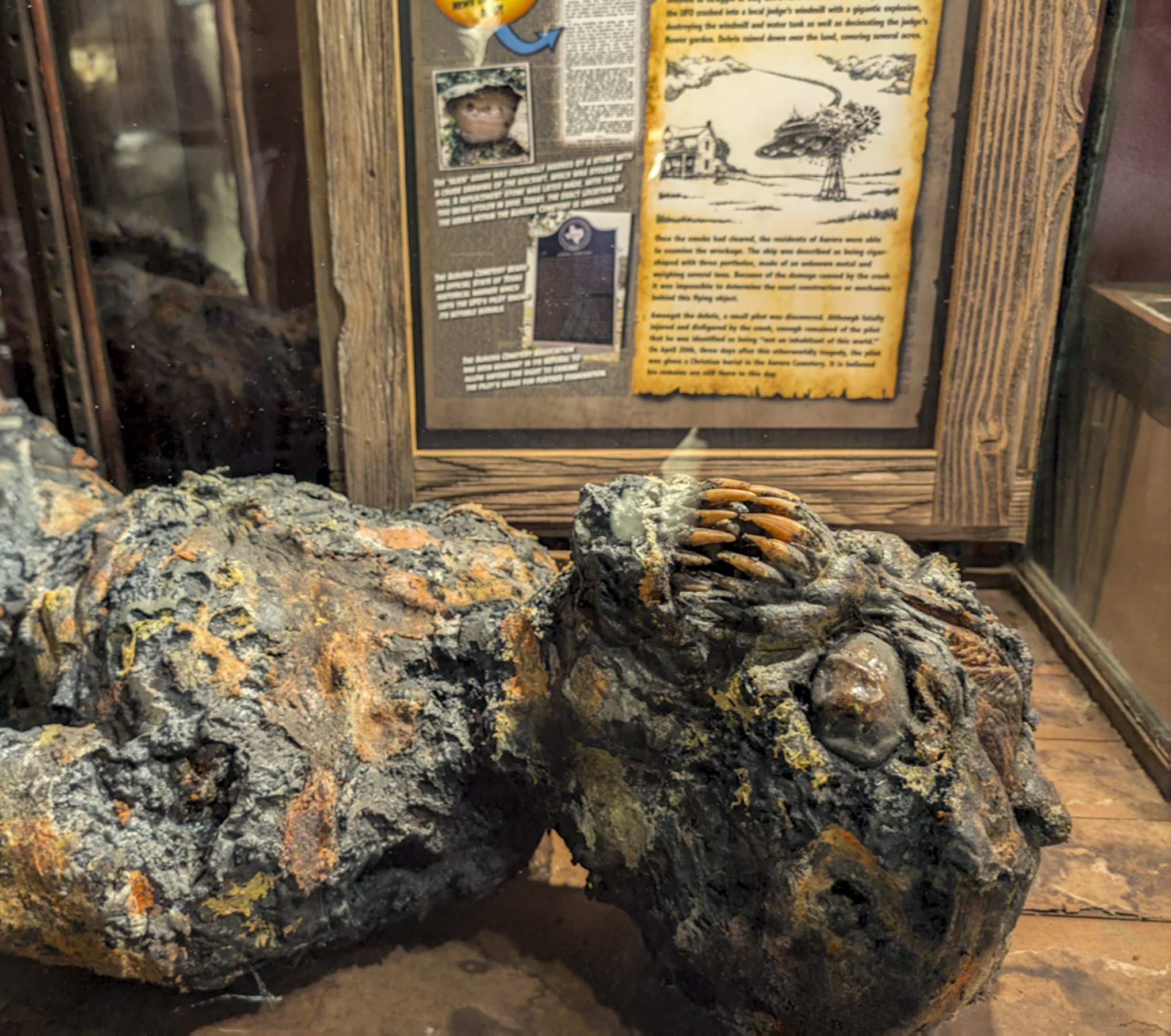
Barb at the Austin Museum of the Weird
It’s a great book, and I drew the I drew the illustrations for it. And first we were gonna hire my artist friend Paul Mavrides to do the illos, and Wired was going to pay him, but Tor doesn’t want to spend that money, and Hartwell says, “Look, these are drawn by a nut in a flying saucer, so how good do they have to be?” And that’s about my my drawing level.
And then Bruce wrote a great, great intro, explaining all the ins and outs. But the book didn’t do that well. You could almost say it bombed. Tor classified it as science fact instead of science fiction, which was probably a mistake.
It’s curiously neglected, as I say about so many of my works. The real saucer nuts didn’t want to buy my book because they could tell I was mocking them. And science people don’t want anything to do with saucers, you know, so everybody kind of spit on it. But it’s a great book anyway. And later it got reprinted and Bruce came out of the woodwork and wrote another introduction to it, and this one was even funnier.
Comment by Bruce Sterling
“It’s kind of a good example of cyberpunk technique in action in the sense that the doors and windows have blown out in kind of a spectacular fashion. I mean it, you know, it’s not a like, it’s not going to win the national book award. It’s a very eccentric text, but I’m all in favor of that, and I think you can’t, like, judge it by whether the New York Times best seller list approved of it. It’s more like Saucer Wisdom is going into a space where no one else has ever gone, right? I mean, like, you’re just reading it, and it’s so eccentric and different, that things are sort of trampled? And if instead of that you actually do what people want and provide things that people really want to read a whole lot, that’s not even science fictional. That’s a waste of time because there are a lot of other writers who are actually intent on, like, achieving Market Success, and eventually they’re just going to copy whatever you’re doing anyway, and they won’t be advancing the field or opening new things up.”

Back to Rudy.
Let me talk a little about what it’s like to have a writing career. It’s steady work, you’re never done. It’s not easy. For most of us it never becomes easy to sell your books, not over the long term. But you keep writing anyway because you like to write. Writing a novel is one of the happiest places I’m ever in.
I have no control over the outside world, and when I’m writing, I have control over the world I’m imagining. And I like the craft. It applies at many levels. At the bottom, writing is like poetry, in that I think about the sound of the words. I would never play music while I’m writing. I need to hear the rhythms and harmonies of the words.
Writing is a craft, I’ve been practicing for sixty years. I don’t want to stop doing it. But, as I say, it’s hard to sell your novels, At no point in my life have there been more than one or sometimes two editors who would buy my novels. Maybe three who would buy my stories.
Only a few very small windows or cracks where you can get through. John Oakes did a lot for me. And I had some good, safe years with David Hartwell at Tor. But he died a few years ago.
Dave had really a lot of books, thousands, and he was carrying a box of books down the stairs, and he fell, and he broke his neck, so in effect the book collection killed him, which is crazy. Odd and ironic. But I wouldn’t call it funny. He was a wonderful man.
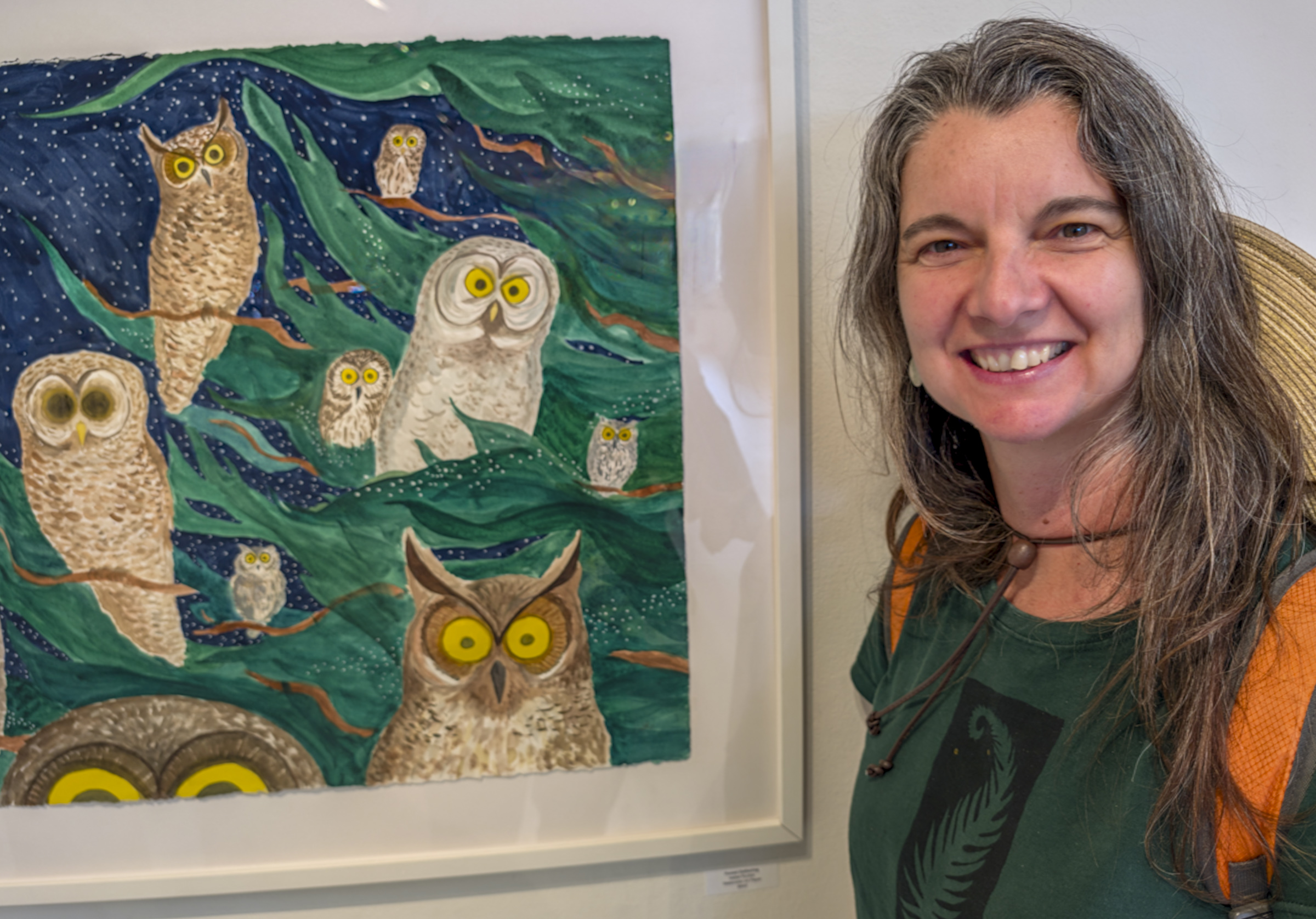
Daughter Isabel with a new painting.
Here and there, other editors have cropped up for one-shot deals. But soon they’re swept away by the maelstrom. Actually I tend to feel a little sorry for editors when they buy a book from me. They think they’re going to make money, and they’re enthused, but deep down I know they’re throwing their money away. Well, let’s say they’re making a donation to the field of Literary SF.
And by now, as I mentioned, I can’t find any big publisher at all. The new editors would rather publish younger writers because those are like lottery tickets. You never know who’s going to be a big seller. And, face it, my sales records aren’t that great.
Go for a small press? One thing, the less someone pays you, the worse they treat you. You might have to wait over a year for a small press to decide on your book. And if they take it, the advance may be extremely low. And any promotion they do is going to be minimal.
So that leaves self-publication. To put a better face on it, I say that I am a small press. Transreal Books. It was good enough for Virginia Woolf, right? Thanks to modern tech, the self-pub path is clean — if you can learn how to use programs like InDesign, Photoshop, and Calibre, you can put together a professional-looking PDF for print, and an EPUB for ebook. And your book will be onsale in every every online booksellter. And, weirdly enough, doing this doesn’t cost you a cent. Well, okay, less than $100 for an official ISBN book number.
Lots of details pf course. Being a cyberpunk former computer-science professor helps.
In any case, I’m still alive, my books are still appearing. What about a book advance? Well you do that by running a Kickstarter for each book. I might get something close to $15K for each new book. That’s work too, but at least I’m still out there. Keeping it alive. Spreading the message.
I just published my 26th novel. It’s called Sqinks, spelled with a Q. Once again it’s totally transreal. It’s a novel about a writer who’s a washed up science fiction writer. It was inspired by William Burroughs’s last novel, The Western Lands, which has a similar setting.
My old SF writer is living in a dumpster. By the San Francisco Bay. Happens to be a real commune that I’ve visited. In the novel we’re a bunch of artists lived there, and we’ve got, rogue or pirated everything: gas, electric, water, internet. My guy lives there without paying anything.
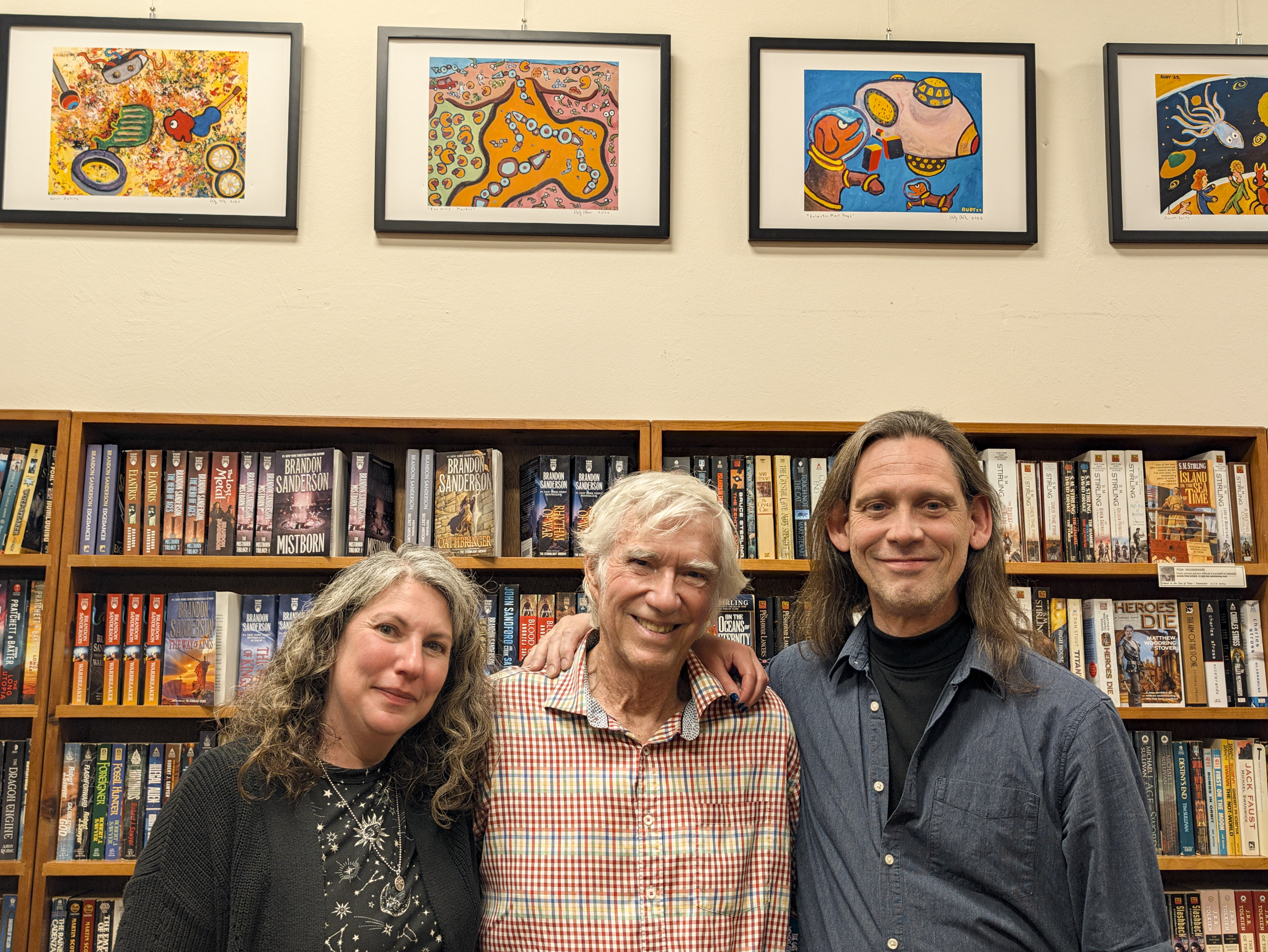
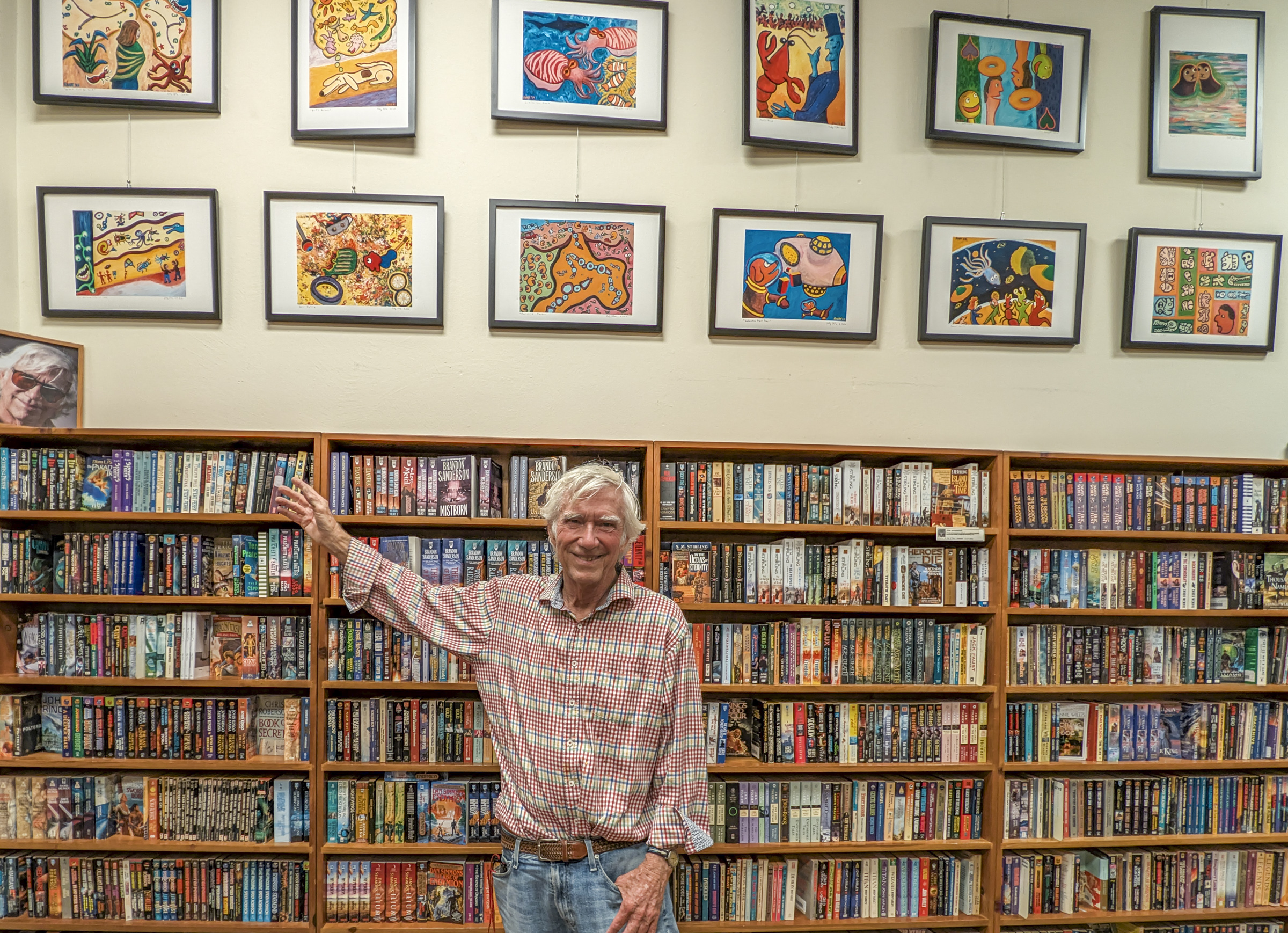
As of summer 2026, my old SF-bookseller friends Jude Feldman and Alan Beatts have prints of my paintings on sale at their store Borderlands on Haght St. kind of ironic that I ended up on Haight. Kinda where I started, at least in terms of inspiration by R. Crumb and Zap Comix.
My Sqinks hero’s main his problem is that his wife has died, just like my Sylvia died with in 2023. And he wants to find a new woman to love.
Also my Sqinks guy can’t sell any books, but he’s going to write another one anyway, and maybe this one will sell. And the novel he’s going to write will be Sqinks itself. The world he’s living in. It’s a little like the Saucer Wisdom setup, but in that book the author is supposedly writing an account of what actually happened to him, but in Sqinks he’s explicitly writing a novel which somehow turns into his actual life. The chain of causation is slightly different.
Regarding my futuristic hero’s writing process, he doesn’t need a laptop or a hand-held to write. He can write in your head. It’s like the cloud is in your head. It’s not far away. You can create the manuscript all in your head. My guy is writing a book that it’s fully immersive transreal. As I said, he’s in the novel he’s writing, and the novel he’s writing is Sqinks, which is the book that you, the wise consumer, are going to read. I’m stressing this because it’s an unusual setup for a novel. It’s experimental literature. Maybe Nabokov’s Pale Fire is a little like this.
The character in the book know he’s in the novel, and some of the other characters know it too, and at times they might ask him to change the story. Well, he might change try to change it. After all he’s in control of his reality, which is, as I’ve mentioned, one of the nice things about being a novelist
One of the meta facts about Sqinks is that, as I was beginning to write it, I did in fact meet a woman to love. This would be Barb Ash, who is Carol C in the novel. It often happens that the world I live in takes on a resonance with the world I’m writing.
That’s the meta transreal thing. There’s an element of magic that happens when I’m writing. If I get so intensely involved with the book, the universe starts dancing with me, and it’ll, like, throw things my way. Pieces of synchronicity.
Like, I’ll be writing about something. And I’ll see that same thing in the street the very next day. My fictional events will come up to me in the real world. It’s a strance and magical way of living. It’s not like regular life. I’m at a higher level of existence, and it’s great. I don’t force it. It just happens. It’s a way of being high.
I have always loved getting high, and about thirty years ago, when I was fifty, I learned that I don’t have to take anything to be high. I can be high all the time. It’s a matter of paying attention. Why would you need to take anything in order to get high? This is such a ridiculously intricate, complicated world, and it came from nothing. We don’t know why it’s here. And my new Barb Ash is here too. Thanks to me writing Sqinks.
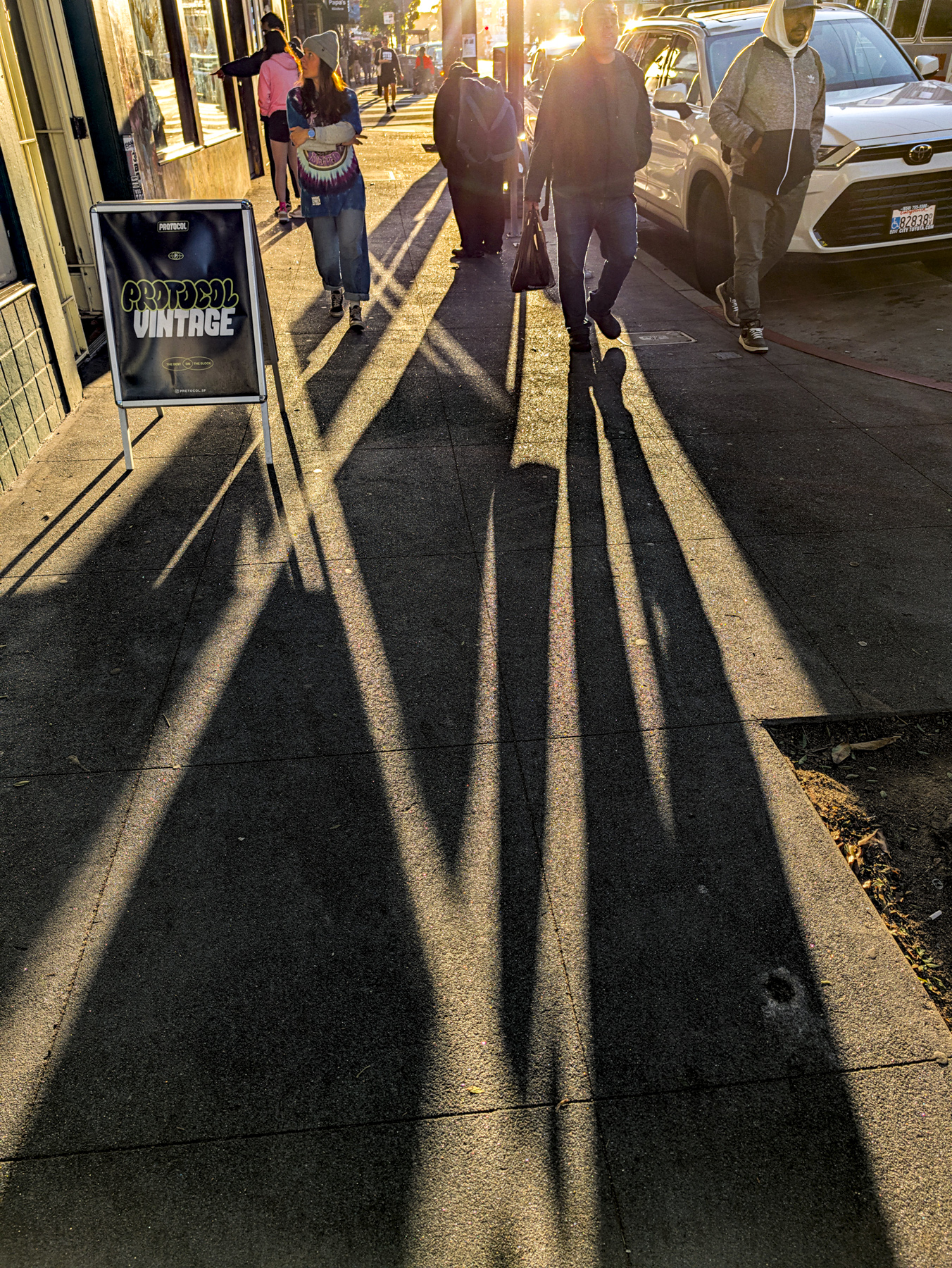
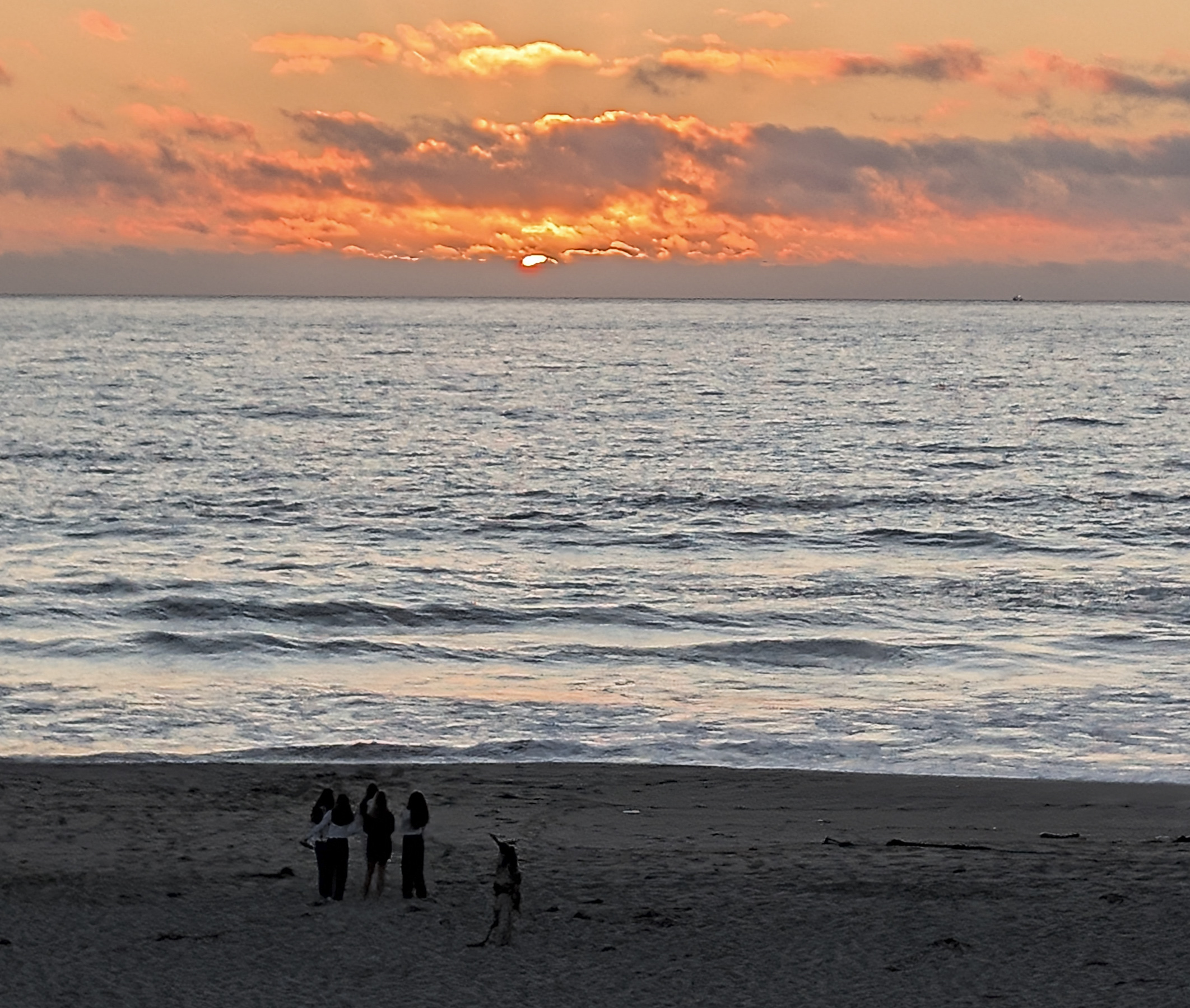
Dusk in the Haight, sun off the Pacific, the day that Borderlands hung my prints.
Bruce has mentioned the political significance of the fiction that we write.
A lot of my books are primarily fantastic, but I did write an explicitlyly political novel in 2021, right before Trump’s first election. I rushed the book out via my Transreal Books because I had some faint hope that it might possibly help stop Trump. My book is called Juicy Ghosts, and it’s about a group of computer freaks who assassinate an evil, illegitimate president like the big T. He’s called Ross Treadle. My guys bio-program some giants wasp to sting the guy to death at his bogus Inauguration.
Killing Ross Treadle in the novel felt so good to me that I did it two more times. Seems he’s he’s left a clone, so my charactacters tweak the clone so that it synthesizes nitroglycerin, and the clone explodes. And Ross Treadle has a lifebox model of himself living in a Russian-controlled part of the cloud, so my guys trip into Hilbert space and trash that third version of Ross Treadle as well.
And of course there’s an evil cabal of people like the ones who run America now, the billionaires. And the next job in my book us is to take them all down. It’s a very political book. Not flue music in the woods. A novel about the bitter, hard reality of American today. It anticipates a lot of what’s happening today.
I was actually afraid I’d be arrested or sued or secret-agented for Juicy Ghosts, and I hesitated. The regular American publishers wouldn’t touch it. Although it did come out from a big publisher in Italy. In the US, as I say, I self-published it via my Transreal Books. My dear friend and sometime collaborator Paul Di Filippo reviewed it in Locsus online. Otherwise bupkus in terms of publicity. Jack shit. Curiously neglected. Too cool for the room.
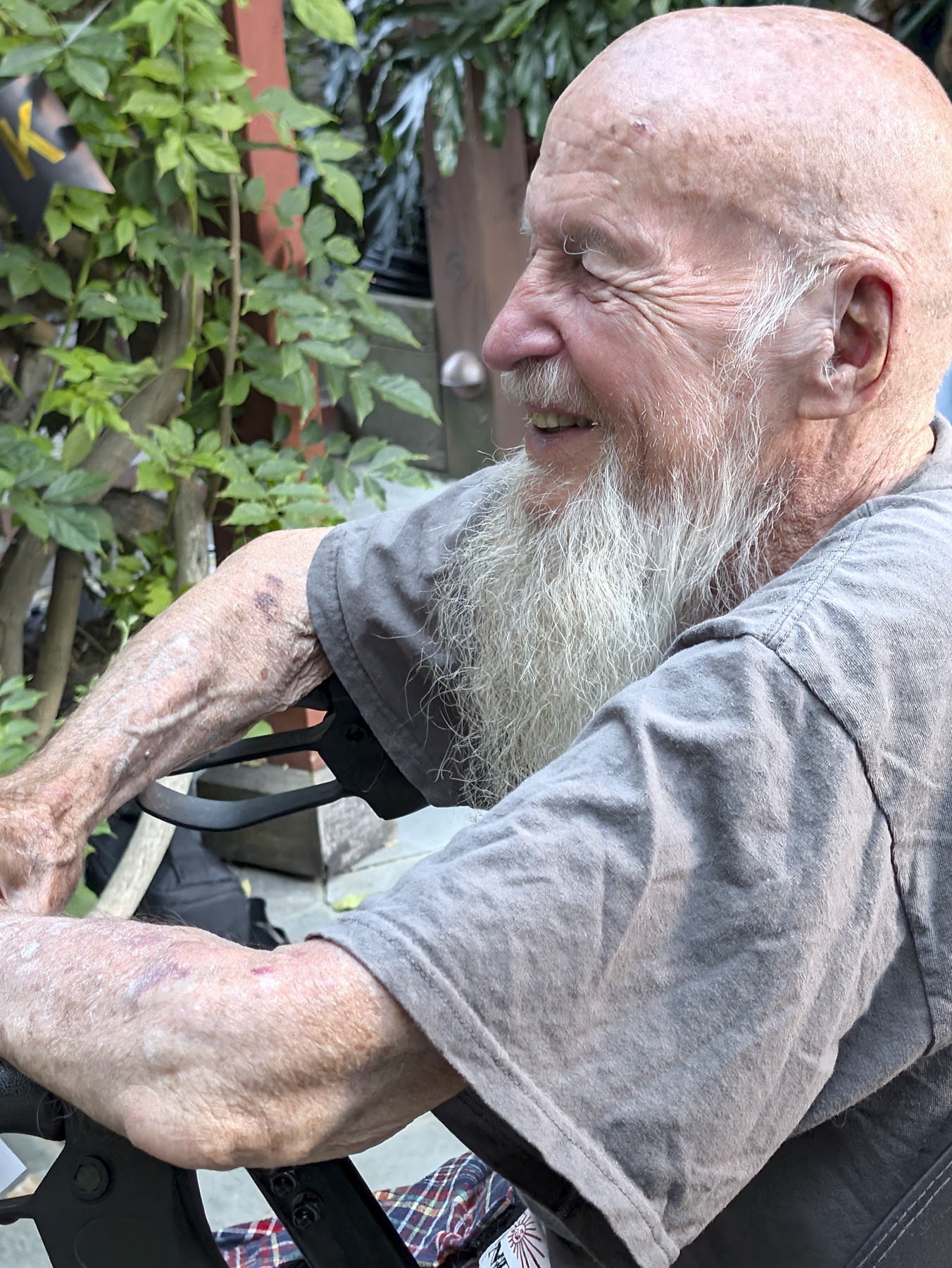
My 90-year-old freak science pal pal Nick Herbert. Once he and I were lost in a park and it was raining and I said, “This is a nightmare.” And he said, “No, Rudy, it this was a nightmare, you could wake up.”
Why is my novel called Juicy Ghosts? The thing is that, as living beings, we aren’t just the brain. We aren’t just this pattern of neurons. We’ve got a physical body. The “ghost” is the AI model of your personality. What I call a lifebox. But to get real life you need to put the lifebox into a juicy physical body. For that you can grow a clone. Or use a dog. Or even a plant.
Another of the big SF elements in Juicy Ghosts is that the cloud owners are offering free lifeboxes to people. Like Google, Apple, Adobe and Musk—they’ll rent rent space for a software lifebox model of you that lives in the cloud. Immortality. It’s expensive. But if you can’t afford it, you can still get a lifebox model of yourself. The catch is that you’ll be a gig worker. Driving a car, or doing online sex with users, or programming apps. And you’ll still get some me-time off.
But my heroes find a way to make software immortality free. And you get a physical a body for yourself as well. A glowing torus of aether.
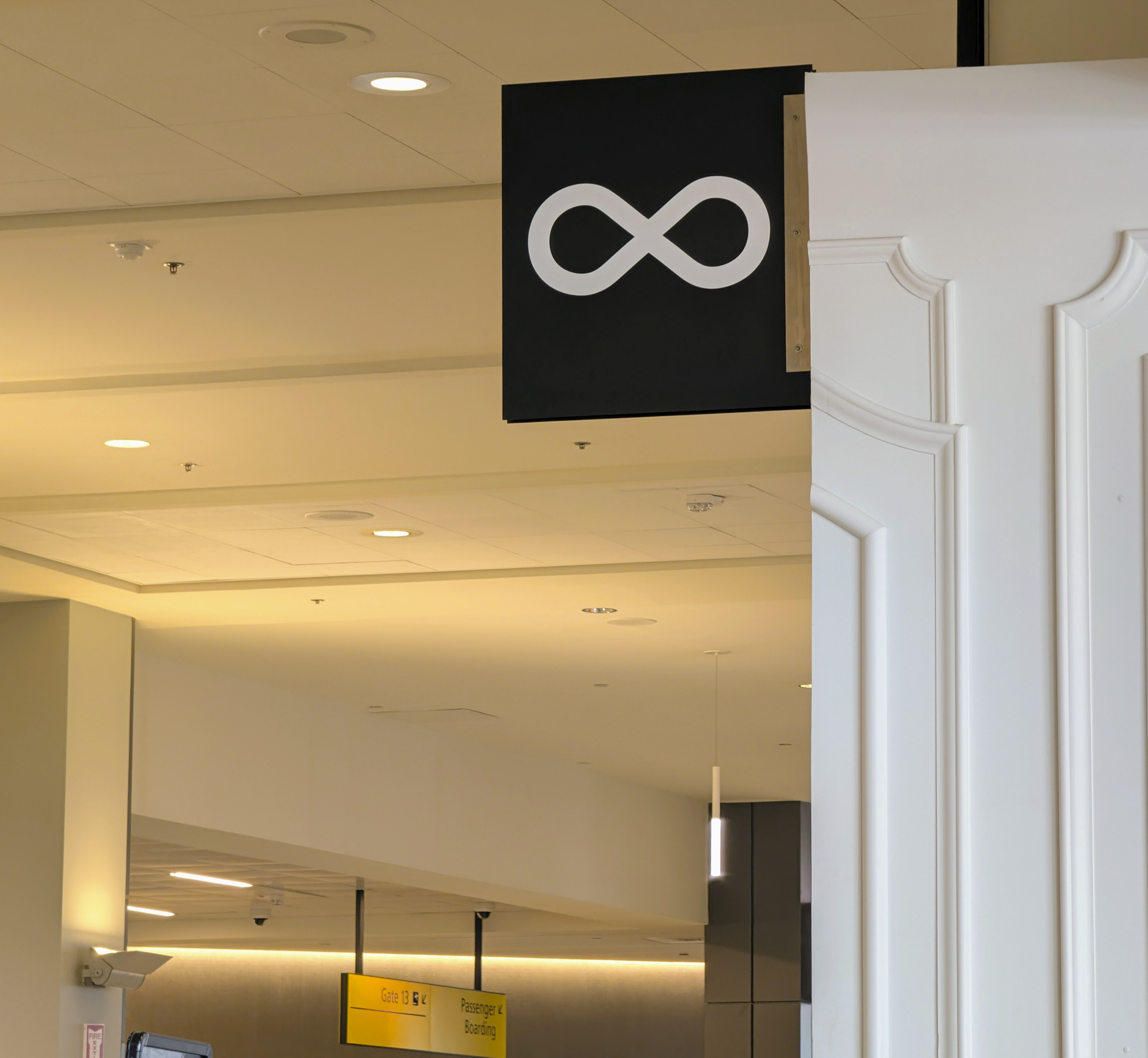
Heading home to Infinity.
September 21st, 2026 at 9:01 pm
It was such a pleasure meeting you again after having met back during your con going years. Think we figured out it was a Disclave, after The Secret of Life was published. Give my best to Barb, it was delightful meeting her. I’d be curious to hear her thoughts on fandom after her first con experience.