

I’ve been reading David Foster Wallace’s book of stories, Oblivion. Amazing, wonderful stuff. He's one of my favorite writers, although I didn’t like his non-fiction book about infinity. (I'm referring to the book “Everything and More” about Georg Cantor, not to the novel Infinite Jest, which I really liked.) Thinking back, “Everything and More” could have been saved if only he'd had better editing and more help with the math. Also the fact that I myself wrote a book on infinity means that I might not be the most objective judge of Wallace's success in this niche. I know well that I'm subject to professional envy and resentments.
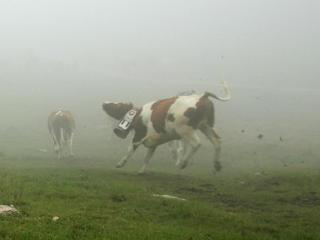
[Agitated cow resembling Rudy in a bad mood.]
Nobody can match Wallace for use of different language registers: the vernacular, the clinical, the scientific, the business-speak. As a writer, I can usually see how another writer is achieving their effects, but with Wallace, it's like “How did he do that?” It takes close study to figure it out, but it's hard to stop and do that as you're so swept along by the hypnotic jabber. The page-long sentences. The deep insights.
Wallace does seem to have a problem with ending his stories or novels. He builds up to a frenzy about 3/4 of the way through, and then the piece may just fizzle out. Sometimes this works, the fizzle serves as an appropriate artistic effect, a reminder that life is all of the piece and this piece is just an excavated chunk of the human tundra. Like it worked at the end of his transormative novel Infinite Jest, but sometimes, like in his non-fiction book on infinity, a reader thinks, “Instead of getting so worked up in the middle of the story you should have saved some energy for writing an ending.”
Some critics complain that Wallace is too intelligent. Like that's a pervasive problem to worry about. “Hey, I found this glittery rock and, damn, it's not a rhinestone, it's a diamond!”
Under Wallace's influence that I am today, the rest of this entry will be gnomic.
Wallace doesn’t seem to have an official website, but this Wallace site has a lot of good stuff, including a link to a really interesting essay ‘explaining’ the title story, “Oblivion,” which ends in a very odd and unexpected way (Spoiler warning: don't read the essay before the story. Note also that the 'explanation' could be mistaken, maybe the two people talking at the very end are, say, Hope as a teenager and her father, or even Wallace and his wife, it's all very dream-like and bewildering, and this is a time when the weird ending achieves just the right disorienting and troubling effect.)

[View of Montery Peninsula from Wilder Ranch Park north of Santa Cruz. Objective correlative for “Fata Morgana” image of a vanishing island (or wave) that symbolizes the soul merging into the One.]
One story, “Good Old Neon” is narrated by a guy who killed himself, and has some great philosophizing in it.
“the whole my whole life flashed before me phenomenon at the end is more like being a whitecap on the surface of the ocean, meaning that it’s only at the moment you subside and start sliding back in that you’re really even aware there’s an ocean at all” (p. 152)
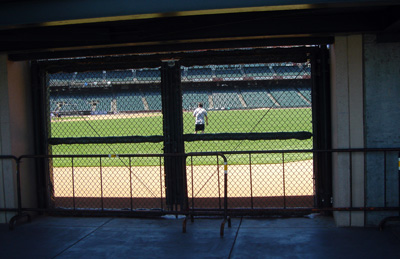
[View into baseball stadium in SF. Objective correlative to the “infinitely dense and shifting worlds of stuff inside you every moment of your life.” p. 178.]
Wallace has some intriguing notions about how the dead souls “talk” with each other, the idea being, more or less, that they can communicate a near-endless amount of info at once, like direct telepathic link, or a parallel extremely high-bandwith link (as opposed to the serial bottleneck of spoken or written language) not that he puts it so SFictionally:
“You already know the difference between the size and speed of everything that flashes through you and the tiny inadequate bit of it all you can ever let anywone know. As though inside you is this enormous room full of what seems like everything in the whole universe at one time or another and yet the only parts that get out have to somehow squeeze ou through one of those tiny keyholes you see under the knob in older doors. As if we were all trying to see each other through these tiny keyholes. But it does have a knob, the door can open … you can as they say open the door and be in anyone elses’ room in all your own multiform forms and ideas and facets…” p. 178.
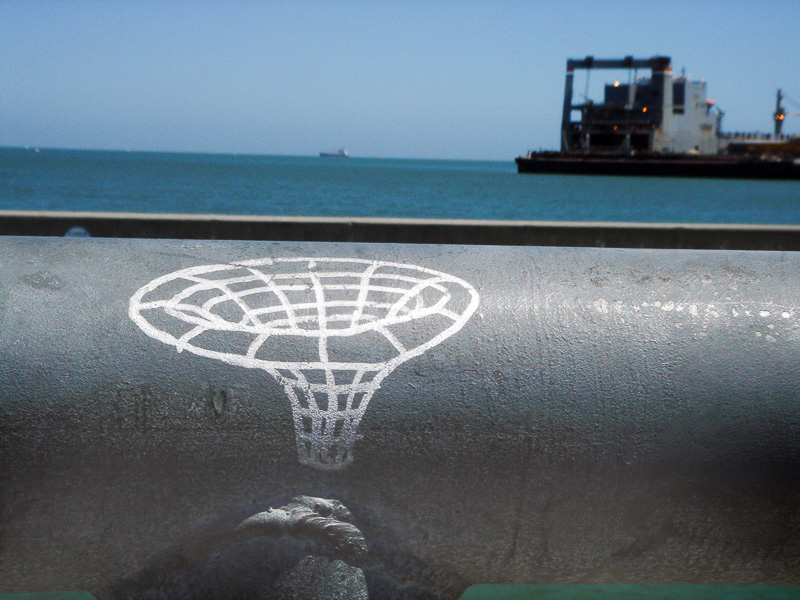
[Seen on a railing behind the baseball stadium in SF. Objective correlative to the experience of death as described by Wallace or to, alternately, a tunnel to La Hampa used to flee the crushing machineries of the Law.]
I'm planning a scene for Mathematicians in Love where Bela's band Washer Drop is playing at this stadium, now named Heritiagist Park after the ruling Heritagist party, and Bela is slated for assassination by the Heritagists, for handing out long-lasting bubbles in which you can see the future, giving away the latest high-tech of the PIG. You can't pop these bubbles at all, they just break into two smaller ones, so the stadim steps after the concert are littered with little bubbles showing the scenes that people wanted predictions of. Bela's gonna hampajump off a skateboard ramp to get away, you understand, and jellyfish God will speak to him, and it'll be like … opening a door.
Ffwwwwwwup! Come back and the hitmen are gone. Back to Wallace's Oblivion, if you only read one story, don't miss the last one, “The Suffering Channel,” about a People-magazine-type reporter working on a story about a hick in Indiana who makes sculptures on the order of “The Winged Victory” out of his own poo — without touching it. The sculpting happens within the guy's bowels. All the interns at the magazine are NYC hipster women from elite East Coast colleges. It's devastating and hilarious.