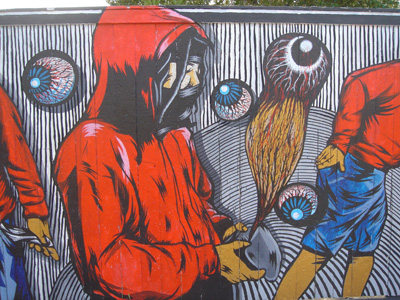
[This somewhat disturbing picture is from an ad for the Chukchansi gambling resort in today's San Jose Sunday paper. The rest of today's pix are recycled from the blog image bank. If you're really curious about a picture, right click on it to get a context menu and select Properties to get a window containing the name of the file. In some browsers, the Properties window will be too small to show the whole file name, in that case, you can click inside the filename and arrow-key to the right. Once you have the name of the *.JPG file, copy the name. It's likely to work better if you don't include the path, and you don't need the “.jpg,” you can just double click on the name itelf to select it. And then you paste the name into the blog Search box in the sidebar on my blog page. In Windows, of course, you can use Ctrl+C and Ctrl+V for copy and paste, with the Mac you use the Apple key instead of Ctrl. Once you copy the picture name into the Search box and press the Go button by the Search box, you get a page with clickable titles of all the entries where the photo in question appears — normally you want to click the last and oldest entry to discover the picture's origin. It would be nice to have PHP code to do this automatically, that is, find previous appearances of a given picture. I'm inching towards the Complete Lifebox Platform, here.]
I got intrigued by this thing Charles Stross mentions in my favorite recent SF novel Accelerando. He talks about an “…alien superpower – maybe a collective of Kardashev Type Three galaxy-spanning civilizations – running a timing channel attack on the computational ultrastructure of spacetime itself, trying to break through to whatever's underneath … [yes,] something vast – a timing channel attack on the virtual machine that's running the universe, perhaps, or an embedded simulation of an entirely different universe.”
What the f*ck is a timing channel attack? It sounds great, Charlie just says it, and we feel like it means something even before we know any details.
Searching the web, I find that a timing channel attack is a type of side channel attack, which is any attack that uses something other than purely abstract software analysis, it gets actual physical data about the encryption process, like it measures how long the machine takes to encrypt something, or listens to its sound, or watches its power consumption or RAM use. The idea is that, e.g. if I eavesdrop and see a lot of y get coded into y^x MOD n, and n is known as well, then I can guess the bits of x one by one from the timing info because the “0” bits of the exponent use less computing time than “1” bits.
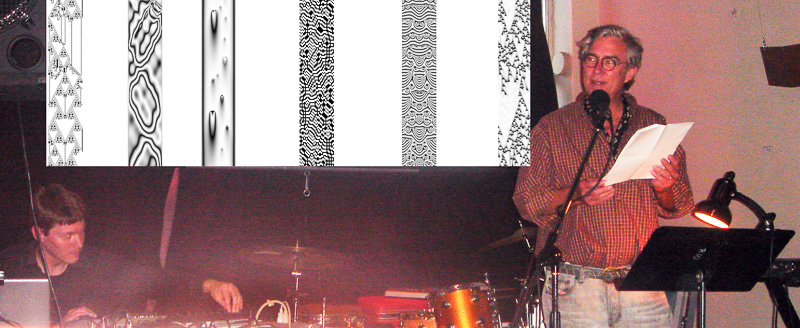
So in my story, some people are doing a side channel attack to figure out the ultimate reality program. Or they use the channel attack info to go to the deeper reality. Or both. They’re called reality hackers, natch, just like the old Mondoid phrase.
Suppose some diaphanous alien spirit-creatures have to check in and out to travel back and forth between here and the other, realer, subworld — call it the subfab.
Suppose I am able to monitor the — call them silfs — going from here over to the subfab. I can time, let us say, the interval between the silf saying “Go” and the silf wavering and disappearing. The silfs are being encrypted and I can see how long the encryption time takes. Problem here is that the data in a silf is so big and gnarly, so it’s hard to write it in binary and get the timing per 0/1 bit tested. Of course with the arphidnet mind, this would in fact be feasible.

Encryption isn’t an obviously relevant notion for exploring the computational ultrastructure of spacetime, and still less does it open an obvious travel route to the world’s deeper levels. How could the side channel attack give you information about the structure of the subfab? How could it help you get there?
Suppose you slavishly encrypt your body just like a silf does and then hope that it simply happens that you’ll then trickle down into some cracky-crack of spacetime. We won’t do this so crudely, though, we won’t turn ourselves into, like, radio waves as they did in The Fly. What we’re gonna to is quantum-tunnel from a material body to an aethereal body.
Suitably encrypted data slides through the grill between worlds on its own. Like a beetle walking over a grating in such a way that it doesn’t step on any of the separators. A thin man dropping between the bars of a curbside sewer drain. Yes.
Transforming or encrypting yourself with the silfs’ process gives you an “aethereal body” which is, let us say, a congeries of subtle dark energy vortices. Catch: due to the quantum mechanical no-cloning theorem, you can have a material body or an aethereal body, but not both at the same time. So the first person who encrypts into aethereal form is taking a big chance.

A key element in the process is the quantum mechanical notion that if nobody is watching something then it smears out into a superposed state. Let’s suppose that for a silf to travel between our universe to the subfab (1) she superposes herself, turns off self-observation and spreads out into an indeterminate state, and then (2) observes herself in such a way so as to collapse into the aethereal or material form.
The observation method is the encryption method. A certain quantum-mechanical operator. It takes the form of a koan-style question. “A flag is flapping. What is moving: wind or flag?”
As well as the koan, the material/aethereal transformation routine embodies a mantra, an information pattern which is, in effect, a code number.
Quantum meditation.

Our universe and the subfab are overlaid upon each other in the same space, separated by a tiny distance in the fourth dimension. In the aethereal form, this is the subfab; in the material form, this is the universe. You perceive the one that matches your body.