



Click covers for info. Copyright (C) Rudy Rucker 2021.


Archive for the ‘Rudy’s Blog’ Category

A Formal Proof of Panpsychism and Hylozoism

Tuesday, January 22nd, 2008

I’ve been busy working on my novel Hylozoic. I finally got into Chapter Seven, my second chapter set in Bosch’s home town. (Part of the first chapter set in Bosch’s town was in Flurb #4). It’s bawdy and medieval and funny and I’m happy to be writing and polishing my words. But I’m not having much time to blog.


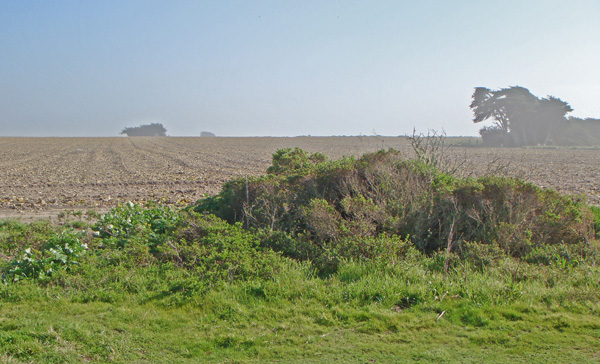
[A 200 pound yam on Ponhpei in Micronesia: objective correlative for my Chapter Seven.]

Sooo, for today, here’s a nine-step argument that everything is conscious (panpsychism) and that everything is alive (hylozoism). While getting ready for Chapter 7 I wrote up this argument for my paper for the published proceedings of the “What is Life?” conference I went to in Kyoto in Fall, 2007. You can see a PDF of a draft of the full paper online, or just examine the bare-bones outline of the argument here.


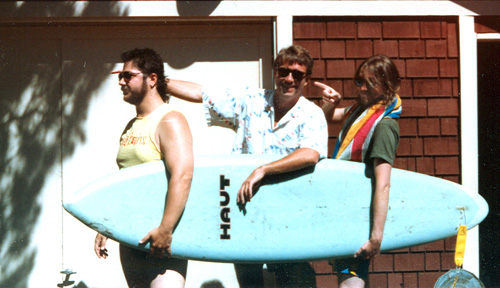
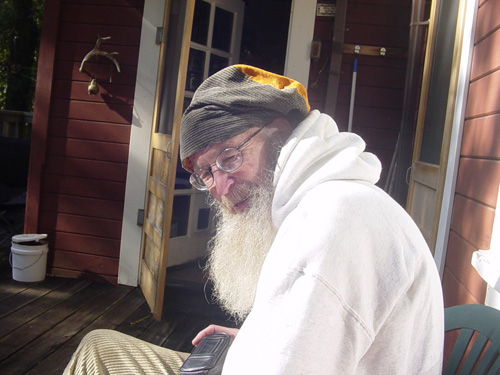
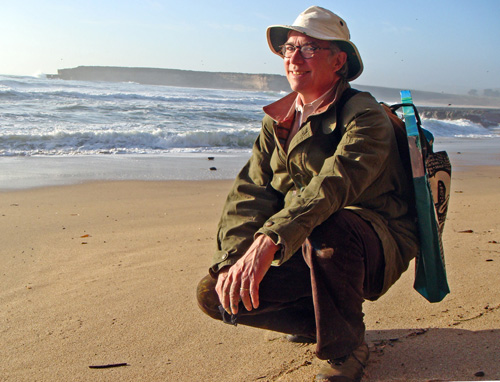
[Nick Herbert at his house last week, wearing his “indescribable hat.”]

(1) Universal Automatism. Every physical entity is a computation. (See The Lifebox, the Seashell, and the Soul, scroll to Chapter 1 on p. 4).

(2) Moreover, every physical entity is a gnarly computation. (See my YouTube “What is Gnarl” video, below.)

(3) Wolfram’s Principle of Computational Equivalence. Every naturally occurring gnarly computation is a universal computation. (See A New Kind of Science, p. 715.)

(4) Consciousness = Universal Computation + Self-Reflection.


[Nick’s outdoor bathtub.]

(5) Any complex system can be regarded as having self-reflection.

(6) Panpsychism. Therefore every physical entity is conscious.

(7) Walker’s Thesis. Life = Universal Computation + Memory. (See Walker’s online paper.)

(8) Every physical entity has memory via its interactions with the universe.

(9) Hylozoism. Therefore every physical object is alive.

Q.E.D.


[Professor Rucker demonstrates the “rolling buffalo” yoga asana at Nick’s.]

Yoga and the Elements

Monday, January 14th, 2008

Thursday morning I went to yoga class in Los Gatos, and the teacher, Jan Hutchins, was talking about styles of breathing. He said “Breathe in Mountain, breathe out Solidity. Let the solidity of the mountain fill the cracks in your body where pain can seep in.” He also suggested “Breathe in Space, breathe out Freedom.”

And I was thinking these were good models for hylozoic thought modes. You could do a five element version (including the Chinese fifth element: wood).

Earth====Strength, solidity, groundedness. calm.
Air====Freedom, looseness, non-attachment, driftiness.
Fire====Alertness, intelligence, glow.
Water====Flow, grace, wiggliness.
Wood====Growth, liveness, expansion, socialization.

Thinking in terms of telepathic contact with living objects, this gives me a feeling about how it feels to be in touch with the five elements. What if even here, on our world objects really are conscious, drawing their memories from the One Mind?

I always like class with Jan, he’s a hip and funny guy who often coaxes me into a deep meditative zone. Today, at the end, I was seeing the most beautiful spreading patch of blue with my eyes closed.

The yoga room is mirrored on one wall, and Jan often asks questions of the class at large, and often as not nobody answers. So today he says “Sometimes I imagine I’m under observation in a psychiatric hospital, and those are one-way mirrors with doctors on the other side, and there aren’t really any students here at all, I’m only hallucinating them, and the doctors are watching this crazy guy who thinks he’s teaching a yoga class.”

I had a hallucination like that in 1965, I was a college student, and an upperclassman had given me a couple of peyote cactus buds he’d gotten by mail-order from a Texas garden supply company. I’d eaten the buds and puked them up, and I was over at some friends’ house, and I imagined their kitchen was amphitheater-like classroom full of students, and that I was giving a lecture on Special Relativity—a subject about which I then knew almost nothing. It was a precognitive hallucination, for in 1977 I was in fact a professor lecturing on the mathematics of Special Relativity in an amphitheater-like classroom at SUNY Geneseo. The wisdom of the spiny bud.

Near the end of Jan’s class, I was tired, and so was the guy next to me, we were off in the furthest corner of the yoga room, and we were slacking, lying on our mats instead of doing yet another pose, and Jan walks over and says, “What are you guys—the hoods? Lying low in the back of the classroom?” And he pokes me. I was delighted. In high-school I always feared and admired the hoods—and at Swarthmore I more or less was a hood—at least relative to my gentle, intellectual classmates. Actually I don’t think anyone uses “hood” in the sense of juvenile delinquent anymore. But Jan’s nearly as old as me.

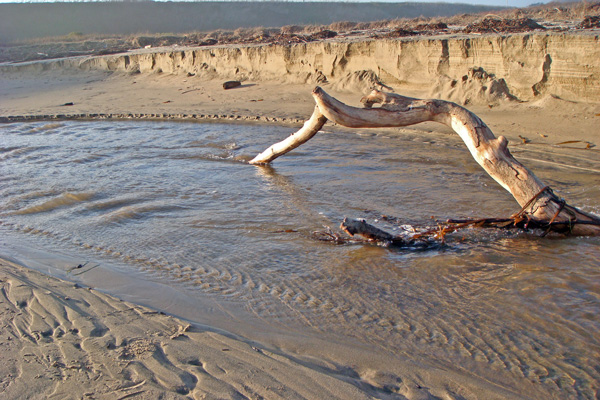
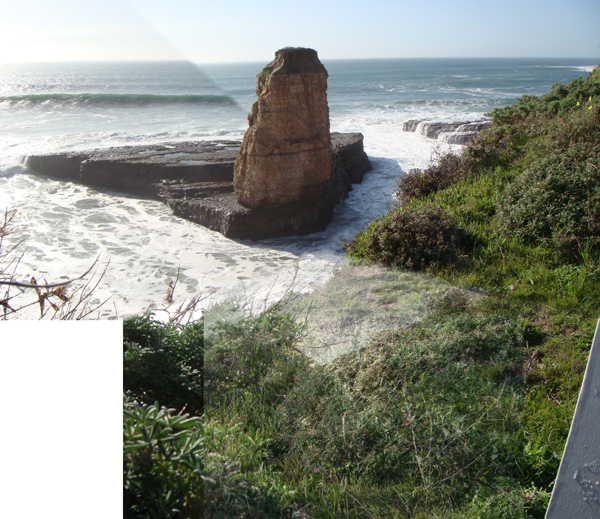
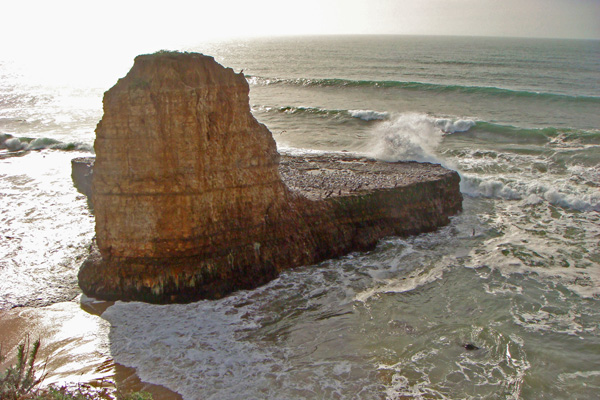
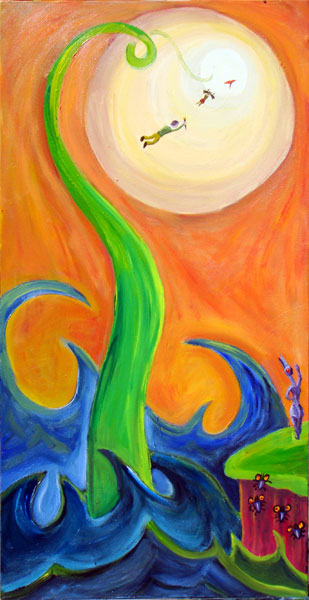
I was out at Four Mile Beach in Cruz again on Saturday, I started a new painting of this tower (I think twenty years ago it was a natural bridge), as seen from a nice little spot in the bluffs. It was paradise to be there, communing with the five elements, and I felt like I was getting a good picture going—although when I got home and looked at the daubs I’d actually made, it was sort of shocking how rudimentary they were. I’ll just have to go back!

“Dreamers Are Us.” Planning Hylozoic Chap 7.

Wednesday, January 9th, 2008

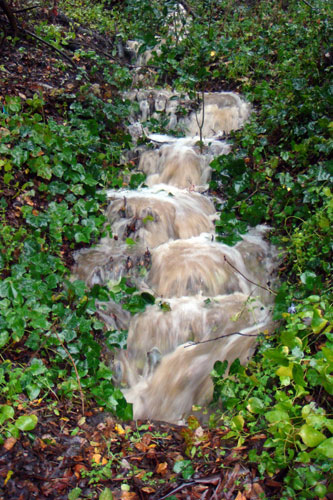
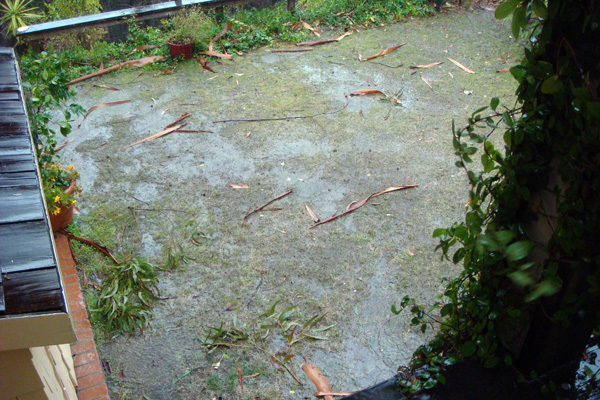
It rained a lot last week. The rain is good. It’s a sign that we’re nearly at the end of our country’s painful eight years under the whip and lash of those who hate us. The flooding is a living I Ching sign: Overflow.

This morning I woke up very early; it was still dark; I was awake because my wife was bustling around packing for a trip. I laid low with my eyes closed for about forty-five minutes, and in my head, I went over all of my as-yet-unwritten Chapter Seven, scene by scene. It was like dreaming while awake. I thought of a propaganda phrase from my novel, Spacetime Donuts, “Dreamers Are Us!”

When I was done, I told my wife what I’d been doing, and she was like, “Poor Rudy, that sounds like so much work!” And I said, “But I like doing it!”

And then, brushing my teeth, I wondered if I could remember all the thoughts I’d had. Odd to think that I can remember such intricate scenarios by means of—what?—circulating patterns of excitation in my neurons? Bulked up synapse connections? Biochemical trails?

I always feel safer after I’ve written it down. I forget so many things.

Later that morning I went to the physically whipped, but very congenial, Caffe Pergolesi (“The Perg”) in Santa Cruz and typed in my already fading memories of dawn’s lovely waking dream.

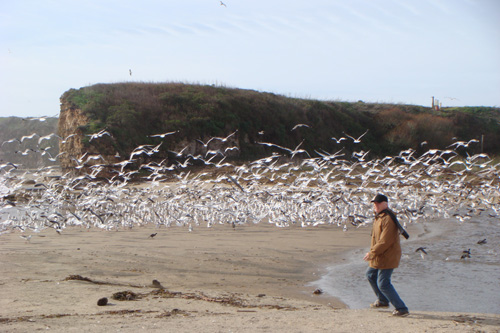
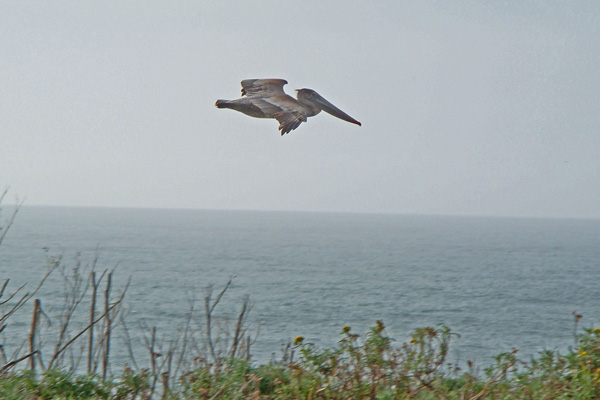
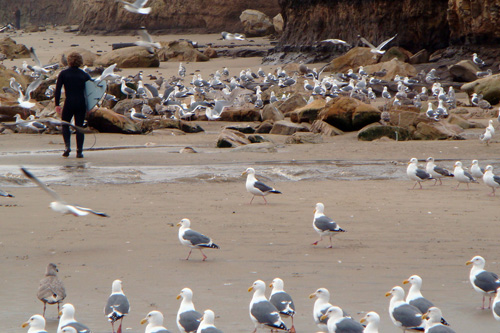
And then I went to Four Mile Beach with my old pal Jon Pearce. A lot of seagulls standing around on the beach. Jon agrees it would be great to be reincarnated as a California brown pelican.

Several nice new reviews of Postsingular came out lately, see the excerpts and links on the Postsingular page.

Here’s today’s outline for Hylozoic, “Chapter 7: To the Gibbet!” This chapter will be from the point of view of good old Thuy Nguyen.

(7.1)

When Thuy and Azaroth leave Jeroen “Hieronymus” Bosch’s house in the Hibrane (the local year is 1496), they go out the back door, get his boat, and row to the Muddy Eel. Thuy really wants a bath. She meets Anja in the bathing area. Anja is a cute, lively prostitute, formerly a housemaid. She claims she’d slept with Bosch—but only once—as he insisted on pouring out the contents of his chamber pot upon her naked body before they had intercourse.

Thuy is savoring how it feels to once again be in a world without telepathy. Enjoying the low hubbub from the marketplace. The old-school hive mind. She has dinner with Azaroth, they sit around talking to some jugglers and conjurers. An older fortune-teller woman reads Thuy’s palm, she has a weird prefiguring of Thuy’s impending trip beyond infinity. Magic is real. The seer tells Thuy she’ll be give birth to Mother Earth.

Wine is passing around; Thuy begins dancing on the table top. She’s enjoying the spoken-word medieval hive mind. Groovy, the aktual pitchfork, shows up and hangs around a little. He tells Thuy that the beanstalk where he took Jayjay is actually in the subdimensions. Thuy says a little about the trip that she took to Subdee back in the first volume. The pitchfork says that if she’d gone deeper, she’d be a zenohead capable of ten tridecillion thoughts in a second—or maybe even an aktual, capable of infinitely many thoughts.

Groovy talks about how to think of the subdimensional land of Subdee as underlying the Lobrane, the Hibrane, and the interbrane Planck sea between them. He says to think of a city with two buildings on either side of a street: the buildings are the branes, and the ground level is the Planck sea. Although we see the sea exposed in between the buildings, this dividing interface continues under the buildings. And in the underground is a continuous maze of passages and carnival-like spook stuff: Subdee.

Bosch’s ill-tempered, drunken, alderman neighbor, Jan Vladeracken arrives late in the evening. He grabs Thuy—who’s one-foot tall compared to him—and shoves her doll-like head and shoulders inside his smelly, baggy trousers; she wrestles her way out, giving him a solid punch in the stomach that doubles him over. Azaroth smacks Vladeracken on the side of the head, knocking him to the ground, and the worthy says he’ll see them all dangling from the gibbet. Anja cools things out, calling him Mijnheer and leading him off to the baths.

Thuy crosses the square, enjoying the bustle. People are getting ready for the procession; actors are rehearsing tableaux of bible scenes; musicians check their instruments. Jugglers practice in the dark.

Thuy beds down in Bosch’s basement, wondering where Jayjay is.

(7.2)

In the morning she awakes to yelling and then she feels lazy eight unfurl. All the Hibrane objects are waking up and everyone is getting omnividence, telepathy, and endless memory—although the locals don’t yet realize they’re capable of teleportation. The bricks on the floor talk to Thuy. The silps aren’t so verbal as in the Lobrane, as they aren’t incorporating the knowledge of any ambient orphids. They speak in images rather than in words.

Reaching further and further out, Thuy contacts Hibrane Gaia, the newly accessible planetary mind, but this Gaia is quite inchoate and non-verbal, something like the traditional notion of God as a numinous glow.

Thuy teleports up to Jayjay in the attic. The harp says Jayjay and Thuy are supposed to become aktuals, too, pretty soon. She asks them to remember exactly what she looks like. And then she turns into a green woman with three eyes—Lovva from planet Pepple. She stretches out her arms and disappears, flying home to Pepple.

Moments later an identical woman appears, clueless. It’s Lovva, just arriving from Pepple. Her sojourn on the Lobrane and Hibrane Earths will be a closed loop. Thuy tells Lovva she is supposed to look like a harp and hang around here for 500 years.

“A long time,” says Lovva, then laughs. “Or not. I see, I see.” Apparently she has some kind of internal time control, so that she can psychically whiz through centuries, seemingly just sitting there. Embarking on her loop, she turns into the harp, copying its pattern from and Thuy, and learning the all-important lazy-eight-unfurling Lost Chord from Jayjay.

Bosch pokes his head up into the attic, he’s both delighted and terrified scared. He is wondering if he’s gone mad, or if demons have taken over the town. Is it the end of the world? Thuy and Jayjay reassure him. His wife Aleid and the maid Kathelijn are hysterical, inconsolable.

Alderman Vladeracken shows up from next door, angry, blaming Jayjay, Thuy, and Jeroen Bosch for the change, wanting to arrest them. Eager to escape this tedious bully, Jayjay shows Jeroen how to teleport. Nobody here knows this trick yet. The three hop to the market to enjoy the scene.

The marketplace is crowded with merchants, country people, city people, musicians, beggars, conjurors, magicians, acrobats, pickpockets, cutpurses, soldiers, guilds, images of saints, actors pretending to be biblical figures, floats, litters, canopies, painted banners. Everything’s talking, including the items on sale: sheets, shoes, stockings, leather shoelaces, hats and caps, pins, baskets, kettles, pots an pans, twine, vegetables, fruit, flour, meat, butter, cheese, cloth.

The locals are bewildered. They’re trying half-heartedly to carry on, glaring at the talking objects and shaking their heads, each person kind of wondering if it’s just them alone going crazy like the beggars who’ve eaten too much ergot-tainted bread.

Vladeracken is pushing through the crowd, yelling. Thuy remembers the art of teep camouflage—she shows Jayjay and Bosch how to do it. And now they look (via teep, but not face to face) like a hunchback with a cat and a dog. A group watching a cockfight disperses; nobody can handle the direct teep experience of the roosters’ pain. In the hubbub, Thuy, Bosch and Jayjay get out of Vladeracken’s direct sight and now he can’t find them by teep.

”˜S-Hertogenbosch is known for knife making and for bell making. Casting a bell was a dangerous thing; the big bells for churches had to be cast on site, as they were so heavy. To kick off this year’s annual procession for the Virgin, the locals are casting a special bell.

Distracted by the burbling voice of the molten iron, a guy falls into it and is hideously burned to death during the casting. The guy and his body let out hideous juicy screaming. The silps of the molten iron and the charring human flesh sing an antiphonal anthem.

The crowd’s mood shifts to a mass freak-out. The superstitious locals begin flagellating themselves, rubbing ashes on their faces, and looking for someone to blame. The soldiers and monks are arresting people in droves: the beggars, the actors, the magicians.

An orgy of punishments springs up sway before town hall. Flogging, mutilation by sword, breaking on the wheel, beheadings by the sword. Jayjay and Thuy feel sorry for the victims, they start teeping them the secret of how to teleport away, and the docket empties out.

Vladeracken spots the cause and points an accusing finger at Jayjay and Thuy. “These devils have ensorcelled our town! Bosch and his familiars!”

Soldiers with cudgels descend, laying out the three of them unconscious before they can teleport to safety.

(7.3)

When Thuy comes to, they’re imprisoned inside the cathedral. The cathedral’s dour silp is willing to block teleportation and teep so that people can be tortured and executed in here. (A good symbol for religion’s dark side.) The incense-wafty, waxy-feeling, body-odorous air of the cathedral is blocking the teep and teek of whoever is inside. It’s like being packed in cotton wool.

The execution frenzy has been moved in here. The floor runs with blood. Azaroth, Thuy, Jayjay, and Bosch are to be hung from a makeshift gallows or gibbet above the pulpit. Thuy and Jayjay are shackled with heavy chains, the Hibraner-sized shackle rings around their waists. Even though they have the six-to-one brane-to-brane power advantage, they can’t readily break loose. And they’re scared to try, as two soldiers with cross-bows are standing over them, a fat one and a thin one, keeping the crossbow bolts aimed at their throats.

Azaroth actually does get hung before Thuy and Jayjay can think of any way to stop the horror. Some real sorry over losing this friend. And Jayjay is to be next. Thuy is shackled up next to Bosch. “Help me,” Thuy whispers urgently to the great artist. “Make a distraction.”

Bosch flips a painting rag into the air, tossing it with such kiqqie lazy-eight-mind-enhanced precision that it looks for all the world like a ghostly devil. The distracted soldiers track the rag with their cross-bows.

Meanwhile the executioner has shoved Jayjay off the pulpit; he’s arcing down toward the floor, with the slack of the rope about to run out. Thuy bursts her shackle, grabs a sword from a soldier, races across the floor, cuts Jayjay’s rope, kicks down open the cathedral door, and shrills the Hrull whistle. Jayjay and Bosch join here.

(7.4)

But there’s no sign of the alien manta ray for a moment. Just as the soldiers are about to recapture our three heroes, the pitchfork belatedly appears—he says he was in between the branes, scouting out the best path back to the Lobrane Earth. And now, blessedly, Chu and the giant manta ray Duxy glide in to save them, homing in on the beacon of Bosch’s upheld brush.

Duxy flies back across the Planck Sea bearing Thuy, Chu, Jayjay, Glee, Bosch, and the pitchfork. They’re drawn into a maelstrom, deep into Subdee. Partway down, Glee, Bosch, Thuy and Chu have become zenoheads like Jayjay, capable of speeded up thought.

Thuy looks out from Duxy at Subdee. Walls of it around them, like the walls of a tunnel leading into the Hollow Earth. Last time Thuy visited Subdee, it looked like ancient Egypt to her, but that was only because the subbies had recently eaten the Egypt-obsessed Jeff Luty. This time Bosch’s thoughts seem to be driving the subbies antics. For Thuy is seeing Boschian scenes, perhaps something like Bruegel’s Bosch-influenced The Fall of the Rebel Angels. Thuy is scared.

Suddenly the pitchfork shoves Jayjay, Thuy, and Bosch out of Duxy’s mouth. They’re free-falling towards the infinity at the base of the great whirlpool vortex. Due to Bosch’s influence, infinity looks like a triangle holding the eye of God. Looking upwards, Thuy sees Groovy, the pitchfork, jump free of Duxy, the manta. The pitchfork cackles, turns into a lanky hillbilly, and speeds home towards Pepple. Lightened and freed of Groovy’s influence, Duxy spirals upwards and wings towards Lobrane Earth, taking Chu home.

(7.5)

And now they pass through infinity, though the Eye of God. The interface is like a cotton candy cloud. And on the other side they see—Bosch’s Garden of Earthly Delights, all three panels. Thuy, Jayjay and Jeroen are aktuals now. They can alter their bodies at will. Thuy forms herself into an egg—for womb (she’s pregnant), for incubation (she’s working on a metanovel called Hive Mind), and to act as a resonant gong. Jayjay becomes a corkscrew; Bosch a flying bagpipe.

The three stick together and carry out four tasks. Bosch, as squalling bagpipe, brings lazy eight to the paradise panel on the left and to the hell panel on the right. These prove to be Pengö and Hrullwelt a million years ago. Jeroen is blowing Last Judgment blasts. Sqwooonk! And, again, Sqwooonk! Two tasks down, two to go.

They focus on the central panel, which is Pepple. Thuy brings lazy eight to Lobrane Pepple a thousand years ago, she’s a gonging egg. Digging beneath the panel, she does the back side of it as well, which is Hibrane Pepple. It isn’t so complicated for her to unfurl lazy eight as it was for the harp. She has a better idea of what she’s doing. And she doesn’t have such a fuss about handing both branes. The harp didn’t even know about the other brane before she became an aktual. One more task to do.

Time waves are sloshing around them. Fish fly in the sky. Jayjay, as corkscrew, takes a stab at the central panel, at Pepple, he drills in and aktualizes Groovy and Lovva, bringing them here to the glowing white-light land of infinity. An infinity of mirrors, and multiple images.

Bosch says farewell and returns to Hibrane Earth. Jayjay and Thuy return to Lobrane Earth

The Pekka Problem (Weirdness from His Writing Notes, #2008003)

Thursday, January 3rd, 2008

I had my first full day of work after the holiday break yesterday. It felt so good to be tidying everything up, removing some of the low-level anxiety that nags me when I know there are still holes in my plot. And it was nice simply to be working, back in my own world of thoughts.

Hylozoic is nearing a manageable state. I’m looking forward to finally having the titanium skeleton of story in place—and then being free to mold the foam rubber bulges of characterization, clothe the creation in eye-catching garnishes of description, and polish up the dialog.

Alas, last night about 3 a.m. I thought of some problems with Pekka. Here’s the situation (the axioms, if you will).

(1) The invading Peng birds come from the planet Pengö, which has a planetary mind that’s orchestrating the invasion. I am calling this mind Pekka—she’s a counterpoint to Earth’s planetary mind Gaia.

(2) In the current draft, Pekka appears to Jayjay in the form of a Peng bird on a beanstalk leaf partway out towards lazy eight infinity. In order to enslave Jayjay, Pekka weaves her body’s particle strings with the strings of his body, forming a quantum entanglement that can’t be jammed or blocked out in the same way that lazy eight teep signals can be jammed.

(3) Not being humanoid, the planetary mind Pekka is not capable of teleporting or teeking (affecting objects via telekinetic mental powers) or vaaring (using runes to create new objects from thin air, also known as direct matter control).
The difference betwen teeking and vaaring, is that if you can vaar, then you yourself can figure out the proper quantum computational program—called a rune—which will convert some existing chunk of matter into your targeted form. Designing a rune is so computationally demanding as to require, I believe, an infinite mind. Pekka does indeed have an infinite mind so she can design the necessary runes. Her difficulty is that she can’t put the runes onto Earth atoms; she needs a local slave or stooge for that.

(4) Pekka has powerful teep (telepathy), and can mentally contact humans or Peng tulpas on Earth.

(5) We may suppose, if necessary, that Pekka has been to infinity and is an aktual and has mental Turing Evaluator abilities, therefore she can design runes to achieve desired effects. But she can’t vaar them into atoms herself.

Now to lay bare the contradictions in this state of affairs and to deduce some additional assumptions which will resolve the logical clash!

Question: How does Pekka project a physical presence through infinity and partway down the eighth dimension towards Earth? Isn’t this presupposing an ability to teleport to Earth, which is exactly the ability that she doesn’t have?

Answer: Pekka didn’t produce that body, Groovy the pitchfork did! He vaared it into existence and hooked it up to Pekka’s teep, and Pekka quantum entangled that avatar’s body with Jayjay’s. Why, then, doesn’t Groovy just vaar all the Peng invaders directly onto Earth? He could, but he doesn’t want to, it’s too much trouble, and he doesn’t like Pekka well enough to carry out a sustained campaign on her behalf. And neither Pekka nor a loyal Peng aktual can do the vaaring work themselves, as only humanoids can teek.

Question: When Pekka did her very first planetary invasion on Brux, did she need a teeker aktual like Groovy to help her?

Answer: Not necessarily. We might suppose that the teeker zenohead Bruni on Brux was voluntarily willing to help Pekka invade. There is no absolute need for a quantum entanglement between Pekka and some given teeker who’s acting as her runecaster on a target world. The entanglement is only necessary if the teeker is (like Jayjay) an unwilling slave. If the teeker is an eager cooperator, teep can suffice.

Question: Why didn’t Pekka just nose around for a quisling human (e.g. a benighted fundamentalist) to help invade Earth? Why bother asking Groovy to make her an onsite avatar that can enslave Jayjay?

Answer: At the start of Hylozoic, Pekka doesn’t yet have the Chu & Kakar’s Snake operator—which allows any teeker at all to implement a Peng ranch by teeking a rune onto one single atom. Pekka needs to find a native teeker who has also become a zenohead by dint of climbing (or descending) a considerable distance into the subdimensions along the axis of the eighth dimension. And, as the unfurling of lazy eight is still so very new to Earth, there are, at the beginning of Hylozoic, no zenoheads at all on Earth. Eventually someone would have found the way, but Groovy proposes that he initiate an Earthling to zenohead status. Perhaps Groovy could have chosen an Earthling who’d be willing to help Pekka without coercion, but he finds Jayjay to be congenial, and it’s no serious difficulty for him to vaar an avatar for Pekka onto the beanstalk leaf.

And, ooo, I just thought of something else. The Pekka avatar can come down off the beanstalk and do soemething on Earth, like, say, trying to disembowel Chu lest he learn to spread the reset rune. Like having Hera come down of Mt. Olympus to snapify your ass.


[My cousin (and godson) Brian with his friend Jane.]

I like these new ideas. It’s pleasing to me that I wouldn’t necessarily have thought of these ideas on my own, and that it was the process of logical deduction that led me to them. Ah, what a sweet science is logic! I say this to echo a story that my college roommate Greg Gibson loved to recount, about the painter Paolo Uccello, as described in Giorgio Vasari’s Lives of the Artists:

His wife used to say that Paolo would sit studying perspective all night, and when she called him to come to bed he would answer, “Oh, what a sweet thing this perspective is!”

You might say that for a novelist, particularly for a science fiction novelist, logic plays a role similar to that of perspective in the visual arts. It constellates the events into coherent patterns, and forces the artist into surprising acts of composition.

I’d say that movie screenplays and fantasy novels often turn away from logic. I can appreciate the value of sometimes abandoning logic—if this results from a deliberate artistic choice (rather than from incompetence or lack of care). Indeed, I’m thinking of pulling this move in Hylozoic’s culminating maelstrom scene.

On New Year’s Eve, my wife and I watched the second half of Ingmar Bergman’s supreme film Fanny and Alexander. There were these Jewish magicians who said something relevant. They said every pebble is alive (hylozoic!). They said that various realities overlay ours, the realities swarm around. And at the baptism at the end, Gustav Ekdahl says that we have our own “Little World” of peace and joy, even though ravening Evil has broken its chains and is on the prowl. All we can do is be happy while we’re happy.

In the very last scene, Grandmother Ekdahl is reading from August Strindberg’s notes to A Dream Play:

Everything can happen, everything is possible and probable. Time and space do not exist; the imagination spins, weaving new patterns on a flimsy basis of reality.

My point is that I could abandon logic and have some inexplicable things in the maelstrom scene. I could end the maelstrom scene in a blackout and start up again back on Earth.


[Image by Paul Mavrides]

On a different theme, there’s vibby new science fiction blog called io9, with Annalee Newitz, Charlie Jane Anders, Kevin Kelly (not the Whole Earth Kevin Kelly, but a younger one,) and others—all blogging their heinies off. The blog is owned by a group called Gawker, and according to an entry on io9, Gawker bloggers get paid by their wordage and hitcounts. Rude Boy sez check it out.


Rudy's Blog is powered by WordPress