






Click covers for info. Copyright (C) Rudy Rucker 2021.


Archive for the ‘Rudy’s Blog’ Category

THE WARE TETRALOGY: Monkey Brain Feast … Southern Style

Wednesday, April 14th, 2010

Updated June 17, 2010. My new book, The Ware Tetralogy is in print!

I originally created this post after revising the early proofs of this Prime Books omnibus, The Ware Tetralogy—consisting of my four novels Software, Wetware, Freeware, and Realware—we’re talking about some 750 pages of phreakadelic cyberpunk goodness here.

I was copy-editing the proofs for next two weeks—they were put together from optical-character-recognition scans of the decades old originals, and the work takes a little care. The tome becomes available in mid June, 2010, dropping from the sky like an engraved plutonium tablet from a low-flying saucer.

Today, just for kicks, here’s a reprint of the classic brain-eating scene from Software, somewhat abridged, Copyright Rudy Rucker (c) 2010.

And, as an extra, I’m also including a podcast of me reading this brain-eating scene from Software, as well as Sta-Hi Mooney’s introduction to the drug merge in Wetware. Click on the icon below to access the podcast via Rudy Rucker Podcasts.

Read on for the brain-eating scene…


[The original Ace cover, and the Avon reprint cover.]

Sta-Hi opened his eyes. His body seemed to have disappeared. He was just a head resting on a round red table. People looking at him. Greasers. And the chick he’d been with last . . .

“Are you awake?” she said with brittle sweetness. She had a black eye.

One of the men at the table shifted in his chair. He wore mirror-shades and had short hair. He had his shirt off. It seemed like another hot day.

The man’s foot scuffed Sta-Hi’s shin. So Sta-Hi had a body after all. It was just that his body was tied up under the table and his head was sticking out through a hole in the table-top. The table was split and had hinges on one side, and a hook-and-eye on the other.

“Y’all want some killah-weed?” drawled one of the men. He had a pimp mustache and a pockmarked face. He wore a chromed tire-chain around his neck with his name in big letters. BERDOO. Also hanging from the chain was a little mesh pouch full of hand-rolled cigarettes.

“Not me,” Sta-Hi said. “I’m high on life.” No one laughed.


[Covers for the British Penguin and Roc editions.]

The big man with no shirt came back across the room. He held five cheap steel spoons. “We really gonna do it, Phil?” the girl with green hair asked him. “We really gonna do it?”

Berdoo passed a krystal-joint to his neighbor, a bald man with half his teeth missing. Exactly half the teeth gone, so that one side of the face was flaccid and caved in, while the other was still fresh and beefy. He took a long hit and picked up the machine that was lying on the table.

“Take the lid off, Haf’N’Haf,” the woman with the black eye urged. “Open the bastard up.”

“We really gonna do it!” the green-haired girl exclaimed, and giggled shrilly. “I ain’t never ate no live brain before!”

“It’s a stuzzy high, Rainbow,” Phil told her. With his fat and his short hair he looked stupid, but his way of speaking was precise and confident. He seemed to be the leader. “This ought to be a good brain, too. Full of chemicals, I imagine.”


[Cover of the Japanese edition.]

Haf’N’Haf seemed to be having some trouble starting the little cutting machine up. It was a variable heat-blade. They were going to cut off the top of Sta-Hi’s skull and eat his brain with those cheap steel spoons. He would be able to watch them . . . at first.

Someone started screaming. Someone tried to stand up, but he was tied too tightly. The variable blade was on now, set at one centimeter. The thickness of the skull.

Sta-Hi threw his head back and forth wildly as Haf’N’Haf leaned towards him. There was no way to read the ruined face’s expression.

“Hold still, damn you!” the woman with the black eye shouted. “It’s no good if we have to knock you out!”


[Covers of the German and Italian editions.]

Sta-Hi didn’t really hear her. His mind had temporarily . . . snapped. He just kept screaming and thrashing his head around. The sound of his shrill voice was like a lattice around him. He tried to weave the lattice thicker.

The little pimp with the tire-chain went and got a towel from the bathroom. He wedged it around Sta-Hi’s neck and under his chin to keep the head steady. Sta-Hi screamed louder, higher.

“Stuff his mayouth,” the green-haired girl cried. “He’s yellin and all.”

“No,” Phil said. “The noise is like . . . part of the trip. Wave with it, baby. The Chinese used to do this to monkeys. It’s so wiggly when you spoon out the speech-centers and the guy’s tongue stops moving. Just all at—” He stopped and the flesh of his face moved in a smile.

Haf’N’Haf leaned forward again. There was a slight smell of singed flesh as the heat-blade dug in over Sta-Hi’s right eyebrow. Attracted by the food smell, the little poodle came stiffly trotting across the room. It tried to hop over the heat-blade’s electric cord, but didn’t quite make it. The plug popped out of the wall.

Haf’N’Haf uttered a muffled, lisping exclamation.


[Covers of the Finnish and Spanish editions.]

“He says git the dog outta here,” Berdoo interpreted. “He don’t think hit’s sanitary with no dawg in here.”

Sta-Hi threw himself upward again, before Haf’N’Haf could get the heat-blade restarted. Anything for time, no matter how pointless. But the vibrating of the table had knocked open the little hook-and-eye latch. The two halves of the table yawned open, and Sta-Hi fell over onto the floor.

His feet were tied together and his hands were tied behind his back. He had time to notice that the people at the table were wearing brightly colored sneakers with alphabets around the edges. The Little Kidders. He’d always thought the newscasters had made them up.

Someone was hammering at the door, harder and harder. Five pairs of kids’ sneakers scampered out of the room. Sta-Hi heard a window open, and then the door splintered. More feet. Shiny black lace-up shoes. Cop shoes.

Art Show Party, Saturday, May 22, 2010

Wednesday, April 7th, 2010

I had two art show parties in the lobby of the Variety Preview Room in the Hobart Building on Market St. in San Francisco. It’s a small space, but it has a bar. Here’s a link to a Google map. It’s not easy to park right there, so you might plan to park in one of the garages a block or two away.

I squeezed in 23 of my recent paintings. Rina Weisman of SF in SF fame is doing a lot to make this happen—thanks, Rina.

The opening party was Friday, April 9, from 6-9 p.m. (We had a nice crowd that night, maybe 70 people. I sold a few books and prints. Thanks for turning out, guys!)

Here’s a video of the pictures after I hung them—a couple of hours before the actual show.

And the closing party on Saturday, May 22, from 6-10 PM, where I’ll also read with author Michael Shea as part of the SF in SF author series. I think the plan is that we’ll party from 6 to 7, have the readings (with breaks) and discussion from 7 to 9, and party a bit more from 9 to 10. Don’t feel like you have to come for the whole thing, but do drop by if you can. I’ll be reading some of the all-time gnarliest scenes from my Ware novels, soon to appear . m My readings will be some of the gnarliest bits from my forthcoming four-novel omnibus Ware Tetralogy. Michael will be reading from his kick-ass new novel, The Extra.

To have some stuff to sell besides paintings, I made a new edition of my book of collected paintings, Better Worlds, with paintings #1 through #66. I ordered twenty-five of them on spec, and I’ll be selling some of them at the parties at about the same price as on Lulu, charging $32 each—only signed and with no shipping charge.

I’m also planning to sell a few prints. This weekend I made about 20 high-quality prints of my paintings, using my new high-end Canon Pixma 9500 ink-jet printer and some classy 13” x 19” Hahnemühle Photo Rag paper. As always, you can also buy the prints online from Imagekind, but the ones I’m selling in person will be signed, and a (slightly) better buy, I’m thinking $29 each for the big ones.

A real bright spot on the art front: I’ve found buyers for the Hylozoic triptych, for Under the Bed, and for Octopus in a Funny Hat. But don’t worry, there will be plenty more pieces on sale at the show, see the price list on my paintings page for what’s currently available.

It would be cool if I could keep inching the art biz upward. Or not. Just painting for fun is okay, too. Whether or not it pays, turning painter seems like a good move for an aging writer. I remember as a teenager being impressed to learn that the geezer-writer Henry Miller was selling his dashed-off-looking paintings. Forget the words, just smear the colors around!

At the show, I’ll be offering my painting, Thirteen Worlds, for sale. Unlike my other works, Thirteen Worlds is also available as a Creative Commons Noncommercial-Share Alike hi-res download, so you can make your own print of this one. Cory Doctorow generously funded this release of Thirteen Worlds, which he’s using as an alternate book cover for his “freemium” story collection With a Little Help .

Retro old coot that I am, I thought I’d sold Cory the painting, and was all set to ship it to him—and he was like, “Oh, my place is too full as it is. Keep the physical object and sell it again. All I really want to buy are the rights to use the image as a cover. And…can you make it a Creative Commons release, too? That fits the theme of my book.” Sure, Cory!

On a completely unrelated note—to allay my pre-show jitters, I dove back into fractal programming for the last couple of days, and I figured out how to draw the quartic and quintic versions of the Julia sets and the Rudy sets. Rather than making a fresh post about this boring-for-most-people news, I just added the new material into my prior post, “The Rudy Sets.”

Freakin’ and a-geekin’!

Virtualization

Sunday, April 4th, 2010

I’ve been thinking about “virtualization” in various senses this week.

First of all, I’ve recently read some SF in which some characters are living (or might be living) in a virtual world that might be a subprocess of our own reality. I’m thinking both of Jonathan Lethem’s brilliant novel Chronic City and of Christopher Shay’s great Flurb story “IntheBeginning.”

Secondly, I’ve been listening to my son, Rudy, Jr., talking about how his and Alex Menendez’s internet company, Monkeybrains, can set up virtual machines for their clients to use as their “servers.” There’s a company called VMware that makes a business of selling virtualization tools.

So you might have two, or five, or more people using one and the same hardware box as their server, but with very little chance of interaction between their virtual machines. Ideally, there’d be no chance of seepage among the virtual machines, but in the real world, there’s always a hack. Rudy and Alex, as “Gods of the Cthonic Multiverse,” can certainly move information from one virtual machine to the other.

Trying to get my old free software programs to run in Windows 7, I discovered that I could download some free VM-style ware from Microsoft that pops up a window that’s running a virtual machine whose operating system is the older platform of Windows XP. And Cellab runs okay in there, and Boppers runs, kind of—except that it crashes a lot. And Chaos doesn’t run at all.

There are two odd things about depending on virtual machines to replicate past conditions. For one, there will inevitably come a time when more layers are necessary. Like in ten years, you might need to run Quibix 13, which runs a virtual machine with Windows 10, which runs a VM with Windows 7, which runs a virtual machine with Windows XP, which runs your legacy program.


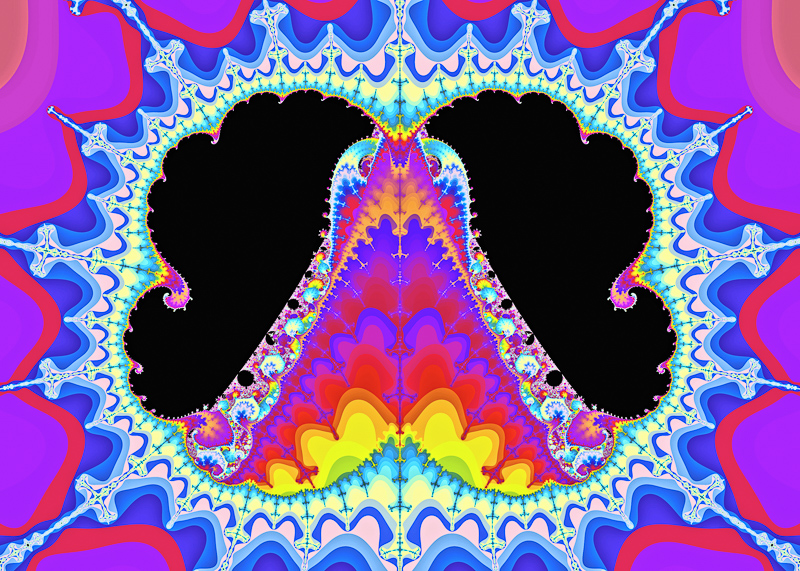
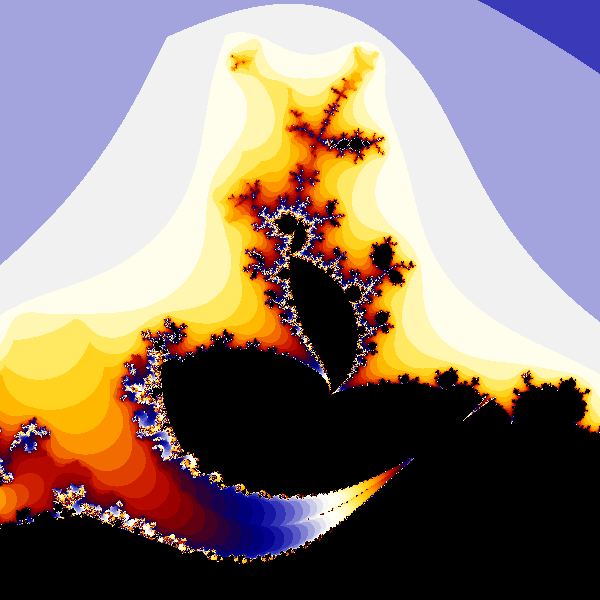
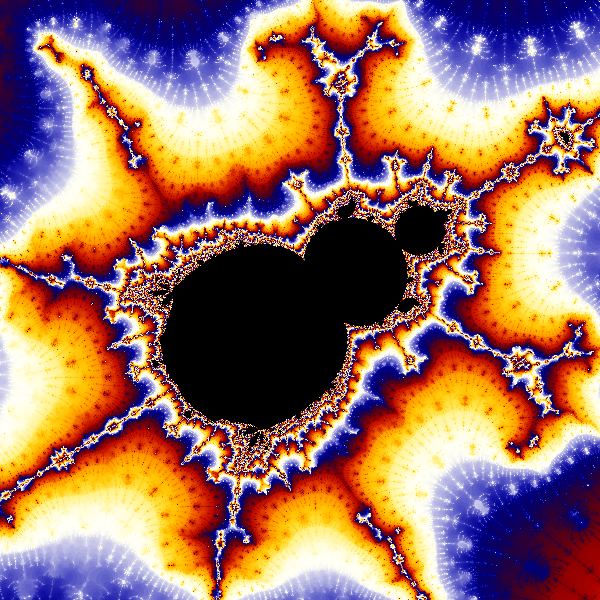
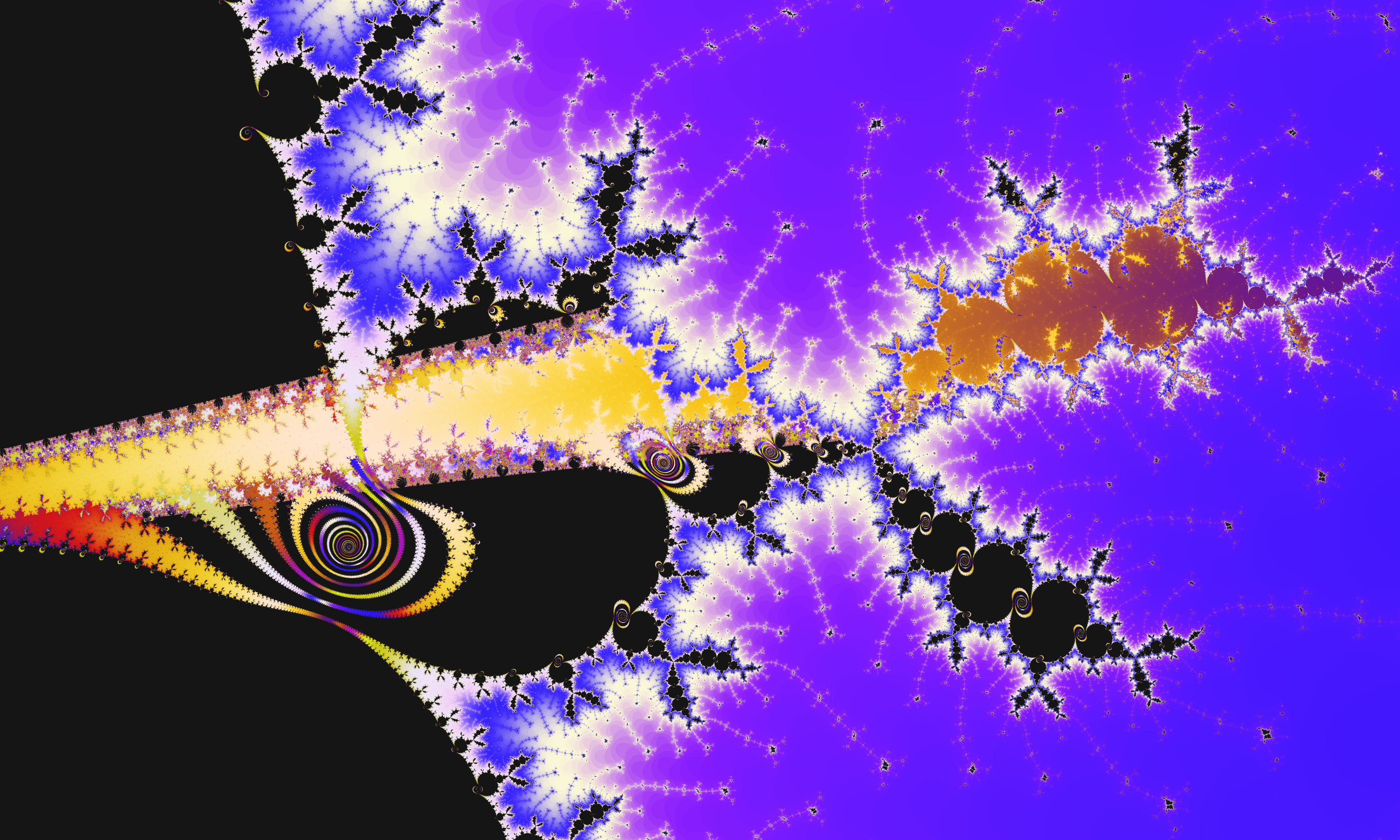
[Drawn with Ultra Fractal using latest online rvr.upr params RudyGuadalupe]

And the second odd thing is that the simulations will be imperfect. So get glitches that are kind of like supernatural phenomena. A patch of fractal fuzz, a ripple in the wall, a friend who explodes into angular scraps of computer-graphics “fnoor.”

It might be nice to science-fictionalize a situation where someone is living amid multiple layers of VMs—with crashes and glitches. Of course this theme has been treated before, it’s all been done before, but there’s always the hope of doing it with a little more intelligence and soul.

One path out of the VM stack is to meta-virtualize your ware. That is, you “port” it. You abandon the old shell of code, and excise the soul, the core algorithm, and install that in a new body. That’s what I ended up doing with Chaos last week. I ported my favorite fractal, the Rudy Set, from the moribund Chaos ware into the vigorous younger program Ultra Fractal.

Looked at in another sense when you build a house, you’re making a virtual world for yourself. A place where it’s warm and dry and the bugs and dogs can’t come in. A beaver dam is a virtual world, and so is an anthill.

When my old pal Peter Lamborn Wilson, a.k.a. Hakim Bey, writes about congenial gatherings as “Temporal Autonomous Zones,” he’s writing about virtualization—see his online TAZ article. Sometimes you manage to fall into a scene that’s out of this world. An alternate world to live in, an all-meat VR.

The use of the word “virtual” seems jarring in a physical context, as we think of virtuality as wedded to the notion of immaterial software. But in some sense, matter is a kind of software made up of quantum computations, so lets do go ahead and say that, for instance, a picnic blanket creates a virtual world emulation of a living-room rug.

I’m always trying to break away from the received idea that we need computers for interesting things. Post-chip computation was a big theme in my novels Postsingular and Hylozoic, not that this feature of the books was widely remarked upon. I see chips as a passing fad, like mankind’s earlier obsessions with clockwork, with radiation, or with electricity, or with chemistry/alchemy. Like I always say, a rock is a computer. He that hath ears let him hear.

These days, with no particular writing project in mind, more and more things are spontaneously taking on the look of SF stories. It’s how I see the world, particularly when I don’t have any particular goals in mind.

The other day, I was watching a DVD of a concert movie from 1964, The T.A.M.I. Show , with a very wide range of acts, including, near the end, James Brown followed by the Rolling Stones.

I like and respect the idea of James Brown, but his shows have never actually done much for me—not even when I saw him live at the Louisville State Fairgrounds in 1962, oh my brothers. It’s exciting to see someone acting so weird but, for my taste, Brown was too inner-directed. I always had a sense that he doesn’t actually see the audience. This said, I recognize that many people, such as Thom Metzger, think he’s great—see Metzger’s historically weird 1991 novel Shock Totem (today available for $1.57 on e-Bay) about a guy addicted to shock treatment and James Brown.

The young Mick Jagger and his band follow James Brown in the T.A.M.I. movie, and I’d thought I’d see a similarity in their dance styles. Surely the older man was a kind of role model for the younger. Certainly their shoes are similar. But the Mick of 1964’s dance moves are lackadaisical, quasi-ironic, more like sketches of things he might do. Meta-dance. He’s like the Ultra Fractal port of the Chaos version of the Cubic Mandelbrot set. At the time, many thought Mick inferior to James, but he was in fact doing something different. He was using a new operating system.

What impresses me the most in this performance Mick’s eyes—he’s so alert, watching the audience, the other band members, continually aware of his surroundings, although at certain points he too goes into the chanting trance of the singer.

In one cross-stage shot I could see the big-mama Electronovision cameras they were using to simulcast this concert to movie theaters—as well as to record it for posterity. And here, again, I had an SF feeling. The trope of the new transmission device. For 3D, or maybe for feelies, or telepathy, or matter transmission. But not exactly those old things…something more

I’d like to go to that 1964 T. A. M. I. concert. Suppose we assume that time-travel is impossible. So then, the only way to go to the show is to virtualize the Santa Monica Civic Auditorium of 1964, and worm into that VR. Assume that I want the musicians and the go-go dancers to look exactly like in the film. And maybe I’ll go ahead and have it be in silvery shades of black and white. How do I get there?


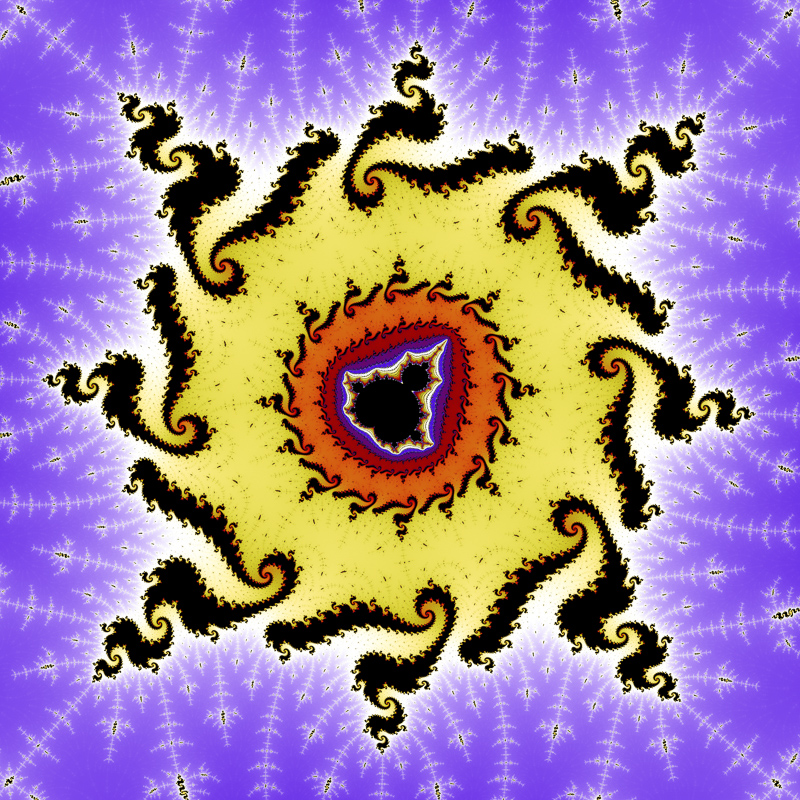
[Drawn with Ultra Fractal using latest online rvr.upr params RudyJellyfish]

The traditional way is to plug wires into my brain and jack me into a computer simulation. But—for reasons I’ve discussed before on this blog—I tend to think computer-based VR is never going to be all that convincing. The simulation should be in some sense physical, analog, perhaps based on quantum-computers, like the pocket-universe VRs that Christopher Shea talks about in “IntheBeginning.”

If you’re going physical, there’s no reason to dick around with corny wires in your brain. Make a damned tunnel to a bubble world. That’s the way to do it. I’m going there now. Maybe I’ll catch a buzz with Mick and Terri Garr—she’s the go-go dancer throwing her head around and then doing zombie-moves right behind Chuck Berry.


[Drawn with Ultra Fractal using latest online rvr.upr params RudyStarBranch]

Mick will have, of all people, the plain-jane songstress Leslie Gore on his arm. And we four will bop down to the beach and catch a ride on a chrome-gray UFO. We’ll ride the virtualization into the far future—all the way to 2010.

“Rudy Set” as Ultimate Cubic Mandelbrot Set. Quartics & Quintics, too!

Friday, April 2nd, 2010

*On May 27-28, 2010, I posted two more YouTube videos, one of a zoom into the quintic Rudy Set, and the other of a zoom into the quartic Rudy Set. I’ve embedded the second video into this post down where I discuss the Quartic Rudy set.

*On May 7, 2010, I began selling T-shirts with my fractals on the custom product site Zazzle at www.zazzle.com/rudyrucker. The first T-shirt on offer features a Cubic Mandelbrot’s WhoopDiDoo on the front and the Rudy set’s Sanskrit Mandelbud on the back.

*On May 5, 2010, I made a short name for this URL, tinyurl.com/rudyfractals.

* On May 4, 2010, I began selling art prints of these images at my Ultrafractals gallery at rudy.imagekind.com.

* On May 3, 2010, I added some more Cubic Rudy Set images, and I started claiming that the Rudy Set is the “true” or “ultimate” meta-version of the Cubic Mandelbrot set.

* On April 22, 2010, I began adding some movies of these fractals to my rudyrucker Youtube channel.

* On April 7, 2010, I expanded this post to discuss the Quartic and Quintic Rudy sets.

* On April 2, 2010, I started this post with a discussion of the general Cubic Mandelbrots and the Cubic Rudy set.


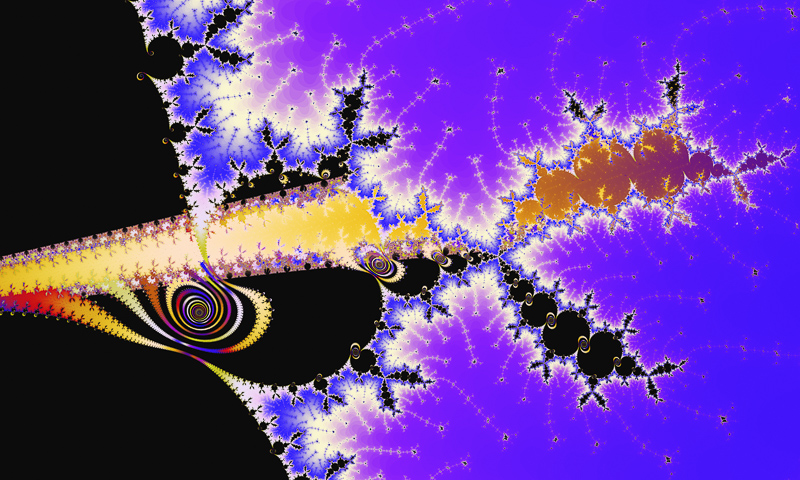
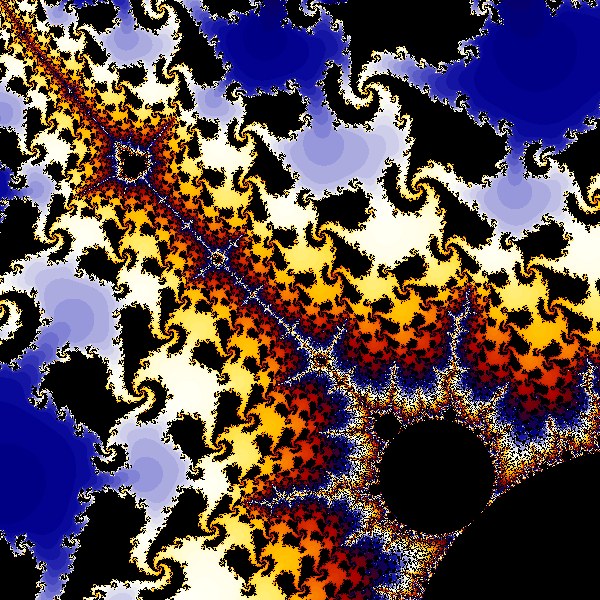
RudyRockets (detail of the Rudy Set). Lower down in this post is an animated YouTube zoom to the Rockets.

I gave an early version of this post as a talk at the Computer Systems Laboratory Colloquium Stanford University twenty years ago, on March 7, 1990, as “Computing Sections of the Cubic Connectedness Map.” The hardware designer John Wharton invited me. Some of this information also appeared in the manual for the James Gleick’s CHAOS program.

As I was discussing near the end of my previous post, CHAOS is unusable on the newer versions of Windows. So this week, I’ve been porting my favorite algorithms to the Ultra Fractal platform, and this post briefly describes the formulas and how to view them.

To run these fractals on Ultra Fractal, download a copy of Ultra Fractal 5 — you can get a free, (almost) fully featured, evaluation copy that’s good for a month. To see my Ultra Fractal implementations for the fractals I’m discussing today, you can just download all of the Ultra Fractal public formulas by clicking Update Public Formulas on the Options menu of the Ultra Fractal program.

My two public files are text files rvr.ufm and rvr.upr, which you can read online. The rvr.ufm file is a “formula” file that has the algorithms for the Cubic Julia, Cubic Mandelbrot, and Rudy sets written out as a text file in something like source code, along with a lot of comments explaining the process. The rvr.upr file gives the particular parameter settings used for certain especially attractive images. Note that lately I’ve been updating these two files every week or so—particularly the parameter file—so make sure you have the latest versions.

As I say, the rvr.upr file holds several sets of parameters for fractals—including, as I say, all the fractals whose images I’m showing today. When you download the Ultra Fractal public formulas, you can find my two files in the “Public Formulas” subdirectory of the Ultra Fractal directory. Open the Parameter File rvr.upr, and then click on the thumbnails or the names of the included fractals to see them run interactively. You can zoom in on them, pan, change the resolution, and more.


Detail of the MandelCubicWhoopDiDoo Cubic Mandelbrot Set.

Iterated Functions and the Old Quadratic Julia and Mandelbrot Sets

A map in the plane is some system for finding an image P’ of each point P. If f is a map in the plane, and f maps z into z’, I can express this either by writing z’ = f(z) or by writing z –f– > z’. Given an f and a z, we can define a sequence zn by:

z0 = z, z1 = f(z), z2 = f(z1, and in general, zn+1 = f(zn).
In terms of f,
z –f– > z1 –f– > z2 –f– > z3 –f– > z4 –f– > …

For some starting values of z, the zn sequence hops around within some bounded region of the plane, and we say z is bounded under f. And for other start values of z, the zn sequence heads off across the plane towards infinity.

The Julia set for a map f is defined as the set of all z in the plane which are bounded under f. Symbolically, the Julia set for f is { z : z –f– > FINITE )}.
The quadratic map fc given by fc(z) = z^2 + c has been widely studied. The Julia set for the fc map is called Jc. They became popular in the 1980s, along with a kind of “directory set” called the Mandelbrot set, which can be defined equivalently as M = { c : Jc is connected}, or , M = { c : the origin is in Jc }.

The Cubic Julia Sets

Okay, now for the good stuff!!! The maps which the Cubic Julias and Cubic Mandelbrots are based on have the form fkc, with fkc(z) = z^3 – 3*k*z + c

For each fkc we can define a cubic Julia set Jkc by: Jkc = { z: z–fkc– >FINITE }.

Why do I write fkc(z) in the particular form that I do? As discussed in Bodil Branner and John Hubbard, The Iteration of Cubic Polynomials, Part I: The Global Topology of Parameter Space, if you write polynomials in certain special ways, it’s easier to locate the so-called critical points of the polyonomials. More on this point later on. For now, the point is simply that, by moving the origin of our coordinate system and a judicious choice of k and c, we can in fact write any cubic polyonomial in the indicated form.

To graphically represent the Jkc sets, each pixel position on the screen is identified with a distinct complex number c, and we look at c’s behavior under the map, which generates successive zn values. If zn is more than, say, 4 units way from the origin, we assume the sequence is headed for infinity, and give the pixel a color based on the value of n. And if zn stays within the boundary distance for as many steps as we check, then we assume that the pixel represents a point inside the set, and we typically color these points black.

Unlike in the quadratic case, these cubic Julia sets Jkc are generally not symmetric. Some of them are connected, like these two.


JuliaCubicAsteroids


JuliaCubicTwirly

Some are connected but not totally disconnected (made of numerous separate connected
patches) like this one:


JuliaCubicChunks

And some—who we won’t bother showing— are totally disconnected, like clouds of dust.

It has been proved that Jkc is in fact connected if and only if both the complex numbers k = a +ib and -k = -a -ib are in Jkc. These are the critical points of the fkc map that I was talking about above. We’ve written the cubic in the special form z^3 – 3*k*z + c precisely so that the critical points have a simple definition: k and -k.

As Jkc is not symmetric, it may happen that only one of k or -k is in Jkc. Jkc is connected only when both of these critical points are in Jkc.

Cubic Mandelbrot Sets

The four-dimensional set of all complex pairs k and c such that Jkc is connected is known as the Cubic Connectedness map, or the CCM. Why do I say four dimensional? Well, k has two numbers inside it in the form a+bi, and c also holds two numbers. Ranging over four parameters gives you a 4D space.

The CCM set has been studied by Adrian Douady, John Hubbard and John Milnor — as well as the paper mentioned above, see Adrian Douady and John Hubbard, “On the Dynamics of Polynomial-like Mappings,” and Bodil Branner and John Hubbard, “The Iteration of Cubic Polynomials Part II: Patterns and Parapatterns.” (Love the title.)

I never have understood why the Cubic Connectedness Map isn’t much better known! For some odd reason, my fellow fractal fanatics have consistently snubbed or misunderstood this incredibly rich vein of gnarl.

CCM = { (k,c) : Jkc is connected}
or, putting it differently,
CCM = { (k,c) : ( k –fkc– > FINITE ) AND ( -k –fkc– > FINITE ) }

The way our program depicts the CCM is to show various two-dimensional cross-sections of it. These cross-sections are what we call Cubic Mandelbrot sets. If, for instance, k is fixed, then we can look at the Cubic Mandelbrot set Mk.

Mk = { c : Jkc is connected}, or
Mk = { c : ( k–fkc– >FINITE ) AND ( -k–fkc– >FINITE ) }.

It turns out that that Mk is symmetric around the origin, that is, if c is in Mk, so is -c. If k = 0+0i, one gets a degenerate Mk with fourfold symmetry; this is the default Cubic Mandelbrot set that I have as the MandelCubicBasic parameter. This rather boring fractal is, sadly, the only well-known cubic Mandelbrot. Most fractal explorers neglect all the other—much more interesting—Mk.


The boring MandelCubicBasic

Note that a small change in the K parameter makes it more interesting.


The interesting MandelCubicStack

And things get better.


Detail of MandelCubicInvasionOfTheHrull

One often sees small replicas of the pieces of the quadratic Mandelbrot set inside the Mk, though sometimes with wedges cut out of them.


Detail of MandelCubicPacMan

By slightly varying the two components of the k parameter, one can look at k-sections near each other, and try to visualize stacking them one atop the other. Looking at successive sections, I have formed the impression that the Mk re like cross-sections of a three-dimensional Mandelbrot shape, buds all over it—the semi-mythical beast called the Mandelbulb.

As I mentioned above, the full CCM is in fact four-dimensional, and this shows up in the fact that many of the bud cross-sections have pieces missing from them. As an aid to mathematical visualization, I think of it this way. The CCM is like a three dimensional solid which is free to move pieces of itself to arbitrary time locations. Thus if a section of a bud seems to have the right half missing, we might think of the left half of the bud as being in Monday and the right half of the bud as being in Tuesday, with your cross-section being computed at the Monday time coordinate. I use time not at all in a physical sense here, but simply for the vividness of the image.

Some of the Mk details are fairly amazing.


Detail of MandelCubicZipper

As well as the cubic Mk CCM cross-sections, we can also compute

Mc = { k : Jkc is connected}, or
Mc = {k : ( k–fkc– >FINITE ) AND ( -k–fkc– >FINITE ) }.

The Mc are, to my eye, not as interesting as the Mk. But you can look at them and decide for yourself. Here’s one that has a certain gruff charm.


Detail of MandelCubic(Cplane)Ogre

I would very much like to view 3D sets which are stacks of Mk sets (or stacks of Mc sets) that arise as one varies, for instance, the real part of k from -1 to 1. I have a lingering hope that these objects may look bulbous rather than taffy-like, despite the lack of success of some preliminary investigations. See my blog post on the Mandelbulb for more on this topic.

The Cubic Rudy Set is the TRUE Cubic Mandelbrot Set

An apparently new fractal which I have enjoyed investigating is this.

R = {c : Jcc is connected}
= {c : c is in Mc}
= {c : ( c-fcc– > FINITE ) AND ( -c –fcc– > FINITE) }.

I immodestly call this the Rudy set, although it may be that pros like Branner, Douady, or Hubbard have their own name for it. As I say, I first starting working with this set some twenty years ago, but computers were pretty slow back then. In the last few days, using Ultra Fractal, I’ve seen much more detail of the Rudy set than ever before. Images that used to take hours to render can pop up in seconds.

Note that the Cubic Rudy Set has an absolute or non-relative quality, in that it avoids the choice between the Mk and Mc Mandelbrot Cubics, each of which are a certain kind of orientation-dependent cross-sections of the Cubic Connectedness Map. By going down the Jkk in the definition of the Rudy Set, we reach down to something that’s not relative to any specific orientation. Note also that we could equivalently define the Rudy Set as {c : c is in Mc}. For this is just {c : Jcc is connected}, which is the same as {k : Jkk is connected}.


The Rudy Set

Compare the definition of R as {k : Jkk is connected}to the definition of the Mandelbrot set M as { c : Jc is connected}. This makes me think that R is a good generalization of M, in some ways better than the Mk or Mc.

Actually I would go so far as to argue that the so-called Rudy set is the TRUE cubic Mandelbrot.

Standard Quadratic Mandel: {c : Jc is connected}
So-called Rudy Set (which is really the TRUE Cubic Mandelbrot): {c: Jcc is connected}

Slam dunk!

R is an object which is extremely rich in unusual fractal structures. One good region is the plume between 2 and 3 o’clock relative to the whole set. I call this area “Mars”.


RudyMars

An image like a rocking horse is found in the Mars region of the Rudy set. This horse is one of my favorite spots.


RudyHorse

Another good region is the spike at the top, at 12 o’clock. There is an interesting structure there that is a bit like a Mandelbrot set, but considerably gnarlier. I call it FatBud. This is a great region for gnarl.


RudyFatBud

The Julia sets from inside the Fat Bud zone are lovely and spidery—branching patterns of connected lines.


JuliaCubicFromRudyFatBud

And here’s a YouTube movie of a zoom in and out of the Rudy set, with the turnaround point at the “RudyRockets” image at the start of this post. Note again that you can find all of these locations by using my online UltraFractal parameter set rvr.upr.


“Rockets” zoom into the Rudy Set.

I keep finding more and more great stuff in the Rudy set. All these parameters are in the online text file rvr.upr, which I’m updating every week or so.

RudyHedgehog. And click here for a humongo 3 Meg RudyHedgehog you can get lost in.

Lots of little Mandelbrot sets turn up inside the Rudy set.


RudySanskritBud

I recently found a really powerful region in the first miniMandelbrot bud above the top of the Redy set. There’s an exawatt particle beam blasting out to make the RudyParticleBeam.

And near the ParticleBeam are some globs of paired twirly things I call the RudyIsopod.

And down inside the very center of that gap at the core of the RudyIsopod is a mini-Mandelbrot set, RudyMandelInTwirls

This looks better all the time…

The Quartic Rudy Set

I was puzzled about how to find the critical points for fourth degree and fifth degree polynomials. Googling for the answer, I found a series of articles by the Swedish fractalist, Ingvar Kullberg, who is one of the only people who’s gotten into making images involving the Cubic Connectedness Map. And his article “28) To derive the optimal iteration formulas for polynomials of degree d,” has the reference to pp. 151-152 of the crucial article by Bodil Branner and John Hubbard that I mentioned earlier, The Iteration of Cubic Polynomials, Part I: The Global Topology of Parameter Space.

Without going into too much mathematical detail here, suffice it to say that we can write the general quartic polynomial as
fmkc(z) = z^4 + 2(mk -(m+k)^2)*z^2 + 4mk(m+k)*z + c
The z which don’t run off to infinity under iterations of this map form the quartic Julia set Jmkc.
Jmkc = { z: z–fmkc– >FINITE }.


A JuliaQuartic, pretty natty.

And Jmkc is connected if and only if the following three critical points are in Jmkc: m, k and -m-k. And the Quartic Connectedness Map would be the six-dimensional set of all complex triples (m,k,c) such that Jmkc is connected. The Mandelbrot cross-sections of the Quartic Connectedness Map verge upon resembling crushed pieces of trash in the street, I won’t bother showing one. Instead here’s the Rudy Quartic, which has a trefoil shape.


The RudyQuartic.

We can define the Quartic Rudy set R4 as follows.
R4 = {c: Jccc is connected}.
The three critical points will be c, -c, and 0, so,
R4 = {c: c –fccc– > FINITE ) AND ( -c –fccc– > FINITE) AND ( 0 –fmmm– > FINITE) }.


The three corners of the Rudy Quartic have things like Mandelbrots, with a very turbulent V-shaped spike.

And check out the floating sky palace in the Rudy Quartic in this area.


RudyQuarticSkyPalace

Here’s an animation zooming down into the RudyQuarticSkyPalace, past the RudyQuarticHeffalump and down to a mini Mandelbrot bud. I made the animation on May 28, 2010.

The Quintic Rudy Set

Finally we come to the Quintic Rudy set. First we define a fifth-degree polynomial map fnmkc with four parameters. For the gory details of the map, see the comments in the GeneralQuinticJulia algorithm in the pseudocode file rvr.ufm—which, as I mentioned above, opens as a text file if you click on it.


JuliaQuinticRunningMan is pretty nice.

And then we define the quintic Julia set Jnmkc, as Jnmkc = { z: z–fnmkc– >FINITE }. And, as before we find some critical points, four of them for each Jnmkc, and we can use the critical points to test if Jnmkc is connected.


The connected but asymmetric JuilaQuinticDangle.

We can also find a Quintic Mandelbrot set Mnkm = {c: Jnkmc is connected}. Poking around in one of them, I found a nice quadratic Mandelbrot shape surrounding by leopard spots of quintic gnarl.


The MandelQuinticLeopard.

Below is a video taken around the edges of a quintic Mandelbrot set. The video is 300 frames, and it took my brand-new maximum speed computer thirteen hours to compute! It ends with a zoom down to the MandelQuinticLeopard spot.


[Use Ultra Fractal and the rvr.ufm parameters to locate the MandelQuinticLeopard.]

And now, finally, we define the Quintic Rudy set R5.
R5 = {c: Jcccc is connected}.
In these somewhat degenerate Jcccc cases, the four critical points collapse to two points, c and -3c, so we can say R5 = {c: c –fccc– > FINITE ) AND ( -3c –fccc– > FINITE }.


The RudyQuintic is fairly unprepossessing.

But if you zoom in, you can find some kind of pretty stuff.


RudyQuinticEightfoldMandel

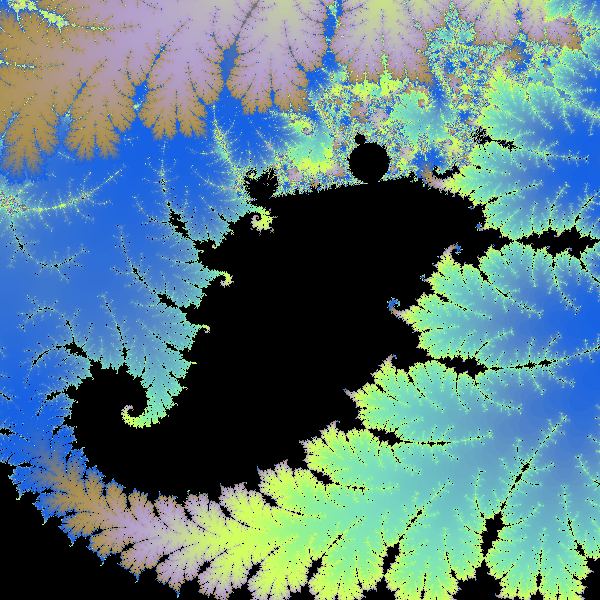
But I have to say that the basic cubic Rudy set seems more interesting. It’s like those high powers wash things out. I was actually frightened when I zoomed into the cubic Rudy set and found the region shown below. It was like I was too far underwater, or too far out in space.


Venture to the RudyExtraterrestrial if you dare.

In closing, note that you can in fact check the correctness of my old cubic Rudy Set, Quartic Rudy, and Quintic Rudy algorithms by using the Fractal Mode Switch feature. In Ultra Fractal, press F7 and move the cursor around over one of the three Rudy sets, and note that the corresponding Julia sets shown in the Fractal Mode window are connected if and only if the cursor is over a dark, interior region of the Rudy sets. While developing the algorithms, I in fact relied on this feature to make sure I wasn’t putting in bugs.

I’ll probably keep adding to this post as time goes by.

Remember , you can find it by using the simple URL tinyurl.com/rudyfractals.


Rudy's Blog is powered by WordPress