
Oct 13, 2005. Review session summarizing Chapters 1 – 3 of The Lifebox, the Seashell, and the Soul. A good introduction to the material. Visuals of the questions I wrote on the blackboards are online.

Subscribe to Rudy Rucker Podcasts.
 |
 |
 |
 |
 |
 |
 |
 |
 |
Click covers for info. Copyright (C) Rudy Rucker 2021.
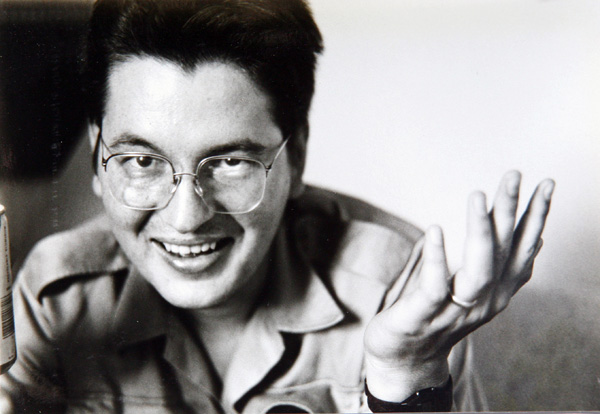
I first met Bruce Sterling in the early 80s, John Shirley and I went and stayed at his house for a Cyberpunk panel in Austin, Texas. In 1983, Bruce and William Gibson came to visit us in Lynchburg, Va, where I was being a free-lance writer, which is when I took this first picture.
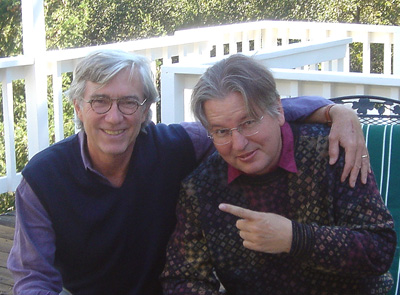
Yesterday Bruce showed up again, on his way to a consulting gig in San Francisco. It’s always so nice to be with a fellow SF writer, especially one who’s so much on your wavelength.

Bruce and I have written three stories together, “Storming the Cosmos,” “Big Jelly,” and “Junk DNA.” Yesterday we started talking about a fourth, with working title “Hormiga Canyon.” It was great sitting around spinning ideas.
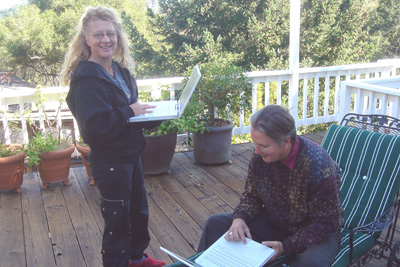
Bruce was traveling with his writer friend Jasmina Tesanovic. They were into using wireless that leaks down the hill from my neighbors. Bruce has a daily blog on Wired. They actually pay him to blog! What a deal. Well, Bruce is always fun to read, or to listen to. He has an engaging way of sounding both enthused and sarcastic.
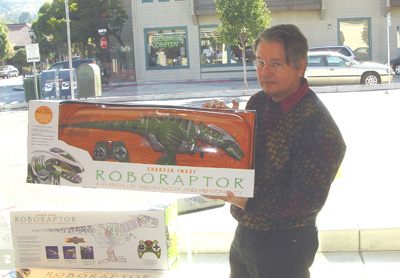
We walked down to Sharper Image on Santa Cruz Ave. in Los Gatos and looked at some of the robots for sale. Bruce is into design these days, he's been a guest professor at Art Center in Pasadena, and has a book on Ubiquitous Computatoin coming out from MIT Press. This morning when I woke up he was gone, off to get some righteous bucks from the Global Business Network in SF. You gotta get up pretty dang early in the morning to keep up with my man Bruce!
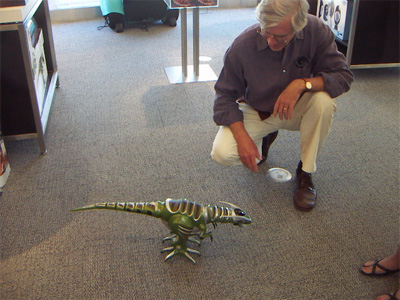
By the way, Bruce blogged our meeting as well; and this is a picture he took.
Oct 11, 2005. Rudy reads at radio KFJC. A story on multiple universes, introducing Chapter Two of Rudy Rucker, The Lifebox, the Seashell, and the Soul, see www.rudyrucker.com/lifebox. Intro included. (1.17MB. min.)
Hey, I'll be reading a story on KFJC bright and early Tuesday morning again.

Yesterday I mentioned using a koan in an SF story as a way of jumping between the material and aethereal layers of reality. Shuzan's koan of the shippe (short bamboo staff) seems like a good one to use. I looked for it online and first found this form.
(Form 1) Shuzan held out his short staff and said, “If you call this a short staff, you oppose its reality. If you do not call it a short staff, you ignore the fact. Now what do you wish to call this?” [Text found in an online koan collection.]

Note that in traditional Zen teaching, the penalty for a poor answer was a hard whack on the head with a short bamboo staff like Shuzan held.
The commentary on this koan says, “It cannot be expressed with words and it cannot be expressed without words. Now say quickly what it is.”
All the other online refs quote the same text — a weakness of online info. So I went the dead-tree route. D. T. Suzuki describes some variations on this koan in Essays in Zen Buddhism (1961 Grove Press, NY) which sits on my bookcase.
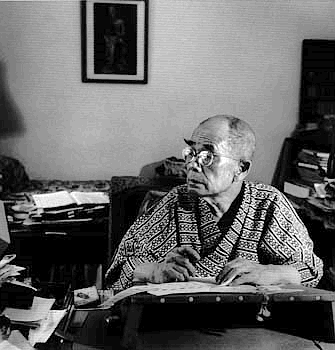
[The Suzuki picture is from a cool Neobuddhism site.]
(Form 2) The masters generally go about with a kind of short [bamboo] stick known as a shippe, or at least they did so in old China. It does not matter whether it is a shippe or not; anything, in fact will answer our purpose. Shuzan, a noted Zen master of the tenth century, held out his stick and said to a group of his disciples: “Call it not a shippe; if you do, you assert. Nor do you deny its being a shippe; if you do, you negate. Apart from affirmation and negation, speak, speak!” Suzuki, p, 275.
(Form 3) Ummon expressed the same idea with his staff, which he held up, saying: “What is this? If you say it is a staff, you go right to hell; but it is not a staff, what is it?” Suzuki, p. 276.
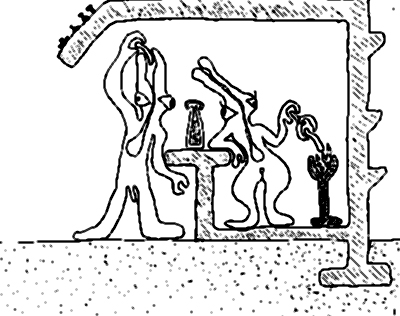
(Form 4) Ummon once lifted his staff before a congregation and remarked: “In the scriptures we read that the ignorant take this for a real thing, the Hinayanists resolve it into a nonentity, the Pratyekabuddhas regard it as a hallucination, while the Bodhisattvas admit its apparent reality, which is, however, essentially empty. But, monks, you simply call it a staff when you see one. Walk or sit as you will, but do not stand irresolute.” Suzuki, p. 34.