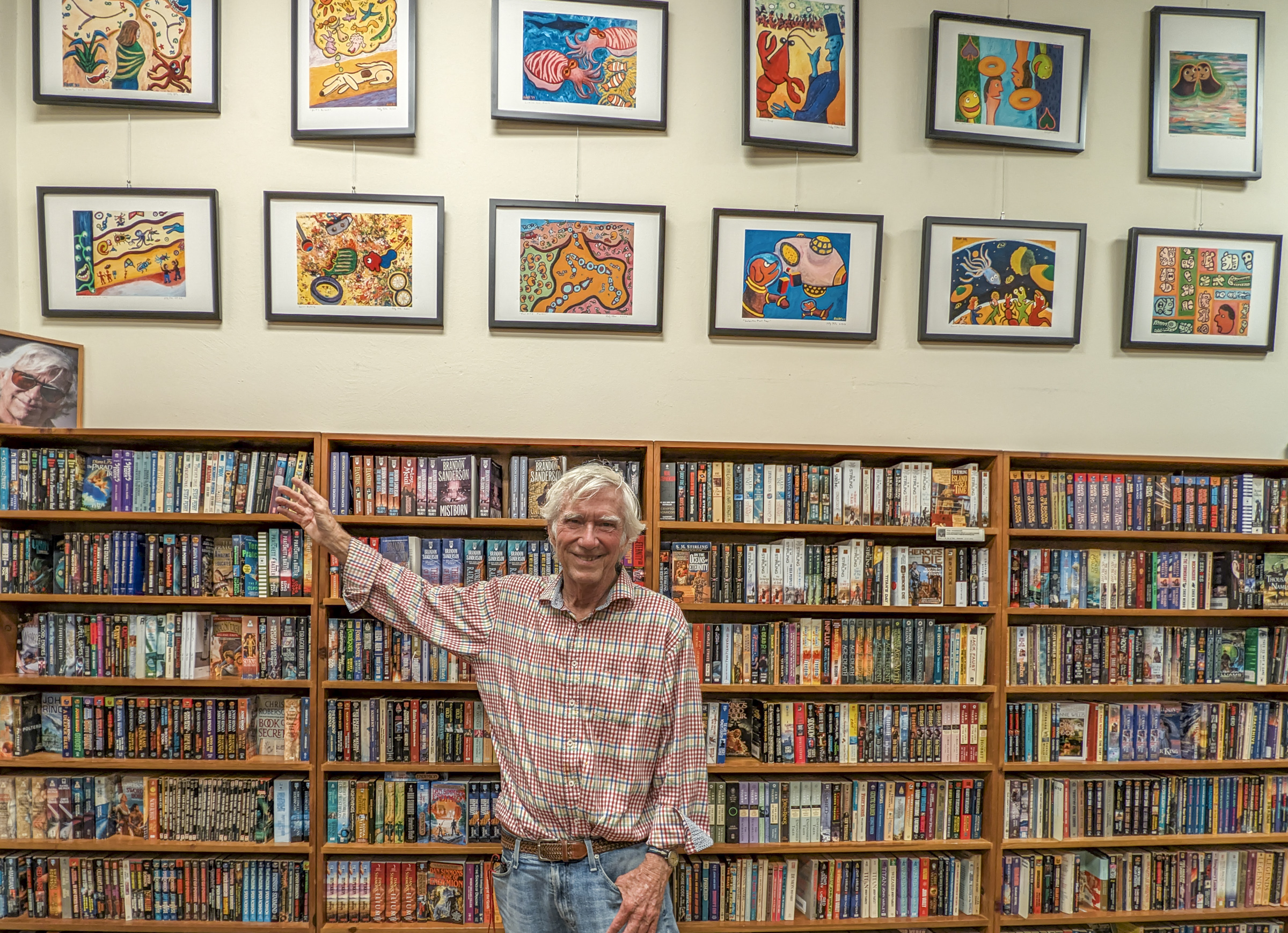


Click covers for info. Copyright (C) Rudy Rucker 2021.


“Bottle Imps” Rudy Rucker & Bruce Sterling

November 3rd, 2026

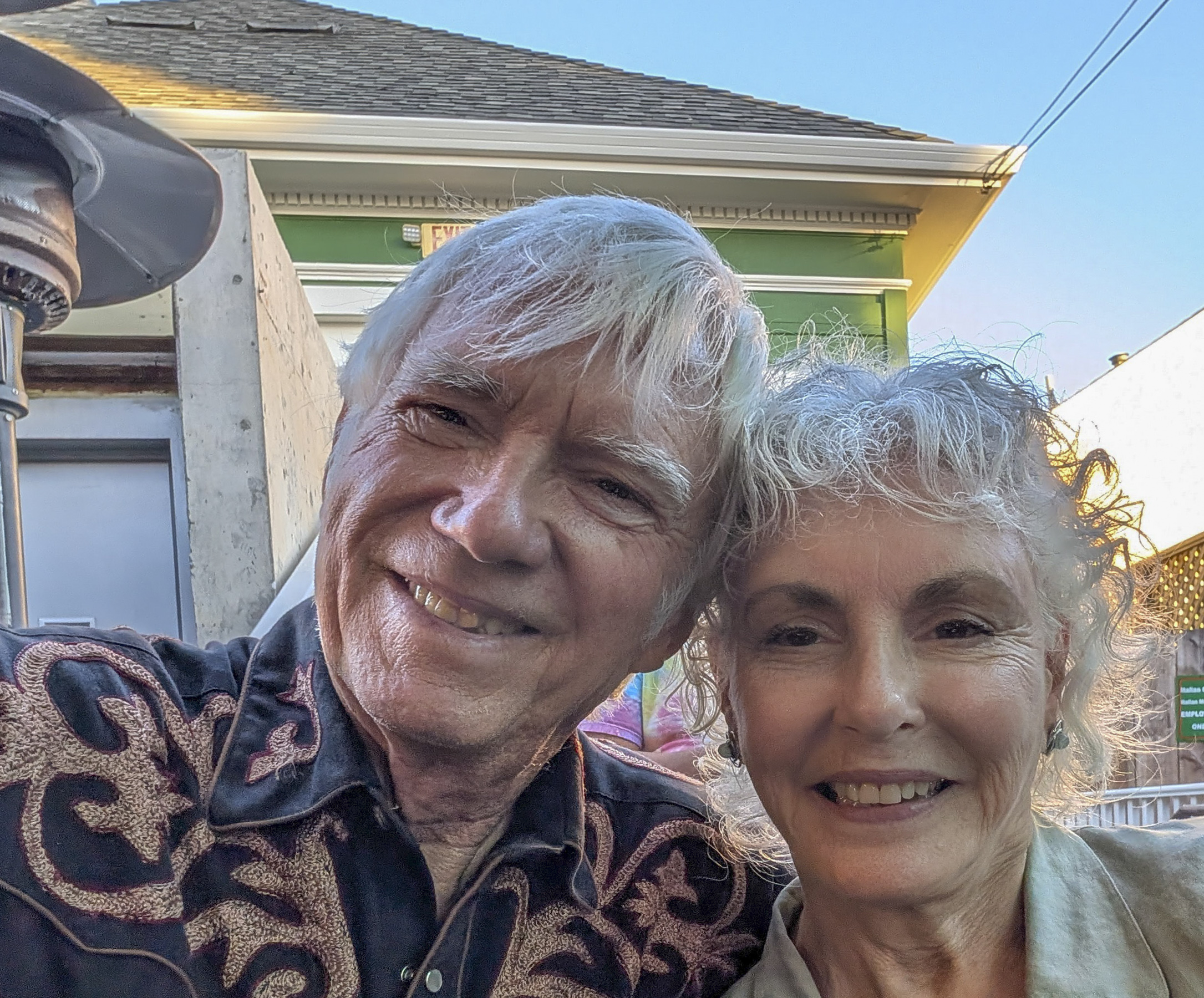
This is new story by me and Bruce Sterling. It appeared on Boing Boing, on Halloween, 2026. And I added it to a new 2nd edition of our anthology, Transreal Cyberpunk, which went live the same day. And now I’m posting the story on my blog, mixing in some photos and paintings that I have kicking around among, including a couple of Bruce and me. And to top it off, I also put the story on Meidum. And it actually looks better on Medium, as they have better control of the sizing-adjustments than I do.

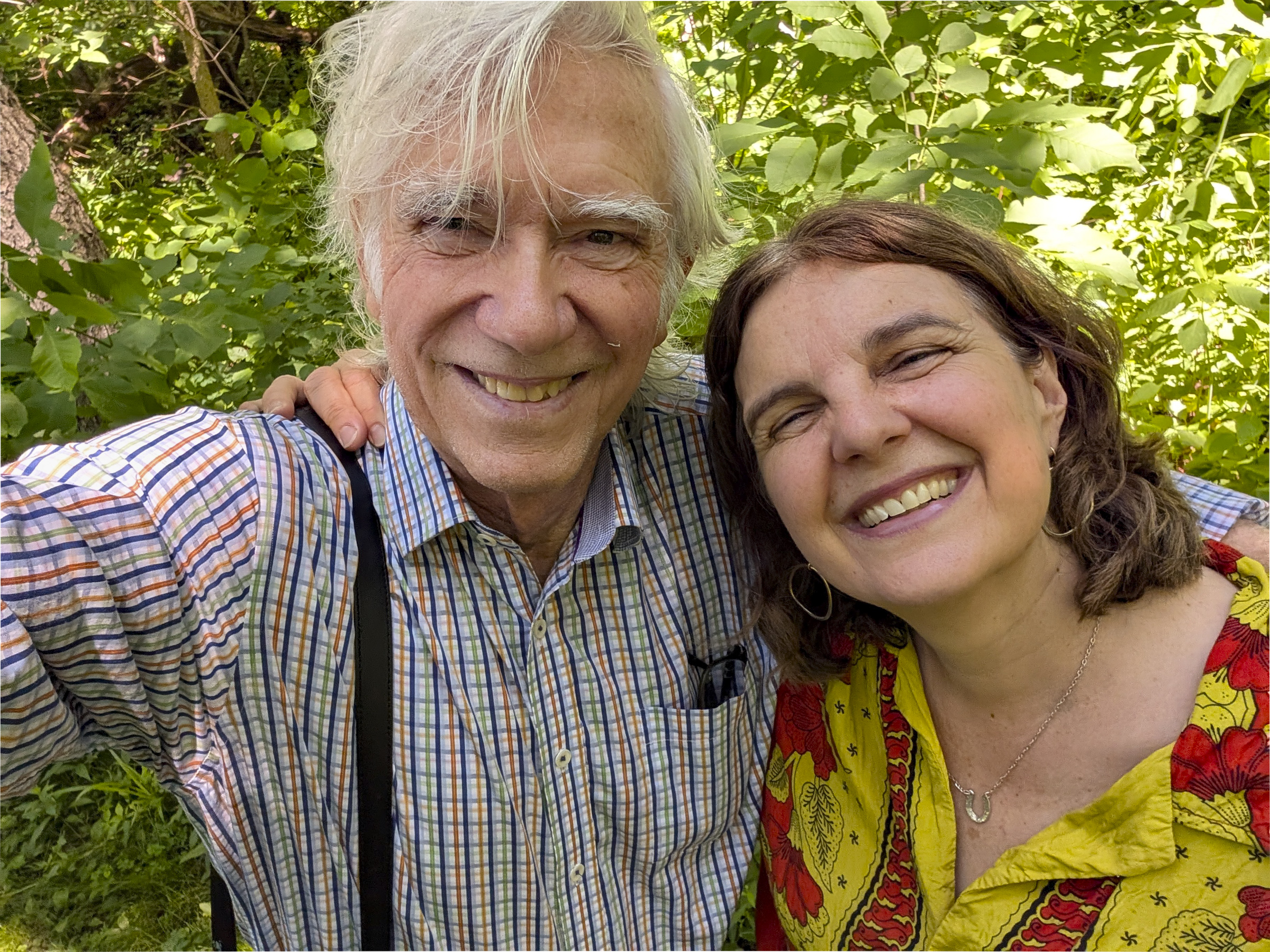
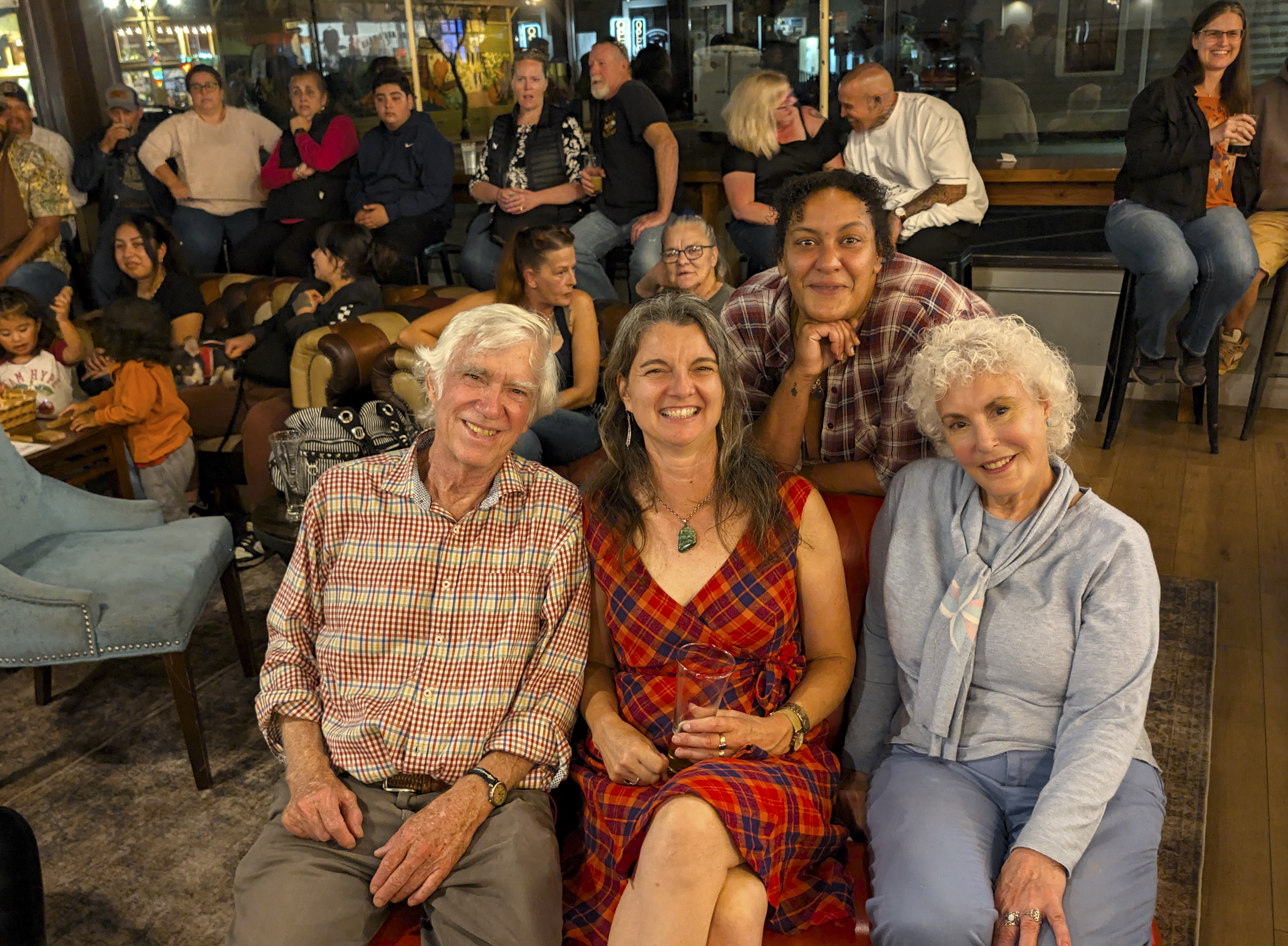
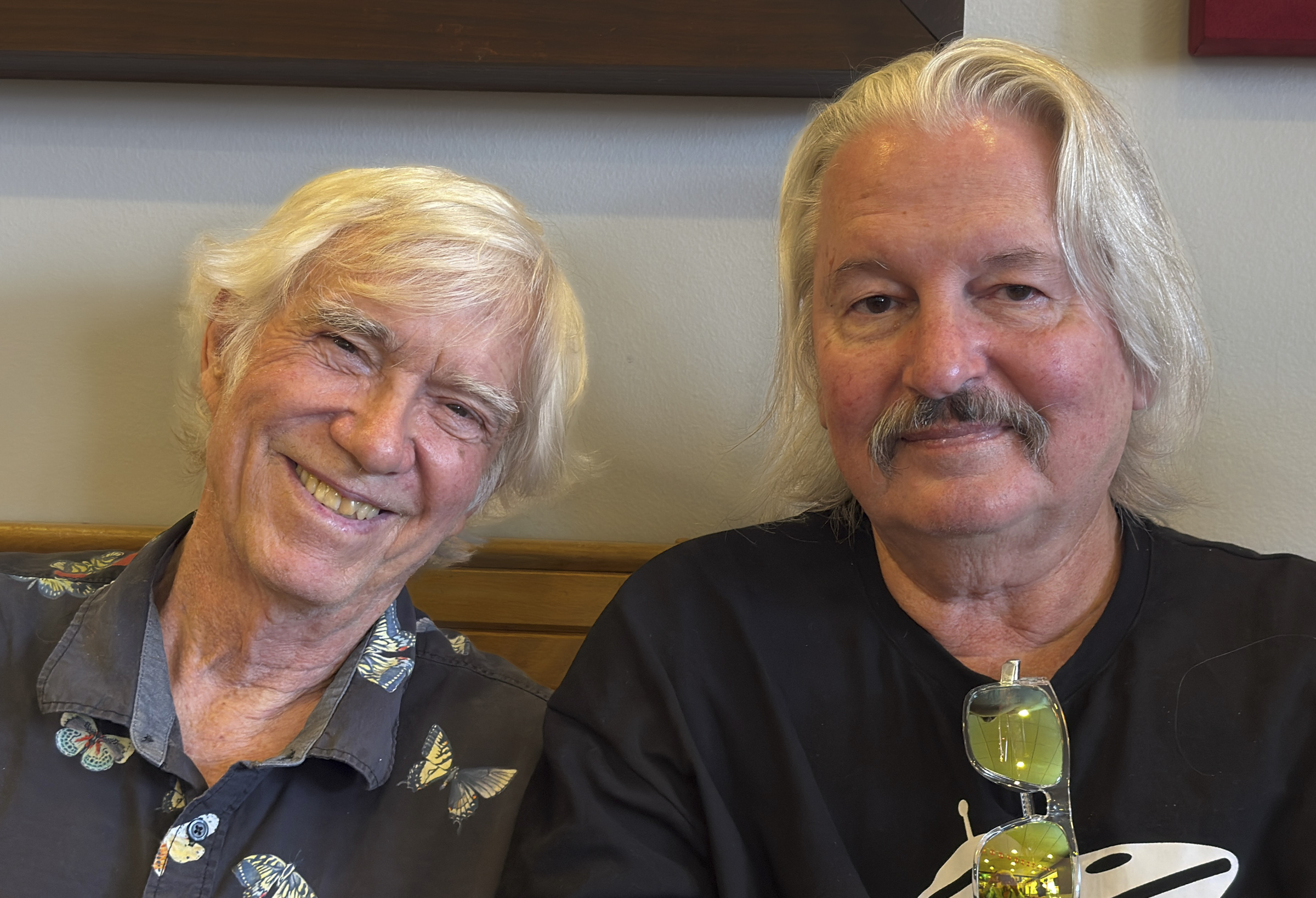
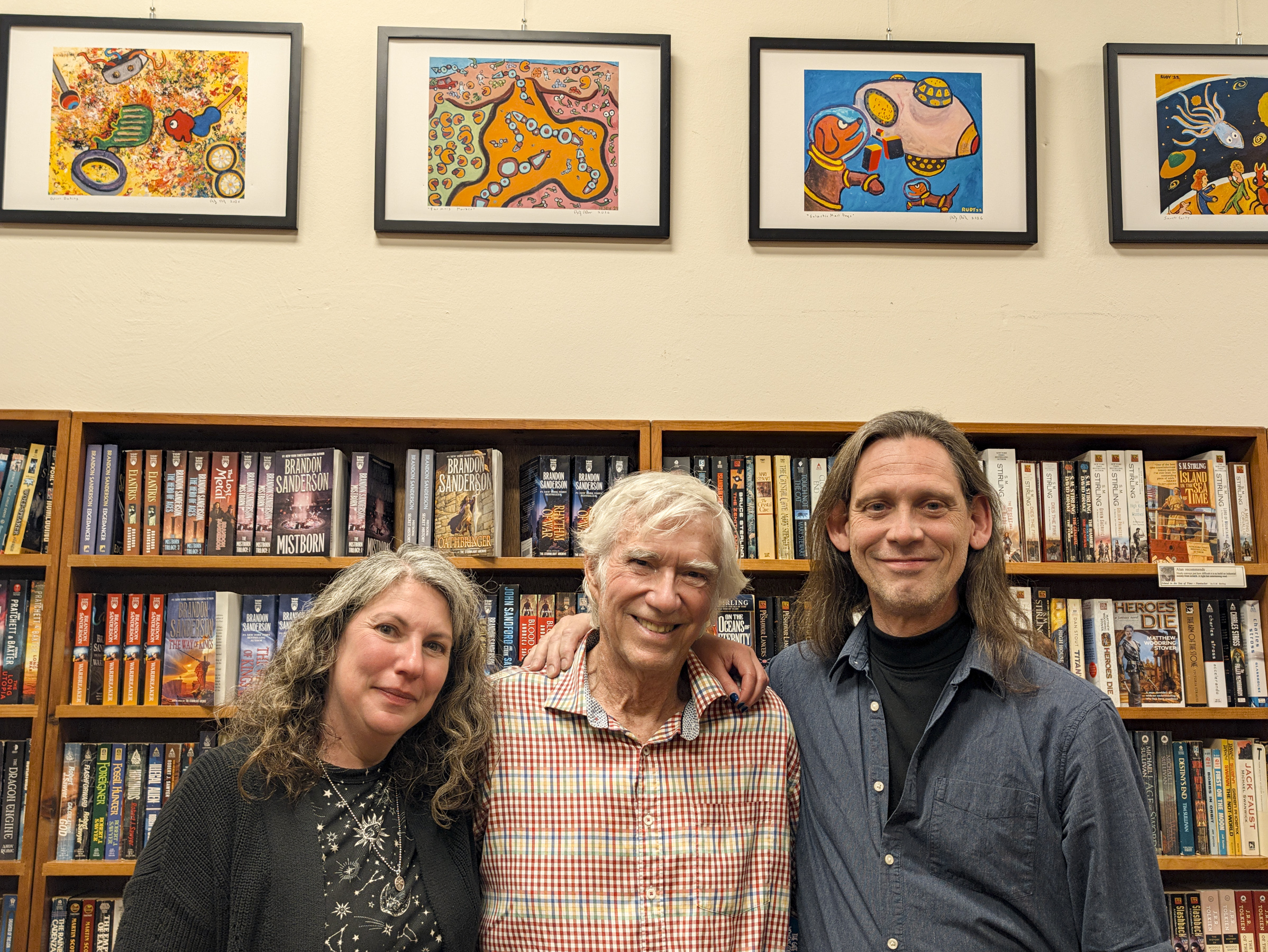
Bruce and I were guests at Armadillocon in Austin, Texas, in October, 2026. (See my two posts on the event.) Very nice scene, and invigorating to see Bruce. He sat next to me on a “What Is Cyberpunk” panel at the start of the con. “I always knew it would come to this,” he murmured to me. Kind of resigned, but facing it. I was eighty now. Like a Twilight Zone episode.

We agreed to write another story together. Our eleventh! I knew that Bruce had been on a Robert Louis Stevenson kick lately. So I’d been thinking about a possible a Dr. Jekyll and Mr. Hype routine.But who would be Mr. Hyde?

Bruce thought we should tackle a simpler trope, a magic wishes story, taking off from Stevenson’s classic “The Bottle Imp.” And I liked that.  I was ready to go. I hadn’t written any fiction for a year. And I knew Bruce and I would end up with something unique.

Sending a draft to Bruce is like laying your sword on an anvil. The blacksmith heats the blade to a screaming-hot glow—and whales on it with a sledgehammer. Thereby annealing the steel into something more potent than before.  I think the story turned out well.

Enjoy.

——————————————–

“Meeting the Bottle Imp”. AI Animaiton by Bruce Sterling, Click the link to see it run.
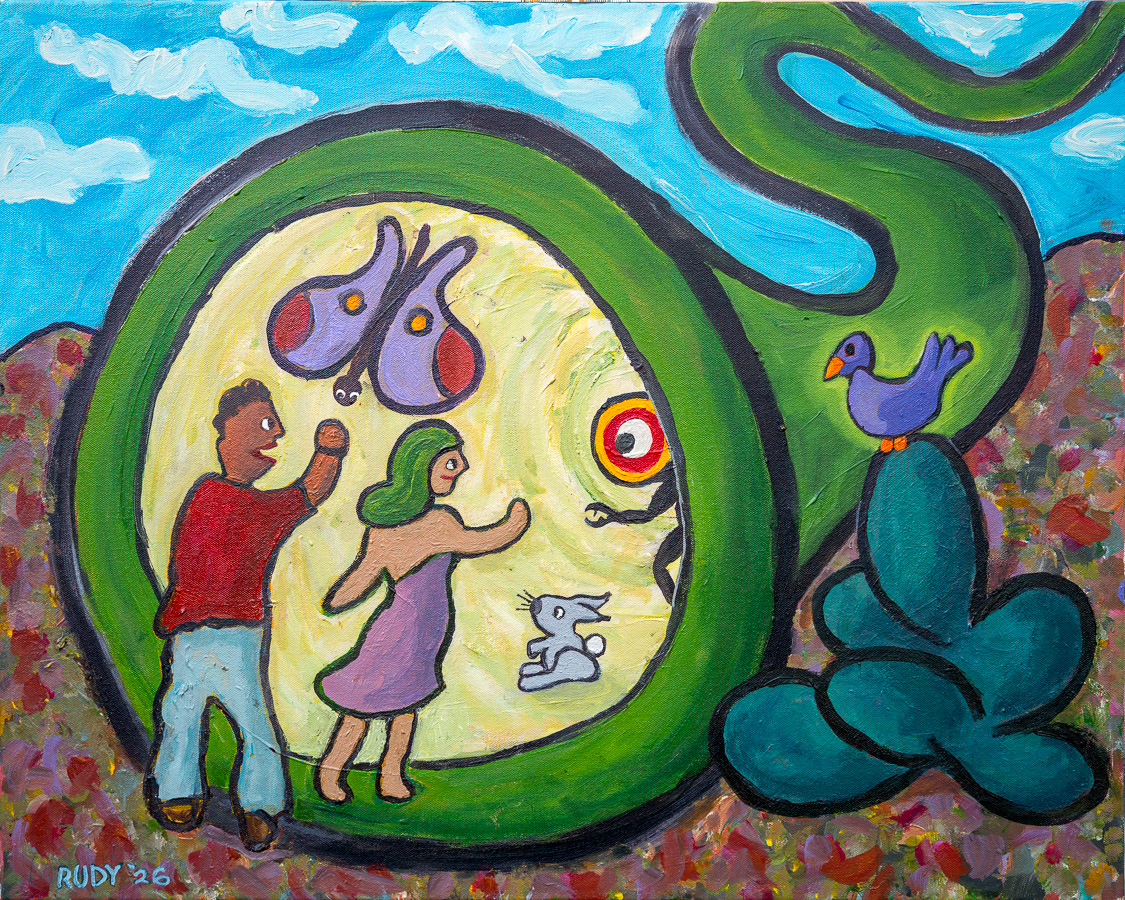

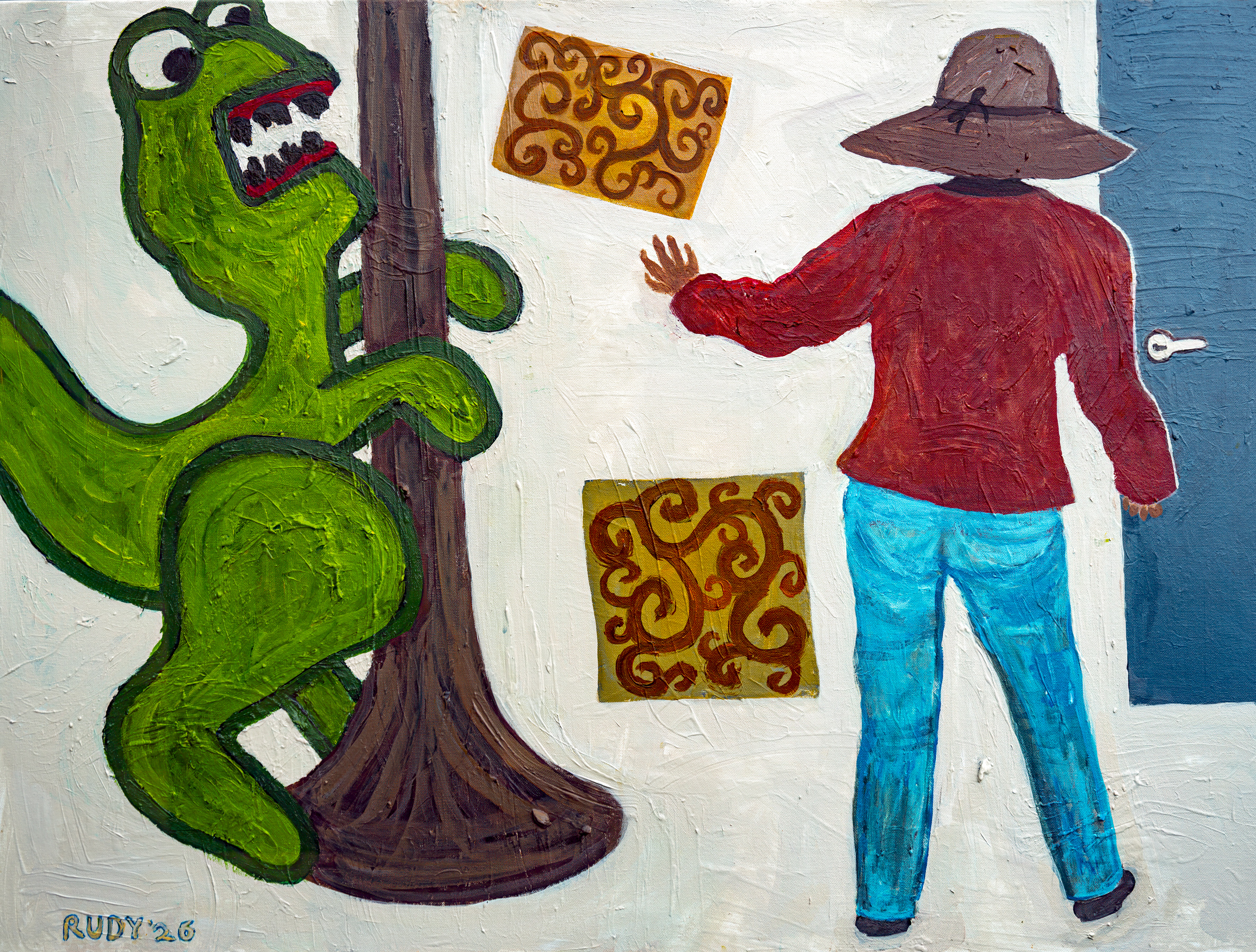
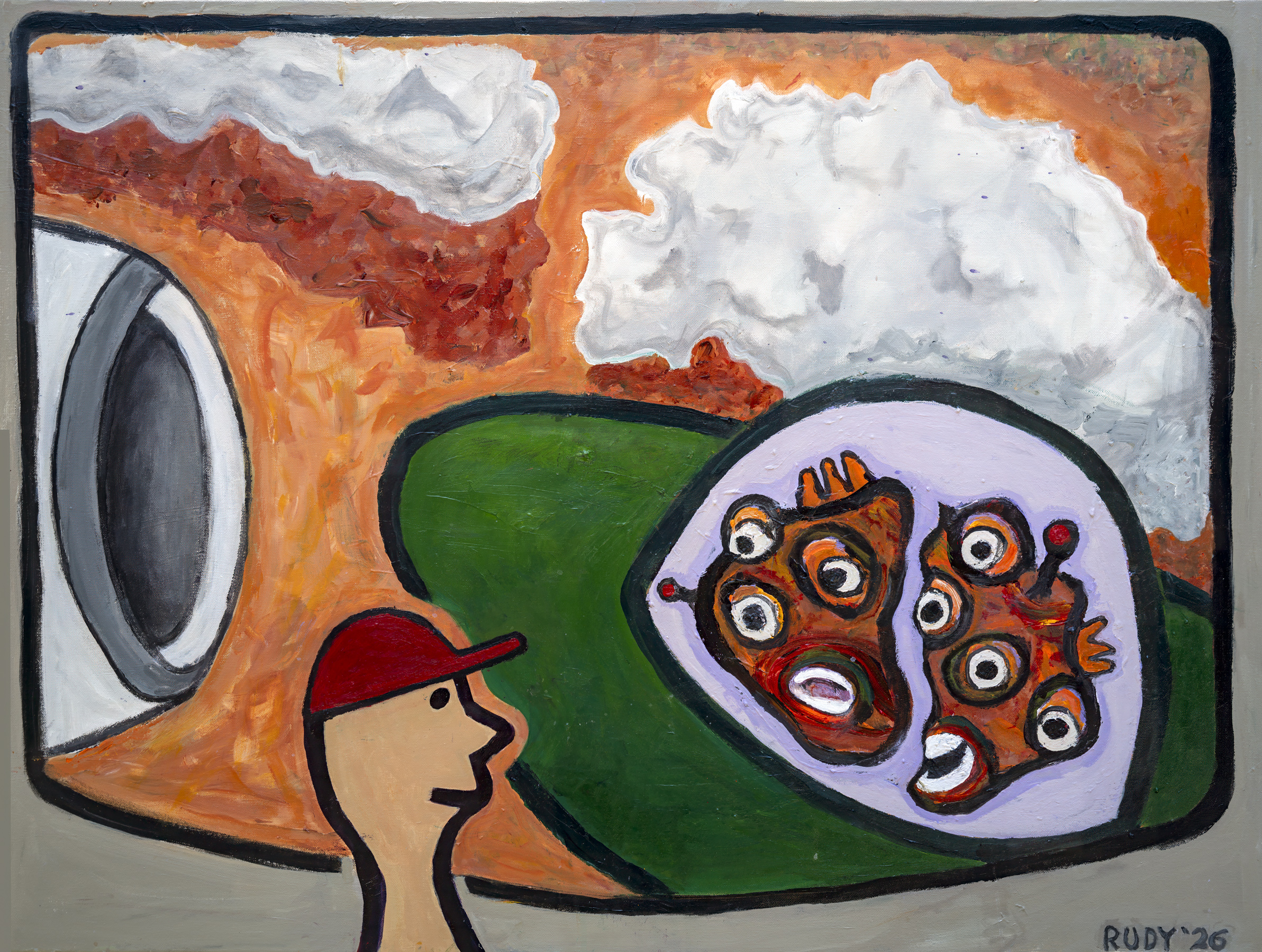
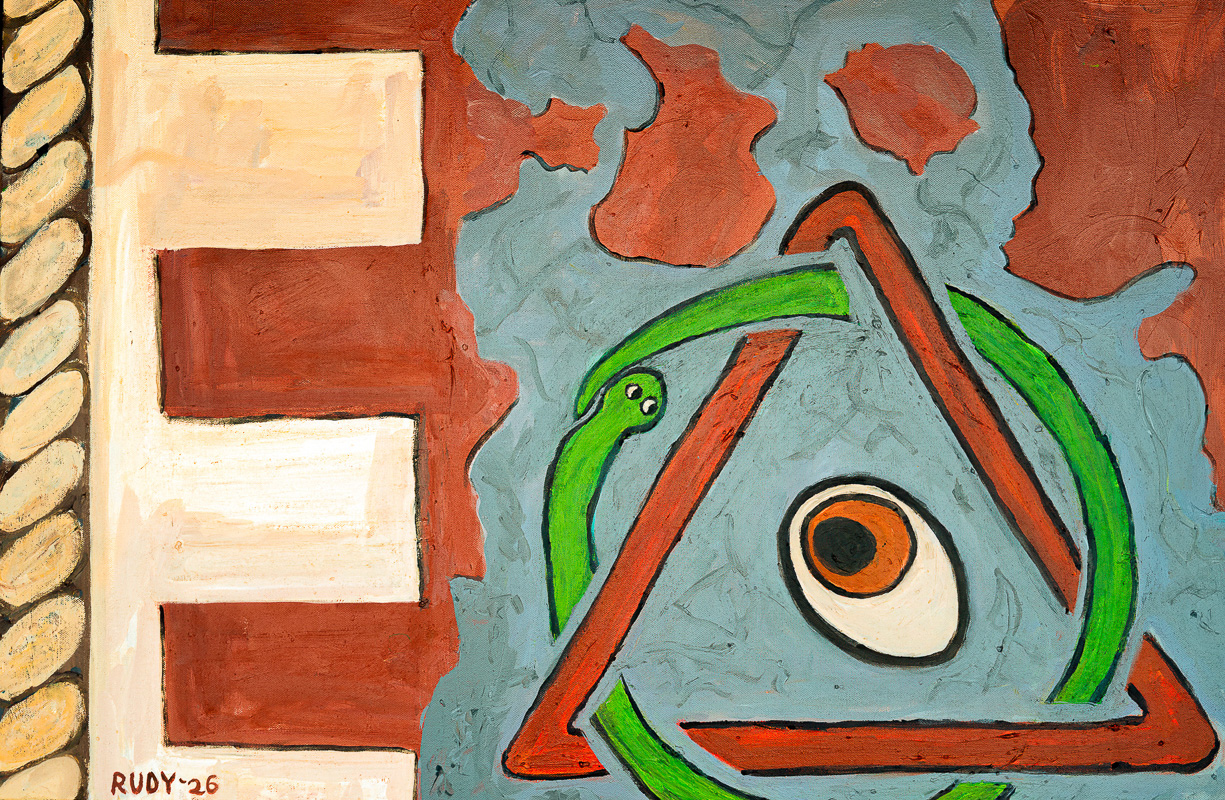
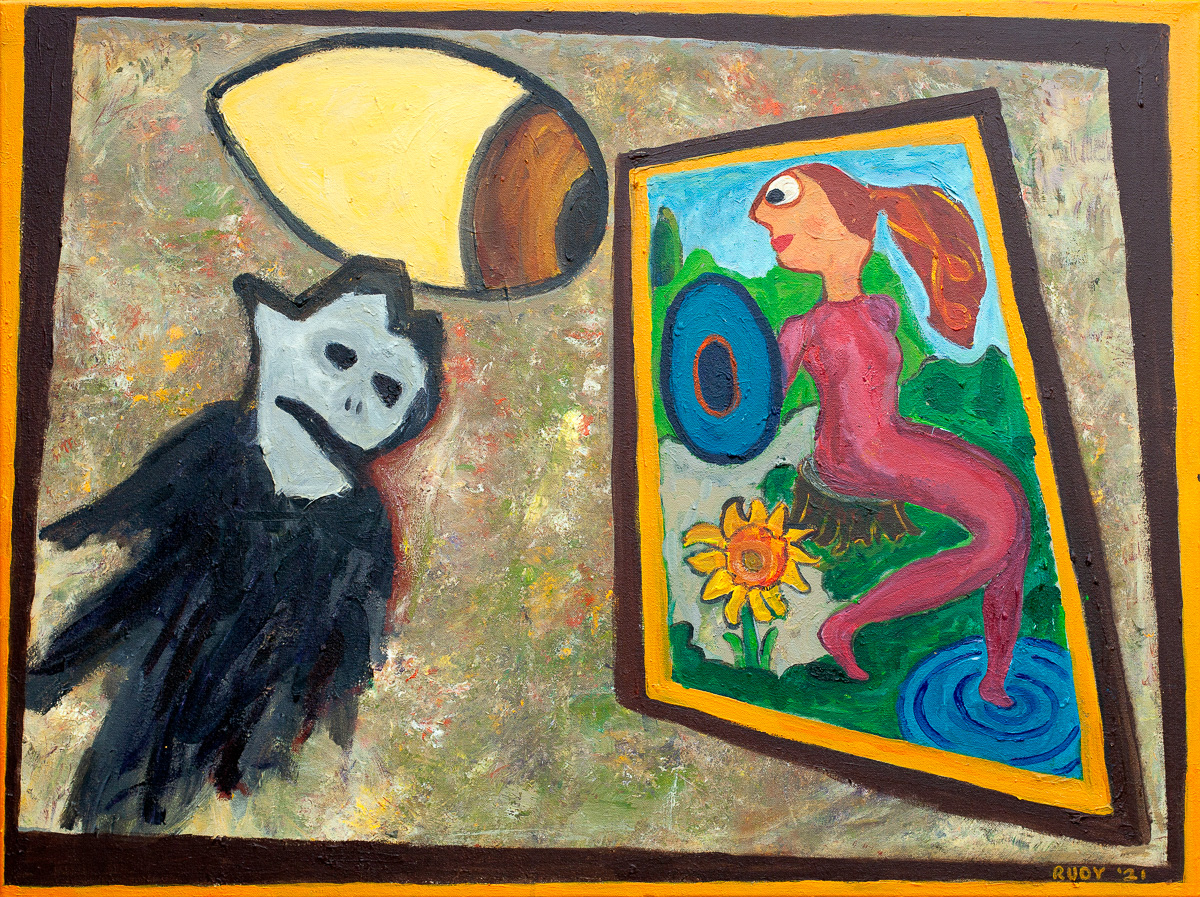
 “The Bottle Imp.” Painting by Rudy Rucker)

———————————————

The Bottle Imps

Copyright (C) Rudy Rucker & Bruce Sterling

On the money front, Lou had a side hustle: hunting bubble jade. He needed it because he was canned.

Canned from his post as marine biology professor at UFO. Canned like a Monterey sardine. Gone as the monster squid and mosasaur who tussled on a childhood poster in Lou’s home-lab.

Regarding bubble jade, the name doesn’t mean the stone has bubbles inside. The name only means the gemstone’s surface has circular patterns that resemble bubbles. Bubble jade is heavy. And it’s very, very rare.

Hunting the precious bubble jade was a long shot, but it was wide open. Not a lot of people would dive for it anymore. Over a hundred feet below the skeevy surf of Jade Cove in Big Sur. Enormous, heavy waves slammed constantly into the cliffs, with spray shooting all the way up past Route 1, spawning hosts of micro-avalanches.

In previous years, Lou had a tight-lipped crew of former students to help him, all from UFO, the humble career-oriented University of Fort Ord—where Lou had worked. Despite all the good they did for the mostly Latino community, UFO was imploding just now, with a toxic culture-war fomented by new administrators: creationists, born-agains, book burners, and god-pigs. They’d fired Professor Lou Lopez for calling the dean a bone-eating zombie worm.

With Lou’s comfortable UFO scene blown, his stepdaughter Amparo was now his dive partner. She’d take a day off from her job organizing whale-watch cruises out of the Moss Landing harbor.  She was better than the students had been. Smarter, with great reflexes and more stamina. She claimed she could smell the bubble jade, which made no scientific sense, but Lou was willing to call it a fact. Amparo was that good.
Normally the dive season at Jade Cove ended with the summer, but this year, unemployed and needing bread, Lou started having vivid dreams about bubble jade.  Dreaming about one specific chunk. It was like a character in a cartoon. A large gingerbread man, bumpy and shiny and beautifully patterned. Telling Lou to come get him. Three nights in a row Lou had this dream. So, okay, he’d go for it, even if it was early November

The week before, a climate-tweaked Pacific typhoon had torn big chunks from the Big Sur bluffs. So, sure, that might be a good time to hunt jade! And, well, even if it still wasn’t exactly sunny, the rains had abated a bit.

So Amparo and Lou headed down to Jade Cove, driving Amparo’s large, third-hand, back-country pickup. Lou himself didn’t happen to own wheels just now.

“We deserve a big score,” loyal Amparo told Lou on the way down. He’d just told her about his dreams. “Visions are a good sign,” said Amparo. “Especially for rock hounds.”

Route 1 was a little iffy, in fact, technically speaking, it was closed, but with Amparo’s charm and Lou’s old-timer connections, they wended their way down the coast, taking some back-road detours along the way—especially old Coast Road that looped inland past the remains of scenic Bixby bridge, half of which had recently collapsed.

The weather was rather brisk. Nobody else had  the gumption to visit Jade Cove today. Our seekers’ hopes rose. What new treasures had the storm unveiled? Clutters of branches jammed the narrow shingle at the water’s edge. Not really a beach. Lou and Amparo wore their heavy-duty hooded wetsuits. They paused at water’s edge.

Lou took a fond and, he worried, final look at Amparo. Her fit form was surf-cured like salmon jerky, her hair a dense shock. She had a tense, dramatic look. She’d inherited her mother Lupe’s gift for bending unlikely men to her will. Could Amparo’s fisherman boyfriend Renato possibly be a proper match for such a mermaid?

Amparo’s mother Lupe had left Lou a few years ago. They’d never gotten legally divorced. Lupe wanted to land a big fish first. She’d had a few affairs, but the high-rollers wouldn’t marry her. Lupe could be a little raw. Her job these days was so-so. She managed the checkers at the big Costco in Sand City. Her hobby was fitness. She was a gym rat, and skilled at judo.

Lou had to admit that he missed Lupe, and Lupe knew that, and maybe at some level she missed Lou. She liked to stop by the house, just to talk. She’d sit with Lou and quietly rattle his chain. And remind him that she still owned half the house, and that he should maintain it better for when it was time to flip it. Ah, Lupe.

“Let’s go, Poppy,” said Amparo, interrupting Lou’s reverie. “Dive in.”

Lou waded through the surging waves. Gave a farewell whoop, mouthed his regulator, donned his fins, and slipped beneath the surface.

For her part, Amparo was thinking how nuts this was. They were little crabs looking to pinch something tasty. Hoping for a speck of joy.

Lou swam down along the underwater bluff, stopping at 120 feet. Unwise with no special equipment, but he was a veteran diver. He figured he knew what to do. If he only stayed fifteen minutes, he’d be safe enough.

He fought his way through a tangled forest of giant kelp. And then, aha, he saw a spot where the undersea wall was bare of growth.  Swept clear by the violence of the typhoon. Better than that, the wall was heavily cracked, giant plinths of granite leaning together. And, aha again, Lou saw something embedded in one of the plinths…something beautiful.

But he had a problem. His thoughts were echoing. Rapture of the depths kicking in. Nitrogen narcosis—that thing where the pressure drives nitrogen into your blood and you space out. Maybe he was a little deeper than 120 feet? He hadn’t been watching his depth gauge and, oh hell, he couldn’t seem to read his gauge at all. Fully narced.

But here came trusty Amparo, tugging on his arm, signaling it was time to head toward the surface. Amparo was in control. She was, up to a point, more resistant to the narcosis than Lou. She had her mother Lupe’s grit.

But Lou wasn’t stopping now. He was looking at the biggest chunk of bubble jade ever. He pointed toward it so Amparo would see. It jutted from an immense stone chunk like a time capsule emerging from the past. Massive, the size of a human, or of a coffin. A sarcophagus! In his addled state, Lou was somehow thinking this would be a good place to die. Or,  no Lou, a place to get rich.

Dragging Amparo along, Lou went and ran his hand across the bubble jade, stroking it like a pet. Divinely smooth, with soft bullseye patterns, lovely beyond compare. Did he see faces inside it?

Insanely intent, Lou unsheathed his big dive knife, drove the point into the crack along the jade, and pried. Did it again, and did it a third time. Like extracting a molar. The bubble jade twisted clear—but somehow it wasn’t properly heavy. It was light. The precious boulder rose straight toward the surface, keeping pace with the bubbles from Lou and Amparo’s SCUBA. Impossible.

Lou wanted to swim straight to the surface. He could see the gleaming underside of the floating jade up there. High, high overhead. Amparo slowed Lou by main force. Slowed him enough so that he didn’t burst a lung or get the bends.

And then finally they were out, fins and masks off, staggering across the shore’s rugged stones—and herding the floating raft of bubble jade along. Dragged it onto a dry spot at water’s edge. Sat on a log panting, touching their stone, wondering.

“Smooth as a yacht hull,” said Amparo. There were rather a lot of wrecked yachts on the shores of California these days.

“Such a beautiful sheen,” said Lou. “All those blues and greens,”

“With bulls-eye circles on the bumps. Polished from tumbling for…what? Centuries? Thousands of years? What a score, Poppy. Epic.”

“Except that it’s too light,” said Lou.
Yes, as a smooth and surf-tumbled giant gemstone, it would have been a truly fantastic score, but somehow it seemed more bubble than jade. Easily they balanced the great, near-weightless piece on one end, with near-weightless ease. It was streamlined like a speed-smoothed meteorite found in the dirt, but grand in size, even monumental.

“Maybe it’s hollow inside,” suggested Amparo. “Full of great crystals!”

Lou rapped on  the object with the butt of his dive-knife. “I really don’t think this is really stone. Or metal. And forget plastic. Down at 120 feet inside a block of granite?” He put on his professor voice. “Highly anomalous.”

He scraped at the surface with the sharp tip of his knife. The tip snapped off with a sharp ping. He tapped hard on the surface—and the rock tapped back, very rapidly, like the sound of a woodpecker.

Out to sea, the waves were rising. The rain had renewed its force, lashing pockmarks across the tubes. Amparo ran her hands over their lovely prize.

“I say something’s alive inside it,” said Amparo. “Those dreams you had?”

“Let’s take it home,” was all Lou said.

They loaded the specimen into the bed of Amparo’s lumbering primer-painted back-country pickup. An apparent lump of dense, precious rock that somehow seemed not to weigh more than fifty pounds. They tied ropes across it in the truck bed, but that didn’t seem like enough. What if it slipped out?

As if hearing Lou and Amparo’s worried discussion, the treasure stone obliged them by making itself heavy. Solidly in the truck.

Lou and Amparo rode comfortably home. They sang songs most of the way, very cheerful, repeatedly looking back to make sure their wondrous find remained in place.

Lou’s house was a structure he’d cobbled onto the concrete and steel stub of a dead railway spur in a lost zone of Sand City, a formerly blue-collar district near Monterey, and by now a home for big box stores.

The house itself was on a gravel road at the very edge of Sand City, with steps running up to the living quarters from the front yard, as well as a ramp from the yard to the lab.

Over time, Lou had hammered his dwelling into shape, mostly with sweat-equity from his UFO grad-students. He’d installed a kitchen, bathrooms, windows, flooring, rugs and hand-crafted furniture—the finer touches at Lupe’s wifely commands.

The harsh industrial lighting had been muted to pleasing apricot tones. Amparo’s quarters had pastel walls and a view of the sea. Some nooks were reef-like lairs with orchids and plump succulents. Lou and Lupe owned it, free and clear.

The place had been a campus party-house for a while, in happier days: red wine had flowed, Bach had played along with old corrida ballads, with gnarly debates and abstruse arguments till the pink glow of dawn. But no more.
Lou wished Amparo would adopt an academic career like his. He felt Amparo deserved a Ph.D. from UC Berkeley.  And a research post at the Moss Landing Marine Laboratories.

Amparo knew what her stepfather wanted, but she’d counter with remarks about the world as she saw it. “The student debt would crush me.  Our universities are scams these days, Poppy.   They’re not here for my dreams, my house, my baby, my big career. We’re a permanent underclass. Rags to rags in four generations. Also, I hate school.

Safe at home Lou and Amparo dried themselves, dressed, and laid the agreeably light-weight jade form on the not overly clean carpet of the lab. For now the thing was quiet.

“If it’s hollow, we gotta be able to open it,” said Amparo. “I like it. So pretty and smooth. Like a bowling pin.”

Lou fetched a wheeled plastic case of heavy-duty tools.

The jade bowling-pin seemed to sense this menacing activity. Smoothly, soundlessly, it shrank down to a new form, a new shape. A form with the distinctly casual air of an empty wine bottle tossed from a car. A classy white-wine bottle. Glassy and tapering with no opening on the top. It kept the same colorations  before. A pattern like bubble jade.

A long silence. Lou sighed. “I’ll do this as a matter of principle. Not that I’m expecting much.” He laid the bottle-specimen on the lab bench and set to work with a microscope, fluorescent light, and a full deck of reagents. Probing for mineral composition, organic traces, and any evidence of metabolism. Scanning for growth layers, tubes, pores, vessels, and cellular textures.

Acids and bases dribbled right off. Chisel and hammer got nowhere.

“I don’t think it’s even made of atoms,” said Lou.

“Everything has to be made of atoms,” said Amparo, losing patience.

“What about reflections?” Lou said.

“Put it on the scale,” said Amparo. “Weigh it.”

The digital readout of Lou’s scale flickered back and forth, like a gasoline pump fried by Middle Eastern warfare.

“This thing is a phantom,” Lou sourly said. “Our bottle is literally made of nothing.”

“You’re too rough with it,” decided Amparo. “Let me try talking to it.” She gave the bottle a thorough polish with a handy microfiber cloth. “Come on out,” she said, and set the bottle down with a clack.

The bottle rocked and its surface cleared. Like a two-way mirror. Pale green light inside. Lots of room toward the center, more and more space, the further in your eye went. Like the reflection in a Christmas tree ball. The image was slightly veiled by the now-faint bubble-jade pattern on the outer surface.

Two imps were visible, if you want to call them that. A large one and a small. Male and female, if you will.

They passed through the surface like a sleight of hand-trick. And slowly the imps grew larger, right up to human size.
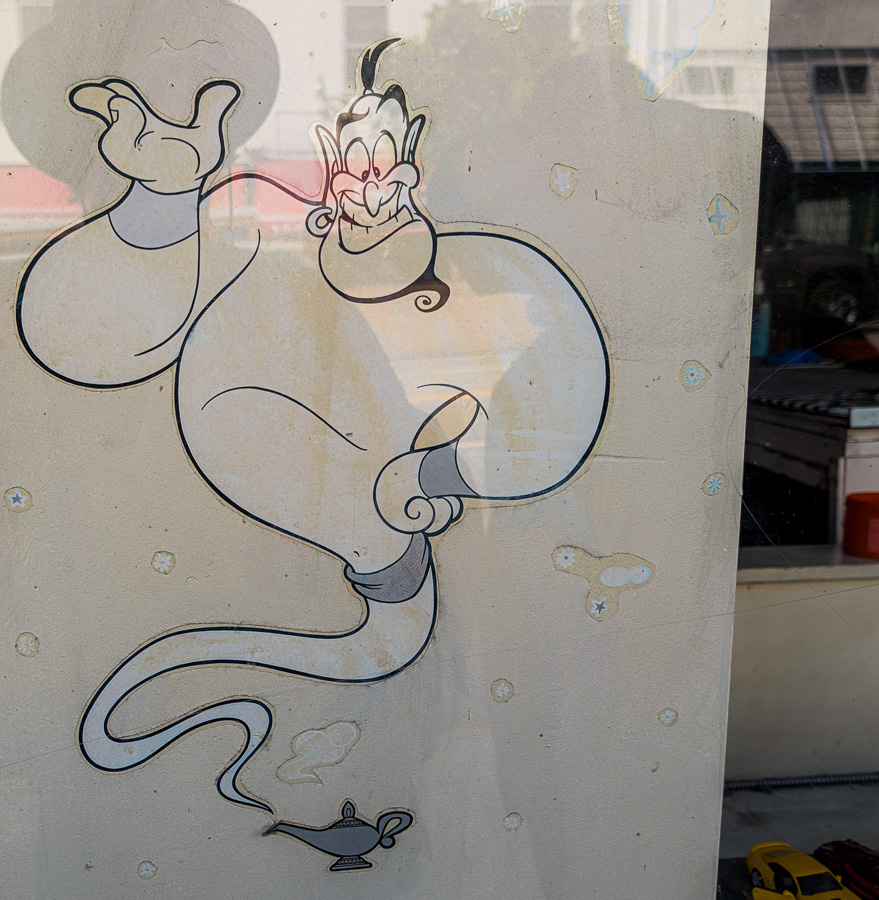
“I’m Quube,” said the bigger imp, with a voice like a pneumatic hiss. His flesh was tan, with parts of it chromed over. A head, a torso, spidery arms and legs. He had no more material substance than the shine in a wicked woman’s eyes.

“I’m QubQub,” said the smaller one. High, cracking voice. The smaller imp was not as fully-rendered as the bigger one. As if she couldn’t be bothered to properly dress.

“We can grant wishes,” said Quube. He seemed in a hurry. Like a car salesman rushing a sucker. “Entities on the surfaces of planets always want that.”

Amparo cut to the chase. “How many wishes do I get? Am I limited to three?”

QubQub let out a hissing giggle. “No, senorita. One only wish.”

“But extended membership plans are available,” added Quube.

Amparo turned to Lou. “This is a scam, Poppy. It’s bots with holograms. As if we’re rubes.”
“Not a scam,” said little QubQub. “It’s higher science. We’re from infinite dimensional Hilbert space. Seeing what you’re like, and what you’ve got.”

“Experiencing the qualities of your qualia,” said Quube. “From the inside out.”

“Hilbert space,” said Lou, kind of smiling. “Whatever you say. Let’s see where this trip goes, huh, Amparo?”

Quube and QubQub were settling into their new environment, and became more perceptible to humans, Their faces were crooked cartoons. Shiny black eyes. Long, air-hissing lips.

They stretched their narrow arms and kicked their legs, enjoying their freedom. They seemed glad to visit a new world. Glad to be out of their bottle.  They ran in circles around the laboratory, skipping and dancing and making shrieking, wub-wub sounds, like a pair of techno DJs. They capered on the walls and ceiling, as if gravity was beneath their notice. Like two subdimensional shadow-puppets projected on a screen of earthly physics.

“It’s like they’re drunk,” said Amparo.

“They’re on shore leave!” said Lou.

He was thinking of the working lives of the world’s great oceanographers. Rotten, repurposed boats, cramped quarters, bad food from the galley, endless storms and pitching decks, the smell of fish and formaldehyde everywhere. That was part of the mission. Charles Darwin did that on the Beagle.

With an alarming, glitchy special-FX stretch, Quube loomed across the lab to get into Lou’s face. “Go ahead, pick one wish apiece. Spill up your guts, your deepest desires, we want to see them!”

“You two are special to us,” added QubQub. “You and Amparo helped us at Jade Cove. A very long time ago, we grew a tunnel into your world. But the tunnel ended inside a giant mass of granite. And the tunnel wouldn’t pull back. And we couldn’t cut the tunnel loose. We were stuck. I fell asleep. And then something happened, and I woke up, and Quube said a guy named Lou could get us all the way out.”

“I don’t understand,” said Lou.

“It’s like QubQub said,” replied Quube. “Our tunnel was stuck inside the rock. We couldn’t push loose. The dimension was tilted wrong. So we had to wait. Finally an avalanche cracked the rock. But we still weren’t quite all the way out. But now I could vibe, and I found you, Lou, and I gave you dreams about bubble jade, and you showed up, and hooray.”

“You’re intrepid explorers!” said Amparo.
“Yes, yes” chirped QubQub, who was beginning to manifest in a more gendered, human-girlish fashion. “And collectors. With powers over your world. Is there anything you need?”

“Well, to begin with, we’re poor,” said Amparo.

QubQub giggled. “You’ll never know how poor! You should see how bitchin’ it is in the subdimensions. That’s, like, the downtown of Hilbert space.”

“And, by the way, you can go there if you enroll in that membership plan I mentioned,” said Quube.

Amparo ignored the sales pitch, and focused on her wish. Keep it simple. “My crappy old beater truck is a pain in my ass. So if—”

“Don’t be hasty!” Lou cried, hastily. “This might be the greased path to Hell. Everybody knows that about bottle imps. We can’t just shout commands at crazily powerful aliens! We need precautionary principles and an ethical structure. And a code of responsible behavior.”

Amparo looked at him with pity. “Oh, Poppy, you’re a scientist from California. You’ve never done any of those things in your whole life.”

Lou was crestfallen. “Well, that’s true. But I wish we could have lunch before starting on big plans.”

Oops!

An old, sealed window cracked open in the wall of the lab. A $39.99 Taco Bell Party Pack floated through, and settled onto the workbench. The fast-food meal was closely followed by a Drink Party Pack.

“Oh fuck!” screamed Lou, utterly sickened by his bush-league blunder. “Couldn’t you at least have gotten food from Tia Veronica’s? I mean, shit, this isn’t real. You have to let me—”

“Too late!” cried Quube, obviously enjoying himself. “Too late! Too late! Too late! You might be interested to know that by way of enhancing your wish, Lou, we folded in the desires of three fruit flies living in your lab. Their tiny brains are refreshingly classic. Honest, simple, sincere. No mixed states and quantum collapse for these little fellows.”

Meanwhile Amparo was deftly unfolding the Taco Bell boxes and removing the tacos and burritos. She crunched through a ground-meat, ice-berg-lettuce and a cornmeal taco-shell with her strong white teeth.

“Eat some, Poppy. It’s American food. You eat it when you’re drunk. How did you get the food anyway, Quube?”

“A childishly simple matter of material translocation,” said Quube. His voice was improving rapidly; he sounded less like a rusty steam-whistle, and almost like…like a professor. “We scarcely had to bend a law of physics.”

“You’re bastards to trick Lou,” said Amparo, starting her second taco. “I’m not gonna blow my wish.”

“What will it be then, young lady,” said Quube.

Amparo thought things over, sipping at her customary Mountain Dew Baja Blast. “I think you already know what I want. A new pickup truck.”

“To hear is to obey,” said Quube.

“And no tricks,” said Amparo. “A maxed-out top-of-the-line pickup exactly like Renato has.”

“Let me do it, it’s my turn!” cried QubQub. Her poorly-realized feet had taken on more solidity. In view of the rain, she’d gone for flat, webbed ones. Duck feet.

“Lo and behold!” she exclaimed. They heard a thud outside.
The four of them made their way outside Lou’s hulking steel and concrete dwelling, walking down the steps to the front yard. The rain had stopped and the sun was peeking out. A handsome pickup truck had appeared. A pearlescent truck with chrome trim. It had settled into the wet dirt without disturbing it.

“But, but…that’s Renato’s truck,” wailed Amparo, instantly recognizing it. “With my photo on his dash. You stole my boyfriend’s truck!”

“It’s yours now,” QubQub calmly said. “You ate our food, now you drive our truck. The key is in it. I put the title and insurance in your name. Drive it around, it’s yours.”

Unable to resist, Amparo yanked open the door, climbed in, honked the horn. She took the wheel, backed out of the yard, and made screechy turns, zooming up and down the dirt road away from the lab, veering, even skidding a donut.

She then drove back, braked the truck fiercely and hopped out. “I always wanted Renato’s truck. And his boat.” She paused. “But not like this.”

“You should just marry Renato,” said QubQub.

“What?”

“That’s your true wish,” said Quube. “The one you didn’t say.”

“Renato keeps not asking me,” said Amparo.

“Frankly, I don’t think he’s smart enough for my stepdaughter,” interrupted Lou.

“He is smart,” cried Amparo. “Just not around you, Poppy. Nobody else is allowed to be smart, when you’re around. Basically you want to stall my life forever, because you don’t want to be alone.”

“You tell him, Amparo,” said QubQub, going into telepathic life-counselor mode. “And Amparo, the only reason Renato doesn’t ask you to marry him is that he’s scared you’ll say no. Because of your stepfather. And, Lou, the guy didn’t go to college at UFO, but he’s running a fishing boat, which is something Professor Lou Lopez would never be smart enough to do.”
Lou frowned and shook his head.

“Renato adores you,” Quube said to Amparo. “He’ll do anything you say. A smart, hard-working guy, at your service. Like a tame bear in a little cottage with furniture. Just tell him whatever you want. If he knows what it is, and if he can find it on Amazon, you can have it, fresh in a box.”

“I love it!” exclaimed Amparo.

Lou didn’t like where this was heading. He shot a pic of the abducted pickup, and messaged it to Renato with location attached. Hoping to fill him with rage. From Lou’s point of view, this seemed like a good strategic move. What was with these damn imps? Amparo got a stolen truck, and Lou got gringo junk food.

He turned on his heel and went back into the house. The two imps followed him, trailed by a reluctant Amparo, who was still trying to sort out what was going to happen.

“We were just teasing you with the food,” Quube quietly said to Lou, coming up next to him. “We have a better wish for you. We’ll grant it later. After you say it aloud. So don’t worry.”

Lou shook his head, not wanting to discuss this. “I’d like to know where you came from. I mean, what is the bottle, anyway?”

“Simple,” said Quube. “We bulge our a tunnel that connects our world to yours. And the bottle is the tunnel.  From your point of view our universe is inside the bottle. But from our point of view, your word is inside the bottle. You think the bottle is lying in your living room. We think the bottle is inside the lounge on our ship. Very Kurt GÖdel.”
They were in Lou’s comfortable living room. The half-silvered wine bottle was here too, rather large, leaning against a heap of tasseled silk cushions, vaguely Ottoman-Turkish. The imps were proud of their house, or spaceship, or whatever it was.

“And we can look inside it?” asked Lou.

“Of course,” said Quube. “You two freed us from Jade Cove.”

The reclined bottle was at a debonair angle, its smooth, slanting surface exposed.

“Stick your head through the wall,” advised Quube. “It’s like a soap-bubble film. But keep your feet outside, or you’ll slide all the way through.”

“What would happen if we slid all the way through?” asked Amparo, her head turning back and forth. Trying to understand everything at once.

“Haven’t you been listening?” said Quube in a not very nice way. And then he chuckled. “You might end up in our world for keeps. That’s what it means to get a full membership plan. But let’s not rush things. For now, stick your head in there and peek.”

The space in the bottle was a pocket eternity. It was like the skin of a black hole turned into a luxury wrap. Like a Lewis Carroll chessboard whose squares get smaller as they near the center of the board—and the fleeing queen never gets to the middle because she shrinks with each step.

Not that the space in here was a tidy grid. It was more like the old-town district of Lisbon, all turns and forks and ramps and unexpected gates, the details crumbly yet precise Lou and Amparo saw live things back there, too. Butterflies and whales and kinfolk of QubQub and Quube.

A faint soundtrack tickled the air: far-gone Nowheresville jazz, seeping from the tapering horn of an endless trumpet whose bell lay near their feet, and whose mouthpiece might be at maze’s core. Gabriel’s horn.

“I’d like to grab hold of that trumpet,” Lou said to Amparo. “Just to show these imps who’s boss.”

But now, speaking of horns, a Chicano-style custom Harley was tootling in their yard. Renato on his brother’s bike.

Amparo was out there in a flash. Renato seemed more puzzled than angry.

“You wack or some shit, Amparo? You’re stealing my truck?”

“It’s not,” she stuttered. “It’s not me. Please don’t be mad.”
Renato saw that his vanished truck was to be returned unharmed, and immediately found this funny. His too-smart, soul-troubled girlfriend was the manic-pixie in his life. He had never understood her, and never would, and didn’t want to, because her antics cheered him up.

“You’re out there, babe. You’re wild.” He threw his arms around her. “Don’t cry, Amparo. I know you hate your shitty lunker pickup, but…”

“Fix things!” Quube ordered QubQub. “Now!”

A fresh gesture from the little imp, the gesture grander than before, and now ka-boom. A new truck sat in the yard beside Renato’s bike and his stolen white truck. The new truck was midnight black with gold trim. Motor running.

“Hey, look,” called Amparo as she got in. “It’s got Renato’s photo glued to the dash!”

“Better than that,” sang out little QubQub. “Try the extra lever by the steering wheel. Your new car can fly! That’s some serious direct matter manipulation, eh, Quube? I copied a flying car from Beta-9. So stop putting me down.”

“Oh my god,” said Renato, more excited than Amparo had ever seen him. “Oh my god, oh my god. Can I fly it, Amparo? Take it over the bay. It would be cool to spot schools of fish. Give me an hour. Please?”

“You’re cute when you beg,” said Amparo, very happy. “Of course you can borrow it, dear Renato. But be careful! And you have to give me a kiss. And tell all these people that you love me.”

Renato grinned. “I do love Amparo. Of course. Who doesn’t.” They kissed, and then he was gone.

It was sunnier than before, with puffy clouds.

“We’re taking a walk,” said Quube. “See how it feels. We’ll be back. Just a little errand down at Costco.” They turned, heading downhill toward the Sand City chain stores.

“Wait, wait,” called Lou. “What about the bottle?”

“It’ll be okay,” said Quube.

“Have fun,” added QubQub.

As Quube and QubQub walked away, their bodies were shifting. Taking on more human forms.

Lou and Amparo stood alone, wondering what the hell to do.

“They really are aliens,” said Amparo. “Not magic sprites. They came a long way. And that bottle, it’s…”

“The door to their spaceship,” said Lou.

“And they left the spaceship wide open. I think it’s still running, Poppy. Like they left the keys in the ignition.”

They went and took another look at the bottle, comfortable angled against the cushions in their living room. Probably it could outstrip the speed of light. If speed even matters to an alien spaceship from infinite-dimensional Hilbert space.

Tentatively they stuck their heads through the membrane-like surface once more. Taking a better look. Everything was calm. Light emanated from the walls, which were decorated with delicate multi-color patterns. Exquisite objects rested on the smooth nearby shelves. Eye candy like you’d see in a gallery of art-glass. Strange fruits, eldritch figures, paradoxical polytopes, fantastical nudibranchs. That tapering bugle’s bell still rested nearby, and its tube writhed inward through the halls, its endless curves heading for the central infinity, a pipeline to the depths of Hilbert space and whatever lived there.
“They said don’t go all the way inside,” cautioned Lou.

“I think we’d be trapped,” said Amparo. “Remember what they said about a membership plan? And how happy those two imps were to get out? Running around the walls of your lab? How long do you think they might have been trapped?”

“A horrible relativistic Einstein-Hawking stretch of time,” suggested Lou. “Not to mention that the geometry inside the spaceship is warped. You might flatten out like an M. C. Escher drawing. Or turn inside out.”

“I wish Quube and QubQub weren’t weird aliens from Hilbert space. I mean, they were giving me good advice.”

“And the advice worked for you, Amparo. In an indirect way. I mean, Renato came out and said he loved you.”

She smiled. “Too true. Maybe that’s the first time I ever really got a wish. And don’t keep saying I could do better than Renato. I hope he’s careful with my flying car.”

“Did you notice what the imps were doing as they walked away?” said Lou. “Changing shape.”

“It almost looked like…looked like they were disguising themselves as you and me?” said Amparo.

“So creepy,” said Lou. “What if, just for hell of it, you and I did become bottle imps. Just for a while. We move into the spaceship, and learn all about it, and go on amazing trips, and then come back and fix things on Earth.”

“That might work for you, Poppy,” said Amparo. “But I’m not going into that ship. I’m staying here with Renato. I want to start my real life.”

“I’d hate to go aboard the imps’ ship alone,” said Lou.
And now, all of a sudden, Quube and QubQub are back from their outing. Looking like their same sketchy, scary, capricious bottle-imp selves.

“You never told us what you really want,” QubQub said to Lou.

“Confess,” added Quube. “It’s time.”

“I don’t want anything,” mumbled Lou, very uneasy.

“You do want things,” Quube hissed. “Just now you were telling Amparo that you might want to come aboard our ship. And…?”

“I…I don’t know,” said Lou.

“Spit it out,” cajoled QubQub. “Bare your down and dirty heart’s desire.”

“I wish Lupe would come back to me,” cried Lou. “Like in the old days. Make us fajitas and salsa. We’d throw a big house-party. We’d be happy.” He clamped his hands to his cheeks. “I don’t mean any of that.”

The imps disappeared into their bottle. Laughing.

Lou and Amparo heard the grinding clatter of an old car. Footsteps on the stairs—and here was Lupe. Like an older Amparo, but tougher. And still hot, at least in Lou’s opinion. His Guadalupe. Her made-up eyes flicked quickly around the room, coming to rest on the spaceship bottle.
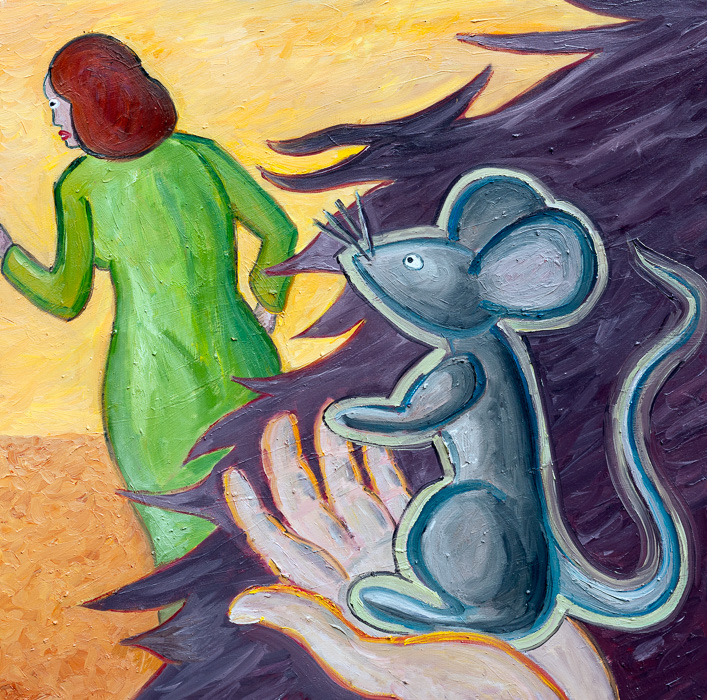
“So many secrets,” purred Lupe. “Cutting me out? Aren’t we three still close? We’re still married, Lou. And I still own half this house.”

“Don’t start,” said Lou. “I don’t want a scene. I was going to tell you.”

“Half an hour ago I was on my lunch break from Costco, and I saw a truck up in the air over the bay,” said Lupe. “Like a pelican looking for fish. Gliding along smooth as a magic carpet. I recognized the driver. Renato.” Lupe stepped closer. “Talk to me, Lou.”

“Look,” said Lou. “There’s nothing to get excited about.”

“After I saw the car, two people came up to me. They looked like my husband and my daughter. Even though they weren’t you.  They said Lou wants me back.” Lupe moved still closer.

The bottle ship was making a noise, a low hum. As if it was about to take off. Its hull remained diaphanous, like a soap bubble, and perhaps still permeable. A tidy stack of gold ingots rested on the floor inside. Bait. Out of reach.

“Don’t let that gold get away!” cried Lupe. “Get it, Lou!”

“I’ll go if you come too,” said Lou.

“Hell no,” snapped Lupe.

She caught Lou’s wrist and elbow, ducked, twisted, and threw him into the bottle.
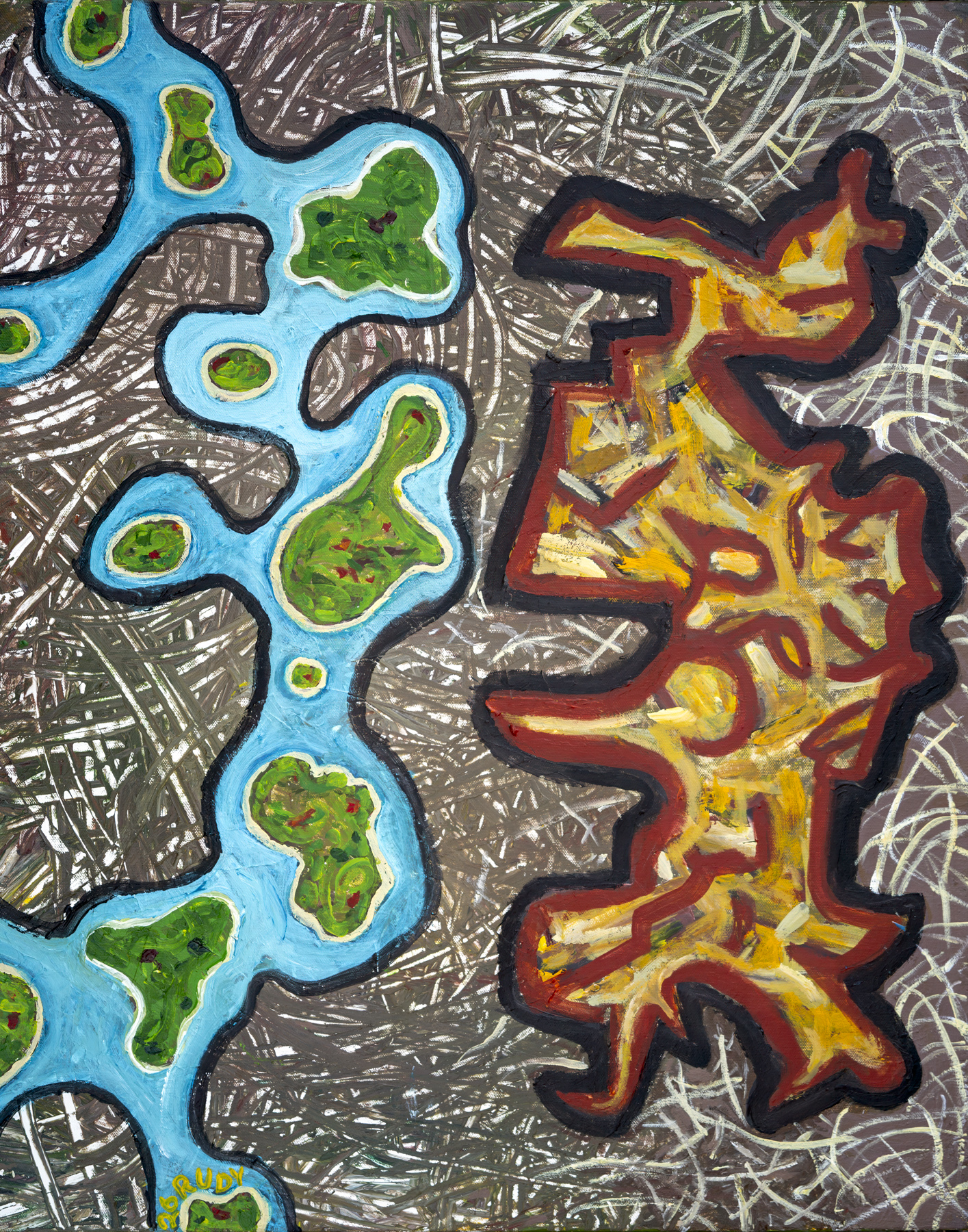
Figures moved within the bottle. Quube and QubQub and…others. A big lavender butterfly was in the air. The bugle was jabbering in an unknown tongue. The gold glinted. In the distance a giant squid was fighting a toothy prehistoric mosasaur, as if cloned from the poster in Lou’s lab.

Lupe gestured wildly to her husband. He seemed sluggish. As if confused. Lupe called out to Amparo. “He’s supposed to be getting that gold! He’s supposed to do it alone!”

Amparo mirrored her mother’s recent move. She put a leg behind Lupe and butted the woman with her head. Lupe staggered backwards, completely off balance, falling through the tunnel wall, and then she was fully inside, toppling the stack of gold.

The surface glazed over. Plain old bubble jade. With a sliding upward whistle, the Hilbert space craft was gone.

Amparo shuddered, sobbed, laughed. She was free.

More sounds outside. Renato in Amparo’s new truck.

“Hey mamacita,” he called, looking up at her. “Small problem. It doesn’t fly anymore. Maybe I can fix.”

Casting off family sorrows, Amparo ran down to hug him. Strong and warm. He smelled good. She spoke.

“Will you marry me, Renato? Let’s just do it. We’ve got my house, your boat, our two trucks. It could work.”

“Si,” said Renato. “Yes.”


——————————–

Rudy on “The Bottle Imps”

Near the end of  my work on this tale, I had one of those flashes that, as an SF writer, I live for. I realized that the “bottle” can the thought of as the neck of 4D tunnel that connects two parallel worlds. Also known as an Einstein-Rosen bridge.

My illustrator David Povilaits drew an image of such a tunnel for my book The Fourth Dimension (Houghton Mifflin 1984, Dover Books 2014)
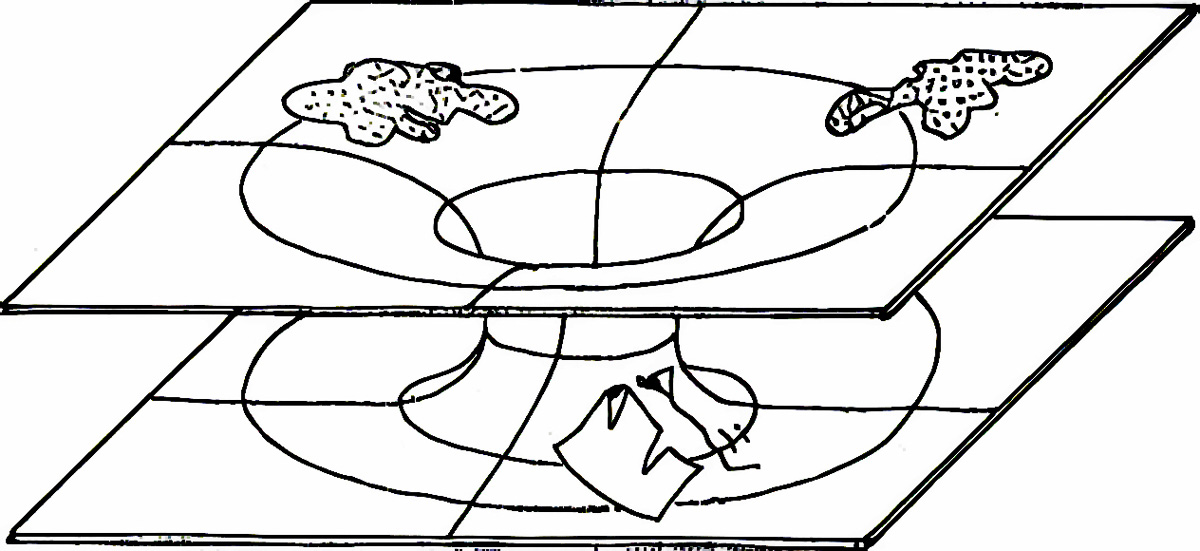
It’s a Flatland-style diagram. That is, the planes represent 3D spaces, and the vertical direction represents the fourth dimension. The “bottle” here is a transparent circle around the throat of the tunnel, which consists of circles stacked in the third dimension..

And for us 3D beings, the bottle is a transparent sphere, halfway through the tunnel, which consists of spheres stacked in the fourth dimension.

Key realization: in each of the two connected spaces, the locals see the bottle as containing a world inside. We see Quube inside the bottle; Quube sees us inside the bottle. One and the same bottle—seen from two different sides. It’s like we’re looking into a reflective ball with a different world inside, and critters in that ball are looking at a reflective ball with our world inside.

As I like to say, for me, writing SF is a type of thought experiment.  That’s why Bruce calls me Professor.

And by the way, I’m Quube and Bruce is Lou. Or maybe I’m Amparo.

——————————–

Bruce on “The Bottle Imps”

What is “Bottle Imps” really “about”?  I’m inclined to think that it’s about Californian housing problems, but it’s also about wish fulfillment and profound new possibilities opening up wherever they are least expected.

Also, the prose style has a beach-shack, sandy, garrulous looseness about it, which is the polar opposite of intensely-detailed cyberpunk “crammed prose.”

There’s a sense of relief and release to it, like becoming uncorked. We don’t have a lot of reasons to write stories like this, but also we lack reasons not to.

——————————–

“The Bottle Imps” is the newest story by Rudy Rucker and Bruce Sterling. Read all eleven of our tales in the 2nd edition of our anthology, Transreal Cyberpunk.   .
Armdillocon 2. Telepathy, Filmifying, 25 Pictures.
September 23rd, 2026

Here’s my secone post about Armadillocon. See my much longer Armadillocon 1 post for more matrial, and for my Austin photos.

Here’s a  one-click link to the audio for today’s post. By the way, I’ve just now found a terrific free online Adobe Enhance Speech tool that totally cleans up your crappy cell-phone-lying-on-a-table recordings. I used it on the Armadillocon 1 audio as well. Who says the world isn’t getting better?

I think today’s material is drawn from an opening panel where we talked about the bitrh of cyberpunk.

I have a big backlog of non-Austin photos, and I’m loading about 25 of them into today’s post. Locations include Venice, Fort Bragg CA, Los Gatos CA, and Madison. Do they dovetail with with the text? Well, as I like to say: a fundamental principle of Surrealism is that everything fits with everything.  It’s all one  pattern in Hilbert space.

Some of my recent paintings appear in today’s post. I’ve sold about 110 of them over the years, and would love to sell more —  both for reassurance, and to pay for materials.  Check out the Rudy’s Paintings page.

I keep an eye on the book reviews a little bit, and I noticed there are actually a lot of more people are writing science fiction than used to, and but they don’t call it science fiction anymore. You know, it’s like. It’s like you wouldn’t say you’re writing pornography. You’d say you’re writing erotic fiction or a sensual novel or a book of love say now.


Tattoo parlor in Fort Brtagg.

And you don’t say you’re writing science fiction. Instead you say you’re writing something futuristic or speculative, you know, or sttunningly imaginative. A lot of these books will recycle some science fiction idea. We SF writers have a certain number of tropes that are fairly well known among SF readers.


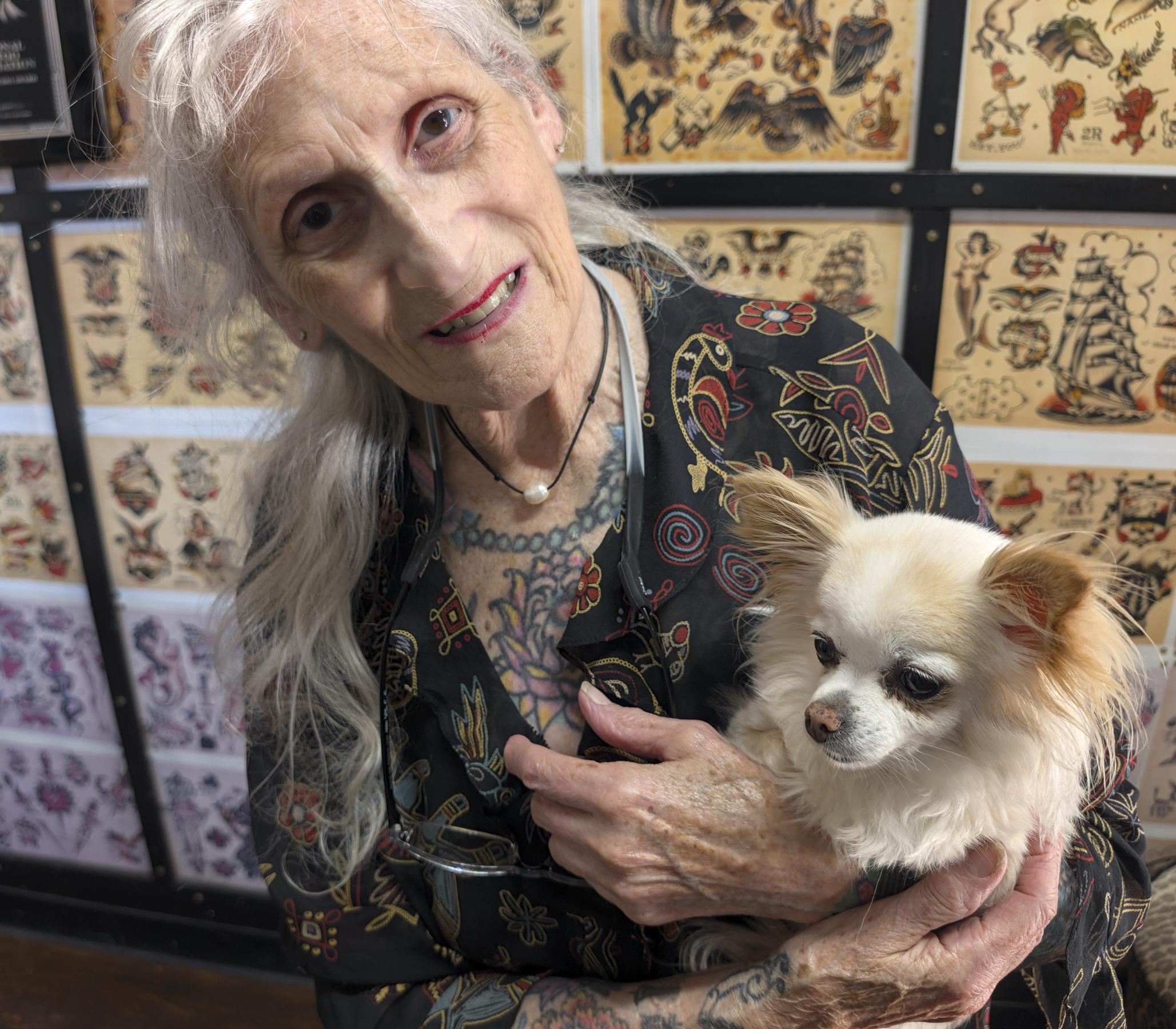
Chinchilla the tattoo parlor lady in For Bragg

But suppose somebody hasn’t been reading science fiction, and the first time they encounter an SF trope—let’s say somebody’s somebody’s mind is being transferred into the cloud. And the naïve reader will be, like, oh my god, this author this is such a genius. Yeah. Ahd certaihjly this fine literary author isn’t one of those scuzzy science fiction people.


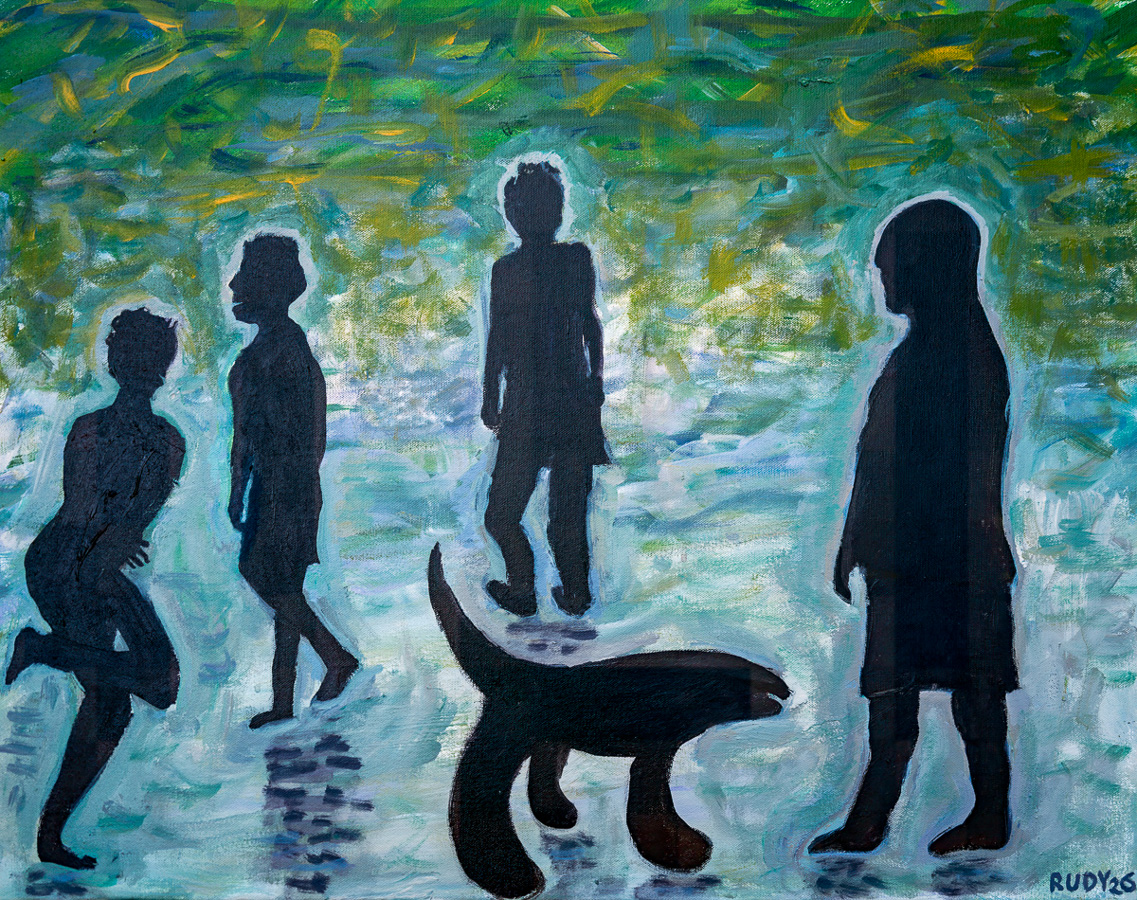
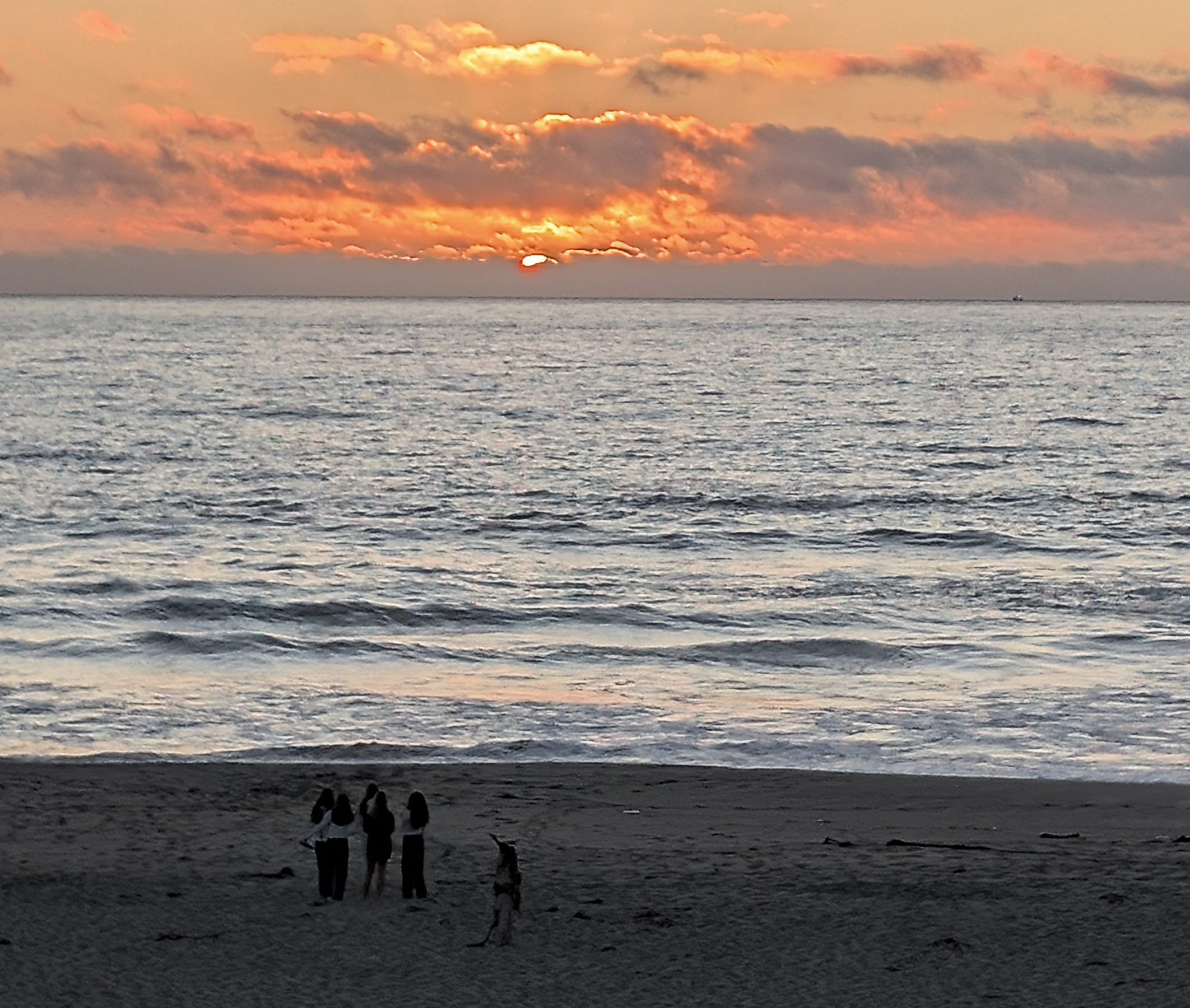
Black’s Beach in Santa Cruz. Sillhouettes with mer-dog

Science fiction is a house with many mansions. We’ve got the TV science fiction. We’ve got the movie science fiction. We’ve the literary science fiction. All kinds. So, what’s a new form of SF? Simple move. Write science fiction that is not called science fiction.


Rudy painting “Dancers.” Photo by Dinah Cotton

A move that a lot of non-SF authors use is something I call transrealism. I’ve been transreal for over forety years  —   see my 1983 “A Transrealist Manifesto.”  Transrealism is the idea that you can write science fiction about your own life. It’s can be kind a beatnik thing, writing about yourelf, and you can goose it up with SF tropes. Transrealism. More and more popular.

One of my heroes as a teen was the SF writer Robert Sheckly. Later I was lucky enough to meet him in person, and hang out with him a bit. At one point the universe smiled on us, and we twp were invited over to Tim Leary’s house talk about a weird science series that Tim wanted to host. What a day! (No, it was never produced.)


Fourth of July in Sf. “Illegal” fireworks in the Mission

Talking to me about writing, Robert once remarked that there are three problems for a writer: how to write, how to finish something, and how to write about yourself. Transrealism is way of writing about yourself. It might be called autofictino, but the idea here is that you put in some science-fictional or “speculative” ideas to amp it up.


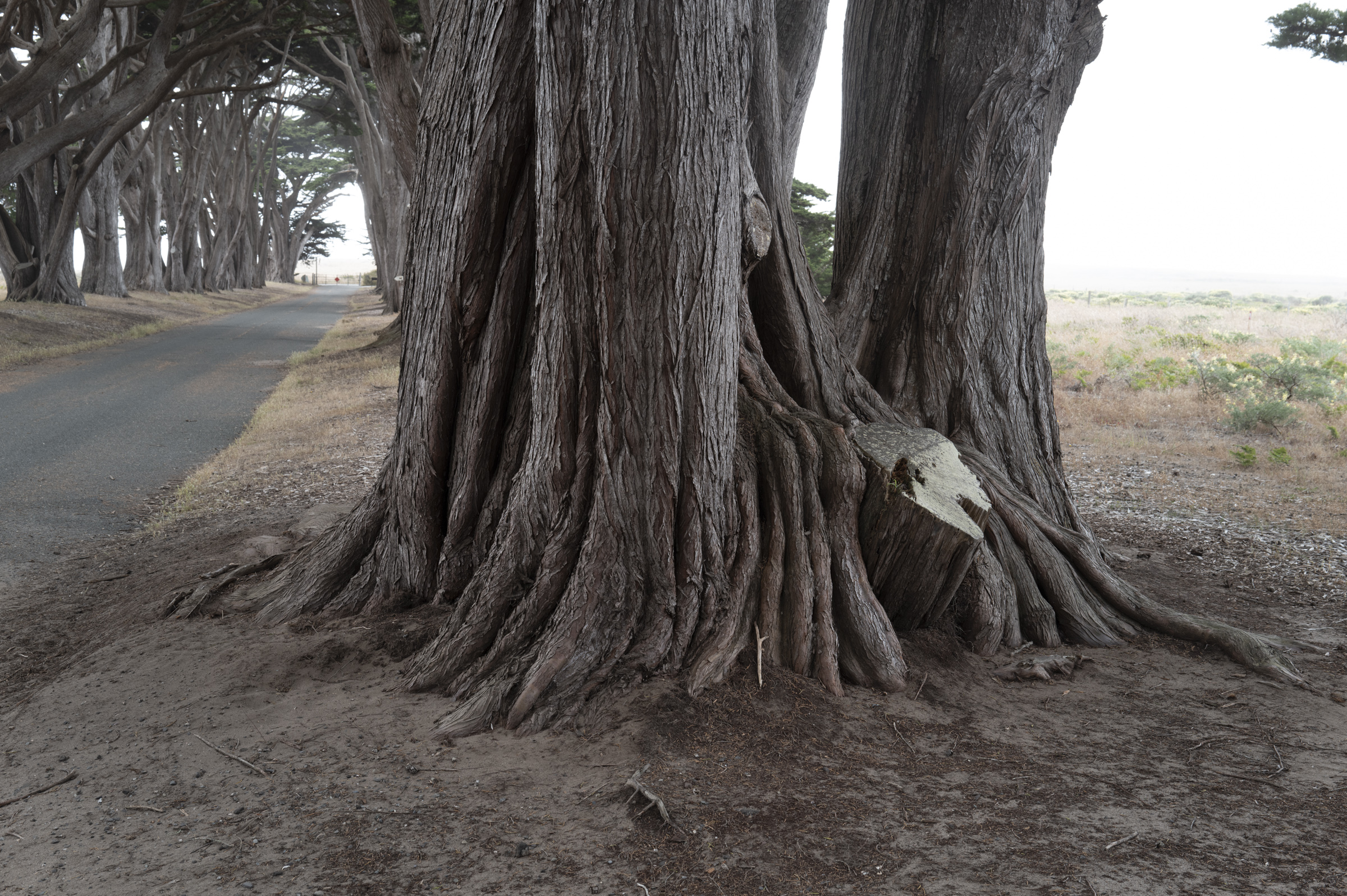
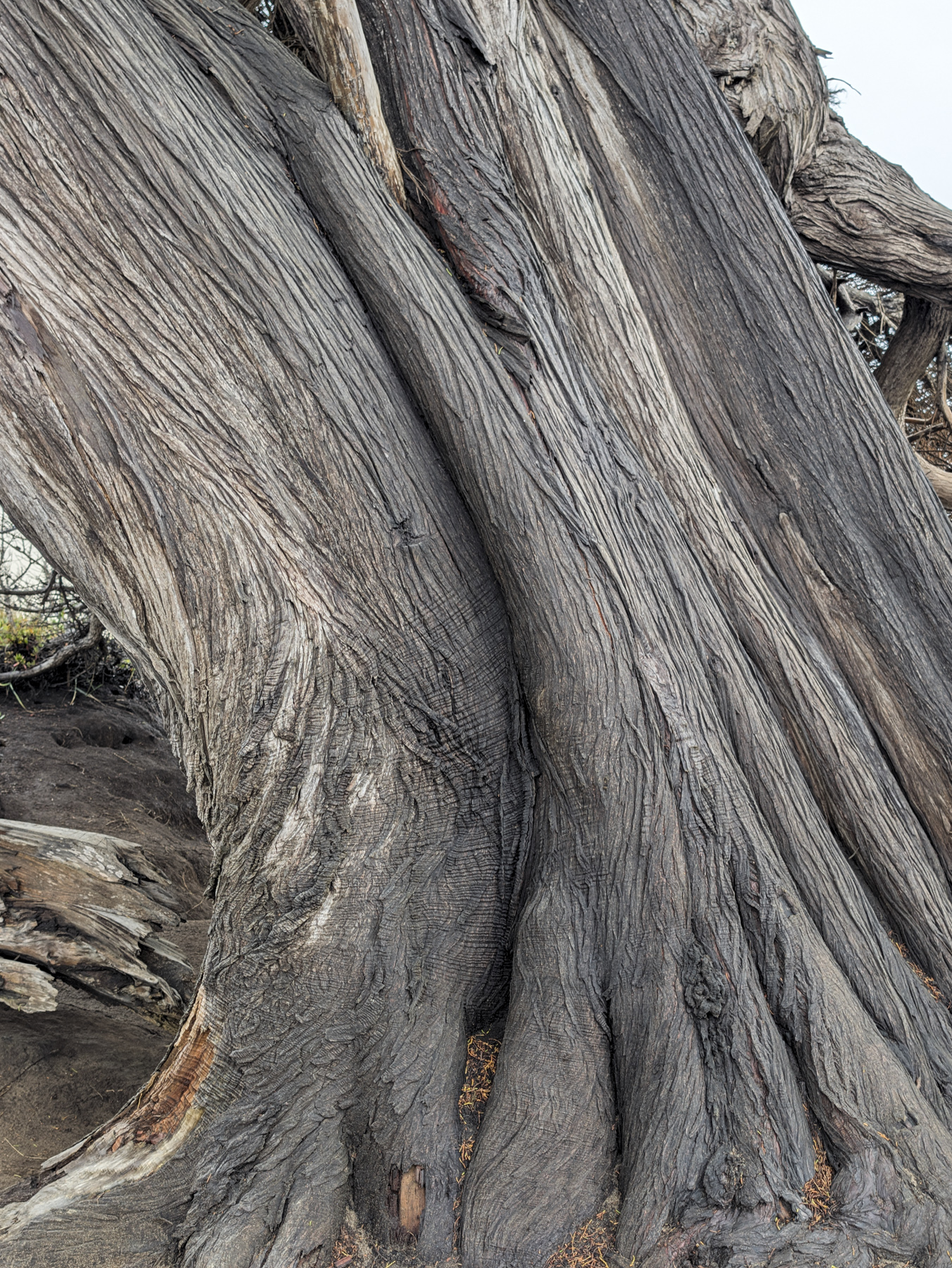
Monterey cypresses in Point Reyes park

Something odd I’ve noticed in my own experience is that the stange events I stage for my transreal hero have a way of coming true my real life. It’s flat-out synchronicity, and it’s real. Less cryptically, I might say that the transreal SF events in my characters’ lives are symbolic of my real life, and there is an ongoing transfer back and forth.

As an example, if you write about telepathy, you are, in a way, writing about the deep need for somebody to understand what the fuck you’re talking about. And as you write this, you get better at understanding those around you.


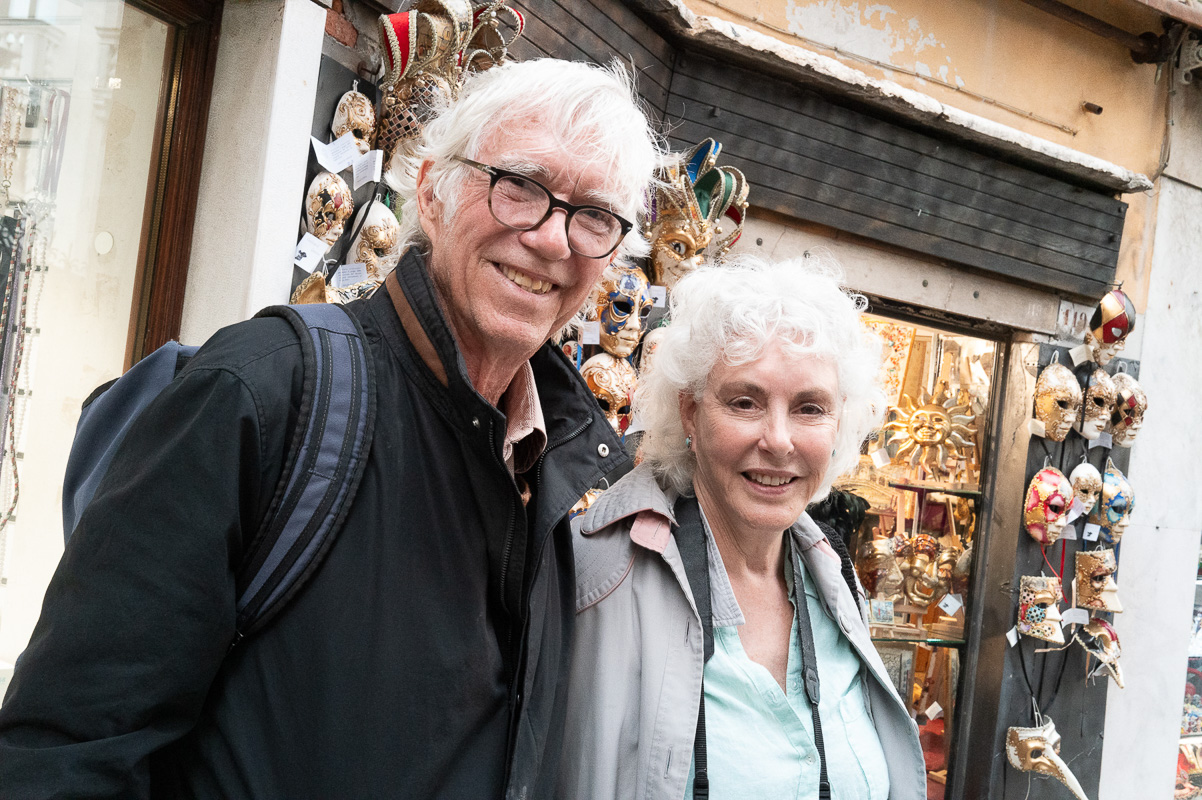
Rudy and Barb in Venice

Speaking of telepahy—it’s so very odd that we can communicate at all. I mean, when you’re “talking,” you’re using an arbitrary system system of grunts and squeals, as Jorge Luis Bores once put it. How is that people menteally replicate your state of mind by listening to your grunts and squeals?


“Open the Door,” Barb in Point Reyes. Those rectangles are Belusov-Zhabotinsky cellylar automata, of course.

Of if you make scribbles, people can “read” them and know your thoughts? Or you daub colored mud on a cloth and they “see” your mental visions? It’s so amazing that that all this works. Never forget how strange the real world is.


With daughter Georgia in Madison WI

Moving into SF, we look for ways to make the transreal connection stronger. For instance, can we expand our makeshift system of squeals, scribbles, and mub into a more effective form of telepathy?

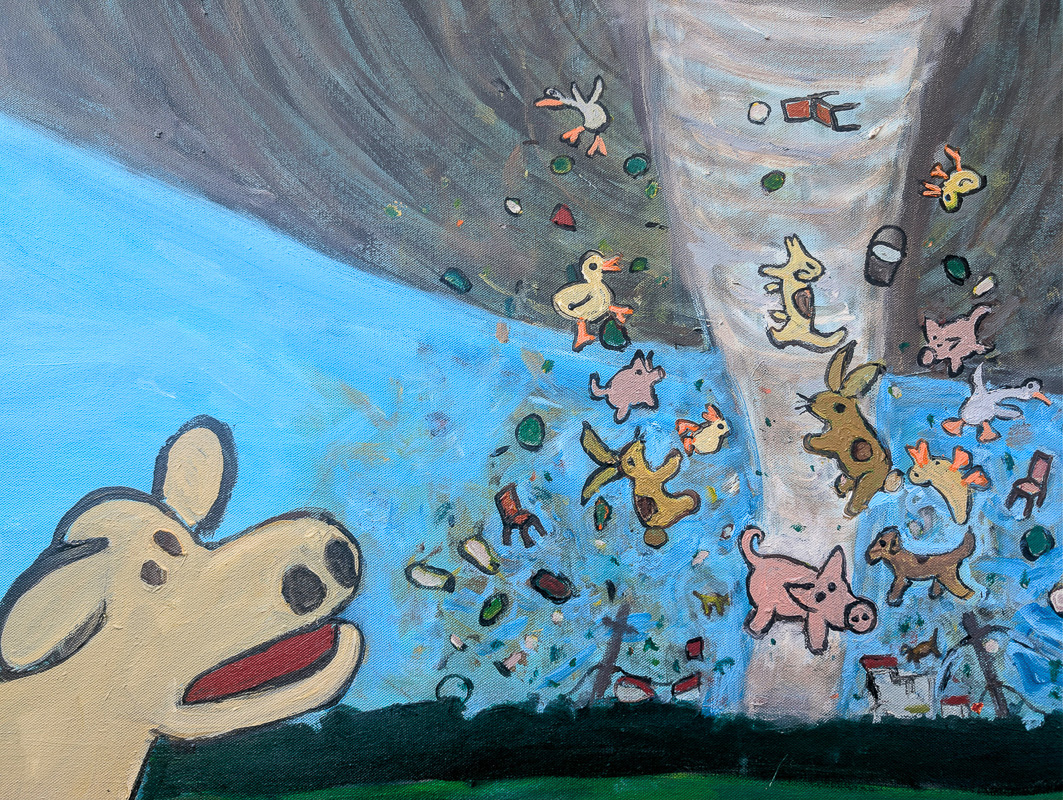
My painting #292: Farm Twister.  The three empty chairs are my parents and my wife.

What if we had some kind of silent thought waves? We’d just lie around, nodding at each other like stoners. “Ya, mon, I dig where you’re at.” But, more seriously, how might an SF version of telepathy work? In reality there can be, even when sober, a sense that it’s possible. And if you’re a SF writer, you say, okay, I’m going to image how it might be.

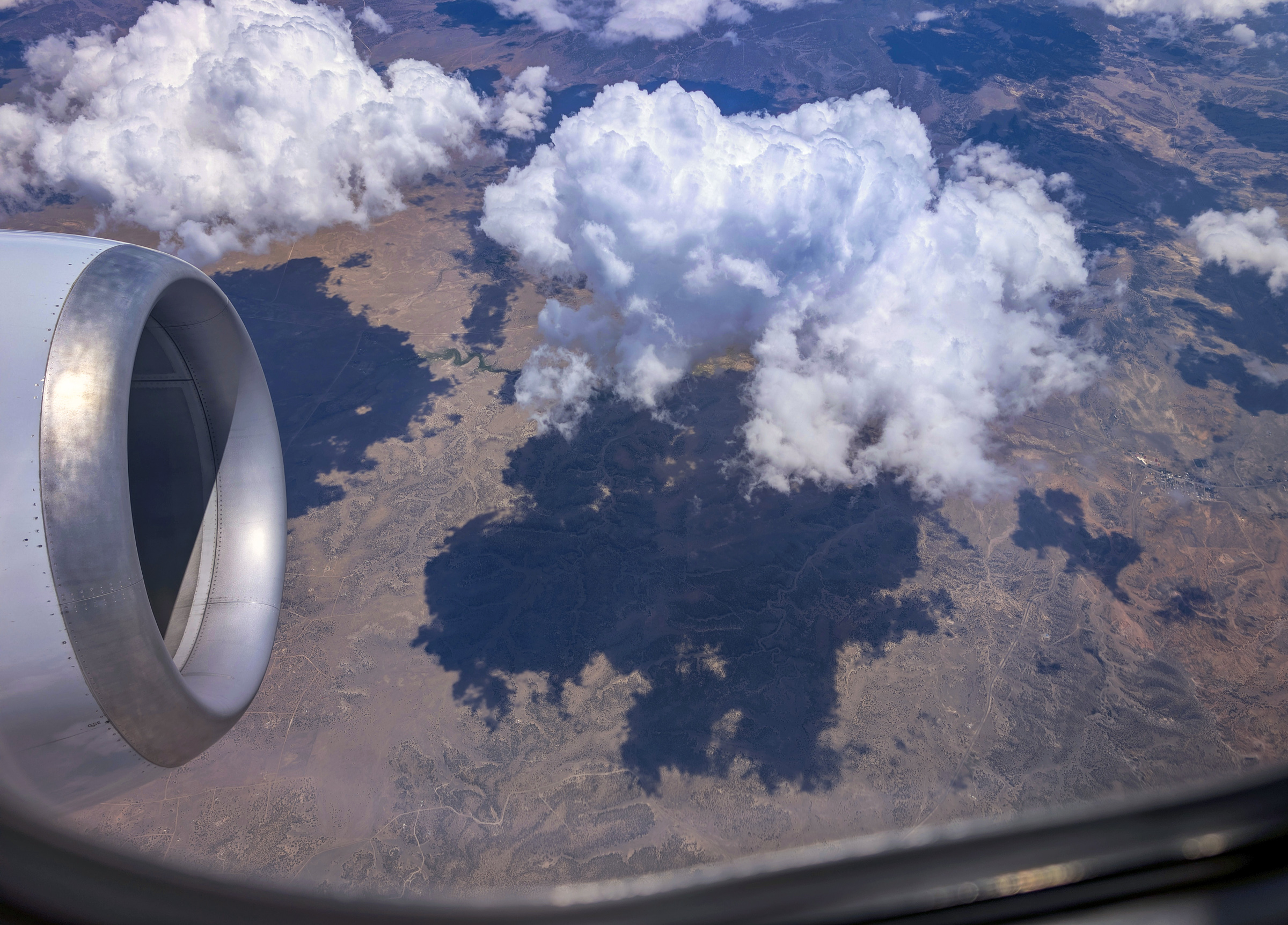
View from plane. Miles hibh Love the shadows of the clouds. What chaos theorists call “Poincare sections.”

My standard move for telepathy in my later novels is to use a biotech object that I call an uvvy. “Uvvy” is pronounced as in “lovey-dovey.” A cozy, friendly-sounding word. It’s like a small banana slug. Actually a little smaller than a banana slug, and slightly alive, but, you know, not too live;y. You put one on the nape of your neck. They come in different colors, and with individualized patterns.

Young Rudy observes that view and dreams of being a Beatnik Science Fiction Writer.

You put the uvvy on the nape your neck, and it picks up on your brainwaves. It doesn’t put tendrils into you. You do not ever want to put tendrils into your brain. And above all, you don’t ever want to put a chip or a biotech device inside your body. If are at all familiar with tech, you know, you know about upgrades.

Barb and Rudy at the fun and funky dance club Poor House Bistro in good ole gets-no-respect San Jose CA.

You don’t want a chip inside your head because after awhie it’s going to say: “Well, you have version 2.31, and that build has a critical problem. Come into the lab, and we’ll fix you up with version 3.17. Upgrades are fee. In the future, you’ll want to check in with us every six months or so. And othehrwise we’ll contact you. Thank you for being our partner.”


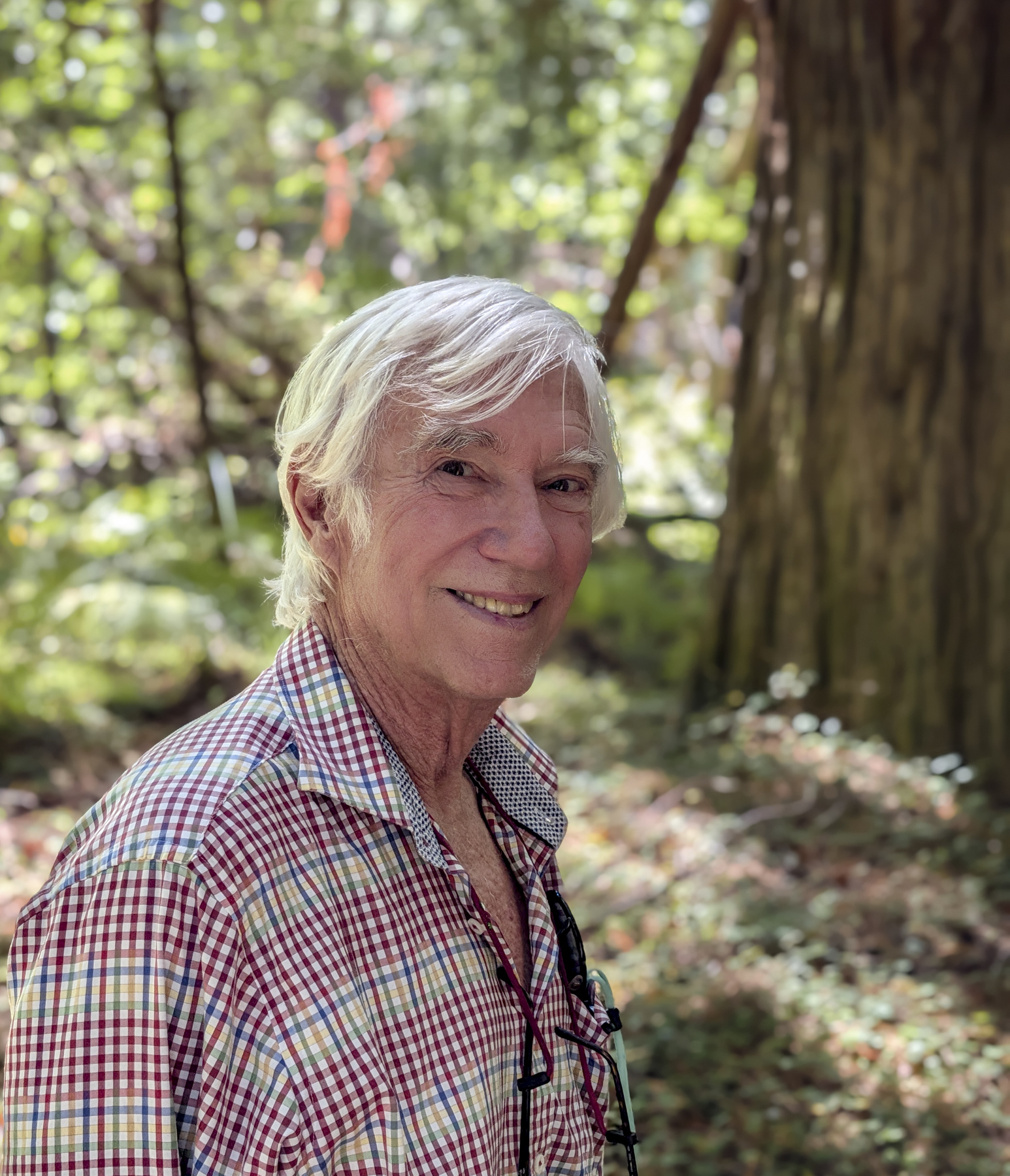
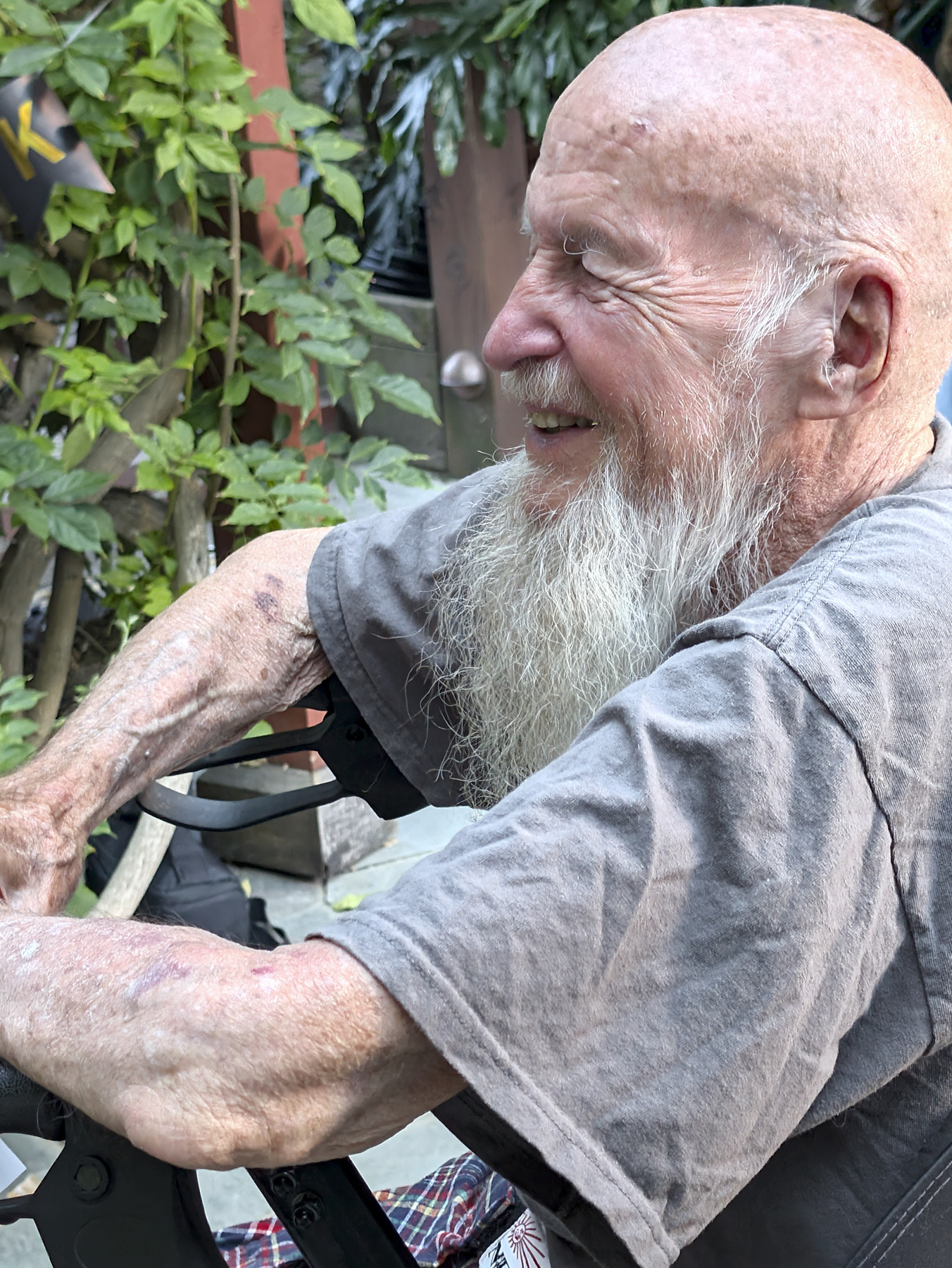
Whale City Bakery in Davenport CA. I love this old man.

You don’t want the upgrade procedures. And you don’t want tendrils.

But can the neck-riding uvvy pick up your bain waves well enough? Electromagnetic signals can be faint and fuzzy. Well, we have our hopes pinned on quantum mechanics. Quantum mechanics like this magic Genie that SF writers and start-ups like to invoke.

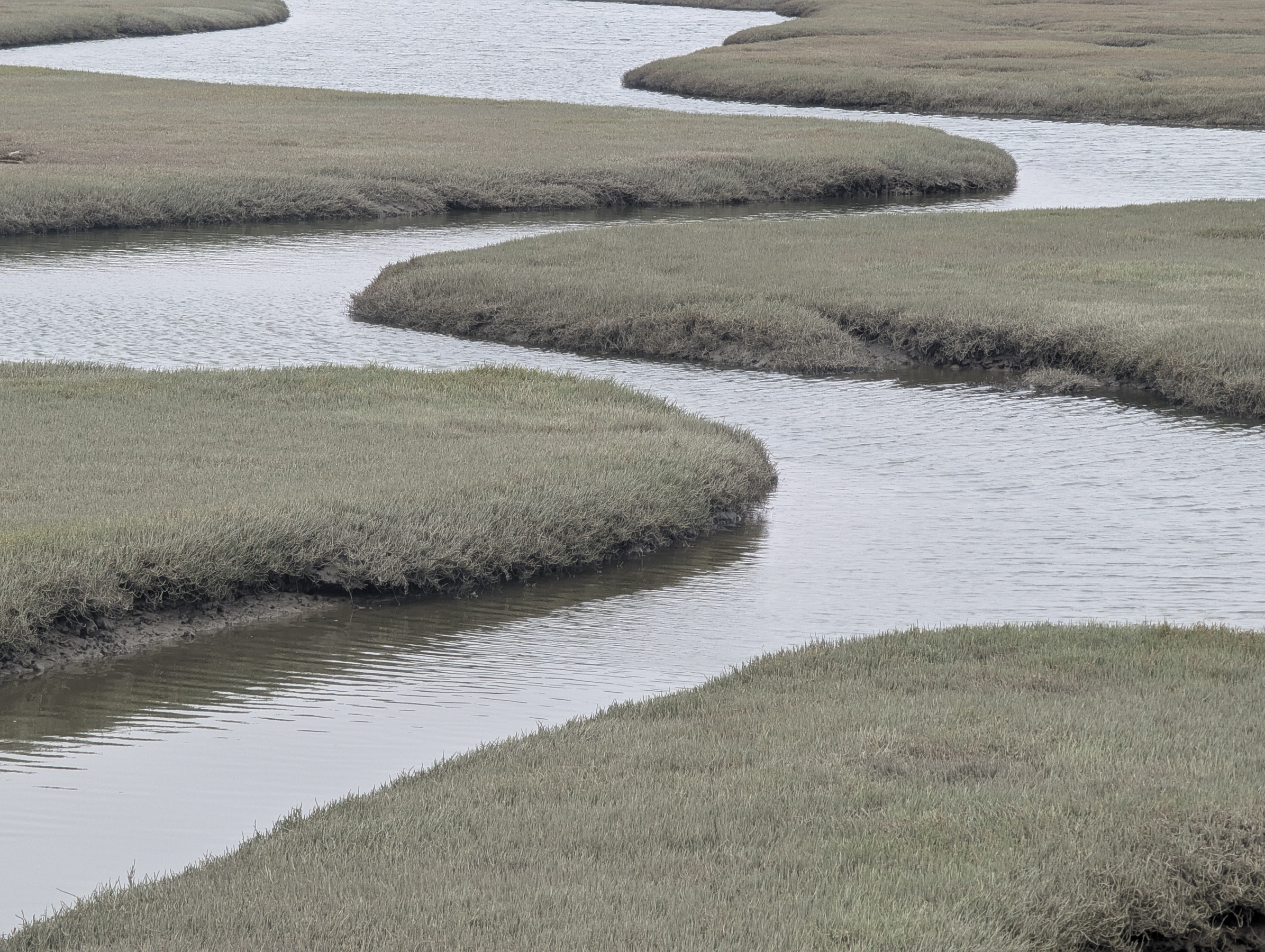
Wetlands at Point Reyes park. I adore these kinds of “lop lop” curves. I got that word from Max Ernst’s writing.

We do have quantum computation starting to work now, and it’s advancing ratjer drastically jow. But the quantum effect that might help more with telepathy might be quantum entangement, which is something different. Entanglemen has to do with the notion of separated physical systems might be locked in harmony. Perfect for long-range signalling, right? I used it in: Postsingualr, Million Mile Roadtrip, Juicy Ghosts, Sqinks.

Not that I really know what I’m talking about. I do knonw some science, but really I’m just an SF writer.

The simplistic notion about quantum entanglement is that you  get deeply in sync with someone. And then when you think this thing here, the thought might also over t  here. In the other person’s head.

As I mentioned before, we do sometimes get flashes of this. When you’re with somebody you know  very well. Like a lover, or an old friend, or a family member. Could be that you’re just reading their micro expressions or picking up their pheromones. But sometimes you really do get this vibe of knowing where they’re at.


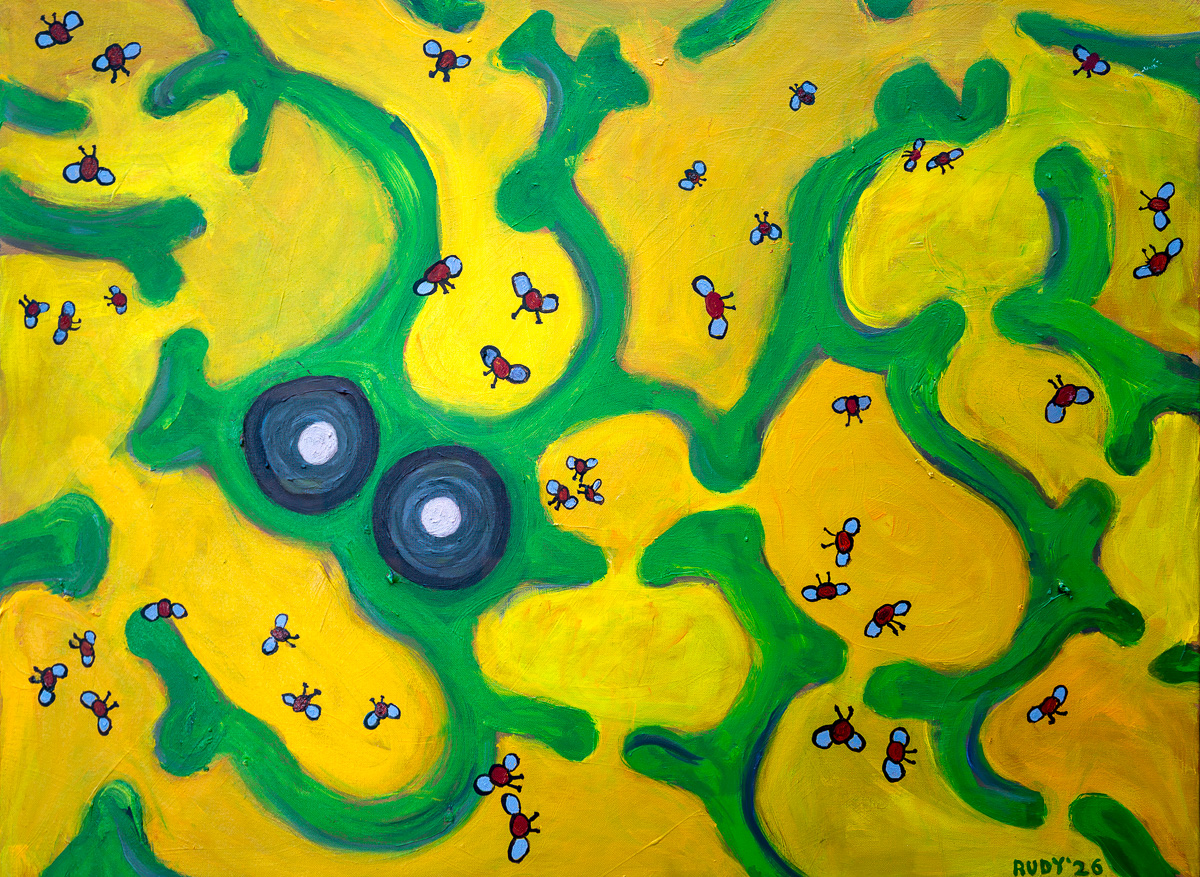
“Maze” With cartoon flies looking for something icky in the basement.

It’s worth noting that the mind-meld type of  contact seems more likely to happen when you’re physically face to face with a person. Online Zoom hookups feel way flatter. But of course this might be from the lo-fidelity of our remote video tech.  But there’s a sense that you’re more likely to enjoy a full quantum-entanglement with somenoe who’s physically present.

The contack couple possibly be enhanced by the fact that you’ve just been eating or drinking the same things. I think it was John Updike who remarked that if you live with someone for sevaral years, you are eventually made of more or less the same batches of  molecules. And, who knows, that might have something to do with quantum entanglement.


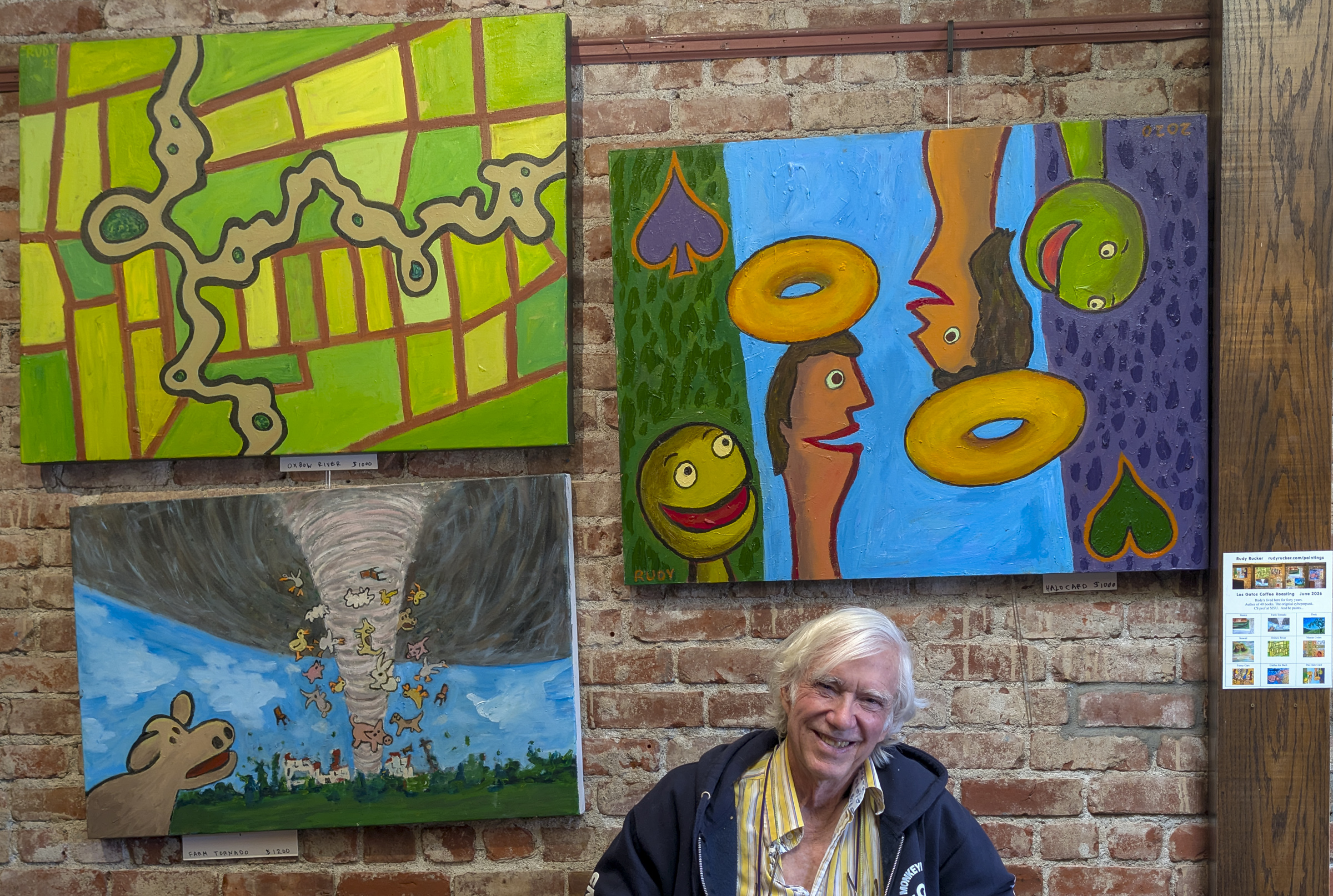
My art show at Los Gatos Coffee Roasting. Reminder: you can buy my originals at Rudy’s Paintings page.

I do happen to think that pheromones are very important. When you find somebody and you’re subconsciously deciding whether to fall in love with them or not, it’s could have to do with the simple fact that certain long, floating molecules from one person are fitting into certain cellular receptors in the other person’s nose.

“I like how you smell.”

Never forget that we are not just lifebox data patterns of neuronal connections that can be stored in the cloud. We are physical bodies, with all that entails.

You  meet someone, and date’s pheromones fit into your receptor sites and you’re all, OH yeah.

And maybe it’s not just a matter of drifting molecules. Maybe there’s this quantum field aura that glows from your brain. A field of muli-dimensional Hlbert space wave-funcntion energies, as I like to say. Some very complicated phenomenon which we don’t even begin to understand.

Keep mind, after all, that we’ve only been doing science for, like, two hunderd years. A small span against the million or so years that higher forms of life on Earth have existed!

One of my first photos with my new Pixel 11. Un-fucking-believable.

So, yes, we’re far from being able to to manipulate  or measure our brain waves, whether electromagnetic or quantum mechanical.  But we know they’re there. So sure, telepathy can happen.

As an example of drastically rapidly we’re advancing, just think of cell phones. If out of the blue you had seen a few of them in 1890, you might already have said we had telepathy.

Like, you’re standing on a hill, holding a little box, and somebody on the other side of the country is holding a little box, and you’re talking to them? And you’d be like, how can this be? This is telepathy!

Painter that I am, I individualize my phone cases. It cuts my chances of losing my phone on any given day from about 10% to 3%.

I remember when cellular phones were first coming, and I had this feeling they’re too complicated, and I was at the airport and I aw a very average guy in a business suie holding his phone to his head, like a kid with a toy, and I’m, like, “I can use one of these, too! It’s not that hard.”

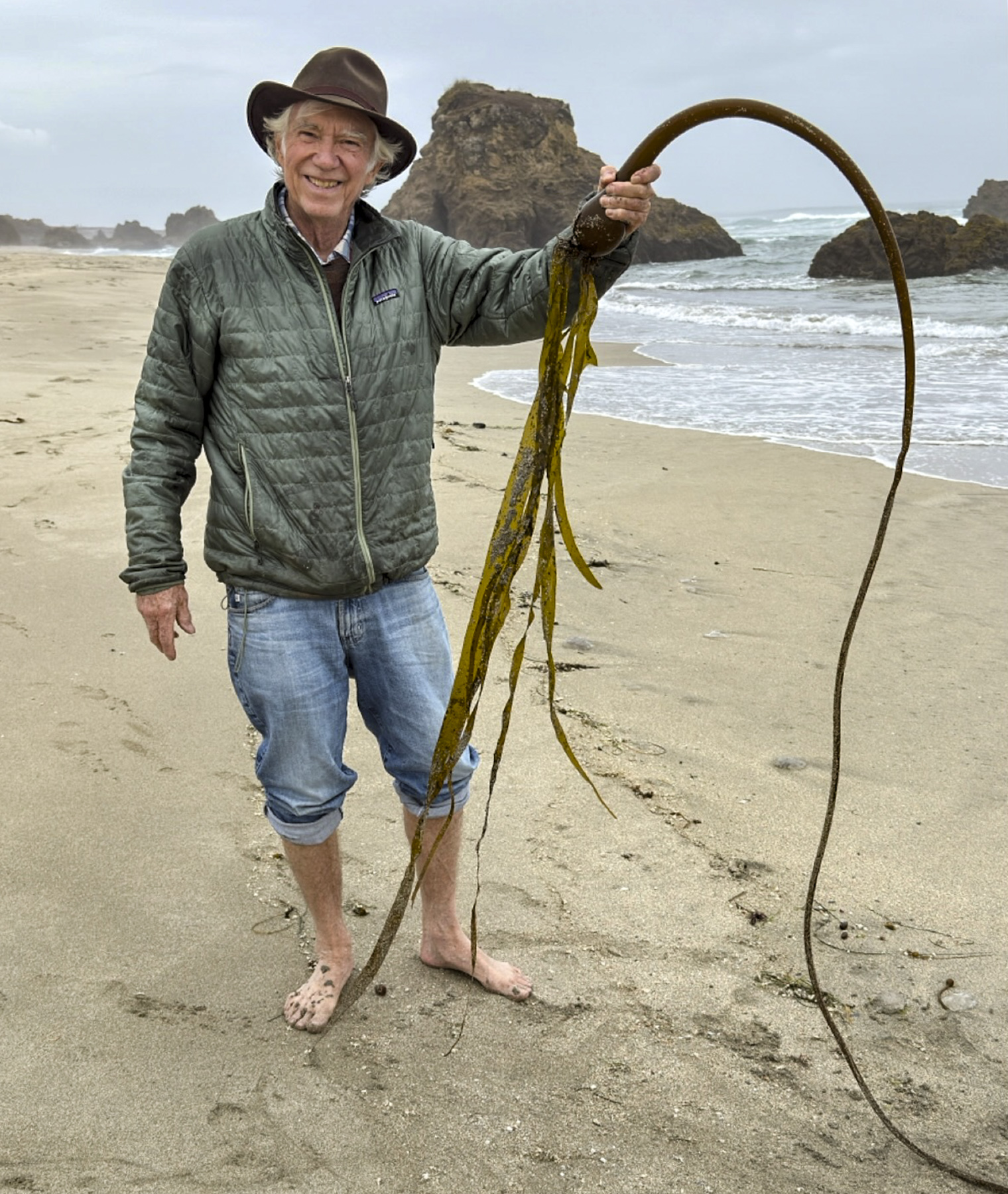
Bull kelp at Fort Bragg. I ;ove to whip the beach with these things.  While singing Neal Young’s song, “Guess I won’t be goin’ to Woodstock for awhile.” With the whip hitting the sand on the beat. No reason. It’s just fun.

So? I think we’re going to get real telepathy in in our real life, not so far away. And that’s going to make a difference. I mean, look how much smart phones have changed the world.

Very briefly, one other thing. I like how AI, can generate pictures and now videos. And here then, we’ve got the solution to a perennial problem. Every science fiction writer has the Hollywood dream that some day they’ll make, a movie out of out of their book, and everything’s going to be just rosy.

Look what the appearance of his movie Bladerunner did for Phil Dick! He died?

But seriously, I would say that it’ll happen for all of us in 60 years, or maybe sooner. It’d be  easy to take a novel and turn it into a feature-length movie. With really good rendering thaat’s completely realistic if you like. And the plot can either tweaked by the AI, or not…you an adjust this. That is, your novel becomes like sheet of music that is being played.


At a Fort Bragg club.

And of course if that’s the only way you can get your movie made, poeople might cluck and say, oh, he’s a self-producer. Or maybe not. Maybe the craft of making the conversion will be a thing.  Like engineering  prompts.

It’ll be really interesting when any book in the world can be a movie. An SF concept to explore.

People really don’t read as much as they used to, right? But they’ll be “reading” via their custom AI-made movies.

Filmifying.

Sooner than you think. Where the world snake bites it’s tail.

Armadillocon 1. Writing Cyberpunk. Rudy Books. Austin Photos.

September 21st, 2026

Bruce and Rudy at Armadillocon!

I rarely go to SF cons…in some ways the field has mutated away from my style and interests. When I was starting my career, it seemed important to attend these cons to make contacts. But now I’m eighty, and I have essentially no chance of getting a big publisher to accept up my work anymore. Even so, I am still writing novels, and I manage to keep my work in print via my small press, Transreal Books.

Over the years my two main collaborators have been Marc Laidlaw and Bruce Sterling. I’ve published ten stories with Bruce, with nine of them in our anthology Transreal Cyberpunk. Note that this site also includes links to Bruce and me reading the stories. Regarding my stories with Marc Laidlaw, there are seven of them, to be found in my Complete Stories..

I don’t get to see Bruce very often, and my main motive for accepting the generous invitation to Armadillocon was that I wanted to spend time with him. We were on a two-person panel, and I managed to tape it. What we have in this blog post is a partial transcript, primarily of my sections of the panel. You can hear a somewhat fuller version of it in my podcast of the event.

And now let’s get on with it…and and read what I had to say about one of my early novels, White Light.

I like putting math into my science fiction. There aren’t that many mathematician science fiction writers. That I know of, well, Lewis Carroll wrote Alice in Wonderland in a way that’s mathematical science fiction, and he wrote some interesting books on logic.

One of the first books I wrote was White Light. I was excited about the idea of people taking LSD and seeing the white light, and the white light would be god, the mystic One. And I had in fact taken LSD at that time, also peyote, but just once each. I always liked the idea of God being a white light, as I’d seen it.

If you go outside and you look around and there’s something you see outdoors, what’s the one object that you think, “Well, this must be god,” and that clearly is the sun. I mean, it outshines everything else. White Light was presented as being about infinity. In mathematics, I got my PhD in mathematical logic or, more specifically, in set theory.

And this would be 1968? What I wanted to write about was levels of infinity, and this was the peak of the 60s. So, of course, I was interested in Infinity.

Infinity was, you know, far out stuff. And there’s this wonderful theorem that was proved by George Cantor in 1888 that there are two different levels of infinity. People might just think infinity is infinity. But there are levels.

If you have a set of numbers one, two, three, four, five, all that, how many are there? We say it’s aleph null. And then, what about if I look at the points on a real number line like 0.677… and each real number has an endless tail of an infinite decimal expansion. Cantor proved there’s more real numbers than there are counting numbers. There’s no way to to count them up in a row.

There’s always one that you’re going to miss, and so there’s a second level of infinity, and they call that, well, they call that size of the set of all real numbers c. For continuum. And the infinite number that comes after aleph null is aleph one. So is c equal to aleph one? That’s Cantor’s Continuum problem. It’s such a heavy, cool, science-fictional thing to ask.

The greatest logician who ever lived was Kurt Godel. He was at The Institute to Advanced Study in Princeton, and I was going to Rutgers in grad school near there. And somehow, I don’t even know how, I managed to worm my way in to meet Godel in his office at the Institute for Advanced Study. He was an extremely reclusive man. He was somewhat paranoid. And I was just this hippie grad student who’d taken LSD and seen god, and I was in a seminar with this cool Japanese logician Gaisi Takeuti, and somehow I managed to get in to talk to Kurt Godel and talk about Cantor’s Continuum Problem.

Talking with Godel was like telepathy. He knew everything I knew. He laughed a lot. I told him my big theorem from my Ph.D. thesis and he was like, “Yes, of course.” It was like meeting the guru. The smartest man I’ll ever meet along the long, weary journey of life. Once in a great while you meet a truly intelligent person.

After grad school I got a job teaching in this little village called Geneseo, in upstate New York. All my life, I’ve had trouble getting jobs. I’ve had trouble getting published too. There’s something about me, I’m always too cool for the room. I’ve been too cool for the room for my whole life. But I managed to scrounge out this job in Geneseo. And I’ve gotten my books published.

Geneseo wasn’t bad. I was making ten thousand dollars a year and I had some good courses to teach, in particular History of Math. And I loved teaching Geometry. I made it into a course of my own and wrote notes that became a pop math book from Dover, called Geometry, Relativity, and the Fourth Dimension. I also wrote my first SF novel, Spacetime Donuts.

After a couple of years they fired me, basically for political reasons. I was the only hippie in the math department. I got a grant to go over to Germany to the University of Heidelberg for two years. I went over there with my wife Sylvia, and our kids Georgia, Rudy Jr, and Isabel. We sold our house and went to Heidelberg.

Kind of an Exile on Main Street thing, but all in all we liked being there. I worked on the continuum problem at first, reading all of Cantor’s untranslated essays in German, and publishing a math paper about the problem. But after about about six months, I’m like, you’re never going to solve the full problem.

And then I thought, well, why not write a science fiction novel about it? Yes! There’s this French author called Renee Daumal, sort of a Surrealist although, like cyberpunk, the surrealist movement had competing factions, and he liked to say he did pataphysics. He was a recreational mountaineer and he wrote a little-known posthumously-published novel called Mount Analogue, about somebody who found a mountain that was infinitely high, on Earth.

The mountain was in a place you didn’t usually see. It didn’t show up on the maps, but you could go there. And I thought, okay, I’m going to use that. There’s going to be a mountain that’s infinitely high. So I wrote White Light while I was there on that two-year grant with my little family in Germany. It was a transreal book, and I was the main character, and I set the book mostly in Geneseo, where we’d lived.

Armadillocon organizers Matt Rifley and Devon Foster , with my girlfriend Barb Ash between them.

I should mention that when I say I write transreal books and I paint transreal paintings, what I mean is that they are always about me and my family and my friends and my problems and my environment. But they’re warped by SF tropes. Instead of nostalgia you have time travel. Instead of love you have telepathy. Instead of a soul you have a memory lifebox in the cloud. Not surreal, but transreal. The same but different.

There was a graveyard in Geneseo that engrossed me. It was very crumbly and old, and, writing about this in Heidelberg, I said, okay, my Rudy character is gonna go there, and he’s gonna get Zapped in some way, and leave his body, and he’s going to fly out far away, infinitely far away, and he’s going to the afterworld, but he won’t be dead. And there’s going to be infinitely high mountain there, like in Mount Analogue. The first range of Peaks goes up to aleph null, and then goes higher up to alef one and on and on and on, and my guy is going there and he’s gonna make friends with a giant cockroach called Franx in honor of Franz Kafka.

And my man starts out at Hilbert’s hotel where there’s always room for another person, because you can just move every guest to the next higher room number. So he goes there, and all kinds of cool things happen. There’s this one chapter, I like, it’s called “Candy Hearts.” And every line of dialog is something you’d see on one of those candy heart that come in bags.

Love You. Stink Pot. Sex Bomb. Too Cool. I’ve always liked these slogans. Everybody in the chapter just says lines with two words. Different ones. It was a great chapter.

As I mentioned, White Light is transreal. The main character is a young professor, and he’s got children and his wife is desperately unhappy because she’s an extremely intelligent woman, and she’s being shackled into this housewife thing and hr husband is unsuccessful and barely employed. A lot of my job is teaching calculus to—well, I wouldn’t call him hillbillies, but they’re upstate New York people. I never learned calculus in college, or paid attention, but they had me teaching it, so I finally had to learn it.

Having a job was fun, but my life was hard. There was the constant threat of being fired because they didn’t like me. And on the transreal front, there’s a whole thing about the guy and his wife. But they together when he when he comes back from infinity.

At the very end, he’s higher and higher up the mountain. I had this vision at one point in grad school that Zero and Infinity are the same thing, and that’s a meditation.

Trick is to be thinkig “and this too, and this too,” and the same time be thinking “not this, not this.” Adding and taking away. Trying to see true nothingness, and trying to see everythingness. And they’re going the same place. It looks like they’re going around away from each other, but they hit each other in the white light, and then you’re there.

And, that’s where it ends, but then my character notices. I don’t know, he notices there’s this. Sort of a manhole on the floor. So, what’s in there? He goes through and he ends up back with his wife on Halloween in Geneseo.

Comment by Bruce Sterling

“Okay, that sounded like a very eccentric recitation there, but you know when you’re reading it, it actually goes along rather well as a science fiction narrative. And maybe if you were going to tell somebody how to write cyberpunk, it’s like, I think what I really need are, like. infinitely tall mountains based on Cantor’s continuum problem, and all the dialogue should be taken off the surface of candy heats!

Those sound like two deal breakers right there. But if you actually are a cyberpunk writer and you’re reading a text of this kind, it feels extremely liberated. The constraints really don’t matter at all. White Light doesn’t have any of the standard kind of cyberpunk visual gaming or movie cliches, like, pretty girls with large weapons, or somebody with one eye that has augmented reality, or there’s no kind of decaying neon cityscapes in it.

It’s just this  extremely tippy narrative, right? And people don’t get it about how this works in cyberpunk. Practice it. I opens this up.”

By the Texas Capitol. Men and their weapons. Dick and balls!

Back to Rudy.

Another book I’d like to mention is Saucer Wisdom, a kind of cyberpunk thing I did with a little help from Bruce Sterling. I had a friend at Wired magazine, Mark Frauenfelder of Boing Boing fame, and he said, “Rudy, why don’t you do a book about your visions of the future? I’m trying to figure out how can we I do this. We have to find a way to frame it.”

And then. I thought, all right, there was very popular 1987 book Communion by Whitley Strieber. He claimed he’d been abducted, and they probed his anus and all that. A huge hit. He made abduction a popular thing.

So I’ll do that. I’ll say I have a friend who’s been abducted multiple times, and he comes and tells me what he saw, and they always take him to the future. And each chapter is a different trip than he went on. One of my visions in each chapter. d. My agent and I are excited. Wired has a lot of money, and they don’t know what they’re doing because they hadn’t published any other books yet, so they don’t realize how cheapy I can be had.

So, I drive up to the pitch meeting at Wired in San Francisco — at that time I lived down the peninsula near San Jose.

And I brought along a friend of mine who was supposed to be the abductee. My college friend and old drinking buddy Greg Gibson, he’s visiting me, and he’s he’s got a beard down to his chest, he’s wearing like Good-Will clothes and he’s scowling. Very weathered. We made up the name Greg will use: Frank Shook. Love it. “Frankly, I’m Shook.” When I almost got drafted, the guy in front of me was named Shook. It all fits. Synchronicity.

I bring Greg to the meeting and it’s like, 20 and 30 year old people, and we just lie to them. “My friend Frank Shook was abducted many times. And he told me the things he saw and I want to make a book out of that.”

And they’re interested, they’re excited, and at first they’re not sure if I think Frank Shook is telling the truth or not, but I insist he is, I say we’ve had a lot of intense experiences together. In the books introduction, Bruce says this was, like, very cyberpunk, to be pitching complete and total bullshit to the Masters of the Press. But I’ve got them, and they’re saying we like it, we like it.

And then, about halfway through the meeting, Greg has a fit. They’re asking him him questions, and he goes, “It’s all so… It’s too hard to talk about it… I can’t take anymore.” And he stumbles out of the room. Going out to get a drink—we already picked a bar where we’d meet.

And so then, afterwards, I’m alone with my friend Mark Frauenfelder, and I feel duty bound to tell him the truth: “Actually Greg’s, just a friend of mine, and he’s not really a saucer abductee, and this is just a scam.”

And Mark says, “That’s okay. That’s okay. It’ll be a secret between you and me. We’ll, promote this as actual abductions. It’ll work.”

But I’m a little worried. You know, it might damage my already very questionable reputation. That I’m writing an…an alien abduction book? But my agent gets Marc’s boss to offer us $70K, so what the fuck, I’m writing it. It’s the best advance I’ll ever get in my life.

So I went ahead and wrote it, and it’s great book, great book. I go fully transreal on it. The Rudy character is in fact called “Rudy Rucker” and it’s about him writing this book.
I did have some trouble with my friend Greg, who got maybe a little too far into his role, and he’s phoning me up in character.

I transrealized this pollen by giving the fictional Rudy Rucker a lot of problems with the character Frank Shook. Like, during the book, Frank steals my manuscript and my typewriter. And at the end, I have a heavy alien contact at the foot of the Devil’s Tower — which appears in the canonical Close Encounters of the Third Kind.

I actually travelled out to Wyoming and visited the spot in order to shake loose some images for the book’s end.

Yeah, so, so then I give the manuscript Wired, and the top lady says, “You know? We don’t want to do this book. We don’t want to do books at all. Books aren’t a profitable thing. We can give you a kill fee. Maybe twenty percent.”

And this where my agent Susan Protter came in. Her father was the treasurer of the Communist Party of New Jersey. So this guy knew about business deals, right? It was in the blood. Susan went after Wired, and they paid me the full seventy thousand dollars.

And then Susan sold it to David Harwell at Tor Books, who paid me as well. And he said, “But we’re not going to pretend it’s real.” And I said, “Oh, that’s okay, it’s too much pressure on me if we do that.”

And we call it the book Saucer Wisdom, which amused me, as wisdom is, after all, the last thing you associate with people who believe in UFOs but…maybe? Could be, could be, seekers!

Barb at the Austin Museum of the Weird

It’s a great book, and I drew the I drew the illustrations for it. And first we were gonna hire my artist friend Paul Mavrides to do the illos, and Wired was going to pay him, but Tor doesn’t want to spend that money, and Hartwell says, “Look, these are drawn by a nut in a flying saucer, so how good do they have to be?” And that’s about my my drawing level.

And then Bruce wrote a great, great intro, explaining all the ins and outs. But the book didn’t do that well. You could almost say it bombed. Tor classified it as science fact instead of science fiction, which was probably a mistake.

It’s curiously neglected, as I say about so many of my works. The real saucer nuts didn’t want to buy my book because they could tell I was mocking them. And science people don’t want anything to do with saucers, you know, so everybody kind of spit on it. But it’s a great book anyway. And later it got reprinted and Bruce came out of the woodwork and wrote another introduction to it, and this one was even funnier.

Comment by Bruce Sterling

“It’s kind of a good example of cyberpunk technique in action in the sense that the doors and windows have blown out in kind of a spectacular fashion. I mean it, you know, it’s not a like, it’s not going to win the national book award. It’s a very eccentric text, but I’m all in favor of that, and I think you can’t, like, judge it by whether the New York Times best seller list approved of it. It’s more like Saucer Wisdom is going into a space where no one else has ever gone, right? I mean, like, you’re just reading it, and it’s so eccentric and different, that things are sort of trampled? And if instead of that you actually do what people want and provide things that people really want to read a whole lot, that’s not even science fictional. That’s a waste of time because there are a lot of other writers who are actually intent on, like, achieving Market Success, and eventually they’re just going to copy whatever you’re doing anyway, and they won’t be advancing the field or opening new things up.”

Back to Rudy.

Let me talk a little about what it’s like to have a writing career. It’s steady work, you’re never done. It’s not easy. For most of us it never becomes easy to sell your books, not over the long term. But you keep writing anyway because you like to write. Writing a novel is one of the happiest places I’m ever in.

I have no control over the outside world, and when I’m writing, I have control over the world I’m imagining. And I like the craft. It applies at many levels. At the bottom, writing is like poetry, in that I think about the sound of the words. I would never play music while I’m writing. I need to hear the rhythms and harmonies of the words.

Writing is a craft, I’ve been practicing for sixty years. I don’t want to stop doing it. But, as I say, it’s hard to sell your novels, At no point in my life have there been more than one or sometimes two editors who would buy my novels. Maybe three who would buy my stories.

Only a few very small windows or cracks where you can get through. John Oakes did a lot for me. And I had some good, safe years with David Hartwell at Tor. But he died a few years ago.

Dave had really a lot of books, thousands, and he was carrying a box of books down the stairs, and he fell, and he broke his neck, so in effect the book collection killed him, which is crazy. Odd and ironic. But I wouldn’t call it funny. He was a wonderful man.

Daughter Isabel with a new painting.

Here and there, other editors have cropped up for one-shot deals. But soon they’re swept away by the maelstrom. Actually I tend to feel a little sorry for editors when they buy a book from me. They think they’re going to make money, and they’re enthused, but deep down I know they’re throwing their money away. Well, let’s say they’re making a donation to the field of Literary SF.

And by now, as I mentioned, I can’t find any big publisher at all. The new editors would rather publish younger writers because those are like lottery tickets. You never know who’s going to be a big seller. And, face it, my sales records aren’t that great.

Go for a small press? One thing, the less someone pays you, the worse they treat you. You might have to wait over a year for a small press to decide on your book. And if they take it, the advance may be extremely low. And any promotion they do is going to be minimal.

So that leaves self-publication. To put a better face on it, I say that I am a small press. Transreal Books. It was good enough for Virginia Woolf, right? Thanks to modern tech, the self-pub path is clean — if you can learn how to use programs like InDesign, Photoshop, and Calibre, you can put together a professional-looking PDF for print, and an EPUB for ebook. And your book will be onsale in every every online booksellter. And, weirdly enough, doing this doesn’t cost you a cent. Well, okay, less than $100 for an official ISBN book number.

Lots of details pf course. Being a cyberpunk former computer-science professor helps.

In any case, I’m still alive, my books are still appearing. What about a book advance? Well you do that by running a Kickstarter for each book. I might get something close to $15K for each new book. That’s work too, but at least I’m still out there. Keeping it alive. Spreading the message.

I just published my 26th novel. It’s called Sqinks, spelled with a Q. Once again it’s totally transreal. It’s a novel about a writer who’s a washed up science fiction writer. It was inspired by William Burroughs’s last novel, The Western Lands, which has a similar setting.

My old SF writer is living in a dumpster. By the San Francisco Bay. Happens to be a real commune that I’ve visited. In the novel we’re a bunch of artists lived there, and we’ve got, rogue or pirated everything: gas, electric, water, internet. My guy lives there without paying anything.

As of summer 2026, my old SF-bookseller friends Jude Feldman and Alan Beatts have prints of my paintings on sale at their store Borderlands on Haght St. kind of ironic that I ended up on Haight. Kinda where I started, at least in terms of inspiration by R. Crumb and Zap Comix.

My Sqinks hero’s main his problem is that his wife has died, just like my Sylvia died with in 2023. And he wants to find a new woman to love.

Also my Sqinks guy can’t sell any books, but he’s going to write another one anyway, and maybe this one will sell. And the novel he’s going to write will be Sqinks itself. The world he’s living in. It’s a little like the Saucer Wisdom setup, but in that book the author is supposedly writing an account of what actually happened to him, but in Sqinks he’s explicitly writing a novel which somehow turns into his actual life. The chain of causation is slightly different.

Regarding my futuristic hero’s writing process, he doesn’t need a laptop or a hand-held to write. He can write in your head. It’s like the cloud is in your head. It’s not far away. You can create the manuscript all in your head. My guy is writing a book that it’s fully immersive transreal. As I said, he’s in the novel he’s writing, and the novel he’s writing is Sqinks, which is the book that you, the wise consumer, are going to read. I’m stressing this because it’s an unusual setup for a novel. It’s experimental literature. Maybe Nabokov’s Pale Fire is a little like this.

The character in the book know he’s in the novel, and some of the other characters know it too, and at times they might ask him to change the story. Well, he might change try to change it. After all he’s in control of his reality, which is, as I’ve mentioned, one of the nice things about being a novelist

One of the meta facts about Sqinks is that, as I was beginning to write it, I did in fact meet a woman to love. This would be Barb Ash, who is Carol C in the novel. It often happens that the world I live in takes on a resonance with the world I’m writing.

That’s the meta transreal thing. There’s an element of magic that happens when I’m writing. If I get so intensely involved with the book, the universe starts dancing with me, and it’ll, like, throw things my way. Pieces of synchronicity.

Like, I’ll be writing about something. And I’ll see that same thing in the street the very next day. My fictional events will come up to me in the real world. It’s a strance and magical way of living. It’s not like regular life. I’m at a higher level of existence, and it’s great. I don’t force it. It just happens. It’s a way of being high.

I have always loved getting high, and about thirty years ago, when I was fifty, I learned that I don’t have to take anything to be high. I can be high all the time. It’s a matter of paying attention. Why would you need to take anything in order to get high? This is such a ridiculously intricate, complicated world, and it came from nothing. We don’t know why it’s here. And my new Barb Ash is here too. Thanks to me writing Sqinks.

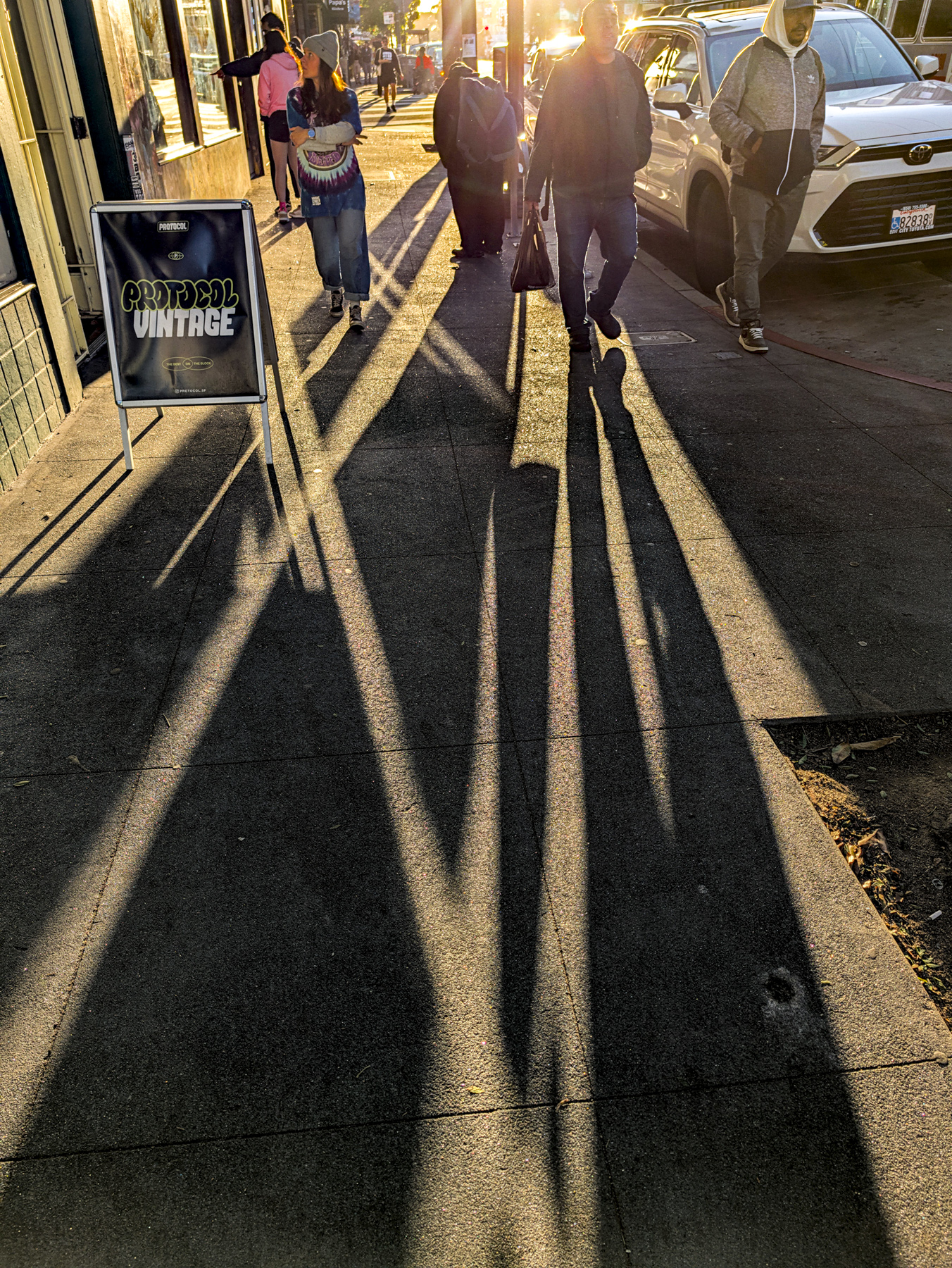
Dusk in the Haight, sun off the Pacific, the day that Borderlands hung my prints.

Bruce has mentioned the political significance of the fiction that we write.

A lot of my books are primarily fantastic, but I did write an explicitlyly political novel in 2021, right before Trump’s first election. I rushed the book out via my Transreal Books because I had some faint hope that it might possibly help stop Trump. My book is called Juicy Ghosts, and it’s about a group of computer freaks who assassinate an evil, illegitimate president like the big T. He’s called Ross Treadle. My guys bio-program some giants wasp to sting the guy to death at his bogus Inauguration.

Killing Ross Treadle in the novel felt so good to me that I did it two more times. Seems he’s he’s left a clone, so my charactacters tweak the clone so that it synthesizes nitroglycerin, and the clone explodes. And Ross Treadle has a lifebox model of himself living in a Russian-controlled part of the cloud, so my guys trip into Hilbert space and trash that third version of Ross Treadle as well.

And of course there’s an evil cabal of people like the ones who run America now, the billionaires. And the next job in my book us is to take them all down. It’s a very political book. Not flue music in the woods. A novel about the bitter, hard reality of American today. It anticipates a lot of what’s happening today.

I was actually afraid I’d be arrested or sued or secret-agented for Juicy Ghosts, and I hesitated. The regular American publishers wouldn’t touch it. Although it did come out from a big publisher in Italy. In the US, as I say, I self-published it via my Transreal Books. My dear friend and sometime collaborator Paul Di Filippo reviewed it in Locsus online. Otherwise bupkus in terms of publicity. Jack shit. Curiously neglected. Too cool for the room.

My 90-year-old freak science pal pal Nick Herbert. Once he and I were lost in a park and it was raining and I said, “This is a nightmare.” And he said, “No, Rudy, it this was a nightmare, you could wake up.”

Why is my novel called Juicy Ghosts? The thing is that, as living beings, we aren’t just the brain. We aren’t just this pattern of neurons. We’ve got a physical body. The “ghost” is the AI model of your personality. What I call a lifebox. But to get real life you need to put the lifebox into a juicy physical body. For that you can grow a clone. Or use a dog. Or even a plant.

Another of the big SF elements in Juicy Ghosts is that the cloud owners are offering free lifeboxes to people. Like Google, Apple, Adobe and Musk—they’ll rent rent space for a software lifebox model of you that lives in the cloud. Immortality. It’s expensive. But if you can’t afford it, you can still get a lifebox model of yourself. The catch is that you’ll be a gig worker. Driving a car, or doing online sex with users, or programming apps. And you’ll still get some me-time off.

But my heroes find a way to make software immortality free. And you get a physical a body for yourself as well. A glowing torus of aether.

Heading home to Infinity.

Podcast #119. Writing Cyberpunk. Rudy vs. Bruce.

September 17th, 2026

September 12, 2026. At Armadillocon in Austin TX. Spirited one-on-one panel about being a cyberpunk writer. Me and Bruce Sterling. Kind of a pro wrestling vibe, even though we’re old friends and long-term collaborators. I taped this on site, and edited it down. I also have my edited text online as a blog post. Press the arrow below to play “Writing Cyberpunk. Rudy vs. Bruce.”

Play

And, if you like, Subscribe to Rudy Rucker Podcasts.


Rudy's Blog is powered by WordPress