Rudy’s Blog

Buy Rudy's books! Click covers for info.                 Blog text and images copyright (C) Rudy Rucker 2012.


Archive for January, 2011

Painting of Monument Valley

Thursday, January 27th, 2011
Share


Monument Valley, acrylic, 24″ x 18″, January 2011. More info at my Paintings page.

I started this en plein air at Monument Valley in September, 2010. We had some warm days this week, so I got out in my “studio” (the back yard) and finished this one. Acrylic for a change, which works better when you’re carrying a painting around outdoors—it dries fast. Strong colors even if it is acrylic.

Those rock formations on the left are called the Mittens. This is an amazing place, with a strong spiritual vibe. The day after I painted this, I got up before dawn and hiked down into the valley, around the mitten on the left, and back up—which took about four hours.

If you ever get a chance, go there and stay at THE VIEW, the Navajo-run motel right there with this view.

Share

Cronenberg’s NAKED LUNCH as Transreal SF

Tuesday, January 25th, 2011
Share

For whatever reason, most people don’t think of William Burroughs’s novel Naked Lunch as science-fiction, but really it is. In particular, it’s what I call Transreal SF, that is, a form of autobiography in which one’s experiences are made more vivid by transmuting them into SFictional tropes, see for instance my talk, “Power Chords, Thought Experiments, Transrealism, and Monomyths.”


[Hummingbird and Orchid by Martin Johnson Heade.]

Burroughs himself often wrote admiringly about SF in his letters, and said that’s what he was indeed writing. But people ignore this. Perhaps it’s that so few SF works aspire to such a high literary level, or that Naked Lunch doesn’t have a straight-through plot-line. But if you look at the tropes in the book, it really is SF¬—aliens, imaginary drugs, telepathy, talking objects … the gang’s all here.

I’m thinking about the book both because Burroughs is a character in my novel-in-progress The Turing Chronicles, and because I watched David Cronenberg’s Naked Lunch via NetFlix instant-watch last night.

What great cinematography—the framing, the colors, the segues, the simple but telling effects. The acting is great too, it’s understated, which is important—it’s easy to go over into gauche, hammy stuff when portraying legendary figures like the Beats. Judy Davis is a wonder as Joan Vollmer (called Joan Rohnert in the film), and as Jane Bowles, also called Joan in the film.

And what a wonderful script. Cronenberg himself has the credit for the screenplay. You can find it online, transcribed from the movie by some fanatic, at Drew’s Script-o-Rama. The novel Naked Lunch doesn’t have a single clear plot-line that would make a movie—indeed the lack of such a plot is a key artistic element of the book, and a key aspect of the mythos around the book.
For the purposes of the film, Cronenberg created what Wikipedia terms a “metatexual adaptation.” That is, he blended elements of the novel with the by-now-legendary story of Burroughs’s life—the shooting of his wife, the expatriate years in Tangier, typing the pages of Naked Lunch high in his Tangier room, Jack Kerouac and Allen Ginsberg helping him assemble the manuscript. All of this material is outlined in Burroughs’s letters, and in the reminiscences of his Beat friends—the transreal oeuvre is blended together to produce the transreal film.

It’s a brilliant move on Cronenberg’s part to have the typewriters be alien beings. For a writer in those pre-computer days, a typewriter was an object of great mana. A partner, a friend, a tool—more reliable than any computer ever is. I remember in 1982 going on a trip with nothing in my suitcase but underwear, my pink IBM Selectric typewriter and some Clash and Ramones records. And to have these machines become talking insects or alien heads is a great concept.

Cronenberg made two marketing moves to enhance the film’s general appeal.

First of all, rather than having the main character be addicted to opiates, the Bill Lee of the movie is addicted to not-quite-real substances like cockroach-extermination-powder and the powder of the “black meat,” taken from very large fresh-water Brazilian centipedes. Burroughs himself used this move in the novel—rather than going on and on about heroin as he’d done in Junkie, which is a turn-off for many readers. In Naked Lunch , the characters are obsessed with these more science-fictional drugs.
The second market-friendly move by Cronenberg—which aroused the ire of some—is that he plays down his Bill Lee character’s homosexuality. To some extent this fits with the Burroughs of the early 1950s. Bill was, after all, married for a time—before he shot his wife. And, judging from his letters, he was always put off by overly flamboyant flaunting of one’s homosexuality. One gathers from Burroughs’s work that there there was a definite transition period for him in the early 1950s, and Cronenberg sets his character in the period of the transition.

By time Burroughs was actually living in Tangier, he was well past the transition, constantly writing about boys in his letters, so in that sense the film is historically inaccurate. But we’re not talking about true history in the movie Naked Lunch . We’re talking about attaching the images and dialog of an author’s fantastic novel to a mythologized version of the author’s life. And in some ways the transitional state is a good choice to use for the film. In any case the character is, as Burroughs remarked to Cronenberg re. the film, “queer enough.”
I did find the ending of the movie a downer, to have Bill repeating the same dreadful mistake that he’d made near the start. Cronenberg is taking off on a possibly ill-advised remark by Burroughs to the effect that if he hadn’t shot Joan he might not have become a writer. That’s not a place that most of us want to go.

For my taste, it always a little cheap and obvious to give a novel or a movie a serious feel by using a hard, downbeat climax. What’s the line? “Tragedy is easy, comedy is hard.”

One of my favorite bits in the film is when the Burroughs character is talking to the Paul Bowles character, and the older man is telling Bill all these shocking intimate things about himself, and Bill says, “I’m surprised you’re telling me all this,” and Bowles says, “Well, I’m not saying it out loud. The conversation you’re hearing is telepathic. You see, if you look closely, the words you’re hearing don’t match the motions of my lips.”

Another great bit is when Bill is passed out on the beach with, he thinks, his broken typewriter in a gunny-sack. And Jack and Allen show up to cheer him up. And Bill mumbles, “A little trouble with my typewriter.” And the boys look in the sack, and all that’s in there is trash—empty pill bottles and cans and bottles. “My typewriter.”

Share

The Classic CHAOS Software Goes Multiplatform

Monday, January 24th, 2011
Share

Today I got around to using a fix that allows our old CHAOS software to run, I think, on every platform. See my CHAOS page for full details, and for the free downloads. Thanks to “Torbjørn Pettersen” and “Jac” for having advised me.

Summarizing some of that that page says, CHAOS is a shareware release of James Gleick’s CHAOS:the Software.  We provide both the complete executable and the source code for the 1990 Autodesk release based on the wonderful book Chaos, by James Gleick

The software was written by  Josh Gordon, Rudy Rucker and John Walker for Autodesk, Inc., with Josh Gordon doing the lion’s share of the programming work. It is our hope that this shareware release will allow educators, students and dabblers to freely use our software. Great for classroom use or individual exploration.

CHAOS can presently be run, using the free DOSBox ware, under Windows, Linux, Mac OS X, and other platforms.

CHAOS has six modules.

1. MANDEL. A fast Mandelbrot set program, incorporating: quadratic and cubic Mandelbrots, various fill patterns, quadratic and cubic Julias, and the gnarly "cubic Mandelbrot catalog" set that I call the Rudy set. For more up-to-date info on these fractals, you can also look at my 2010 formula files and parameter files for the commercial Ultra Fractal software as described on mys blog post, “The Rudy Set as the ultimate Cubic Mandelbrot.”

2. MAGNETS… A Pendulum and Magnets program showing chaotic physical motion.

3. ATTRACT. A Strange Attractors program showing some of the Hall of Famers as the Lorenz Attractor, the Logistic Map, the Yorke Attractor, the Henon Attractor, etc.

4. GAME. A "Chaos Game", which is a Barnsley Fractals program showing Iterated Function System fractals such as the famous "fern".

5. FORGE. A "Fractal Forgeries" program that shows mountain ranges based on random fractals.

6. TOY. A "Toy Universes" program that shows some cellular automata.

Share

Unpredictability and Plotting A Novel

Friday, January 21st, 2011
Share

I was happy for a few days last week about a new outline for my novel-in-progress, The Turing Chronicles , and I posted about the outline in, “Reading in SF. New Outline. Ripping Vinyl.” But now that I’m down to actually implementing it, it’s clear that the outline has a big hole in the middle. Not enough plot. So I’m re-doing it again, on the side, while I continue work on the new chapter.


[A great African mask in the African collection upstairs at the DeYoung museum.]

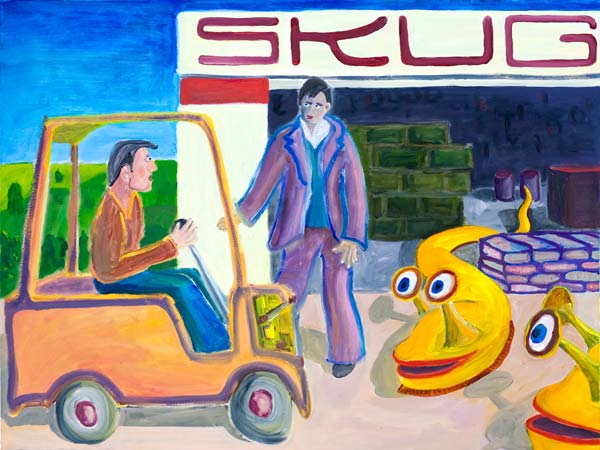
I think I will need something like what I was calling “dreamskugs” after all, that is, some incorporeal beings who one see from the corners of one’s eyes. But that isn’t the right name for them, for any talk about dreamskugs blends with and muddies the biocomputational skugs that Alan Turing discovered/invented/enabled. The spirit-things need their own name. So I’ll call them gazaks for now. An onomatopoeic word mimicking, say, Alan’s anxious grinding of his teeth and or retching at their initial appearance. “Gaaak!”


[“Turing and the Skugs”. More info on my paintings site. I can’t get enough of this painting! Pretty soon I might try and paint some gazaks too.]

I see the gazaks as elemental spirits, elves, discarnate ghosts, or perhaps minds as software images embodied in nature’s flows. Their interaction with us might as well be what potentiated the appearance of Turing’s skugs. The gazaks “saw” Turing on the verge of providing a biocomputational interface to link the two worlds, and they helped him make it happen. And then, near the end of the book, the gazaks soul-suck a lot of people off into their world, which may or may not be a pleasant place.

I’ve always felt that it’s okay to keep revising my plot outline as I go along. This dovetails with a lesson I’ve learned at a deep level over the years, to wit: “The World is Unpredictable.” I in fact have a very short essay with this title in this year’s edition of superagent and tummler John Brockman’s “World Question Center, 2011”, you can see me here about halfway down page two. Brockman got about a hundred and sixty people to answer the question, “What scientific concept would improve everybody’s cognitive toolkit?”

Unpredictability not only to the world at large, but to your personal life, as I describe in my 2004 blog post, “Free Will.” That is, even if the world is in some scientific sense deterministic, we cannot in practice to predict what we’ll be doing tomorrow. I wrote about this at some length in my tome on computation and the mind, The Lifebox, the Seashell, and the Soul,,


[Escaped tulpa from my novel "Jim and the Flims," recently spotted in Los Gatos.]

But my point in today’s post is that unpredictability is being very much an aspect of how one dynamically works with the outline of a novel in progress. Quoting from my short how-to book, “A Writer’s Toolkit,” as revised in 2009.

When you’re writing a novel you’re working at the most extreme limit of your capabilities. What you’re doing is beyond logic, so far out at the limits of what you can do that there’s no hope of your having a short and manageable simulation of the process by which to figure out what you’re doing, it’s computationally irreducible. When you get into this zone, out on the very surface of your brain, you become sensitive to the tiniest chaotic emanations of the world outside. At times it feels as if the world, feeling your sensitivity, gladly dances back. Dosie-do. Keep your eyes peeled.


[Aardvark mask, also in the DeYoung.]

I’ve known this for quite a few years, but I’m always learning it at deeper levels. Here’s a quote from my “A Transrealist Manifesto” of 1983:

The Transrealist artist cannot predict the finished form of his or her work. The Transrealist novel grows organically, like life itself. The author can only choose characters and setting, introduce this or that particular fantastic element, and aim for certain key scenes. Ideally, a Transrealist novel is written in obscurity, and without an outline. If the author knows precisely how his or her book will develop, then the reader will divine this. A predictable book is of no interest. Nevertheless, the book must be coherent. Granted, life does not often make sense. But people will not read a book which has no plot. And a book with no readers is not a fully effective work of art. A successful novel of any sort should drag the reader through it. How is it possible to write such a book without an outline? The analogy is to the drawing of a maze. In drawing a maze, one has a start (characters and setting) and certain goals (key scenes). A good maze forces the tracer past all the goals in a coherent way. When you draw a maze, you start out with a certain path, but leave a lot a gaps where other paths can hook back in. In writing a coherent Transrealist novel, you include a number of unexplained happenings throughout the text. Things that you don’t know the reason for. Later you bend strands of the ramifying narrative back to hook into these nodes. If no node is available for a given strand-loop, you go back and write a node in (cf. erasing a piece of wall in the maze). Although reading is linear, writing is not.


[Cranes in the Amsterdam zoo.]

Finally, here’s some more about the unpredictability of plot from “Seek the Gnarl,” my Guest of Honor address at the International Conference for the Fantastic in the Arts in 2005. A variant of this talk appeared in the Journal of the Fantastic in the Arts, and I also have this excerpt in the how-to book that I mentioned above, “A Writer’s Toolkit.

With respect to plot structures, I see a spectrum of complexity. At the low end of complexity, we have standardized plots, at the high end, we have no plot at all, and in between we have the gnarly somewhat unpredictable plots. These can be found in two kinds of ways. I tend to use what I call the transreal approach of by fitting reality into a classic monomythic kind of plot structure and using some standard (say) science-fictional tropes. In the less flashy, but perhaps even more complex realistic mode, you try and mimic the actual world very precisely, working hard to avoid overlaying received ideas and cliches. In some ways, truth really is stranger than fiction. And so I view transreal fiction as a bit less computationally complex due to its position at the nexus of reality, fantasy, and the trellis of a classic plot structure such as the monomyth.

Complexity

Literary Style

Characteristics

Techniques

Predictable

Genre

A plot very obviously modeled to a traditional pattern.

Monomyth

Medium gnarl

Transrealism

Traditional story pattern enriched by realism. Observation acts on the fictional tropes to create unpredictable situations.

Realism + monomyth + power chords

High gnarl

Realism

A plot modeled directly on reality, with the odd and somewhat senseless twists that actually occur.

Observation, journals

Random

Surreal

Completely arbitrary events occur. (Tricky, as the subconscious isn’t all that random.)

Dreams, whims, external input.

Yum! The muse wants to help you.

Share

The Hollow Earth Online Now

Monday, January 17th, 2011
Share

My novel The Hollow Earth is now online for free download under a Creative Commons license, in ePub, PDF, and HTML formats.

I made up a new cover for the book, based on a painting of mine. The text is drawn from the excellent Monkeybrain Books edition of 2006, which had a great cover by John Picacio. The book has sold well, but some paperbacks are still available. You can also find links for that on my new page for The Hollow Earth .

I had some fun figuring out how to make an ePub edition I can read on my iPhone. I used this great free multiplatform software called Calibre. Calibre is more for managing and creating ebooks, and it’s terrific. Calibre can work as an ePub reader as well, but there are some smoother tools around that are purely for the reading part—see the remarks about ePub readers on my page for The Hollow Earth .

Lots of crashing through the web’s thickets for me today… Aha!

Why a free ebook release?

This weekend I was talking to my friend Rick Kleffel about my motivation for posting some of my works as free Creative Commons licensed e-books. And I had the insight that I do this to make my work more lasting. It requires steady vigilance and effort to keep one’s books in print. Only a tiny fraction of books remain in print for more than a year or two after the author’s death.

If your book is online, you’ve got a much better shot at reading readers twenty or a hundred years from now. And if your online book is a free Creative-Commons-licensed work, your few faithful readers can continue distributing it and porting it to new platforms and file formats across the world and for many years to come. Like Peter Bruegel’s “The Beekeepers,” shown above. And here is Mason Algiers Reynolds’s sketch of the Hollow Earth, allegedly discovered in the UC Berkeley library.

In an earlier post, “Writing the Hollow Earth,” I describe how I came to write the novel. And Mike Perschon has posted a 2009 interview with me about The Hollow Earth on his blog, Steampunk Scholar.

Enjoy! And leave your comments below.

Share

Reading in SF. New Outline. Ripping Vinyl.

Thursday, January 13th, 2011
Share

Upcoming event: I’ll be reading “The Birth of Transrealism,” a section from my forthcoming memoir, Nested Scrolls , at 7 PM this Saturday night, January 15, 2011, in San Francisco at the SF in SF gathering in the Hobart Building on Market St. near Montgomery St. and 3rd St. Diana Paxson will be reading as well.

My writing is moving slowly this month. It’s taking some time to ramp back up after the Xmas break. Also I pissed away days and days tweaking my music collection on my computer for my new iPhone, and coming to terms with the obtuse and balky iTunes music management software. And blogging about it, God help me. As an on-going part of the process, I’m “ripping” some vinyl records to files. Converting analog to digital, which is, of course, a good analogue for my lifebox-and-Ware-Tetralogy Digital Immortality kick. I have a brief guide to ripping vinyl at the end of this post.

One cool thing about my novel-in-progress, The Turing Chronicles is that it shows Alan moving against the tide, that is, he’s going from digital computers to analog biocomputations. But the more relevant thing is that it shows something computational (the skugly biocomputation) becoming symbiotic with human life (like people carrying smart phones).

I remain unsure about the over-all plot, which is hanging me up. When I’m lost sat sea in the middle of a book, I fall back on what we used to call “paper-shuffling.” That is, I play with organizational matters. Tidy things up. It’s like—when I lose my wallet, glasses or keys, I can often find them by cleaning up my whole office.

I’ve also been firming up my ever-evolving conceptions about the skugs and their origins, and this involves revisions. It seems a bit much to suppose that the skugs have really strong personalities, as they’re just AI-tweaked networks of biocomputations. I need to keep reminding myself that they’re not alien invaders. This said, I do have the possibility of giving the skugs a hive-mind personality that’s to some extent based on what they pick up over radio and TV signals. This could be a correlative for, e.g., the hive minds you see if you study Twitter or Facebook or Google search results.

Looking ahead, I had been planning to add in a higher level of reality populated by dreamskugs, effectively a second race of odd critters. But yesterday in the car, driving up to Berkeley with my wife, I was telling her about my plans for the book. And when I got to the dreamskugs, she was like, “What!? Don’t do that again, Rudy! One kind of creature is enough. Don’t always overdo it.” And she’s right.

It boggles the mind to think about how many kinds of critters I jammed into each of my last three novels, that is, Postsingular, Hylozoic, and Jim and the Flims. It’s okay and maybe even good that I packed those books with alien eyeball kicks, but it’s a baroque high-SF supercartoon style that I’d like to get away from for The Turing Chronicles. I’d like to see novel one be a more stripped-down. Like a 1950s black and white SF invasion movie. Like Them or the originals of The Fly or The Invasion Of The Bodysnatchers.

But way of opening up my mind to a new conception fo the novel, I moved the second half of my former outline into a new “False Paths” section of my notes for the novel. As I discuss in my free “A Writer’s Toolkit” on my writing page, having this kind of data repository means that I feel less constrained in making brutal cuts and changes to the old outline (or to the text). And thus, today I managed to rewrite my working outline, which is something I’ve been wanting to do for a month. It’s the kind of job that only takes an hour or two when you do it—but getting your head in the right place for the job can take weeks or months.

And now a word from our lord and master, the computer. I’ve been delegated to make a long story short on the subject of ripping vinyl. By the way, the first album I ripped was the first one I ever bought, Go Bo Diddley, purchased fifty years ago when I was 14. “Crackin’ Up.” [Apparently people can post copyrighted songs on YouTube because the users don’t get to keep the song, they only get to listen to it stream from the site.]

(1) You can use a regular (non-USB) turntable, but it’s advisable to have a little pre-amp box about the size of a pack of cigarettes. The turntable sends two plugs into the pre-amp, and you run two lines out of the pre-amp. You need a two-to-one connector to hook the pre-amp to your computer. This can be the same connector that you might use to plug your one-socket iPod or iPhone into the two stereo input jacks of a living-room sound-system amplifier.

(2) You use the two-to-one connector to run from the pre-amp into the “Line In” jack that you can find on the exposed back of your sound card on the back of your desktop computer. Most laptops don’t have a Line In jack. You don’t want to use a “Microphone” jack, as that won’t pass the stereo through.

(3) You get the free software Audacity for Windows , Linux or Mac. You fire up Audacity and click on the round button to start recording. At about the same time you put your needle onto your turntable and let your record play. You can set Audacity to pass sound out to your computer speakers. See the Audacity help files for help on recording a record on your computer.

(4) Tape both sides of the record into a single sound track. You might want to run the Effect | Click Removal and maybe Effect | Normalize to clean up your track. Now to save as separate songs. You have to show Audacity where the breaks between songs are, see the Audacity help on this. The easiest way to do this is by hand, inserting labels. There’s an automatic Analyze | Find Silences control you can use, but it doesn’t work very well because vinyl really never is silent anywhere. So I put the labels in my hand, sometimes looking at the song list on the album to make sure I get the right count. Don’t bother putting song names in the labels, just leave them blank, Audadicty can put in numbers for the labels when you save, which keeps them in the right track order. You save the recording into separate files, one for each song. You can use the “Export Multiple…” command, sending the files into a reasonable directory like Music\Bo Diddley\Go Bo Diddley, as numbered files. And tell Audacity not to ask you about each song. Typically you save them in a fairly high quality MP3 format. Don’t close your Audacity project file until you’re sure that everything exported properly and is in good shape.

(5) Open your newly created directory of (still unnamed) mp3 files with (if you’re a Windows user) the tool mp3tag. You can set the album name and artist for all the files at once yourself. And then you can use the album name and album artist to get mp3tag to look up and install the track name metatags for you. There’s various places to search, sometimes you need to try more than one of them. When you find the right list, mp3tag can copy the web data into your track title metatags. And then you can get it to copy the track titles onto the file names. I don’t know what the best free Mac tool for this is, you can find a list of some apparently free options on Softonic. It doesn’t work very well to ask iTunes to find the track titles for you, it tends to only want to help you with tracks that you bought from their iStore.

(6) Use the File | Add Folder to Library… selection in iTunes to bring your new files into iTunes. You can find a nice album cover with a quick Google image search and paste it into place.

See some of you Sat nite, I hope.

Share

Digital Immortality Again

Sunday, January 9th, 2011
Share

So, cool, I got a passing mention in the Sunday New York Times Magazine today in an article by Rob Walker, “Cyberspace When You’re Dead,” about various kinds of digital immortality.


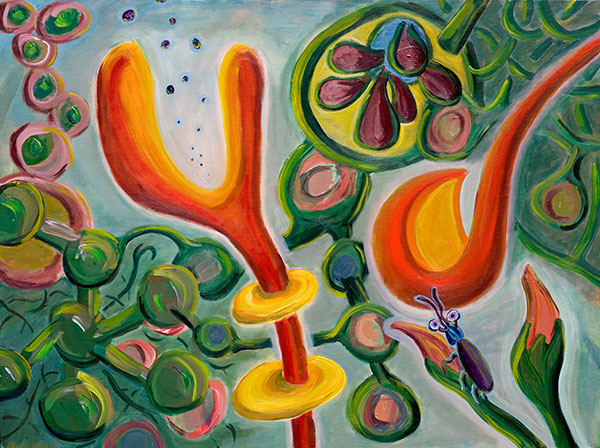
[The illos in today’s post, for reasons which will become clear, are my photos used to illustrate a story by Mac Tonnies, “One Hundred Years” which appeared in issue #3 of my online zine, Flurb. Some of the photos are from other stories in the same issue #3. By the way, I’d love to know the name of the artist who painted the wonderful street mural shown above.]

As regular readers will know, I’ve written about themes of software immortality in several contexts. To start with, the four novels in my Ware Tetralogy deal with the notion of copying someone’s mind to another platform. The collection is available in print, as a commercial ebook, and as a free CC ebook.

I coined the word “lifebox” in a short story, “Soft Death,” which appeared in The Magazine of Fantasy and Science Fiction in September, 1986. I used it to mean a digital or online simulacrum of a person. I go into considerable detail about the lifebox in my novel, Saucer Wisdom, in my non-fiction book, The Lifebox, the Seashell, and the Soul, and in my 2009 article “Lifebox Immortality” which I co-authored with Leon Marvell. This article has also appeared in a recent issue of h+ magazine.

In a nutshell, my idea is this: to create a virtual self, all I need to do is to (1) Place a very large amount of text online in the form of articles, books, and blog posts, (2) Provide a search box for accessing this data base, and (3) Provide a nice user interface.

I made a first crude stab at this a month ago, with my Rudy’s Lifebox page. This page lets you Google-search my rather large www.rudyrucker.com site.

The “test subject zero” discussed in today’s Times magazine article is Mac Tonnies, who died this year. I was one of Mac’s numerous online friends—you can find the exact extent of this by typing “Mac Tonnies” into the Search box on the Rudy’s Lifebox page mentioned above. Most of the hits are to posts which have comments by Mac at the bottom. And, as mentioned in the caption to first illo on today’s post, I published one of Mac’s stories in my webzine.

As the Times article discusses, some friends of Mac’s have kept his Posthuman Blues blog alive as a kind of lifebox. Note the slightly ominous final post, although Mac liked these kinds of images, so really they aren’t all that ominous in the context of his blog.

The Times article is a harbinger of a trend I’ve been predicting for some time: there’s going to be a small industry based on people building digital memory-shrines for themselves. The Nokia phone company had an early entry into this sweepstakes with their Lifeblog package, but that’s gone now, so far as I know. More recently, I noticed that Hallmark Cards is getting into “memory-keeping products.” And everyone’s heard of Microsoft’s Gordon Bell and his MyLifeBits project.

Some of the links in the Times article are for companies like Entrustet that serve as digital repositories for your “lifebox” data such as online photos or collections of your writings. At this point, some of these services are primarily about cloud-based data-storage, kind of like Carbonite with an immortality spin. These services are expensive, though, and often involve a monthly fee—which you’re likely to stop paying a few years before you die.

Another company, Deathswitch, will send post-mortem messages to people from you! How do they know when to send the messages? When you stop answering their emails and/or, presumably, when paying the bills they send you. It’s easy to imagine some tragicomic scenarios here—a guy writes angry “Aren’t you sorry now” messages, forgets about it, lets the account lapse. Actually, the idea for the company is grounded on a short-short story “A Brief History of Death Switches” by the company founder David Eagleman.

Back to digital immortality. One way to create a lifebox is, like Gordon Bell, just to save everything you type and photograph everything you see. Another way is to become a writer and to craft a memoir. People in search of shortcuts will turn to companies who purport to help them. A couple of links from entrants into this sweepstakes: LifeNaut and Virtual Eternity. This exercise quickly turns kind of creepy, veering into the Uncanny Valley.

Clearly what’s needed is some solid shareware to layer onto something resembling Google Search. I wrote a little about this in my post on “Chatbots,” and in the comments on the post.

Actually, as the years go by, this whole enterprise of digital immortality seems less important to me than it used to. By now I’m kind of okay with passing away. And, with or without high tech, I’ll be leaving some printed books behind and, even closer to my heart, my children and grandchildren. That oldschool wetware immortality…

Share

Rudy’s Blog is powered by WordPress