Rudy’s Blog

Support this blog ... buy Rudy's books!

Postsingular, Mathematicians in Love, Mad Professor, The Hollow Earth,
The Lifebox, The Seashell, And the Soul, and Frek and the Elixir!

Original material on this blog is Copyright (C) Rudy Rucker 2007.


Archive for January, 2007

Wrestling With My Computer

Wednesday, January 31st, 2007

Today’s post is the kind that gives bloggers a bad name… Yattering on about my frikkin’ computer.

The good news is that I switched to using WordPress to power my blog, and I think it looks a lot nicer.

Before I’d been using Simple PHP, which isn’t so well-maintained. Naturally I’ve had a lot of boring and or horrifying computer issues to deal with for the last couple of days. I couldn’t have done it without my son Rudy Rucker, Jr., of MonkeyBrains Inc.

Plus three weeks ago the fan on my motherboard died and the guys at ClickAway in Campbell erroneously (IMHO) thought I needed a $300 hard drive, which has now taken taken scores of hours to configure in the way I like. The drive-change didn’t fix the fan problem, of course, the motherboard was still beeping help help help, so I had to go back to ClickAway for the real problem (the $7 fan). And I scanned my old drive, which was still in the machine, and no, it really doesn’t have any bad sectors, the ClickAway guys found a false positive. But, okay, I’ll use the new drive anyway, it’s bigger, and this way I’m backed up.

So now everything works except that every morning my computer won’t start the first two or three times I turn it on. I tried disconnecting the old hard drive (just in case it wasn’t still perfectly good), the new hard drive, the CD ROM drive—but it’s always the same in the morning, no matter which drives are connected, the computer clicks a few times and turns itself off. The pushbutton on/off switch freezes up for a few seconds, I push-push-push it , eventually the machine makes it through a start cycle. Any ideas? I dread going back to ClickAway. Hoo boy.

City Lights tonight! I’m nervous as hell.

Soon I”ll get back to writing SF about a Hylozoic world that’s blessedly free of computers. LOL.

PS2 Note #6: The Noospheres of PS1 and PS2.

Monday, January 29th, 2007

I have a really long and intricate post today, so I’m gonna leave it at the top for the most of the week so you can absorb it and comment. But first, I need to mention that I’ll be reading at City Lights in North Beach on Wednesday, January 31st at 7 pm. As their announcment puts it: “Legendary novelist, mathematician, computer scientist, and cyberpunk innovator visits City Lights for an evening of readings, conversation, and synchronicity in action.” I’ll try and podcast it.
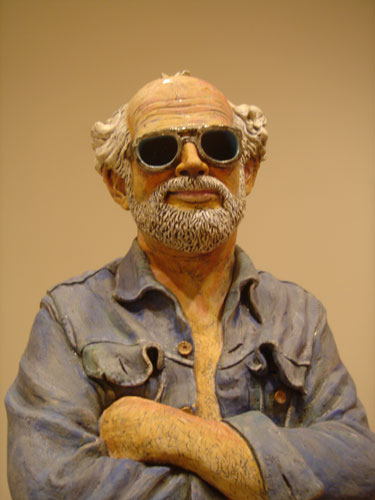
[“California Artist” sculpture by Robert Arneson. This was one of the first works of art I saw when I moved out here 20 years ago. Note that the artist’s head is empty; those “mirrorshades” are black holes. It’s like the artist is saying, “Yeah, we’re flaky in California. You got a problem with that?”]

I recently turned in a novel called Postsingular, or PS1 for short, and now I’m working on a sequel called PS2. Last week I was calling the new novel After Everything Woke Up, but today my working title for the new novel is Hylozoic, which means “relating to hylozoism,” where hylozoism is the doctrine that every object is alive.

I’m working on a series of notes for ideas for my new book PS2. So far we’ve had

PS2 Note #1: Talking to Objects,

PS2 Note #2: Lazy Eight,

PS2 Note #3: Omnividence,

PS2 Note #4: Telepathy,

PS2 Note #5: Hostile Silps,

and today’s PS2 Note #6: The Noospheres of PS1 and PS1. Later, maybe this Friday, I’ll post PS2 Note #7: Teleportation. And then for PS2 Note #8, I’ll do a post which summarizes some of the comments you readers have made on PS2 Notes 1-7. This post will be similar in form to the Postsingular Comments post I did last February 14, 2006, when I was getting reader input for some of the ideas for PS1. So go ahead and post some comments on this long note today. The comments can relate to any of the earlier PS2 Notes as well.

In today’s entry’s title, I’m using the word “noosphere” to refer to a planet’s collective forms of mind. Just as the biosphere includes all living things, or the atmosphere includes all the air, the noosphere includes all the minds on the planet.
A Pyramid of Mind.

In both PS1 and PS2 I have three levels of intelligence in the natural world. The pattern is something like a pyramid with a broad base, a tapering hierarchy, and a single point at top.

(Base) A low level of ubiquitous entities which store data and carry out processing;

(Hierarchy) An extensive medium level containing a successive layers of AIs which first emerge as distributed processes based upon the low level but which then pile higher and higher upon each other.
(Top) A top level containing a single entity that stores its data in the base level and which incorporates all the mid-level agents that are in the AI hierarchy. An alternate model is that there are two or three of the highest level entities, and they compete for the allegiances of the mid-level agents and for the base data space.
The PS1 Pyramid of Nanotech Mind

In my recently completed SF novel PS1: Postsingular, I implemented the mind pyramid as follows

(PS1 Base) The lowest level base consists of uniform hardware units that are molecular computers or nanomachines called orphids, each of which has about a gigabyte of memory and a gigaflop of processor power and is roughly as smart as a dog.
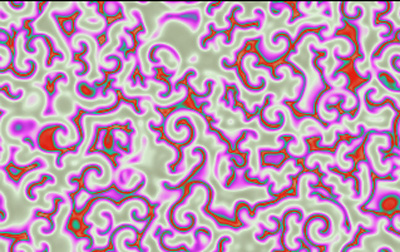
(PS1 Hierarchy) Emergent lifelike AIs resembling the Belusouv-Zhabotinsky scrolls found in cellular automata. They’re called beezies. They act as helpful agents for people, carrying out things like complex and tedious searches for information or simulating and evaluating multiple alternate action scenarios. Some groups of smaller beezies coalesce into single higher-level beezies, and so on in an upward cascade.

(PS1 Top) The so-called Big Pig, a god-like mind that people enjoy tuning in on. Communing with the Big Pig is something like a mystical experience or a drug trip. People who become addicted to this are called pigheads.
The PS2 Pyramid of Natural Mind

Now I’ll outline how I plan to realize the mind pyramid in PS2. Some of my ideas about universal analog computation are “explained” in the 2005 video below. I love putting in these YouTube links! By the way, you want to click the big transparent arrow you see the video. If you click elsewhere in the preview image you go to a YouTube page. And to stop the video you click the pause button. I know the sound quality is terrible; it’s the Big sur wind blowing across my pocket-sized SONY digital camera.

(PS2 Base) Every bit of matter is endowed with endless “lazy eight” memory, and the computational seething of the quantum states provides the processing power. Using a word made up by the philosopher Leibniz, I call the lowest low level natural minds monads. Most simply, I can regard a monad as the mind of an elementary particle. (Eventually, but not yet, I’ll need to consider the effect, if any, of lazy eight in Subdee, the subdimensional world below the Planck level.)

(PS2 Hierarchy) The monads support higher-level intelligent emergent minds that I will call silps. An extended large object has a fairly hefty silp mind. Groups of objects have silps minds as well, as do larger regions: cities, counties, continents. As with the beezies, we have an upward-mounting hierarchy of silps.

(PS2 Top) The top level mind is Gaia, the world-soul of planet Earth.
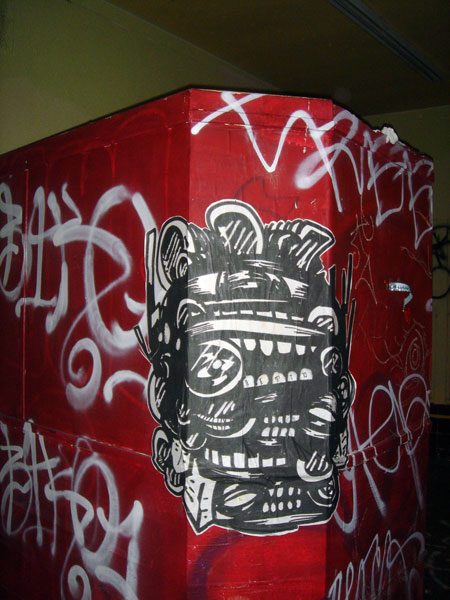
[Graffiti on former ticket kiosk of a closed movie theater on Mission Street. Is that a Mayan god, or what?]

The Transition From PS1 to PS2

(Eliminate the orphids.) At the end of PS1, lazy eight is unrolled, and the emerging silps immediately destroy some bad nanomachines called nants. The silps also destroy the orphids, even though the orphids were relatively benign. I eliminate the orphids because, applying Occam’s Razor, I don’t want to have two distinct low level ubiquitous computation networks in PS2. If I have monads, I don’t need orphids. A second reason to kill off the orphids is that I want to cleanse the world of digital machines.

(The Big Pig survives.) The Big Pig of PS1 manages to port herself or embed herself or somehow come into being within the Gaian mind of PS2. I require this due to the following considerations. The Big Pig is very smart and powerful, and if she had wanted to, she would have been able to prevent the lazy eight from coming about. She could, for instance, have killed Jayjay or the magic harp alien before Jayjay and the harp teamed up to unfurl lazy eight. But, to the contrary, the Big Pig repeatedly said she would be okay with the change, and that it might be a good idea, so evidently she believes she will in some form survive the transition. Given that she is smart enough to work out very deep consequences, we can assume that she’s correct in her belief that she will survive Therefore it must be that the Big Pig does indeed survive in some form or another.

(Preserve the data from the orphids.) In order for the Big Pig to survive, at the very least we have to assume that the data that was in the orphids survives. I believe that, given the data and enough computational ability, the Big Pig can regenerate herself. Like a Unix system recompiling itself. Like a simulated mind called PIG from a Windows machine coming into being on a Mac that’s been fed a PIG data disk. We’ll suppose that the silps read and store the data that was in the orphid nanomachines.
(Wipe out the beezies.) In PS1, the Pig sits at the top of the pyramid of the beezie hierarchy, but we can have her sitting upon a silp hierarchy just as well. Occam’s Razor tells me to wipe out the beezies so as not to have two hierarchies of mid-level minds.

Having absorbed the beezie data and beezie code that was stored in the orphid memories, the silps can in fact emulate beezies. But they are richer and quirkier than the emulations. I don’t want the silps to be exactly like the beezies. I don’t want to flinch away from the juicy problem of figuring out how it will feel to do telepathy with brute natural objects and with spirits of place. I want to teep into objects and locales that are just being themselves. I don’t want to devalue nature by having it taken over by the beezies, which are more like computer-science agents. I don’t want my awakened objects to be co-opted immediately. Perhaps later some evil aliens try to co-opt objects, but we don’t want it to happen by default right away.
This said, the beezies were quite human friendly, much more so than we can expect the silps to be. So if we lose the beezies then we lose some mental power. Unless the silps are more helpful than I expect them to be, humans lose much of the intelligence amplification (IA) that they had enjoyed by using beezies as virtual agents. In any case, humans do still have considerable IA in that they have omnividence, telepathy, and “mental Google.” All that’s now missing is the ability to effortlessly conscript beezie mind agents.
Comparing the Noospheres of the Lobrane and the Hibrane

In my postsingularity series, I have two parallel worlds, our Lobrane and the another world called the Hibrane. The Hibrane’s lazy eight unfurled five hundred years earlier than ours. They never had a need to develop our type of high-tech digital science; in particular, they never had nanomachines. And their local silps were careful to exterminate any nanomachines that we might have brought in when we began traveling there during our relatively brief nanotech era preceding our own lazy eight.

As kind of legacy from our nanotech era, our Gaian mind is somewhat Internet- like. She inherited the base-level data of the Big Pig, and reconstructed the Big Pig as a kind of interface. Having absorbed the data and the beezie program routines stored in the former orphids, our silps are fairly personable and adept at communication
The Hibrane’s native computations are relatively unsophisticated, as is the Hibrane’s planetary mind. The Hibraners can’t “Google” their objects. Some of our silps will emigrate to the Hibrane by riding upon humans who travel to there and by then hopping over to Hibrane matter. But the few silps that we transfer will not be able to carry across the planet-sized data base and code legacy that our orphids and nants created during our nanotech era.

Given that the contemporary Hibraners’ silps are unsophisticated, it has to be that our silps can’t easily upgrade them. For, due to a bend in the direction of our Lobrane timeline, some of our silps will in fact emigrate to the Hibrane’s past. If they could upgrade those past Hibrane silps, we’d have a time-paradox, given that the Hibrane silps we saw in PS1 were relatively primitive.
About Silps

To the human eye, a rock appears not to be doing much. But viewed as a quantum computation, the rock is as lively and seething as, say, a small sun. Up till now I’ve been placing a high premium on visible and human-scale forms of gnarl: wobbling leaves, flowing water and flickering flames. But now I realize that, if I look at the atomic level, there’s all kinds of stuff going on in a rock. For instance, in a crude molecular model, a rock is like a zillion atom-balls connected by van-der-Waals-force springs, and we know this kind of compound oscillatory system behaves chaotically. My point is that even a dull-looking object constraints enough gnarly natural computation to support a sophisticated silp.
We’ll also have the higher-level silps that are genii loci of spirits of place. Maybe I need a better word for these. Local silps?

When I decided to have all objects come alive in this novel, I was thinking of, like, Disney or Crumb-style teapots and clocks and spoons and hamburgers and salt shakers, each object an eager little pal. But we can also have surly silps. The silps might sometimes be like the peyote-trip vision I had in 1964, of tree branches like evil claws. (Disney shows this kind of animistic vision too, come to think of it, in scary lost-in-the-forest scenes.) Certainly those spirits of place I saw in the creek bed when I was lost in Big Basin weren’t friendly beezies. They were, at best, indifferent.
Self-Teleporting Objects?

I definitely don’t want objects to be teleporting, at least not for now. But mightn’t an object want to hop around to improve its situation? Naw, an object computes the same wherever it is. I want objects to be disinclined to move around. They’re, like, fully enlightened, each object like a tiny guru on a tiny mat, with no thought of doing anything other than going with the flow. The higher-level silps can move around, but in the style of programs in the web; the high level silps could move simply as information patterns, and wouldn’t need to move the hardware around.

I’m worried about smart fire, though. If flames teleport, maybe the planet goes up in a firestorm. Or maybe the smart trees know to bend away from the flames. Fire and trees chasing each other around…
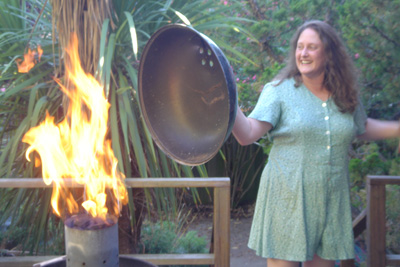
If I start out with the objects being mellow and inactive, then this is something that the Kang’s enslavement might interrupt, making objects restless, to very bad effect. So by making the restriction now, I gain a plot point later on.

The flow could be that (a) the silps start out just as themselves, natural, some of them slightly hostile or at least selfish, some of them friendly, then (b) the Kang can’t get to the high-level silps or to the Big Pig/Gaia, but they are able to exploit our monads and low-level silps and in this makes silps a bit more awake and discontent, and then (c) after we block the Kang, there is some residual revolutionary fervor in objects and maybe they are teleporting and making trouble. Maybe the objects march en masse against the Kang. Try finding my glasses then!
What About Animals and Plants?

It’s natural to think in terms of a great chain of being:

Monads, Silps, Plants and animals, People, Society, Gaia.

How does a human’s or an animal’s old-school mind relate to the silp mind of their enhanced body? I’d want to see these as merging; wouldn’t like to have the mind-body problem turn into an ongoing debate, with two voices in your head.

I feel like plants should have somewhat richer silp minds than mere stones, but maybe that’s a prejudice. Might a stone be as heavy a thinker as man?

Will society actually have a group mind now?
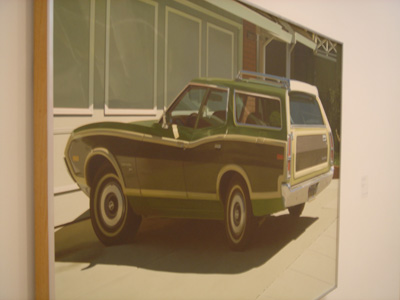
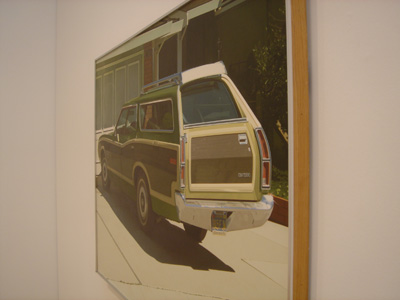
[I took two photos of a painting by Robert Bechtle at SF MOMA the other day. It’s bizarre what the perspective does to your perceptions; from one side the car looks too long, from the other it looks too short.]

Googling the Silps.

Thanks to the legacy ware from the orphids and beezies—the data and beezie-code—the silps have the concept of URL addresses and networking, which is convenient if you lose something. Finally you can “Google” for missing objects. Certainly I was thinking of this the other day, looking for my lost glasses in the forest floor duff. In PS2, I’d be able to telepathically find my glasses. For I know the vibe of my glasses, I can feel them out. This doesn’t have much to do with the fact the glasses have a memory.
Direct Contact with Silps.

What kind of mental contact do I have with silps?

Talking to objects is at the core of what’s important to me. I had a stab at it in my story, “Panpsychism Proved.”: “the mind she’d linked to was inhuman: dense, taciturn, crystalline, serene, beautiful—”
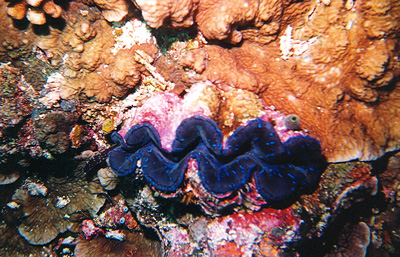
Whaddaya say?


Stalking the Wily Spectacles

Saturday, January 27th, 2007

So I drove back to Big Basin Redwoods State Park today near Boulder Creek, CA. I made a beeline for the spot where I lost my glasses; it took about two hours to walk that far in. On the way it started raining. But I felt happy to be in the primeval woods for the second time in a week. The air has a special clean woodsy quality, and it’s so utterly quiet. There’s no machines in earshot.

At first I can’t find the same path at all. I think of those fairy tales where a certain door or path appears only occasionally. We’d be in trouble if the nascent spirits in matter starting moving our paths around!

What I’m realizing this week is that the woods are big. And somehow I don’t end up in the same side arroyo of the woodsy canyon as the other day. I try working my way sideways along the canyon wall, looking for that same stand of manzanita and those particular boulders, but—you know—my legs are still sore from three days ago. I realize I’m not gonna be able to endlessly trot up and down the sloping terrain of a canyon the size of Manhattan And I’ve still got the two-hour walk back in the rain ahead of me.

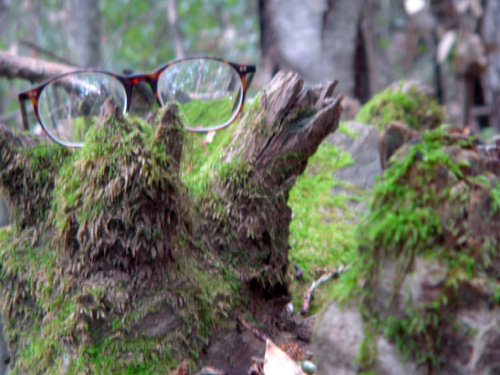
So I gave up. My glasses are on the loose. Those black bumps on the log in the video appear to be fungi, but are actually reality-control knobs.

The day before realizing the glasses were really gone, I’d cruised my favorite optician, Eye Contact of Los Gatos, to get the fit of my backup glasses adjusted, and I noticed they had some nice new Oliver Peoples frames.

Frame styles are finally rebounding from those tiny Benjamin Franklin Urim-and-Thummim type lenses that lamentably have been the fashion for the last ten years. Finally you can get some frames with decent-sized lenses so that you’re not peering at the world through tiny peepholes. On my way back out of the park, visions of new glasses danced in my head. I can pay for a quality specs with my half of the money for of that story “Hormiga Canyon” that I just wrote with Bruce Sterling, a story set in, oddly enough a canyon very much like this one, poulated by ants with legs the size of redwoods…

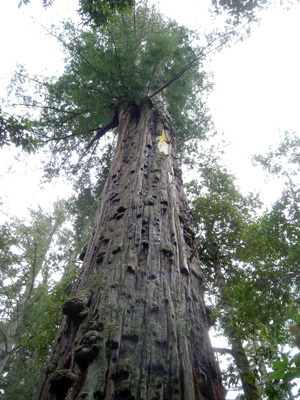
The redwoods are great. Walking in the woods close to my house is always nice, but when you’re in a Redwoods State Park, you feel like, whoah, “Beastie Boys always on vacation.”

My old escaped glasses are in subdimension land with the subbies.

God Save the Queen. We mean it man.

Friday, January 26th, 2007

Our local theater tends to keep movies until everyone in town has seen them. Weeks and weeks and weeks. If I won’t go to a particular movie, the villagers surround the house, bearing torches and farm implements and chanting, “Set us free!”

So last night we knuckled under and saw the worst movie I’ve ever seen. The Queen, which has been playing here for about four months. It’s the lamest, most boring movie imaginable. The big “crisis” is when HRH reluctantly makes a two minute speech that it’s her frikkin’ job to do. BFD BFD BFD. Nobody changes, nobody grows. We’re talking serious parasitism.

Also it’s cheaply made; a lot of the movie is simply TV newscasts that I didn’t watch in the first place because I didn’t care. The only bright spot is Ruthie’s husband George from Six Feet Under, playing the Queen’s consort.

My mind turns to the great Sex Pistols song, God Save the Queen. First I found the lyrics, printed below. Then I found an MP3 music file of the song. Several versions there, actually. And then, whoah, I found a (bad sound, bad synch) video of a performance on YouTube. The sound is a lot better on the mp3 link, but it’s so cool to see Johnny Rotten and Sid Vicious again. Play the video and and MP3 at the same time for a nice effect! I need bigger speakers on my computer. I love the Pistol’s intense and deeply felt outrage. “We mean it man.”

Whoah! I figured out how to link in YouTube video! Telepathy is here for real…

God save the Queen
Her fascist regime
They made you a moron
Potential h-bomb

God save the Queen
She ain’t no human being
There’s no future
In England’s dreaming

Don’t be told what you want
Don’t be told what you need
There’s no future, no future
No future for you

God save the Queen
We mean it man
We love our Queen
God saves

God save the Queen
Cos those tourists are money
And our figure head
Is not what she seem|

Oh God save history
God save your mad parade
Oh Lord God have mercy
All crimes are paid

When there’s no future
How can there be sin
We’re the flowers in the dustbin
We’re the poison in the human machine
we’re the future, your future

God save the Queen
We mean it man
We love our Queen
God saves

God save the Queen
We mean it man
And there’s no future
In England’s dreaming

No future (x3)
For you
No future (x3)
For me
No future (x3)
For you
No future, no future
For you

****

As long as I’m getting all political on you today,

you could do worse than join in a protest tomorrow, Saturday, January 27, especially the big one in Washing ton DC.

Peace.

PS2 Note #5: Hostile Silps; Scary Wilderness Hike (Big Basin)

Thursday, January 25th, 2007

On Tuesday, Jan 23, 2007, I went for a big hike in the woods at Big Basin State Park, which is an hour-and-a-quarter’s drive from my house. I’d planned to walk up the so-called King Trail to the Mt. McAbee overlook, but I missed a turn or something and stemmed off into a smaller trail that dead-ended on an old logging road with trees across it blocking the way. I picked my way around the trees and kept going. At first I thought I was still on the right trail and that it was just poorly maintained. And then I realized I wasn’t on a trail at all, but I figured that as long as I headed uphill, I’d reach the top of Mt. McAbee all the same.

I was enjoying being in the wilderness, thinking about all the silp minds in the trees and leaves and air, and especially the genii loci or spirits of place that inhabit certain spots.

I’d been thinking of spirits of place from reading up on Papua New Guinea spirit boards, in which the natives hope to house some local spirits of place. Kind of like bird houses. As chance would have it, the other day I saw a documentary TV show about a tribe in a jungle, and it was raining too much, and an elder man said the rain was because the spirit of the sacred bend in the river was angry because people were disturbing him, and then we see the kids playing there and they say, “We like playing in the sacred bend of the river!” It was refreshing to see how children are just as ready to ignore elders’ injunctions when the tribe shares an animistic religion as when they’re kids in a Christian society. Somehow when we read about other society’s religions, we imagine every single one of “them” takes their religion very seriously and robotically—but in any society there are jokey, agnostic, practical-minded people who view religion as just another input in the mix.

Anyway, I’m walking along, and suddenly the spirits start harshing on me. I encounter a stand of tough-to-get-through manzanita, with branches like stern claws. I fight my way through, expecting to find a saddle ridge leading up to my targeted peak, but damn, there’s this really deep gorge here with a kind of scary slope to it.

Studying my map—finally really seeing it—I come to understand that the correct trail is way over on my left, passing along the high ground at the head of the canyon. I’m on a wrong (lower) peak, and the gorge is between me and my goal. The good news is that the gorge contains a blue line, which must be stream leading down to the Skyline to the Sea trail which itself wends along the bottom of Big Basin itself. I decide to blow off Mount McAbee and clamber down the slope into the gorge, follow the stream to the Skyline to the Sea trail and take that back up the basin to the park headquarters where I parked my car.

Heading downwards, more and more mental danger signals go off. The thick humus of leaves and sticks slips beneath my feet. Most of the branches I might grab onto are dead and brittle. Up ahead are some giant boulders with fairly sheer drops on their downhill sides. I focus, planning my route, which is something I’ve always enjoyed about tramping the woods and mountains—looking ahead and picking out the safest and easiest route. I’d be doing that a lot on this outing—to the point of getting sick of doing it.

The best route seems to lead over a boulder, and as I work my way down a spirit—that is a branch—plucks off my beloved, expensive, perfected-via-many-readjustment-trips-to-the-optician bifocals and sends them skittering down the slope, who knows how far. I can’t see! I do dig out my prescription shades form my knapsack, but it’s shady and dim in the gorge, so it’s hard to see through them. I search a half hour for my lost glasses with no success.

And now I’m at the woodsy bottom of the canyon. In retrospect—and I did a lot of retrospection in the next three hours—it would have been easier to go up the canyon and find the so-called King trail that I’d lost. But, seriously underestimating the distance to the Skyline to the Sea trail, I headed downstream.

On a good day, with my glasses and with the sun shining and with a walking stick (which I’d neglected to bring) and without time pressure (I’d gotten a rather late start, so I had nightfall to worry about), I would have found this little scramble to be exhilarating. As it was, the passage was a strenuous ordeal. And the walk back up the Skyline to Sea trail was hella long. It was quite dark when I finally made it back to my car—wet, bruised, exhausted, half-blind. I wore my shades to drive home, switching on the brights whenever the other lane was clear.

But it was a useful day. Even if it wasn’t exactly fun, I got some insights. For one thing, it’s always salutary for me to be reminded that I’m not in control. And for another, while I was struggling those miles along the steep, slippery banks of that rock-and-log-choked stream, I came to revise some of my notions about silps, spirits of place, and genii loci. Previously I’d been laboring under a lazy default happy-hippie conviction that Gaia is our friend, that nature is a nurturing mother. But in the wilderness I was reminded that, in truth, nature is utterly indifferent to us. Each object is placidly doing it’s own thing. They have no feelings towards me whatsoever. And the stark disinterest can feel like hostility.

I now see that if, for the purposes of my novel, I do want to ascribe minds and personal feelings to the spirits of place, then these elemental minds are just as likely to be hostile (stealing my glasses, making me slip), as opposed to being helpful (extending a solid branch for me to grab).

So rather than having the silps smiling and dancing around and helping Jayjay and Thuy build their house in the woods—I’d been thinking of an Amish barn-raising kind of vibe—maybe it’s more that the silps will be tripping them up, breaking their fingernails and being sure that nothing fits. Maybe the silps will like hostile xenophobic neighbors jeering at immigrants who are trying to fashion an ethnic little dwelling for themselves. A brick flies through the window, wrapped with a paper saying, “No Humans Here!” In other words, I’m seeing a scene where things go wrong for Thuy and Jayjay in the woods. And that’s fine, it’s more interesting that way for the story. One of the basic tricks for story-telling is to have the characters’ plans go awry.

Maybe tomorrow I’ll go back there early in the morning wearing my backup glasses and find those glasses that got away. Running as fast as their little legs would carry them…

PS2 Note #4: Telepathy

Wednesday, January 24th, 2007

More notes towards Postsingular #2, a.k.a. After Everything Awoke.

How Telepathy Works.

As mentioned in the lazy eight note a couple of days ago, there is a singular shared point accessible from each location, as if the vanishing point of a painting were in contact with each spot in the picture plane. This universally accessible point at infinity acts as an entanglement channel that connects every point with every other point in synchronicity. A router.

Animals, plants and objects are telepathic too, although I still need to figure out how this feels. I’ll call the intelligent, telepathic objects “silps.”

I’ll use “teep” for an all-purpose verb to mean “doing telepathy.”

How Telepathy Feels

This is hard. Thinking about it is like trying to stare into the sun.

William Burroughs, in his February 28, 1953 yage letter, describing the upper Amazon jungle near Mocoa, Colombia. “The trees are tremendous, some of them 200 feet tall. Walking under these trees I felt a special silence, a vibrating soundless hum.” What a wonderful image for how telepathy might feel. The vibrating soundless hum.

I’ve always thought of my science fiction as an extension of Beat literature.

As I mentioned in the omnividence section yesterday, lazy eight telepathy is going to be participatory rather than voyeuristic. Think in terms of our brains having empathy circuits that let us internally emulate someone else—it’s said that autistic people are weak in these abilities.

In Saucer Wisdom (Forge Books, 1999, pp. 78-84) I describe telepathy along the following lines:

You’re looking far away, but you’re looking inside your head. People can get into endless mirror-regresses, seeing each others’ images of each other inside each others’ heads, and it can lead to feedback with an unpleasant effect. Strong emotions bring this on, too. Whipping each other up, possibly to the point of having a seizure. One way to block the regress is to focus on a specific detail. Also, to prevent the emotional feedback, you try and project a low affect. “Just go, ‘I’m all boo-hoo,’ instead of actually slobber-sobbing.”

It’s easier to understand a stranger’s telepathy if you have a context for them, that is if you absorb a lifebox model of their mind.

The telepathic fields can feel like gnarly egg-white-stiffened dreadlocks or Mohawk spikes on your head.

Lovers enjoy skirting around the white hole of telepathic feedback, bopping around the fractal edges of overamplification.

It’s more than omnividence; you’re not just seeing through someone else’s eyes, you’re picking up shades of feeling.

Blocking Telepathy.

* Intrigue. It makes it easier to create a story if we can evade certain teep contacts, as plots depend on people tricking each other or surprising each other. Could I have intrigue in a world of perfect information? Maybe—I think of a game of chess between two masters who can very well deduce what their opponent plans to exfoliate from a given move. If I had perfect information about the plans and motives of everyone in my real life, and they conversely could see all my thoughts—then some outcomes would still be unpredictable. For instance, you know that I want to write a good book, but you dan’t predict if I’ll succeed. Or think of two male rivals courting ths ame princess and they know each others plans and schemes, but they still can’t predict whom the princess will choose.

* Offensive thoughts. A blogger is almost like someone who’s broadcasting telepathically. On my real blog, I don’t express my less attractive fears, worries and dislikes. If I did, I’d seem like a hot-head, a depressive, a pig. Everyone does have certain unattractive thoughts that they know better than to vent lest they become social outcasts. But if telepathy airs everyone’s secret seething, then maybe no one person’s seething seems like a big deal?

This said, on a one-to-one basis, arguments could really escalate, I see violent feedback loops flaring up. But perhaps after a period of adjustment, people would get thicker skins? Like in some subcultures, people yell at each other a lot without necessarily getting excited. Also it could be that we’d all become more accepting, as telepathy would be hipping us to the fact that we’re really all the same on the inside. Sometimes I remember to try this in daily life, to trying for empathy with fellow humans.

* How to Block Telepathy. In PS1 I had a high-tech substance called quantum-mirror varnish to block orphidnet “telepathy”. But in PS2, no spatial barrier is possible. For the telepathy is via a higher dimension (the eighth) and it hops over any three-space barrier. So the only way to get privacy will be to use jamming or camoflague. Help I’m a rock.

I think, as with internet security, many people won’t bother to hone their jamming or cammo skills. And even those who do will have an ongoing struggle; there will be an arms-race akin to the spam vs. spam-filter co-evolution.

Entertainment After Telepathy.

* Food markets, restaurants. If we have telepathy we can really watch the chef. Maybe there’s someone with such a great sensitive palate that it’s pleasure to mind-meld with them as they chow down. You’re eating with the chef’s whole sense of the process, the preparation, and as you eat it, the chef’s eye guides you, he’s put teep-tags onto the food.

* “Sin.” Would people still get drunk and high? Sure. Imagine the havoc you could wreak getting wasted and “running your brain” instead of just email or phone or conversation. You’d really need to have a filter to block this. But maybe you forget to put it up. Some will be addicted to the high of intense feedback via mutual mirrorring.

With telepathy, peeping is unlimited and free, but, again, this won’t be so much of an ocular thing. It’s more like you merge with other minds, you can’t stand back and peep. If you find a mind that really welcome you in, that might be quite sensual.

* Art. A chaotic medium—an agitated tank of immescible fluids—senses what you want to see and shows you that. Someone finds a way to record mood snapshots. So we have objects that simply project the raw experience of transcendence, sense-of-wonder, geuphoria, mindless pleasure, a vision of actual infinity, a savor of sensual beauty.

This gets close to the “teep-tags” I talked about in PS1. How will teep-tags work? How do you create an object that is a copy of a mental state? I guess you mark it out on the eighth dimension of some object that will presumably be passive enough not to go changing the marks you made.

But even rocks have memories. I think of the beautiful memoreis of a rock that’s lain in a stream bed and you look at it and savor the years of lovely currents in the water.

* Books. Telepaths have language for superficial small talk, but they more often use teeped images and emotions. They barely use the written language. Books are now like very elaborate teep tags. Writing is like being a bas-relief sculptor. Or video-blogging yourself. A beautiful state of mind is saved into the a memory network, glyph by glyph.

* Ads. Things projecting vibes of paranoia to get your attention. Or anger or lust or ecstasy: the whole palette of extreme emotions.

John Walker’s Thoughts on Telepathy:

We want to imagine a world in which telepathy has high bandwidth, but people retain their individuality and sense of self. In other worlds we want a full-on mentally networked society, but without having it turn into a group hive mind where everyone speaks of “we” instead of “I”.

In order to retain individuality in the presence of high bandwidth telepathy, you need some kind of individualized filters. For if all the input reaches everyone’s conscious level, then everyone’s thoughts are in everyone’s head and everyone is be the same, and you have a hive.

But it’s natural for us to filter. The vast majority of what goes on in the brain is below the conscious level. Even for senses like hearing and sight, most of the input is filtered at a low level, and conscious attention is directed only toward things you are trying to concentrate upon or things which your low-level mental processes identify as important threats or opportunities. (Snakes, guns, food, nudity.) The influx of telepathic info will largely be processed at a subconscious level, and we’ll only become consciously aware of, like, things we’re looking for, valid threats and unusual opportunities.

Now kick it up a notch. You’re not necessarily ignoring the subconscious telepathic input. You might, for instance, be providing information and services to others at a subconscious level, but without your conscious attention and without detracting from your own work. I can think of this in a positive light as Mental Google, or in a more sinister light as Mental Slave Computers.

(Mental Google.) You’re supplying memory data to others. In this system, information requests are distributed among a pool of telepaths without the need for conscious intervention. This is an altruistic kind of sharing—the entire knowledge of the species is on tap for each individual. Searching the collective mind isn’t as fast as getting something in your own brain, but you have access to far more information.

(Mental Slave Computers.) In this more sinister form of mind sharing, it might be that you’re unwittingly performing other beings’ computations. When your mind should be contemplating or resting or dreaming, it’s doing work. Mental tasks are distributed among the pool of telepaths; it’s like everyone is a PC hosting some processes in background. Opportunistic individuals increase their own mental powers by enlisting “background computation” in the brains of others. They claim it’s a two-way street, but it’s not.

PS2 Note #3: Omnividence

Tuesday, January 23rd, 2007

More notes towards Postsingular #2, a.k.a. After Everything Awoke.

You can tune in on distant objects. The lazy eight link via the ubiquitous point at infinity is like the object in Jorge Luis Borges’s story, “The Aleph.” It’s like a crystal ball that displays whatever you want to see. Since the lazy eight link attaches to every possible location, the view is endlessly smooth and rich.

Quotes from Jorge-Luis Borges, “The Aleph,” in Collected Fictions, (Viking 1998, pp. 280-285).

“An Aleph is one of the points in space that contains all points…all the places of the world are within the Aleph [which is] the microcosm of the alchemists and Kabbalists, our proverbial friend the multum in parvo, made flesh!

“I come now to the ineffable center of my tale; it is here that a writer’s hopelessness begins. … In a similar situation, mystics have employed a wealth of emblems: a bird that somehow is all birds; a sphere whose center is everywhere and circumference nowhere; an angel with four faces, facing east and west, north and south at once…Perhaps the gods would not deny me the discovery of an equivalent image, but then the report would be polluted with literature, with falseness…

“In that unbounded moment, I saw millions of delightful and horrible acts; none amazed me so much as the fact that all occupied the same point, without superposition and without transparency. What my eyes saw was simultaneous; what I shall write is successive… Something of it, though, I will capture.

“I saw a small iridescent sphere of almost unbearable brightness. At first I thought it was spinning; then I realized that the movement was an illusion produced by the dizzying spectacles inside it. The Aleph was probably two or three centimeters in diameter, but universal space was contained inside it, with no diminution in size. Each thing … was infinite things, because I could clearly see it from every point in the cosmos. I saw the populous sea, … [a wonderful page-long Borgesian list ensues] …, saw my face and my viscera, saw your face, and I felt dizzy, and I wept because my eyes had seen that secret, hypothetical object whose name has been usurped by men but which no man has every truly looked upon: the inconceivable universe.

“I had a sense of infinite veneration, infinite pity.

“Out in the street…in the subway, all the faces seemed familiar. I feared there was nothing that had the power to surprise or astonish me anymore, I feared I would never again be without a sense of d�j� vu.

“Aleph … is the name of the first letter of the alphabet of the sacred language. Its application to the little sphere of my tale would not appear to be accidental…that letter signifies the pure and unlimited godhead [and] its shape is that of a man pointing to the sky and the earth, to indicate that the lower world is the map and mirror of the higher.”


Rudy’s Blog is powered by WordPress