I’m giving a reading at Borderlands Books, 866 Valencia St., SF, 3 PM, Sat, February 10.
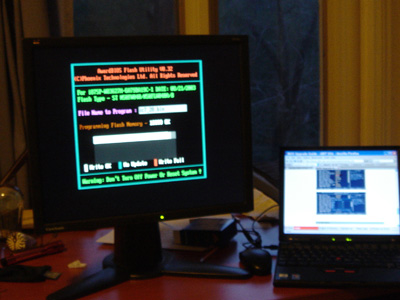
I mentioned I’m having some computer problems, and Rudy, Jr., persuaded me that I need to flash my ABIT motherboard’s BIOS with an upgrade. If you’re a computer hacker, BIOS flash day is a rare and sacred event. Like the day when the ants get wings and fly out of the hive. Like the five dead days that roll around every three years in the Mayan calendar. A hush falls…
The hard part about flashing your BIOS is that you have to do a clean boot either off a CD ROM or off — scared relic of our ancestors — a floppy disk drive. And, like most modern machines, my computer doesn’t HAVE a floppy disk drive.
Making a bootable CD ROM with a DRDOS.IMG file didn’t work for me, though I told ROXIO to use to make a bootable CD.
So I went to the High Temple, that is, Fry’s, and I got a USB Floppy Disk Drive and OH NO it installed itself as the B: drive, not as the Floppy A: Drive, so when I entered ADVANCED BIOS SETTINGS to set FIRST BOOT to FLOPPY, and rebooted, the machine was looking for a (nonexistent) internal A: floppy drive and spurned my my USB floppy disk drive B:
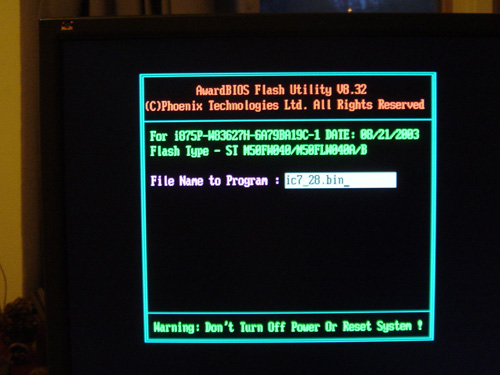
Gnashing of teeth. Rending of garments. Panic and fury in the ant hill that is my brain. But then I noticed that in my ADVANCED BIOS SETTINGS, I could set FIRST BOOT to be USB-FDD, and oh, joy, it booted off the floppy and showed me the beloved A:> prompt and I entered the sacred formula:
RUNME.BAT
……………….and I flashed the BIOS.
Five minutes ago. SO FAR everything’s fine. I’m livin’ in a fool’s paradise! Might as well get this post up before I reboot once again and discover my machine is a doorstop.
On a later day, I’ll tease out some SF metaphors of flashing the BIOS, but now I have something to say about Omnividence and Telepathy.
This is another of my series of notes towards my novel in progress, a sequel to my Fall, 2007, novel Postsingular. I call the sequel PS2 for short, though the final title is probably Hylozoic. For earlier notes, you can run a search on my blog, or just click to this list of the notes.
Teleporting is all about making yourself uncertain about which of two possible locations you’re actually in. The trick is to eidetically and precisely visualize both your source location and your target location. Video isn’t good enough for this very rich visualization; you need something as strong as telepathy or omnividence—I used the orphidnet in PS1, and in PS2 (and in the Hibrane) I use lazy eight telepathy.
Once you have your source location and your target location clearly in mind, you can confuse yourself about which is which by linking up the two scenes, feature by feature. Thus if one scene has a cliff then the other scene needs to have something that you can at least think of as a cliff. If there’s an espresso machine in the coffee shop where I’m sitting, and I want to go home, then I have to think of my TV as being essentially the same thing as the espresso machine and, conversely, I have to think of the espresso machine as being essentially the same as my TV. Angular boxes that make noise.
In PS1, I initially have people using Jayjay’s so-called metamorpher agents to help set up the links, but soon people get the hang of weaving scenes together on their own.
Where I’m going with this is that I view teleportation as a three-step process. First you perfectly visualize two locations and mentally weave them together, second you become uncertain about which location you’re actually in, and third you abruptly observe yourself, asking, “Where am I?” Thereby you precipitate a quantum collapse of your wave function, putting you into a specific location.
[Generally I’m just going to act as if the collapse puts you in the target location. But, logically, you have a fifty-fifty chance of finding yourself either in the source spot or in the target spot. If it doesn’t “come up heads” on the first try, you might need to keep “flipping the coin” till you get where you want to go. But I didn’t mention this complication in PS1. Perhaps I can hint at it in PS2, by remarking that there’s a strobing quality to some teleportation jumps, like a lightning bolt striking repeatedly. Like the lightning strokes at the start of Spielberg’s War of the Worlds. Like the multiple camera flashes in a nighttime video on the bitchin’ celeb-stalker site X17online showing, like, Lindsey or Britney or Paris walking from a limo to a restaurant door. The Advent of the Great Old Ones. Whoah. Is this BIOS flash day? But generally I’ll suppose you don’t notice the false starts on the jump. Suppose you just view them as part of the observation.]
I’ll summarize teleportation once again (avoiding any mention of the repeated measurement issue). First you eidetically visualize your target, second you turn off self-observation and spread out into an ambiguous superposed state — neither here nor there, neither now nor then, not inside, not out — and third you observe yourself in such a way so as to collapse down into the target location.
I’m also supposing that anything I’m tightly coupled with (i.e. whatever I’m clutching) will teleport along with me. That way I can rescue or kidnap other people by whisking them off to distant places; also I can steal things. I’ll suppose that I can carry anything up to weight of, say, a heavy suitcase. Twenty or thirty kilograms.
I’m now going to replace the word “uncertainty” by a more buzz-worthy word: “coherent.” In quantum-speak, having no particular location is called being coherent . Note that being coherent is as opposed to our normal, unexciting bourgeois state of being nailed down in one particular spot, which is decoherent .
Becoming coherent means tuning out the real-world stress-questions like “How much do you weigh?” or “Where are you?” or “What do you think of Iraq?” or “Do you love me?” Bailing out of the meaningless social games. Like a junkie on the nod—or a yogi in a state of bliss. “I have no feelings.” “I have no body.” “I’m everywhere.” “I’m coherent.”
The process of becoming coherent feels like a single psychic gesture. No need for drugs, a simple breath can do it. Inhale Many, exhale One.
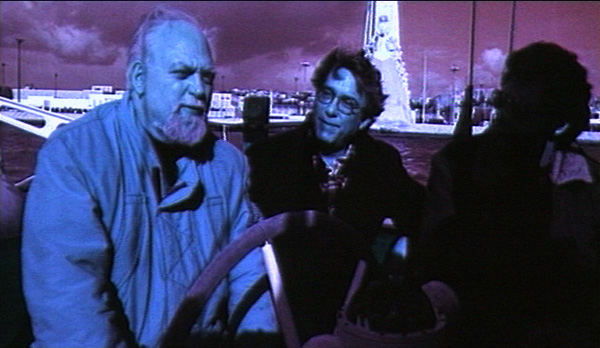
In 1994 Portugese filmmaker Edgar Pera made a wonderful dadaistic movie called “Manual of Evasion” featuring me, Terence McKenna, and Robert Anton Wilson. My character was called the Lord of Chaos.
I just heard from Edgar today that he’s posted some clips from the movie on his blog . It’s kind of heavy that he does it now, with Bob Wilson recently passed on. Terence is dead too, sigh. You can find clips of all three of us on the blog. We had such fun on that shoot; it was in Lisbon. I wrote about it in my essay collection Seek.
Be warned, the link on Edgar’s blog called “Endless Loop for Robert Anton Wilson” really is an endless loop, maniac that Edgar is: it sets your browser into looking up the link that is the link that is the link that is …. Bob would love that. The YouTube link of Bob one image one down from that works, though.
Bob, Rudy, Terence, and I’m the only one left. Lucky to be alive and kicking.
I’m going light on hyperlinks today because my desktop machine is — the horror, the horror — back at ClickAway. Of course they can’t reproduce the problem. Of course they won’t listen to me. Going to ClickAway is like descending into a horrible, crippled, slow-motion world. My machine has to spend the weekend there, waiting for them to observe it’s inability to start on Monday morning. If they remember. Wheenk wheenk wheenk. I’m doing this blog entry with some difficulty on my laptop. A desperate voice from the front…
I’ve obsessively collated, edited, ordered, and responded to a bunch of your comments on PS2 Note #1 through #6. To find these notes, you can put put “PS2 Note” into the Search box at the upper right hand corner of the blog.
<<<<<=====rs on One Mind:
I notice that in panpsychism or hylozoism you have many separate consciousnesses, a different mind in each thing. How does this relate to the mystical or Eastern-philosophy notion of the universe being filled by one cosmic mind?
When a log burns, its silp consciousness might experience a great release into the freedom of being the air, merging into the consciousness of the air which previously in sensed not so clearly.
One thing that seems to be consistently reported about awakening, as in enlightenment, is the realization that “I was always awake.” It’s not the personality that wakes up, but the connection to the All.
<<<<<=====Steve H on One Mind:
Why would each pebble have its own separate memory? Why not have all rocks share a big memory, and all fire, etc.
Fires are transient; they’d see their inevitable entropic destruction as soon as they became sentient and panic, try to spread. I feel like a fire wouldn’t have much to say except “Feed me.” But maybe they have a shared racial memory, so you can light a match and talk to it; the next match remembers your question.
=========>>>>>Rudy on One Mind
In any case, I do believe in the One Cosmic Mind. Monism. But that’s a wholly separate issue from whether or not rocks can think as individuals. The name “panpsychism” for the idea of objects being alive is a little misleading, as it sounds like it might mean that there is Cosmic Mind. Monism can be true or false independently of whether or not rocks have minds.
On enlightenment, the other day Terry Bisson said to me, “I figure that your existence is a huge circle, and everything is singing, and when you’re ”˜alive’ is the only time that you don’t hear the song.”
I think we could accept that a fire has a localized and rather short life. Maybe the fire accepts it too. Maybe they don’t care about dying. As I think I said before, the reason death is such a big deal to us is that we are genetically reproducing beings. We need to spread our genes while alive. An inorganic being doesn’t have that issue. There’s always more fire. The flame dances and enjoys with no fear of extinction.
This said, there’s something to the idea that the fire might pass its thoughts on to another one. Maybe fires’ souls cumulatively get smarter.
<<<<<=====alek on Living Organs:
Do parts of a human body other than the brain become sentient as well? If so, then as well as your old brain, you’d have silp personalities inside you too, like etheric parasites. Maybe humans turn into something new.
=========>>>>>Rudy on Living Organs
I do sometimes feel like my organs are alive. Richard Pryor had a routine about his heart choking him to repay him for all the cigarettes. But it would be really different to have the parts talk to you in voices in your head. But, you know, they already do. Sometimes you don’t listen and the pain gets worse.
In some ways, I think live in the hylozoic era won’t be all that different. I’m working all the time now to see objects around me as alive. It’s not that big a switch.
<<<<<=====rs on Ghosts:
Maybe when a human dies, there is a real ghost, as the memory persists in the matter that made up the body? Could a body repair itself?
=========>>>>>Rudy on Ghosts:
So you’re brain is mush, but the muscle slips and bone silps are still active. I can see some zombie scenes. This is a great idea. Zombies are cool.
<<<<<=====rs on Googling:
Note that in our world, effective search in the style of Google requires massive indexing and massively distributed hierarchical computing. Does something analogous happen in the world of PS2?
=========>>>>>Rudy on Googling:
That’s an interesting problem. It would be worth at least mentioning this though. About how the silps all have to work together to keep the index working. It’s like a tax they’re paying to Gaia, and Gaia is doing the indexing because it helps her think. Maybe some silps want to hold on her, but she won’t let them.
<<<<<=====Joe Ardent on Atomic Silps:
Is there a threshold of size or complexity for an object to wake up? Are your body’s cells awake? The molecules that comprise them? The atoms of the molecules? The quarks of the atoms? There could be disciplines devoted to communing overtly and directly with your cells or atoms. Mindful meditation to the max!
=========>>>>>Rudy on Atomic Silps:
This is a traditional objection to panpsychism, the slippery slope that ends with quarks and electrons being alive. But why be stingy? Let the l’il gaahs have their tiny little lives. Fireflies of mind. Quantum mechanically, even a single electron is a gnarly computation, a vibrating state function field.
There was this stoner bible some forty years back, Thaddeus Golas, The Lazy Man’s Guide to Enlightenment, I worshipped that book. And his big teaching was that there’s only one kind of thing in the universe. Monads kind of. “Nobody here but us chickens.” In his view, the mind of an atom was in fact just as rich and big as the mind of a human, a sun, or a rock. I can see running with this idea a little. If you push too hard, this turns into Monism. The ubiquitous and identical Many are in but multitudinous reflections of the One. I can see using this as a move at some point. But for most of the book, I want the rocks and so on to be nitty-gritty alive. And, yeah, the atoms are alive, but we don’t talk to them so much. They’re like a chorus in the background.
<<<<<=====Steve H on Time Scale:
Silps might not be on our time scale at all. Rocks might think in geologic time, atoms in Planck time.
=========>>>>>Rudy on Time Scale:
In principle a valid point. Atoms might think really fast, planets really slow. But for purposes of the story, I’m not gonna go there.
<<<<<=====Steve H on Silp Intelligence:
Giving a rock the power to think might not be enough. With no instincts or desires, what would they reach for or wonder about? I’d say you need installed software along with the lazy-8 memory or you’d have a Zen rock garden that did its own meditating. You have it right when you say they’d be little gurus meditating, already in nirvana at birth.
Maybe it takes a nudge to start them off thinking. Didn’t Treebeard say the elves wanted to wake everything up and talk to it?
Perhaps a silp mind coalesces around fragments of legacy AI code. Would the new mind find life as a pebble tedious?
I think talking silps would be rare, and silps with something to say even rarer. I suspect silps who spoke might inspire pilgrimages.
=========>>>>>Rudy on Silp Intelligence:
When the lazy eight unfurls and the silps are born, they reflexively “eat” all the nants and orphids, absorbing their data. I’m not going to have the beezies per se survive, but some of that thinky code will be in the silps. It’s good legacy code, it comes to us from when Mars was a Dyson sphere of a jillion nants, the Nant Mind figured a lot of stuff out. So that gives our silps a kind of boost that they might not otherwise have. In fact other planets with unfurled lazy eight don’t have such smart silps as we do. Earth itself is worth a pilgrimage. “See the incredible talking rock!” But those talking rocks are all over the place on our weird wonderful world.
I’m just beginning to get a glimmer of how rocks think. They actually like being made into walls. They like being stuck together with mortar, and they think it’s cool to be raised up a few feet above the ground. Getting high!
<<<<<=====alek on Artistic Hylozoism:
I saw a video kind of like yours on YouTube made by an autistic woman, who has her own language that she describes as ”˜being in constant conversation with every aspect of my environment’. Living in a panpsychic world would really, really change the way we are.
=========Ira Madclaw on artistic hylozoism:
The artist Andy Goldsworthy totally lives in the hylozoic world.
=========>>>>>Rudy on Artistic Hylozoism:
rs compared my videos to the autistic video too. Thanks a lot, guys! I was just really happy in my video, don’t you understand? Seriously, I get what you’re saying. That’s a great video, too, by the way, I put a link to it up there, and I found it by seaching video.google.com.
I can really relate to where that woman is at. And her argument is that by kind of dancing with the world she’s speaking a kind of language with it — in addition to the regular language that we normals speak. Sometimes I go hiking with people and we end up talking the whole time and not adequately seeing the nature.
<<<<<=====Steve H on Kiqqie Animals:
Sentient dogs and cats might be very common and dangerous. As smart as we are and with less morals, they could become a new criminal class. Insects could be very dangerous - hordes of hyperlinked roaches might be a menace.
=========>>>>>Rudy on Kiqqie Animals:
I haven’t thought much about animals with high IQ or at least perception increase. This is a good point, I’ll have to take it into account. But maybe not till PS3, I have enough issues already I think.
<<<<<=====Steve H on Scary Silps:
I think you’ve had a key insight that some of them might be angry or cold, and not very good company.
It would be a handy trick if, say, a garden gnome took over the planet or your kneecap went on strike; just erase them. Every doorway might have a silp-remover field to prevent your pocket change from screaming “don’t spend me, daddy,” or your rings and jewelry from demanding jewelry of their own.
<<<<<=====Doctor Jabbir on Scary Silps:
Redwoods are not intrinsically unfriendly. But remember our species clear-cut this entire valley about 100 years ago and trees have very long memories. I am wary of redwoods and give them my excess nitrogen whenever i can.
=========>>>>>Rudy on Scary Silps:
I don’t think there’s any way to “stun” the mind out of a silp. Their mind is stored in the eighth dimension, and we can’t really touch that. I do see some limitations on the silps imposed by Gaia. It would just ruin things if objects could teleport, so I’m gonna decree that Gaia doesn’t let them.
I like the idea of cranky silps. That’s what animist religions are all about. Getting in good with the spirit that you annoyed by defiling a certain glade. In animism we have meta silps too, like a panther god that lives in all panthers, which was something Steve H was talking about. But I don’t want to go there. Gotta limit the options. As it is, I’m in more danger than ever in writing the Mathematician Godfather novel: “He makes you an offer you can’t understand.”
<<<<<=====Steve H on Telepathic Parasitism:
In terms of being parasitized or used as a slave on a server farm, someone could come up with a bit of brain software to prevent someone leeching off your calculating ability by distorting the data as it was processed. Or maybe your brainware could give them viruses. If leeches couldn’t trust the data they cribbed, they’d give up.
If we could block parasitic usage of our computation, then we could sell off computer time. Or band together for members-only brain sharing.
=========>>>>>Rudy on Telepathic Parasitism:
I’ve already decided that in day to day life humans simply have the ability to close off our telepathy. Like you can close your eyes or put in ear plugs. We gotta have that or we’re screwed. Maybe rocks aren’t that skilled, maybe they can’t close themselves off, because they don’t need to anyway, as rocks aren’t mind gaming each other much.
The evil Kang are in fact going to parasitize our uncommonly rich silps and use them as a server farm. And they’ll be waiting like slobbering ghouls at the door to parasitize us every time we open our telepathy blinders. So it’s either be parasitized or don’t do telepathy.
The Rull and the Magic Harp will in fact help humanity figure out a way to stave off the Kang parasitism. I’m calling the firewall (obscure math joke) an Ultrafilter. I suppose it could work by warping the input/output enough to make it useless or by spreading viruses. But I’m thinking I’ll come up with some other means of its action.
As for the group mind-sharing, that’s a separate idea, and a good one. Thinking clubs. Well, that’s what this blog is an example of right now, isn’t it?
<<<<<=====Joe Ardent on Telepathic Society:
How is individuality preserved? Because of course, the gnarliest behaviors come from just that right mix of boundaries and merging. People are really anthologies as it is: our separate cognitive modules have really high-bandwidth interconnections inside our brains; a group of people is really just a single cognitive entity whose higher-level cognitive modules (whole brains) communicate via low-bandwidth channels (language and other expressive mechanisms). There’s probably an inverse relationship between level of cognitive ability and maximum speed of data transfer between peer-level modules, and that relationship has evolved over millennia for maximum gnarliness (and hence adaptability). The lazy eight telepathy seems like a way around that: a high-quality, high-speed channel between two or more really giant, sophisticated cognitive machines (brains).
But maybe society works worse with high-bandwidth communication. A lot of effort might go into techniques for maintaining and defining inter-brain boundaries, much like the discipline of cultivating Zen non-attachment in the face of the overwhelming material richness the world provides. Increasing the data flow could easily degrade the gnarliness of the computation space, like a flash flood overwhelming a whirlpool in a stream.
=========>>>>>Rudy on Telepathic Society:
This is a rich vein of thought. I’ve played a lot with dynamical systems and parallel systems like alife colonies or cellular automata. And indeed, these things can be very finely tuned for gnarl, and if you change essential parameters you spiral down into dead repetition or up into chaotic dog-barf seething. So maybe society doesn’t “work” when communication gets to be so high-bandwidth. Certainly it would change in ways hard to imagine—thus the need for the PS2 thought experiment.
<<<<<=====Joe Ardent on Merging:
It might be hard to restore the flame of an individual mind after too deep a merge.
=========>>>>>Rudy on Merging:
Yeah, I’m all over this idea, I talked about it in my novel Saucer Wisdom already. I also think of the spacecases who took acid too many times. Too much merge. Can’t snap back. But with lazy eight we’ll be more robust. A complete system backup awaits in the eighth dimension.
<<<<<=====Doctor Jabbir on Quantum Mechanics:
The most intriguing property of the quantum world is the notion of complementarity—that you can ask one question (momentum?) or another (position?) but not both and that somehow the world contains both but you can’t get at it. There is also the possibility of asking questions that were simply inconceivable in a classical. Maybe if we could find some classically nonsensical ways to address the macroscopic world we’d produce entirely novel and unexpected outcomes. I suspect that consciousness is one of these answers that the world gives to a weird-ass request and that there are more ways of being out/in there too that can be discovered by learning to ask to right questions.
=========>>>>>Rudy on Quantum Mechanics:
I love this line of thought. Maybe consciousness consists of a weird-ass request. “Am I happy?” I always come back to Damasio’s idea that being consciousness means having a mental image of yourself watching your life. So your conscious mind is the thing watching the feelings of your self-image as it watches your life. That’s how rocks get conscious too, by the way. They become aware of themselves having feelings about things.
<<<<<=====rs on Quantum Computation:
From the perspective of quantum computation as described in Set Lloyd’s “Programming the Universe” it seems easy to have memory and computation all over the place, there are lots of bits to go around.
=========>>>>>Rudy on Quantum Computation:
Yes, I recently came to realize that, given quantum computation, a rock really is as rich a system as a fire or a waterfall. At the quantum scale it’s like a sun. Or like a ball and spring model with a trillion chaotic strings. I had some nice email from Seth Lloyd after I reviewed his book on my blog (use the Search window to find it…). He said something along the lines of, “even if you don’t LIKE the idea of a quantum reality, that’s what’s really TRUE.” I’m letting the quantum into my heart.
<<<<<=====rs on Silp Happiness:
Consciousness centered in inorganic objects would have different motivations, different mental axes. For instance a rock might not mind if it never moved? Perhaps it’s only humans that are so often unhappy with their situations. Maybe silps don’t even have the unhappy/happy axis.
=========>>>>>Rudy on Silp Happiness:
Maybe not, but I think it’s gonna be more fun to pretend that they do. The animist religions always have the spirits being happy or unhappy with what we’re doing.
Thanks for all the feedback, y’all. This is a big help to me.
I was really nervous about reading from Mathematicians in Love at City Lights last night. Like City Lights has always symbolized hip beatnikdom to me. I remember when I first walked in there in 1970, it was like entering a temple. And when I moved out here in 1986, I went straight to City Lights and saw my first issue of High Frontiers, which led to all the fun with Mondo 2000.
My wife and I went up a bit early to walk around North Beach. And then it was time to face the music.
They always have my SF novels in the basement room at City Lights, which is nice.
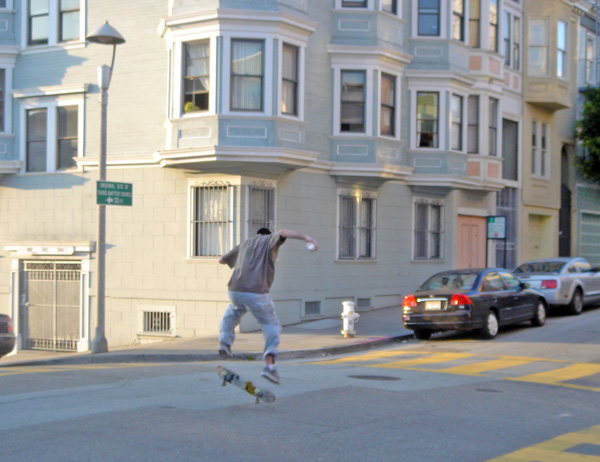
The reading was in the little upstairs room with the poetry and the beatnik books, with Jack Kerouac alley right outside the window. In the event, the reading wasn’t very intimdating after all. I forget that by now I’m a lot further along the road to Mount Parnassus than I was back in the day. By the way, the next picture is on Grant Street, and isn’t of City Lights. It shows, rather, a human soul leaping upward.
I rose the occasion and did a good, highly political reading. I forgot to photograph the audience, but I got a good tape.
Click on the icon above to access my podcast.
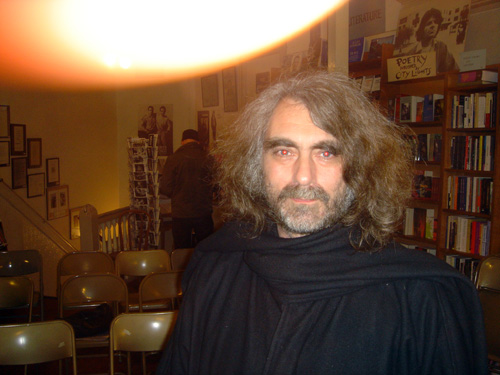
One of the more colorful characters at the reading was Paul McEnery, a friend from the Mondo 2000 days, he stuck around to chat at the end.
And then Sylvia and I went to Cafe Greco and had some tiramisu. I’m a free man.
Well, not quite free. I’m still endlessly screwing around with plug-ins for the WordPress blogware. And, dammit, I thought I was done with computer programming. The only upside of the tedious labor is that, judging from the past, I’ll probably transrealize the pain into something interesting in the stefnal postsingular world of my current novel. As Gurdjieff said, “No effort is ever in vain.”
What is “stefnal”? My editor Dave Hartwell used it an email the other day, he was saying he liked my proposed book title Hylozoic as it’s so stefnal. So I went on Google and unearthed a definition in the context of an April 21, 2006, post in a Nightshade Books Discussion, the info from no less a man than Paul Di Filippo:
“Historically, within the genre, stef has been another long-standing term for science fiction. The derivation comes from the old scientifiction, which was always abbreviated stf. The vowel was interpolated so that one could actually pronounce the term. Stefnal has three fewer syllables than science-fictional, always a plus for economical writing. Additionally, it functions as a totally baffling shibboleth.”