

Click covers for info. Copyright (C) Rudy Rucker 2021.


Archive for the ‘Rudy’s Blog’ Category

Postsingular Writing Notes

Tuesday, May 8th, 2007

Today posted my writing notes for Postsingular. 6 Megs, 300 pages. Enough to chew on for quite some time!

If you get stoked enough, preorder Postsingular from Amazon. Preorders help a book’s launch.

This was an odd kind of a book, not nearly so easy to write as Mathematicians in Love. I started writing Postsingular without knowing I was starting a novel, I just had the “Chu and the Nants” story. But that world drew me in. And I became compelled to write it.

I started my first notes towards the novel in July, 2005, finished the first draft in November, 2006, revised it up through February, 2007, and now that I’ve put the (slightly edited) writing notes online I’d say I’m about done.

And here’s my description of the book that I just wrote up for the Postsingular website.

Postsingular and its sequels represent my return to the cyperpunk style of my classic Ware tetralogy. But this is 21st Century cyberpunk; I call it psipunk.

Postsingular takes on the question of what will happen after the Singularity—what will happen after computers become as smart as humans and nanotechnology takes on the power of magic?

A mad scientist decides it might be a good idea to create a giant virtual reality simulation that is running a copy of Earth and of most of the people in it. Fine, but in order to create this simulation, the mad scientist plans to grind our planet into a zillion supercomputing nanomachines called nants.

Ultrageek Ond Lutter and his autistic son Chu find a way to block the nants—but then Ond can’t resist infesting Earth with a congenial breed of quantum-computing nanomachines called orphids.

The orphids coat the planet, one or two per square millimeter, and now everyone is on-line all the time, and everything is visible in the orphidnet. Artificial life forms emerge in the orphidnet, these are helpful agents called beezies, and they pyramid together into a superhuman planetary mind called the Big Pig. People can mentally access the Big Pig and feel like geniuses—with the catch that when they come down they can’t really remember what they saw. Those addicted to this new kind of high are called pigheads.

The lovers Jayjay and Thuy begin as pigheads, but Thuy manages to kick the habit to work on a vast orphidnet-based narrative called a metanovel. Jayjay continues his sessions with the Big Pig in hopes of learning more about science—and this puts a damper on their love affair. But the mad scientist is still machinating to bring back the nants and destroy Earth, and Thuy and Jayjay reunite to save the world.

It helps that Jayjay has figured out how to do teleportation via the orphidnet. And that Thuy has made friends with a giant, ethereal man from a parallel world called the Hibrane. Jayjay helps Thuy teleport to the Hibrane for help. The Hibraners do have a fix for Earth’s problems, but it’s going to be a bigger change than anyone ever imagined. Earth is on the verge of a postdigital age, more postsingular than anyone ever imagined.

Nature will come alive.

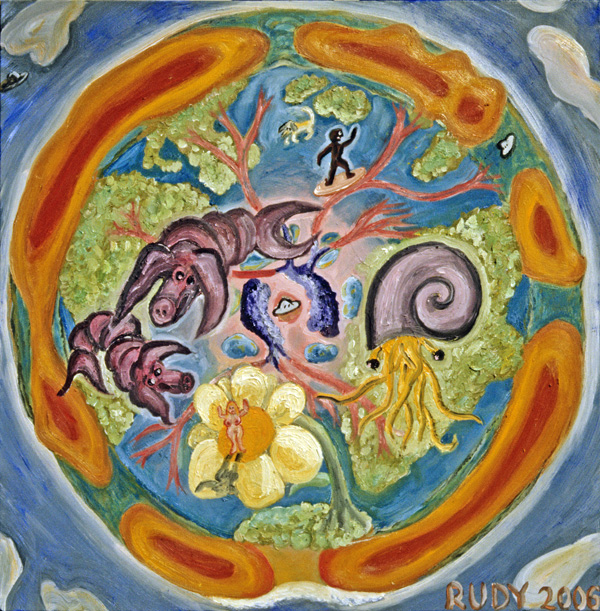
My Art at rudy.imagekind.com

Friday, May 4th, 2007

I’ve been working on my painting websites again; I have a local “Rudy’s Paintings” page on my site, and I’m now done with uploading higher-res better-color versions of my pictures to Imagekind, a company that sells prints of images online. My Imagekind address is simple: rudy.imagekind.com

It’s been a long, drawn-out process getting the pictures up. I first had the idea a few months ago when one of my fans emailed that he wanted to buy prints of my paintings. I did some research and found a couple of sites that sell prints of pictures. The artist sends in the image file, and the site takes the orders, makes the prints, collects the money, sends the prints out, and gives the artist a cut.

Zazzle.com is for the T-shirt and coffee-cup market. Art.com is the biggest image-seller, I think, but Imagekind has maybe a classier feel, and maybe they’re a bit more artist-friendly. So I opened my “free” rudy.imagekind.com account at Imagekind. (Sell it, Ru.)

Next was the issue of how to get good images of my pictures. I shot some images with my digital camera, but the resolution isn’t all that high. With my new 8 Meg SONY digital I get 3,200 by 2,400 pixels. Also my sense was that the image quality wasn’t going to be as good with the pocket point-and-shoot as it would be with my trusty old Leica, a clunky old R3 single-lens reflex that feels like it’s made of solid steel. Many people dis the R3 model, actually, as the body was made by Minolta, but the lenses are still that classic Leica glass.

Initially, I thought I’d get prints and scan those and thereby get hi-res images. Dumb idea. . If you scan a print, you add two weak points in the image chain: (a) you’re dependent on a desktop scanner, whose quality isn’t necessarily that great, and (b) you’re undergoing image degradation via the process of printing from negative to paper, and who knows how reliable the printing process is gonna be in any instance. So I decided to have the photo shop directly scan my negatives to CD (I only recently grasped that they can “invert” a negative’s scan so the colors are “normal” and it looks like a slide.) Unfortunately, the local shops only scan at 2000 ppi (pixels-per-inch), and a “35 mm” negative has the dimensions of about 1.5 inches by 1 inch, so you end up with 3100 by 2100 pixels, which is no better than what the digital camera does.

By the way, the shops can scan negatives or slides equally well, although if you’re heading towards scanning, slides are out to be a better way to go, as it’s easier to select out and send in individual slides for further scans than it is to send in strips of negatives a hope they scan the right ones. And it turns out you can get a wider range of high-end color-sensitive film in slide format.

One stressful thing is that, if the photo shop people don’t know what they’re doing, and if you don’t make a real pest out of yourself, they’ll often scan at some incredibly low resolution, like 400 ppi—I had Long’s Drugs do this to a roll of film last week, giving me images that were—ye gods—640 pixels across. Also, if you aren’t a pest, the drugstores will scan to a low or at best medium JPEG quality setting. But you can always get the negatives or slides re-scanned.

Shooting the pictures, I came to the question of lighting. I don’t have a flash for my Leica, and my sense is that flash produces somewhat uncontrollable glare in any case, and you can’t tell until you get the film developed. So I tried setting up lights; I actually went to the hardware and bought this heavy-duty rack of halogen lights. They were plenty bright, but there was huge glare problem unless I put the lights way over to the side and had them glance off the canvas at a shallow angle. But then, since I only had the one rack of lights, I had the problem that one side of the canvas would be lit more brightly than the other. Not good.

Regarding glare, I did find that the problem is less if you back off and use a longer lens, that is, go with a 90mm if you have it, or in any case a 50mm instead of your 35mm. The closer to the canvas you physically are, the likelier it is that you’ll be including a glare angle. But it’s hard to beat the glare unless you have lights on both sides, and, better, pro-lights with gauze screens over the bulbs.

After a few bad rolls of film, I gave up on lights and went out on my deck, where I get a nice bright low sun California coming in full in the mornings. I got the best slide film I could find, some expensive Ektachrome, relatively slow for finer grain and richer color: ASA 100. I put the canvases on a nearly vertical easel and I put the camera on a tripod, adjusting the camera so its height matched the center of the canvas. I used a plunger-type remote to press the shutter so I didn’t have to worry about jiggling the camera. I measured the distance with a tape-measure to confirm what the rangefinder was telling me. I stopped the camera down to something like f11 or f16 for crisp focus, and I shot each picture at three speeds, bracketing to make sure that at least one image would have a good exposure.

So then I got the resulting slides scanned at 2000 ppi (pixels per inch) at the local photo shop and picked out the good ones. But then I wanted to get a higher-res scan so that I could sell bigger prints of my pictures.

If you want to pay maybe $20 to $50 per picture you can get an individual negative or slide “drum scanned” at much higher density, like up to 10,000 ppi if you like. But there are a number of lower-end mail-order firms which will scan at 4,000 ppi, and that turns a slide into an image with dimensions of some 5,800 by 4,000 pixels. I went with one of these companies called Digital Memories in, I think, somebody’s home in Ohio, proud owners of high-end Nikon Coolpix scanner.

A plus in getting the 4,000 ppi mail-order scan was that the Digital Memories guys were willing to (a) save the images in the eidetic TIF format instead of the standard lossy JPG format that the local shops use, and to (b) scan at 48 bits of color information per pixel instead of the usual 24 bits per pixel. This makes for gigundo TIF files of nearly 100 Meg per image. But they put them all on a DVD, rather than a CD.

By the way, the important thing about TIF file is that you can keep re-opening it and re-editing the color maps and saving it, and you aren’t degrading the information in the image by doing this. With a JPEG image, every time you save it, you’re crushing a little more information out of it.

Even though my scans came back a little dark, I was able to fix the pictures to look nice in Photoshop CS1. I used the crop tool with Perspective turned on to crop the canvas to occupy the full picture frame. The crop tool lets you select a trapezoidal or arbitrary quadrilateral area, which means you get to correct for perspective distortion.

And then I worked on the colors and contrasts for days. Most often I used these three Image | Adjustments dialogs: Shadow / Highlight, Color Balance, and Hue / Saturation. One of the virtues of having the image in 48 bit color is that you’re less likely to be clipping graded colors into flat areas, as having more bits gives you a bigger range of possibility to play in, a bigger color-space room where you don’t smack into the walls.

At first I was trying to make the images look like me paintings, but after awhile I realized that’s flat-out totally and utterly hopeless. So then I just went for making the images look good, making them pop and be crisp, making them sweet and warm. Sometimes I’d even use the Magnetic Lasso tool to select a region and adjust its color separately.

To make the size of TIF smaller, I found that I could save them with either LZH or ZIP compression. The ZIP compression makes them the smallest—this is again without any actual loss of information. Once one of my 4,000 ppi 48-bit color images is cropped and put into ZIP it’s around 70 Meg.

Given that I have about 18 paintings, I now have net mage data that’s amount pushing two Gigs, far in excess of the 100 Meg that Imagekind gives you for a “free” account. So I bit the bullet and shelled out $100 for a year’s “Platinum” account on Imagekind, which gives me unlimited memory. In fact, since I have unlimited room now, maybe later I’ll upload some of my photographs in hi-res in case anyone wants to buy prints of those.

The Imagekind servers are sloooow. It took me the better part of two days yesterday to upload my two Gigs worth of files. I’ve blown a lot of time and money on this so far. Help me break even on this public service! Here comes Ed McMahon to tell you the URL again. What’s the frequency, Kenneth? “rudy.imagekind.com”

If you want some explanations regarding what the paintings are “about,” I wrote up a longish set of notes on the paintings that are incorporated into the Imagekind RSS feed from my gallery.

I’m hoping to do more painting this summer. And, oh yeah, I need to get back to work on that, um, psipunk postsingular hylozoic novel I’m writing.

Dorkbot Psipunk

Wednesday, May 2nd, 2007

I performed my Psipunk talk at the Dorkbot SF gathering on May 2, 2007.

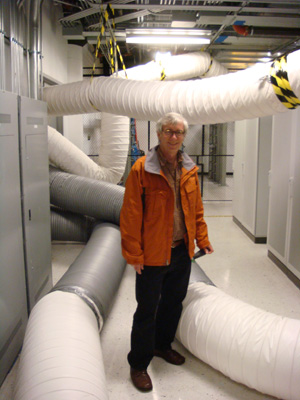
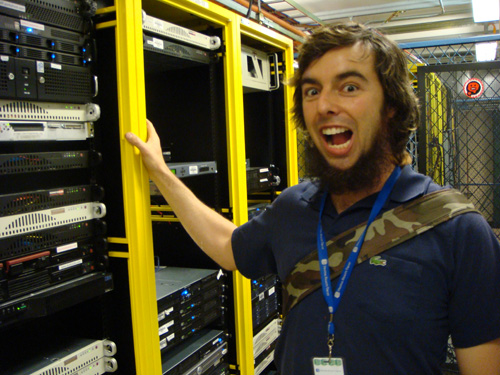
In the afternoon I spent some time with my favorite person in SF, the co-owner of Monkeybrains, Inc. We visited the data center where his cabinets of servers live, checking on a machine that’s sending out a 128 Meg movie of Ludacris several times a second—a.o.k. Speaking of video, there’s a funny video interview of Monkeybrain moguls Rudy, Jr., and Alex Menendez online.

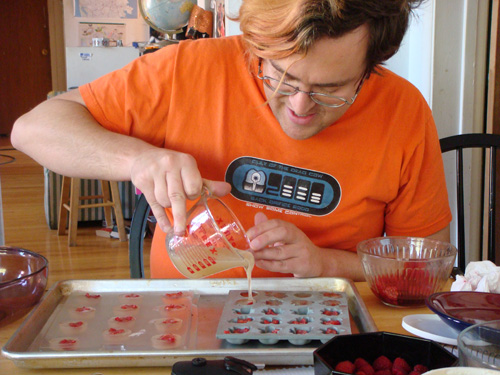
Rudy Jr.’s foodhacking friend Marc Powell made ant and raspberry gum-drops for the event!

The dedicated rabble-rouser and Dorkbot impresario Karen Marcelo posted a slideshow’s worth of DorkbotSF #34 images on Flickr. We didn’t manage to tape or video it, but Rudy, Jr., pointed out that the telepathic bricks in Chicken John’s wall have the event stored in their lazy eight memories so no prob.

In Amsterdam I was uptight about my presentation because of culture shock and the language barrier, so when I was there I actually read my speech from a print-out of it I’d prepared in advance—like liberal arts types often do. I’d thought I might just read the same speech again at Dorkbot, make it a no-brainer, but—seeing all those hip, lively kids there, I didn’t want to come on all stiff and fuddy-duddy.

So I didn’t use the text or, for that matter, any computer projection—a good call, that last decision, as the Dorkbot projector was a balky device dangling from a swaying rope above the crowd of maybe two hundred, who were seated in church pews. I just stood up there and taught the lecture like a class and it went over well, lots of laughs.

I stayed till then end, then caught a train home. There were a bunch of other good presentations, one that particularly caught my attention was by a crew representing the Osaka incarnation of Dorkbot spoke, describing a vibby installation they called Openpool; they showed some Youtube videos of it. The speaker’s English was borderline incomprehensible, but, hey, how well do we speak Japanese? The images were lovely; turns out these Japanese dorks like the same kinds of things that we West coast dorks like: chaotic things. Big undulating domes of fabric. Dangling electronic mobiles twisting in the air currents.

I was listening to NOFX song “The Cause” this week to psych myself up for the talk. It perfectly expresses why I’m still out there doing things like Dorkbot and Flurb for free, not that I’m anywhere near as punk as Fat Mike. I can’t find a video of the song online, but here’s a video of their vibby song “Punk Guy,” mismatched with the lyrics for “The Cause.”

It isn’t for the money
Nor is it for the fun
It’s a plan, a scam, a diagram
It’s for the benefit of everyone
You gotta have a little respect
Subterranean ideals
Traditional of neglect
Reflect on how it would make you feel
The cause—we’re just doing it for the cause

No it isn’t for the fortune, it isn’t for the fame
It’s a scheme, a dream, a barterine[?]
We want everyone to think the same
Because you know what you know is right
And you feel what you can’t ignore
And you try so hard to point the blame
A shame—what are we doin’ this for?

The cause—we’re just doing it for the cause

Open, your eyes, don’t trust, these lies
What are we doin’ this for?
The cause—we’re just doing it for the cause
The cause—we’re just doing it for the cause.

William J. Craddock and BE NOT CONTENT.

Friday, April 27th, 2007

Stoner humor is a way of giving the finger to consensus reality. That’s what I always liked in Burroughs’s Yage Letters or in Phil Dick’s Scanner Darkly, or William J. Craddock’s Be Not Content. Turning your back on received ideas. Participatory surrealism.

Looking ahead, in I’m proud to announce that June 15, 2012, my Transreal Books publishing company  scored the coup of bringing William J. Craddock’s classic psychedelic novel back into availability. I reached an agreement with Craddock’s widow, Theresa, and Be Not Content became available both as an ebook and as a quality paperback, via my Transreal Books page.

Go here to read my intro to my print  edition. Many thanks to all the readers of this blog for your support and encouragement.

Sadly, as of June, 2020, my contract to publish the novel expired.  Happily, as of June, 2021, the book is back in print from Jay Shore of Backtrack Publishing.

Back to the memories—here’s two old journal excerpts of mine about the book.

(1) Oct 5, 2003. I bought a used book on the web, William J. Craddock, Be Not Content, a book I worshipped in the 1970s, and then lost. I paid too much for this used copy, $140, and it’s not in very good shape, but I just had to own it again. It was pure joy rereading it, I recognized so very many bits that I’ve totally integrated into my worldview, so many kicks and tricks that I used in my own transreal work. What I hadn’t remembered/understood in reading the book in the Seventies is that it’s set in San Jose. It’s a Bildungsroman transreal novel about Craddock’s experiences as an acid-head while a student at San Jose State, 1963-1967.

[4D Painting by David Povilaitis.]

He was born in 1946 like me, and went to college the same years! I wish I could find him and give him a copy of my mirror-world right-coast work in the same vein, on the same period, The Secret of Life. Looking for him on the web reveals only one hit, a reprint of something he had in one of those Authors Lives reference sets back when Be Not Content came out. [Note, I can’t find this link anymore.] He was born in Los Gatos. Was living in the Santa Cruz mountains. Right when I moved here in 1986, I remember seeing a column by him the Santa Cruz free newspaper Good Times. I hope he’s still alive. Maybe I could help get Be Not Content back into print.

I’m always worrying about wasting time, right, and I saw a great line in Be Not Content, the author-narrator Abel Egregore expresses this fear to one of his stoner friends, who guffaws, “Time? How can you waste time?” And I get a little enlightenment there. Time and space, the all-pervasive ineluctable modalities. What’s to waste? You use one second per second no matter what you’re doing. A wonderful teaching.

(2) September 25, 2005. A fan emailed me that Craddock is dead, so today I went to the SJSU library to look up Craddock’s obit. It was on microfilm, San Jose Mercury News, March 20, 2004, a tiny obit written by, I think, his wife Teresa. How little recognition he died with. It was eerie, the microfilms are down in the basement in this new and graphically uncluttered room with an art piece that makes the room look like a mausoleum — the two facing side walls are covered with mirrors set into tiny arched openings like the doors to crypt boxes. Like being in Citizen Kane. I pull open the huge flat metal drawer with ranks and ranks of microfilm boxes, my hand reaches in, plucks out the box with Billy’s obit. Go to the microfilm reader, the same old big clunky kind of machine as ever, grind forward to his the obits on 3/20/04, I’m looking for a big article, but it’s just a little tiny thing, with a picture him looking tired and sad, his eyes hidden in dark sockets.

How bum, how alien, how weird it would be for him to see this microfilm room in a flash-forward, him walking careless and high around the campus forty years ago and suddenly, whoah, he sees the hand pulling out the box of microfilm with its image of his weary, suffering face.

When I go outside, the bell on Tower Hall is ringing an hour, tolling deep and reverberant, the sounds overlapping and forming beats. “It tolls for thee.” I really am going to die, and someone will walk around this campus marveling that Rudy Rucker once trod here, and now is no more, that really and truly is gonna happen. Nobody escapes. William Craddock knew this his whole life long, I think he wrote something like “there is only the one trip, the true trip of life itself.”

It’s not quite accurate to call the book “stoner humor,” by the way. Better to post what Billy said about it on the back cover of his book:

See also his entry in Gale Contemporary Authors in one of the comments below…

In 2009, my friend Nick H., who lives near Boulder Creek, came across Billy’s grave in Soquel and sent me two pictures.

RIP, man.


Rudy's Blog is powered by WordPress