




Click covers for info. Copyright (C) Rudy Rucker 2021.


Archive for the ‘Rudy’s Blog’ Category

Visiting Terry Bisson

Sunday, February 15th, 2009

It’s been raining hard all day, very unusual here. I like the waxing and waning of the drops sweeping across the roof. Think of all the vibrations in all the drops…

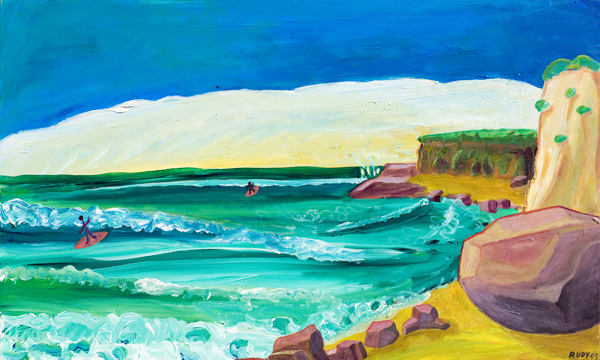
I don’t have much to say today. Suffice it to say that I’m still grappling with the shape of my novel, Jim and the Flims. And I did another layer on some parts of my new painting, Four Mile Beach. I might finish it in a couple of days.

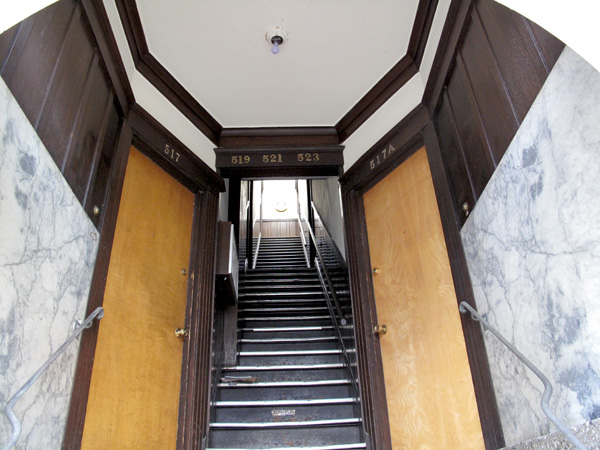
For me, writing is very much a matter of groping. Exploring possible paths through the story universe to find one that’s both surprising and with a kind of inevitable story-like feel. This is a flight of stairs in an apartment building on Telegraph Hill, where we were this weekend. There’s a clock on the wall at the very top of the stairs in this picture, but my obnoxious camera battery died before I could reshoot and get the exposure right.

I like this scene, it’s an example to me of how certain physical situations have the feel of concrete symbols: a hemmed-in flight of stairs with a clock at the top. Life in a nutshell. Bridges are like that too.

An equliateral triangle on a cop flasher. Not an archetype, just a shape.

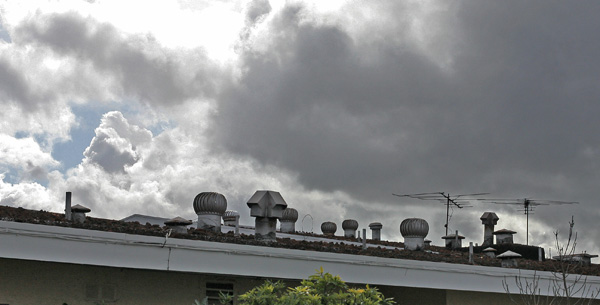
In Berkeley I often walk past a dilapidated motel-like home for seniors on Shattuck Avenue. These vents against the dramatic sky are again archetypal. The vents connect the individual souls within to the higher Gnarl above.

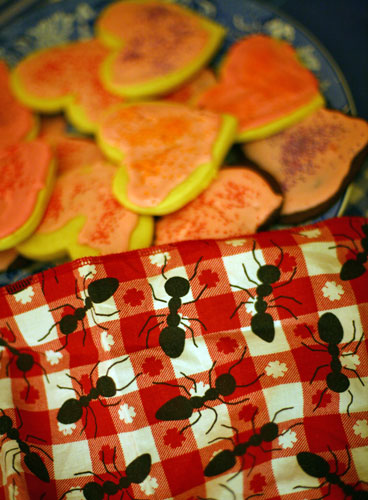
Friday we had dinner at the home of my fellow Kentuckian and SF writer, Terry Bisson. Terry was going on about how photography is the lowest art form — because he thinks it’s easy to do (hah!) — and this reminded me to take some pictures. Dig this ant-decorated napkin beside a plate of Valentine’s cookies. Relatively easy to shoot, yes, if you’ve practiced using your camea for a considerable time, but to see the picture there to be plucked, ah, there’s the tricky part.

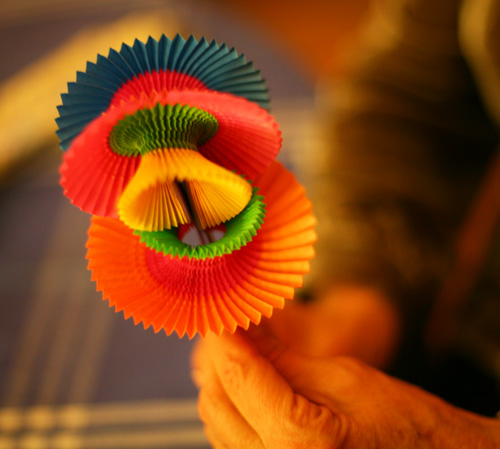
The Bisson’s granddaughter had a cool paper toy that she’d gotten as a favor at a birthday party. We all played with it. I thought of the cases of plaster models of curved surfaces that the old-school European mathematics departments have on display—relics from the days before the chips ate our brains.

I’ve pretty much photographed all the bric-a-brac in my own house, but Terry’s house had new stuff to shoot. I like the orange/yellow color on their walls. Maybe I cold put some weird gods and goddesses walking around in the land of Flimsy in my new novel. When I’m as uncertain as I currently am about my story, I’m wide open to influences from stuff that I see. Inhaling metric tons of sensation, with my sensitive baleen filtering out the twitching krill.

Terry’s wife Judy is a quilter, she has stacks and stacks of them. Here’s one in progress. Lovely stuff.

Bisson himself! My pal.

I also saw my artist friend Paul Mavrides and his friend Mimi Heft this weekend. That’s Mavrides on the left.

And I got together with my old college friend Greg Gibson as well, but I didn’t get any pictures of him. Greg was in San Francisco for the California International Antiquarian Book Fair, representing his company Ten Pound Island Books. It’s kind of scary how old we’re getting. But the books are older. Some very cool stuff on display, this great underground river of images and words, forgotten but not gone.

Designing an Alternate World

Wednesday, February 11th, 2009


[Photo copyright (C) Embry Rucker 2009. Shot for DC Shoes.]

I was just looking at some of the pictures in the “Current” portfolio of my photographer nephew Embry Rucker. Wow. Maybe this woman lives in Elfland! I asked Embry for more info, but he just said: “i forget her name – she’s in some rock band in LA – or was last year, she could be a suburban mom by now for all i know.”

I was out at Four Mile Beach north of Santa Cruz yesterday, working on a new painting. I’ll be layering on more versions of this one…

Several surfers paused to inspect my progress. They approved. “That’s my beach!”

My writing problem today is that I haven’t decided what it’s going to be like in Flimsy. What are some options? Before listing options, note three desiderata to keep in mind.

Playable. The world should be able to support a story. In particular Jim should be able to move around it as a human character, and he should be able to interact with the flims in fairly comprehensible ways.

Meaningful. The world should transreally represent something that’s important to me, and should carry some satiric or philosophical subtext.

Wonderful. The world should be beautiful to think about, and somehow be essentially different from any environment in our present or past world.

So here are some possible worlds that come to mind.

The Afterworld. Whatever I decide on for Flimsy initially, we might eventually reveal this world to it overlap with the afterworld—and then have a big scene where Jim meets his dead wife. The “surprise, this is heaven” move is however a bit of a genre cliché, and corny, and plot-wise it’s a kind of retrograde step to meet his dead wife, and, come to think of it, I used the afterlife in White Light. So I think I’d rather not do this here.


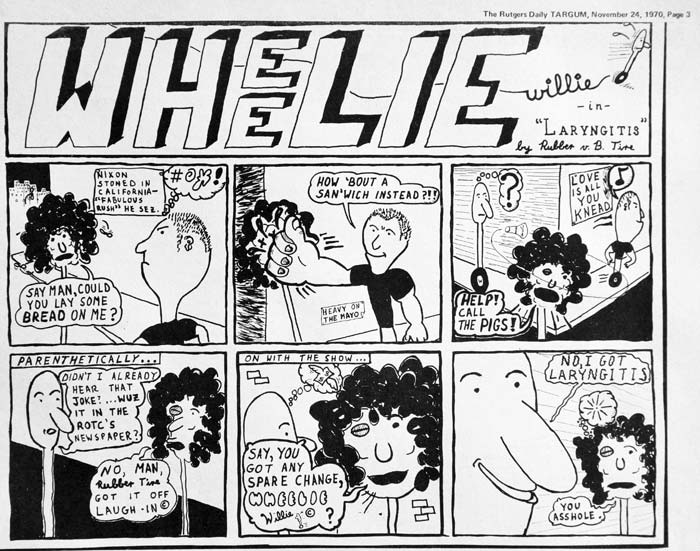
[A cartoon I drew as a hippie in 1970 for the Rutgers campus newspaper. The somewhat reactionary joke in it actually was something I’d seen on TV show, Laugh In.]

Cartoon world, with cartoon conventions. Fine, but if I do this, I immediately face the same what-is-the-nature-of-Flimsy question all over again, for I have to ask what kind of underlying world this is a cartoon of. Of course when I mention cartoons here, I think of Frank, and of the jivas that Jim Woodring draws—and maybe the yuels would look like spiders—but to make this playable at novel length, I think I’d need for the flims to take on a more humanoid form most of the time. I think that, rather than having a cartoon world, I might better have a somewhat realistic humanoid world, but with cartoon physics.

Fantasy kingdom. The default for “fantasy” these days is a medieval land with nobles, knights and dragons. But it’s hard for me to get very excited about such a world, as it’s so burdened with received ideas, so fannish, so non-transreal. To make a fantasy land that’s meaningful and vibrant for me, I might rather suppose that it’s a rural world like the paintings of Bosch and Bruegel. But I have in fact written about this B & B rural world in As Above So Below and in Hylozoic. So, wait, how about a fantasy world that’s…Elfland! I’ll break out a new section for that.

Elfland. I think this might I what I really want to write about. A land where magic is real, and it’s not the Middle Ages. So elves, goblins, elementals, and so on are in fact real, but they live in the world of Flimsy that’s slightly askew from ours. Note that I wouldn’t want to be overly tendentious about matches between Flimsy and the folk mythology of our fairy tales, as this leads to mere name-checking. What might it be like in my Flimsy Elfland? I could have a kind of episodic picaresque, like a trip through America, and we encounter a variety of scenes, each with its own odd natives.

We might start in a rural Elfland akin to the Grulloo Woods of Frek and the Elixir—recall that the Grulloos were like goblins, and their bio-tweaked tools were effectively like magic. Transreally, this is my country childhood near Louisville, Kentucky. And then we segue to a small town, like all the little villages I lived in over the years: Highland Park, Geneseo, Lynchburg, Los Gatos. It’s like our contemporary world, only with things like magic that works, things like flying carpets, genies in bottles, spells, demons. And then, near the end, we get to the capital of Flimsy to deal with the issue of installing Ayaka as the Jotei, or Empress. And maybe this city is like Kyoto. And we might also visit the power center of the yuels, which is a brutal immense Manhattanesque city. Maybe for the finale, Flimsy segues into a dreamscape or into a surrealist scenario, like the Magritte world they visit at the end of Frek and the Elixir.

It would be good to have some specific and radical difference to the laws of nature or the nature of society in this other world.

In our world, it’s easy to change something physically or to build a machine. But it’s hard or impossible to affect something with your mind. What if it were the other way around in Flimsy. They can teleport stuff, but they can’t put together a wagon or a flight of stairs. They’re unable to build a window that lets in light and keeps out the wind and rain, they count on teeking away the droplets one by one—or maybe they train the house wall to do the teeking, maybe the house teeks something like a force field barrier within the window frame.

Would they even need a house in a telepathic Elfland? It doesn’t protect you from teleporting thieves or ruffians. Any protection is, once again, going to be teek-based. We might set this up by having Weena be very awkward with physical things. She’s not used to using her muscles to do stuff. But, back to the point, sure we want houses in Elfland. So it’s what I call playable.

Do understand that I use the world “Elfland” with a touch of irony and in somewhat the same spirit that I might touch a sore gum-canker with the tip of my tongue. The very corniest (yet somehow among the most memorable) verses we had to memorize in school were these:

The splendour falls on castle walls
And snowy summits old in story:
The long light shakes across the lakes,
And the wild cataract leaps in glory.
Blow, bugle, blow, set the wild echoes flying,
Blow, bugle; answer, echoes, dying, dying, dying.

O hark, O hear! how thin and clear,
And thinner, clearer, farther going!
O sweet and far from cliff and scar
The horns of Elfland faintly blowing!
Blow, let us hear the purple glens replying:
Blow, bugle; answer, echoes, dying, dying, dying.

O love, they die in yon rich sky,
They faint on hill or field or river:
Our echoes roll from soul to soul,
And grow for ever and for ever.
Blow, bugle, blow, set the wild echoes flying,
And answer, echoes, answer, dying, dying, dying.

— From “The Princess,” by Alfred Lord Tennyson

I can still hear John Cadden reciting this my ninth grade English class, little John with his cozy Kentucky accent…

The Tunnel to Flimsy

Tuesday, February 10th, 2009

As I’ve mentioned in this blog, I’m working on a novel called Jim and the Flims in which we have two worlds, the “real” world of Fatland and the alternate world of Flimsy.

In traditional style, I see a tunnel connecting the worlds. The tunnel between the worlds is in the basement of a crumbling Victorian house in Santa Cruz. The house, inhabited by three surf punks, is called the whipped Vic around town. Most of the time you can’t see it. You have to walk a certain labyrinthine path to get there.

How does Jim Oster find the whipped Vic in the first place? I’ll suppose that some higher being from Flimsy led him there the first time—she sent Jim signs in the form of a colorful bird flitting from tree to tree, a bird that was really an apparition of a jiva under the being’s control.

Now—this higher being in Flimsy is, let us say, a disenfranchised Queen or Princess whom Jim is supposed to help to power. But “Princess” too pedestrian a word, so I’ll use a Japanese word. A “kougou” is the wife of an Emperor, but a “jotei” is an Empress herself. So I call her a Jotei.

As it happens, the lovely Japanese-Italian actress Rosa Kato (see these Japanese commercials) played a girl named Ayaka in the 2007 Japanese TV series Jotei, based on a manga comic of the same name, which is about how the school girl Ayaka who, aided by a handsome underworld boyfriend, becomes the “empress” of the Osaka demimonde of bar hostesses. (Hostesses, the Japanese never tire of asserting, aren’t actually prostitutes.)

Initially I was seeing my Jotei character as being from a truly royal family of Flimsy jivas and she’s blocked from her throne by an evil anti-intellectual yuel. But, yeah, maybe it should somehow be like an Osaka nightclub scene…with the bad guys being Japanese gangsters in the pay of psychic polluters who, like, send out telepathic spam. That could be cool.

Anyway, we’ll suppose that Jotei Ayaka helped Jim get to the whipped Vic the first time around, but now the yuels are harassing her, and she can’t project an image of her jiva over to Fatland to help guide Jim, so Jim and Weena have to get back to Flimsy on their own. So they run all over Santa Cruz looking for some trace of the three surf punks from the whipped Vic.

Here I need to ponder what kind of beings these punks are? Are they (a) regular humans, (b) flims, (c) some kind of interworld beings like security guards in airports or like aphids living on the “flower” of the whipped Vic, or (d) are they organelles or parts of the Whipped Vic “house” itself—as if they were pistils on a flower.

I’ll go with (a). It could be that lots of people know about Flimsy—the psychics and schizos and stoners and meditators. The three surf punks are locals who’ve found out how to squat in the twilight zone or interbrane or tunnelspace as we might best call it. In this case, it would indeed make sense to ask other surfers around Santa Cruz about these three. Suppose that Jim asks (as I was thinking the other day) one of his daughter’s high-school surfing pals.

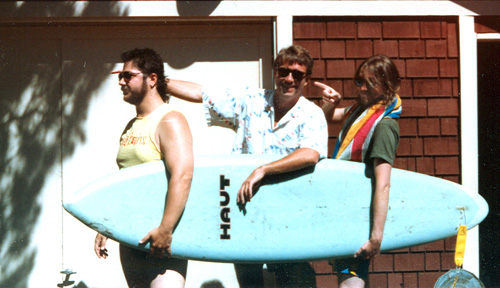
So now I need to invent that character. His name is Chang. He teaches introductory surf classes to goobs at Cowell Beach by the pier. He’s cynical, and a randy con man, but also kind of an enlightened surf sage who truly doesn’t care about anything. He’s ethnically Asian, but very much a Santa Cruz California boy. The guy who first owned my blue Haut surfboard that I bought second-hand was named Chang, so I like that name. Perhaps our Chang has bleached the tips of his hair to be blonde.

Chang escorts Jim and Weena to a wild party at the Whipped Vic that evening. During the day they have to dodge the yuels, and we get to see Dick Simly burst open to birth out two dozen jivas that fend off the yuels. But in the process, Jim is seen and is accused of murdering Dick Simly.

Wild Cucumbers, Random Reviews

Sunday, February 8th, 2009

On Saturday, I took a walk up towards St. Joseph’s Hill over Los Gatos, California. I’ve been walking on this hill about once a week for some twenty years so I guess I’ve been up there nearly a thousand times. It’s always new to me, because Nature’s a fractal.

It’s been raining this week, but the rain let up for a day, and I could enjoy how green everything is.

I took my new 100 mm macro lens along and shot mostly small stuff. This is the tip of a tendril of an early spring vine called wild cucumber that we get out here.

I really love the shapes of the tendrils, they form conical helices, and latch onto lots of other plants.

In a month or two, the wild cucumbers bear their fruits, which are spiky green pouches akin to scrotums, filled with a pair of big seeds and milky juice.

Here and there, I could even spot the vestiges of last year’s wild cucumber crop. I see more details when I’m carrying around a macro lens—I’m looking at the world in a special, detail-oriented way.

The sun hit these berries in just the right way to set three hanging water drops alight. Whoah.

What else did I do this weekend? We saw Paula Poundstone do a stand-up comedy gig at the Rio Theater in Santa Cruz. She was pretty funny, with that edge of bitterness and misanthropy that so many stand-up comics have. But she showed up a frikkin’ hour late, and kept telling us some boring B.S. story that she’d slept through the plane’s landing in San Jose, and had ridden it on to Portland. Right. Like the plane people aren’t going to clear out the plane at ever stop?

I didn’t like that Paula thought she could stand there and lie to us. But, like I say, she made me laugh. She did a thing about a near-death experience and she didn’t see any dead friends and relatives or any white light, and she’s like, “Even in the afterlife they’re avoiding me! They’re, like, ”˜Quick, hide the light!’” The light is a water drop on a cucumber vine, you understand.

We watched “Zack and Miri Make a Porno” on DVD. It had a few laughs, but not quite as many as I’d expected. Earlier this week we saw “Revolutionary Road,” which was somewhat better than I expected, I’d thought it would just be lots of bitter yelling—there was a lot of that, but they had a good crazy mathematician.

I finished reading Jack Kerouac and William Burroughs’s early work “And the Hippos Were Boiled in Their Tanks.” It’s amazing to me how weak their writing was at that early stage, considering how good they got later on. It’s a complicated process. In some ways, their writing later on seemed better because by then each of them had built up a “brand” and a personal legend.

I think Buddha means “grow.” So this bud is Buddha. It’s a chestnut tree. They’re always in such a hurry to grow up, these chestnuts. They turn yellow and lose their leaves by August. “Live fast, die young, leave a beautiful buckeye.”

I totally zinged this shot—I saw it, this giant hilltop tree that I love, and a nice tasty cute single-unit cloud overhead, and I had the 100 mm lens and I was able to frame it just right. The hill was all in shadow in the original, but I ran the Photoshop Shadow/Highlight adjustment and got the light back on the hill. The thing about digital photography—a whole of information about the scene is present in your image file, and you can excavate things that you can’t even see to start with.

I’ve shot these vents before, but today I was able to get more of them into the picture thanks to the telephoto effect.

Up on the hill, I have this nice view of San Jose, it’s an isolated whole, the downtown. And I always think of a story about a boy meeting up with an old hermit, and they’re walking towards the actually rather poky little market town nearby, and from a hilltop they glimpse the city, and the hermit, who’s a religious fanatic, starts railing against the town, “Yea the mighty shall be brought down, the walls of Babylon shall fall, woe unto the wicked.” And, really, its just ordinary people living their lives down there, and the furious hermit is hopping up and down shaking his gnarled fist. The boy—he’s eager to get into the town. Like Mason Reynolds in The Hollow Earth.

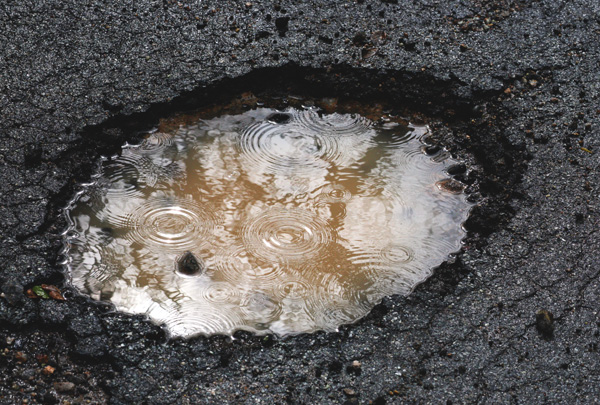
M. C. Escher made some nice etchings of things reflected in puddles. This shows a tree with some branches and leaves dandling over a muddy puddle near a spot where I usually crawl under a fence to get back down to my house. I miss having my dog Arf along for that part.


Rudy's Blog is powered by WordPress