May 16, 2007. A reading of my story “The Imitation Game,” about the last days of computer pioneer Alan Turing and his persecution by the British secret service. This time, Turing wins… The story appeared in INTERZONE magazine, and as Chapter One of my 2012 novel, TURING & BURROUGHS. Reading at monthly “SF in SF” event, which also included a reading by Cory Doctorow. In 2015 my story title was used (with no acknowledgement) by the producers of a movie on Turing.
I did my reading at the SF in SF series last night. Terry Bisson was the MC, Corey Doctorow read a chapter from his upcoming radical YA SF book Little Brother, and then I read “The Imitation Game,” a short story about the last days of computer pioneeer Alan Turing, and about his persecution by the British secret service. This time, Turing wins… My story will appear in the magazine Interzone this summer or fall.
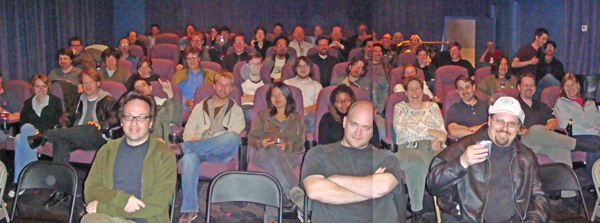
We had a nice crowd, including Jeremy Lassen of Night Shade Books in the front row. I recorded my segment of the reading and put it online on my Gigadial pages.
I just read an interesting post by Charlie Stross about lifelogging. The ideas overlap a little bit with what I said in my Psipunk talk. Great minds think alike.
Wednesday evening I’ll be reading with Cory Doctorow for Terry Bisson’s SF in SF series at the Variety Theater near 2nd street on Market Street.
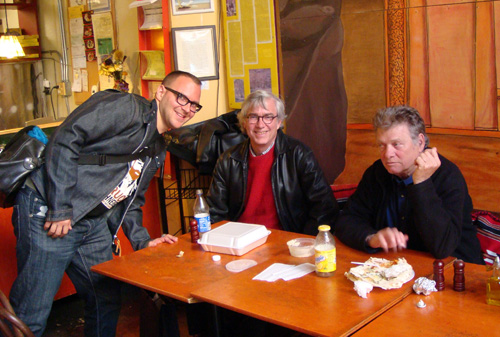
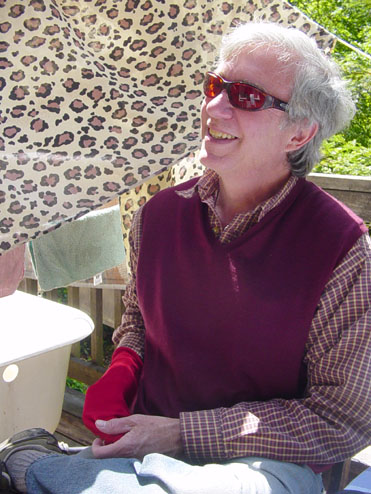
I went to see my far-out physicist friend Nick Herbert in Boulder Creek, as I so often do when I’m starting a novel. Nick knows a lot about quantum mechanics; he has this abiding hope/dream that people will some day learn how to communicate directly with matter. He calls this “quantum tantra.” As Nick puts it, our standard scientific experiments are ways of interrogating matter; and our brains are complex quantum-influenced systems; so why not find a way to get it on with matter.
This lies close to my dream of hylozoism and telepathy, so we see eye-to-eye; though for Nick this is more than SF fodder, it’s a serious quest.
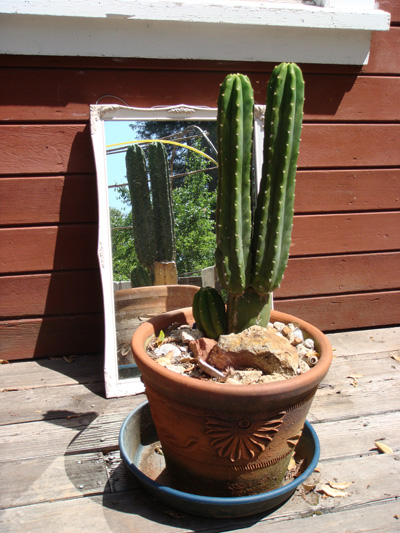
Nick has a cactus on his porch looking at itself in a mirror. Collapsing its own wave function.
Nick showed me what he called a Heisentoy, which was a small hand-made fired-clay sculpture that Arne Olafson of Denham Island, British Columbia, had mailed Nick. Nick first opened the box at night, and touched the object without looking at it, and then he got the idea that it would be fun to leave the object’s appearance in a permanently uncertain state.
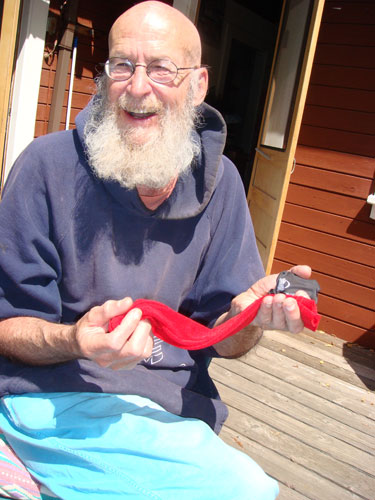
So he “showed” it to me by handing it to me swathed inside an “anti-viewer” made up of the spandex sleeve of on of his neighbor’s shirts (she liked to cut off her sleeves). It felt like a cube with the edges finger-pinched out like petals, in an irregular pattern.
As we discussed some of the ideas for Hylozoic, we sat in the La Joya cafe in Boulder Creek, formerly the Blue Sun. They were playing the Beatles White Album on the sound system, which I can’t recall having heard played in a public place since the summer of the Manson murders.
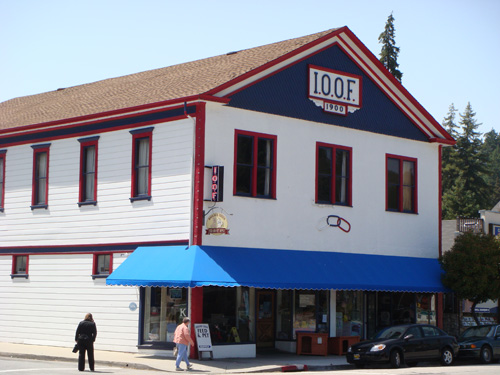
As a boy, taking in the info from movies and the comics, I was sure that: I would serve in the army in a war, spend time in a penitentiary, join a lodge. I always liked the sound of IOOF, the International Order of the Odd Fellows, seemingly still flourishing in Boulder Creek.
After lunch we synchronistically ran into a guy on the street who’d worked on the Doubleday Books sales force promoting Billie Craddock’s Be Not Content way back when. The guy said Billie’s editor was Luther Nichols, and that Billie had been under 21 when his early masterpiece was published.
Driving back to Nick’s house, Craddock passed us on the road, on his chopper with the high handelbars. His ghost. A sign. Be Not Content is going to rise again.
The Hrull are slobbering manta-ray-like aliens who are slavers, conscripting humanoids to act as aids to intergalactic trnasport. They fly when in our atmopshere because they’re buoyed by domed hydrogen bladders, or maybe methane bladders. In space they use humanoid pushers to teleport.
I was gonna call these guys the Rull. Years ago, I wrote a story called “Wish Loop” featuring an alien creature resembling a sea skate that is called a Rull. I didn’t realize at the time that A. E. van Vogt wrote a series of stories about humans fighting against nasty worm-like shape-shifting Rull. The War Against the Rull. So I decided I better call them something else this time. I decided to go with Hrull. An element of homage to van Vogt, and an odd-ball spelling, kind of east European, maybe Czech.
Amazing video, it totally changed the way I think of the Hrull. The Hrull aren’t evil, they’re beautiful. Although in Monday morning’s version of this post I speak as if the Hrull will have saucers they travel in, in the evening, after a day with Nick Herbert, I think the Hrull ARE saucers. And maybe, rather than selling engines, they sell freighting. Carrying goods and passengers in ther cavernous mouths.
For the Hrull’s home world, I start with the idea of an ocean world shaped like a water torus encircling a sun—a bit like Ringworld, though not flat. The collection of water-planets is called Hrullwelt; I like the harsh, Teutonic sound of this name. Such a torus would be dynamically unstable. So we can suppose that the torus has broken into giant globs; we have a toroidal archipelago of water globs— like an asteroid belt where all the asteroids are water. And the Hrull leap from one glob to the next.
Their great wings glowing in the empty darkness of space, soaking up solar radiation. Perhaps with pusher-creatures attached to their bellies like remoras. Or perhaps the pushers ride in their enormous mouths like cleaner wrasses. (The Hrull are filter feeders despite their menacing look.) Although the Hrull who visit Earth are only thirty feet across, maybe the big freighter Hrull are a hundred meters across. The littler guys who came here are scouts.
The Hrull conscript humanoids and use them as integrated symbiotes for star travel. The Hrull use humanoids as pushers to power teleportation hops. Practically all of the alien races use Hrull for shipping and for passenger transport. The Hrull come in various sizes, such as interstellar and intergalactic—the power and range of a Hrull depends on how many humanoids are dangling off him or swarming in his mouth. Like cylinders in car engines.
Robert Sheckley wrote a story, “Pusher,” about humanoids as being the only kinds of species which are capable of teleportation. I discuss this in a Feb 24, 2007 blog entry.
As I said before, with Sheckley, I would maintain that we can teleport precisely because we have so much regret, doubt and fear. Why? Having doubt and fear involves creating really good mental models of alternate realities. And being able to create good mental models of alternate realities means the ability to imagine yourself being there rather than here. And this means that we can spread out our wave functions in ways that other beings can’t. We carry out certain delicate kinds of quantum computation.
Perhaps the humanoids that make up a Hrull pusher are surgically and chemically made into pathetic paralytics unable to escape the engine rooms? No, that would be too harsh, as I want my character Chu to be part of a Hrull pusher for awhile and then bounce back. Let’s suppose that when you’re a Hrull pusher, your encased pupa-like in Hrull body-slime, which slowly hardens. The Hrull slime provides full life-support—oxygenation, hydration, nutrition, and waste removal. People call it godslime.
Why? Well, the kicker here is that the humanoids pretty much enjoy being a Hrull pusher—it produces an intoxication of some kind. Perhaps psychedelic ecstasy, but perhaps something cozier and lower-chakra.. Perhaps The Hrull are intensely interested in the infinite, and being swathed in their godslime makes you feel as if the most important part of you is infinite, in heaven. Your body becomes just an attachment point to maintain a presence in the gross material plane. Or maybe the godslime just makes you feel like you’re on a happy date with your best girl. At home with grandma for the family reunion up in heaven.
But working as a Hrull pusher isn’t endlessly pleasurable. After awhile, you notice that you’re hearing a continual hum—like a leaf-blower or a clothes-dryer or a refrigerator—the hum is in some sense driving and owning your thoughts. The hum is the mentation of the Hrull. The pushers get to go off on leave in the Hrulls’ ports of call. But eventually they make their way back to their owner Hrull, as they miss the godslime. I can see an evening of spacers like this, the vibe reminds me of Samuel Delany’s story, “Aye, and Gomorrah.”
The Hrull carry Chu back to Hrullwelt to test and display him as a sample for a new line of Hrull pusher. The Hrull clients also know about Earth, but they leave the use of pushers to the Hrull. The clients aren’t going to be kidnapping humans themselves. Only the Hrull can exude the essential godslime. That’s the Hrully angle for using humanoids as pushers.
Maybe, as a pun on the Sheckey usage of “pusher,” the Hrull pushers also make a little money when in port by selling small amounts of godslime to rubes. “Just a taste. Your heart’s delight.”