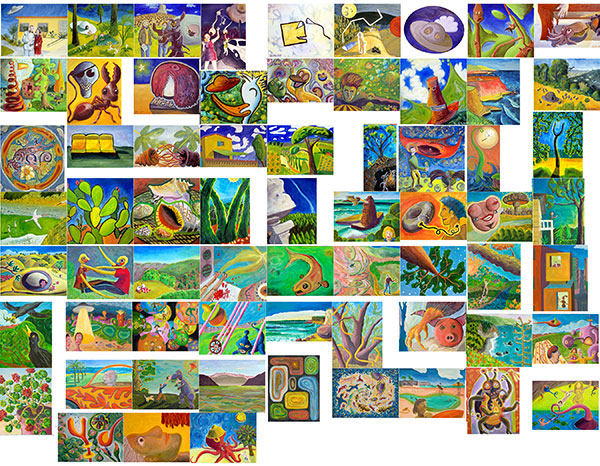
This weekend I had the closing party for my art show. The SF in SF group organized a reading that night as well, featuring me and Michael Shea. I read I from my new cyberpunk omnibus, The Ware Tetralogy-—consisting of my four novels Software, Wetware, Freeware, and Realware. I made a podcast of my part; I’m reading from the classic “monkey brain feast” scene from Software, and Sta-Hi Mooney’s introduction to the drug merge in Wetware. Click on the icon below to access the podcast via Rudy Rucker Podcasts.
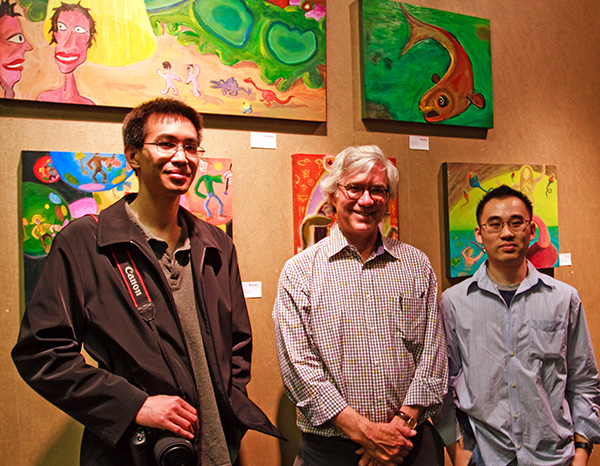
A couple of my old software engineering students from San Jose State showed up for my art show parties, below we see Jason Tong and Alvin Cho at the opening party. Videogame coder Leo Lee was there for the closing.
So now I’m back to working on a couple of short stories and doing a little painting and computer art.
Last night I made a video of a zoom into the quintic “Rudy Set.” There’s a cute little standard-shaped Mandelbrot bud down inside the details (shown at the end of today’s post). And I made another, maybe better, one on May 28, with a zoom past the Heffalump inside the quartic “Rudy Set,” I won’t embed it, but here’s the YouTube link.
I’m sorry to report that Martin Gardner died on May 22, 2010. Scientific American is running some nice web pages about him. Be sure to check the links at the bottom of the Scientific American page, they have are four different pages to look at. And check the New York Times obit as well.
I’ll do a bit of a Martin celebration here as well. First of all I’m posting the text of an article, “Martin Gardner: Impresario of Mathematial Games,” that I wrote for a magazine called Science 81 in 1981.
Secondly, I wrote up a short note on Martin for a Milestone piece in next week’s Time magazine—my note just appeared online, and it will be in the print edition as well.
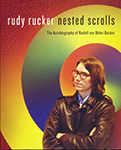
And thirdly, here’s an excerpt from my forthcoming memoir, Nested Scrolls. This passage describes the trip that I took to North Carolina to interview Martin.
The beloved popular mathematics writer Martin Gardner had just retired from his post at Scientific American. I’d worshipped Martin’s columns as a boy, and over the years I’d corresponded with him a little bit—he was great about answering his fan letters. So in the summer of 1981 I got Science 81 to send me to interview him at his house in North Carolina.
This was the first truly journalistic outing of mine, and I enjoyed it a lot. Martin was a kindly old guy, very sharp, and a wizard at sleight of hand. He showed me a trick where he made a coin move right through a sheet of latex rubber that he stretched tight over a shot-glass. He claimed he’d made the coin move through the fourth dimension.
“Please tell me the secret!” I cried. “I’ll give you half the money I’m being paid for this interview!” I’ve always been a sucker for the fourth dimension.
Martin waved off my foolish offer. Not only did he show me how to work the trick, but he gave the requisite supplies so that I could mystify my family and friends. They appreciated the trick, not that any of them ever offered to pay me for the secret!
Rather than using a tape recorder, I just jotted down notes on Martin’s answers to my questions, and that was enough to help me later on when I had to write out the full answers on my typewriter. I have a very good memory.
Something that impressed me about Martin was that he’d been a freelance writer his whole life. He’d even sold some mathematics-based science-fiction stories when he’d been starting out. Up near the ceiling of his basement office, he had a very long bookshelf with all the books he’d published, each title in numerous editions and translations. I dreamed that someday my books could fill a shelf like that.
Before dinner Martin made martinis for his wife, himself and me, using a special glass eyedropper to measure out the vermouth. I went to motel and smoked a joint, then met Martin and his wife at a local restaurant for dinner. At the table, I excitedly rattled on about infinite dimensional space and parallel worlds. Martin and his wife gave each other a look. They knew exactly where I was at.
The next morning, before I left, Martin lent me a box of rare books on the fourth dimension. And eventually he even wrote a preface for my book, The Fourth Dimension, even though he had a philosophical disagreement with my mystical notion of an overarching One Mind. Martin was a pluralist, believing that there are many higher forces at work, rather than just one. He loved pondering arcane metaphysics, indeed he wrote a little-known novel about theology called The Flight of Peter Fromm. A fascinating and warm-hearted man.
May 22, 2010. Rudy reads from his four-novel cyberpunk omnibus, THE WARE TETRALOGY at the SF in SF gathering in San Francisco. This clip includes the classic “monkey brain feast” scene from SOFTWARE, and Sta-Hi Mooney’s introduction to the drug “merge” in WETWARE.
A reminder that the closing party for my art show in San Francisco is on Saturday, May 22, 2010, running from 6 to 10. Details here. I’ll be selling recent art and fractal prints as well as canvases. As part of the SF in SF series, I’ll be reading with author Michael Shea. My readings will be some of the gnarliest bits from my forthcoming four-novel omnibus Ware Tetralogy. Michael will be reading from his kick-ass new novel, The Extra.
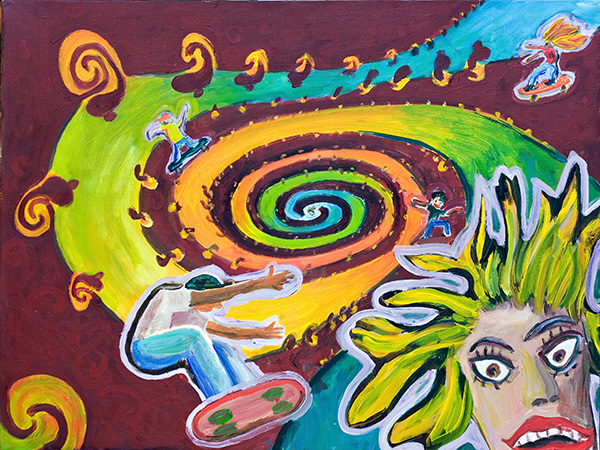
Here’s a new painting that I worked on this week, I guess it’s called “Insane Skate Posse.” As I mentioned in my post earlier this week, “Fractalmania! With a T-Shirt,” I’ve been working with higher-order fractals of late, and I found a really nice double spiral that came from a cubic Mandelbrot set. I saved off a high-res image of it, and started selling the image online as a skater T-shirt with the caption “Seek the Gnarl.” And then I decided to do a painting of this fractal, even though it’s a quixotic effort to paint an infinitely complex object.
I started with just the painting of the fractal, and then I took a photo and pasted on some web images of skaters, and drew on the computer image, and painted that desgin onto my picture. I always think I can’t draw or paint people, but somehow if I chip away at it, something kind of reasonable comes out. It’s not like I need to do photo realism, after all.
I’m slowly working on a story about fnoor, like I was talking about before. In it, a renegade app-programmer is studying a pink patch of fnoor (a.k.a. graphic chaos) in an image made on his off-brand tablet-computer by his run-anywhere “Phractal Phun” app, and he says, “You might say that the pink fnoor is a funhouse-mirror image of a spoiled-rich-kid Apple exec’s furious face inside the Qwirky program that I’m using to emulate the iPad’s app-running code.”
Speaking of programming, I did something potentially self-destructive night before last. I had insomnia, and around 2:40 a.m., I noticed that Microsoft gives away a free “Express edition” of their Visual C++ compiler, and I downloaded it and started trying to rebuild my old 16-bit Boppers app as a modern 32-bit app that will run in Windows 7. I felt like a crack-head deciding to do just one rock. I thought I’d given up programming for good. But the computer gods were kind to me, my old programming skills came back to me, and I managed to fix most of the issues and even some old bugs in Boppers yesterday, and hope to post a superduper Boppers 2010 version soon. Just one more rebuild! [As of May 20, it’s happening baby! Go to www.rudyrucker.com/boppers.]
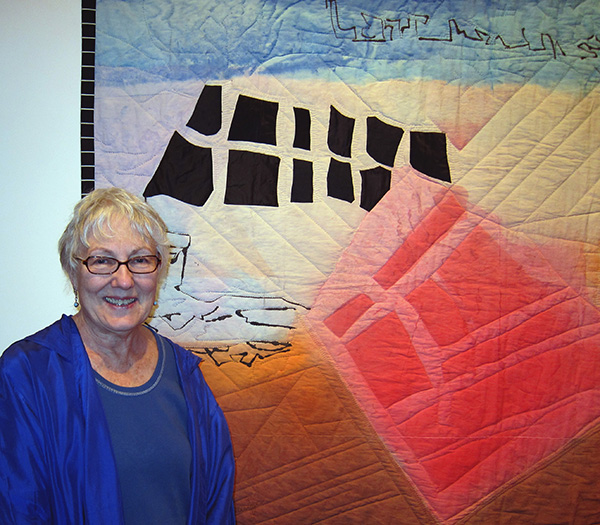
Last week my wife and I saw a great show at the San Jose Quilting museum by Joan Schulze, who lives in the South Bay and has a studio in San Francisco. Schulze herself was at the show—it was the exhibition’s last day—and she was very friendly and talkative. Her quilts are anything but traditional—one might equally well call them fabric art, and Schulze is justly compared to Rauschenberg. I got a photo of her next to one of her works that I liked a lot. She made it while teaching a worshop in the U. S. southwest. That squiggly calligraphy, it’s ink, and it looks vaguely Arabic to me. The color shades are so lucious here, and the quilting stitches are a whole game in themseles. Anothe favorite of mine is called “The Angel Equation.” There’s a nice slide show of her works on her site, and a link to a reptrospective book of her work: Poetic License.
I saw about half of the movie Nine last week. I’d thought it sounded promising: a remake of Fellini’s classic 8 1/2, with a superstar cast, transmogrified into a musical. But, my word, it’s awful. I’m always forget what hideous songs they use in musicals—the singers narrating, in flat-key half-notes, prolonging arbitrary ugly notes for…what? Emphasis? “It’s nice to see you naaaaaaaaaaaaaaoooooooooooooooooooooooow?” And those horrible songs are always at least twice as long as seems bearable. And, oy, the vulgarity and puritanism of the script! Fellini’s imposing, battered, primitive-sex-goddess Saraghena becomes…a Victoria’s Secret model? And the mistress played by Penelope Cruz has none of her the pathos, wit, or dignity—what a waste of Penelope’s skills. And ditto for Nicole Kidman’s role. Ugh, ugh, ugh!
Speaking of songs, I read a glowing article about LCD Soundsystem in the New Yorker a couple of weeks ago. (The review, by Sasha Frere Jones, is only online in an abridged form.) I looked up one of LCD Soundsystem’s videos: “Drunk Girls.” It rocks like Lou Reed’s “White Light, White Heat.”
As a video, “Drunk Girls,” reminds us that music videos really don’t have to consist male and female sexhibitionists doing aerobics (sorry, Lady Gaga, although I did enjoy parts of “Telephone”—like your prison-yard sunglasses made of a hundred burning cigarettes, and your quick little right-on dance move right before you get out of jail, and the horizontal-hands Egyptian-style-happy-rabbit dance moves in the diner after you and Beyonce poisoned everyone—but, please, enough with the Jackson family leather-thong dance troupe aerobics!)
LCD Soundsystem is on tour, playing here in SF at the Fillmore on June 3, but dang, the show is sold out. James Murphy, if you’re reading this, put me down for two tickets on the guest list!