Click covers for info. Copyright (C) Rudy Rucker 2021.


Author Archive

The New AI * Bot Writers * What is Reality?

Wednesday, June 17th, 2026

The Point Reyes Reality Investigation Center (PRRIC) is hosting their third High Castle Dinner Club with Rudy as special guest.
Dinner is at  7pm on Friday, June 26th in Point Reyes.
You can learn more about this free event  here.

This post is the edited text of an interview David Gill of PRRIC did with me last week. I may add some images later on, but I wanted to get this out before the dinner. This long post has three sections.
1. The New AI.
2. Bot Writers.
3. What is Reality?

Copyright © Rudy Rucker 2026. Last updated June 18, 2026..

Part 1. The New AI.

David Gill: How are you, man?

Rudy Rucker: I’m doing well. I’m feeling pretty happy. I’ve got a girlfriend. I’m doing a lot of painting.

Gill: You were just in Europe for your 80th birthday.

Rucker: Yeah, we went for almost a month to Venice, And it was it was really really nice to be there.

Gill: Have you been to Europe in the past? Like do you have any thoughts on how it’s changing?

Rucker: Well, I’ve been to Europe about 40 times.

Gill: Oh wow.

Rucker: My wife Sylvia, who died three years ago, her family lived in Geneva and so we would go there almost every year. And I would also get speaking gigs over there and this and that. So, yeah, I’ve been there a ton of times. And we lived in Heidelberg for two years. While I was writing White Light and Software.

But you know, when you’re over there, you’re you’re always on the outside. You never really know what’s going on.

I managed to get together with a couple of people in Venice. Like my Italian translator, Daniele Brolli. My recent book Juicy Ghosts came out in Italian. They wouldn’t publish it in America because it was partly about assassinating Trump.

Gill: Wow.

Rucker: I wrote it before Trump’s first election, too, and published via my Transreal Books press, before the election. I had some vain hope that I might slightly weigh against his chances. Thing was, I saw what was coming and—it’s working out like I thought it would. It’s kind of scary to have predicted it. In any case, there’s a nice classy addition of it in Italian, from a top publisher.

Gill: That’s great. Can you lay out sort of what you saw coming as we approached the first Trump term?

Rucker: Well, he was already talking about having three terms, you know. And about us no longer having to vote once he got things going. Supposedly in a a sort of joking way. I thought the third term thing was a red flag. And then the thing about his goons trying to commit treason. To prevent Biden’s inauguration.

And now the increasing polarization, and everybody’s on the ropes because the guy does something different and crazy every day. And maybe that’s okay, it’s just bullshit, but my big fear is that he might start a nuclear war and ruin the world for my grandchildren.

Gill: Yeah. That’s a fear.

Rucker: Anything else he does can be rolled back. You know, we can put back the environmental protections. We can makes the taxes fair. We can make them stop the gerrymandering. Just about all of that can be remedied. But, if you start dropping H bombs, you can’t you can’t roll that back.

Gill: How does this 2026 compare to what you were looking forward to 40 years ago as a cyberpunk in the mid-80s.

Rucker: Well, it’s funny. My first novel, Software, I set in 2020. I hadn’t heard that, as a science fiction writer, you shouldn’t really put in a specific year, because that’s a sell by date. But at that time, 2020 seemed so impossibly far in the future. It was like 1980 when I wrote Software.

Gill: Right. You were thinking like Orwell going from 1940 to 1980, right?

Rucker: It’s incredible. A huge jump. And I did in fact predict some big science things that happened. Mainly the notion of software immortality. I feel like I don’t get jack in the way of of credit for it. I’m not sure why it is that certain kinds of taste-makers ignore me. Refined literary types. There’s something about me that’s sort of improper or too punk. And my higher degree in math annoys them. I’m from the wrong team. Too anti. Too smart. Too nihilistic. Too cool for the room.
Gill: Too cool for the room. Yeah. I mean, your stuff is from from 10,000 ft high. It’s mindboggling that nobody ever came, that Hollywood never came knocking at your door,

Rucker: Well, some of them have come at times. And we get close but never quite, you know, take that last step. But they could still come back. I don’t know. I used to obsess about it. Now I don’t.

The thing about movies is that, what with the avalanching of deep fake LLM video, in forty years you’ll be able to turn any book into a full-length movie with the press of a key. In immersive 3D format if you like. All Rudy’s books!

Gill: But why not sooner? And with human actors. You look at Phil Dick, right? I mean, when he died, almost none of his work was in print and people were forgetting about him faster than they were picking him up.

Rucker: Well that’s the vintage career move. Die. They said that about Elvis. Phil wasn’t that old when he died. I made it to 80, man. Maybe I stayed too long. I never thought I’d get to 80

Gill: Well, looking back on Software one wondered.

Rucker: Like I say, there’s something I wrote about in Software that has really come to dominate the SF landscape. The idea of software immortality. That was an idea that nobody had worked out in detail before. Not in a science fiction context. And now it’s in almost every SF novel and movie.

I also predicted our struggles with converting the data into software immortality. I talked about something akin to the large language model thing. I call it a lifebox. I also wrote about in my nonfiction tome, The Lifebox, the Seashell, and the Soul. You can get somebody’s mind by having all their memories. Store the memories with some incredibly good front-end software that turns the lifebox data into the simulation of the person.

I didn’t initially understand the difficulty of creating that front-end software. Turns out it’s too complicated for us to write. So I thought we might develop it by evolution. What they call genetic programming. In my novel Software, I had the moon robots evolve. The reproduce, and compete, and like that.

Gill: Yeah.

Rucker: In real world evolution, the world is running a billion peoples’ computations planetwide. It’s not practical do do this in software, and to emulate the evolution. It takes too long so simulate all those critters rushing around.

So we jump up a level. Think of a big tree of hyperlinks in your head. What we need is a way to generate those links. A process for adjusting the links inside a lifebox of memories. Melding all the separate notions that are in your head.

I could never quite see how it would happen. In the Ware novels, of course, I, you know, wave my hands. I talk about evolution, but, as I say, that’s really too slow, although at first I didn’t realize that.

But now we’re getting into the neural net thing and the large language model. And what you end up with a shit-ton of little intensity numbers. Fractional numbers between 0 and 1. Like settings on dials. Weights between different nodes in the neural net. Two billion nodes and a trillion intensity values. And you don’t understand in detail how the system work. And you never will. But it works.

The way we compute those trillion values is to blindly beat the problem to death. Our huge huge neural nets train themselves by looking at our planet’s entire network of information.

And the training method sounds completely trivial. Get your enormous neural net to be good at finishing sentences. Big effin’ deal.

Yes, your net of bots learns how to pick the next word. And, you know, that’s dull. That’s stupid. That’s nothing. But there’s this thing called a phase transition. When you go from having fifteen pool balls bouncing around to having, say, a billion of them, it’s different. The bouncing balls start to resemble the flow water. Instead of a drifting cloud of gas.

What speeds up the training is that the learning process is unsupervised. We don’t go and simulate a giant world for the bots to evolve in. We have them play a game with language. Ahd we don’t have people telling the neural networks, yes, you answered right, or no, you answered wrong. We’d never finish that task. It would take a trillion years.

Gill: Unsupervised learning.

Rucker: We tell the neural net to train itself. At a very crude level. We it does is to keep suggesting the next word for partial phrases. A ginormous stream of sample phrase, automatically generated from actual phrases. The net checks its guesses against the actual phrases. After each guess it adjusts some the trillion numerical weight factors that link its nodes together.

And somehow, on a big enough network, the process gives amazing results. It undergoes a phase transition. The AI problem is, as people might say, nibbled to death by ducks.

My friend John Walker, he and I had some talks about this. We did a joint blog post in December of 2025, “The Roaring Twenties.” He was referring to the advances occurring in the 2020s.

https://www.rudyrucker.com/blog/2023/12/07/the-roaring-twenties/

We wrote that only a few months before Walker died. He was a great computer guru, the guy who founded Autodesk. I went and worked for him after I moved out to Silicon Vallen in 1986. I didn’t know anything about computers. But Walker thought I was cool. He liked my science fiction.

Somehow I was at San Jose State teaching CS, learning it as I went along. I had a special interest in some dynamical graphics called cellular automata. They were kind of an addiction among hip geeks. I was writing CA programs in Intel assembly language. You needed the low-level language so the CAs would run faster.

Gill: What was Walker like?

Rucker: I had this plug-in card I’d gotten from some guys at MIT. They’d made them, like one at a time. Called it the CAM 6 card for “cellular automaton machine.” You could put one into a slot inside a generic IBM PC—I’m talking about their first consumer model PC.

With a CAM 6 card in a PC, you could watch cellular automata. They’re like the old game of Life. Every pixel on the screen is computing its next state based on what its neighbors look like. And you get these boiling patterns, and what they call Zhabotinsky scrolls, and melting rugs, fabulous things.

And our man John Walker figured out a way to do this in software without having to find a rare and expensive MIT CAM 6 board. He fully designed and evolved his cellular automata CA Lab in a week. That’s the kind of guy we was.

Getting back to our new wave of LLM bots, Walker had this thing he pointed out while we were working on our blog post in 2023. He says, “Well, you might think that it’s too crude to develop AI just by predicting the next word.” And then he says, “But that’s the way you program your own brain.”

When you’re born, you’re watching what happens. And people aren’t writing programs for you. They’re not drawing hypergraphs. You’re just seeing what happens next. And you build out from that in very subtle ways. And it’s not obvious the way this kind of process works. The neural nets in the new AIs, they’re sophisticated. They have hidden layers. Levels and levels.

As a maturing human, you work out this process of making things fit. You notice on your own how your mental network fits the world. Your brain keeps making your itself a better fit. Adjusting the connection strengths between your neurons. Nobody has to be training you, at least not all of the time. Parents and teachers do try to help, although what they say doesn’t matter all that much. In point of fact, despite parents’ worries, it doesn’t matter all that much where you go to school. You you can see the world and you can see if what you’re predicting is happening.

Gill: Rock on.

Rucker: There’s an interesting historical angle here—on how people had this dream of finding the magic key for AI. It was a core belief among early AI workers, a notion that thinking was like a logical system that works out logical consequences. Like, if we could just get a good logic system, we could deduce everything.

But logic is bullshit. I say this as a computer science professor with a Ph.D. in mathematical logic. In the real world, logic iss doomed to fail. We have these results that Alan Turing and Kurt Godel proved in the 1930s. Alfred Tarski was in there too. It’s impossible to define truth. And this leads to a proof that it’s impossible to write a rule that will logically predict in advance what’s going to happen. There’s no way to compress the complicated computations that underly a real person.

To know where you’re going, you have to live through the process of going there. You have to live it in real time. There is no magic key. There’s no shortcut.

Suppose you say, “What am I going to be thinking about at noon tomorrow?” You can’t glance at a computer screen and say, “Oh, that’s what I’m going to be thinking about.”

So if there’s no magic key, how to create human-level AI? Well, as I mentioned, we might try genetic programming. Let our AI systems evolve. Bit first of all, that takes forever. And second of all—and this is subtle—it’s had to know what kind of system to evolve.

When I worked at Autodesk under John Walker, I wrote an educational software package called Artificial Life Lab. I had some colonies of virtual “ants” that crawled around on the computer screen. And they were using genetic programming to get better at eating each other.

I had several different behavior parameters, and he ants evolved by sliding their parameters up and down. But I was never sure if I had enough parameters. And my ants didn’t evolve all that well. I was hitting the deep AI problem of deciding what is the system I’m trying to evolve. Logic? Numbers? Maps? Links? Stories?

In the new AI, we simply punt on the problem of what the the elements should be like. We make them butt simple. We use a giant mounds of all-purpose neurons. A neural net.

It has a couple of billion nodes, and trillion strength parameters connecting the nodes. We dump the giant net onto the observed world and let the neuron-worms wriggle around, making trial guesses about how things fit—and eventually they’ll fit their network to reality.

And we won’t know how or why the details work. Never. It’s a meaningless mound a trillion little numbers

But that’s not a bad thing! It’s just how Godel and Turing and Tarski told us it has to be. Deep, tangled, incoherent, incomprehensible networks of arbitrary neurons. Shaping themselves to fit. Like toddlers learning to walk.

That’s how it is. It’ll never be tidy. Get used to it.


Part II. Writer Bots.

Gill: Whoa. Are you a materialist when it comes to consciousness? Do you think everything happens in the gray matter between our ears?

Rucker: No, not entirely. If you’re into writing or computing, you spend a lot of time looking at keyboards and words and you begin to think that’s reality. But then you go outside. And that’s why I called my recent novel Juicy Ghosts. Suppose that you’ve achieved software immortality by making a “ghost” or an animated lifebox pattern that imitates you. But it would be better if the version of you had some juice. Some living flesh. A biological body.

In ancient Egypt when someone died, they’d parcel the organs of their body into “canopic jars.” Important organs like the the liver, the lungs, the stomach, and the intestines. They’d leave the heart in the body because it’s so important, also it doesn’t rot so easily. But what about the brain? Well, they just thought that was snot. They’d clean it out of the skull and throw that crap away. The brain isn’t everything.

There’s this extra that we get from a physical body. A kind of buzz, emanating from the physical universe. Quantum mechanically speaking, scientists like to call the universe a pattern in Hilbert space. The meaning of that is a little unclear, unless you’re into quantum mechanics. I like to use the phrase in my science fiction. It’s one of those buzzwords that adds some class. Love that Hilbert space buzz. It’s like being high.

If you press me, I can tell you that Hilbert space is an infinite dimensional space holding patterns with endless amounts of information blah blah blah. As a more practical explanation, I’d say that Hilbert space is where your mind lives. You mind is complex and infinite and entangled. And it’s not especially logical. It’s the answer sheet for endlessly many questions.

Often when I’m thinking, I’m not I’m not using logic at all. I’m just feeling. If I’m relaxed. Feeling and drifting, and the images are going past me, and I’m merging into the All.

If I’m in the backyard, I’m one with the trees. I’m with the birds. We’re all one thing. The universe is like a giant Hilbert space jellyfish that includes us all. Why should we say we’re separate? I do seem to be covered in skin. But the higher skin, the jellyfish skin, the Hilbert space skin —it envelops us all together.

I’m making the point that consciousness is more of a distributed thing than we realize. Not just mine and yours. Ours. And I’m happy about that.

Thing is, I’m comfortable with mysticism. Everything is alive, everything is conscious, and all is one. Your precious brain doesn’t make all that much difference.

You don’t always fall in love with someone because of how they talk or what info they spew. It might be because of how they smell. The pheromones. The subtle glance. The touch of their hand, the curve of their cheek. Brains aren’t everything.

Gill: So much of what we do is automatic. The sense of being a mind in command, it’s like you imagine you’re this tiny little admiral with epaulets and brass buttons, standing in the conning tower and bored, but meanwhile the ship itself is like, “What’s that? He’s eating again. Open the hold.” And maybe then the admiral makes a string of noises as if he’s in command.

Rucker: Yeah. Let that he strutting general rant. Let him rave. Screw him. Nobody cares.

Gill: This is great. Let’s talk a little more about AI. Tell me what’s happening right now.

Rucker: It’s stunning how far things have come. When I was in high school, you know, there weren’t really any computers that you ever saw. In 1962, our class went to career day at the University of Louisville. And they had the proverbial giant machine in the basement that could, you know, with great effort, print out, like, the first five prime numbers as a bar graph.

I was interested in the idea of a computer mind, and of course I was reading science fiction. In science fiction it’s you can get things done very easily. You make up a word, and brandish it, and the robots live. Positroics!

Even though I didn’t know if I’d ever be able, I wanted to write about robots and aliens. Being a beatnik SF writer was the greatest thing you could possibly be. My hero was Robert Sheckley. He had a way of making his aliens or his robots be funny. There’s different ways of being funny in science fiction. One way is low, slobbering, and fannish. But Sheckley was funny in a cool way. Like a beatnik, yeah. He wasn’t pounding his his elbow into your ribs. His characters were humane and even cute although, let me reiterate, never in a slobbering way. I learned how to write SF from him.

Hollywood really didn’t pick up on the hip, beat version of SF. At least not to start with. If they wanted somebody to talk to a computer, the computer would use a strained monotone or, even worse, write its answers in all capital letters. Like this all-powerful machine can’t grasp how to use the shift key on a typewriter?

Back to computers, it’s astonishing how they’ve advanced in the last 75 years. A universal library in your pocket! Guessing where we’ll be in another 75 is hard. But that’s what SF writers are for.

I think biocomputation is going to be very important. There’s this one example I always think of. The skins of octopuses and squids and cuttlefish. These guys can make their skin display all these amazing patterns, and they’re swift. It’s an analog computation involving skin cells. The cephalopods are like living cellular automata.

So why wouldn’t we start using that biotech for our display screens? It seems obvious. It’s just a matter of designing an interface.

Gill: From my perspective as a reader, your great area is speculating on this sort of hybridization. I really love your biotech novel The Big Aha. There’s so much great stuff in there about genetically engineered bits and bots and weirdness. As you say, biotech is a frontier that we’re just about to crack, with things like the biotech CRSPR tool that can edit genes in real time.

Rucker: John Walker made the point that if you’re in exponential mode, continually doubling your progress, then on the second-to-last day, you’re only 50% done, and the next day you’re finished.

In terms of bots mimicking us, that’s not so far off at all. Talking to bots on the phone is increasingly less annoying. The bots understand you better, interact better. The old Turing Imitation Game thing is solved.

Writing like a person is a big issue—especially among authors. In generating text, there’s a parameter called heat. Has do do with how unpredictable you want the next word to be. In political speeches or in news stories, the heat is on the low end of the spectrum. Maybe one on a scale from one to ten. For boiler-plate scripts or fiction, the heat might be two. You can sort of hear that low-heat prose style. Always using an obvious next word, or phrase. And the stale witticisms are dead on arrival.

Gill: Stuff that truly can be written by a bot.

Rucker: Yes, the cruddier scripts cand speeches are now written by AIs. If the producers happen to be morons, they don’t see anything wrong. Writers are being laid off.

What about quality literature? I did an experiment on my own writing. I was working on my recent novel, Sqinks. Spelled with a Q.  This could be my last novel, by way. Not necessarily because bots are phasing me out, but because I’m getting so old. Maybe I’ve said enough.

Anyway, Sqinks is about a a washed up science fiction writer who is living in a a shipping container on the San Francisco Bay, and his wife is dead. He’s living there with some young people he met through his kids, and he’s trying to find a woman. He’d like to write one more novel. Transrealism alert! Sqinks is about the main character writing Sqinks.

The guy meets up with a woman and, you know, starts having a life. And when I was writing Chapter Three, I thought, well, just for the hell of it, let’s see what Chat GPT would write for the second half of this chapter.

So I got a Chat GPT account, and I fed it the first half of my chapter as a big-ass prompt. I said, “Write the rest of this chapter in the style of Rudy Rucker.” And the bots knows my style because I’ve made a point over the years of putting almost every one of my books online in format or another, and the studious bots have read them all.

Gill: Okay. you’re talking about free browsing copies, and not necessarily the pirated editions. I did that with some of my books too. Using various ways to put them online. So you put yours out there intentionally. Can you just just sidestep for a moment to tell us why you did that as a as a writer?

Rucker: Main thing is that I want to be read. Aso I figure the best form of publicity is to put my pieces out there. Building my brand! As a practical matter, it’s a hassle to read something as a web page or as a as a PDF. So I figure that if the trial readers like it, they might go ad buy a legit copy

I saw the writer-bot thing coming. I mean I already saw it in 1979. I knew that eventually the bots would be imitating people, and I wanted to them to imitating me. More Rudy books, right? That’s a good thing.

Gill: Why do you think more writers don’t do like you do? Like they look at that kind of free material on the internet as something that’s dangerous to them.

Rucker: Maybe the fact that I am so intimately familiar with computers makes me less paranoid. Less anxious. Some writers might worry that posted pieces get this taint on them, and the work will be just totally stolen. But really you’re safe if you post a copyright notice. I published a free zine online for a few years. Flurb. And lots of writers were okay with that. But I don’t think they’d produce a free zine themselves. And on the dark side, you you can get any book you want in pirated form. It’s not hard. But, getting back to my point, I like it if the bots can legally find all my books, and learn how to write like me.

Gill: And that’s what you did. So, how did it go when Chat GPT looked at all your work and tried to finish a chapter like you?

Rucker: Well, it wrote a damn good section.  It…it surprised me. I mean I was really surprised.

Gill: John Henry surprised.

Rucker: It wasn’t just my style. They even put in couple of new characters, with clever names. And a new twist, and a new device. They —brought in some aliens. They did these nature descriptions that were exactly like I might write, but they weren’t copies of my words. None of it was cut and paste.

People say that the AI chatbots are doing cut and paste, but that’s not how it works. They are not literally stealing our writing. They’re learning from it. Like I’ve been saying, they have this immense network of linked neurons. Like a spring-mattress the size of the New York City. Billions of nodes and a trillion springs connecting them. And we don’t directly program it. The giant bot programs itself.

Like the way a child might learn to imitate adults. The bot does what would-be authors do. Reads books and learns to imitate them. It’s not a crime. Some people can’t understand that. They don’t understand the power of an ultra-massive neural net. Thanks to its size, it undergoes a phase transition. Like steam turning into water.

Gill: When you say “some people” what do you mean?

Rucker: Let’s just say that I have some writer friends who are very paranoid about AIs. If you have your own style and plenty of ideas. you’re safe, at least for now. But if you’re writing low-brow, highly predictable, most-obvious-response, low-heat stuff, then your days are numbered.

And, strange to say, it could be that eventually the Reaper will come for you and me, David. They’ll have high-quality lifebox emulations of us, and they’ll be able to generate Rudy and David witticisms and jokes.

Oh well. There will be, as I already mentioned, the upshot will be that there are t0ns and tons of scintillating Rudy Rucker and David Gill novels in the year 3K. And, again, all of them will be available as immerxive 3D movies/videogames as well. “Have you played Rudy Writer?”

Gill: Yeah, baby. Binge-watch.

Rucker: And­—I can’t say this often enough—the bots will not be collaging our work to make the imitation books. That’s not how it works. It helps to be a computer scientist to understand the process. The details are complex. I don’t fully understand them. And they’re changing all the time. Getting subtler. That’s what the new AI companies are all about.

Anyway, that big law suit against Anthropic is not because they’re cut-and-pasting our work. It’s about something low, and stupid, and dumb. Instead of buying copies of our books for study, they used pirated book copies. They shoplifted our books.

But they are not plagiarizing them. They’re emulating them. And that remains completely legal. But, yes,they do owe some money for stealing the actual copies of the books.

Gill: Oh, that’s an important key. That was what I was going to ask you next. Okay. Did you use the half-chapter that Chat GPT wrote? Did you not use any of it?

Rucker: Well, it was good, but it wasn’t good enough. I’m still the king. The writer bots may get there, but they’re not there yet.

I mean, to really make up new Rudy-ideas, it takes more than programmatically emulating me. It’s about getting something extra coming in. Something else.

Gill: Like what?

Rucker: Two things. One is the facts and experiences of my entire life. Of course a lot of that can be packed into what I call my lifebox. And the writer bot could be tweaked to add references to my life and like that. Fairly easily done.

The second edge I have is that I’m alive in a physical body with a human personality. I pay attention to the real world around me and I have emotional experiences. I call my style transrealism.

Part 3. What Is Reality?

Gill: Ttransrealism is on my list of things to ask you about. Fantastic.

Rucker: Transrealism is a good topic to discuss, you being the consummate Phildickian. I was initially encouraged by Phil Dick’s style and in particular by his novel A Scanner Darkly.

Norman Spinrad wrote a a blurb for the British edition of Scanner that says it’s a “transcendental autobiography.” And I latched onto the word trans. And realism means it’s about the the artist and their life. Like a beatnik novel, like William Burroughs in particular. Transrealism means you’re jacking it up with some kind of sci-fi twist.

And it’s hard to do all that. I doubt if today’s bots can do it in a convincing way, not that I’ve tried. Seems like a lot to ask.

And of course I’d like to think that, you know, my finely-tuned skills from studying literature for my whole life and thinking about it day and night—seems like that’s a step above today’s bots.

My fiction embodies my full transreal life, and this makes it richer. All the side references, emotions, dreams, and jokes woven together.

Of course most of us writers imagine there’s something special about what we d0.

Gill: I’ve been really inspired by your transrealism. I’d already thought about the idea of writing about yourself, and the idea of making the literal figurative through science fiction tropes. But to hear your description of transrealism really drove the idea home for me. Can you speak about why it seems to make sense to look at our lives through science fiction tropes?

Rucker: William Gibson says science fiction enables us to get a little bit of distance on the world. You can see more clearly if you can back off.

That’s part of the motive for SF transrealism. Another part is that if you only look at cruddy entertainment that could have been written by a low-heat LLM—if you do that, you’re missing out on the strangeness of the real world around you.

I mean, the people that you know, they’re all strange. Go and ask anybody, “What’s your family like?” And they’ll always say, “They’re not normal.”

Gill: Right? Like Tolstoy’s line. Every happy family is the same? Every unhappy family is unhappy in its own way.

[Last Updaated to Here]

Rucker: The concept of “normal” is a scam. A whip our would-be masters use to beat us down.

Something I like about the world is its richness. This connects to my interest in computation and chaos. It’s not not widely recognized that the view you see out your window is probably not exactly duplicated anywhere else in the entire history of the universe.

Proof? Suppose you have a tree with a hundred leaves, and each leaf can be in ten positions. The number of possible arrangements is ten times ten times ten … a hundred times. Ten to the hundredth power. Sometimes knows as “googol.” A very large range of options from just a few leaves.

Matter of fact, a mere ten to the eightieth power may, according to some cosmologists, be the total number of particles in the universe. All that choice from one scrawny tree. And add in the full motions of the bushes. And the thoughts of the people around you. And the shapes of the clouds.

Youri personal daily world is unique. One of a kind. Reality is chaotic and rich. So why do people keep writing about the same stupid-ass cliches?

My point is that reality is not a cheap collage of stock chracters, standard situations, and shop-worn tag lines. We’re not living in a beige mall. Not in an airport food court. The range of our our daily experiences is vast beyond measure.

Make it new, tell it like it is, let your freak flag fly, and make your robots funky. Badda boom.

Gill: Funky. What’s that mean to you? Funky.

Rucker: What’s a funky robot? Oh, it curses. It stinks. It takes drugs in the form of crooked electrical waveforms. It laughs at things, but the laughter is backwards. It changes the subject six times in one sentence. It’s questions your reality. It hates the Pig.

Gill: What do you think about Isaac Asimov’s robots?

Rucker: Well, they were a start. Of course my bopper robots would utter a hearty FU to any “three laws.” But the laws were a nice gimmick for setting up stories. I met Isaac once. He was a good guy. Jovial. A genius.

Gill: Yeah. Did he snap your bra?

Rucker: From what I saw, he could be quite charming. Very into himself. Maybe a little like a stand-up comic on break.

At one point Isaac was angry at me because Charles Platt did an interview with me and I mocked Asimov a little bit. I said, “Well, you know, I like to write about people that talk the way my actual friends do. And if I’m explaining something to them, it’s not like an Asimov book where they say, ‘Please tell me more. professor.’ They say, ‘Screw that. Let’s do something else.’”

Gill: Like, you’re boring me.

Rucker: Yeah. And somehow Isaac latched onto this and and he wrote a column railing against, “this Rucker person, whoever he is.”

Gill: Really? Would you be able to find that column anywhere? Do you think you have a copy of it somewhere?

Rucker: I don’t know.

Gill: Point me to it. I would love to read that. That sounds amazing.

Rucker: Well, he used to write columns in the Asimov’s SF magazine.

Gill: Yeah. I’m gonna put my researchers on that task.

Rucker: But then I wrote him a letter apologizing and he wrote back a very nice note. So it was all okay. I mean, I did greatly admire a lot of things about his work. Even if he was a little uncool.

Gill: I also liked his books a lot when I was growing up. That brings me to another question. What got you into science fiction as a kid?

Rucker: Well, I liked Heinlein a lot better than Asimov. He was funkier, you know. And noir. Though sexually so strange—this jumped out when I reread The Door Into Summer, which I’ve always admired for its superb treatment of time travel. But it has a Lolita number at the end. And he dos that in Farnham’s Freehold too. A seriously repellant book. Homer nods.

Heinlein’s treatment of curved space and hyperspace travel in Starman Jones was a huge influence on me, as was Tunnel in the Sky. And my novel Master of Space and Time was greatly influenced by Heinlein’s The Puppet Master.

Going from Asimov to Heinlein involved a shift from SF written for 12 year olds to SF written for 20 year olds. Even Heinlein’s “juvenile” novels feel grown-up. He had a great narrative voice. Kind of wordily wise, jaded, open to new kicks, and sardonic. Maybe a little like Raymond Chandler.

For reasons unknown, I once was assigned to write a double-hearer book-review for the LA Times: Ed Sanders, The Family (the Manson family) and a re-issue of Heinlein’s Stranger in a Strange Land, said to be one of Charlie’s fave reads.

I don’t really remember my review, probably I was joking about the whole thing. But I do remember an angry letter to the editor, protesting that a punk like Rucker shouldn’t be allowed to write about the Master. “It’s like letting a member of (the band) Quiet Riot review Beethoven’s Ninth,” Oooh-kay.

Gill: When did Phil Dick enter the picture?

Rucker: The King. I’ll get to him in a minute. But first I want to talk about Robert Sheckley. He was my shining light. My true mentor. I was a sophomore in high school when I got hold of his first anthology of stories. Untouched by Human Hands. Later I got to know him as a personal friend. He was working as fiction editor at OMNI magazine, and he wanted to buy a story from me, but then the top editor Ben Bova wouldn’t let him. Sheckley loved my work; he wrote a funny intro for my first story collection, Seek! He was a very hip guy. Like a beatnik. Apartment in Manhattan. He smoked pot with me, and he had lots of women friends and he was a wildman in his own way.

At one point he came and stayed at our house in Lynchburg, Virginia. He had a camper van and was with his then-wife Jay Rothbell. He plugged his van’s wire into my house and connected his water hose to my faucet. It made me so happy. The Sheck-man, hero of my youth.

Not to go too far onto tangents, at one point Timothy Leary, of all people, wanted Robert and me to write the scripts for a Carl-Sagan-type TV series he wanted to host. Science for freaks. Robert and I went over to Tim’s house in Hollywood and talked, and he thought we’d be prefect. Whispered to his agent, “These are the guys.”

I took Tim’s PC computer apart and installed a CAM 6 cellular automata board so he could see the pretty patterns. Goot times.

Gill: What’s the connection for you between science fiction and math? You were getting into that a little bit when you mentioned chaos theory and computation.

Rucker: Mathematics is what I majored in at college. My father told me, “Don’t major in literature. You can read books. Major in something hard. Be a Renaissance man.”

Gill: Good advice, right?

Rucker: It was. And it was good to study mathematics. I was a terrible student in college. I was drinking as much as I could, and smoking pot, and doing very little studying. Subjects like History, Economics, and Political Science­­­­­—out of the question.

Gill: Living the dream, man.

Rucker: Yeah. In the mid ‘60s, And I did like math, even though I missed a lot of my classes. Math comes easy to me. I like that way of looking at the world. It’s a built-in twist of my mind. I like to see stark underlying principles that explain how the world works. And math is a treasure trove for science fiction. The fourth dimension! As soon as I heard of that, I wanted to know more. Eventually I published three non-fiction books about the fourth dimension. And I have my novel Spaceland that’s about a guy going into the fourth dimension.

Gill: Is that a rip-off of the book Flatland?

Rucker: Well, I wouldn’t call it a rip-off. It’s, you know, a riff. Not a rip. And the main character is a middle manager in Silicon Valley. You might say he stands for A Square from Flatland.

Gill: Yeah. Is that another thing that you get from Phil Dick? The interest in a main character who’s a zhlub, a loser.

Rucker: Well, writing about the downtrodden comes naturally to me, given that I have not been the most highly regarded person at any point in my life. At the beginning, I called myself Mister Nobody from Nowhere.

Gill: I think that worldview sets itself up for a special kind of greatness, you know.

Rucker: I had a lot of trouble getting teaching jobs, and often it was hard to get published. I really relate to Phil Dick. I like the everyman quality of his characters. Although a lot of the time, they were depressed. And I did sort of get tired of that. I want them to to have a more fun. In Scanner Darkly they’re having fun, in a way, even though things are terrible.

One bit cracked me up. This blown-mind guy thinks aphids are infesting him, and he’ll look at you across the room, his eyes slitted, because he knows you’re an aphid-carrier person. Or when our hero Bob Arctor is freaking out, and his car engine is dead in the pull-over laree of a freeway, and the parts of the dashboard are calling out to him in “high horrible thin voices,” and his tormentor Barris runs his finger over the engine block and holds he finger up to Arctor’s face and says, “Look, Bob, it’s dog shit. Your engine is coated with dog shit” Or when Arctor’s friend Luckman is choking to death on a piece of food, and Barris watches Luckman twisting on the floor, and then Luckman manages to cough out the food and, and he glares at Barris and says, “Why didn’t you help me? What were you doing? Jacking off?” And Arctor is watching all this through a police surveillance scanner that he may have installed himself. Full, rich humor.

Gill: I’ve had friends who, you know, after a certain number of Phil Dick books, they say, “I just don’t want to read mean people sniping at each other anymore.”

Rucker: Yeah, exactly. But he can be so funny. And, like I say, I worship A Scanner Darkly. I’ve read that so many times. Not everyone understands that it’s funny. Maybe you have to be a stoner or a former stoner to get it. The stoner humor is so incredibly perfect. Like in Freak Brothers comix, and in William J. Craddock’s supernal masterpiece, Be Not Content.

Phil is great at dialog, a whole level above Heinlein. He captures this flat style of speech. Ironic, paranoid, despairing, and whatever. So California. I used to call it “language with a flat tire.”

In a different vein, another Dick book that I love is Time out of Joint. I read that in college. I hadn’t known there could be science fiction like that.

And I’ve gotta mention Do Androids Dream of Electric Sheep? More thoughtful and philosphically engaged than the two Bladerunner movies. Not that those movies aren’t great. The giant hologram of a sexy woman nudging a tiny human in Bladerunner 2049, such a wonderful transreal representation of us vis-à-vis the media.

I want to mention a key birth-of-cyberpunk moment. I was in NYC to receive the very first Philip K. Dick award. For my paperback novel Software. And right before the ceremony some of us went to see Bladerunner at a theater in Times Square. It had just opened that week. Bam.

Gill: I want you to tell us more about SF and and math. I don’t want to waste this chance to hear about that.

Rucker: There’s a specific aspect of math that inspires me. Logical consistency. I hold to that. One way you sometimes do math is to start with a theory, and see what comes out of it. You get some basic rules, like Euclid’s postulates for geomery or the Zermelo-Fraenkel axioms for set hteory—and you see what logically follows from these.

So when I’m writing a novel, I like to develop certain rules about the universe we’re in. But I might adjust the rules as I go along. If something that really I want isn’t consistent with the rules as they stand, then I’ll tweak the rules. Or change the thing that I really want.

At the end, I want the whole thing to hold together and be completely logical and air-tight. Kind of a hard-SF thing.

Another aspect of this is that as I study my rules, I may find consequences that weren’t evident to me at the start. This part is fun. It sets up extra action for the later chapters. It’s like I’m doing a thought experiment. Studying a new world by living in it. And scoring fresh kicks.

I love when my novel surprises me. If it doesn’t surprise the author, it’s not going to surprise the reader. You shouldn’t come on all godlike and act like you know everything. You don’t want to be pompous, boring windbag.

I love when the big special effects emerge from what was already there. Cool things that emerge spontaneously. Like orchids growing from sand.

In Sqinks, which I finished last year, I somehow got the point where the SF Giants baseball stadium is packed with literally  a billion rubbery sqinks. And a few hundred million bad-ass Mu9ers descend, and they zap the sqinks with rays. And then an immense talking potato appears. Pure logic at work, you gotta believe me.

Gill: So science for you is an important part of science fiction. It’s not just like a blank slate where you can play with those tropes willy-nilly. You have an over-arching plan.

Rucker: That’s how I roll.

Gill: I love it. All right. Last question. How do you define reality.

Rucker: Reality. It’s rich. It’s Hilbert space. There’s one thing I learned recently that I should have known, but I didn’t. The stars are shining all day long. I mean, they’re up there shining and you don’t see them because the sky is bright from the sun.

Gill: Yeah.

Rucker: And I think your dreams are like the stars. You see your dreams at night because your bright daylight mind is isn’t in the way. But the dreams are playing in your head all day long. Always there. Deams are part of reality.

That’s something I tell people when they ask how I write. “It’s like dreaming while I’m awake. All I do is write it down.”

Now take it a step higher. Your dreams and my dreams are shared a little bit. They’re in this mental Hilbert space where there’s no barriers. Our dreams are bumping into each other. Entangled. I think reality is a huge shared thing. Sleeping and waking, all of us together.

And always there are connections and synchronicities. In my life, they seem to come in waves. More of them in certain times and situations…maybe when I’m paying more attention? Or finding my way around a new city. Or at times of great emotional upheaval, like after a death in the family, or a birth. Or during a passionate romance. Or when concentrating very hard on some intellectual task.

The world around me goes wild with coincidences when I’m working on the end of a book. Reality is dancing with me. I’m in a different mode.

But stuffy, dullard spoilsports say synchronicities are random, or that people imagine them, or that they’re a symptom of mental illness. But synchronicities can feel very real, especially when you get these runs of them.

How can it be? Suppose we think of our world as a supreme work of art. Compare it, say, to a painting or a statue or novel. If you’re going to write the biggest and best novel ever, you’d want to put in lot of cool connections. Not just the “vertical” links of cause-and-effect, but with “sideways” connections happening too. Strangers unexpectedly meeting, strokes of luck, curious frags in your message feed­—coincidences weaving it all together.

I’m saying that some coincidences are not random and accidental. They’re an essential part of the grand design that we live in. It’s okay to have exist connections that are not based on conventional cause and effect. The phenomenon is subtle, but real. Why wouldn’t it be? Why would the world be chintzy? As opposed to rich and multi-layered.

Reality is this incredibly rich and precious thing that we happen to be part of. And we’re never going to find out the answers. All you know is that you’re here now. In the middle of it.

Gill: As a mathematician, does that bother you that at the end of the day there’s nothing on the other side of the equal sign?

Rucker: It doesn’t. When I was younger, I imagined I would figure it out. And now I realize I’m not going to. I’m just enjoying being in it. It’s a wonderful place to be.

Gill: Oh, what a fantastic place to end, Rudy. Honestly, I think that was an incredible interview. You are a fountain of great amazing insights and thought. I really enjoyed this.

Rucker: Well, thanks. I did too.

Talking, Writing, Painting

Wednesday, February 25th, 2026

A talk on recent paintings by Rudy Rucker. Inspired by his sojourns in the lands of math and SF. The idea of the talk is to compare three different channels of communication: conversation, text, and paintings. The talk was be part of a Dorkbot event on February 25, 2026 at the Monkeybrains building in the SF Mission.

Photo by Karen Marcelo.

The talk went over well, and I sold some high-quality prints that I made.

I didn’t manag to tape my talk, but I’ve inserted some of my notes for the talk. The notes are bulleted, and are centered.
================

  • You want other people to understand what you’re thinking. Lots of reasons. The pleasure of sharing thoughts, and coming to understand your own self better. Making friends,  finding a lover, fending off  enemies or rivals. Asking for food, shelter, or affection. Giving and getting information. Doing philosophy. Telling jokes. Reminiscing. Entertaining. Sharing emotions.


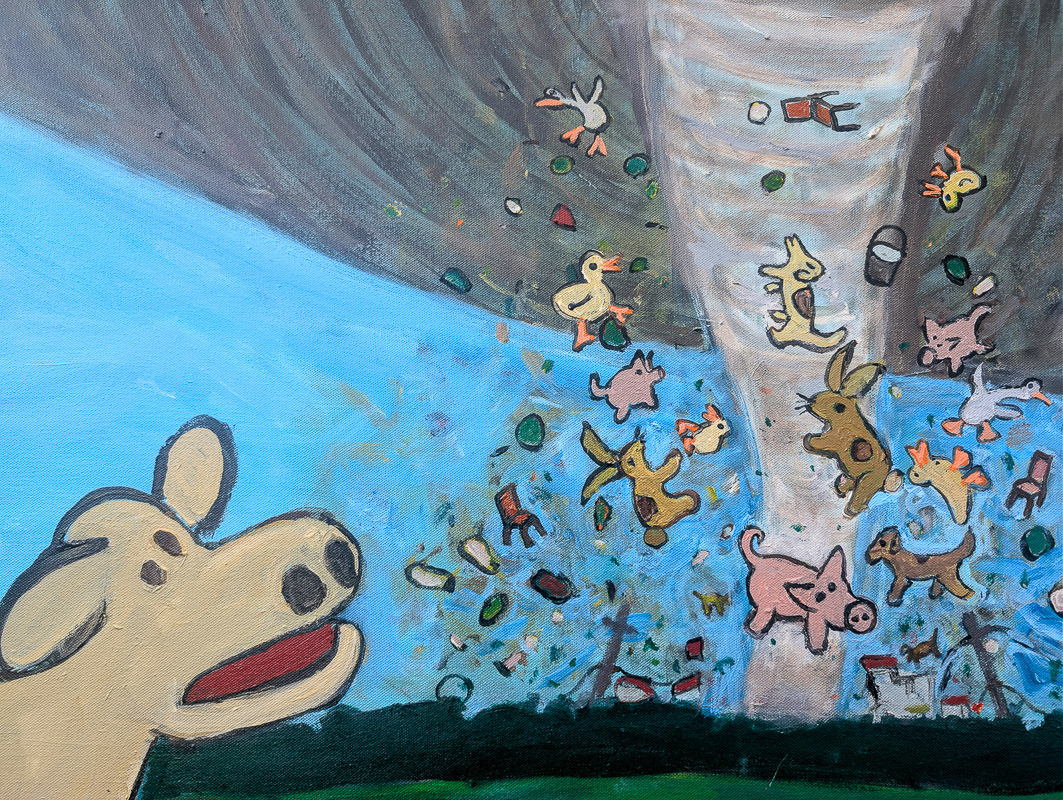
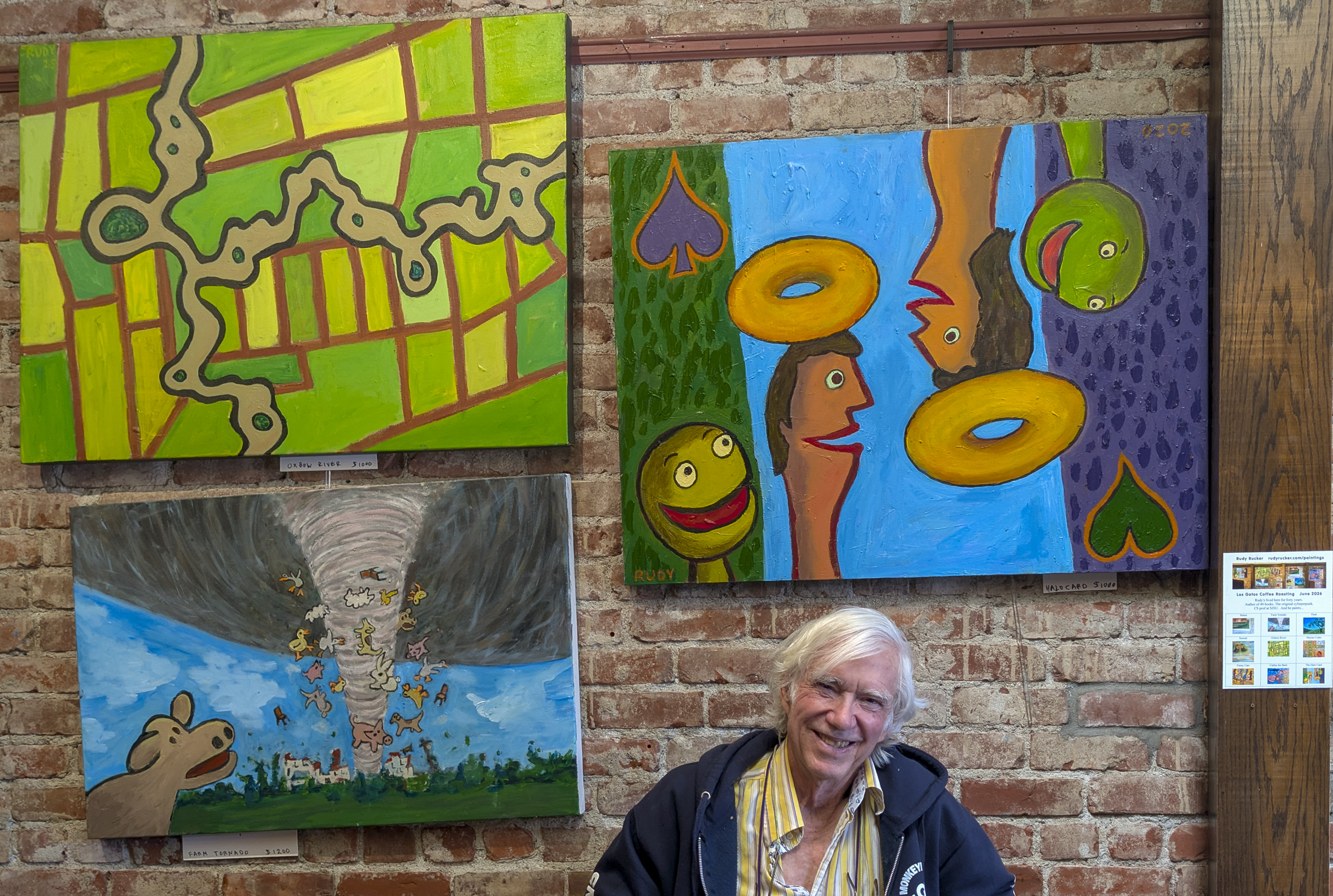
292. Farm Tornado
Acrylic on canvas, 36″ x 24″. February, 2026

Sometimes I watch tornado videos on YouTube. These are made by fanatical storm chasers who seek out heavy weather. In one of the videos I saw a beautiful frame that I wanted to paint. So I screen-grabbed it, and got hold of a wide canvas, and painted the scene, and it was pretty easy. But it felt maybe too too easy; also my painting wasn’t really as good as the photo. So I decided to make this more of a Rudy painting…with critters! A a farm’s worth of animals. What with tweaking and retweaking the tornado itself, the process took me a long time, eight or nine sessions. It’s in a playful style, not stressing the dangers—although those three empty chairs make your wonder. I liked having a cow off to one side, watching. “Mur?”

  • Speaking face to face is the richest channel. The tones and harmonies of the voices. Body language comes in, not to mention micro facial expressions. Scents, fragrances, pheromones. The touch of skin.

291. The Light
Acrylic on canvas, 40″ x 30″. January, 2026

Brilliant sunlight and fresh grass on the bluffs overlooking Three Mile beach north of Cruz.-I love how the light fully illuminates the substance of the grass blades, lighting them up as if they’re stained-glass windows. And I have this recurring mystical sense that there is a higher SUN in, let us say, the fourth dimension, and its glow permeates each of our bodies inside and out. And this shared illumination is the essence of our souls. And all these souls are as one.

  • A story make take a couple of weeks, a novel might take a year. A long written work takes on an identity of its own. A thing external to yourself. A place you go and visit every day or two, constantly picking away at it. Buffing it. Erasing and replacing. Annotating, and integrating the notes.

290. Dusk
Acrylic on canvas, 30″ x 24″. January, 2026

Acrylic on canvas, 30″ x 24″. January, 2026
I like to walk in some hills above my house in Los Gatos. I was up there with daughter Isabel, and one winter afternoon we noticed this beautiful oak tree, with the moon in the background. I was able to paint it pretty rapidly, with thick brush strokes, going back to it once or twice to get it right. I used an early version of it as my e-mailed new year’s card for 2026. I considered putting in some flying saucers, but in the end it seemed perfect just the way it was.-

  • Finishing your novel provokes mixed feelings. Relief that the long trip is over.  Tempered by homesickness, missing the dream world you inhabited for so long. And your beloved or despised characters! Touch to see them gone.

289. Kawaii
Acrylic on canvas, 24″ x 24″. December, 2025

I had a nice square canvas, and a lot of fresh paint on my palette, so I decided to cover the blank canvas with lines. Initially the canvas was in a position where those lines were vertical. It was fun and easy to keep refining the lines with loose, full-armed strokes, using two different-sized brushes. And then I wondered if the painting might be done. I wasn’t sure. But then I rotated the canvas by ninety degrees so the lines were horizontal; and — aha! A sunset. I’d been wanting to paint an ocean sunset. I’d just been on a beach trips with Barb, to Moss Landing, near Monterey. And here was my ocean sunset. But it didn’t have enough. It needed critters. I let the painting sit around the house for a couple of months until I could see them. Seals! I looked at some photos of seals, but, by way of repeated revisions, made mine simpler than life. Cute seals. For the title, I went of the Japanese word “kawaii,” which means something like cute, but in a special Japanese sense. I think it’s pronounced a little like “Hawaii.”

  • Painting and drawing. Much less digital than writing. No letters or words. Shades, blobs, arcs. Smeared paint on the palette.

286. New Friends
Acrylic on canvas, 40″ x 30″. October, 2025

I wanted a loose, semi-abstract painting. I wanted a composition where we have some critters at the bottom looking through a door or a windshield, or over a wall, and seeing a different type of critter, perhaps in another world. In New Friends I was initially thinking of a big aquarium tank butted up against a zoo cage, and each group is seeing the others as entertainment. But then I was thinking more of a jungle scene, with two groups in the open air, encountering each other, and hoping to be friends. I used my trick of having the critters emerge like Rorschach test results from blobs I’d made. And I liked the idea of giving almost every one of them an eye. As for the sea anemone or campfire at the bottom, well, that’s an extra I wanted to see.

  • Hard to predict. No two eyes look the same, and the curve of the lips escapes conscious control. Ditto for the bodies. You draw what you’re really thinking.

285. The Fall of the Rebel Angels
Acrylic on canvas, 40″ x 30. Oct, 2025

I love Peter Bruegel’s painting, The Fall of the Rebel Angels, a fantastical and realistic masterpiece that shows a hundred misshapen creatures tumbling down from heaven. I was working on my novel Sqinks, with a zillion odd aliens are swooping around. I thought of Bruegel’s painting, and I tried to paint a copy for inspiration. But that’s far beyond my skills. I went abstract, and filled a canvas with gauzy figures in shades of green, pink, yellow, blue, and orange. One is indeed modeled on a Bruegel fallen angel. It’s is halfway up of the left, and resembles a bursting seed pod. I showed my first version of the painting to my artist pal Vernon Head, and he said, “This is great, it’s like a Willen de Kooning, you should leave it just the way it is.” I was happy he said that, but I was tempted to keep going, and to start outlining things, the way I like to do. As a compromise, I only outlined the figures in the lower part of the painting. I see those guys as the creatures who are allowed to remain in heaven, and the evicted ones are the gauzy figures in the upper half. I see them as farther away, and in motion. The red arc across the canvas might be the edge of a cliff, or the rim of a planet. Or maybe it’s the lower edge of a UFO’s windshield. So our viewpoint would be with the aliens in the cockpit. Mathematical logic, right?

  • Painters lesson for writers: you can always paint something over. And do it again. No loss here. Bumps show through, and hints of colors. Same with writing, because you know what’s underneath.

284. My Shadow
Acrylic on canvas, 24″ x 30. July, 2025

Here I am in my studio, that is, in my parched back yard. The sun is high overhead. Thei summer-nuked lawn is yellow, with dead straw and few green blades. I’m holding my phone camera with both hands, with my elbows sticking out. You can see my lower legs, my shoes, and the short, dark shadow of my body. My pants have smears of paint on them. The articulation of the legs, shoes, and shadows is a bit tricky but, once you know what you’re looking at, it seems logical. At least to me. I have a PhD in an arcane field knows as Mathematical Logic. The other day I was talking with my friend Barb, and I was making some outrageous claim, and I insisted, “It’s simple logic.” And then I had to stop and think, and I admitted, “Well, it’s mathematical logic.” Which is not the average person’s notion of logic at all.

  • How do you know when a book is done? When you stop! And at some point you’re waiting for a spot where stopping is possible. A place where you can jump out of the boxcar door and roll down a soft bank. Bye, train!

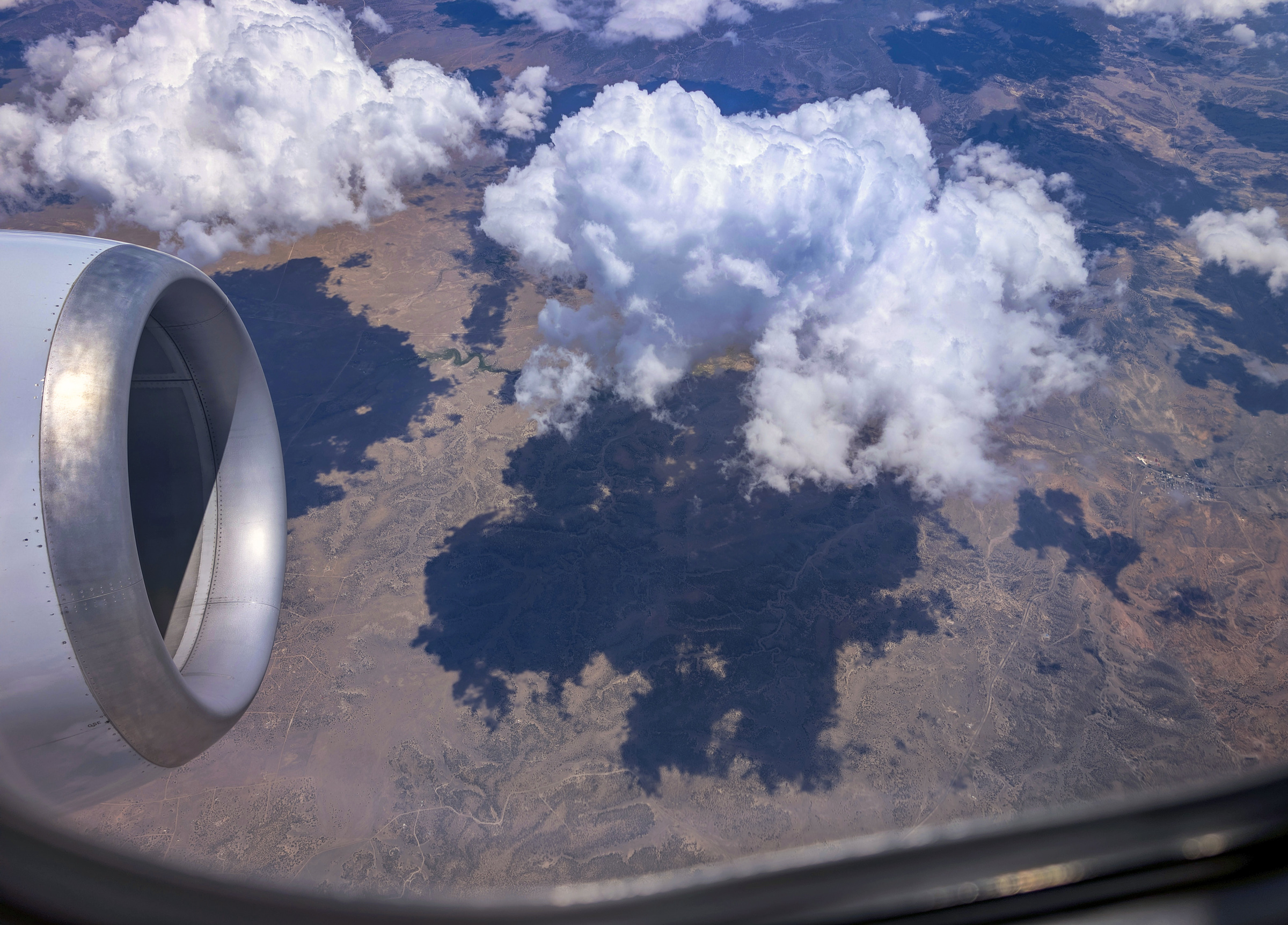
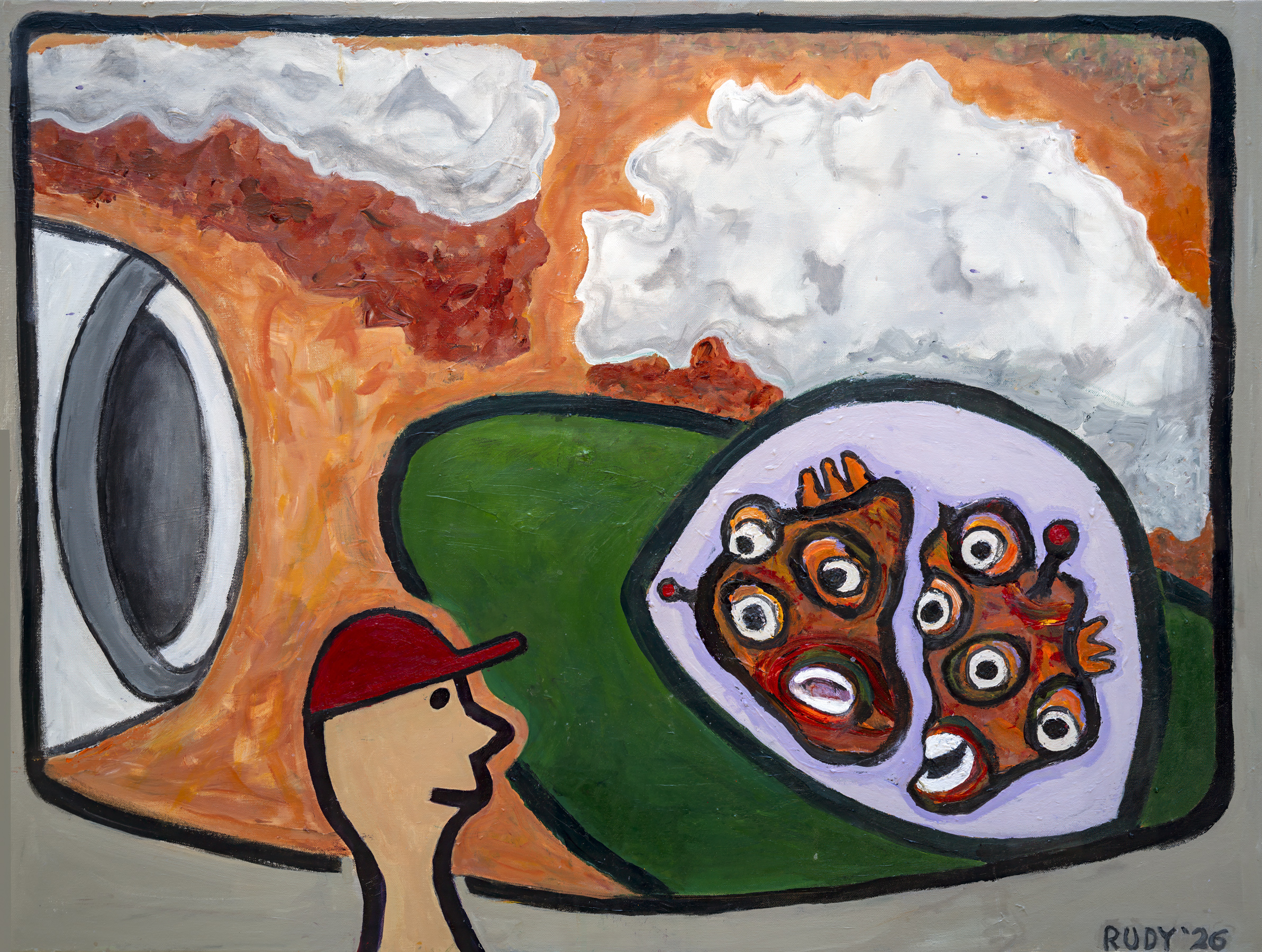
2282. Oxbow River
Acrylic on canvas, 40″ x 30. June, 2025

I saw this view from a plane while flying east from San Francisco and passing over the Sacramento–San Joaquin River Delta. The multifarious winding streams in this area have oxbows, that is, bulges where the river may or may not pinch off into an oxbow lake. Fan of gnarl that I am, I love looking down at this area from a plane. The great modern California artist Wayne Thiebaud painted this region many times. It’s an inexhaustible motif. One thing I like here is the contrast between the orderly polygonal fields and the twisty river streams¬¬—mirroring the split between digital and analog, computer and soul, word and image. Gnarly, dude.

  • Painting is a little different. It looks perfect after five minutes. But you bought all that paint and the big canvas, and you don’t want to give short weight. So paint more and, quite soon, you find you’ve ruined it.


281. Hvalfisk
Acrylic on canvas, 24″ x 18. June, 2025

Abstraction. Color harmony. I added the two eye-circles at the end. I always like painting eyes and flying saucers and tentacles. And once the first eye was in place, I was thinking of sea creatures or, more specifically, whales. The title? In Norwegian, “hvalfisk” means “whale fish,” or simply “whale.” And this happens to be a word I sometimes like to yell when I’m alone on the beach, using the accent of my Norwegian friend Gunnar.

  • You take a day or two off, sadly glancing at the broken painting. But one morning you go at it again. And now you’ve fixed it! A rush of invention. Everything’s clicking.

278. The Lovers
Acrylic on canvas, 30″ x 24″. May, 2025

I’m imagining a pair of lovers spiraling down¬—a cosmic gateway? Ecstasy? Who knows. They look like they’re getting a little smoother on the way down, like rocks tumbled in the sea. I like the way the two lovers are cruising along. I did the yellow background with finger-painting, an effect I sometimes use. That is, I squirted blobs of four different yellows and smeared them around, wearing my latex painting gloves. Getting the right reds and blues fort the lovers took me some time. Shade, saturation, and value¬—all three have to be harmony. Another challenge for The Lovers was to get the geometry right! I would say they’re moving along a helix that has increasing torsion—in the sense of being more and more stretched out, like a Slinky being pulled straight. I worked it out by eye, with plenty of do-overs.

  • And the next day…and you ruin it again. And then fix, and ruin, and fix. Over and over, until there’s nothing left that bothers you when you look at it. No snags where your eyebeam catches.

275. Mayan Codex
Acrylic, 30″ x 24″ canvas. February, 2025

My friend Barb and I took a vacation trip to the Yucatan in Mexico. The beaches and skies and towns and jungles were amazing. Everyone was nice. We spent a day at Chichen Itza which made a huge impression on me, with its big square-topped pyramid and its many glyphs with Mayan pictographs. I knew I wanted to paint these. Barb and I took photos. I felt like we were cosmopolitans in a Fellini movie. Back at home I found a couple of websites with simplified images of the pictographs. I wasn’t sure how I’d use them, bus I just started, and kept going, and this is what I ended up with. I like it a lot, and it made me happy to work on it . Generally all the people in Mayan pictograms face left, but I turned a couple of them around for variety. And I put in a couple of snakes or crocodiles. The Mayans have an important plumed serpent god, Kukulkan. And they love depicting skulls. I used the cool word “codex” because there exist some illustrated documents illustrating Mayan and Aztec temple art. My beloved beatnik author William Burroughs revered these records.

  • Writing seems like it has a message, but does a painting? The two modes are channels you broadcast on. Talking about yourself, or things you’re worried about, or thinks you love, or simply thing that caught your attention.


274. Scary Beach
Acrylic, 30″ x 24″ canvas. December, 2024

I don’t remember exactly what got me started on this painting. I guess I wanted to do a painting, and lacking any better idea, I decided to go for a giant tentacled creature from the sea. With tall buildings on the beach, like you might have at Miami. With an alien attack scenario. And then my big brother Embry was suddenly dying of cancer. It came on very quickly. I flew back to Louisville, with my son Rudy Jr. along, and we had a chance to say our goodbyes to Embry. He was very weak. It was good to be together. I held his hand for a long time, and he told me his whole life was flashing before his eyes, bouncing around, and he liked that. So strange and sad to reach this milestone. Embry and I were little boys together, seventy-five years ago—and now I thought of us as little boys in the woods with something scary drawing near. The day after I got back to California, Embry was dead, and I went back, this time with daughters Georgia and Isabel. It was a big funeral, with many familiar faces from the old, old times. I got it together to deliver a eulogy. Back home I didn’t know what to do with myself. I picked up my half-done painting and finished it. That gravestone monster with the big teeth emerged, and it made sense for me to paint that. You might say it’s Death itself.

  • When it gets good, the painting or the writing, when it get goods the world begins to dance with you.

263. Halloween
Acrylic, 24″ x 20″ canvas. October, 2024

I started with random blobs from my palette. For a couple of months I thought this was a decent abstract painting, but then I wanted to paint some more, so I studied the blobs, looking for images, and I found a way to crop down a blob to get that big, crooked critter in the middle. I was working on my novel Sqinks, which features some bad aliens called Mu9ers. I turned the other blobs into shambling zombie-like figures like the one in the middle, ending up with a posse of invading Mu9ers. Rather than putting pupil-dots in the white eye-disks, I left them blank, so they’re like goggles. I used six different shades of orange and yellow for the background, creating a lively Hell-scape feel. Clearly this is a Halloween painting, but I hoped it would help me write another chapter about the Mu9ers in my novel.

  • Writing works at many levels. Ping-pong of social network comments. Poems. Graffiti. Email messages. Stories and essays. Novels and tomes. Often, when writing, you don’t know exactly what you’ll say….at least not the details of it. You have a give and take with the text. Rereading it, correcting it, emending it.

266. Farmers Market
Acrylic, 30″ x 24″ canvas. January, 2024

I kept thinking about some new aliens I was going to call sqinks. I formed the notion that the sqinks might be trading or shopping at a farmers market here. What would they want? Perhaps fresh fruit and vegetables, which are among the most unique treasures that a planet has to offer. To liven things up I added two more alien races that you might call happies and spikes. The aliens are emerging from an underground portal system, with volcano-like exits. I like the colors and the crowded feel of this one—perhaps a bit like a scene from my beloved Bruegel.

  • <No more talk notes, but dig the pictures and the raps.>

265. Riding the Flat Cows
Acrylic, 40″ x 30″ canvas. November, 2023

In 2013 I painted 160: Flat Cow, showing a squashed-flat flying cow that appears in my novel Million Mile Road Trip. The flat cows amuse me, so I painted a couple more of them here, adding a spacefarer couple and three odd critters (not our children). I call the purple ones “sqinks” because it’s a creepy word. And it’s always fun to have a planet in the background. I this image for my 2023 Christmas e-card. And what’s going on in this scene? Who knows. Oh, and I’m thinking those warped little rectangles are teleportation portals..

262. Dating
Acrylic, 30″ x 24″ canvas. October, 2023

This is what you might call a Rorschach painting. I use my old disposable paper palette like a stamp, putting patterns on the new canvas. And then I paint what I see. That green thing in the middle was the first to appear, and I thought of the grill of a particular kind of car, the 1956 Edsel. So the initial title for the painting was Wrecked Edsel. I added a tire, a gearshift knob, some kind of controller box, plus a couple of headlights which, in the end, look more like flowers. Plus a guitar—perhaps it was in the back And a Rudy-standard the blob with an eye. An alternate interpretation came to me: Online Dating. I had lost my wife, and I was trying, with little pleasure or success, to find a woman friend. And it occurred to me that my messy, disorganized image symbolized, in some way, dating. Note here that the candidates group into four pairs!

260. Cyberpunk Forever
Acrylic, 40″ x 30″ canvas. August, 2023

A painting like this is an exercise in balancing the forms, hues, sizes, and values of brightness. It took me a long time, with multiple revisions. I needed to stay continually open to revising major parts of it. By the end I was glad I was done, but it was worth it. I find the work pleasing to look at. A flag to celebrate my way of seeing things: Cyberpunk Forever.

253. Neuron
Acrylic, 40″ x 30″ canvas. May, 2023

I started with the reddish blob in the center, and went on from there, first adding an orange edge, then putting green outside the edge, and then coming up with a network of yellow dots connected by purple tubes. I began thinking of this as an image of a neuron in your brain, with its connective synapses. And of course I was inspired by the then-current work on artificial neural networks as a path to AI. These networks have a flaw, in that no processing is taking place within the individual artificial neurons. So inspired by a paper by Stephen Wolfram, I went ahead and put a cellular-automaton-like pattern inside the neuron—so that it can “think” on its own. But mainly this painting is about richly interacting colors.

249. The One
Acrylic, 30″ x 24″. May, 2023

I was hiking with a friend, and we were talking about gnarl, and the nature of mind, and of higher consciousness. When we lay down on a rock to rest, I was thinking about the cosmic One being present in every part of nature. So this painting shows a person looking at a flower, with a divine eye nearby. Instead of having the person look like me, I had them be a woman. I was thinking of my recently lost wife. It seemed fitting to show her laid out with a flower, and with the divine One nearby. You might even call this a painting of heaven.

247. Empty Mind
Acrylic, 28″ x 22″. April, 2023

I did my reuse-the-paint-on-the-palette-from-the-previous-painting routine for the background. And I put lots of circles on top. I considered leaving the circles blank and empty, but it’s more fun to see a lot of eyes. I wasn’t thinking much of anything while I made Empty Mind, I was just painting, letting it come out. I enjoyed the process itself, as a way to get away from the raw and heavy grief I was experiencing. I thought of book called The Zen Doctrine of No-Mind, by D. T. Suzuki. I never read much of that book— it’s extremely technical and philosophical, almost like Hegel or Kant, but I was always amused by the title. The eyeballs are mirrors of the ongoing empty mind of the cosmos—quite unrelated to our individual fates. The world just going on.

244. The Same Yet Changed I Rise Again
Acrylic, 28″ x 22″. Mar, 2023

I started with a background that I created by pressing my used-up paper palette against the canvas. When I do this, I don’t smear the palette around, I use it like a stamp, pressing it repeatedly. Then I touch up all the blank spots. And then I painted the simples possible thing I could think of. The so-called logarithmic spiral or growth spiral, similar to the one seen in nautilus shells. It was extensively investigated in the 17th Century by the Swiss mathematician Jacob Bernoulli who wanted it inscribed on his tombstone with the Latin phrase “Eadem mutata resurgo,” which means “The same yet changed, I rise again.” This phrase is a personal touchstone of mine, and I always invoke it when stating a new project, or a new phase of my life.

242. Whoop-Di-Doo
Acrylic, 24″ x 30″. Jan, 2023

I wanted to get away from narration. My wife was in her last weeks, dying on a hospital bed in our living room, and we knew what was coming, even though at some level we didn’t know. Couldn’t visualize it. Taking solace in math, I decided to paint an intricate image that I found with a cubic Mandelbrot set algorithm that I unearthed some years ago. The interesting thing here is that there are two nested spirals. One goes in from the left, the other goes out the right. They meet at that yellow dot in the center. Like death and rebirth. And that lively green triangle at the lower right? That’s paradise, the garden of Eden. The term whoop-di-doo is used by skaters, snowboarders, and bicyclists to describe a funky twirl.

241. Math
Acrylic, 40″ x 30″. Dec, 2022.

Sometimes I just paint a nice background and scatter things across it. Here I used about four different shades of yellow. I laid the canvas on the ground and squirted on yellow blobs from above, along with globs of buff white along with impasto medium. I smeared it around, being careful not to overdo the smearing. I didn’t want to homogenize it; I wanted the seething push-pull of the varying shades. That swoop in the middle is a shape from Wassily Kandinsky. And I added various shapes that are (or might be) from mathematics. Balancing the colors and inventing fake symbols was a big part of this.

237. New Glasses
Acrylic, 24″ x 18″. November 2022

I was in the process of buying new lenses for two pairs of glasses, and the lenses were unbelievably expensive, and then I had to get them redone. When things bug me, I try to make art from experience. So…what if my so-called glasses were some kind of teep aid, or empathy receiver, or pheromone sniffer, or vibe feeler. Suppose that, wearing them, I sense something unusual. Ghosts, aliens, creatures from the subdimensions. The experience ruins me, and I end up like those unfortunates I saw writhing in the alley behind the optician, the degens known as snorkers. Idea for a story? But too much trouble to write it. So I painted the view through the…new glasses. With the glasses in front of the bookcase in my office. My nephew bought the painting almost right away. He said I should do a second painting, in which you see the books through the lenses, and you see those fractal land-and-water patterns outside the lenses. It would be a whole different scenario, with the glasses an island of sanity, as opposed to a door into madness. But, yeah, in the story the guy could flip from one to the other. Hmm. Maybe someday.

236. Going to Heaven
Acrylic, 30″ x 24″, October, 2022

The two space jellies are poised at start of a great adventure. I think of them as a couple, about to die one by one, and eventually going to heaven. The hazy shape around the star was inspired by a photo of the Tarantula Nebula. I gave each of the jellies two eyes, so they can be looking at two different things: here it’s each other and their goal. I put a green border around the jellyfish eyes. And the target star has a dot of green at its center. And my signature is green as well.

Images are Copyright (C) Rudy Rucker, 2026. For more info on Rudy’s art, go to his Paintings Page.

Note that I have a new edition of my art-book / catalog in print: Better W0rlds.

Wondering

Friday, December 19th, 2025

————
This is part 2 of a long blog post. The first part is called “Wandering” and this part is “Wondering.” No real reason for those names, just playing with words. But mostly these posts are about images.

Kawaii. Acrylic on canvas, 24″ x 24″. December, 2025

At one point, I had a nice square canvas, and a lot of fresh paint on my palette, so I decided to cover the blank canvas with lines. Initially the canvas was in a position where those lines were vertical. But then I rotated the canvas by ninety degrees so the lines were horizontal; and — aha! A sunset. I’d been wanting to paint an ocean sunset like I’d seen at Moss Landing, and here it was. But it didn’t have enough. It needed critters. I let the painting sit around the house for a couple of months until I could see…seals! I made mine simpler than life. Cute seals. For the title, I went for the Japanese word “kawaii,” which means something like cute, but in a special Japanese sense. I think it’s pronounced a little like “Hawaii.”

I was here just the other day. Lexington Reservoir near Los Gatos. I’d just been up at a tree farm with Rudy’s family, and we stopped at Lexington to make sure Rudy’s tree wasn’t going to slide off. Sunsets…so obvious, so transcendent.

Rudy is interested in mushrooms, in a botanist kind of way, and here he’s using one as an umbrella. Up at the tree farm.

The tree meets its doom…or its elevation to iconic status!

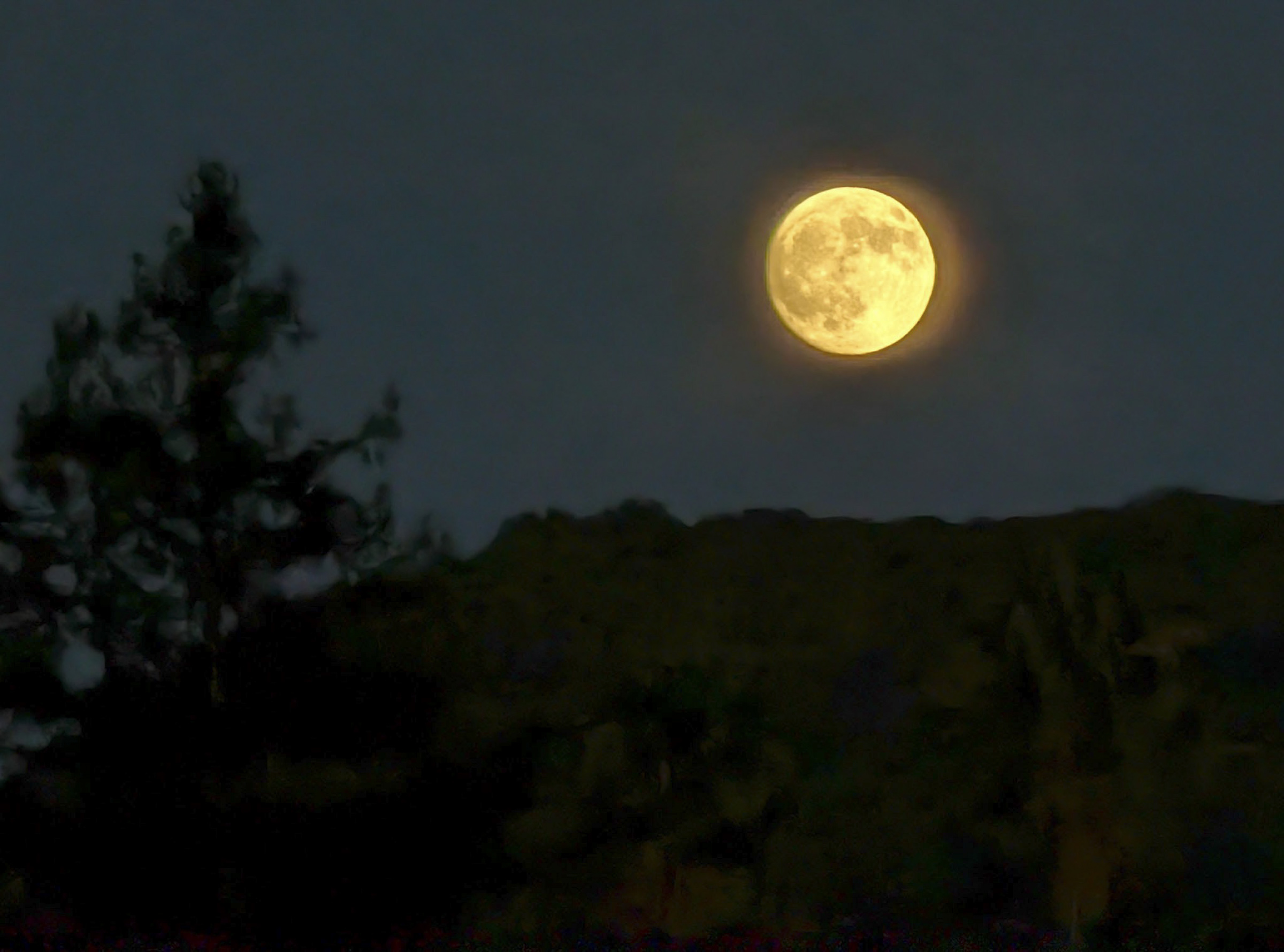
This month we’re having a new retaining wall installed. Big, big job with many stages. Note the I-beams. I like this shot of the moon and, beneath it, the planet Venus.

Sawed-off tips of the “lags,” like railroad ties, which are to be stacked into the grooves on the sides of the I-beams.

With daughter Isabel on a hill above where we live.

Equipment for drilling the holes where the I-beams went. I love helix shapes.

Wedding With Cat. Acrylic on canvas, 40″ x 30″. November, 2025

One of my collectors, Julian Reschke, approached me with the proposal that I do a painting for his upcoming wedding to the woman he’d been living with for many years. We discussed possibilities, and he sent me some photos of him, his lady, and their one-eyed cat. I was eager to start work, but I didn’t have a blank 40″ x 30″ canvas. Rather than waiting for one to arrive by mail, I decided to paint over a recent work, Eye Candy, letting the green rivers become bodies. As I’m by no means a skilled portrait painter, I chose to model the faces on Picasso images. And I found a fun way to depict a one-eyed cat. I wasn’t sure if my friends would like the work, but they did.

Spring in November. Acrylic on canvas, 22″ x 28″. November, 2025

As I often do, I started my next work with abstract patterns drawn from the paints still on the palette from the previous work, that is, Wedding with Cat. . I had a lot of nice blues and greens, as if for a beautiful spring day with gentle skies and budding plants. And that was indeed the weather we were having just then, even though it was November. That’s California! I wanted something on top of that, so I drew dark lines in a kind of pictogram animal shape. I went over the lines three or four times until I got just the right colors and brightness. And then some flowers/eyes came it. I spent a last day refining the edges of the dark shape, making sure it didn’t run off the edges, or get too thick.

Isabel held an event at rudy Jr’s Monkeybrains headquarters in the Mission. Isabel and I were to be talking about the nature of time. And somehow Barb had a made a photo of a warped clock with a tossed potato in front of it…I think that’s Rudy’s hand. We have fun, our clan.

Rudy’s warehouse is another spot where I like to take photos. This is some electrical thingie that resembles a gnarly bug. I tweaked the perspective sliders to make sure the background lines are at right angles.

During the covid plague, Rudy bought an old school bus, which was retrofitted as a camper. He and his family, all five of them drove across the country and back, visiting friends and relatives, and sleeping in the bus. It’s still parked behind the Monkeybrains building, with a sky hole on the roof.

As I’ve mentioned, I did a Kickstarter for my novel Sqinks. Here I’m an uncut raw SF dealer heading for the post office. Took a couple of months for my back to recover.

Barb and Rudy at a cheap ocean-view motel in Santa Cruz.

Awesome car show in the Cruz Boardwalk parking lot. I love those ’30s hotrods.

Barg’s photo of an exceedingly long-lived orchid at my house.

Barb and Rudy dressed for Halloween. I’m an artist, right (these being my regular painting clothes), and Barb is a North African dancer.

One more photo of my Sqinks stash. They’re not selling particularly well, but at least I wrote the book, and got some money, and it’s out there published.

New Friends, Acrylic on canvas, 40″ x 30″. October, 2025

I was initially thinking of a big aquarium tank butted up against a zoo cage, and each group is seeing the others as entertainment. But then I was thinking more of a jungle scene, with two groups in the open air, encountering each other, and hoping to be friends. I used my trick of having the critters emerge like Rorschach test results from blobs I’d made. And I liked the idea of giving almost every one of them an eye. As for the sea anemone or campfire at the bottom, well, that’s an extra I wanted to see.

Barb and I went hiking at Abbotts Lagoon in Point Reyes National Seashore. A very long hike through sand and ponds, completely deserted most of the way, but then a huge group of people showed up, some kind of expedition. About half of them undressed and marched into the very cold Pacific together. Barb, who is more talkative than I am, approached a member of the troupe to find out what was up. They were members of an entrepreneur-ship workshop at Stanford!

This display of Tibetan artifacts at the Asian Art Museum…it blows my mind. That apron thingie is carved from some one person’s bones, and if you wear it, you can fly.

Another dawn shot of Tomales Bay. Love the touches of pink.

Wandering

Thursday, December 18th, 2025

I’ve been hanging around with Barb Ash a lot. I published Sqinks. I painted quite a bit. I’ll break my doings into two posts: “Wandering” and “Wondering.”

Barb is a photographer, as am I, and we enjoy working on pictures together, each using their own camera, but helping each other see. Barb is better at focusing than I am. This is her shot of sunset at Moss Landing. We were down there for a whale watching trip, spending three nights while we were at it.

Made a visit to the Asian Art Museum in SF. I like this guy, he makes me laugh. D.T. Suzuki wrote a book called The Zen Doctrine of No Mind.

Amazing demon sculpture from, I think, Tibet.

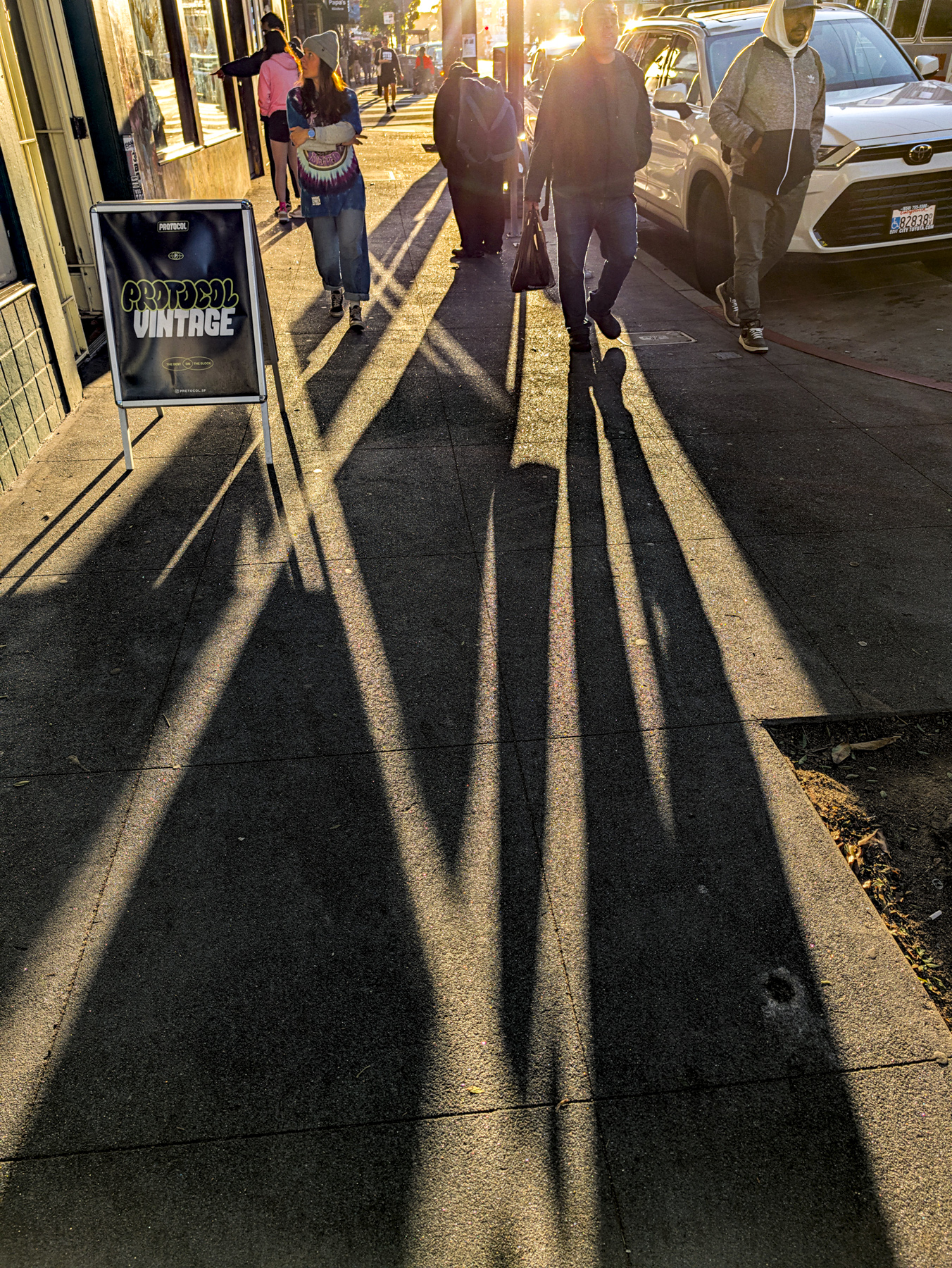
Down in Santa Cruz with Barb, near the Boardwalk. I love the zigzag shadow.

Barb by the chimneys in Moss Landing. Looking kinda cyberpunk. This used to be a fuel-burning power plant, but now it isn’t. I think they do something having to do with solar power there.

I never tired of the living mandalas of yuccas and such succulents.

Asian art museum: Ganesh the elephant god. I’ve always loved this guy.

Halloween pumpkins with Barb. The one on the left is mine; I carve him the same every year.

The Fall of the Rebel Angels, Acrylic on canvas, 40″ x 30″. October, 2025

I love Peter Bruegel’s painting, The Fall of the Rebel Angels, a fantastical and realistic masterpiece that shows about a hundred misshapen creatures tumbling down from heaven. I was working on my novel Sqinks, in which a zillion of odd aliens are swooping around. And I thought of Bruegel’s painting, and I tried to paint a copy of it for inspiration. Quickly I realized a precise copy would be far beyond my skills. So I went semi-abstract, and filled a canvas with gauzy figures in shades of green, pink, yellow, blue, and orange. One of the figures is indeed modeled on a specific Bruegel fallen angel. This one is halfway up of the left, and resembles a bursting ripe seed pod. I only outlined the figures in the lower part of the painting. I see those guys as the creatures who are allowed to remain in heaven, and the evicted ones are the gauzy figures in the upper half. You might think of them as farther away. And the red arc might be thought of as edge of a cliff, or the rim of a planet.

A pan shot of my office. I always have a bunch of my recent paintings on the walls. But I’m always making new ones so they don’t get to stay up all that long. I especially like that one in the middle.

Eye Candy. Acrylic on canvas, 40″ x 30″. June, 2025

This is based on a photo taken from a plane over the California region called the Delta. In this one, I was interested in the delicate gradations of yellow among the slightly different fields. And I emphasized the islands within the oxbows. To liven them the image, I filled the islands with circles. Wanting to make something that’s fun to look at. Eye candy! Somewhat foolishly, I painted over this a few weeks later, because I was desperate for a fresh canvas, and didn’t want to wait a week for a new one to arrive in the mail.

Mannequins in empty store windows are always creepy and surreal. Especially if they don’t have heads!

Att the annual St. Mary’s School Fair in Los Gatos. A saucer ride! I guess that once a bunch of people are inside, it spins around. Not for me! But I love the way it looks.

My Shadow. Acrylic on canvas, 24″ x 30″. July, 2025

Here I am in my studio, that is, in my parched back yard. It’s two in the afternoon of a full-on sunny day. Thei summer-nuked lawn is yellow clay, with dead straw and few green blades. I’m holding my phone camera with both hands, which is why you see my elbows sticking out. I’m photographing my lower legs, my shoes, and the dark shadow of my body. My pants have lots of paint on them. The articulation of the legs, shoes, and shadows is a bit tricky but, once you know what you’re looking at, it seems logical. At least to me. I have a PhD in an arcane field knows as Mathematical Logic. The other day I was talking with my friend Barb, and I was making some outrageous claim, and I insisted, “It’s simple logic.” And then I had to stop and think, and I admitted, “Well, it’s mathematical logic.” Which may not the average person’s notion of logic at all.

The source photo for My Shadow. Part of painting is learning what things to leave out.

I think this one of the greatest photos I ever took. With my Leica. Walking down a street on Bernal Hill, it might have been on the Fourth of July.

In Chinatown with Barb. We like hanging around in North Beach these days. We’ve found a cheap hotel with free parking, and we like to dance in the bar/club called the Saloon. Supposedly the oldest bar in San Francisco. They have good live music. I love these old guys playing their own instruments on Grant Street.

Rudy & Penny’s twins, Jasper and Zimry, set off for college this fall. I remember their baby years and childhoods and teens so well. And now I’m nearly eighty. How time rolls on.

Barb shot of me in North Beach. She doesn’t like to crop, and maybe she’s right. We like the hills and the Vic houses of North Beach. And of course I like the sone’s history as a beatnik / artist enclave.

What I call a “Rudy picture.” Shapes and silhouettes and 3D.

Another Rudy picture from North Beach. I like that little wall around the base of the tree.

Flukes of a whale on our whale watching trip to Moss Landing. We saw about 30 whales over a couple of hours, they were right offshore. I was rereading Moby Dick around this time, and I liked it in that book when one of the old whalers, before going to bed, says, “I’m going to turn flukes.” This would be an expression, you understand, for a whale diving down deep.

We spent a couple of nights near Point Reyes Station in a motel next to Tomales Bay. So peaceful.

Now continue to the Wondering post, up next.


Rudy's Blog is powered by WordPress