
Rudy’s Blog

Buy Rudy's books! Click covers for info.                 Blog text and images copyright (C) Rudy Rucker 2012.


Archive for the ‘Upcoming Events’ Category

Art Show & Reading At Borderlands Books

Tuesday, January 8th, 2013
Share

[My Borderlands art show has been extended until Tuesday, March 26, 2013. Stop by in March if you haven't seen it yet! There's still a number of good bargains on sale.]

I’m venturing forth from my office this weekend to do some promo at Borderlands Books at 866 Valencia St. in San Francisco.


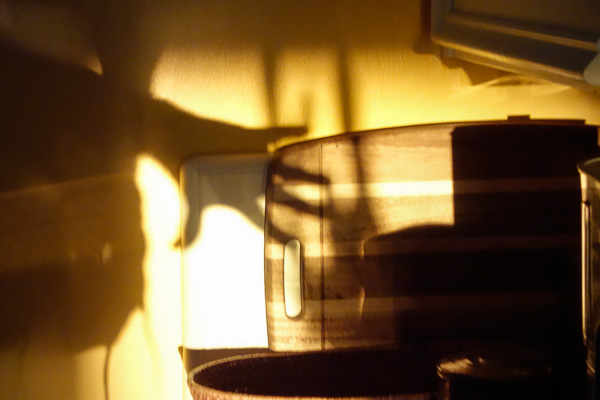
View of my home office from my desk chair. Click for a larger version of the image.

I’ll be hanging a show of my paintings in the Borderlands Books café with a reception on Friday, Jan 11, 5-7 pm. And I’ll give a reading and Q&A session for my novel Turing & Burroughs: A Beatnik SF Novel on Saturday, Jan 12, at 3 pm—you can visit with the paintings then as well. The show is scheduled to run until March 7, 2013.

Added Jan 13, 2013. I made a podcast of the first 20 minutes of my presentation on Turing & Burroughs, I’m describing the book and reading from it. Unfortunately I ran out of memory on my digital recorder, and the podcast stops abuptly at the 20 min mark. But it’s fun for as far is it goes. You can click on the icon below to access the podcast via my Feedburner podcast station.

(Note that Feedburner only shows my most recent podcasts. For older audio files, see my archive on Gigadial, which runs back to 2005.)

I number my paintings, and I have an overview image of all my paintings below, showing paintings #1 – #94. The pictures in the show will from the bottom rows, that is, in the range #79 – #94. Further down in today’s post I’ll put in images of the individual pictures that will be in the show, with notes on each picture.

For a limited time, the pictures are on sale at drastically reduced prices—up to 50% off! The current prices of the paintings can always be found on my Paintings page. Several of the paintings in the show have already sold, so do buy early if you want to be sure of getting a given picture at a low sale price.

Note that the Painting page also has a link for buying prints of the pictures, and a link for buying Better Worlds, an art book of the paintings. Better Worlds and a few prints are also available at Borderlands Books.


Overview of my paintings. Click for a larger version of the image.

All the pictures I’ll be showing have not been shown before, except for one, Turing and the Skugs, which relates to my Turing & Burroughs novel. This older picture appeared in my last Borderlands Books cafe show, which was in November, 2010.


“Turing and the Skugs”, 40″ x 30″ inches, Oct 2010, Oil on canvas.” Click for larger version.

I made Turing and the Skugs while gearing up for my Turing & Burroughs novel involving the computer pioneer Alan Turing, the beatniks, and some shape-shifting beings called skugs. I got the word “skug” from my non-identical twin granddaughters, aged three. When I used visit my son’s house in Berkeley, I always liked to open up his worm farm and study the action with the twins. We found a lot of slugs in there, and we marveled at them. The girls tended to say “skug” rather than “slug,” and I decided I liked the sound of this word so much that I’d use it for some odd beings in my novel. I’m supposing that Turing has carried out some biochemical experiments leading to the creation of the skugs. Here we see Turing outside the Los Gatos Rural Supply Hardware garage, with two skugs backing him up. Alan is meeting a handsome man who may well become his lover. Unless the skugs eat the guy.


“A Skugger’s Point of View”, 40″ x 30″ inches, January, 2011, Oil on canvas.” Click for larger version.

In A Skugger’s Point of View I wanted to render an extreme first-person point of view…in which we see the dim zone around a person’s actual visual field. The person in question is the Alan Turing character in my novel The Turing Chronicles. He has become a mutant known as a “skugger,” and he has the ability to stretch his limbs like the cartoon character Plastic Man. He’s traveling across the West with two friends, a man and a woman. In this scene, Turing’s cohort is being attacked by secret police, one of whom bears a flame-thrower. Turing is responding by sticking his fingers into their heads, perhaps to kill them, or perhaps to convert them into skuggers as well. We can see Turing’s arms extending from the bottom edge of his visual field. Even though it’s not quite logical, I painted in his eyes as well because they make the composition better


“V-Bomb Blast”, 40″ x 30″ inches, July, 2011, Oil on canvas.” Click for larger version.

This painting has to do with my novel, The Turing Chronicles. In the last chapter, my hero, Alan Turing gets inside a nuclear weapon called a V-bomb. I figured this lies beyond the A-bomb and the H-bomb. Turing is in there tweaking the bomb until the last minute. And due to Turing’s efforts, the bomb explodes in an odd fashion: it makes a fireball that shrinks, rather than growing—and then the bomb explosion tears a hole in space and disappears into another dimension or into another level of reality. The early nuclear devices really were hut-sized metal constructs, as shown on the right. Somehow I ended up putting a naked woman inside the bomb instead of Turing. In the middle we have a kind of sunflower/fireball with a zonked face on it. And on the left, a small explosion-ball disappears into a vaginal rent. The woman seems to be pulling a cord that sets the bomb off in the first place. I like the picture because, as with some of Bruegel’s paintings, it seems to illustrate a detailed parable whose precise meaning is forever a mystery.


“Painter Near Mt. Umunhum,” 24 x 18 inches, September, 2011, Acrylic on canvas.” Click for larger version.

My painter friend Vernon Head and I were painting en plein air in the Almaden Quicksilver Park south of San Jose near the Guadalupe Reservoir. I was about to get my left hip joint replaced, due to arthritis, but I led Vernon up to a nice oak I admired on a hilltop. I framed Painter Near Mt. Umunhum to include the reservoir, Vernon, the oak, and Mount Umunhum in the background. “Umunhum” is an Ohlone word meaning “home of the hummingbird.” The box on top is a leftover from an Air Force radar station, that’s due to come down…someday. I layered on my paint thicker than usual, using my palette knife to imitate the grooves of the bark on the tree, the waves in the water, and the long stalks of grass.


“Noon Meeting”, 40″ x 30″ inches, August, 2011, Oil on canvas.” Click for larger version.

Noon Meeting is one of those pictures that’s a bit like an unknown parable. I started out with a set of pebble-glass windows that I like, for the the background grid of green and yellow rectangles. I put three characters in front of the windows, happy to be getting together in the daytime: a woman, a dog, and an octopus. I feel like these three friends are people I know. Indeed, I might be the dog in the middle, bringing the two others together—I used to have a dog who looked a lot like that, his name was Arf. When I told my artist friend Vernon Head bout the theme of my new picture and he said, laughing, “Ah, yes, the three fundamental elements of any successful painting: a woman, a dog, and an octopus.” My other artist friend Paul Mavrides had suggested that I try using an impasto medium to build up more of a texture on my pictures and I did this here, with a nice effect.


“Santa Cruz Harbor,” by Rudy Rucker, 20 x 16 inches, September, 2011, Acrylic on canvas. Click for a larger version of the picture.

My friend Vernon Head and I went to Santa Cruz Harbor for a painting session. The waters were fill of life—apparently a school of mackerel had swum in, and the pelicans and seals were there feeding. I liked how this cute baby seal seemed to hover so weightlessly in the very clear water. I started my Santa Cruz Harbor painting on the spot, and finished it at home, working with some photographs I’d taken. It had been awhile since I used acrylics, and I was pleasantly surprised by how quickly I was done.


“Rigging,” by Rudy Rucker, 20 x 16 inches, September, 2011, Oil on canvas.” Click for a larger version of the picture.

The reflections of sailboat rigging fascinate me. I took some photos for my Rigging painting during the same session where I started Santa Cruz Harbor. Back home I copied one of the photos for an oil painting. I put on quite a few layers, and used a gel medium to emphasize the brush strokes on the masts and lines.


“Four-dimensional Ducks,” by Rudy Rucker, 30 x 40 inches, October, 2011, Oil on canvas. Click for a larger version of the picture.

I started Four-Dimensional Ducks as an abstract painting with seven globs. I made efforts to make the globs look different from each other, and to have intricate, three-dimensional forms. And then I started thinking of the globs as cross-sections of four-dimensional creatures. And then I realized they should be loosely based on the master cartoonist Carl Barks’s drawings of Donald Duck, as if they were rotating in and out of our space. Four-dimensional ducks. A way to move my pop surrealism style towards abstraction.


“The Lovers,” by Rudy Rucker, 24 x 20 inches, January, 2012, Oil on canvas. Click for a larger version of the picture.

The idea is that these two lovers are in a nearly telepathic state, sharing a single thought balloon. And in the thought, they’re merged like a yin-yang symbol. Her 1940s bob acquires an infinity symbol, and their lips form a pair of little hearts. An early Valentine’s Day picture!


“Loulou and Skungy,” oil on canvas, February, 2012, 30” x 30”. Click for a larger version of the image.

In Skungy and the Rat, Loulou is the somewhat mysterious woman in green, Skungy is the rat, and the guy holding the rat is an artist named Zad Plant. The picture is like an illustration of an unknown proverb or a forgotten fable. When I painted it, I didn’t entirely know what’s going on. But I did have some ideas, as the picture was painted as a previsualization of a scene in the novel I was preparing to write—The Big Aha. The woman character, named Loulou, is luring Zad and his “qwet rat” Skungy into following her. The composition was inspired by a Joan Brown painting The End of the Affair.


“Garden of Eden,” oil on canvas, May, 2012, 40” x 30”. Click for a larger version of the image.

My frequent partner in art, Vernon Head, went out for an en plein air painting session with me on the bank of a stream that runs into the south end of Lexington Reservoir near Los Gatos. It was a lovely spring day, and we daubed away. The one thing that caught my attention the most was a particular bend in the trunk of a tree overhanging the creek. That made it into my painting, Garden of Eden, but not all that much else about the actual scene. Instead I put in two of my favorite things: a dinosaur and a UFO. I’m not exactly sure what the scenario here is—perhaps the UFO is in some way bringing enlightenment to a prehistoric pair, an Adam and an Eve.


“God’s Eye,” oil on canvas, June, 2012, 24” x 20”. Click for a larger version of the image.

I’ve always been intrigued by a certain image that one sees in old European churches—an eye inside a triangle. This icon also appears, of course, on the dollar bill. It’s meant to represent the all-seeding eye of God or perhaps the divine Mind within every object. In researching me novels with Bruegel and Bosch as characters, I got the impression that medieval people really did think God was watching them. So in God’s Eye I’ve painted the eye as looking down through clouds—like a spy-satellite. I made the “skin” in this image pink as a kind of joke on the fact that God is sometimes visualized as an old white man.


“Louisville Artist,” oil on canvas, October, 2012, 24” x 20”. Click for a larger version of the image.

I grew up in Louisville, Kentucky, so the title Louisville Artist is a bit of a parodistic self-image riff. In other words, that’s could be me on the right , shirt all untucked and with no fingers on my hands. The woman might be my muse. Another interpretation is that the two figures are characters from the novel, The Big Aha, which I’m presently working on when I made the painting. In making this picture, I thought it would be interesting to put in some figures that looked like children’s drawings, so I worked from a messy sketch I’d made. The colors are more pastel than usual for me, and there’s a bit of a Japanese quality.


“Night of Telepathy,” oil on canvas, November, 2012, 40” x 30”. Click for a larger version of the image.

Night of Telepathy started out with the abstract background pattern, which I made using leftover paint from Louisville Artist. I decided to put in some figures in, and I thought I’d like to reuse the Louisville Artist figures. In my novel in progress, The Big Aha, my two characters Zad and Loulou had just spent a night in bed in in telepathic contact with each other. And I wanted to give an impression of an odd, dreamy night. The six little rats correspond to some subdimensional creatures that might be scuttling around inside people’s dreams. And the other creatures are just there for fun.

So…make the trek to the mirage-like realm of Borderlands Books at 866 Valencia St. in San Francisco.

And, as I already said, I’ll be hanging a show of my paintings in the Borderlands Books café with a reception on Friday, Jan 11, 5-7 pm. And I’ll give a reading and Q&A session for my novel Turing & Burroughs: A Beatnik SF Novel on Saturday, Jan 12, at 3 pm. Hope to see you there.

Share

Interview On My TURING & BURROUGHS Novel.

Friday, September 21st, 2012
Share

On Saturday, September 22, 2012, I’ll be at the Philip K. Dick Festival on the SFSU campus in south San Francisco. I’m scheduled to give a talk, “Haunted By Phil Dick” at 2 p.m. that day, and I’ll be on a panel with Jonathan Lethem and other Dickians at 5 p.m. as well.

For today’s longish post, we have the text of an email interview about my novel Turing & Burroughs that the young writer Nas Hedron conducted with me from Brazil.

Hedron is the author of the novel Luck & Death which, like my own novel, involves Alan Turing. You can learn more about Hedron via the links on his blog The Turing Centenary, where his interview with me also appears.


$16 paperback, $6 in ebook.

Q 1. I wonder if you can set the stage for us with reference to Alan Turing, you, and writing. Who was Alan Turing to you before you wrote Turing & Burroughs: A Beatnik SF Novel? And what gave you the impulse to write your novel about him?

A 1. In the course of getting my Ph.D. in mathematical logic, I learned the technical details of Turing’s theorems about the idealized computers that came to be called Turing machines. I read his epochal 1937 paper “On Computable Numbers” numerous times, and I was struck by the clarity and the depth of his thought.

Being interested in the possibilities of intelligent machines, I also studied Turing’s 1950 paper, “Computing Machinery and Intelligence,” a non-technical paper in which he proposes the so-called Turing imitation game as a test for true AI: you might say that a program is intelligent if you can’t tell it from a human when you’re exchanging emails with it. It’s worth noting that Turing initially framed his “imitation game” in terms of someone trying to distinguish between a woman and a man.

Later I became interested in using so-called cellular automata programs to simulate the patterns that emerge in the tissues of plants and animals—patterns like the the spots on leopards, the markings on butterfly wings, the zigzags on South Pacific cone shells. This is what Turing was working on near the end of his life. In 1952 he published an amazing paper, “The Chemical Basis of Morphogenesis.” In the morphogenesis paper he explains how, by dint of days of hand computation, he emulated a biological cellular automaton process to produce irregular black spots like you might see on the side of a brindle cow.

To me Turing is a heroic and inspiring figure. He worked on deeply fascinating things without getting lost in merely technical mathematics.

The other compelling aspect of the Turing story is that he was openly gay, he was persecuted for it, and that he had a strange and tragic death—which is usually described as a suicide.

Regarding Turing’s death by cyanide poisoning, I’ve always felt there’s a real possibility that he was in fact assassinated by agents of the British government. This seems even likelier now that we know Turing was involved in a top-secret code-breaking effort during World War II. In the 1950s, there was a collective hysteria over the possibility of homosexuals being a security risk.

Before I began contemplating my own novel, I’d read some stories and plays about Turing. But I didn’t feel that any of these works captured the vibrant image of Turing that I wanted to project. There can be a tendency to write about homosexuality in a lugubrious tone—as if a homosexual is a pathetic person who’s afflicted with a lethal disease. But Turing was anything but downcast about his predilections.

A 1 (Continued).

In the spring of 2007, I wrote a short story about Turing, “The Imitation Game.” And this story later came to be the first chapter of my novel. In the short story, Turing escapes being poisoned by British government agents. And to escape, he swaps appearances with his dead male lover. And here comes the science fiction: Turing grows two new faces by using principles that he described in that paper where he generates the shape of a spot on a black-and-white cow.

As sometimes happens to me, I had difficulty in selling my story. Maybe it wasn’t sufficiently solemn and lugubrious—and I was presenting Turing was a gay outsider, heedless of proprieties, and by no means a victim. In any case, in 2008 my story appeared in the British magazine Interzone and in 2010 in The Mammoth Book of Alternate Histories, edited by Ian Watson and Ian Whates.

Early on, I began wondering if there might be some way to expand my Turing story into a novel. At the end of my story, Turing escapes to Tangier, and I formed the notion that he ought to connect with the Beat writer William Burroughs, who was living there at that time. Two brilliant men, gay, outcast—perhaps they’d hit it off.

I’ve been a huge Burroughs fan ever since I first came across an excerpt of Naked Lunch in the beatnik magazine, The Evergreen Review—this would have been back in 1960, when I was fourteen. My big brother had a subscription to the magazine, and I’d leaf through it, looking for smut. Instead I found a literary career.

I particularly admire the irresponsible and laceratingly funny style of the letters Burroughs wrote to his friends from Tangier. And so I decided to write my second Turing story in the form of letters from Burroughs to Kerouac and Ginsberg.

This second story, “Tangier Routines,” was so gleefully scabrous that I didn’t bother sending it to any magazines, science-fictional or otherwise. Instead, in the fall of 2008, I printed it in a webzine Flurb that I’d managed to start. And then in 2010 and 2011, I ran two further Turing & Burroughs stories in Flurb—“The Skug” and “Dispatches From Interzone.”

I was still unsure about how to build my tales into a full novel, but in 2010 I finally read Alan Turing: The Enigma, the wonderful biography by Andrew Hodges, And here I learned that Turing was everything I could have hoped. Stubborn, unrepentant, impulsive, and with a very warm and human personality.

I discovered that, as part of some psychological therapy he was undergoing, Turing himself made a start at writing a transreal speculative novel late in his life—and this allayed any uneasiness I’d felt about dragging his name into the gutter of science-fiction.

So why did I write a beatnik SF novel about Alan Turing? In short, I’d come to think of him as my friend, and I wanted to give his character a cool place to live.

Q 2. What interested you about bringing the mathematician Alan Turing together with the Beat writer William Burroughs?

A 2. To some extent this was a matter of convenience. I needed Turing to flee England in 1954 to escape assassination by the secret service. Even though Turing has changed his face in my novel, it seemed like he’d feel safer taking trains and ferries than in trying to get on a plane.

From my familiarity with Burroughs, I knew that Tangier was an open city at this time, a good place to take refuge—Burroughs often referred to it as Interzone. And, checking my references, I realized that he was indeed living in Tangier at this time.

Having my two heroes meet seemed perfect. Having them connect also solved a problem I was having in figuring out how to write a gay male character in an effective way.

William Burroughs is a queer writer whom I’ve always found easy to identify with. He has an outspoken zest and a defiant rudeness that make it seem cool and reasonable and entirely desirable to be a homosexual heroin addict.

Even though I myself am merely a punk SF writer, I sometimes feel a certain social opprobrium regarding my esoteric interests, and, over the years, I’ve occasionally girded myself by adopting Burroughsian attitudes and mannerisms. Wearing the old master’s character armor.

One of the challenges in writing a William Burroughs character was that I had to deal with the fact that, a couple of years before the start of my novel, Burroughs had shot and killed his wife Joan in Mexico City. At first I felt like this was too explosive and difficult to write about directly. But then I realized that I had to face the killing.

So my Turing and Burroughs end up going to to Mexico City, resurrecting Joan, and letting her run a number on Burroughs. I wanted to give Joan a voice, and to give her a chance to get even.

I wrote the Mexico City chapter from the Burroughs point of view, writing very fast. It was like I was possessed—but in a good way. The experience was heavy and ecstatic. For months I’d been anxious about writing the chapter, and all at once it was done

I’m always happy when I’m being Bill Burroughs. He didn’t give a f*ck what people think. And neither did Alan Turing.

Q 3. Its impossible to read Turing & Burroughs without comparing and contrasting Turing’s real life with his life in your novel. Two of the simplest ways in which one might develop a story about an outsider’s relationship with the world are victory and defeat. In a victory story, the outsider transforms the world into something more congenial; in a defeat story, the world crushes the outsider.

In Turing’s real life, defeat was the way things played out. But throughout much of The Turing Chronicles, it looks as though Turing is headed for victory or at least for a rapprochement. He and his allies are turning everyone into shapeshifting mutants like themselves—what you call “skuggers.” But then, at the end of your novel, you return to something closer to Turing’s real life, something like defeat. Your Turing character saves the world, and he dies. Did you plan this in advance?

A 3. That’s a very interesting question, and I hadn’t thought about this so clearly before.

I’ve always been piqued and annoyed by the defeat aspect of Turing’s actual life. Either he was goaded into suicide or he was murdered outright. So, as I mentioned before, In writing Turing & Burroughs: A Beatnik SF Novel, I wanted to create a world in which Turing escapes his tragic fate and lives on to have wonderful adventures.

But I knew from the start of my novel that, even though my Turing character has escaped England, he’s a marked man. The pigs, the bullies, the scumbag straight-arrows—they’re unrelenting in their efforts to bring down our Alan. So my novel takes on the quality of a long chase.

It would have been possible, at least in principle, to write a novel in which Turing manages to convert everyone in the world into a shapeshifting skugger like himself. But fairly early on, we begin to understand that this wouldn’t be a pleasant endpoint to reach. We want to be ordinary humans, not skuggers.

So I needed for Turing to somehow undo the mutations—but without killing off all the people who’d become skuggers. And this wasn’t going to be easy, with the cops and feds breathing down his neck. So before long, Turing was heading towards a world-redeeming self-sacrifice. But this felt like the most dramatic way to go. Turing as Savior. It’s a big, strong ending.

I think one can argue that Turing doesn’t truly suffer defeat here. He transcends. As the Beat writer Jack Kerouac would put it, Alan ends up safe in heaven dead. And in the context of my novel’s world, heaven is a real place.

Q 4. In Turing & Burroughs, Turing experiments with what one might call computational human flesh. This bears a certain family resemblance to “flickercladding,” the soft robot flesh you imagined in the Ware Tetralogy, in which each grain of the cladding acts as a processing unit. This particular feature of your work puts me in mind of the effects that director David Cronenberg uses in his movie version of Naked Lunch—I’m thinking of his Burroughs character’s soft, genitalia-like typewriters. Are you conscious of a reason why you like conflating computation and flesh?

A 4. I’ve always been bored by the idea of rigid, clunky, machine-like robots. I wanted robots to be funky and wiggly and sexy. I think it’s likely that if we ever have really useful and intelligent robots, they’re going to be more like tentacled octopi than like brittle ants. Of course thirty years ago, when I started writing about flickercladding and piezoplastic “moldie” robots in my Ware novels, this wasn’t at all a familiar idea.

Having gotten used to the idea of soft machines, it became natural for me to turn things around—and to have the cellular structure of human flesh become as malleable as the material of a computer display.

In my Ware novels there’s a drug called “merge” that lets people melt together inside a tub called a love puddle. And in Turing & Burroughs, a person who’s a skugger can turn into something like giant slug. There’s a scene where Turing and another skugger have sex by twisting themselves around each other while hanging from a rafter at Burroughs’s parents’ house. Mrs. Burroughs throws them out.

Reading a draft of Turing & Burroughs, my wife said, “Oh, you’re always doing this, having people merge together, it’s so icky.” And I’m like, “Yeah, but that’s sex, isn’t it? That’s how it is.”

We’re biological organisms—we’re not computers, and we’re not machines.

A 5. In your free downloadable book-length Notes for the Turing & Burroughs novel, you mentioned the possibility of having J. Edgar Hoover be a character. I’m a little disappointed that he didn’t make it into the book. I had a hankering to see Turing and Hoover go head to head. What kinds of considerations are important in making decisions about what to leave out and what to put in?

A 5. My sense was that I didn’t want to put too many famous people into my book. If you overdo that, then you’re name-checking, and it gets to be like a bus tour of the homes of the stars. And the stars dazzle away the reality of the characters whose lives you want to delve into.

If I am going to recreate a historical character, I want it to be an interesting person whom I like. And for sure that’s not J. Edgar Hoover! He’s a dead horse. Just because I write something in my notes for my novels, doesn’t mean I’m really serious about using it. Often in my notes I’m just killing time and goofing around. Waiting for the Muse.

Given that I had Burroughs and Turing in my novel, I did feel that I ought to bring in some other Beats and at least one other scientist. I went for Allen Ginsberg, Neal Cassady, and the mathematician Stanislaw Ulam.

Ulam isn’t too well known, but he did a lot of fascinating things. He helped invent the hydrogen bomb, he wrote some of the first interesting computer programs, and he worked with lava-lamp-like continuous cellular automata. His friends thought he was too scattered, too much of a playboy. My kind of guy.

I was happy to have Ginsberg and Cassady show up in a Cadillac. My friend Gregory Gibson read a draft of the novel and he said that scene was like in a circus when you see the wild clowns getting out of a car.

I held back from putting Kerouac into Turing & Burroughs, as Jack would have been too much. He would have taken over. Remember that the main Beat I wanted to write about was William Burroughs.

When I was in the middle of writing the novel, I happened to see some video footage of Burroughs at his house in Lawrence, Kansas, taken a year or two before he died. And I knew right away I could use this scenario for the last chapter of my book. So the last chapter is set as a transcript of Burroughs talking to a video camera.

“And now I’m turning off the machine.”

That’s the book’s last sentence, with Burroughs talking. I like that ending. You might say that it captures the theme of the book.

You can turn off the machines and get wiggly. Even if you’re Alan Turing. Long may he wave.

[Curious? Go to Transreal Books or try browsing free sample version of Turing & Burroughs online as a webpage.]

Share

Talk: Transrealism, Beatniks, TURING & BURROUGHS

Monday, August 27th, 2012
Share

(Revised this post on Aug 30, 2012) I gave a talk and reading in Gloucester, Mass, on Wednesday night, 7:30 pm, Aug 29, 2012, at the Gloucester Writers Center.

I made a podcast of the event. You can click on the icon below to access the podcast via my Feedburner podcast station.

(Note that Feedburner only shows my most recent podcasts. For older audio files, see my archive on Gigadial, which runs back to 2005.)

My topics were transreal SF and beatnik writing, particularly that of William Burroughs. I gave a short reading from TURING & BURROUGHS, folowed by Q&A touching on Burroughs’s cut-up technique and contrasts between fantasy vs. SF. The introduction is by my old friend and fellow writer Gregory Gibson.

You can see the web announcement of the talk here. And see the poster below (note that my novel’s title has changed from THE TURING CHRONICLES to TURING & BURROUGHS.)

gloucester writers center talk

I’m here thanks to my old writer friend Gregory Gibson, and thanks to Henry Ferrini. As well as spreading the word on Beatnik SF, I’m pre-promoting my upcoming TURING & BURROUGHS novel.

Be there if you can. And if you weren’t, see the podcast link at the stat of this post.

Share

Reading “I Arise Again” At Borderlands

Friday, July 20th, 2012
Share

My wife and I have been on a road trip out to Wyoming and back. I’ll post some of my pictures over the next week or two.

But first I have a short announcement. On Saturday July 21, I’ll be reading a brand new transreal short-short story called, “I Arise Again”. It’ll take about ten minutes and will be, in a sense, a performance piece relating to my recent difficulties in getting published. The story’s about a beatnik SF writer who finds a new way of distributing his work…

My appearance is part of the Clarion West Fundraiser Reading at Borderlands Books on Saturday, July 21st at 5:00 pm. I’ll be reading with authors Cassie Alexander, An Owomoyela, Tim Pratt, Rachel Swirsky, and Ysabeau S. Wilce. Details on the Borderlands Events page.

The event will be in the cafe section of Borderlands, and should be fun.


[Fellow readers/organizers at the Clarion West Reading. Left to Right: Christopher Reynaga, Maggie Croft, An Owomoyela, Nick Mamatas, Tim Pratt, Kate Kligman.]

[Added July 22, 2012] The reading was fun, and some of us went out for dinner at Frijtz on Valencia St. I always enjoy being with a group of writers—the wit, the gossip, the tips, the solidarity.

I made a tape of me reading my story—which was so transreal (it’s a story about me giving a talk) that I felt a little weird. But it seemed like I was getting over. I may post a podcast, but first I’m going to try and sell the thing somewhere and make sure there’s no conflict.

Tim Pratt read a great love poem called “Scientific Romance,” also a nice story called “Gingerbread.”

Share

Rucker and Byrne Reading in NYC, Tuesday, March 13

Thursday, March 8th, 2012
Share

The New York Review of Science Fiction Readings presents:

Rudy Rucker and Brendan Carney Byrne

WHEN: Tuesday, March 13th. Doors open at 6:30 — event begins at 7

WHERE: The SoHo Gallery for Digital Art, 138 Sullivan Street (between Houston & Prince St.) Map. $7 suggested donation.

HOW: By Subway: 6, C, E to Spring St.; A, B D or F to West 4th; 1 train to Houston St; or R, W to Prince St.


[Photo by Brendan Byrne]

Brendan Byrne’s fiction has appeared in Flurb; his nonfiction has been published in Strange Horizon, The Brooklyn Rail and Rhizome. His novella The Showing of the Instruments was published in 2011 by Phone Booth Press. He is the editor of the webzine The Orphan.


[Photo by Sylvia Rucker]

Rudy Rucker is a writer, a mathematician, and a former computer science professor. He received Philip K. Dick awards for his cyberpunk novels Software and Wetware, now available in the Ware Tetralogy. His fantasy California novel of the afterlife, Jim and the Flims, appeared in 2011, as did his autobiography, Nested Scrolls, which received the Emperor Norton Award. Rudy recently finished writing a 1950s alien invasion novel called Turing & Burroughs, featuring a love affair between Alan Turing and William Burroughs. Rucker took up painting in 2000, and he’s had three shows of his pop-surreal works in San Francisco. For ongoing updates, see Rudy’s Blog.

Thanks to:

* Reading organized by Jim Freund, Producer and Executive Curator of The New York Review of Science Fiction Readings, and known for his long-running live radio program, Hour of the Wolf, which broadcasts and streams every Wednesday night/Thursday morning from 1:30-3:00 AM. Programs are available by stream for 2 weeks after broadcast.

* The SoHo Gallery for Digital Art is dedicated to re-establishing SoHo as an international center for the development of new artistic forms, concepts and ideas. A screens-instead-of-canvases approach allows a wide selection of art from around the world which would otherwise never make it to the City. The SGDA is available for private gatherings and events of all kinds.

* The New York Review of Science Fiction magazine is celebrating its 21st year!
Subscribe or submit articles to the magazine at New York Review of Science Fiction, PO. Box 78, Pleasantville, NY, 10570.

Share

Podcast. Around North Beach.

Thursday, February 9th, 2012
Share

Reminder: I’ll be reading from my autobiography Nested Scrolls at an SF in SF gathering at 7 PM on Saturday, February 11.

I’ll be joined on the podium by the eminent SF writers K. W. Jeter and Jay Lake, also reading from their work. If you come, be aware of the huge Chinese New Year’s Parade in the same neighborhood…in fact come early and watch the parade for awhile before our reading.

I was already up in SF earlier this week, staying in North Beach and giving a reading from my small book Surfing the Gnarl at The Green Arcade bookshop on Market Street near Gough St., a great little store with very cool and diverse pickings. Curated with wit and attitude by owner Patrick Marks.

I made a podcast of the Green Arcade reading, which is introduced by Terry Bisson. You can click on the icon below to access the file via my Feedburner podcast station.

(Note that Feedburner only shows my most recent podcasts. For older audio files, see my archive on Gigadial, which runs back to 2005.)

My wife and I were walking around SF enjoying ourselves. I like how multicultural the city is, how busy, with the sun so bright and the air so clear and intense. Like water.

I always dig seeing the freaky window display at Aria on Grant Street near Washington Square.

Everything shaped and colored so nice in the morning sun.

But beware the Invasion of the Goobs on … blessedly I’ve temporarily managed to forget the name of those obnoxious roller vehicles. A tour of twenty of them went by! Me taking their picture I was, of course, a collateral Goob invader, come to think of it. “It’s okay, I’m from near San Jose.”

Share

Skungy Art. “Surfing the Gnarl.” Read Feb 7, Feb 11.

Thursday, February 2nd, 2012
Share

I have a couple of upcoming readings on Feb 7 and Feb 11, but first I want to tell you about my new painting , Loulou and Skungy.


“Loulou and Skungy,” oil on canvas, February, 2012, 30” x 30”. Click for a larger version of the image.

Loulou is the somewhat mysterious woman in green, Skungy is the rat, and the guy holding the rat is named Morton Plant. At present this is like an illustration of an unknown proverb or a forgotten fable. I don’t entirely know what’s going on. But I do have some ideas, as this is meant to be a previsualization of a scene in my next novel, The Big Aha. Loulou is luring Morton and his helper-rat Skungy to follow her.

The composition was inspired by a Joan Brown painting The End of the Affair, which I just saw in an exhibit that’s at the San Jose Museum of Art till March 11. And I used a thick medium to build up an impasto finish with kind of a van Gogh look on the left. As always, originals and prints of my paintings are for sale on my Paintings page.

I have a small new book out, it’s called Surfing the Gnarl, and it’s from the “PM Outspoken Authors” series at PM Press in Oakland.

The book has two of my more outrageous short stories, a new essay of mine about science and literature called “Surfing the Gnarl,” and an interview conducted by Terry Bisson, the series editor.

I’ll be having a launch party for this slim volume at the funky Green Arcade bookstore near Gough and Market Street in San Francisco, 7 PM, Tuesday, February 7.

Looking a little further ahead, I’ll be reading from Surfing the Gnarl or perhaps my autobiography Nested Scrolls or possibly my recently completed Turing & Burroughs at an SF in SF gathering at 7 PM on Saturday, February 11. I’ll be joined on the podium by the eminent SF writers K. W. Jeter and Jay Lake, also reading from their work.

Share

Rudy’s Blog is powered by WordPress