




Rudy’s Blog

Buy Rudy's books! Click covers for info.                 Blog text and images copyright (C) Rudy Rucker 2012.


Archive for February, 2011

Spanish Basque Country: San Sebastian

Sunday, February 27th, 2011
Share

So now I’ll post the rest of my photos from Spain. Today’s pictures are from San Sebastian, a Basque-country resort town on the Spanish coast, a few miles south of the better-known resort Biarritz, in France.
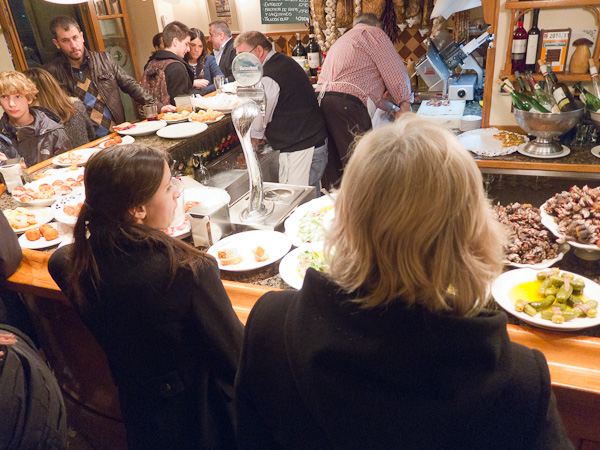
San Sebastian is said to have the best tapas, or pintxos, bars in Spain. You take, or ask for, whatever you want from the platters on the bar, and somehow the waiters keep track of your tab. The stuff can be really great—with toppings like octopus, ham, anchovy, hake, shrimp, cheese, and the like. You do have to a bit wary, as the less-good places will have some tapas loaded with things like coleslaw or tuna salad. The place in this picture was in fact my favorite place, on the Calle Mayor in San Sebastian, I don’t remember the name. Totally jumping in there at 9 pm. Here’s a guide to San Sebastian tapas, but basically you just look for the places where the crowd fills the room.
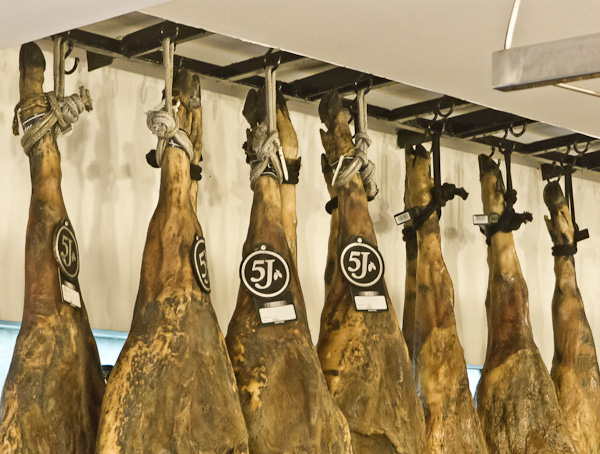
A lot of the snacks include a special jamón ibérico or Iberian ham, which is very nearly unobtainable in the US. A whole ham sells for about 90 Euros, and they still have the original pig trotter intact at the top. Ideally the black Iberian pigs have fed primarily on acorns. I was kind of wondering if I might be able to smuggle one of the hams home inside my pants, taped to my leg. “Yes, I have a trotter on my knee—so?”
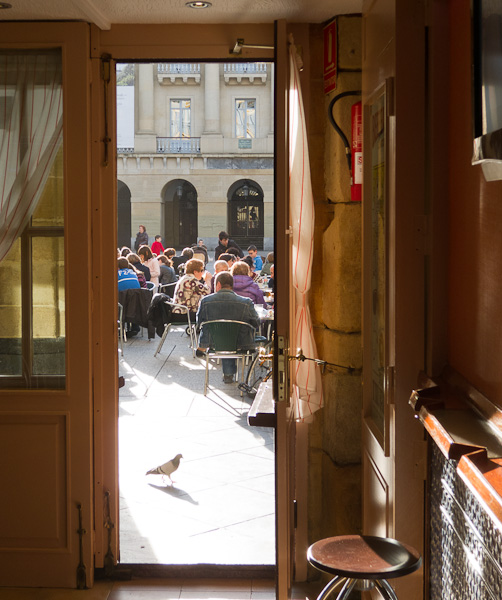
There’s a beautiful old square in the old part of San Sebastian, the Constitution plaza. The windows have numbers painted over them—at one time they used the square as a bull-fighting ring, and sold the window seats. The Constitution plaza is one of those lovely European hanging-out zones. People of every age sit in the cafes, chatting and relaxing. School children play soccer. Mothers with baby carriages exchange gossip.
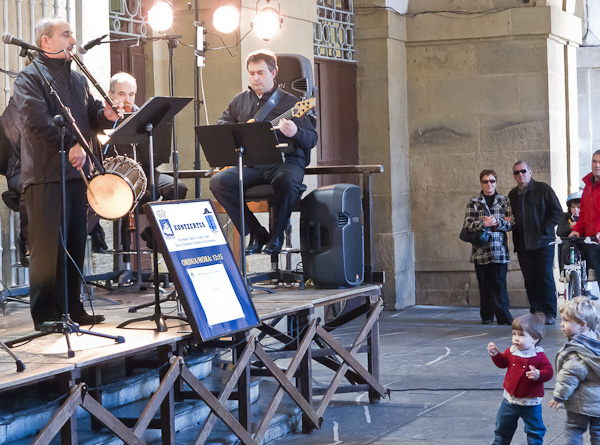
And on Sunday, some local musicians play in one of the arcades around the plaza. I love the toddler on the bottom right, staring at the band. The tyke even danced a little. It’s amazing to me how, as soon as a child can stand, they have the idea of bouncing in rhythm and waving their arms.
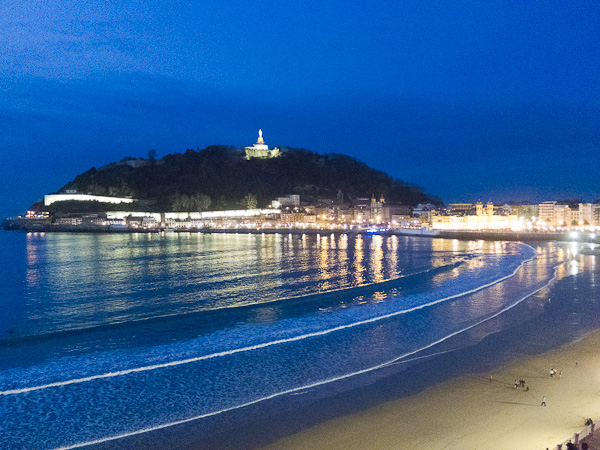
San Sebastian sits on a round little bay, shielded from the most violent weather. The waves break in beautiful circular arc that runs around the whole bay. The beach is very gently sloping, which means that the tides move the waterline up and down by several hundred feet a day.
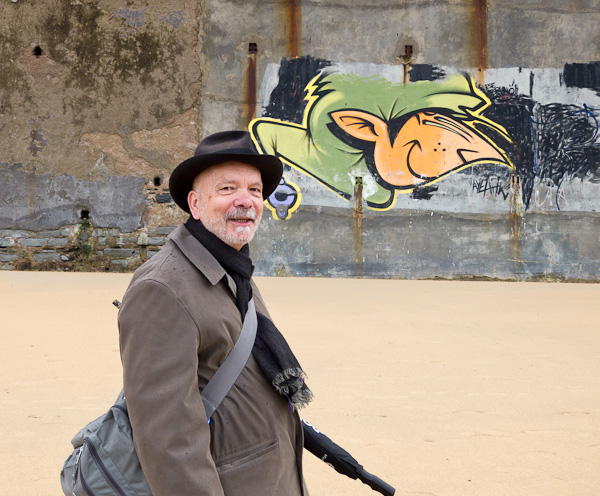
At my talk in Bilbao, I met an American artist, Lawrence S. Johnson, who lives in San Sebastian with a local woman whom he befriended while on a month-long 500-mile pilgrimage hike. Larry has read many of my books, found out about the talk via one of my tweets, and turned up. We spent a while day with Larry and his lady friend, it was great.
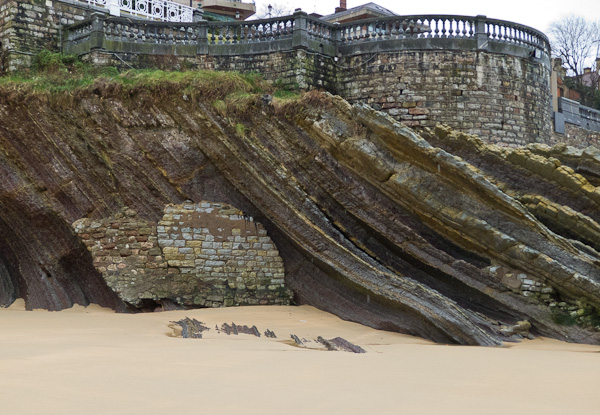
When we started walking, it was raining, but in a fairly mild, pleasant way. Larry and I walked on the wet sand and the ladies walked on the seaside promenade. I liked these cool layers of rock, turned at an angle.
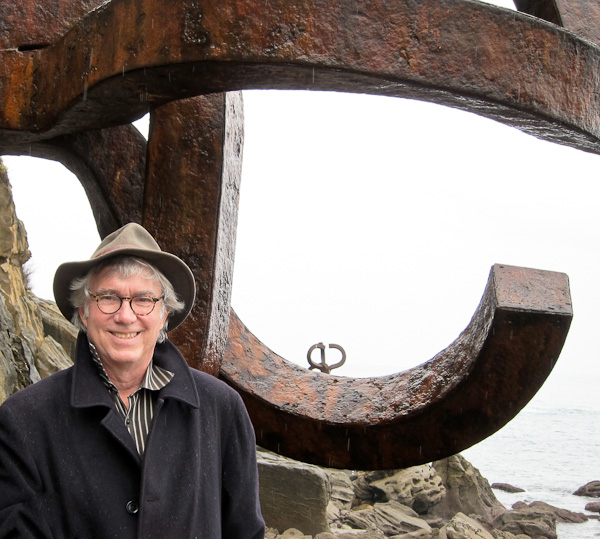
At the end of the beaches along the bay we came to three iron sculptures, embedded into the rocks to make a piece called El Peine Del Viento, or The Comb Of The Wind, by the Basque sculptor Eduardo Chillida.
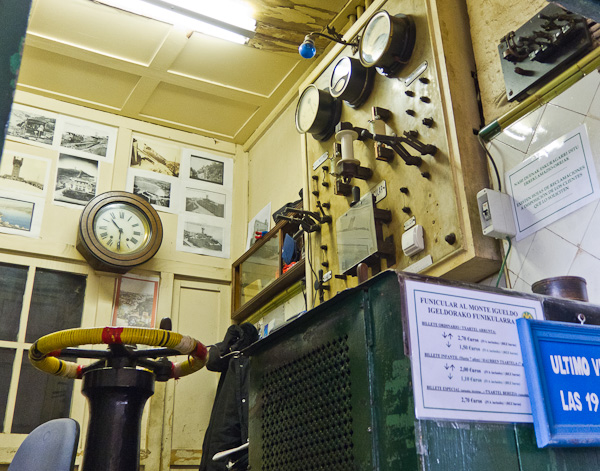
And then we rode a 1912 funicular train a few hundred meters to on overlooking promontory. The control room for the train was a little bit unsettling—like the lab in the original movie of Frankenstein
.
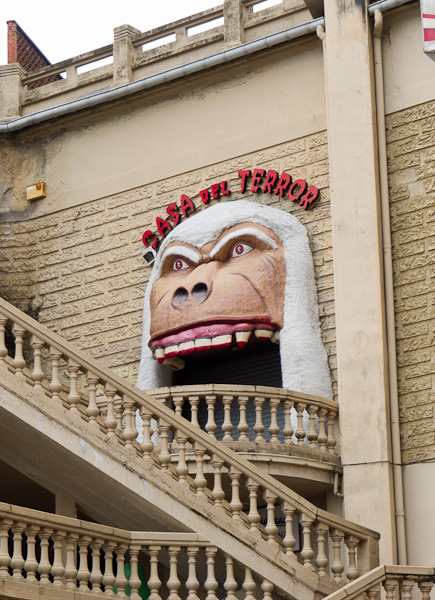
Atop the promontory was a nearly inactive (as it was February) amusement park for kids, a fairly low-tech set up. I dug the entrance to the Casa Del Terror, or House Of Horror. I’ve always been very frightened of those places, and haven’t been in one since I was a kid.
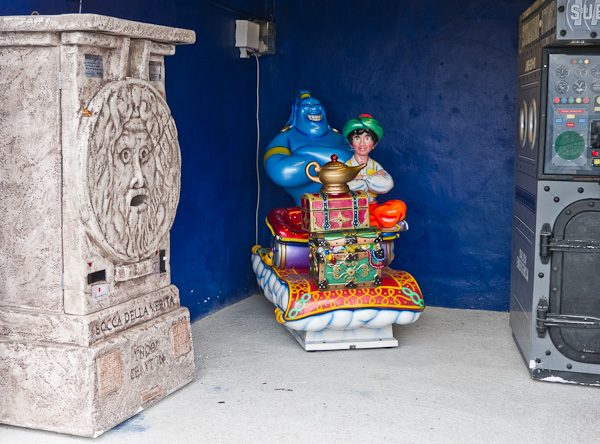
I was surprised to see a fortune-telling machine modeled on a famous sculpture in Rome, the Boca de Verita, or Mouth of Truth. The story goes that if you put your hand inside the slot like mouth and say something, the stone won’t let you remove your hand if what you said wasn’t true. I actually wrote about this in my book Infinity and the Mind, years ago. My paradoxical thought was to put my hand into the mouth and say, “I will not be able to remove my hand,” getting a statement that’s true if and only if it’s false.

And in this off-the-grid kiddie park, there was my old friend the Boca, jammed in with Aladdin.

We slept in an old place called the Hotel Niza, with a nice view of the bay. On Friday night, there was a fair amount of noise from young people partying on the beach—they only partied on Friday, not on Thursday or Saturday. But on Friday they were up until four or five am.
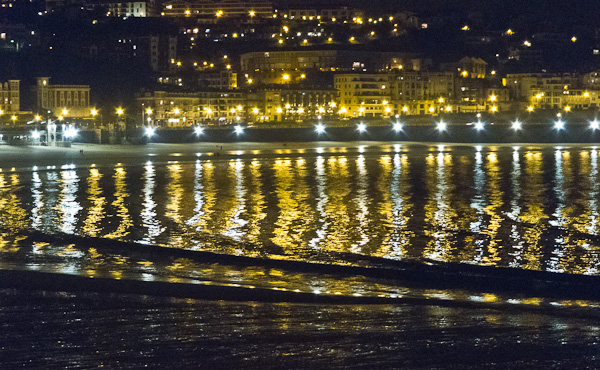
The bay was amazing at night, with the beautiful lights reflecting off it. When we’d go out for supper at about 9 pm, we’d walk along the bay to the old town. This photo reminds me a little of a Van Gogh painting we saw at a show in San Francisco this winter.
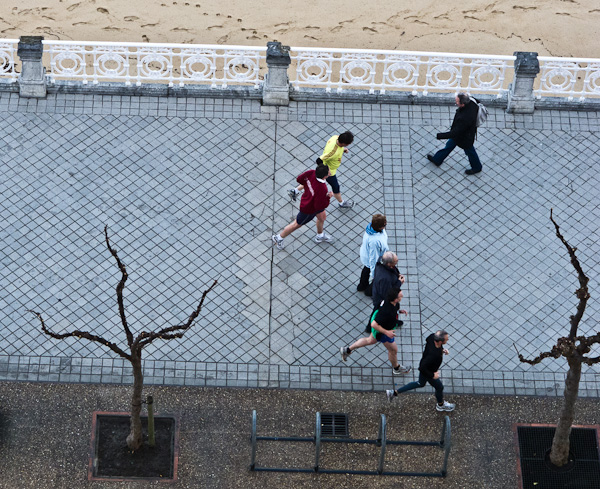
In the mornings and again in the early evening, hundreds of people promenaded along the path by the beach. The trimmed trees look kind of like sea creatures here.
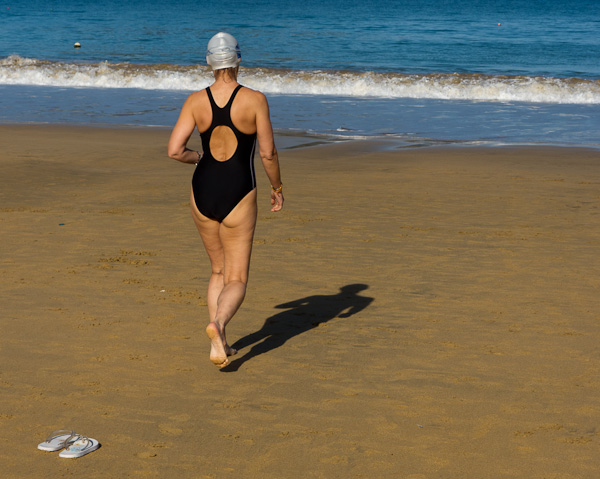
In the early morning, fanatical locals would change into their suits at a bathing-club downstairs and head into the surf.
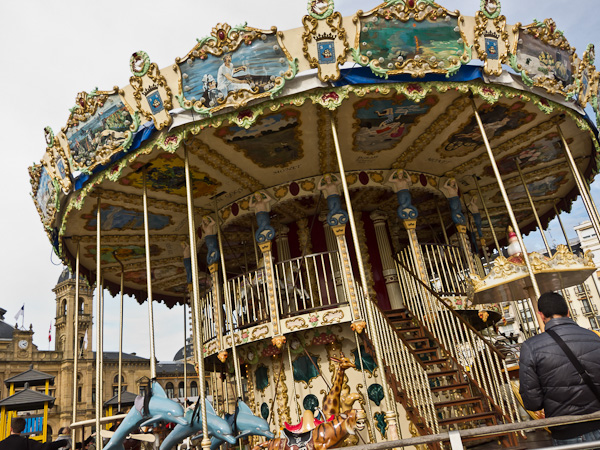
A beautiful old carousel by the beach was decorated with paintings taken from the masterpieces of art—how European.
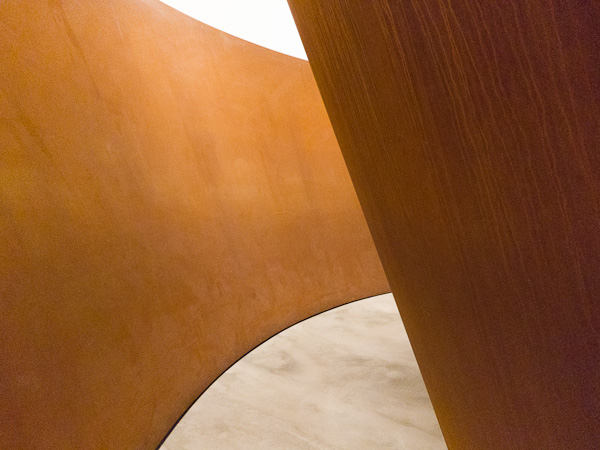
And then our week was over, and we made our way back home via the Serra sculpture in Bilbao.
Share

Speakage, and PDA 2011

Thursday, February 24th, 2011
Share

First I’ll mention three talks in this post. And later, at the end, I add an update about the PDA 2011 con at Internet Archive.

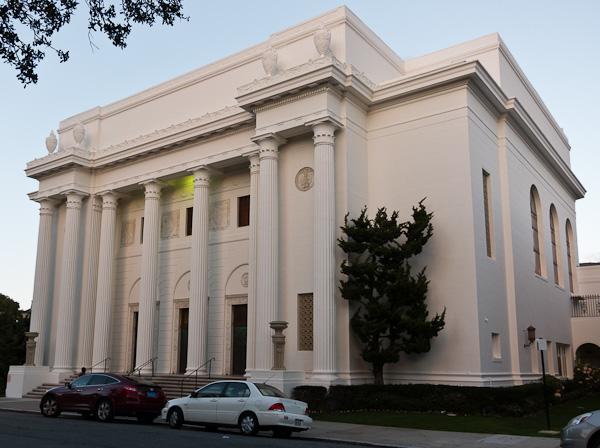
(1) On Friday, February 25, at 4:45 pm, I spoke for a half hour on “Lifebox Immortality” at PDA 2011, a Personal Digital Archiving conference at the awesome Internet Archive in San Francisco—which is housed in a repurposed, Greek revival style Christian Scientist church, shown above

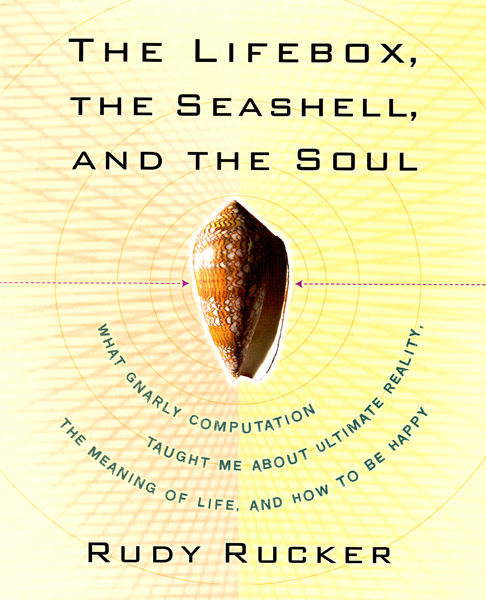
For background on my lifebox idea, see my recent post on “Digital Immortality Again.” I used “lifebox” to mean a digital or online simulacrum of a person. I go into considerable detail about the lifebox in my non-fiction book, The Lifebox, the Seashell, and the Soul, and in a recent article “Lifebox Immortality” in h+ magazine.

In a nutshell, my idea is this: to create a virtual self, all I need to do is to (1) Place a very large amount of text online in the form of articles, books, and blog posts, (2) Provide a search box for accessing this data base, and (3) Provide a nice user interface.

I made a first crude stab at this a couple of months ago, with my Rudy’s Lifebox page at www.rudyrucker.com/blog/rudys-lifebox. This page lets you Google-search my rather large www.rudyrucker.com site.


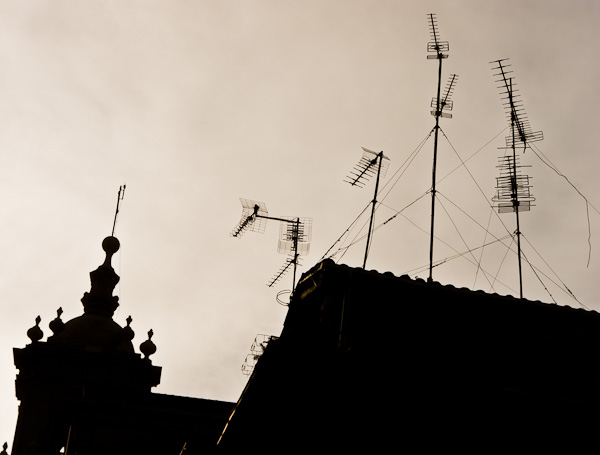
[A skyline in San Sebastian, Spain]

(2) Rick Kleffel made a nice podcast of a reading I did of “The Birth of Transrealism,” a chapter from my forthcoming memoir, Nested Scrolls: A Writer’s Life, back on January 15, 2011, in San Francisco at the SF in SF gathering. Here’s his post about the podcast on his blog, “The Agony Column.” You can also get to the podcast via my Feedburner podcast station, click the icon below.

(Note that Feedburner only shows my most recent podcasts. For older audio files, see my archive on Gigadial, which runs back to 2005.)

(3) A videotape of my Garum Day talk in Bilbao is now online as well.


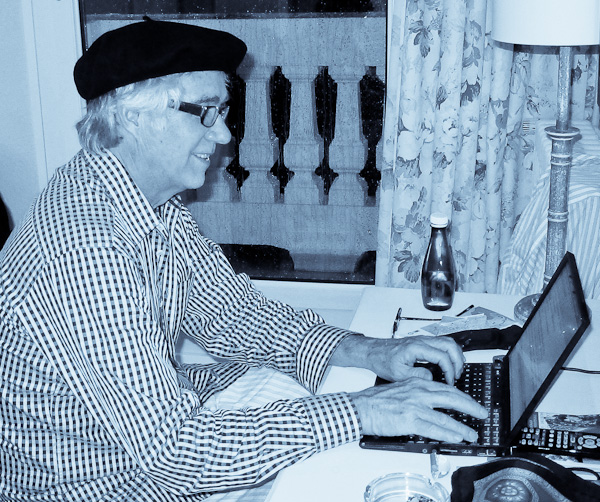
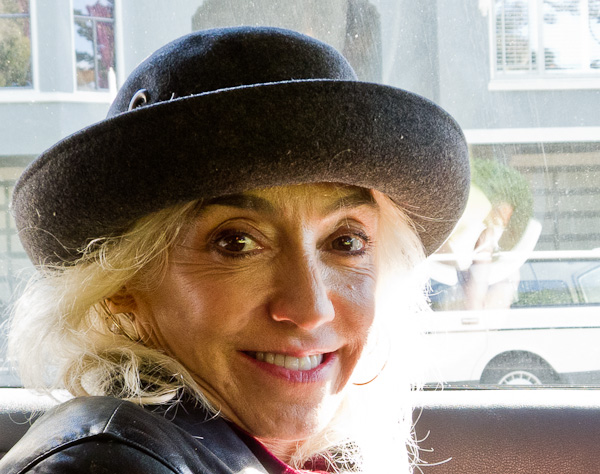
[Rudy being a Continental writer in his new *eeek* Basque beret]

You can find my description of my Bilbao talk in my recent post, “Selling Yourself”. It relates to the lifebox theme as well.

(Back to 1) Now for some notes on the PDA 2011 meeting at the Internet Archive.

As I mentioned above, the venue was in an amazing building. Brewster Kahle (shown above with his server) acquired it a year or two ago for housing the Intenet Archive. Instead of air-conditioning the servers, Brewster has fans drawing air through them…and the air cycles into the building to heat it.

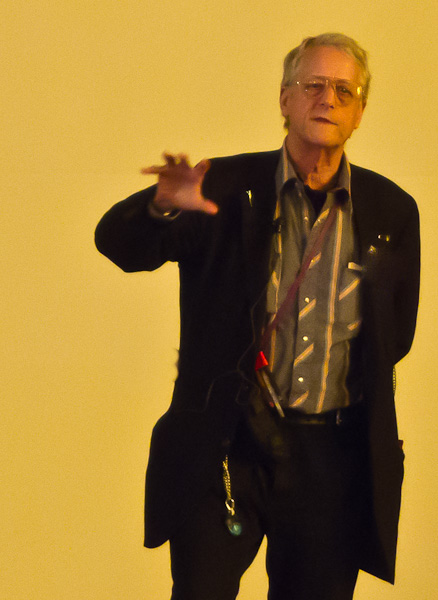
Good old Ted Nelson gave a talk, to some extent promoting his awesome autobiography, Possiplex.

Gordon Bell, the famous lifelogger was there. I stood next to him and talked to him for a few minutes—a genial guy. And the SenseCam he wears around his neck must surely have taken my picture. So I’m safe in his lifelog!

Cathal Gurrin of Dublin City University was wearing a SenseCam as well, he’s accumulated I think 7 million photos over four years, it takes about 3 shots a minute. Searching the database is the hard problem. I asked him the two obvious privacy questions, and he said he reflexively pauses it for 5 minutes as he walks into a restroom and…he takes it off at night so it can recharge.

And my old pal Faustin Bray from the Hacker and the Ants days was there as well, looking good and, as always, taping and filming for her Sound Photosynthesis site, which features Richard Feynman, Terence McKenna, Robert Anton Wilson and other freaky luminaries.

The meeting had an interesting vibe of a whole lot of people turning up and discovering that there were others interested in the same thing—logging aspects of our lives in digital forms. One thing that struck me was that everyone has their own very distinctive notion of what they’d like their lifebox to be like. In a way, it’s similar to the way that people select different kinds of statues for putting over their graves! Virtual funerary monuments. Ghostly pyramids of Cheops. I’m telling you, this is going to be a huge industry.

More: Daniel Reetz gave a great talk on the impact of ubiquitous low-cost cameras, especially as relating to DIY Book Scanning. And Rich Gibson gave an inspiring and relaxed presentation of the new movement towards gigapixel (and larger) photos, see the Gigapan site. I also met Evan Carroll, co-author of Your Digital Afterlife…this book was mentioned the recent New York Times Sunday magazine article about digital immortality.

Videos of the talks will be up in a week or two.

Share

Spanish Basque Country: Bilbao

Wednesday, February 23rd, 2011
Share

My wife Sylvia and I just spent a week in Basque country in the north of Spain, in the towns of Bilbao and San Sebastian. I was there to give a talk for “Garum Day” as mentioned in a previous post. For today’s post I’ll run about half of my pictures, with comments. A few of the pictures are by Sylvia, mostly the ones of me.

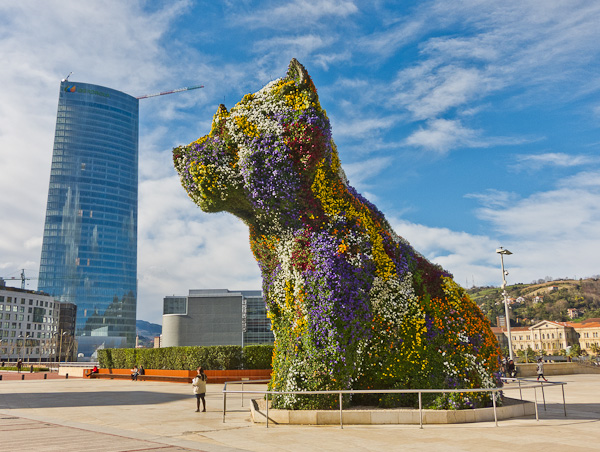
Our hotel, the Domine, was right across from the famous Gehry-designed Guggenheim museum in Bilbao. Jeff Koons’s Puppy stands right outside the museum. Some people find this work annoying, but I think it’s cool, a definite heir to the work of Warhol. “Puppy” has quite a presence in person. The locals seem to like it, and the flowers (pansies) get replaced three times a year. There’s a certain camouflage-pattern quality to how the patches of flower colors are arranged—more thought went into the work than one might think.

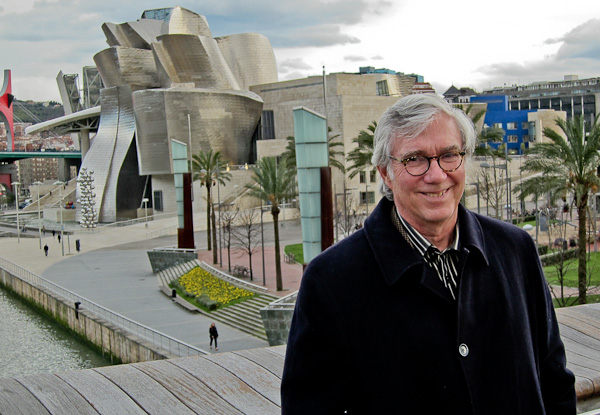
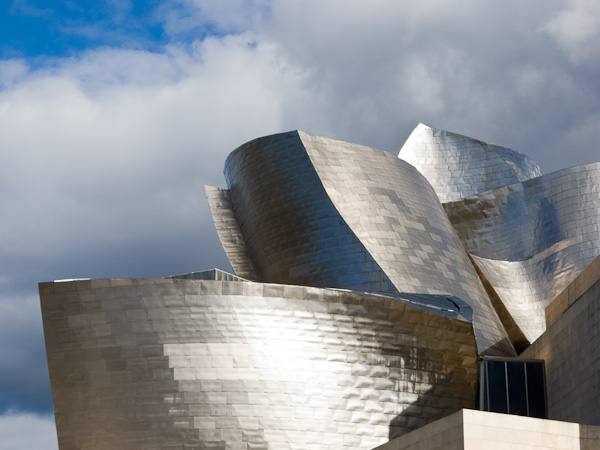
So here I am with the museum itself, the metal skin is titanium, it’s awesome. No one picture really captures the thing.

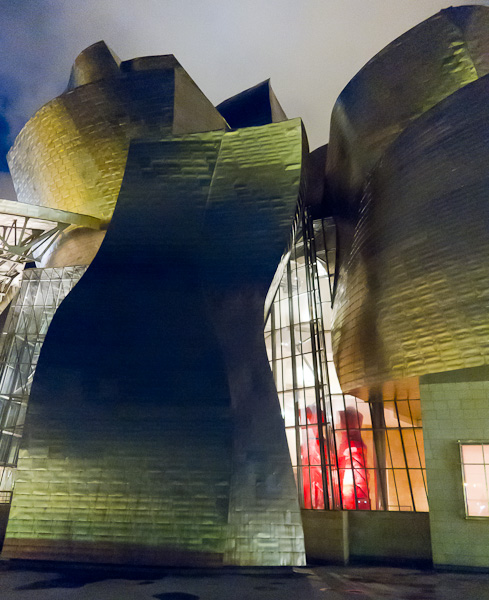
When we got to Bilbao we were jetlagged, and slept till it was dark, and then we walked around the Guggenheim at night. In the back, the buttresses seem like castle ramparts.

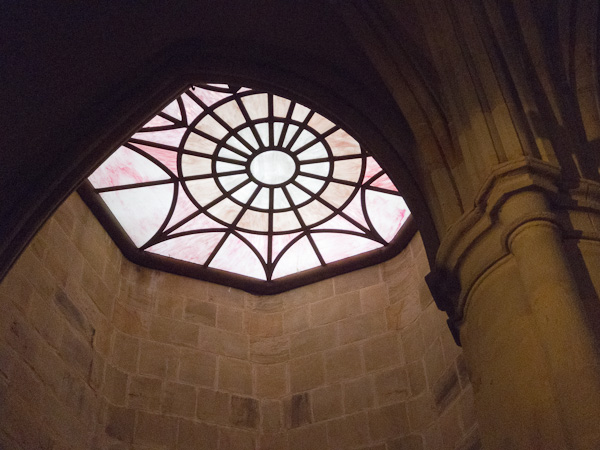
There’s a nice old-town section of Bilbao too, of course, including a church that was at one time part of the city wall. A great rose window in the ceiling of one alcove.

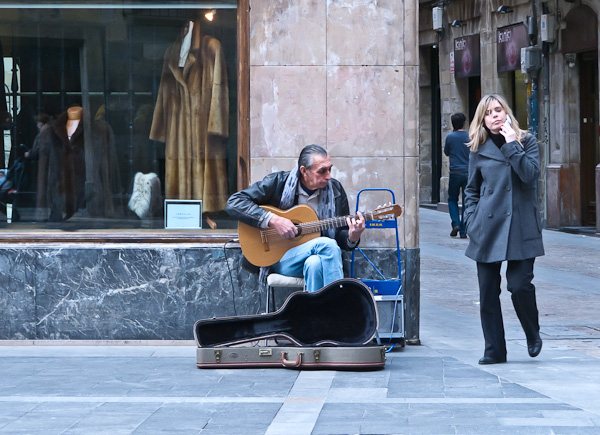
This guy was playing great Spanish-style guitar in the street by the cathedral. And dig the woman hurrying by with her cell phone.

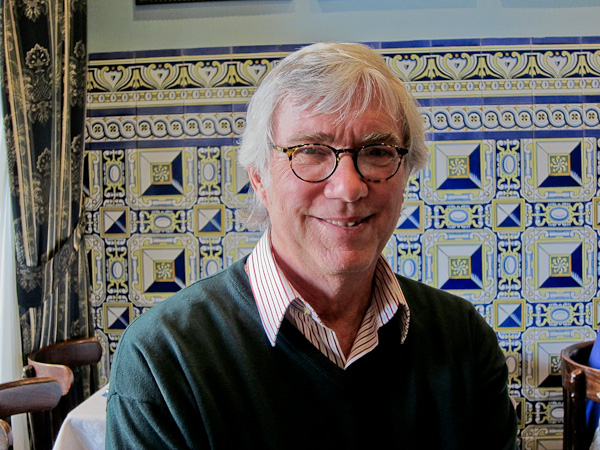
One of our big projects in Bilbao and San Sebastian was seeking out good tapas bars. They call tapas pintxos there, that’s the Basque word for these little canapé-like snacks that are piled on platters in many of the bars. The “tx” is pronounced “tsch”. The place in this photo is the Café-Bar Bilbao, in Plaza Nueva, a really pleasant square. They had good tapas in this place, and I loved the tiles on the walls. But, as any local will tell you the really great tapas is in San Sebastian.

A tricky thing about going out for meals in Spain is the restaurants and cafes mainly serve lunch from 2 to 4 in the afternoon and dinner from 9 to 11 at night. Seriously. Many restaurants aren’t even open before 9 in the evening. It’s a whole different rhythm, but with our jetlag it was a pretty good fit. The thing is, you kind of just do your sedentary evening activities (like lying around reading or cruising the web) before supper.

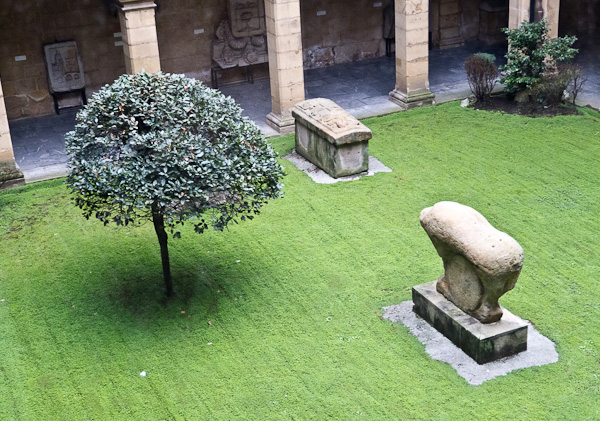
Bilbao has a little historical and archeological Museo Vasco (Vasco=Basque) museum with an ancient (maybe 200 BC) statue of a pig (or maybe it’s a bull…the locals call it the pig-bull). I couldn’t get into the pig-bulls courtyard to touch him, but he was beautiful as seen through the window with his green grass and the gentle shadow of a little tree beside him.

Another picture of the Guggenheim. The upper pieces of the building—what do you call them, battlements?—blend nicely with the clouds. One of the locals claimed it rains every day in Bilbao. But the sun comes out too.

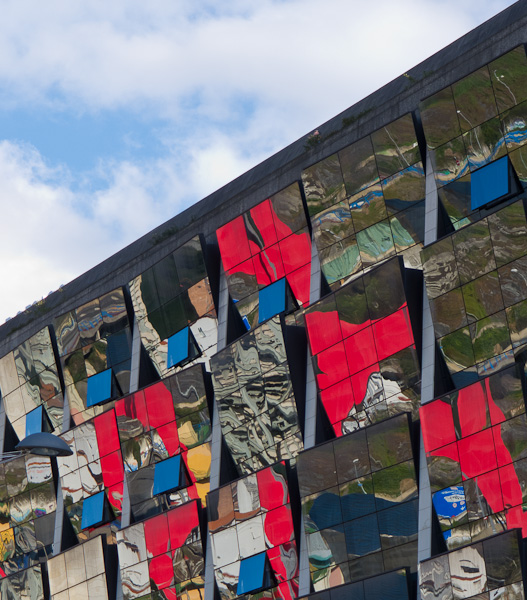
Our hotel had angled windows that reflected the colors of the Guggenheim and of a big red arch over a bridge next to the Guggenheim.

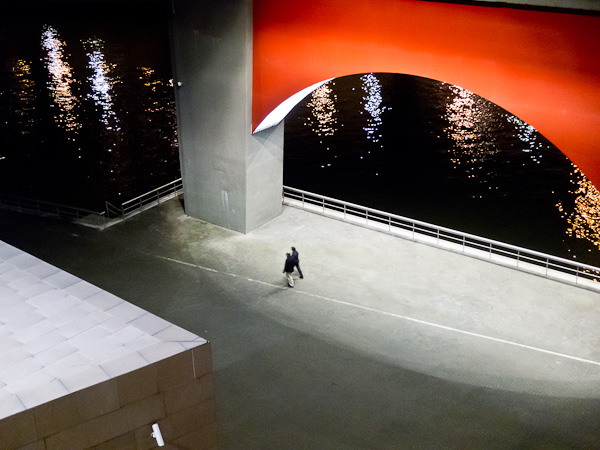
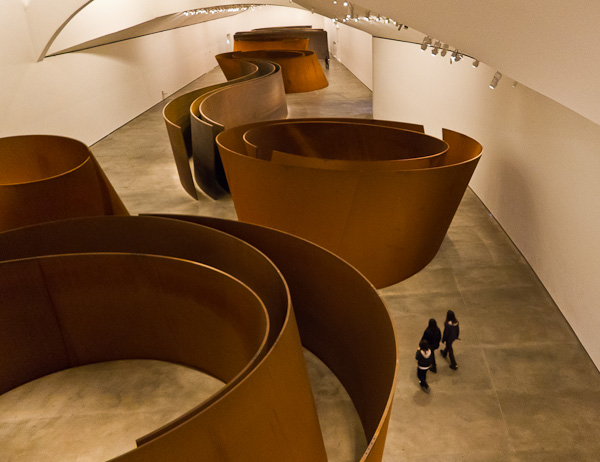
Here’s the red arch at night with people walking along the river below. Gehry ran a long exhibition hall out of the museum that runs under the bridge and holds this collection of really enormous Richard Serra sculptures, a suite called “The Matter of Time.”

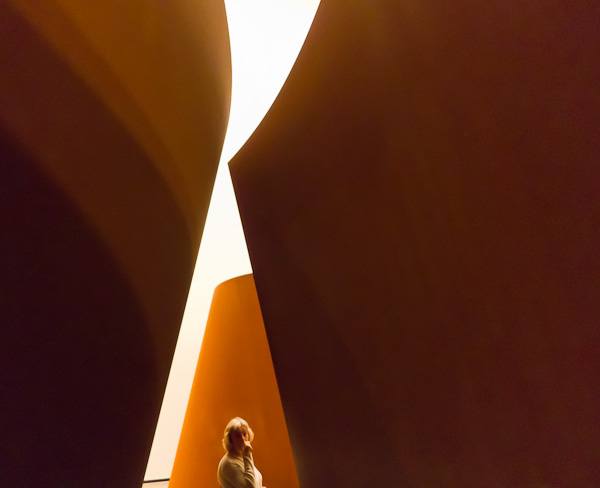
I’d never really liked Serra’s work before this trip—in the past it struck me as overbearing and blank. But it was very inspiring to be walking around inside these giant maze-like spirals with their interesting curvatures—some were spherical in the sense of curving the same way in all directions, some were “toroidal” in the sense of curving in two different directions, like a saddle. There’s amazing echoes inside the Serras as well.

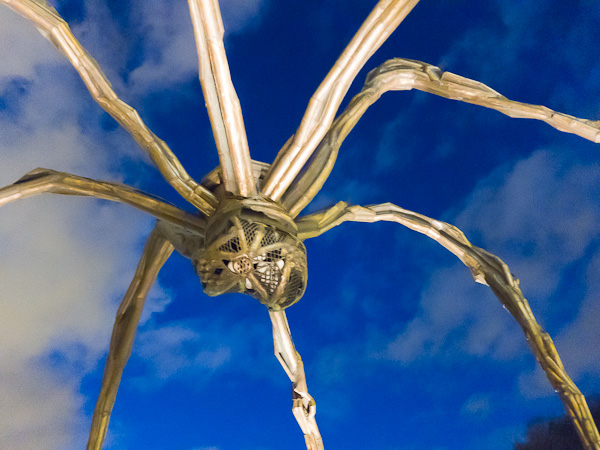
One last photo from Bilbao, and in the next post or two, I’ll show pictures from San Sebastian. What’s this menacing image above? It’s Maman, by Louise Bourgeouis, photographed outside the Guggenheim at night. The jacked-up ISO on my Canon S90’s chip turned the black sky into blue.

And this sculpture is…Mama!?! Eeek. Shades of the spider attack scene in The Incredible Shrinking Man!

Share

My Garum Day Talk, “Selling Yourself”

Sunday, February 13th, 2011
Share

(Post updated on February 23, 2011)

I was in Basque country from Feb 14 – 22, 2011, giving a talk at Garum Day on Feb 16, 2011, in Bilbao.

My talk was called (with slight irony) “Selling Yourself,” and it had to do with various ways in which we try to make money by selling information, culiminating in the notion of creating software replicas of yourself—and then going on to “sell” interactions with your personality model online.

I posted a PDF of my “Selling Yourself” powerpoint slides online, and a draft of the full ‘Selling Yourself” essay.

The Garum Foundation, by the way, takes their name from a type of Roman fish sauce; part of the idea is that, at their meetings, they mix together an interesting stew of ideas, another part of the idea is that a recipe for a traditional recipe is kept alive by communication and interaction.

The Garum Foundation organizer is an idealistic banker, Jose Ignacio Goirigolzarri. The conference was fun, and I had some extremely good meals.

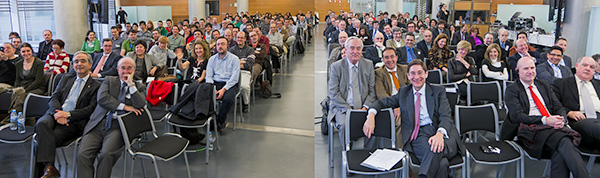
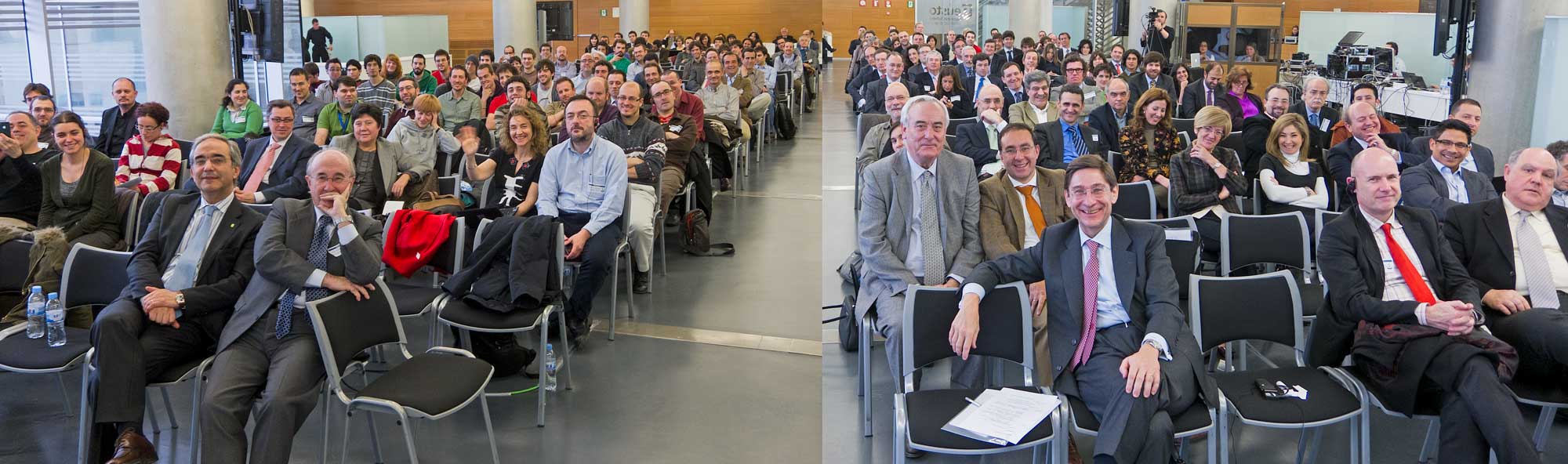
Garum Day brought in a really big crowd, many of them were faculty or students with the Universidad de Deusto, and a number were execs for Spanish industries and banks. I took a photo of them at the end of my talk, which was more or less as outlined in the online PowerPoint and essay, although I threw in quite a bit of autobiographical material. Here’s the photo of the crowd.


The audience at Garum Day, Feb 15, 2011. If you want to find yourself, click for larger version!

As of February, 23, 2011, a videotape of my talk became available online.

At the end of my talk, one person asked if I had advice for entrepreneurs in our age of the internet revolution. I didn’t give a great answer at the time, but here’s a three things I might have said.

(1) Chatbot or lifebox emulations of humans will be a huge online industry, see my post on “Digital Immortality Again.”

(2) Any interesting online program should have a quality of unpredictability or gnarliness so as to appear lifelike and engaging. See my essay “Seek the Gnarl” or my Surrealist video, “What Is Gnarl?”

(3) Online sites are most interesting if you put a full personality into them, and have them be “transreal,” that is, in some sense autobiographical, but with a layer of elaboration atop that. For some discussion of transrealism see my post “Unpredictability and Plotting a Novel.” You can also listen to a podcast of my recent talk, “The Birth of Transrealism.”

And, yes, my advice isn’t what you’ll normally hear in business school but…when has past knowledge ever been right about the future? Odd paths and new recipes are worth a try.

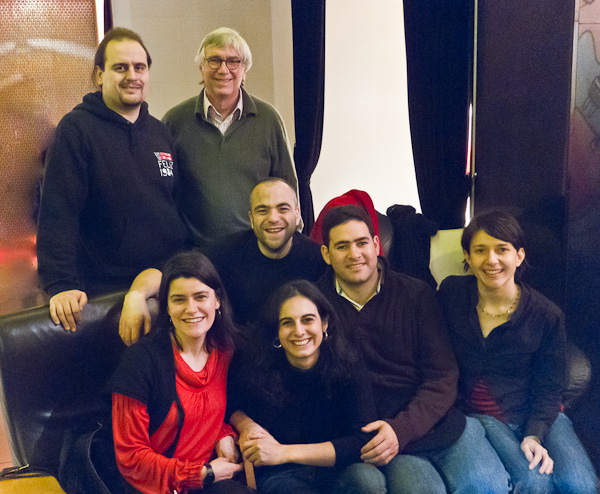
Another fact about Garum Day—the conference’s techs and organizers were largely drawn from a cooperative group known as Las Indias, who say they were originally inspired by concepts of cyberpunk! Here’s a picture of me with them.

Finally, for non-natives of Bilbao, I’ve placed a photo above that shows the awesome hall of Richard Serra sculptures in the Guggenheim Museum here. Serra says his suite is about time. I guess the future is at the far end…

Share

Early Days of Creative Programming

Sunday, February 6th, 2011
Share

[ I will be speaking on some of my experiences involving software at Garum Day, an event in Bilbao, Spain, on Feburary 16, 2011. Part of my talk, and today's post, will derive from the “Computer Hacker” chapter of my memoir, Nested Scrolls: A Writer’s Life, due out from PS Publishing in April, 2011, and Forge Books in Fall, 2011. ]

My new hacker friend John Walker was a founder and the CEO of a booming Sausalito corporation called Autodesk, and in 1988 he asked me if I’d be interested to come work for him. Autodesk had done very well with their drafting software, and they had a big surplus in the bank. Walker wanted to explore some radically new kinds of software products.

Autodesk’s core business was a product called AutoCAD, an electronic drafting program used worldwide by architects and industrial designers. Walker didn’t want me to work on that. Instead he was starting a small Advanced Technology Division, headed by Eric Lyons, and, for the moment, me and one or two other guys.

My first project was to produce some cellular automata software with Walker. He was an insanely talented programmer. He worked at the level of a grand master in chess, or at the level of a mathematician at the Institute for Advanced Study. Over Autodesk’s one-week-long Christmas break, Walker wrote an assembly language program that eliminated any need for a special card such as the so-called cellular automaton machine I’d been carrying around.

My role in this was to create some sample CA rules for our new software to run, and to write a manual explaining it all. I got deeply into the task. Walker and I and finished our project over the course of several months. When we were done, we’d produced a slick, boxed software package called CA Lab: Rudy Rucker’s Cellular Automata Laboratory, which sold for about $50 and went on the market in 1989. In those pre-Internet days, some people were actually willing to buy software of this kind on disks. I did demos of it at a number of computer trade fairs, always having to parry the same old question.

“What’s it good for?”

“You stare CAs for hundreds and hundreds of hours and they eat your brain, okay?”

We sold a decent number of copies, and Walker had the idea that we could develop a whole line of software packages for hackers to enjoy. These packages were meant to be like books, but interactive, illustrating new aspects of science. Walker wanted to call the line the Autodesk Science Series.

The second package in the series was James Gleick’s Chaos: The Software, designed to let users play with some of the programs mentioned in Gleick’s best-selling book Chaos.

What was the chaos craze all about? Chaos is another new idea whose true origins lie in computer science. We all know about simple, deterministic processes that do something utterly predictable—like a cannonball flying along a predetermined parabola through the air. We also know about completely messy natural processes, such as the crackling static we might hear on a radio.

Chaotic processes lie midway between the extremes of predictability and randomness. On the one hand, a chaotic process doesn’t settle into any kind of dull and simple pattern. On the other hand, a chaotic process isn’t actually random. It’s generated by some fairly simple and deterministic law of math or physics.

There’s a certain overlap here with Charles Bennett’s notion of logical depth . A chaotic pattern is logically deep in that it’s generated by a concise rule that uses a long computation in order to produce the patterns that you see.

The hard thing to grasp about a messy-looking chaotic process is that it is in fact deterministic. If, for instance, you set about computing the successive digits of pi, you’ll always end up with that same number sequence, 3.1415926… So all the digits of pi are in some sense predetermined. But yet—and this is the subtle point—the digits aren’t predictable, at least not predictable by any rapidly-acting rule of thumb. Yes, someone like Bill Gosper can compute the billionth digit of pi, but he needs to run a powerful computer through quite a few cycles in order to come up with the answer. There are some good modern formulae, bu there’s no quick and dirty pencil-and-a-scrap-of-paper shortcut for finding the billionth digit of pi. It’s going to take you about a billion steps, no matter what. Pi is gnarly, pi is chaotic, pi is logically deep.

In his bestselling Chaos, Gleick talked about some mathematical systems that were known to generate chaotic patterns. Among these were the Lorenz attractor and the Mandelbrot set, and we put simulations of these into the Autodesk Chaos software, along with some other funky things.

Working on this second Autodesk program all through 1989 and 1990 was a lot harder for me than working on CA Lab had been. The big difference was that this time Walker didn’t step in and write the bulk of the code. Instead I worked with another Autodesk programmer, a knowledgeable and irascible guy called Josh Gordon. Truth be told, my own programming skills were still pretty rudimentary. I was in over my head. And Josh was never shy about telling me this. But somehow we struggled to a conclusion and in 1991 we shipped this second product, too.

Later, on my own, I’d write a third science series program called Artificial Life Lab, which would be published as a disk with a book in 1993, not by Autodesk, but by the low-end Waite Group Press in the North Bay. I might mention that, annoyingly, the Waite Group refused to pay me my royalties on the Japanese edition of the book.

The three software packages that I worked on, CA Lab, Chaos, and Artificial Life Lab, are all long out of print by now, but you can download them for free from my website. Note that eventually we had to change the name of CA Lab to Cellab. A company called Computer Associates was threatening to sue us for infringing on their sacred trademarked initials CA. As if cellular automata hadn’t been around much longer than them!

Share

Alan Turing Near Las Cruces, NM

Tuesday, February 1st, 2011
Share

[Today, some reworked travel notes from 1999 that may make their way into my novel-in-progress The Turing Chronicles. Photos from around Los Gatos and Berkeley in the last week of January, 2011.]

Alan Turing sat on the balcony of his room near Las Cruces, New Mexico, looking at the beautiful silhouette of some low mountains across a plowed field, the range like a long jawbone with teeth in it¬—a cow or dog jawbone that one might find in the woods. A dove sat on a twisting piñon branch in the shade of the tree’s main trunk, an iconic silhouette. A train not too far off was sounded its horn for the crossings in this land of trains.

A red squirrel ram up a twisty pine tree: the squirrel fit the tree, and the two of them fit Alan’s perceptions of what he should see. Everything fit. It struck him that he and the plants and animals and the skugs were all of a piece, they were all part of the same wetware world.

Before getting back on the road in the morning, Alan took a walk, admiring the clumps of prickly pear cactus, the lobbed with buds along their rims, and with yellow and red flowers sprouting amid the thorns. He liked how the cacti were so perfectly placed among the grasses and the dry red rocks. Nature’s wise and lovely designs, at the fertile border between order and chaos. Little lizards lifted up their striped tails to run away.


[Detail of “Turing and the Skugs,” see my paintings page for more info.]

Alan came across a hillside cemetery with a few cracked stones amid long grass and thick-trunked old cypresses, the trees not immensely tall. In the wind-blown grass, Alan accidentally stepped on something alive. It was a rather large lizard who’d been resting there, sluggish in the early sun. The weight of Alan’s foot had broken off most of the lizard’s tail, and it was frantically twitching on the ground. The lizard himself remained motionless. Alan had the notion the was wounded lizard was keeping himself under strict control, as opposed to his cut-off tail which had no control at all, desperately writhing.

With the federal police after him and his fellow skuggers, he needed to be like the lizard and not like the tail.

Share

Rudy’s Blog is powered by WordPress