





Archive for November, 2005
Wednesday, November 30th, 2005
About two weeks ago, I had an entry called “It From Bit” or “It From Qubit”? Part 1.. Today I want come back to that topic and finish it off.
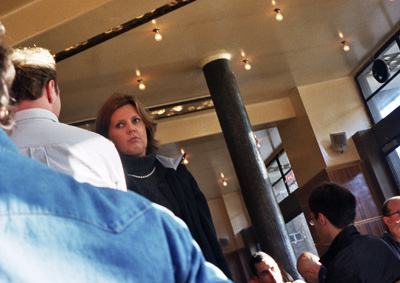
[Today's pictures are from Belgium, this particular one shows some strangers in a cafe. I like the expression on the woman's face. "It from bit?" she's thinking.]
David Deutsch argues that quantum computation is going to better at modeling the universe than classical computation. Quantum computation is built up from so-called qubits instead of bits. A qubit can be 0, 1, or some mixture of the two. The big win, says Deutsch, is that our world is already made of quantum mechanics, so a quantum computer can not only emulate any physical system, it can in some sense be a copy of any physical system. With digital classical computer simulations, there’s always the worry that you’re only running a simplified version of the world.

What does a quantum computer look like? Well, they barely exist, so far, and it’s not clear that they’ll ever be usable. In the current laboratory experiments, a half dozen supercooled atoms might be held suspended in a line in a so-called ion trap. And the experimenter shines pulses of laser light onto the ions, and eventually one of the ions might spit out a photon or flip over, and that’s your output.

What seems to me like a kind of flaw is that, at least for this style of quantum computer, the thing isn’t self-contained. The program isn’t stored inside the system. The pulses of laser light are both the program and the data. Of course I have to load programs into my desktop computer or my walk-around robot. But once those programs are in there, the system can go off on its own and function autonomously. I don’t see that happening in at least the current descriptions of quantum computation.

In some sense it’s easier to say the universe is a quantum computation instead of a classical computation with sharp-valued digital bits. For the universe as we know it seems to be made of quanta. But as Wolfram remarked to me recently, this doesn’t mean there couldn’t be a digital substrate. He says that trying to smuggle quantum mechanics into the lowest level of reality is a bit like the heliocentrists’ desperate attempts to preserve their unwieldy system by tacking on epicycles to the planets’ motions. Maybe at the lowest level we can just let go of the quantum system and get something really clean and crystalline.


Posted in Rudy's Blog | 3 Comments »
Monday, November 28th, 2005

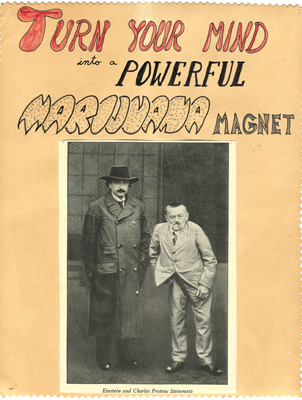
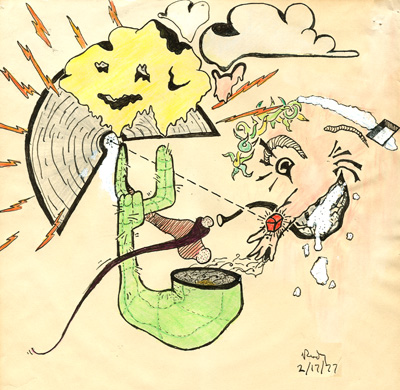
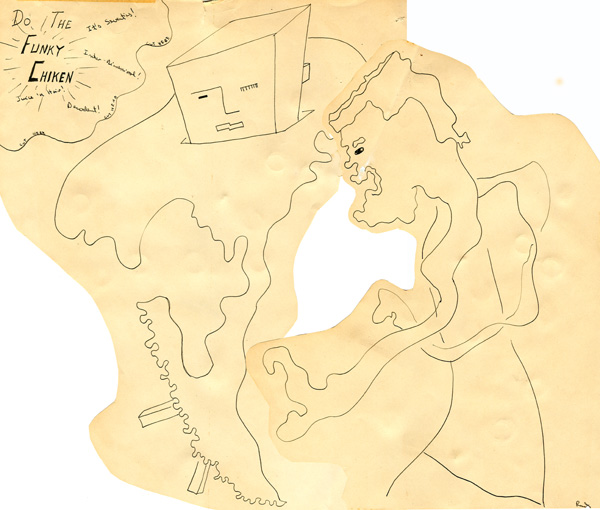
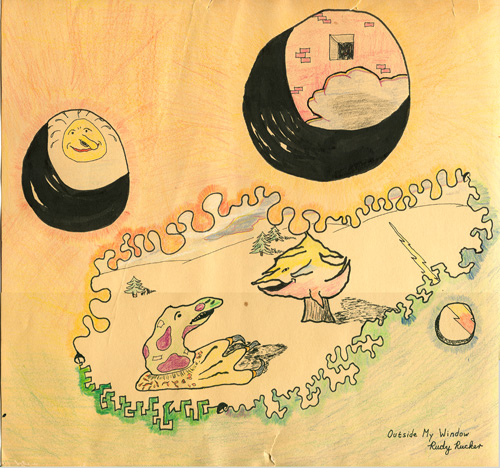
I’m still rooting around in my basement, moving my old papers from cardboard boxes into plastic boxes. I came across a manila envelope containing all the items that were on the bulletin board over my utility-room desk when we emigrated from Geneseo, NY, in 1978 — to Heidelberg, Germany, where I wrote White Light and Software in the next two years. I was primed for ignition.
In parsing this first image, you have to realize that, growing up in Kentucky, I saw that particular pair of phrases very frequently posted near narrow turns on our two-lane highways. So my drawing is what you might call satire. The mouse's neck is infinitely long, you understand, reaching clear up to heaven, and that's the null-and-void behind him/her.

For awhile there I was printing my own photos and then coloring on them with pencils. This is none other than Eddie Marritz.

This little collage goes back to my grad-school days, maybe 1970, when I was 24. That’s a photo of Albert Einstein looking very hip with his inventor pal Steinmetz. As for the caption — hey, surely by now, nearly 35 years later, the statute of limitations for crime-think has kicked in.

I loved drawing with Rapidograph pens, drawing pretty much at random, simply making gnarly curved lines that pleased me by their forms. And then I’d turn them into pictures of surreal scenes, adding extra lines, coloring and so on.

This picture came with an ad for a set of encyclopedias, I think. I always relished the vapidity of the people’s expressions. Like this is the first book they’ve ever seen in their life, and maybe the last one they’ll ever look at. Gosh!

And here’s a nice curvy-line picture of two dancers, a bit like La Goulue and Valentin le Desosse. In the upper left corner it says, “Do the Funky Chiken. It’s Seventies! Inter-Dimensional! Decadent! CUT HERE.”

Ah, the glorious 70s! A time before Reagan, even! And the whole wonderful world right “Outside My Window.”
Posted in Rudy's Blog | 4 Comments »
Friday, November 25th, 2005

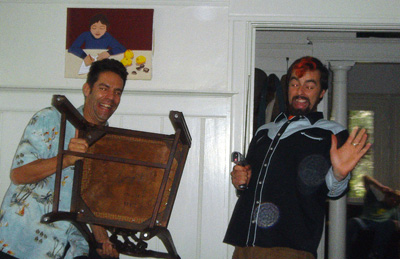
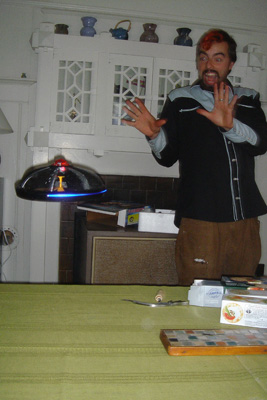
Your humble science-fictionist was witness to an astounding broad-daylight UFO encounter in the city of Oakland, California, on Thanksgiving Day, 2005!!!
Pictures above and below show terrified revelers trying to fend off a dish-sized UFO which flew in through the window!

There was no stopping these inquisitive extraterrestrials! Thanks to my years of paranormal investigative activites, I had the presence of mind to capture several seconds of video footage of the vehicle in flight. After the seeming “crash” into the floor, every trace of the spacecraft disappeared, taking its load of micro-ETs with it!!! Click to see the astounding UFO video (3.6 Meg).

So far, little reaction has been heard from the outlying districts.

And the mainstream media is keeping mum.
Posted in Rudy's Blog | 3 Comments »
Tuesday, November 22nd, 2005
I’ve been in this organizing-my-lifebox kind of mood lately. Rooting around in the basement. Maybe I'm getting ready to write a memoir. As part of the process, I ended up putting together a unified writing notes page.

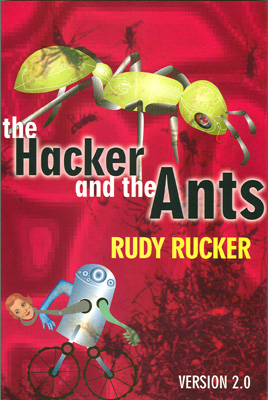
And I put four new sets of writing notes up while I was at it. I extracted notes for The Hacker and the Ants from my fairly harrowing journals of the early 1990s.

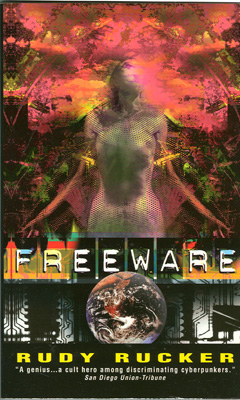
I found some notes for Freeware as well; I’d forgotten I had these notes kicking around.

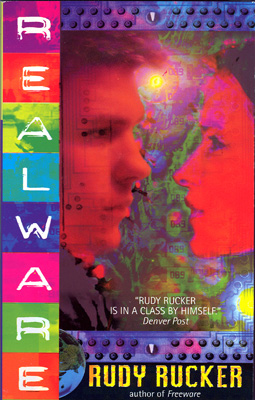
And, yes, I posted the notes for Realware as well. I wish I could get the WAREs out in new editions, I think they're slipping out of print.

And, hottest news of all, I decided to post the notes for Mathematicians in Love, scheduled from Tor in 2006. Why post them now? To build up advance interest in the book. And, hey, they're ready to post now, so why not.

So that's about 212,000 new words of mine online.
Happy Thanksgiving from Jellyfish Lake!
Posted in Rudy's Blog | 3 Comments »
Monday, November 21st, 2005
I’ll get back to “It from Bit” another day. Today I’m pasting in part of my ever-growing cumulative email interview, expanded by questions from Carmine Treanni for Quaderni D’Altra Tempi, an Italian SF review.
Today’s photos are from Brussels, 2002, where I was visiting The Flemish Academic Centre for Science and the Arts (VLAC) and working on Frek and the Elixir and my Lifebox book; I just came across the digital files for these images today.
Oh, before the Brussels pictures, let’s start with a particularly evil-looking photo of El Chimp. I mean is this scary and retro and Orwellian, or what?

Q 171. You are considered to be among the founders of the Cyberpunk, together with William Gibson and Bruce Sterling. After twenty years from the birth of the movement, which are, in your opinion, the traces left by the movement in and out of the science fiction?
A 171. The whole style of dark, glittering, noir Hollywood films running from Blade Runner through the Terminator to the Matrix might be thought of as coming out of the cyberpunk sensibility. One topic beloved of cyberpunk was the fusion between humans and machines, and this is something you see in all these films. We were, if you will, the canaries in the coal mine, noticing the first fumes of mankind’s accelerating roboticization.
Films, however, miss the druggy, antiestablishment satire that lies at the core of cyberpunk. But other writers have picked up the torch of nihilistic humor and apocalyptic speculation. I think of, for instance, Charles Stross’s Accelerando of 2005.

Q 172. With your four novels belonging to the Ware series, you gave birth to a real revolution in the robot concept of science fiction. How do you think that robotic technology will develop in the human future?
A 172. When I visit a lab and see the actual state of cutting-edge robotics, I’m always a bit disappointed. It’s still so flaky and cobbled together. I think it could be a hundred years until we get seriously good humanoid robots. There’s also the question of whether we really need the humanoid robots so beloved in SF. After all, we already have too many people, and people cost next to nothing to bring into being. But it’s work to be around other people, and some geeks dream of being able to get machines that do all the useful things that humans do without including the troublesome things such as: making you feel empathy and sympathy and pity for them; possibly becoming annoyed or even rebellious; not being something you simply turn off and throw away when you’re done.
Laid out like this, we can see how really screwed-up is our desire for robot slaves! In my Ware books, of course, as soon as the robots got as smart as people, they were as much trouble as people.
In terms of actual technology, I’ve always been fascinated by the notion of piezoplastic, that is plastic that flexes like muscles. Brittle gear-and-spring robots seem so unnatural. Putting it quite baldly: What good is a humanoid robot who you wouldn’t want to have sex with? I really get into that in my book Freeware, where there’s people sexually obsessed with soft robots.

An alternative to smart-plastic robots may be biotechnology. If you talk about a biotech robot, you really bring the fundamental contradiction into relief: geeks want to make a person that is a “robot” in the sense of not having a soul or deserving any empathy. Sometimes SF movies have treated this theme, with the underclass being clones. But, again, with overpopulation, this exercise is fundamentally pointless. Humans already know about enslaving each other, and we already know it doesn’t work out as a good thing.
In a more practical vein, I think we will see better and better AI in our appliances. Certainly the self-driving car will come into being, assuming there’s away around the crippling law-suits that will ensue when the vehicles occasionally malfunction. Certainly our computers will learn to speak, to understand speech, and to fake something like a human personality in conversation.
One of the best ways to have a program imitate a human is simply to give it an enormous database of texts that one person has written or said. In this case, a good search engine can replace having to create real AI. The program simply looks up an appropriate answer. I call this kind of device a “lifebox.”

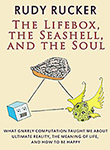
Q 173. Could you, please, talk about your new nonfiction book, The Lifebox, the Seashell, and the Soul?
A 173. The title itself is a dialectic triad. The Lifebox thesis is that there can be computer models of human minds, the Soul antithesis is that I feel myself to be a vibrant energy-filled being and not a machine, the Seashell synthesis is that the computational patterns found on certain kinds of seashells are examples of the gnarly deterministic-but-unpredictable computations that could indeed inhabit my skull.
I might mention that the subtitle is What Gnarly Computation Taught Me About Ultimate Reality, the Meaning Of Life , and How To Be Happy. You can find out more about the book on my Lifebox website.

I think we’re presently in the midst of a third intellectual revolution. The first came with Newton: the planets obey physical laws. The second came with Darwin: biology obeys genetic laws. In today’s third revolution, were coming to realize that even minds and societies emerge from interacting laws that can be regarded as computations. Everything is a computation.
Does this, then, mean that the world is dull? Far from it. The naturally occurring computations that surround us are richly complex. A tree's growth, the changes in the weather, the flow of daily news, a person's ever-changing moods — all of these computations share the crucial property of being gnarly. Although lawlike and deterministic, gnarly computations are — and this is a key point — inherently unpredictable. The world's mystery is preserved.
I mixed together anecdotes, graphics, and fables, in the book to tease out the implications of this new worldview, which I call “universal automatism.” Looking at reality as a bunch of computations reveals some startling aspects of the everyday world, touching upon such topics as chaos, the internet, fame, free will, and the pursuit of happiness.
I tried to make this tome more than a popular science book, a philosophical entertainment that teaches us how to enjoy our daily lives to the fullest possible extent.

Q 174. What is your definition of science fiction? How do you consider and see the current status and the prospects of science fiction?
A 174. Science fiction is writing that analyzes some fast-changing aspect of society by extrapolating current trends into the future or into an alternate world. Traditionally science fiction has certain standard tropes that it uses, but new ones are being developed all the time — I’m thinking of things like blaster guns, spaceships, time machines, aliens, telepathy, flying saucers, warped space, faster-than-light travel, holograms, immersive virtual reality, robots, teleportation, endless shrinking, levitation, antigravity, generation starships, ecodisaster, blowing up Earth, pleasure-center zappers, mind viruses, the attack of the giant ants, and the fourth dimension. I call these our “power chords,” analogous to the heavy chords that rock bands use.
When a writer uses an SF power chord, there’s an implicit understanding with the informed readers that this is indeed familiar ground. And it’s expected the writer will do something fresh with the trope.

This implicit contract isn’t honored by mainstream writers who dip a toe into “speculative fiction”. These cosseted mandarins tend not be aware of just how familiar are the chords they strum. To have seen a single episode of Star Trek twenty years ago is sufficient SF research for them! And their running-dog lickspittle lackey mainstream critics are certainly not going to call their club-members to task over failing to create original SF. After all (think they), science-fiction writers and readers are subnormal cretins who cannot possibly have made any significant advances over the most superficial and well-known representations, and we should only be grateful when a real writer stoops to filch bespattered icons from our filthy wattle huts.
I’m exaggerating for comic effect. (And this rant is lifted from a Readercon address I gave in 2003. Note the ongoing lifebox simulation of me actually being alive…) Really, SF is doing quite well, although of late it seems as if fantasy is eating our lunch. But I’ve been hearing gloom-and-doom for my whole career as an SF writer. I’m just happy I continue being published and read. Maybe someday they’ll start making movies of my books and I’ll get the big money.

Q 175. Please tell me something about the writing process when elaborating a new novel.
A 175. When I start, I always have in mind a few crucial situations or devices that I’m eager to explore and depict. These ideas arise to some extent spontaneously, and to some extent from thinking about scientific and social ideas that interest me.
Once I have a vague idea of the book’s theme, I begin working on figuring out the characters, the geography, the society, the tone, the point of view, the story arc, the physics, and, above all, the plot outline.
I write about all these ideas in a notes document that I develop in concert with my novel; usually my notes documents end up nearly as long as my books. I post each of the notes documents online when the corresponding book is published.
The virtue of having a notes document is that then there’s something I can work on when I don’t quite feel ready to write the novel.
When a book’s going well, I can average about a thousand words a day. When I get my thousand words, I print it and go to the coffee shop and reread it and mark it up, then type it in again and repeat the process. I might cycle through a given section three times in a day, and the next day maybe one more time and then I move into the next section. I have more about all this in my document “A Writer's Toolkit.”
I tend to be somewhat anxious when I work, worrying I won’t be able to get things to come out right. In general, I worry too much.

Posted in Rudy's Blog | 3 Comments »
Friday, November 18th, 2005

Reader Jonathan Flynn points out that my Gigadial podcasts are visible on Feedburner, and that the Feedburner format is easier for his iPod to digest. So I think I’ll start using Feedburner as my main podcast link, using the spiffy hybrid button above that I just made. I’ll continue putting the initial posts on Gigadial, and I think they’ll percolate over to Feedburner in a day. By the way, I just posted two more story-readings plus yesterday’s class lecture on robot consciousness.

The great visionary physicist John Archibald Wheeler coined the phrase “It from Bit” to represent the notion that perhaps the universe emerges from digital computations. [The picture above is a famous illustration that Wheeler used not to symbolize “It From Bit,” but rather to depict the unrelated (?) notion that “the universe is a self-excited circuit,” meaning that because the universe (U) contains wave-function-collapsing observers (eyeballs), it is in some sense bringing itself into existence. I’ll bring this picture into the discussion a little later on.]

When I argue for universal automatism in The Lifebox, the Seashell, and the Soul, I say that every process is a computation. Does this mean I’m arguing for an “It From Bit” position?
Yes, but — three buts.

(But 1) Perhaps it’s more useful to focus on there being computations at all scales. I’m more interested in thinking of computations as existing at all sorts of scales, as opposed to focusing on some possible ultimate ur-computation “underneath it all.” The ripples on the water are a computation of a large-scale computation being performed by the water, and there’s no need to delve deeper. Simply sticking at this level tells us a lot already: (a) The ripple patterns are computationally universal, (b) Even in the absence of any changes to the input flows, the ripple patterns are unpredictable in the sense that there’s no exponentially-fast shortcut prediction method, and (c) Given any proposed theory of physics, there are infinitely many statements about the future behavior of the ripples which cannot be proved or disproved from the theory. (All this is discussed in Chapter 6 of The Lifebox.)

(But 2) Maybe there isn’t one single computation that does it all. If we do go to the lowest scale, it’s not clear that the Many computations have to fit together into One computation. That is, I can imagine a swamp of computations at the lowest level, with our universe emerging above the swamp like marsh lights. We know from mathematical set theory that there are indeed classes of things that can’t be thought of as single entities — the classic example is the class of all sets. It could be that the class of all computations does not allow itself to be thought of as a single computation — somewhat analogous to the fact that the class of all humans is not itself an individual human. This is a subtle philosophical point. The class of all computations may not be a computation.

(But 3) Even if there is one universe-generating computation, we don’t need to imagine it as “running on something.” Suppose we can go to the lowest level and find one cosmic computation down there that generates the universe. Stephen Wolfram is optimistic about finding such a computation. He feels it should be what he calls a “network rewriting” system. From his studies of computation, Wolfram feels that in most interesting cases, a given computational task can in fact be performed by some very simply defined computational rule. So he's optimistic that if he does a brute force search over, say, the first trillion possible network-rewriting rules, he'd going to find a Fundamental Physics rule capable of generating our reality. That would be kind of amazing. Now suppose something like Wolfram's idea were to succeed. Suppose we do find some rather simple computational rule that, if run through enough cycles, can produce something resembling our universe. At this point, people often ask, “What is the system that this ur-computation is running on?” I’d think I'd like to say there isn’t any system that the ur-computation is running on. The ur-computation is running itself. It’s the bottom level. No elephants standing on turtles standing on turtles, dude. All that's down there is a network rewriting system. But why is it there? Ah, that's the unanswerable cosmic Superultimate Why question. That’s all she wrote, bro. And maybe now’s a good time to invoke Wheeler’s big U with the eyeball. The universe is dreaming itself.

I’m blogging about this topic today because I got a nice email from David Deutsch recommending his paper, “It From Qubit”. He’s interested in arguing that if there’s a cosmic computer it should be a quantum computer rather than a digital computer. To argue against the digital “It From Bit” position, he sets up a straw-man in the form of a “Great Simulator” which we universal automatists supposedly believe in. The straw-man Great Simulator belief corresponds to the Matrix-style notion that our reality is akin to a video game running on a desktop under some Geek Goddess’s desk.

Deutsch sets the Great Simulator straw man afire in these words, “A belief in the Great Simulator] entails giving up on explanation in science. It is in the very nature of computational universality that if we and our world were composed of software, we should have no means of understanding the real physics – the physics underlying the hardware of the Great Simulator itself. Of course, no one can prove that we are not software. Like all conspiracy theories, this one is untestable. But if we are to adopt the methodology of believing such theories, we may as well save ourselves the trouble of all that algebra and all those experiments, and go back to explaining the world in terns the sex lives of Greek gods.”

My defense here is that although I think there could be an ur-computation, I don't believe in a Great Simulator. And, backing up, I'm comfortable thinking of my universal automatism as simply saying the universe is made up of computations, without having to claim there is a superultimate aha computation. To be continued…
Posted in Rudy's Blog | 1 Comment »
Tuesday, November 15th, 2005
Superagent and tummler John Brockman announces that David Deutsch has won the Edge of Computation Prize. (“Tummler” means “One, such as a social director or entertainer, who encourages guest or audience participation.” Think Robin Williams or Milton Berle.)

Deutsch looks really cool, like Dracula maybe, or like an East European heavy-metal rock-star. I’ve never met him, though I’d like to. I went online and found some of his more recent papers.

I “read” “Information Flow in Entangled Quantum Systems” yesterday. As I think I’ve mentioned before, when it comes to discussing QM (quantum mechanics), I always feel like a one-legged man at an ass-kicking contest. It’s not so much that I read a truly heavy-duty quantum-information paper like this as I ice-skate it, speeding across the stretches of hide-thin Heisenberg matrices lest I fall through into the frigid waters of despair. Deutsch rewards the intrepid skater with tasty diagrams and primo buzzwords. What I found really mind-blowing is that he solves the Einstein-Podolsky-Rosen (EPR) paradox!

The way the EPR runs is that if I let systems Q2 and Q3 interact near the bottom of the page at time t1, then move them very far apart as time runs up the page, and then perturb the systems by Rx(theta) and Rx(phi), and then, before any signal would have had time to move from Q2 to Q3, quickly at time t2 use Q1 to do a measurement on Q2 and use Q4 to do a measurement on Q3. And then we’ll find a surprising correlation between the results unearthed by Q1 and Q4, and we’ll feel like there must have been some action at a distance or magic-string entanglement to make the info in perturbed Q2 match the info in perturbed Q3. But how can the signal have traveled faster than light?

Deutsch’s solution to the EPR puzzle is so wonderfully simple, so full of the “DUH of Science” that I think it must be true. Deutsch points out that, duh, for you to be sure that the measurements found by Q1 and Q4 match, you have to, duh, bring Q1 and Q4 into proximity, and that the actual “magical” match-up between the Q1 and Q4 data only occurs when Q1 and Q4 are close together — which allows for the explanation that that match-up occurs because of a quantum interference process between the wave functions of Q1 and Q4. In essence, the state of Q3 gets hidden in the state of Q4, and is transported over to interact with the part of the state of Q2 hidden in Q1. We don’t notice this because the info that travels with Q4 is “invulnerable to decoherence but absolutely inaccessible to local experiments.” I think the guy is seriously onto something; to me the insight seems to be on a level comparable to Einstein noticing, hmmm, there’s no absolute way to synchronize clocks.

Other news. The Lifebox, the Seashell, and the Soul got a nice review in the San Francisco Chronicle on Sunday.

Richard Bacchus sent me some Pig Chef pictures from his travels in the South.

Blogger Ken Nickerson sent me a link to a site that makes an ever-changing collage display of an author’s name, tiled with images of his or her bookcovers found on Amazon.

John Shirley sent me a link to a now-do-you-finally-get-it illustration of the fractal concept: a looped zoom into a hand with five fingers, with five smaller fingers on each finger tip, with five etc. It would be cooler if the hand were moving, and flexing and changing position as you zoom in — which is, come to think of it, what a nonlinear fractal like the Mandelbrot set actually does. See also my old link to the zoomquilt.

I wrote about people with hands like this down to a few levels in Saucer Wisdom; Hans Moravec also describes devices like this, which appear in Paul DiFilippo’s novel Fuzzy Dice. By the way, I just noticed that Paul has a cool website with galleries of his richly satiric mail art.
Posted in Rudy's Blog | 1 Comment »
Rudy’s Blog is powered by WordPress
|