




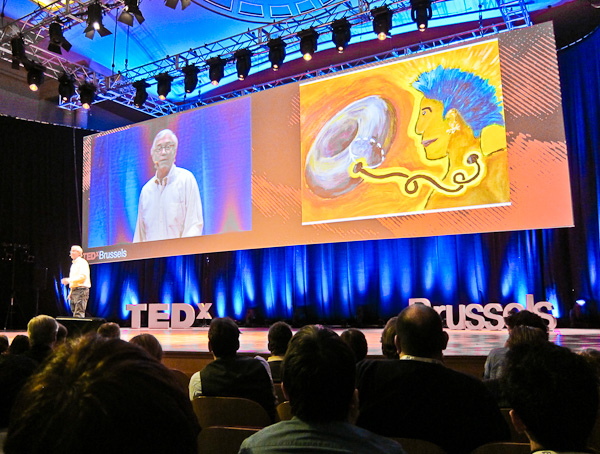
So today I’m posting some more about The Big Aha, and I’ll be using images from Brussels and some older images from Point Reyes. As I mentioned, the reason I was in Brussels was to give a TEDx talk.
And here, once again, is a YouTube video of that talk. I felt like it went really well. It’s kind of a preview of the ideas on my autobiography, Nested Scrolls.
Anway, back to my Big Aha rap. The idea is that I’m interested in some kind of quantum-computation-related type of higher conscoiusness that will put us into something like telepathic contact with the world around us.

And it’s not that I expect this to actually happen anytime soon, it’s that I’m looking for an idea for an SF novel. And, okay, yeah, I’m also, as always on the search for peace and enlightenment. So how do I get to the Big Aha?

One scenario is a Henry Kuttner-type flaky scientist/inventor coming up with an oddball physics device. He can stay in the smooth mind groove without having to collapse his consciousness. We don’t get into any multiple universe angles, we play it straight, a person is expanding their mind by getting their particles into an unusual state.
And then—using entanglement and hylozoism—they can edit the physics of the objects around them. Talk to the objects, make them act weird. Wacky matter. You don’t get high, your house gets high for you.
If you’re a close student of my web activity, you’ll noted that some of the material appeared on my guestposts on Charles Stross’s blog recently. But I’ve re-edited them a bit, and they’re illustrated here.

[John Shirley speaking at TEDx Brussels.]
The action of the Big Aha might be like a deeply intoned Om that reaches down to the attometer level. The aethereal vibration. The faint squeak of the Pigg Boson’s curly tail. But it’s not meditation and it’s not drugs. It’s physics.
I see a subcultural group growing up around the Big Aha. I’d rather not see them become stock market wizards like the guy in that movie Limitless. And I don’t want them to be like acidheads. Some other kind of oddness. They have weird senses of humor.
My precise flimflam physics recipe for achieving the Big Aha is still not quite clear to me. I’ll get there. And then in retrospect it’ll be “obvious.”

[Student beer party in Petit Sablon Square outside our hotel window. Even the women were peeing on the ground. Peter Bruegel would have loved it.]
So I keep asking myself how. How would it be to think in an entirely new way? What routes might take you there? Can you stop collapsing the states of your mind?
And—what powers do you get once you have the Big Aha?
One idea is that some higher being is the observer in the quantum interaction. The cosmos, a giant jellyfish, the Big Pig as I called it in Hylozoic, or simply the One. The One is also the observer in our lives. Many of us have problems with this notion because each of us is conditioned to think there is an “I” that is running “my” life.
I can teep you if we both merge into the One.

In conversation, my friend Nick Herbert made two related remarks about contact with the One, or with the universal wave function.
(1) The soul might perhaps be given a scientific meaning as one’s immediate perception of one’s coherent uncollapsed wave function, particularly as it is entangled with the uncollapsed universal wave function of the cosmos.
(2) Synchronicity might be evidence that we’re all parts of some higher being. And the higher mind’s ideas filter down into remote links.

It’s definitely interesting to suppose that you can, by some physical change, get your brain into a state where you are in fact in a continuous-mode, uncollapsed all-is-one, highly entangled, super-empathy-possessing mind state.
So, again, how do we get there?
Certainly it’s true that an advanced meditation technique might get you there—the accomplished masters are said to have siddhis, or special powers, which might be akin to direct access to the uncollapsed universal wave function. But for an SF novel, I want something with a little more bling to it.

How about a quantum computing gadget that fits into a small case attached to a head band, and the band has circuitry in it that entangles the gadget and some part of the brain. (One of my commenters, Brucecohenpdx, suggested this idea and said the device might use TMS or transcranial magnetic stimulation, although I’m not sure I’ll use such a potentially time-bound notion.)
The head band makes me think of the “brain toys” they used to advertise in the pages of magazines like Mondo 2000. What if someone made one of these that really works? In this vein, I’m thinking in terms of, why not, the old strobe approach—a brain toy headband that pulses lights into your eyes, getting your brain into an unusual state. Light itself is, after all, a type of quantum-computational input/output channel. The gizmo would use a sophisticated quantum computation to key the proper pulsation rates.

Or, kicking it up a level, maybe I use a biocomputation, to make it cool. A cunning cuttlefish pet sits on your shoulder, directing the pulsations. Maybe you don’t have any old-school LED lights, and the cuttle pal simply flickers at a nice rate in the tips of two tentacles.
Even better, the tentacle tips are suckered right over your cornea till you achieve lift-off. Users might be called squidders.
And we might as well include music or a warbling hiss in the squiddy Big Aha stimulation biodevice. And maybe even smells and shudders. The more senses you tickle, the more vivid is a fictional scene.

The efficacy of a given Big Aha routine might wear out—a bit like a sex fantasy or one’s joy in a particular song. And you have to keep tweaking the process to be able to get off. A media biz in new improved Big Aha trips.