





Click covers for info. Copyright (C) Rudy Rucker 2021.


Archive for the ‘Rudy’s Blog’ Category

England #1. Apples, Jetlag, V&A Hoard

Wednesday, October 16th, 2013

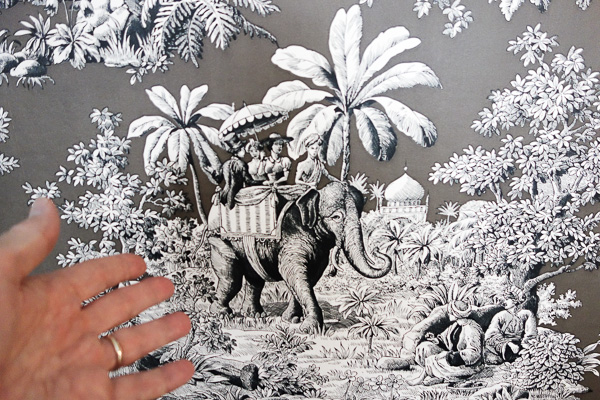
I’ve been in England for two weeks with my wife, and along the way I visited my daughter and her family in Madison, Wisconsin, on the way. It was a nice break, and I didn’t do any writing at all. I took quite a few photos. I’m going to put up a series of posts with the images along with whatever relevant or irrelevant comments I happen to think of.

Views from the air are amazing, and almost all of them are good. Even if you’re shooting with a cellphone through a plastic double window. I like the stripes of alternating crops here, I think they call this contour farming.

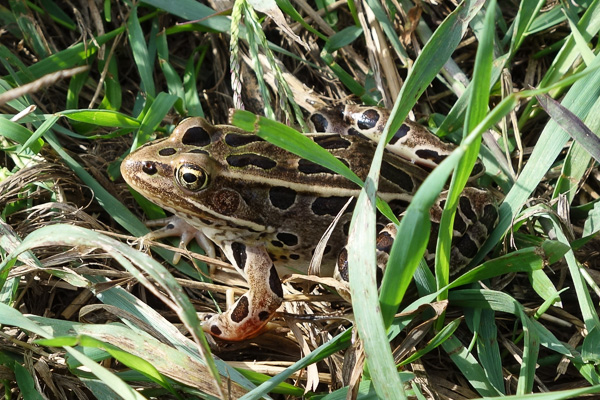
My grandchildren caught a beautiful frog near the family garden patch. They let him/her go after awhile.

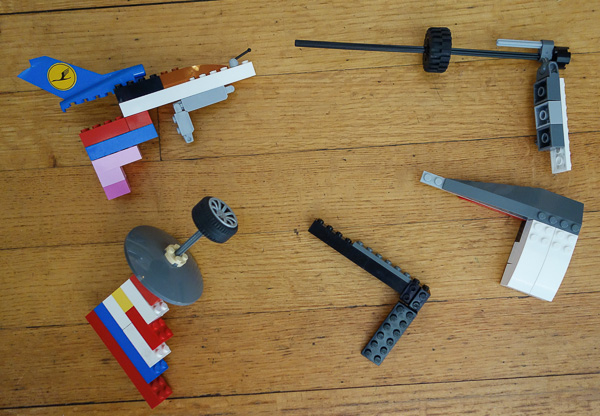
My grandson doesn’t have any guns, but he and I built some futuristic little models with his Legos. Bascially, all you need for a gun is a right angle. One of their neighbors had a yard sale which included some Legos, and the seller had perhaps ignorantly sorted the Legos by color. So I bagged a bucket of the black Legos. What the seller probably didn’t realize is that the black Legos are the quarks, the tau mesons, the Higgs particles of the Lego world—that is, all the weird special-purpose, triple-hinge, worm-gear, fantastically rare gear-axle kinds of Legos are black. Very useful for ray-guns.

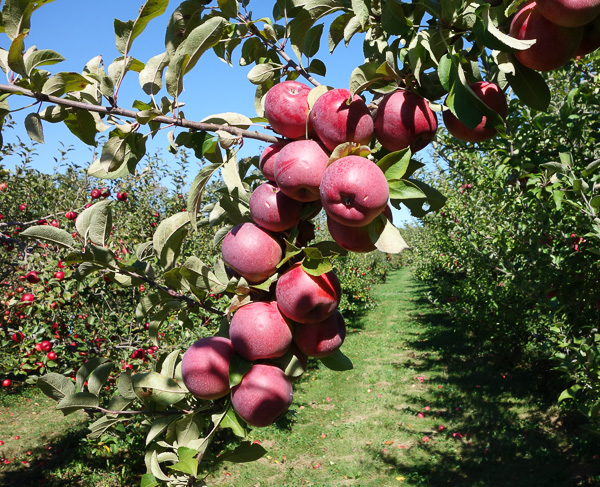
We went apple picking and were initially wondering if it was okay of we ate some free extra apples off the trees, but the farmers said go ahead. The trees were way overloaded, with scores or hundreds of fallen apples beneath each tree. A big year for the crop.

I always like getting out in the countryside. Always fun when there’s a window framing a view of a landscape. A living hologram.

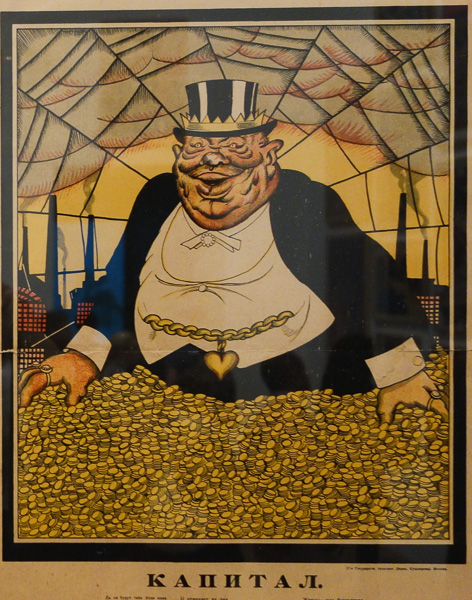
So then we made it to London. One of the first places we wanted to visit was the new Tate Modern Museum, housed in a retrofitted power plant by the Thames. They’re especially known for a vast “Turbine Room” that’s used for special giant ultramodern displays but, unfortunately that room was closed for a year-long upgrade of some kind. In any case the funky galleries have a rich hoard of modern art. The image above is from a Russian revolutionary poster and the caption is, naturally, “KAPITAL.” The Ur-Unca-Scrooge.

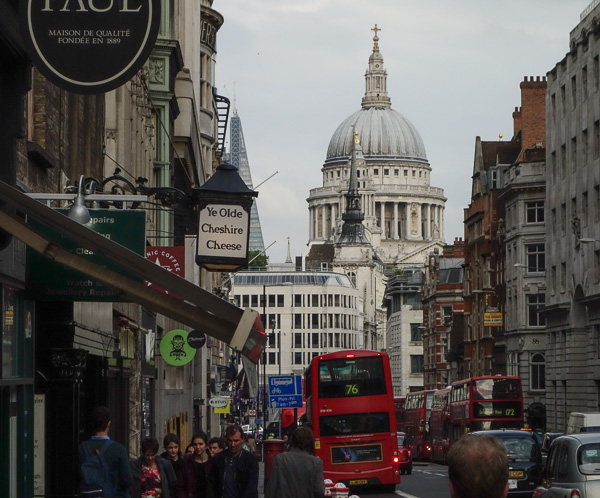
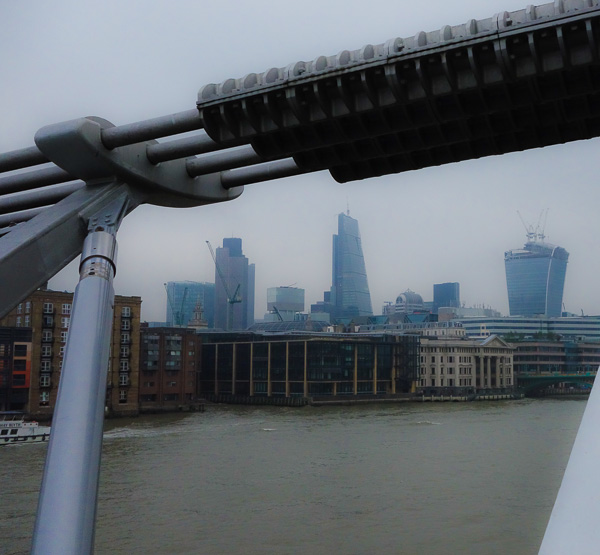
There’s a nice footbridge across the Thames near the Tate Modern, and we noticed some new buildings in the financial district of a London. They have special names for them—the Gherkin, the Shard, the Cheesegrater, the Walkie-talkie…only the last two are visible here. Much more on the Gherkin in a later post…

So I had jetlag the first couple of nights, snapping awake at 1 am and staying awake till about 4 am. I’ve learned just to go with the flow on jetlag. I get up and read something, or play with my computer. At this point I was reading Thomas Pynchon’s wonderful new novel Bleeding Edge as an ebook—my paper version seemed a bit fat to lug along. I’d go in the bathroom to read so Sylvia could keep sleeping.

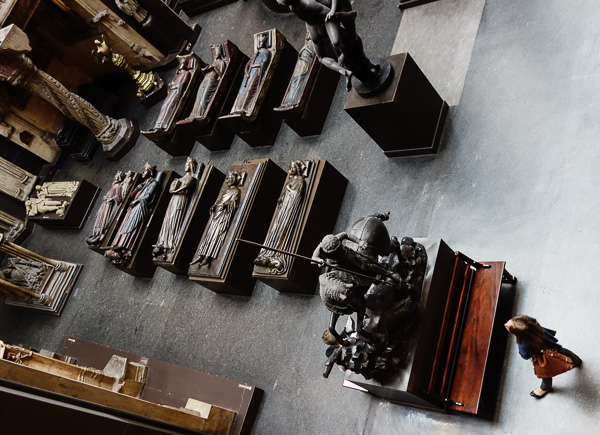
On the second day, we hit the Victoria and Albert Museum in South Kensington district of London, not far from our hotel. I’d never been here before, it’s an amazing place. Kind of like the Smithsonian in DC, or like the craft sections of the Met in NYC.

Like, the ceramics gallery has a mashed together collections of pots from all over the world and throughout history, all jammed into case after case of displays, sorted by style or by theme.

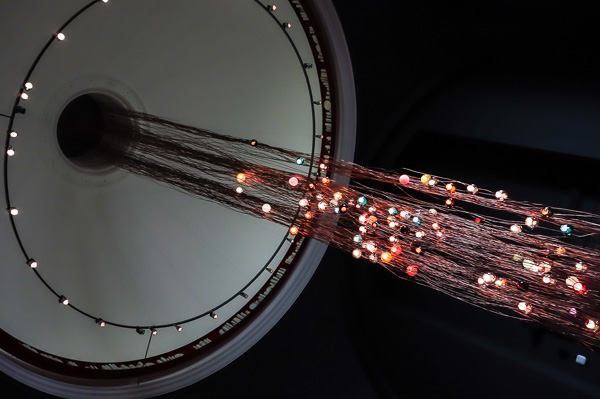
In a central area of the ceramics section they had some modern stuff like a dangling cascade of blown glass lamps, trailing down a couple of hundred feet into the lobby area.

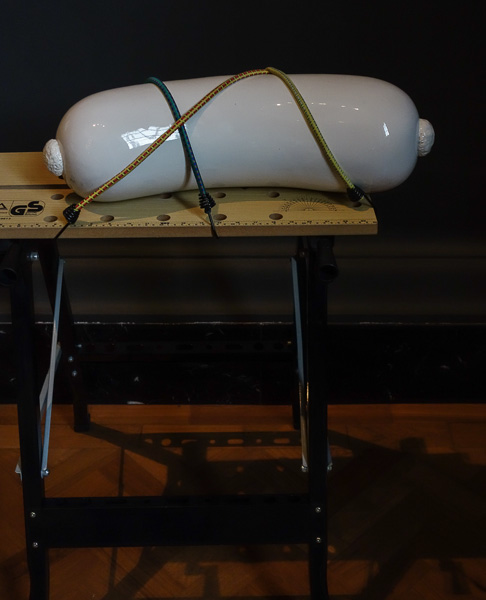
Loved this porcelain white hot dog, tied sacrificially to a cutting stand. Wheenk!

Regarded from below and turned on its side, the dangling chandelier becomes a particle-beam tingler-ray.

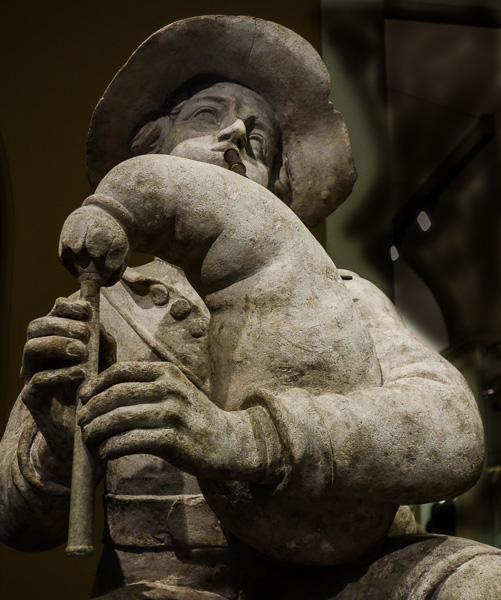
A really vile-looking bagpipe. What is it about those things? Tools of the devil, morphed genitalia, squealing skugs. Squonk!

That’s it for today. Back in California, I have jetlag again, and I’ve been awake since about 4 am this morning. Time to go lie in the sun in my beloved patch-of-grass back yard. No place like home.

“In Her Room.” My BETTER WORLDS Art Book: Paper and PDF.

Tuesday, September 24th, 2013

I finished another painting recently.


“In Her Room,” oil on canvas, September, 2013, 22” x 22”. Click for a larger version of the painting.

This is a painting of our bedroom, showing my wife’s mirror and some of the things on her dressing-table. That painting on the left is by her, it’s called Kate Croy. I got the idea for the painting when I was coming into our room, and it was dark, and the hall-light behind me was on, haloing my silhouette in light, and I saw myself in the mirror. I like the little objects on the dressing-table, they’re like symbolic icons in a medieval portrait. That green shape is a bridge between two realities.

I put together a revised 2013 edition of my art book, Better Worlds. The book includes high-quality images, and a descriptive catalog of my paintings. {And I revised the book yet again in early January, 2014.}

You can access the book in two ways. First of all, you can buy it as a quality paperback. This high-quality art book sells for well under the list price of $25.

I’ve also made a free and lightweight PDF file. This small 2K file includes all the book’s text, that is, the picture-by-picture catalog commentary, but with only small thumbnails of the paintings.

And, as always, you can browse large images of my paintings on my paintings page.

Enjoy.

Designing THE BIG AHA. Commas, Fonts, Serifs.

Thursday, September 19th, 2013

I’ve been working on my books as usual. Rolling right along. Photo of a Santa Cruz roller rink below.

I’m done with the copy-editing and proofreading for The Big Aha , and it’s in good shape. I went through some soul-searching about the serial comma, that is, which do I prefer” “Gray fur, yellow teeth and a naked pink tail.” or “Gray fur, yellow teeth, and a naked pink tail.”

In principle, I’d prefer always to use the serial comma, as then I don’t have to think about it. But maybe sometimes I leave it out without noticing. So I might use it and not use it in the same document. And copy-editors like uniformity. So the copy editor suggested that I take out all the serial commas in The Big Aha.. And at first I went along with that, and then, later today, after putting up my first version of this post, I changed my mind.


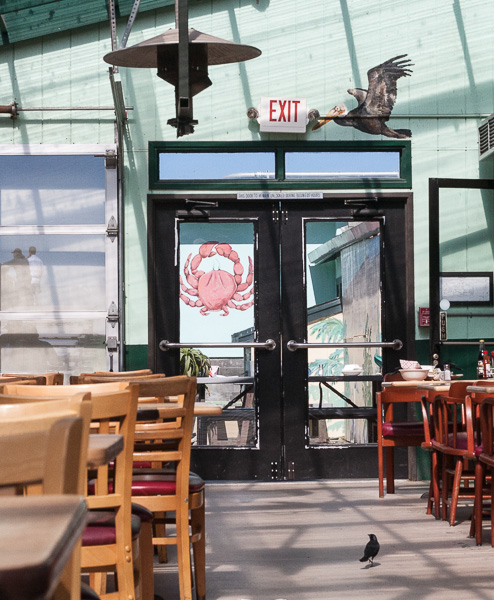
[Patio at the legendary Phil’s Fish Market in Moss Landing. We happened to get there at 10 am and it was empty. Had an awesome grilled salmon sandwich.]

Backing up a little, yesterday, after I took them all the serial commas out, some of the more complicated lists became hard to read, so then I put serial commas for some of them. Like “The myoor was shaking, the plants were warbling, and the unborn gubs were cheeping from within the myoor’s flesh.”

It’s considered okay to do that, that is, to generally not use serial commas, but to put them in when it seems really necessary. Not that the readers generally notice either way.

But then, this afternoon, dammit, (and goaded somewhat by my correspondent Mark Dery) I decided I did want my serial commas back, all of them, and I put them back in. Fortunately I had a backup version of my original MS and I could find the serial commas by searching for “, and” — I mean that turns up other commas too, but it does show you all the serial ones.

What writers think about…

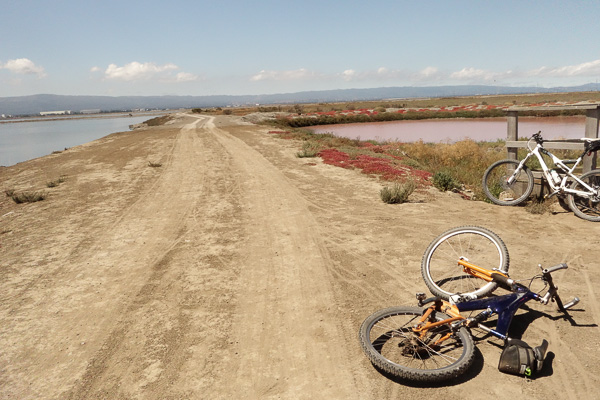
This photo was taken during a ride along the edge of the percolation salt ponds in the SF Bay near the San Jose Airport. Up at the north end of 1st Street in Alviso above San Jose. I was riding there with my 79-year-old friend Gunnar, who’s generally fitter than I am. The water drains back and forth between the ponds with the tides and you get cool vortices.

Anyway, this week I’ve been working on the book design for The Big Aha. Picking a font is a process that I’m still getting used to. I didn’t want to use the ubiquitous Times Roman—it’s nice, but I want the book to look not quite so generic. I used Garamond on Turing & Burroughs, and I was pretty happy with that until my cantankerous book dealer friend Gregory Gibson said, “Garamond looks…squatty.” That is, the vertical strokes, like in a t or an m, are shorter than in some other fonts, and the thick parts, like in the diagonal of an s, are a little fatter than normal.

Here in realtime, they’re tearing down a nearby neighbor’s house. It sold, and the new owners want more of a mansion on the big lot. It’s kind of sad and wistful to see an old house being shattered. And how easily they’re destroyed! Mortality.

Back to the fonts. My friend Michael Blumlein recently published his story collection, What the Doctor Ordered, with Centipede Press. The publisher is labeling it Horror, but I’d put it closer to Literary Fantasy. I wrote an intro for the collection. It’s a really nice-looking book, and I thought the font was cool, so I asked the publisher what he’d used, and he said Electra.

Now, Electra isn’t one of the more common fonts that you’d find already living on your computer, so I went and bought it online from Linotype.com, it’s like $30 for the regular letters and $30 for the italics, and more if you want the bold faces, or even the “display” versions that look good when blown up to huge sizes for signs. It’s conceptually interesting to buy a font.

After setting The Big Aha book in Electra, I decided I didn’t like the look of it. A little too spidery, with the letter elements overly thin, so that, at least to my eye, the letters felt a little gray or even broken. Maybe Centipede Press used a different version of Electra, I don’t know…but their book does look great.

Anyway, just to be safe, I went to a classic font that I could find on my computer, Caslon, that is, the Adobe Caslon Pro font. I like this one a lot. For me the idea of a font is that it should feel comfortable and be totally easy to read.

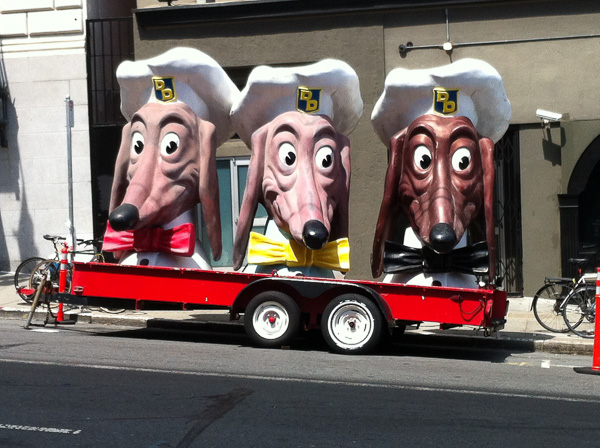
I was at a little BoingBoing-organized conference in San Francisco a few weeks ago. Longtime SF character John Law was there with samples from his Doggie Diner collection. John was an early activist in the Billboard Liberation Front—tweaking public signs in meaningful ways.

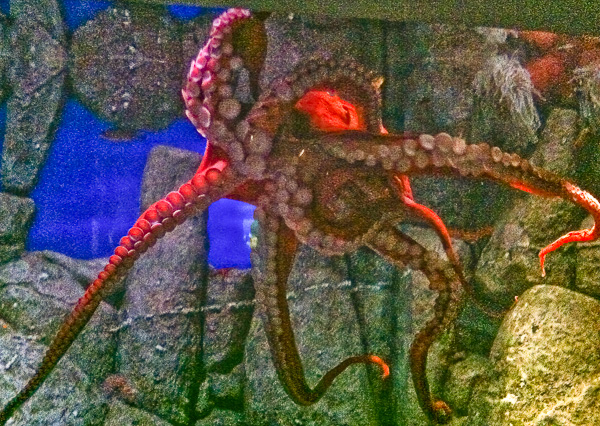
Saw an awesome octopus at the Monterey Bay Aquarium this week. His mouth isn’t open, but it’s the pinhole sphincter opening at the center of the star of tentacles, where they all meet, not that you can make that out in this dim-light iPhone shot. Inside the mouth lurks the dreaded cephalopod beak! I think about those beaks all the time. The ultimate vagina dentata. The octopus’s “head” is a big watery sac, used for breathing and for siphon squirts.

The actual “body” isn’t much bigger than a rabbit, it’s a lump on top of the tentacles, and its hidden in the false head sac. For sex, the male passes the female a spermatophore or “nuptial gift,” a packet of sperm, and she opens it days or weeks later, when she’s ready to lay eggs, in a spot that’s safe and with plenty of food. After the eggs hatch, the mother dies.

Love, love, love the tentacles. So serif. Which leads back to…

A little more talk about fonts. I can’t believe that people ever set a book in a sans-serif font. The serifs—those little blobs and curlicues at the corners of the letters—are such a help to the reader. Like handholds on a rock wall. Two more font bugaboos: using a really small font, and using gray letters instead of black or, even worse, white letters on a gray background. I think sometimes people use small fonts to save paper and cut production costs? Are you kidding me? Like giving a TV dinner to someone in a restaurant. Or a miniscule photo of a sandwich.

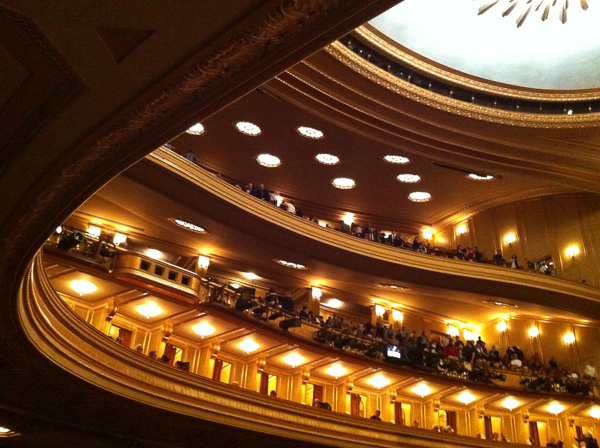
Dig these sweeping architectural lines at the San Francisco Opera. Love this place. Sylvia and I saw Mefistofele there this week. Not the greatest musical score, but a wonderful production, completely over the top. By no means what you’d call “sans-serif.”

Getting back to my rant about font design—one bad thing that that can happen is, I think, that a book or (more often) a web page might be designed by someone who doesn’t actually read.. They want to be different and cool and hardcore and they don’t actually like text. So—they go with 9 point Arial beige type on a brown background.

When doing a web page, such a person might compound their affront by putting in hard line breaks so the text doesn’t flow into new box-shapes, and they fail to use a screen-size-limited page width, so if you try and enlarge the web page by zooming the view, the text block grows right off the edge of the screen and you have to scroll back and forth like chicken pecking up cracked corn…but you don’t peck for long before you give up on reading the story. And the text-hating designer wins. But, hey, who reads, right?

Recently Sylvia and I found this amazing huge Richard Serra sculpture behind the Cantor Museum at Stanford. It’s like walking around inside a huge typographic letter, say an S or an 8. Before I experienced them in person, I used to think Serra’s sculptures were dull. Like sans-serif fonts. But when you’re inside one of them, it’s a whole experience. Emotional. Fear, awe, joy, mathematical exaltation.

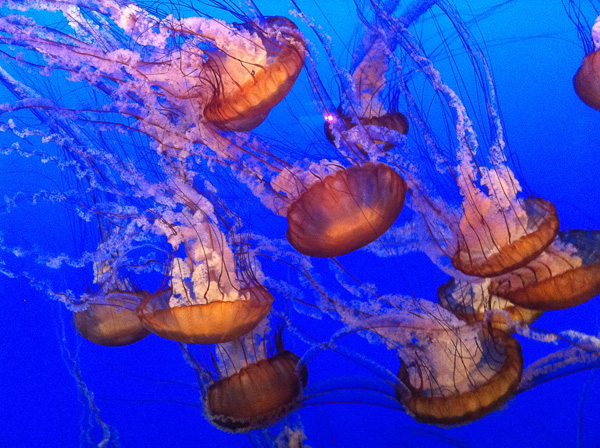
I saw some jellyfish at Monterey too. Sea nettles. Love these guys. Being there reminded me of visiting that aquarium with Bruce Sterling years ago, and we wrote our epic tale, “Big Jelly.” You can read it free online. Readable design…

Gnarly SF Reality. #2: Change the World

Tuesday, September 10th, 2013

This post and the previous one are drawn from an essay called “Gnarly SF” which appears in my Collected Essays. You can read the complete essay online as part of the Collected Essays. I split my excerpts into two pieces: “What is Gnarl?” in my previous post, and “Change the World,” which is today’s post. The illos are drawn from my backlog of photos.

Our society is made up of gnarly processes, and gnarly processes are inherently unpredictable.

My studies of cellular automata have made it very clear to me that it’s easy for any kind of social system to generate gnarl. If we take a set of agents acting in parallel, we’ll get unpredictable gnarl by and repeatedly iterating almost any simple rule—such as “Earn an amount equal to the averages of your neighbors’ incomes¬ plus one—but when you reach a certain maximum level, go bankrupt and drop down to a minimum income.”

Rules like this can generate wonderfully seething chaos. People sometimes don’t want to believe that such a simple rule might account for the complexity of a living society. There’s a tendency to think that a model with a more complicated definition will be a better fit for reality. But whatever richness comes out of a model is the result of a gnarly computation—which can occur in the very simplest of systems.

As I keep reiterating, the behavior of our gnarly society can’t be predicted by computations that operate any faster than does real life. There are no tidy, handy-dandy rubrics for predicting or controlling emergent social processes like elections, the stock market, or consumer demand. Like a cellular automaton, society is a parallel computation, that is, a society is made up of individuals leading their own lives.

The good thing about a decentralized gnarly computing system is that it doesn’t get stuck in some bad, minimally satisfactory state. The society’s members are all working their hardest to improve things—a bit like a swarm of ants tugging on a twig. Each ant is driven by its own responses to the surrounding cloud of communication pheromones. For a time, the ants may work at cross-purposes, but, as long as the society isn’t stuck in a repetitive loop imposed from on high, they’ll eventually happen upon success—like a jiggling key that turns a lock.

But how to reconcile the computational beauty of a gnarly, decentralized economy with the fact that many of those who advocate such a system are greedy plutocrats bent on screwing the middle class?

I think the problem is that, in practice, the multiple agents in a free-market economy are not of consummate size. Certain groups of agents clump together into powerful meta-agents. Think of a river of slushy nearly-frozen water. As long as the pieces of ice are of about the same size, the river will move in natural, efficient paths. But suppose that large ice floes form. The awkward motions of the floes disrupt any smooth currents, and, with their long borders, the floes have a propensity to grow larger and larger, reducing the responsiveness of the river still more.

In the same way, wealthy individuals or corporations can take on undue influence in a free market economy, acting as, in effect, unelected local governments. And this is where the watchdog role of a central government can be of use. The central government can act as a stick that reaches in to pound on the floes and break them into less disruptive sizes. This is, in fact, the reason why neocons and billionaires don’t like the idea of a central government. When functioning properly, the government beats their cartels and puppet-parties to pieces.

Science fiction plays a role here. SF is one of the most trenchant present-day forms of satire. Harsh truths about our present-day society can be too inflammatory to express outright. But if they’re dramatized within science-fictional worlds, vast numbers of citizens may be willing to absorb them.

For instance, Robert Heinlein’s 1953 classic, Revolt in 2100, very starkly outlines what it can be like to live in a theocracy, and I’m sure that the book has made it a bit harder for such governments to take hold. John Shirley’s 1988 story, “Wolves of the Plateau” prefigured the eerie virtual violence of online hackerdom. And the true extent of the graft involved in George Bush’s neocon invasion of Iraq comes into unforgettably sharp relief for anyone who reads William Gibson’s 2007 Spook Country.

Backing up a little, it will have occurred to alert readers that a government that functions as a beating stick is nevertheless corruptible. It may well break up only certain kinds of organizations, and turn a blind eye to those with the proper connections. Indeed this state of affairs is essentially inevitable given the vicissitudes of human nature.

Jumping up a level, we find this perennial consolation on the political front: any regime eventually falls. No matter how dark a nation’s political times become, a change will come. A faction may think it rules a nation, but this is always an illusion. The eternally self-renewing gnarl of human behavior is impossible to control, and the times between regimes aren’t normally so so very long.

Sometimes it’s not just single regimes that are the problem, but rather groups of nations that get into destructive and repetitive loops. I’m thinking of, in particular, the sequence of tit-for-tat reprisals that certain factions get into. Some loops of this nature have lasted my entire adult life.

But whether the problem is from a single regime or from a constellation of international relationships, one can remain confident that at some point gnarl will win out. Every pattern will break, every nightmare will end. Here is another place where SF has an influence. It helps people to visualize alternate realities, to understand that things don’t have to stay the same.

One dramatic lesson we draw from SF simulations is that the most wide-ranging and extreme alterations can result from seemingly small changes. In general, society’s coupled computations tend to produce events whose sizes have an unlimited range. This means that, inevitably, very large cataclysms will occasionally occur. Society is always in a gnarly state which the writer Mark Buchanan refers to as “upheavable” in Ubiquity: The Science of History…Or Why The World Is Simpler Than You Think (Crown, 2000 New York), pp. 231-233.

Buchanan draws some conclusions about the flow of history that dovetail nicely with the notion of gnarly computation.

History could in principle be like the growth of a tree and follow a simple progression towards a mature and stable endpoint, as both Hegel and Karl Marx thought. In this case, wars and other tumultuous social events should grow less and less frequent as humanity approaches the stable society at the End of History.

Or history might be like the movement of the Moon around the Earth, and be cyclic, as the historian Arnold Toynbee once suggested. He saw the rise and fall of civilizations as a process destined to repeat itself with regularity. Some economists believe they see regular cycles in economic activity, and a few political scientists suspect that such cycles drive a correspondingly regular rhythm in the outbreak of wars.

Of course, history might instead be completely random, and present no perceptible patterns whatsoever…

But this list is incomplete… The [gnarly] critical state bridges the conceptual gap between the regular and the random. The pattern of change to which it leads through its rise of factions and wild fluctuations is neither truly random nor easily predicted.… It does not seem normal and lawlike for long periods of calm to be suddenly and sporadically shattered by cataclysm, and yet it is. This is, it seems, the ubiquitous character of the world.

In his Foundation series, Isaac Asimov depicts a universe in which the future is to some extent regular and predictable, rather than being gnarly. His mathematician character Hari Seldon has created a technique called “psychohistory” that allows him to foretell the large-scale motions of society. This is fine for an SF series, but in the real world, it seems not to be possible.

One of the more intriguing observations regarding history is that, from time to time a society seems to undergo a sea change, a discontinuity, a revolution—think of the Renaissance, the Reformation, the Industrial Revolution, the Sixties, or the coming of the Web. In these rare cases it appears as if the underlying rules of the system have changed.

Although the day-to-day progress of the system may be in any case unpredictable, there’s a limited range of possible values that the system actually hits. In the interesting cases, these possible values lie on a fractal shape in some higher-dimensional space of possibilities—this shape is what chaos theory calls a strange attractor.

Looking at the surf near a spit at the beach, you’ll notice that certain water patterns recur over and over—perhaps a double-crowned wave on the right, perhaps a bubbling pool of surge beside the rock, perhaps a high-flown spray of spume off the front of the rock. This range of patterns is a strange attractor. When the tide is lower or the wind is different, the waves will run through a different repertoire—they’ll be moving on a different strange attractor.

During any given historical period, a society has a kind of strange attractor. A limited number of factions fight over power, a limited number of social roles are available for the citizens, a limited range of ideas are in the air. And then, suddenly, everything changes, and after the change there’s a new set of options—society has moved to a new strange attractor. Although there’s been no change in the underlying rule for the social computation, some parameter has altered so that the range of currently possible behaviors has changed.

Society’s switches to new chaotic attractors are infrequently occurring zigs and zags generated by one and the same underlying and eternal gnarly social computation. The basic underlying computation involves such immutable facts as the human drives to eat, find shelter, and live long enough to reproduce. From such humble rudiments doth history’s great tapestry emerge—endlessly various, eternally the same.

I mentioned that SF helps us to highlight the specific quirks of our society at a given time. It’s also the case that SF shows us how our world could change to radically different set of strange attractors. One wonders, for instance, if the world wide web would have arisen in its present form if it hadn’t been for the popularity of Tolkein and of cyberpunk science fiction. Very many of the programmers were reading both of these sets of novels.

It seems reasonable to suppose that Tolkein helped steer programmers towards the Web’s odd, niche-rich, fantasy-land architecture. And surely the cyberpunk novels instilled the idea of having an anarchistic Web with essentially no centralized controllers at all. The fact that that the Web turned out to be so free and ubiquitous seems almost too good to be true. I speculate that it’s thanks to Tolkein and to cyberpunk that our culture made its way to the new strange attractor where we presently reside.

In short, SF and fantasy are more than forms of entertainment. They’re tools for changing the world.


Rudy's Blog is powered by WordPress