
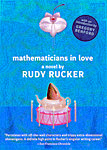

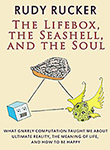

Click covers for info. Copyright (C) Rudy Rucker 2021.


Archive for the ‘Rudy’s Blog’ Category

Back from Early Spring Break

Thursday, March 3rd, 2005

I took Feb 9 to March 3 off from the blog. I was in Micronesia for three weeks.

''

I'll start up a long and detailed series of Micronesia notes tomorrow.

***

My disk storage ran out while I was gone, which is why the site's began looking a little flaky. The inevitable bit-rot of digital storage media. But that's all fixed for now, thanks to the Head Monkey of Monkeybrains.

In fixing it, I lost the most recent entry and the three comments on it, apologies to those three commenteers, do come back and post again.

***

The muxed entry said this:

If you live near SF, keep in mind the Potlatch Panel on Transrealism on March 5, 2:30 – 3:45.

Transrealism and the Ghost of Philip K. Dick, or, Everyday Life Is Science Fiction

A panel at Potlatch 14 in San Francisco.

Moderated by Rudy Rucker, with Charlie Anders, Terry Bisson, Michael Blumlein, Richard Kadrey, and John Shirley

One of the blurbs on Philip K. Dick's A Scanner Darkly referred to the book as “transcendental autobiography.” Inspired by this, Rucker coined the name “transrealism” for the practice of writing about one's immediate perceptions in a fantastic or science-fictional way. Paraphrasing a remark by Robert Sheckley: “A writer's first problem is how to write. The second problem is how to write a story. And the third is how to write about himself or herself.” Questions to be discussed by the panel may include, “What are some interesting examples of transrealism? “How to I use transrealist methods in my own writing practice?” “Is transrealism a liberation or a limitation?” “Where does transrealism lie vis-a-vis the borders between mainstream literature and Fantasy/SF?” “Does transrealism have an inherent political agenda?”

Date: Saturday afternoon, March 5, 2005

Time: 2:30 PM – 3:45 PM

Venue: The seedily grand Ramada hotel on Market St. near the Civic Center.

Con Website: http://www.potlatch-sf.org/

For background on transrealism see

Rucker's 1983 essay: A Transrealist Manifesto ,

Ruckers' 2003 Readercon talk:Power Chords, Thought Experiments, Transrealism and Monomyths

Damien Broderick's book, Transrealist Fiction: Writing in the Slipstream of Science

God, Book of Zogg

Saturday, February 5th, 2005

''

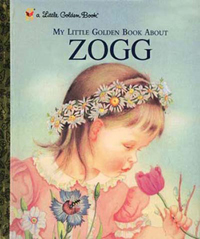
A cartoonist named Jason Yungbluth has doctored My Little Golden Book about God to make a weird and very funny alien-invasion pamphlet called The Book of Zogg. Yungbluth hits all these great classic SF power-chords. (Thanks to Richard Kadrey for the link.)

I wrote something similar to Book of Zogg inside of Master of Space and Time, where I had some Heinlein's Puppet Master spine-riding parasitic leeches that have created a religion of sorts based on submitting to alien control. I ahd this detailed description of a tract about the religion's teachings. When I wrote that novel, I was living in Jerry Falwell's Lynchburg, VA, and reacting to that.

***

I've always felt comfortable with the idea of the Cosmic One being God, and that you can somehow get strength from this notion, although the seeming response could be either a self-exciting circuit of the brain, or a social network, rather than some higher being responding to you.

I picked up a book of the ten Zen ox-herding pictures today in Cruz, from 1200 AD. God everywhere, God nowhere, what's the problem? After the guy finds the ox [God], the ox disappears, and then the guy disappears and the picture is blank.

***

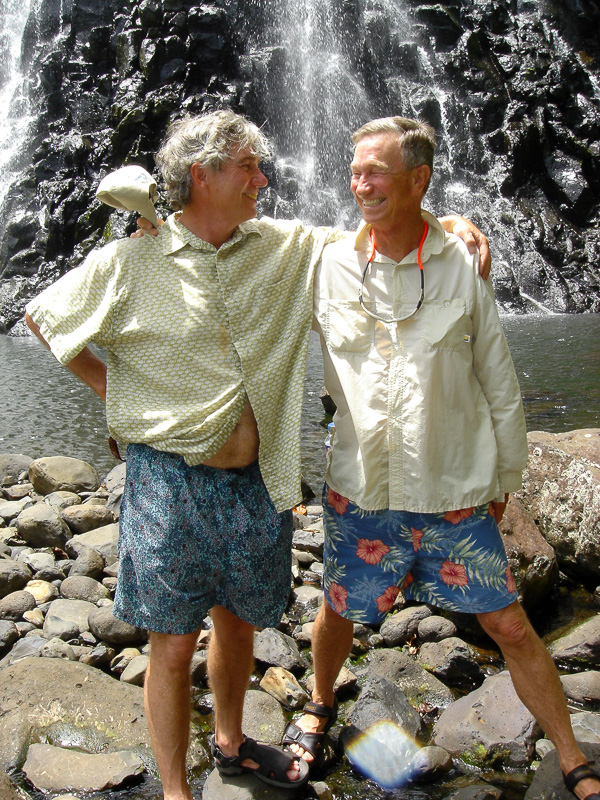
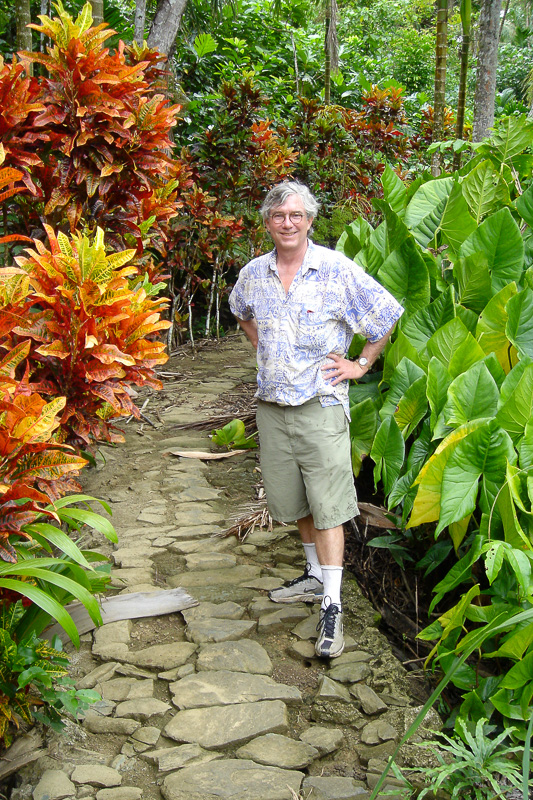
Picture of me and God in the form of Jon Pearce in Cruz today. “In his heart the fool hath said there is no Jon Pearce.” Mathcs 7.3.

''

***

Here's an excerpt, kind of relevant, from The Lifebox, the Seashell, and the Soul.

***

If I say that everything is a computation, I’m saying that everything is a deterministic process. And that means that reality is a weave of logical if-then statements, with each phenomenon linked to a cause.

As an extreme example of universal automatism, Wolfram suggests that if we trace the world’s computations all the way back, there may be some underlying supercomputation that generates not only the entire cosmos but also the underlying fabric of space and time.

But then, of course, we’d have to ask why that particular supercomputation exists.

This leads to what is sometimes called the superultimate why question, “Why is there anything?” The question is inherently unanswerable, for no proposed solution can be enough.

Given that the superultimate why question is impossible to answer, it’s in some sense meaningless — but such a criticism doesn’t remove the question’s sting. The question can never be answered, yet it is not emotionally meaningless.

Even if Wolfram were right, it doesn’t seem as if knowing the world to be the result of some supercomputation would be of much use to us. We still wouldn’t know where the supercomputation came from. And — perhaps even more importantly, we still wouldn’t know what it’s for.

And that, after all, is really what we’re after when we ask about the meaning of life. It’s not so much the cause that’s puzzles us as the purpose. Does a person’s life have a purpose?

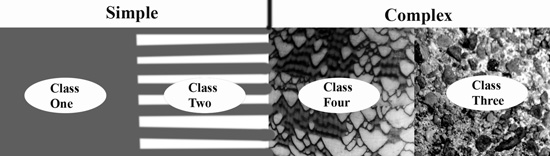
Well, our studies of universal automatism do suggest one line of thought. Computationally rich class four behaviors are in an objective sense more interesting than those that die out, repeat, or have no discernible structure. So a universal automatist might say that the meaning and purpose of a human life is to produce gnarly or “class four” computation.

''

The notion of gnarly computation as the meaning of life fits in with the more humanistic world views.

The human artifacts we admire are computationally rich. An empty canvas is class one. Hack artwork is class two copying of existing artifacts. Ugly scuzz is class three. Great art is class four.

The nobler emotions are computationally rich as well. Murderous rage forces some victim’s computation into class one termination. Hatred throws the hater into a class two loop. Too needy a desire to please puts a person at the mercy of capricious class three inputs. Compassion is an ever-evolving class four process.

Get the picture?

The meaning of life is beauty and love.

***

Back to God, there's a lot of force in the old saying, “God is Love.”

''

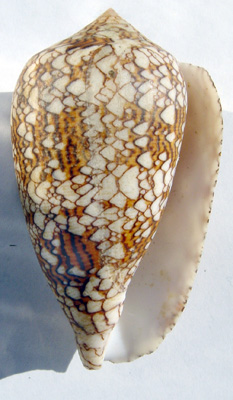
Isn't this a great cone shell? I took this picture today.

***

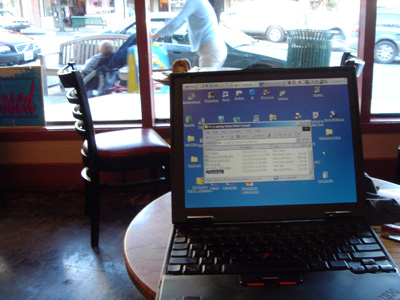
A reader (r.s.) writes in that he sat at the same table as I photographed, in L. G. Coffee Roasting today. Cool. In my Silicon Valley SF novel Spaceland a hole in reality forms just a few feet from that table during a climactic scene!

Firesign Theatre Show, Lifebox Cover Sample

Friday, February 4th, 2005

We went to see the Firesign Theatre near San Jose last night — if you're wishing you could have seen them too, you're in luck, they're putting on a free webcast of their show tonight! You'll find the link on their home page.

I used to worship their records in the 60s and early 70s, listening to them on stereo earphones over and over. Many of their pieces, notably We're All Bozos On This Bus, are great science-fiction, and indeed the boys exerted quite a strong influence on my style, extending even to this day. I share their interest in being funny and serious at the same time. Satire.

Seeing them at this late date is a bit melancholy — the nostalgia thing — but they were in good voice, and seemed as cantankerously lively as ever. One funny bit, Phil Austin pretends to be a minister reading a passage out of the bible, gibberish about moss and “their hearts were not gay,” and he says, “What does this mean? [pause] Nothing.”

I noticed that they've toned down their political incorrectness a bit. They did go after the Chimp — yet somehow it seems harder to laugh about Iraq than it was to laugh about Nam. Well, I'm old now, and not draftable, and don't have that same giddy gallows humor.

Re. the audience, I've never seen so many former hippies in one place. All the same people that I used to see, like, at the Fillmore East thirty-five years ago. Dear friends.

To an external observor, it might look as if I'm rather idle. Just blogging, walking in the hills and hanging out in coffee shops. Wouldn't my energies be better spent in remodeling my house?

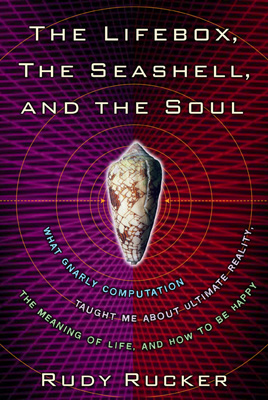
Naw, this is a high-volume content-production facility here! Check out the sample cover (may still be revised) for The Lifebox, the Seashell, and the Soul.

Aesthetics of writing, vlogging, photography, painting.

Thursday, February 3rd, 2005

I had fun working on the Vlogging entry yesterday, kept going back and editing it, also looking at more of the vlog entries I found online. I think they call an entry a “bite.” Many of them are true art.

Searching wider, I found that some people actually video themselves talking about the news like anchormen (it seems to be mostly men that do this)! Help!

When, like, Charlene Rule (link to a MOV) can do so much more just by waving her hands over the camera. Or Mica (link to a MOV) can capture the true pathos of being alive in a quick grab of a few minutes of an unappy friend's face in a bar.

Wonderfully skewed reflections of the world. Mind puddles. (In this photo below that I took yesterday, the water's on top, I have a mirroring theme in todays 3 pictures.)

You’d think that on a day when I blog so much, I wouldn’t get much “real” writing done. But somehow I did. I ran out to the Great Bear coffeeshop with my laptop (which, thank God, isn’t wirelessly connected) and sketched a scene of Bela spending a night in jail with Thuggee and Naz for the Washer Drop incident. And later Sylvia and I went for a walk.

I often think of the painting metaphor when writing. I mean first there’s the architectural thing of figuring out the arc of the novel. And then, faced with each chapter, figuring out the sequence of scenes. And when it’s time to write a scene, I tend to write something pretty rapidly, like a sketch or underpainting. Fast is good, since one is always anxious, faced with the blank page. And then I go over it, adding things, intensifying, fractalizing.

Trees have a ramifying structure underground just like they do above ground, I took a picture of the roots of this one big oak on a cliff near my house yesterday.

I imagine good videos are built up slow like paintings or stories, using the editing software. Most of the more interesting vlog bites are indeed edited. But now and then there’s a simple unedited reality take that’s perfect. The world does give us things for the taking.

Here’s where the other approach kicks in, the photographer’s eye thing of just seeing the artistic event and having the craft to capture it intact. Maybe here, it’s the seeing that’s the hard part. Seeing, and going back again and again to try and get the picture. The successive photos as drafts.

But even in photography, you do PhotoShop to make it look better. You can’t quite do the spontaneous grab with text, although, yeah, you can just natter on without editing. Oh, yeah, and you can collage in passages that you find in the world.

Still thinking about the autovideo thing that my character’s “vlog ring” does. There’s some smart software that breaks it into bites, aims the viewpoint at the loudest noise (like a dog hearing something), and speech-recognizes some words for the title.

But any automatic art pales, at least so far. Art is a class four fractal computation informed by emotion. We can always recognize it at a glance.


Rudy's Blog is powered by WordPress