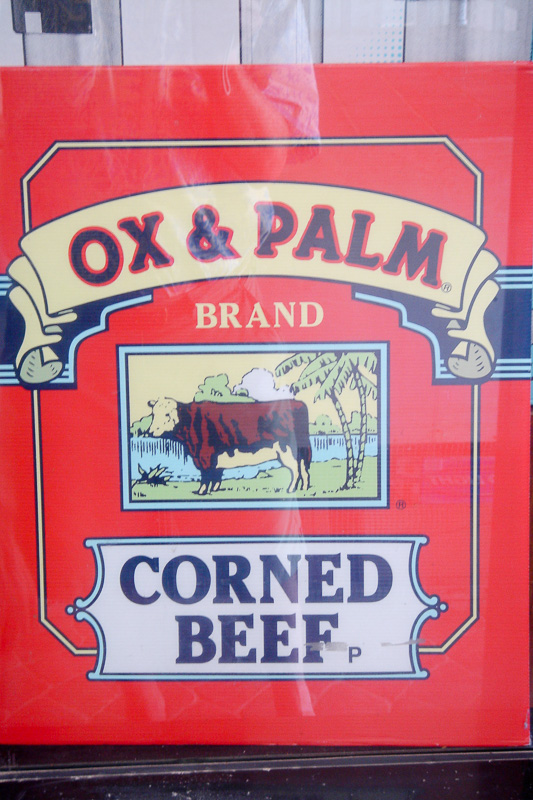
The first thing I noticed on landing in Yap was that all the guys picking up guests had big wads of stuff in their mouths; and their spit was bright red, redder than blood even. Vermillion. You could see lots of the spit in their mouths, spilling out onto their lips.
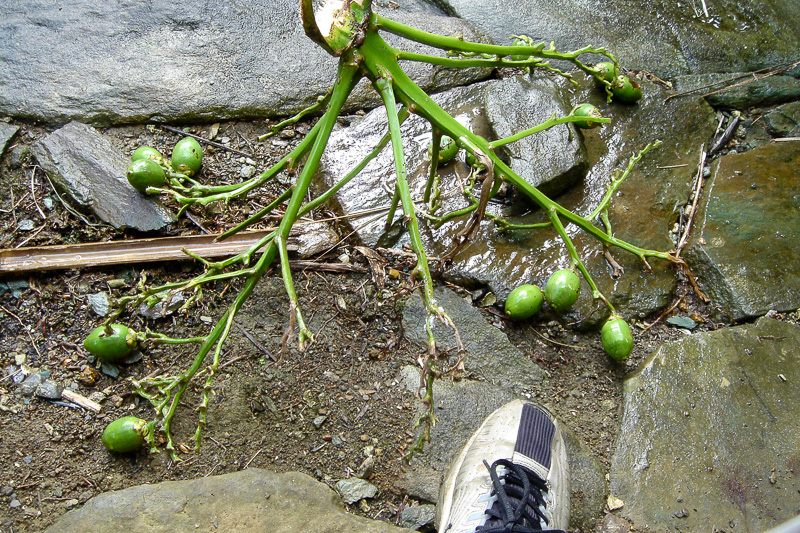
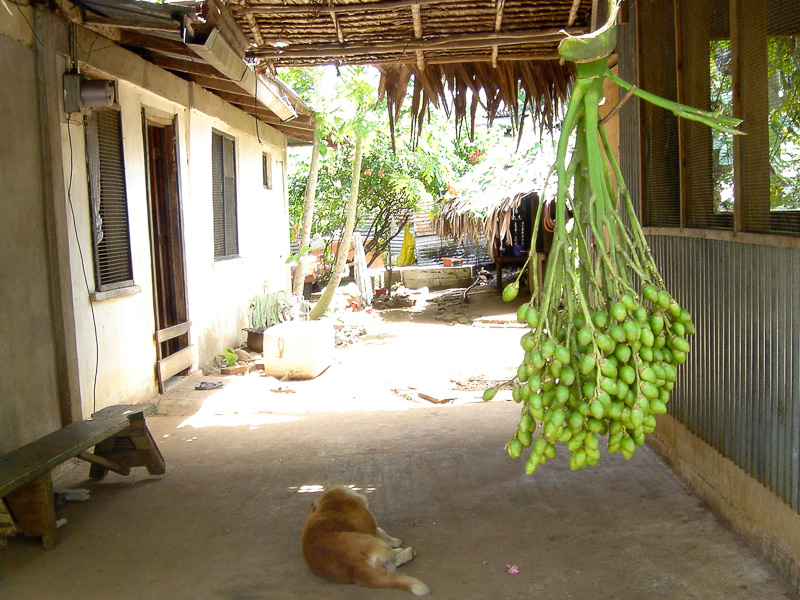
Betel nuts grow all over Yap on trees resembling coconut trees, but with bunches of acorn-sized nuts. They chew the nuts when they're green, if allowed to ripen and get orange they're too hard.
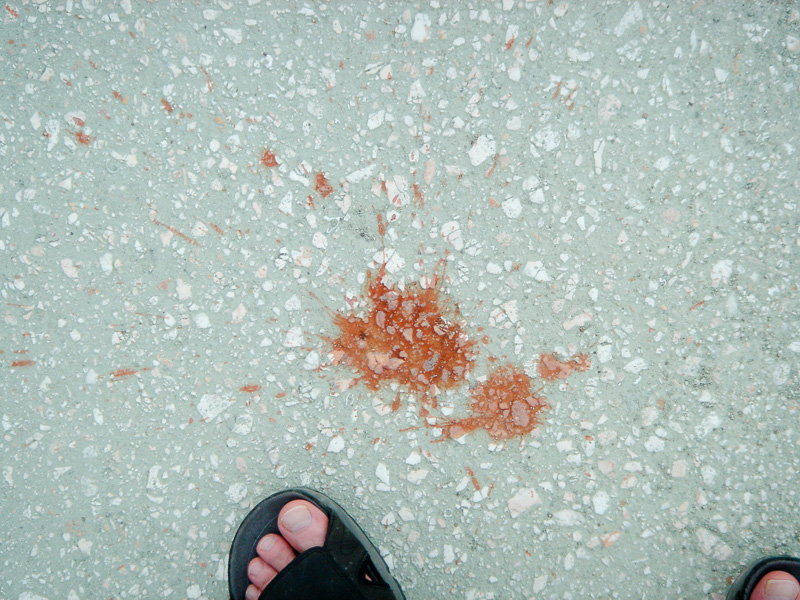
Our first day, we walked into Colonia, the capital of Yap, which has a dozen or two tiny stores and businesses in a modern little shopping complex, also a few shipping buildings, such as the Yap Fresh Tuna Company. Two streets crossing each other. The sidewalk in the main part of the town is red so as not to show the betel nut spit, which otherwise makes a permanent stain that looks as if someone had been stabbed. There's also spittoons in the form of red-painted wood stands with plastic sacks in them.
There's a betel nut stand in town, this is where you see the most people gathered, although you also see bags of betel nuts in the three markets, and in some of the other stores as well. One or two bucks for a bag of fifty or a hundred betel nuts.
I asked a guy running a native crafts gallery about them, and he offered me one and showed me how to use it. You bite it with your back teeth to crack it in half. Then you sprinkle some white powder on it that they call lime, it's ground-up shells or coral, but I think it could equally well be the ground limestone that they sometimes use for fertilizer or for athletic field markings. And then you wrap a piece from a big pepper-plant leaf around the nut and put it in your mouth.

He offered me a nice fresh betel nut, and a lot of bitter clear juice popped out as soon as I bit it. I took it out and sprinkled the lime onto the open halves, wrapped it in pepper, put it back in my mouth. I think the lime mitigates the bitterness, for when I once picked up a betel nut I found under a tree and bit it without lime, the taste was unbearable.
My Yap betel-benefactor advised me that beginners don't swallow the juice, although experienced users do, so as to “get more kick out of it.” Embry declined trying a nut, preferring to observe its effects upon his younger brother — twas ever thus.
Quickly that side of my mouth began feeling a little numb, and shortly after I felt slightly euphoric and relaxed. It's like when you have coffee or tea in the morning, and you feel as if some invisible missing piece of your personality puzzle has just been snapped in. The betel nut juice seemed to fill a hole in me. I felt (as any druggie or former druggie will understand) like you're supposed to feel.
While I was chewing we walked into the office of the Yap legislature. The receptionist was a handsome, dignified older woman with teeth bright red from betel nut spit. We talked for awhile about the building, our conversation slow and relaxed. We were on the same wavelength.
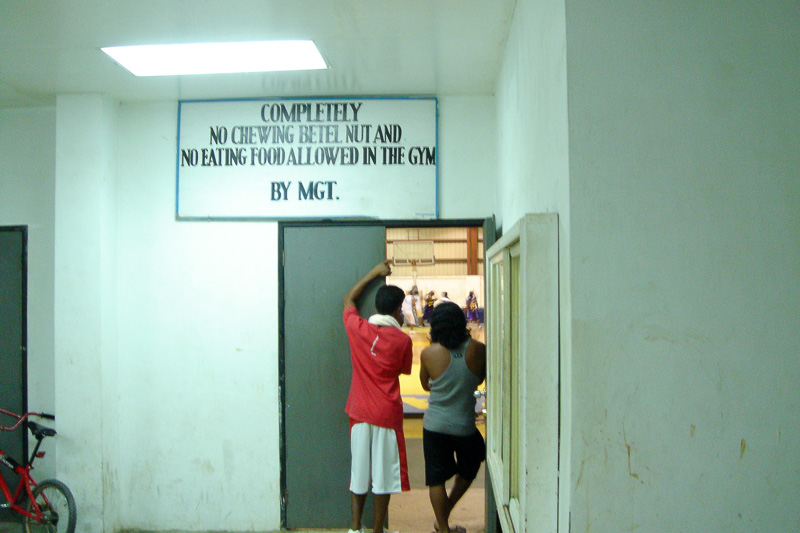
There seems to be absolutely no social opprobrium on betel nut chewing, which is hard for me to grasp, coming as I do from puritan America. I kept thinking there'd be some occupations where you'd be discouraged from chewing, but all the people I encountered were chewing: dive masters, hotel and restaurant people, villagers, secretaries, school teachers, indeed even the white locals here chew. One man said it kept him from going nuts over the leisurely Yapese pace, in other words it put him on their same wavelength.
Funniest was a girl working the computer in a local arts and crafts store, she had a large betel nut in her mouth already, and then while typing in the invoice for the lava-lava (hand-woven cloth intended as a wrap-around skirt but which we'll probably use as a table-runner) that I was buying, she picked up a betel nut the size of a small egg, and crammed that one into her mouth as well, without even bothering to add the lime powder and pepper leaf. She looked so wild and greedy, I had to laugh. Like a kid eating Halloween candy.
I'm not going to push my experimentation with betel nut, but my guess is that chewing a whole of them in a row gives you a cumulative, growing buzz. Certainly some Yapese do seem kind of zonked, but that could also just be the tropical languor and low-stress lifestyle. I haven't seen anyone acting particularly impaired. Well, maybe a little forgetful in some cases.
Betel is definitely a psychoactive drug, though, and seems to be highly addictive. Perhaps on the order of caffeine or tobacco, although the Yapese I asked say the appeal is quite different. It makes them relaxed, one said, and another said he chews just so “something is moving,” something is going on. They also said it's almost impossible to quit, that they'd started when young, and that they know it's bad for them, but they chew up to a hundred nuts a day. Those bulging bags of betel nuts in the market aren't family party-paks, dude, those are one person's daily supply. I didn't see the white powder for sale, that seems to me more in the way of a personal supply, everyone has their own hand-made lime-shaker. Some people use old Tabasco bottles, Tabasco being a favorite spice here.
The effects on their teeth are devastating. A betel-nut chewer's teeth become black and, I believe, are slowly eaten down to stubs. I recently saw an article in Science News to the effect that betel has some dozen known carcinogens. The use of betel has been drastically increasing as some large corporations in Southeast Asia have streamlined and modernized betel, selling packets containing betel, lime, and pepper leaf pre-mixed. Perhaps to remind users of the Pacific Island origins of betel, in Malaysia these betel packs are sold by betel girls who aren't quite topless, but who are wearing bikinis. The betel girls work the traffic jams of cities such as Kuala Lumpur or Hong Kong.
***
Someone asked about why the computer cord is wrapped around the crystal, and the lobster-looking man. Well, those are recycled from earlier blogs, and to find which ones I used the nifty Search box on the right margin of the blog. I searched “crystal” in the blog and find the Computer Holistic Wellness entry.
I remembered the lobster-man was in a show at the Academy of Science in NYC, and searched Adacemy and found SF Art.