


Click covers for info. Copyright (C) Rudy Rucker 2021.


Archive for the ‘Rudy’s Blog’ Category

Micronesia 8: Arriving in Palau

Saturday, March 12th, 2005

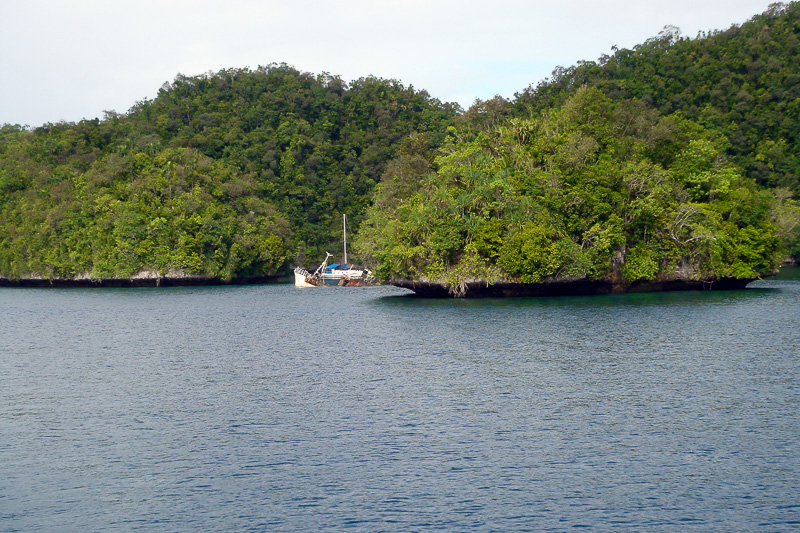
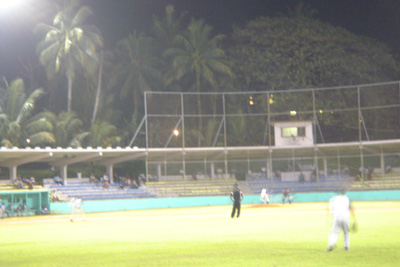
It's a 30-40 minute drive from the Palau airport, across two or three bridges to our hotel. On the way we go through downtown Koror, the capital of Palau, so far it seems like a crumbly third-world shopping strip, stores, hotels, restaurants, steady traffic on the two-lane road. We pass a local baseball game. Our hotel is out at the end of another island. In the evening we take a free bus into Koror and walk around, it's exciting, so alien. Unlike Yap, there's no one main race here, it's just totally polyglot: Indonesians, Chinese, Japanese, Palauans, Koreans.

We went into a market to look for film, it was wonderfully bizarre. The only newspaper for sale was the Weekly World News of January 31, 2005. Headline: “UFO Washed Ashore By Tsunami.” With a large black and white photo of a pie-pan UFO superimposed upon the wreckage of Phuket.

Somehow I'm reminded of the Interzone, the hallucinatory city in William Burroughs's Naked Lunch. Not that I'm seeing people doing anything particularly louche, but it feels utterly outside normal reality in that same way. For maybe the five hundredth time in my life I think of this line from, I think, The Soft Machine, and chuckle. “You win something like jellyfish, meester. Or it win you.”

Walking into his hotel room, Bradley saw something high in one corner of the ceiling, a gauzy veil, like the mucus casing that a parrot fish exudes to cocoon itself in when sleeping. The shape fell down upon Bradley faster than he could form a complete thought; it slid inside his shirt collar, down inside the band of his trousers and underwear, down his legs and inside his sandals. He felt a sexual burning in every nerve. The boy who'd spoken to him in the street, appeared in his doorway, his lips as bright red with betel nut as if he were a vampire.

“Skin like that very hot for two three weeks,” said the boy. “Then wearing the Happy Cloak.”

We took a gypsy cab from the airport to the hotel, driven by a betel-chewing guy called Ted. I forgot my knapsack with my prescription diving mask and my laptop computer in the back seat, realized this only in my room. But Koror is small enough that the bellman knew exactly who'd driven us, and when he couldn't raise him on the phone, sent a guy into town to find him. Half an hour later I had my bag back, and showered large tips on all parties concerned. I have been backing up my diary and novel onto my minidrive, so it wouldn't have been a total disaster. But I'm so glad to still have my little thinking aid. My axe. My memory seems a notch worse than it was the last time I traveled. Sometimes it feels like I'm traveling in a Heisenbergian haze, with all my possessions smeared out in probability space around me, at any time apt to quantum-jump out of my ken.

The hotel is very comfortable, but in some ways a let-down after Yap. Very corporate, polished, mega. Right on a nice beach, but they have such an immense ventilation system over the kitchen that the entire beach is flooded with the roar of fan. Additional machines are all over the place, and when we checked in they were actually, *sob*, leaf-blowing the driveway, which is something I definitely hear enough in California. But, again, the room is super-comfortable, solid, clean. And, really, how dare I complain at this point.

This morning I took a walk in a jungle beside the hotel, and heard an amazing bird song, three tones like a squeaky door, do-mi-(ti below do). And another bird doing a rising coo-coo-coo-coo call, though without ever breaking into the frantic squawk one expects.

The beach has a lot of coral, starting about twenty feet out, at depths ranging from four to eight feet. I went in snorkeling right away with Embry, saw scads of tropical fish, most notably a slowly whirling school of parrot fish — these guys gnaw on the coral, they have a very strong beak-like mouth, and they're shaded in lovely blues and greens. They have this cute tiny chartreuse (brilliant yellowish light green) fins like bird wings.

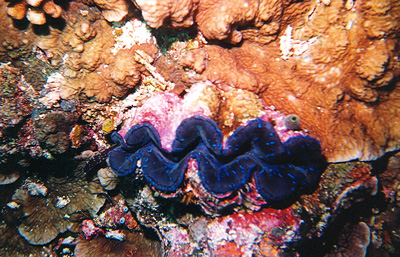
And best of all, the beach is loaded with giant clams, I saw one little “garden” of ten of them, each shell easily three feet across. Big crenellated shells, cracked open about a foot, and stretching across the opening is the clam's mantle(?) with two holes in it, a dot and a slit. The mantles are patterned in the most elaborate and psychedelic fashion, a bit like marbled endpapers, a bit like tie-dye. No two of them seem to be the same, even regarding palette of colors. I already wrote them into my novel-in-progress, where I describe a futuristic computing device that has this exact appearance, to wit:

“The skin was undulating, with slight ripples moving back and forth across it, interacting to form delicate filigrees and fleeting moirés, like a living piece of watered silk. The skin was spotted and striped with blues, greens, aquas, yellows, and purples — like a cellular automaton, like an old book's marbled endpapers, like the mantle of a giant South Pacific clam.”

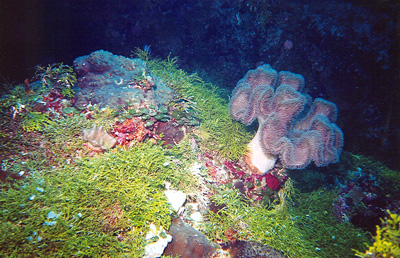
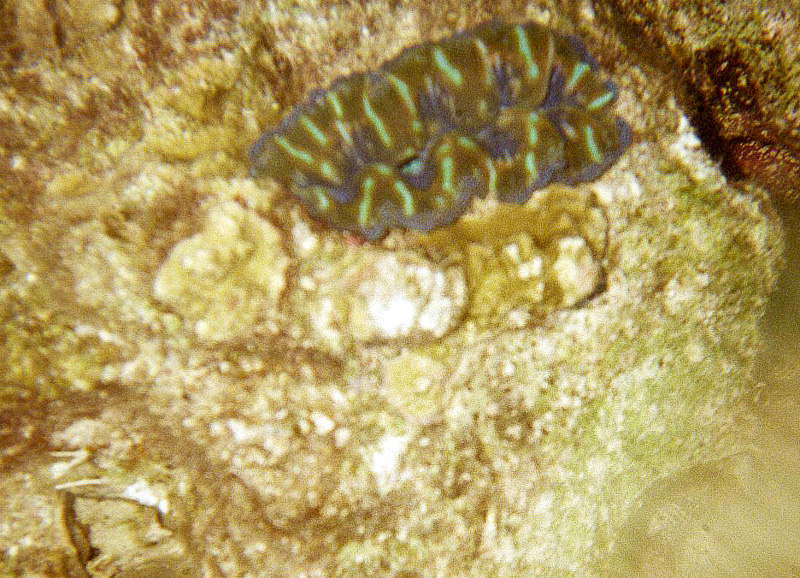
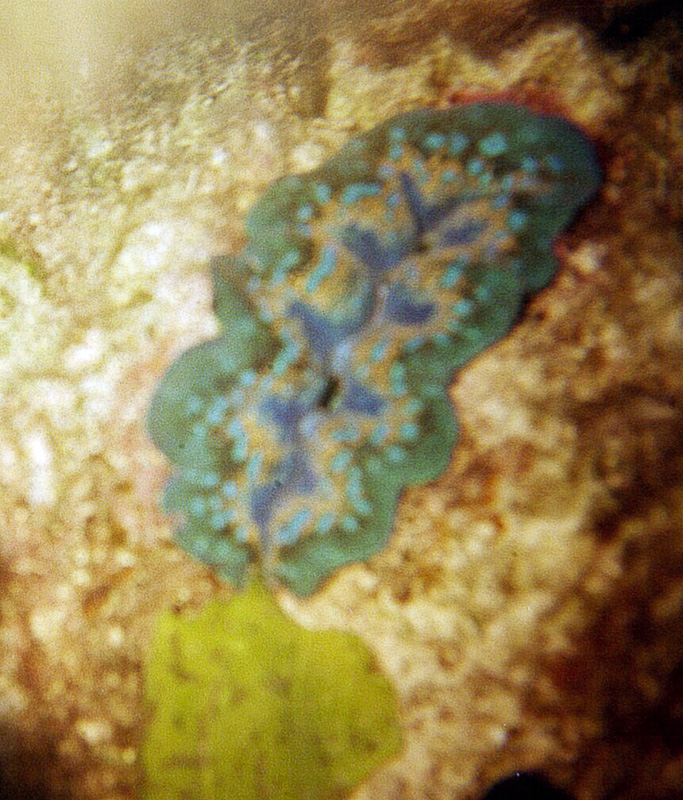
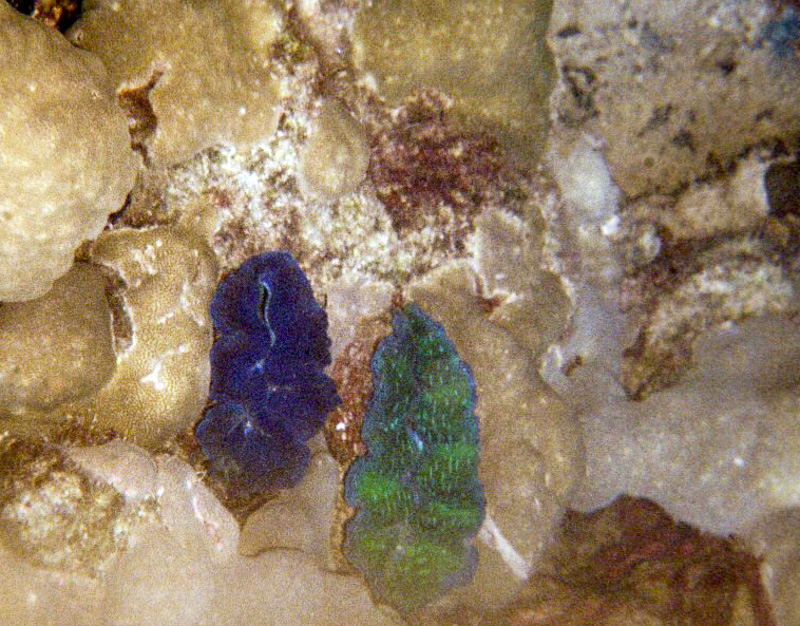
Some guys similar to the clams, a type of scallop with the same brightly colored mantle and lips, wedge themselves into holes in the coral heads, so that, in the middle of the a large maze-patterned brain-like coral orb you'll see a pair of iridescent blue or green lips, leopard-spotted with black or brown dots, as intricately detailed as the borders of the Mandelbrot set. [Actually the latter three of the pictures here are of those scallops, I only got the one good picture of the giant clams, although later we met a diver whose hobby is photographing giant clams, so eventually I may get a link to her site.] Turning on the SF reality-warper, I can readily visualize the people of 2100 instilling cultures of algae or Pacific giant clam cells into their lips or private parts so as to achieve some startling and magnificently iridescent effects. Is this really so inconceivable in our present world of Botox and silicone? Mightn't the 2100 Superbowel Halftime Show involve, let us say, a fading star's “accidental” display of her really quite stunning new biocosmetics?


Micronesia 7: War Comes to Yap

Friday, March 11th, 2005

One touching tale. In the local paper, the Yap Networker, I saw a front page story about a Yapese man aged 42 having been killed in Iraq, his name was Steven G. Bayow. Yapese can join the US army, as Micronesia has a loose association with the US. And our last morning we were having breakfast on this floating wooden Indonesian bark that's the restaurant of the Manta Bay Inn, and there were some US soldiers there. Embry said Hi to one of them, and found out they were there from Guam as the honor guard for the fallen Yapese soldier's funeral. It gave me such a turn, to see the winds of global war spinning a little eddy all the way down here to Yap like this. Reminded me of Bruce Sterling's SF novels, with the workings of distant governments filtering into the furthest backwaters, and I had a kind of chill or shock of recognition, thinking that it's actually 2005, and I'm in Yap, and that my life really is science fiction.

We were staying at the Palauan-owned and Yapese-run Hotel ESA (the monogram of a family name), very clean and cheap and pleasant — initially we'd thought it wasn't quaint enough, but after the Pathways we were glad to get back there. In the afternoon I saw a man walking into the restaurant there carrying a huge fresh tuna, its skin peeled away to reveal its luscious-looking purplish flesh. “Is that going to be on the menu?” I asked, and the man and one of the Yapese women working at ESA just kind of waved me off, like “This is for something else.”

And that night as Embry went out to dinner we passed the ESA restaurant, and inside was a long table with the soldiers and some Yapese, two of them near the head, a woman and a man, the man who'd been carrying the fish. And I realized he was the father of the dead Yapese soldier, Steven Bayow. His expression looked so — gently baffled. Nothing makes sense anymore when your son is killed. My heart went out to him and his wife. I wanted to go in and say, “As an American I wanted to say that I really appreciate and honor the sacrifice that your son has made.” I was too shy to say it in person, but now I write this here.

Right before bed I took a last walk down the street near our hotel. One the left was a thin little bay, on the right some shacks, the decaying Pathways hotel compound (7 huts), a store. Then, on both sides some warehouses made out of shipping containers, used for building materials. The stars overhead, brilliant among the scudding clouds, the air moist and palpable. I heard a radio voice coming from a parked car, someone listening to a preacher, who was working to stir up the fear of death in his flock. “Think of Bobby Kennedy and Martin Luther King gunned down in their prime, think of coronary heart attacks, think of cancer, of plague, of terrorism, of death in car accidents, etc.” So odd to here this demented negatory ranting in Eden. The voice of the Serpent. Resist him, oh dear Yap!

Micronesia 6: Yap Caverns, Kaday Village

Thursday, March 10th, 2005

I dove Yap Caverns at the southern tip of Yap, rifts and boulders with huge bumphead parrot fish. Looking up through the rocks at cathedral shafts of light, great fish above me. Saw a memorable nudibranch, a flat sea slug the length of my thumb, iridescent creamy white, with an orange band around his undulating edge. No eyes, instead two white antenna in front, and a bizarre mini-grove of tree-branched antennae in back. These are his gills.

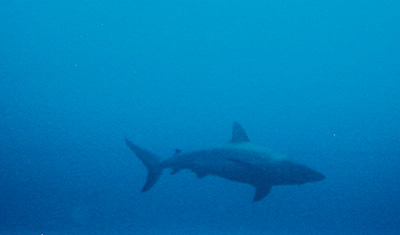
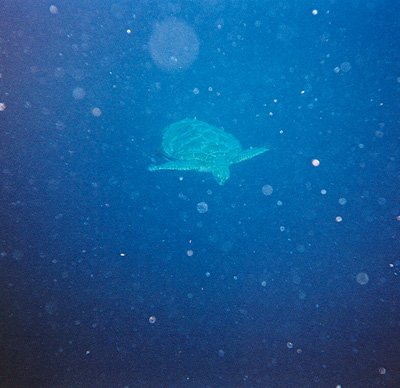
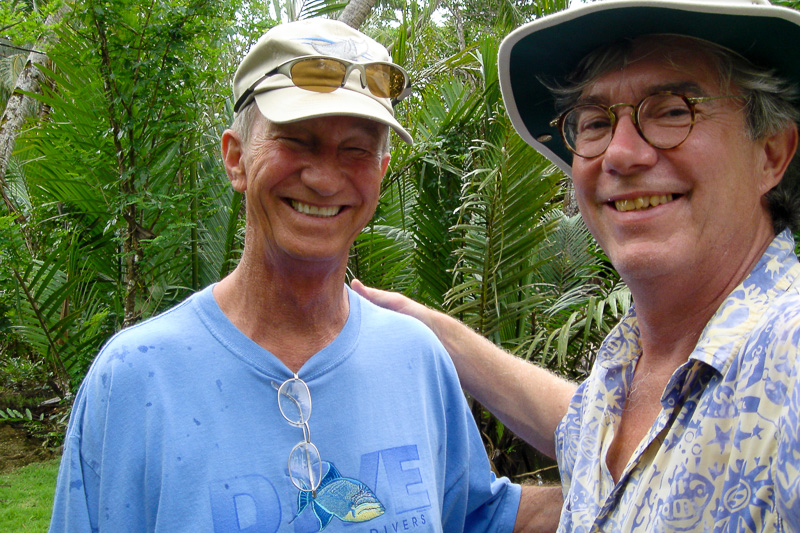
A good model for an alien, as I explained to my two guffawing Yapese guides Gordon and Kintu, having told them that I'm a science fiction writer. [The photo above actually shows two other guys, on the island Pohnpei.] Kintu was sweet, a bit shy, he's from an “out island” called Satawal, at the far east end of the Yapese archipelago, population 500, no airstrip and it takes three days to a week to get there by ship from Yap, depending how many stops the ship makes. Gordon fat and talkative. Gordon wanted to know if UFOs were real or not; he'd seen a couple of episodes of X Files. We agreed that diving is as alien and spacy an experience as one could as for. I saw great clouds of orange fish on the dive, schools of jacks the size of my arm, a shark the size of my daughter, a giant turtle, a carpet-like sea anemone with a father clown fish guarding baby clown fish like tiny specks. The others had all gone to try (successfully) to see the manta again, and the only divers on this southern-most tip of the Yap reef were me, Gordon and Kintu.

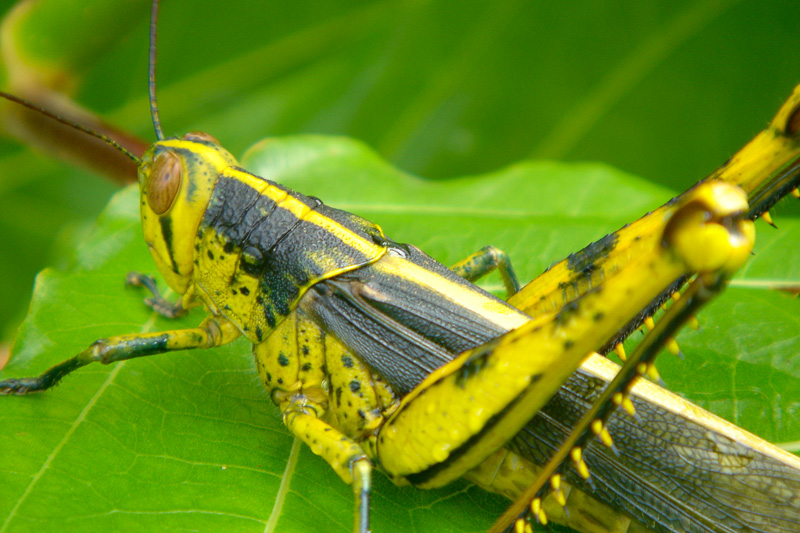
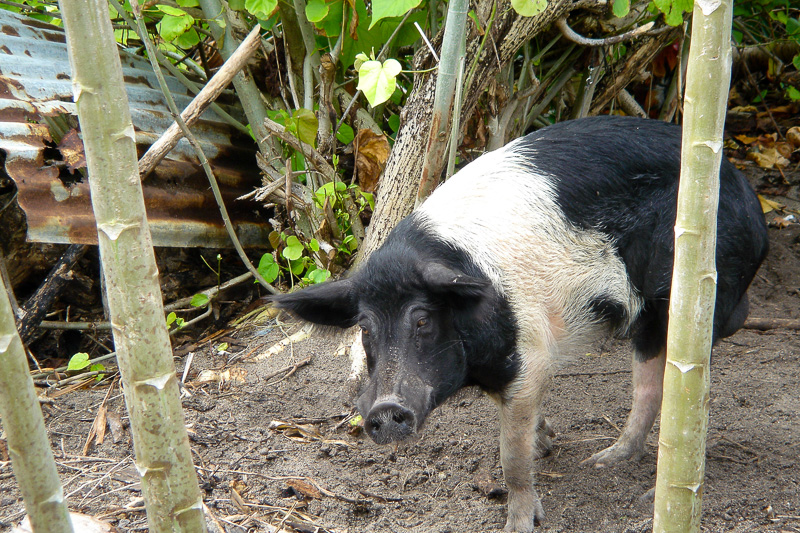
The last day, Embry and I rented a car and drove around the island. We went first to the village of Kaday, a bit hard to find our way, as there are so few road markings, the guide book directions were a bit out of date, and only the vaguest maps are available in Yap. But we did find it, and walked into the village along one of the ancient Yapese raised stone paths. Slippery hard rock, wending among patches of taro, palm trees, cassava, bananas, creeks and ponds. The food crops weren't in tidy rows or anything, just patches of them mixed in with the jungle plants. We saw lizards, frogs, land crabs, a bird with a red back, butterflies, a yellow-and-green grasshopper the size of my middle finger, and a black-white-black striped boar with tusks and a long long snout, tied up by a rag knotted around one foot, poor thing. He looked so intelligent and so doomed. The taste of wub.

The dwellings were shacks of corrugated iron, many of them open on two or three or four sides, like pavilions, primarily for keeping off the rain. The temperature is always eighty degrees. In a city we're so hard and pulled-together, in these villages the dwellings seem just on the point of deliquescing back into organic natural life. The path through the village was covered with ground-hugging grass like you see on golf courses. A row of stone money beneath swaying betel nut trees. For some reason the village was deserted.

Embry and I walked to a river and sat there, wondering at the silence, the beauty. Then one of those brief showers of rain struck and we took shelter under the eaves of the men's house, a thatched hut at the middle of the village. There some betel nut fronds on the ground, with all but the tougher, larger nuts gone. The ancient rounds of stone money in front of us. A shared moment to remember, which is, after all, in large measure what we're questing for in this trip, my brother and I.

Later we were looking for the wreck of a WWII Japanese bomber supposedly near the airstrip, and asked some guys doing road construction, and they said, “We don't know, we are out islanders.” There's a real class distinction between the Yapese from the main island group of Wa'ab (pronounced simply “Wob”), and the out islanders. Funny to us mainlanders, who'd already think of Yap as being about as out-of-the-loop as you could get, that there are people even more out of it than the Wa'ab Yapese.

A couple of times we saw older women walking around bare breasted in grass skirts, as casually as bare-chested men in shorts. And everyone carries a little pandanus (a tree with a palmy kind of leaf that grows a hard pineapple-looking fruit that only the fruit bats eat) purse shaped like a miniature Macy's or Bloomingdale's shopping bag, with their stash of betel nut, lime, and cigarettes in the purse. I miss Yap already. Such peace.


Micronesia 5: Stone Money

Wednesday, March 9th, 2005

The story on stone money is that about five hundred years ago some Yapese canoes reached the rock islands of Palau. They were impressed by the crystalline rock of these islands and carved out a disk of it to take home. So that they could carry the disk, they put a hole in the middle so that a group of men could carry the disk threaded onto a log. To get the heavy stone home, they made a little bamboo raft to float it on.

Back in Yap, the money served as a trophy of the men’s adventure. The harder your trip was (storms, sinkings, drownings, attacks by Palau warriors), the more that given piece of stone money was worth — it had more of a story associated with it. What could you “buy” with stone money? Not goods or a house — for those you needed a different kind of money, shell money. But you could give a disk of stone money to a family as the bride-price for taking a daughter as your wife. Or, as my dive guide Gordon explained to me, “If your brother Embry got drunk and made a lot of noise in the village and some family was mad at him, you could give them a piece of stone money to make it alright.” You wouldn’t necessarily have to move the stone money anyplace, you’d just reassign ownership. Often a village’s stone money would be lined up near the central dancing area to make what they call a stone money bank.

It’s scattered all over Yap, you see it in every village, and pieces of it are near most public places as well.

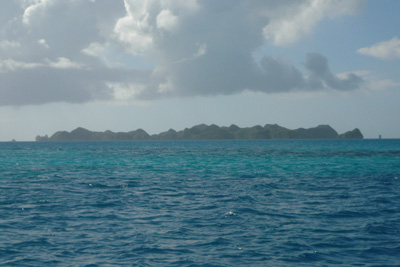
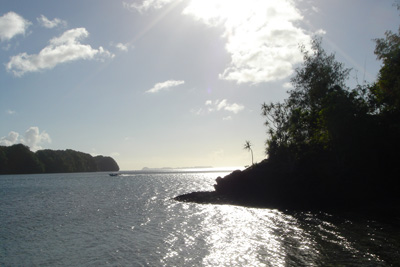
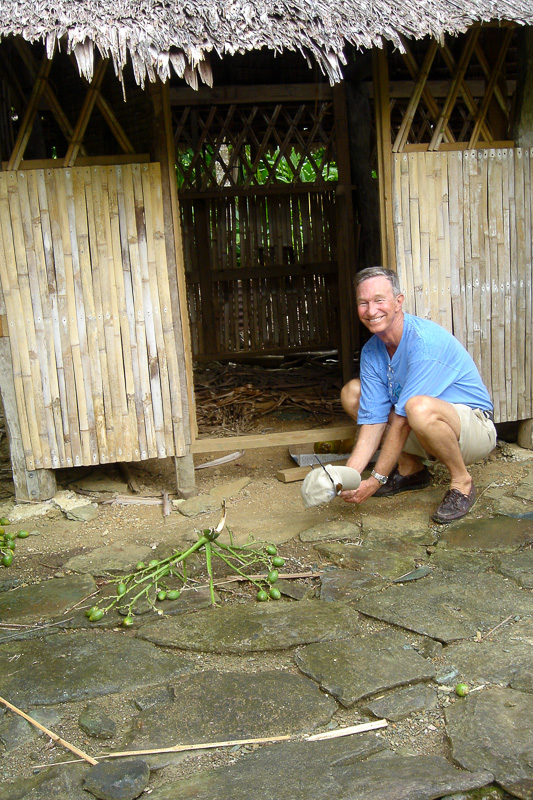
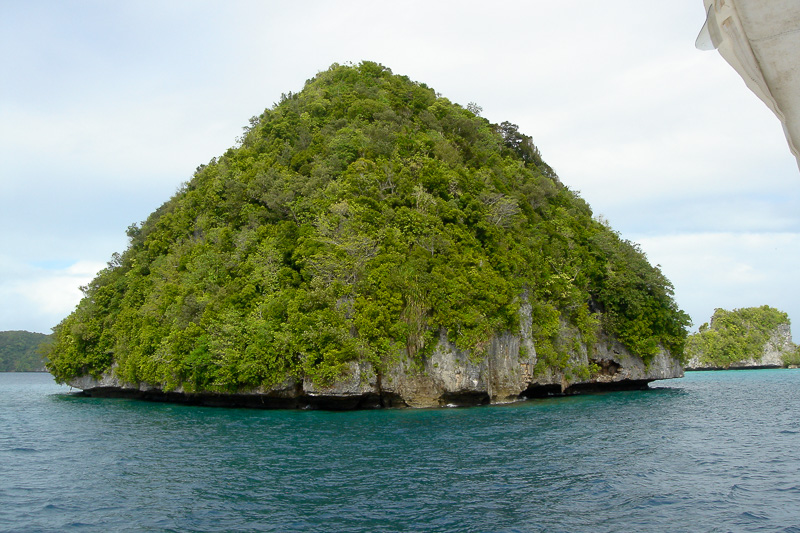
Later when we were on the dive boat in Palau, passing through the rock islands, I was talking with our Palauan boat pilot and I said something like, “The Yapese used to come here and tear off a piece from these islands.” The pilot, high on betel-nut of course, laughed wildly, as if visualizing the folly of those rustic Yapese. [Not actually the same pilot as shown in this picture.] And the next day he returned to the joke, pointing out a natural bridge worn into the rock islands, saying, “That’s where they took away the stone money.”

In a way, taking photos is like taking stone money.

One of my blog-readers asked what kind of camera I used for these pictures. A pocket-sized SONY Cybershot DSC-T1. It has 5 Meg, which is more than enough, and becuase I carry it a lot more than I used to carry my Leica, I get a lot more pictures. The lens is tiny, but it’s okay that the lens is tiny since the “film” is a tiny CCD chip. Also its a Zeiss lens. The only downside with a camera this small is that it’s so lightweight that it tends to shake when you get down to low light long exposures. Would be nice if it has some kind of grabber so you could temporarlily mass-ballast it by fastening it to a handy rock. Just for kicks for the photo mavens, you can click here to see that last cool red,white, and blue stone money picture in larger format, about 2700 pixels across.


Rudy's Blog is powered by WordPress