





Click covers for info. Copyright (C) Rudy Rucker 2021.


Archive for the ‘Rudy’s Blog’ Category

Need Help Understanding Supermind Experience

Wednesday, September 28th, 2005

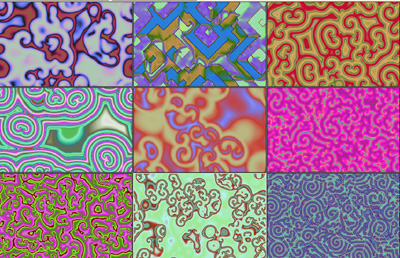
I need some help with a question for an SF story I want to write. [Illos today are golden oldies from the blog; my stash of images is becoming a kind of visual Tarot.]

So suppose we have a superintelligent web of tiny machines with an enormous net RAM and flop, with tons of data, and with smart agents living inside it. The Web, in other words, but more so. And now suppose that we plug into it and get smarter. How will this feel?

But, wait, let me evade the hard question for a second. Plug in how? I could use my usual “uvvy,” a soft plastic computer you wear on the base of your neck and it reaches into your brain with magnetic vortices. You can take it off, which is important, as no reasonable person wants to be permanently plugged in.

Or some nanomachines called “arphids” get into your hair like lice and can diddle your brainwaves. A different kind of uvvy. But maybe people are initially leery of the uvvy and the arphids.

They could get by with what I call “stunglasses,” glasses with a heads-up display overlaid. These could even be contact lenses. And you could have tiny sensors on your finger joints so you can type in the air, or not even type, just make those cool cyberspace moves like Keanu did in the 1998 movie of Gibson’s story “Johnny Mnemonic.” And we can also suppose the system has speech recognition and you have earphone buds perched in the porches of your ears and a mike taped to your throat. Everyone is mumbling and twitching and wearing flickering contact lenses.

But how does it feel to plug into a system that’s say, a million times as smart as a person. You can have agents for yourself in there doing searches, computing things. Of course if they’re so frikkin’ smart, why would they obey you?

When you plug into the supercomputing web, it’s like you go out of yourself into the seamless web mind, and then you come back. Some thoughts you can’t remember until you’re plugged in. You just remember links. You can speak by exchanging links. But real physical life goes on.

When you unplug and go outside, you’re the same. Having supercomputation around doesn’t really change things much when you’re offline and being yourself. People are still the same as in Bruegel’s time. At least this is the situation I need in order to write a story about these people.

Comments?

My Podcast Station, Talk on Gnarly Computation at IFTF

Tuesday, September 27th, 2005

I gave a talk at a think-tank called the Institute for the Future in Palo Alto yesterday, for a group called the FutureCommons that meets there once a month. It was a nice alert audience; I felt happy to be among tech dreamers. Michael Liebhold introduced me. He's into this cool new thing called “locative media”, which involves computer realities that are pegged via GPS to realworld locations.

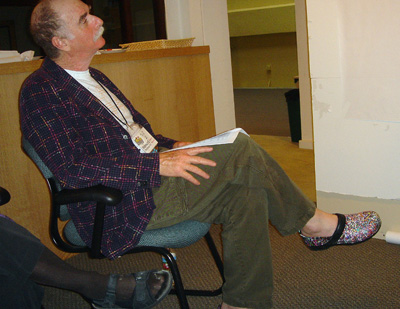
My fellow author Howard Rheingold was there. He decorates his own shoes with spatters of acrylic paint. He says he used to draw patterns, but with splatters, you don’t notice when bits chip off. Before my talk, the group of maybe fifty people stood in a circle and played an encounter-group game. Good old California.

I was promoting my Lifebox book as usual these days. Sell it, Ru! You, too, can experience the multimedia wonder of my talk two ways.

(1) Read the Talk Slides, saved in the friendly PDF form rather than the demanding PowerPoint format.

(2) Listen to a 40 Meg MP3 of my talk on ”Gnarly Computation”. This is better quality than the last MP3 I tried to post. Click the link above or click on the icon below to access the podcast via , which mirrors my Gigadial feed.

It’s thanks to a tip from reader Lisa Williams that I’ve made Rudy Rucker Podcasts called “Rudy Rucker” on Gigadial.net, which will place poddy wrapper tags around the mp3 for those interested. Geekin' out!

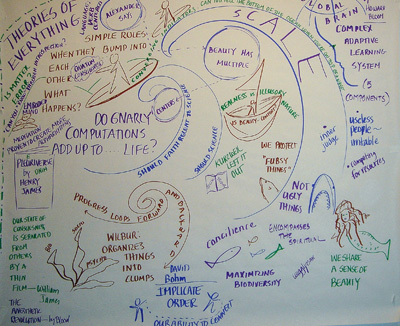
After my talk, the ultrageek (and very nice guy) Jerry Michalski led a discussion about theories about the ultimate nature of reality other than my “universal automatist” thesis that everything is a gnarly computation. As the discussion rambled along, a charming woman named Eileen Clegg made a realtime visual representation of what people were saying. She does this for a living! This photo I took is not, she protested, the final form of the image that she’ll produce.

After the talk we had dinner in an Indian restaurant with suitably gnarly food. Jerry Michalski told me about some software called “The Brain” that he has been using for years to maintain and every ramifying computer model of his mind. He codes in every link between new ideas that occurs to him. Information about Michalski’s brain is available online at his website. This guy is Lifebox-ready! One minor problem is that, just today of course, the link to his brain gives an error message…

Locus, Asimov's, IFF, The Cloud Atlas

Monday, September 26th, 2005

I’ve been doing a lot of promo for the Lifebox

book.

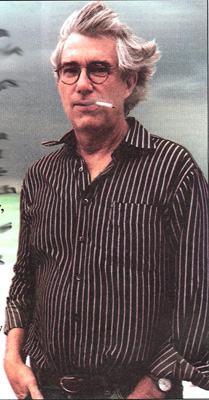
There’s an interview with me in the Locus science fiction magazine, September, 2005, issue, with photos by Beth Gwinn (such as the one above).

I have Lifebox-related article called “Adventures in Gnarly Computation” in the October/November, 2005, issue of Asimov’s Science Fiction magazine. The article's online at this link, with a slight misprint: the first letter is “W” not “T”.

And this afternoon I’ll be at the Institute for the Future in Palo Alto. I put up a Powerpoint for the talk, and maybe I’ll capture and post some audio.

***

On another topic, I’m almost done reading the best literary book I’ve read in a long time The Cloud Atlas by David Mitchell.

The Cloud Atlas is actually six short novellas (or long novelettes), about 20,000 words each, arranged in this curious onion-like way. That is, five of them are cut in half and nested, so that the book’s structure is: 1a 2a 3a 4a 5a 6 5b 4b 3b 2b 1b. The author compares it to a matryoshka doll, that is, a nested Russian doll with dolls inside. Or to a music piece with six solos, each of which is interrupted by the next solo, and which then takes up when the intervening solos are done. What’s really cool is that in each successive story, a character reads or sees the first half of the preceding story, and then when a given successive story ends, the character gets to read or see or show us the second half of the preceding tale.

The fifth and sixth novellas are both science fiction. I’d been prepared to be resentful of the slumming literary mandarin, but, hell, they’re damn good. Number six, “Sloosha’s Crossing and Everything That Came After,” reminds me of Russell Hoban’s superb Riddley Walker. “Trubba not.” And the fifth is “An Orison of Sonmi-451”, which is a lovely tale. Very serious, but not humorless. Odd in good ways.

The “Orison” is about cloned slaves in a future fast food place with the “logoman” Papa Song, I guess he’s a hologram, he stands on a plinth and gives them exhortatory morning sermons and later in the day entertains the customers. He’ll, like, pretend to surf on waves of noodles, or throw holographic boomerang “fire éclairs.” What makes the style really great is that the person describing this, the “ascended” (= become intelligent) clone Sonmi has a very flat, matter-of-fact, wise tone, and doesn’t see any of this as funny. Even though the story is satirical. I guess Brave New World was like that, satirical and, if you think about it, funny, but with the events treated in all seriousness by the protagonists. Actually by the end of the tale, the satire gets so sharp and pointed that it’s more horrific than funny.

This and Charles Stross’s Accelerando do a lot to raise the SF bar. Synchronsitically enough, Charlie too talks about Matryoshka dolls. Except his are Dyson spheres.

Antiwar March in San Francisco

Sunday, September 25th, 2005

My wife and I went to a march in SF against Bush's war, and for kicks took BART via Merritt Lake, meeting up with our son and his woman friend.

I still can't believe that the Chimp got reelected. 3 more years. I don’t like to talk about politics much on my blog — if that’s all I think about, then the Pig has really and truly won. But politics is what yesterday was about.

As always, it felt good to be in a march, in the bosom of likeminded citizens. Safe.

Why isn’t the media asking every day why Bush never caught Osama? This poster suggests that Bush knew, and worked with Osama. Why isn’t there a day-by-day count in the corner of every TV screen, like when we had the hostages in Iran in the Carter years? Is Iran our ally now? Like in 1984. “Oceana has always been the ally of Airstrip One.”

We marched a couple of hours. “Send in the Twins.”

The usual endpoint of marches, the big lawn at the Civic center, had been perversely rented out by the city to a commercial event called the Love parade, so we ended up in Jackson Square.

In my new Lifebox book, I rhetorically ask, “Suppose that at some point you find society’s hive mind unacceptably hysterical and debased. What can you do about it?” and then I suggest, “You can emigrate internally — not to another hive, but to a subhive. The idea is simply to put less emotional involvement into the national hive mind and more into some smaller grouping. Without actually leaving the country you can emotionally leave the big hive.”

As we used to say in the Sixties:

What if they gave a war and nobody came?

The march was a nice sub-hive.

Today’s hairdo award goes to hippie-dreads in giant pigtails with infinity-symbol wrapping.

After the parade I was in Virgin megastore and they had this, like, shrine of Ramones objects for sale. “Even though you’re dead, you’re still my friends.”


Rudy's Blog is powered by WordPress