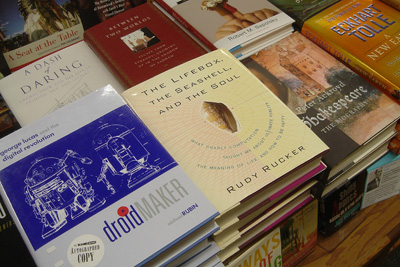


Click covers for info. Copyright (C) Rudy Rucker 2021.


Archive for the ‘Rudy’s Blog’ Category

Selling Out? Memoir Thoughts. Cruz Photos.

Tuesday, December 6th, 2005

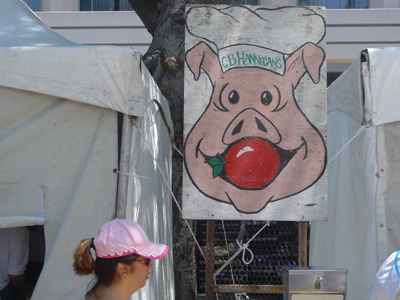
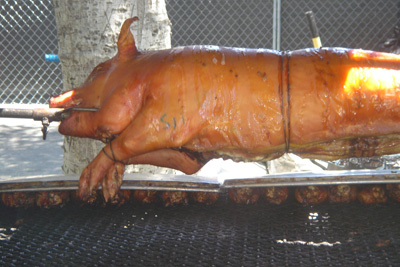
I decided to try running the Google AdSense column on the right. Two hours of HTML-wrassling later, there it is. I'll see if it brings in enough money to counteract my unease at allowing the mass media mind into my little domain. Today's pig, tomorrow's bacon.

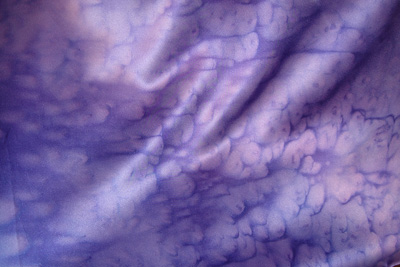
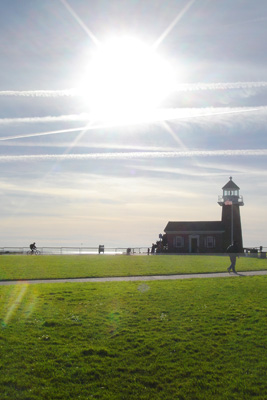
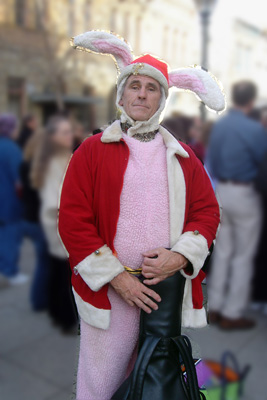
I'm squandering time on this kind of thing because I'm not entirely sure what I want to write next. In a way, I’m enjoying not having a project. It’s like being unemployed. Or retired. I've been writing short stories of late, as a way of holding back from starting the next big one. Another Frek is a good bed; I’m rereading to get up to speed. Or, if I’m not in the mood, maybe a novel beginning a fresh ware-like series, without it actually being another ware. Or a memoir? That’s the least commercial possibility, so I slack off by thinking about it today. [The pictures were taken in Santa Cruz on December 4, 2005. This first one is a remarkable piece of non-repeating silk at Hart’s Fabrics.]

I recently read Bob Dylan’s Chronicles, Vol. 1. I was struck by what he did: he picked three turning points in his life and wrote in some detail about each of these periods: (1) starting out in NY, (2) disillusionment and disgust after fame, (3) cutting a comeback album in N.O. (4) And in the fourth and last section, he goes back to the starting out in NY period. And even when he limits his accounts to these narrow zones of time, the account is still quite superficial, with very little day-to-day in it, although oddly he’ll sometimes zoom in on some period of hours when, perhaps, he was experiencing a turning point or an epiphany. The idea of limiting a memoir to a few focused periods sounds good. Otherwise you’re looking at a fractal, a lifebox, or an academic biography.

But, gee, only three periods? That’s harsh. How about a really short chapter for each year with one anecdote in it? Here’s a (probably false) start at listing some not quite randomly selected events I could conceivably expatiate upon. I’ve numbered them by the age I think I was when they occurred.

(5) Fade In. Walking through the rye field. The Keith girls on the farm near us, gathering us into their spooky dank stone spring-house, telling us a ghost story about the little … white … hands. Sitting on my mother’s lap and Muffin the dog at our side. In the silence I can hear the Earth turning.

(12) On My Own. On a hike with some fellow students at a boarding school in Germany. I imagine the pine pollen in the rain puddles in Germany to be fallout from an atomic war. I get in a fight with a boy am anxious to see him sharpening his knife. My friends promise we’ll stave him off. He doesn’t do anything.

(22) Metamorphosis. I’m a newlywed in grad school, discovering math, Zap Comix, Pynchon, hippiedom. Listening one evening alone to the Zappa record Chunga’s Revenge , I’m inspired and begin making notes for a book about the fourth dimension.

(29) Fatherhood. The last Christmas with the grandparents in Geneseo. The pleasant physicality of lying on the rug like a dogfather in his den, with the kids crawling on me, poking, wrestling.

(32) Transreal. In Heidelberg, working on White Light, I have a dream of finding wonderful polyhedral crystals in the shale on a mountain slope I’m climbing.

(40) Cyberpunk. At the end of my stay in Lynchburg, three young artists from Richmond come to see me, as if sent by Eddie Poe. One of the boys has drawn a tesseract unfolding.

(44) The Great Work. Demoing my fractal Chaos software at the Cyberthon in Silicon Valley.

(57) An Old Eye. In one of the last computer graphics classes I taught, I had a nice image of the perspective matrix changing the size of the world.

Los Gatos Christmas Parade, New Podcast

Saturday, December 3rd, 2005

Once again it’s time for the Los Gatos Christmas Parade. I blogged it last year come to think of it.

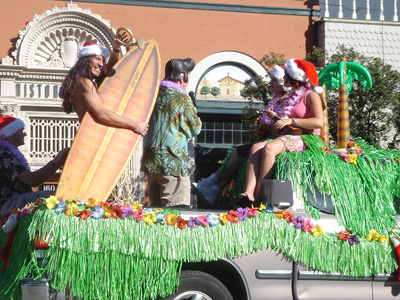
This year was more fun than last year; we came early and saw the whole thing. Unlike last year, I don’t think there was a single float pushing evangelical religion which was nice. Let’s keep the X in Xmas, folks!

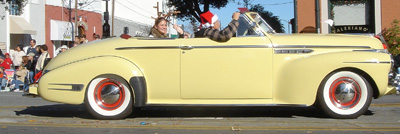
Near the head of the parade we had the standard classic cars bearing our native royalty. That reminds me, I watched “The OC” this week.

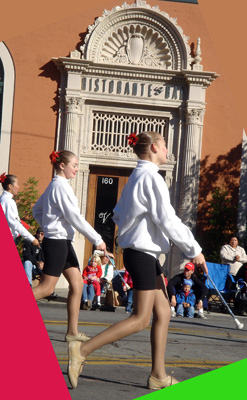
Ah, the dear twirlers, long may they wave.

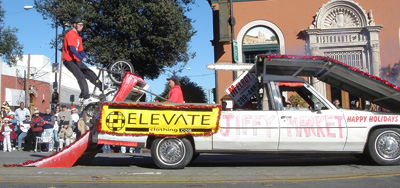
The most exciting float for the last few years has been one sponsored by Jiffy Mart, where I imagine teens to hang out a lot. The float is a truck with two ramps, and kids do huge flip-in-the-air jumps over the truck.

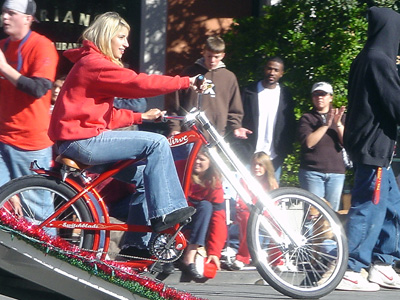
There were blonde girls slowly circling around the Jiffy Truck on low-rider bikes. So California.

I’m thinking about going to Tahiti and Easter Island. Anyone got advice?

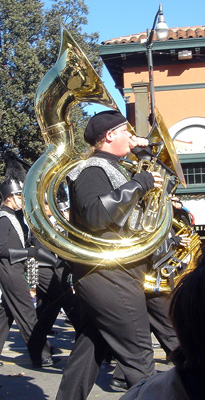
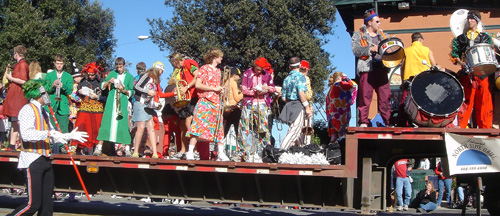
It's always a thrill to see the insanely hyperactive Stanford band. I've never gotten to see enough of them.

I posted a new podcast today, my second-to-last lecture to my Philosophy class. I’ll miss that gig.

My First Fan Letter (1981): The Foot Star Wrinkle

Thursday, December 1st, 2005

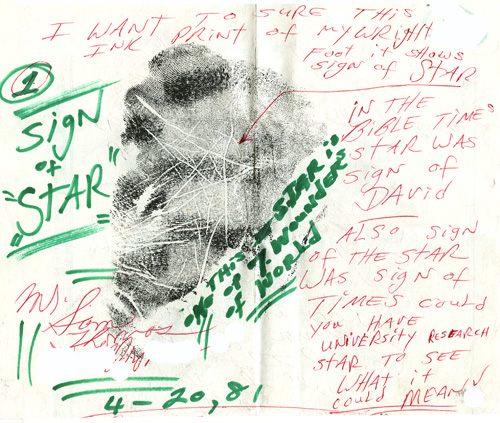
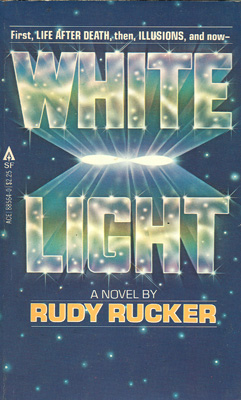
Still rooting in the basement (Magic Pig that I am) I found the first-ever fan-letter that I got, mailed to me in 1981 care of Ace Books who had just published White Light with a somewhat misleading cover.

The letter was from a guy in the penitentiary in Leavenworth, Kansas. In response to my careful melding of literature, philosophy, and the mathematics of the infinite, he’d smeared ink on his foot and stepped on a piece of paper — to show me a star-shaped wrinkle. He wanted me to fund university research on the wrinkle and to write a book on the results with him.

“Thing we could go 50 50 on Writing Book on Star and on what university Researchs Writes out on Research part.”

My welcome by the class of people who read science fiction!

Actually I was pleased. It used to be that carnivals would come to the small towns we lived in and, say, the Ferris wheel operator would have a pulp paperback tucked into the hip pocket of his jeans, and he'd periodically read a page or two while letting the Wheel do its alloted cycles. I'd begun to dream of being the author of that book.

“It From Bit” or “It From Qubit”? Part 2.

Wednesday, November 30th, 2005

About two weeks ago, I had an entry called “It From Bit” or “It From Qubit”? Part 1.. Today I want come back to that topic and finish it off.

[Today's pictures are from Belgium, this particular one shows some strangers in a cafe. I like the expression on the woman's face. “It from bit?” she's thinking.]

David Deutsch argues that quantum computation is going to better at modeling the universe than classical computation. Quantum computation is built up from so-called qubits instead of bits. A qubit can be 0, 1, or some mixture of the two. The big win, says Deutsch, is that our world is already made of quantum mechanics, so a quantum computer can not only emulate any physical system, it can in some sense be a copy of any physical system. With digital classical computer simulations, there’s always the worry that you’re only running a simplified version of the world.

What does a quantum computer look like? Well, they barely exist, so far, and it’s not clear that they’ll ever be usable. In the current laboratory experiments, a half dozen supercooled atoms might be held suspended in a line in a so-called ion trap. And the experimenter shines pulses of laser light onto the ions, and eventually one of the ions might spit out a photon or flip over, and that’s your output.

What seems to me like a kind of flaw is that, at least for this style of quantum computer, the thing isn’t self-contained. The program isn’t stored inside the system. The pulses of laser light are both the program and the data. Of course I have to load programs into my desktop computer or my walk-around robot. But once those programs are in there, the system can go off on its own and function autonomously. I don’t see that happening in at least the current descriptions of quantum computation.

In some sense it’s easier to say the universe is a quantum computation instead of a classical computation with sharp-valued digital bits. For the universe as we know it seems to be made of quanta. But as Wolfram remarked to me recently, this doesn’t mean there couldn’t be a digital substrate. He says that trying to smuggle quantum mechanics into the lowest level of reality is a bit like the heliocentrists’ desperate attempts to preserve their unwieldy system by tacking on epicycles to the planets’ motions. Maybe at the lowest level we can just let go of the quantum system and get something really clean and crystalline.


Rudy's Blog is powered by WordPress