

Click covers for info. Copyright (C) Rudy Rucker 2021.


Archive for the ‘Rudy’s Blog’ Category

“Surfers at the End of Time” with Marc Laidlaw

Wednesday, October 23rd, 2019

My latest story with Marc Laidlaw is in the Nov-Dec, 2019, Asimov’s SF magazine. Today’s blog post is a copy of a post I put on the Asimov’s blog. And thanks to Emily Hockaday for making that happen.

“Surfers at the End of Time” is the seventh story that Marc and I have collaborated on. All but one of the tales are SF surfing stories that feature two guys called Zep and Del.

Often when I collaborate, I’ll do what I call a transreal move, that is, I’ll have the story be about two people, and one of the characters is somewhat like me, and the other is like my co-author. To some extent Zep is like me, and Del is like Marc. This said, we often ventriloquize each other’s characters, in that Marc might write Zep scenes and I might write Del.

This time out, we wanted to do a time-travel story. We’d talked about this for a few years. At first we were focused on the notion of flooded cities, with the sea-level half-way up on the sky-scrapers. This theme was featured in the excellent 2001 Brian Aldiss inspired movie, A.I. Artificial Intelligence, and there’s a touch of it in Tomorrowland too. Marc had imagined surf contests amid the buildings. But in 2017, just as we were ready to start, Kim Stanley Robinson pretty much used up the trope with his New York 2140. Marc and I did write some nice flooded-San-Francisco scenes, but we needed more.

Marc was enthused about the H. G. Wells novel The Time Machine—and about the 1960 movie version directed by George Pal. I watched the movie online, and I dug it. We wanted to use Wells’s classic scene where the Time Traveler goes so far into the future that the sun is bloated and the Earth is nearly lifeless. Thus our title: “Surfers at the End of Time.” I like to pronounce the last word like I’m in an echo chamber: “Tiyiyiyiyiiiiiimmmme.” You know.

Since Marc and I both know Ocean Beach in San Francisco pretty well, we decided to start our story there. A significant research element was William Finnegan’s memoir Barbarian Days: A Surfing Life. The book has a long section about Mark “Doc” Renneker surfing the intensely cold and gnarly waves at the SF beach—you can read it online in the New Yorker.

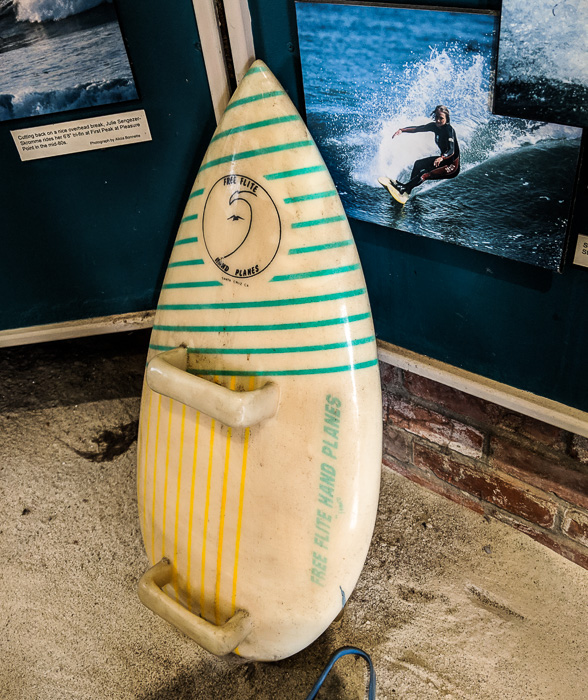
We felt the time machine should be in some sense a surfboard, and I spotted a cool-looking little “hand board” in the wee Santa Cruz Museum of Surfing which is inside a diminutive lighthouse by Steamers Lane.. Marc had the idea of having the boys activate the time machine by scribing an intricate mandala-like sigil upon the face of the sea.

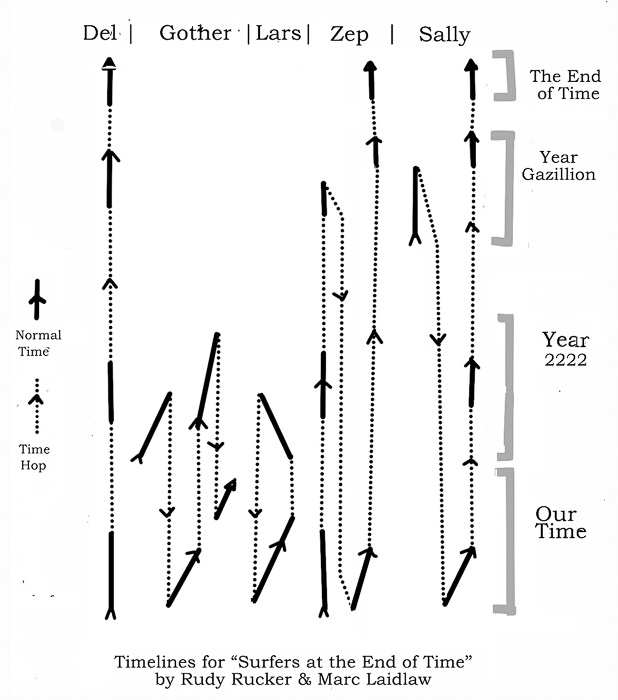
We expanded on the notion of a time sigil by imagining an intricate, arabesque spacetime diagram of our boys’ worldlines. I redrew the figure ten times while we where working on the story. I’m a little surprised how complicated it turned out, but that’s where the logic leads. I kept sending the successive diagrams to Marc, but he wasn’t always that into trying to decipher them. The dude wasn’t a math major!

At least the diagram helped me a in terms of planning the complex plot of the story. Time travel is a bitch. Like, you need to be careful not to imagine that the characters can predict the abrupt and non-causal appearances of time travelers. And, as I’ll discuss below, there’s the matter of time paradoxes.

In the diagram, you’ll notice five names at the top, and these names correspond to the five worldlines below. Gother and Sally are women that Zep and Del meet, and Lars is kind of gnome called a murg. As I’ll discuss shortly, he has a closed-loop worldline.

In time travel stories you always have to deal with the issue of possible time paradoxes. There are two main types of problems.

(1) Closed Causal Loop. A creature like Lars the murg appears at time and place X with a handboard time machine. You hang out with him for awhile, making your way forward in time. And once you and Lars are in the future, he uses his time machine to hop back to the time and place X. Who produced the murg? Who invented the time machine? They produced themselves. Their worldlines are loops. Is this a problem? Not really. There’s no real contradiction in a Closed Causal Loop. It’s just odd. But we can live with odd. Especially in a Zep & Del surfin’ SF story!

(2) Yes and No. Your future self comes back in time and chops you and your friend in half with a broadsword. If you die, then your future self doesn’t exist, so he doesn’t kill you, so then your future self exists, so he does come back and kill you. A contradictory situation. A standard journeyman SF-writer solution is to say that, when you travel back in time, you don’t actually go back into your own timeline. You go into the past of a parallel world. I don’t like this solution; I think it’s facile and dull. My deeper problem is that, if there a zillion parallel worlds, then everything happens. An if everything happens, then nothing matters. And then cares what happens to your characters?

Once in awhile, sure, I’ll invoke an alternate world—like if I need a world who’s physics is wildly different from ours—like if I want a world with infinitely high mountains, or with an endlessly wide plain. But it seem cheap to invoke parallel worlds just to avoid a piddling little yes-and-no time travel paradox. Like using an H-bomb to light a joint. There’s always gonna be a tricky way out of any seeming paradox, if you think hard enough.

In “Surfers at the End of Time” our characters Zep and Del travel up and down the timeline, and they do, at times, encounter past or future versions of themselves. So how do we avoid Yes and No paradoxes without invoking alternate worlds? As the great logician Kurt Gödel once suggested to me, “Let’s suppose that the world always arranges itself so that these paradoxes do not occur. If something is logically impossible, then it doesn’t happen. A priori logic is very powerful.”

As I’ve already hinted, in the opening sections of our story, it appears as if a Viking-like Zep from the future comes back and slices both the original Zep and the original Del in half. Ye and No paradox? Well, it doesn’t have to be—if our boys don’t die. But how do they survive being chopped in half across their waists by a huge broadsword? Well, not to give too much away, let’s just suppose that the boys’ severed halves are treated with some special futuristic biomedicine… Like good old Kurt Gödel says: “The a priori is very powerful!”

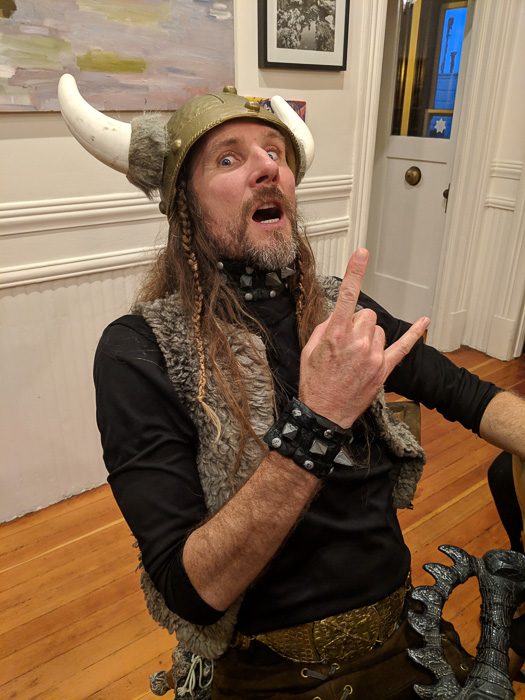
By the way, I got the idea of future Zep being like a Viking when my wife and I went to our son Rudy’s family Halloween party in San Francisco. And in the kitchen I met a friend of Rudy’s named John Bowling. He was wearing a horned Viking helmet, and had his long hair partly in braids, and he had a long beard. He was wiry and lively, and he told me he’s a big wave surfer and that he lived in a condo on the Great Highway by San Francisco’s Ocean Beach—exactly where Marc and I wanted Zep and Del to live. I texted Marc a photo of the Viking surfer dude, and Marc texts back, “HE’S A TIME TRAVELLER, DUDE.” Synchronicity! Times like this I feel like I’m dancing with the Muse.

It was fun to work with Marc again, and not be writing on my own. Collaborating takes longer than writing alone, and at times it’s a little stressful to iron out the necessary shared decisions. But a collaborator like Marc puts in all kinds of beautiful, inspired stuff that I would never have thought of. And I end up thinking about the story more deeply. And the story ends up being funnier. I’m not necessarily trying to write funny stories—I’d hate to be called an SF humorist—but I like it if a story makes people smile or even laugh out loud. And it’s even better if it’s kind of sad and tragic and romantic as well. Like life itself.

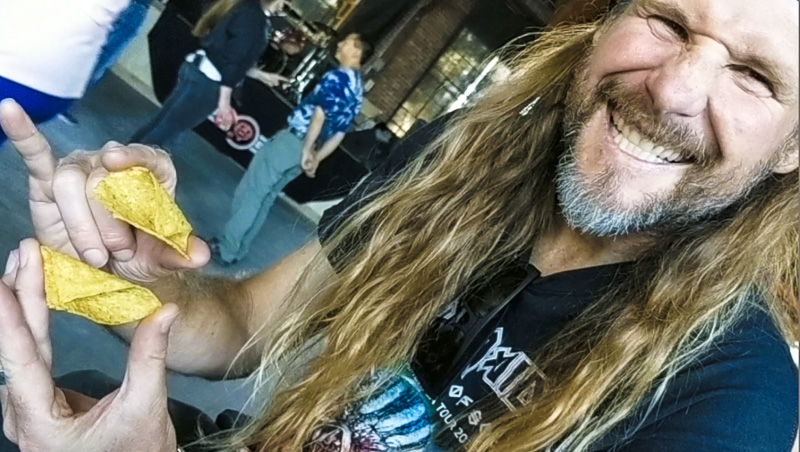
By the way, about two months before our story appeared, I saw our real-world Zep inspiration again, and he explained to me that Dorito chips are excellent models of waves with tubes.  He said he’d had a collection of about twenty really good ones, but that his wife had thrown them out.

Party on, Zep. Party on, Del.

Pisa Talk: “Cyberpunk, Telepathy, Immortality”

Tuesday, October 8th, 2019


Talk by Rudy Rucker for
Internet Festival 2019 in Pisa, Italy,
Friday, October 11, 2019, 15:00 - 17:00,
CENTRO CONGRESSI LE BENEDETTINE, Aula B,
With Ran Zhang and Daniele Brolli.

Where I’m From

I grew up in Louisville, Kentucky during the 1950s and 60s. I read a lot of science fiction. And I was fascinated by the Beat writers Jack Kerouac and William Burroughs. I wanted to be a novelist.

In 1963, I left Louisville, and went to college. I wanted to be a writer, but I majored in Mathematics. I didn’t like the English Lit classes. I figured I’d learn to write fiction on my own.

After Swarthmore, I married my college girlfriend, Sylvia. I got a Ph. D. in mathematics. I went on to have a fairly good career as a writer. I’ve published about forty books. I’ve written popular science books about infinity, about the fourth dimension, and and about the nature of computation. Many of my books are science fiction novels.

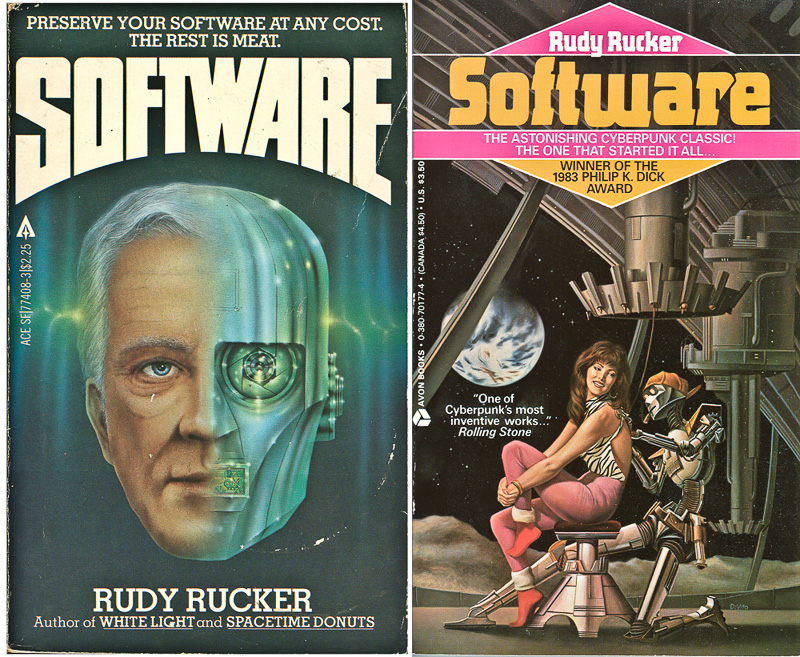
My best-known novel is Software, written in 1980. It was one of the earliest cyberpunk novels.


What is cyberpunk?

Simple answer: Cyberpunk = Cyber + Punk.

The cyber idea behind Software seems simple now.

  • You can make a software copy of your mind and load it onto a robot.

You’ve seen this scenario in a hundred movies and TV shows. But I was the first one to write about it. In 1980, “soul as software” was an unheard of thought. Hardly anyone even knew the word “software.”

To make my Software punk, I made the brain-to-software transfer gnarly. A gang of scary-funny hillbillies extracted people’s mental software by slicing off the tops of their skulls and eating their brains with cheap steel spoons. One of the hillbillies was a robot in disguise, and his stomach analyzed the brain tissue. Did I mention that I grew up in Kentucky?

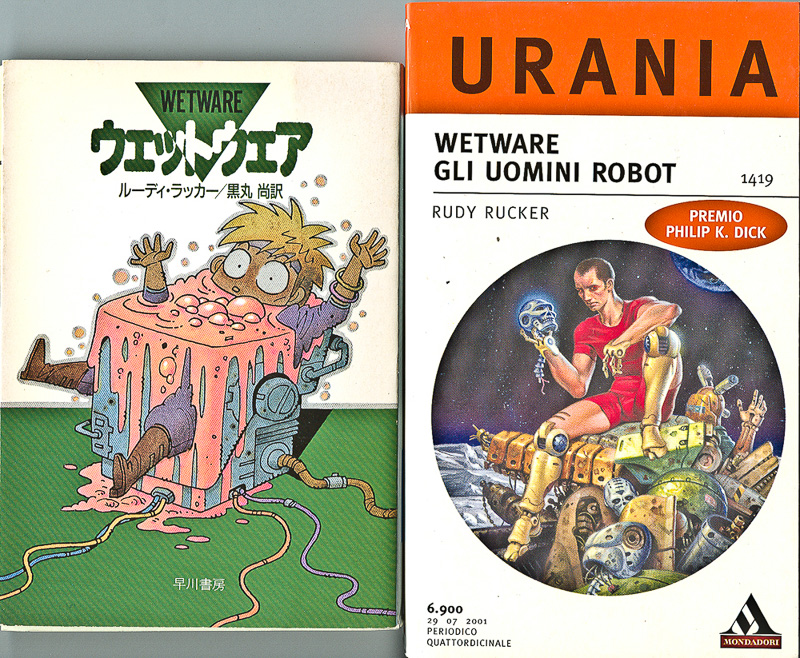
I went on to write three sequels: Software, Wetware, Freeware, and Realware. They’re collected in my Ware Tetralogy. And you can read my Complete Stories for free online. Read one of my stories before you go to sleep tonight. You’ll have interesting dreams.


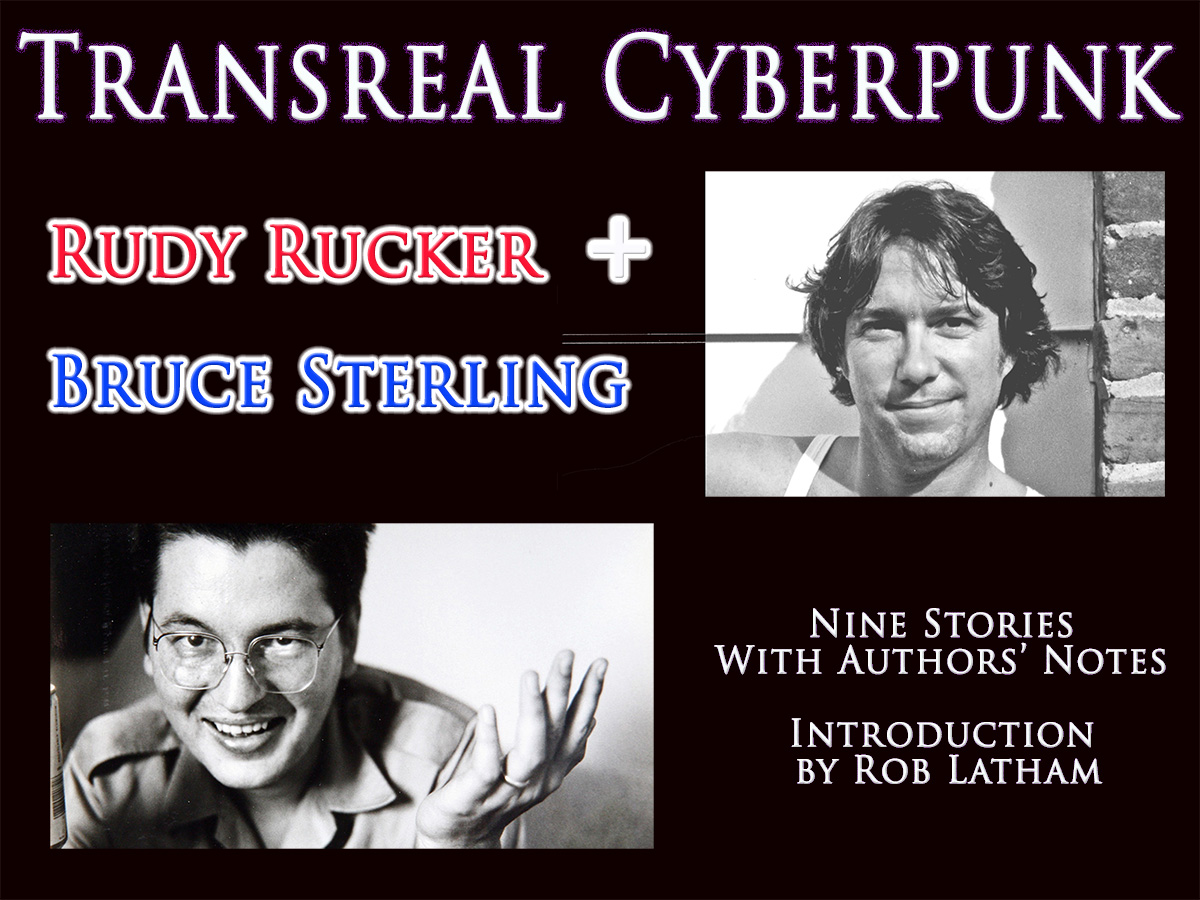
Early in my career I began collaborating with the “almost Italian” writer, Bruce Sterling. We recently published a book called Transreal Cyberpunk with nine stories that we wrote over the last thirty years.


Back to my life story. In grad school I was a hippie, in the Eighties I was a punk, and after that I settled down to being a cyberpunk. Even so, I’m a reliable family man, with three children, and five grandchildren.

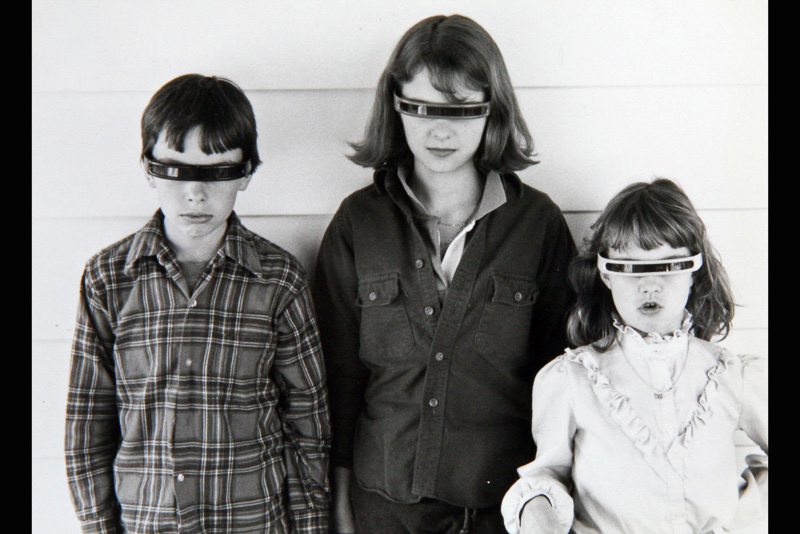
A photo of my cyberpunk children in the early 1980s.

Being a respected writer doesn’t necessarily pay very well, so for most of my life I had a day job. I was a math professor until I was forty, and then we moved to California, and I became a computer science professor at San Jose State, in Silicon Valley.

I let the chip into my heart. As well as teaching CS, I did some work as a software engineer at Autodesk. I published several programs involving cellular automata, chaos, videogames, and artificial life. You can get these for free online.


Cyber

Cyberpunk is about computers merging into our reality. Cyberpunk explores the dancing boundaries among humans, daily life, and computers. The real world is blending with the computer world.


Software → People. Programs imitate us.

  • Software bots emulate partial human functions, taking over our jobs.
  • Hand-coding a full human-level AI is literally impossible, (proved by Alan Turing).
  • But we can evolve human-level AI…using neural nets…but we won’t know how they work.

People → Software. We augment ourselves with bots and robots.

  • People enhance themselves with apps on devices.
  • Apps can move to biocomputing symbiotes…to wear like leeches, like the “uvvy” discussed below.
  • The goal is digital immortality. Uploading into the cloud, or into an android bot, or into an animal.

Software ↔ Reality. The cloud merges with daily life.

  • Our daily world is saturated with the ubiquitous internet. Like damp sand is wet with water.
  • Face to face conversations are replaced by messaging, video, and social.
  • . We shop online with e-commerce.
  • We use VR to emulate the world, for entertainment, for training, and for predictions.

Punk

Punk is about maintaining our individuality, our independence, and our attitude.

Computers aren’t everything. Behaving like a robot is unpleasant. It’s more fun to be human.

The VR worlds of videogames are too clean. Even their scuff marks are clean. As Bruce Sterling once said, “We cyberpunks need to get in there with our spray cans.”

The physical world is grungy and gnarly. Wherever I am, I always look for the chaos, the natural gnarl, and when I find it I feel safer.

Punk is about turning your back on conventional top-down rules. Cyberpunk film and literature breaks free of the boring old plastic, white-bread visions of the future. And folding in more of our actual, daily world.

Punk is for countercultural, decentralized politics. Like, “You’re not my boss. I’m not listening. I’m doing it my way.” In a nutshell?

Punk means give the finger and walk away.

We want to be invisible, to have privacy, and to evade central control.

Don’t get permission, just do it.

Lifebox

I have a preliminary model for full human emulation. This is called a lifebox, and I wrote about it in my tome, The Lifebox, the Seashell, and the Soul. In the next few years we’ll see lifeboxes as consumer products

A lifebox has three layers.

  • Data. A large and rich data base with a person’s writings, plus videos of them, and recorded interviews.
  • Search. An interactive search engine. You ask the lifebox a question, it does a search on the data, and it comes up with a relevant answer. Like Googling a website.
  • AI. A veneer of AI. An evolving neural net.

You can “talk” to a dead person if you have access to an online copy of their lifebox. The lifebox remembers each user’s search history and inputs—and pieces together a semblance of a continuing conversation

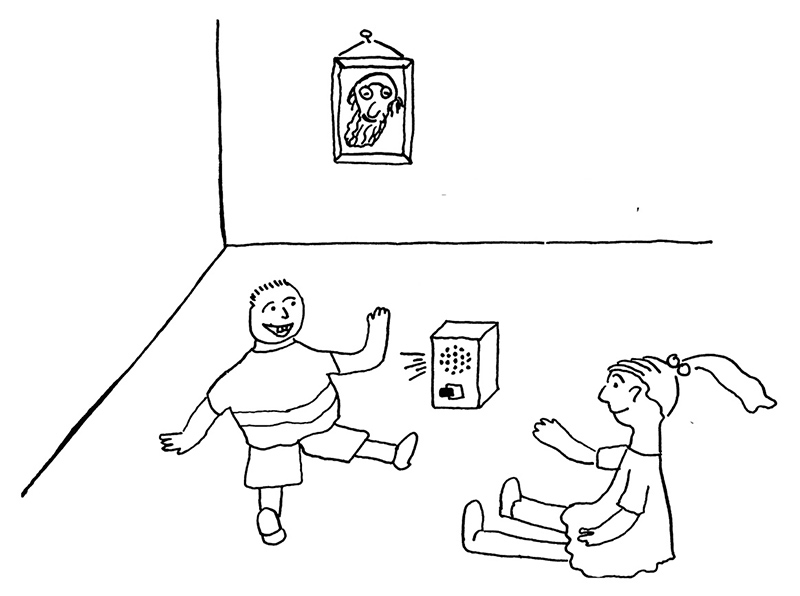
When you talk to an online lifebox, it might show an animated model of the lifebox creator. Or it might just be a little talking box with no screen. Here’s two kids talking to their dead Grandpa’s lifebox. They ask rude questions.


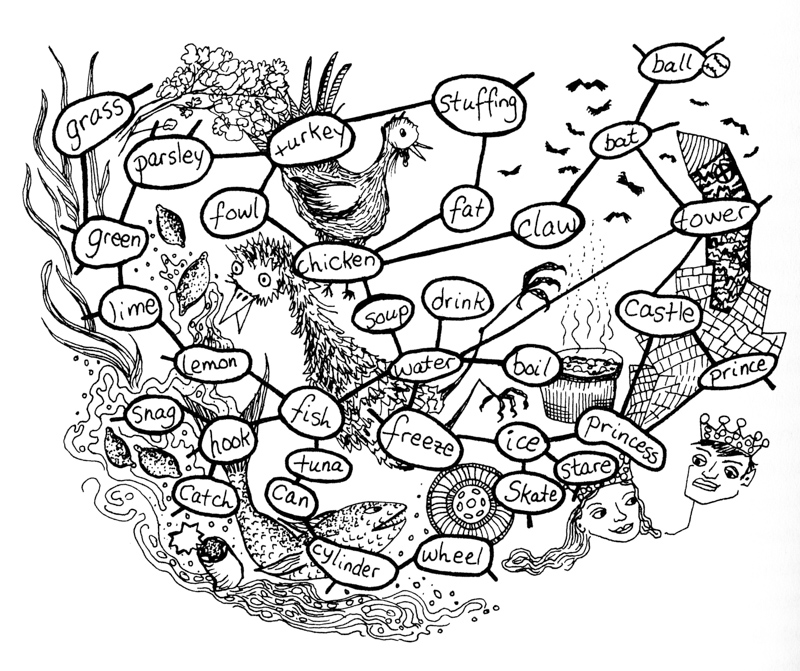
A person’s flow of thought is captured by links among the lifebox items. The links express the author’s sensibility, that is, the person’s characteristic way of jumping from one thought to the next.

How do you create your lifebox? First you can input your writings, your emails, your social media posts, your photos, and the like.

Beyond this the lifebox can interview you, prompting you to tell it stories. The lifebox links your anecdotes via the words and phrases you use. To clarify the data structure, the lifebox asks follow-up questions.

Note that humans build mental lifeboxes of their lovers and friends. In an intimate verbal conversation, language feels as effortless as singing or dancing. The ideas flow and the minds merge. Your internal lifebox models draw on a clear sense of your partner’s history and core consciousness.

By way of enhancing traditional text and image communications, people might use lifeboxes to introduce themselves to each other. Like studying someone’s home page before meeting them.


Telepathy

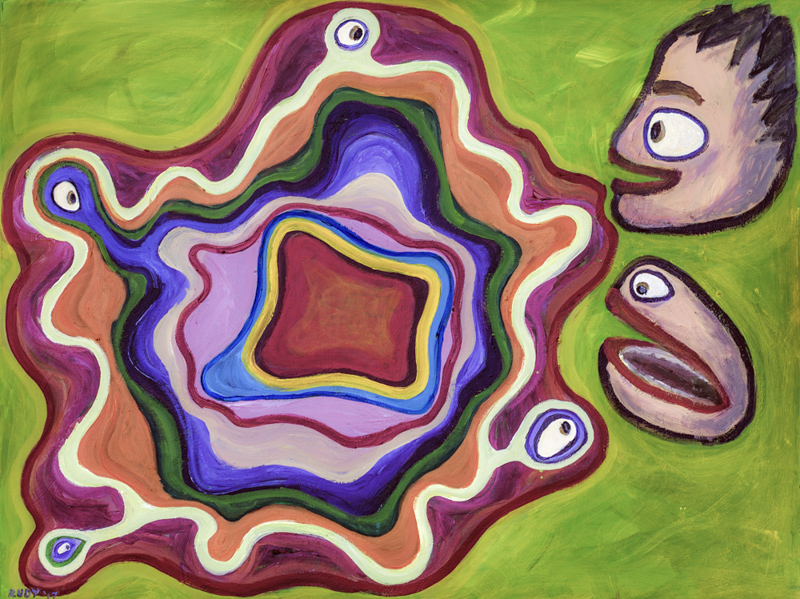
Our words act as instructions for assembling thoughts. But telepathy could work differently. By way of analogy, think about three different ways you might tell a person about something you saw.

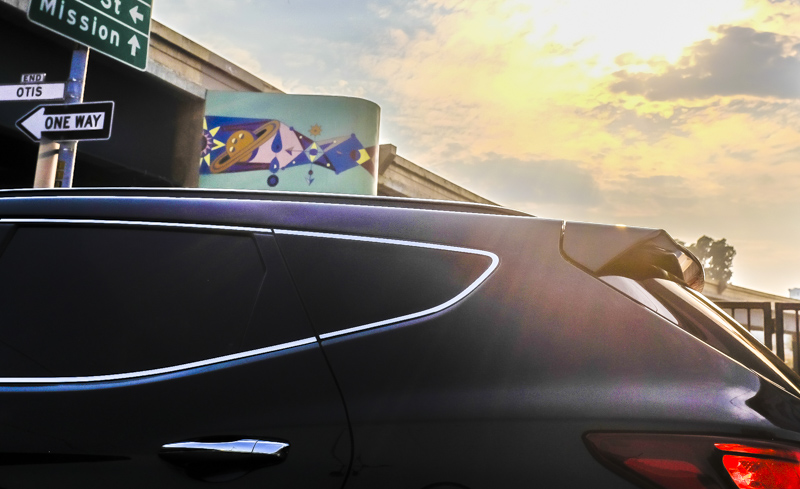
Like this cool image from San Francisco. How to share it?

  • Text. Give a verbal description of the image, via voice or via message.
  • Image. Show them a photo.
  • Link. Give them a link to the photo on your webpage.

In showing you this post, I’m using words and bitmaps to get you to emulate my thoughts. But what if we had telepathy? I like to use the word teep for telepathy. I don’t think commercial, tech-based telepathy is very far off.

Let’s imagine a brain-wave-based cell phone. I call such a device an uvvy. An uvvy might instead be like a removable piezoplastic leech that perches on the back of a user’s neck. Or it might be a biocomputing leech.

An uvvy can read your brainwaves. and transmit the patterns to someone else.

And an uvvy can receive brainwave patterns and etch them into your own brain. You are directly experiencing each other’s thoughts.

The most obvious use of an uvvy would be to use it like a videophone which also includes emotions and physical sensations. We’d use it for teep.

A possible problem with brain-link teep is that you might have trouble deciphering the intricate structures of someone else’s thoughts—seen from the inside.

Sharing lifeboxes could help make sense of another person’s internal brain links.

That is, as well as using ethereal brain-wave-type signals, you’ll want to use hyperlinks into the other user’s lifebox . The combination of the two channels can make the teep comprehensible.

Immortality

A lifebox is a software model of a person. If you have a lifebox, are you immortal?

Preserve your software, the rest is meat?

Two problems.

  • Software doesn’t seem to be conscious and self-aware.
  • We want to be embedded in the physical, natural world. We want sensations, and we want to be able to touch things.

It seems possible to develop a strong AI that it enjoys self-awareness. The essence may be to model one’s sense of “watching yourself watch yourself”

We might call self-conscious lifebox a ghost.

Where does the ghost live? You don’t want Apple, Microsoft, Google, Facebook or Lifebox, Inc., to own your ghost. You want your ghost to be a free agent.

So okay, store your lifebox ghost in a rock, let’s say it’s your tombstone.

Rocks have a lot of computational power….given that they contain an octillion particles joined in a parallel quantum computation.

That’s fine, but you also want to be running a body that can walk around and feel things. You might embody yourself as some kind of machine—an android, a drone, or even a bulldozer.

But natural bodies are where it’s at. They’re gnarly and dirty and interesting. Where there’s filth, there’s life!

If you’re pushy, you might want to take over another person’s body, or share it with them. Or you might use a fresh, tank-grown human body. Or use an animal!

Put your tombstone mind inside a dog.

I use the expression juicy ghost for a lifebox model-ghost that’s running in the body of an animal, like a human, or a dog, a bird, or an insect.

I recently wrote a subversive political story about this called “Juicy Ghost.” You can read it online in a zine called Big Echo.

What if your juicy ghost body dies? Well, you’ve stored your lifebox within the quantum computations of the rock that is your tombstone, so now you can download yourself into any fresh human or animal body that passes by.

And thus you become immortal as a series of juicy ghosts, a series of living avatars, each with sense organs, mobility, and an ability to act in the world.

And all these wonders are thanks to cyberpunk!

References

I discussed the lifebox in my futurological novel, Saucer Wisdom.

I write about the lifebox in more technical detail in my popular science book,The Lifebox, the Seashell, and the Soul>.

See also my Complete Stories , especially the stories “Soft Death” and “Juicy Ghost.”

My novel Software is part of the Ware Tetralogy.

I have a rudimentary lifebox for myself online as, “Search Rudy’s Lifebox,” at www.rudyrucker.com/blog/rudys-lifebox


Smoke and Mirrors

Sunday, September 22nd, 2019

Today I’ve got a bunch of photos with captions.  Each caption is above the corresponding photo, as opposed to below the image, which is where I often put them.

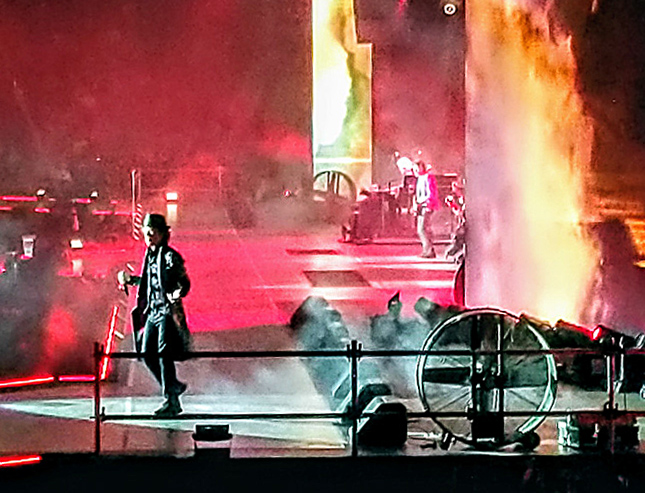
Sylvia and I saw the Stones concert at Levi Stadium in San Jose. I got StubHub tickets on the last day, and the seats were pretty close to the stage, and at a decent price. Sylvia was glad. We’ve seen them about five or six times over the years, going back to 1972, when we went to Madison Square Garden with our pals Fran and Jim Carrig. Jim’s dead, but I always think of him when I see the Stones.

The “Sympathy for the Devil” performance lasted about fifteen minutes, we got lost in it, and it took me away, which is one of the things I really want from music. That’s good old Mick there. Back from the valley of the shadow of Death. He didn’t whip the stage with his belt like he did in 1972. Jim Carrig and I used to do that with our own belts after we saw the 72 performance, merry, callow youths that we were..

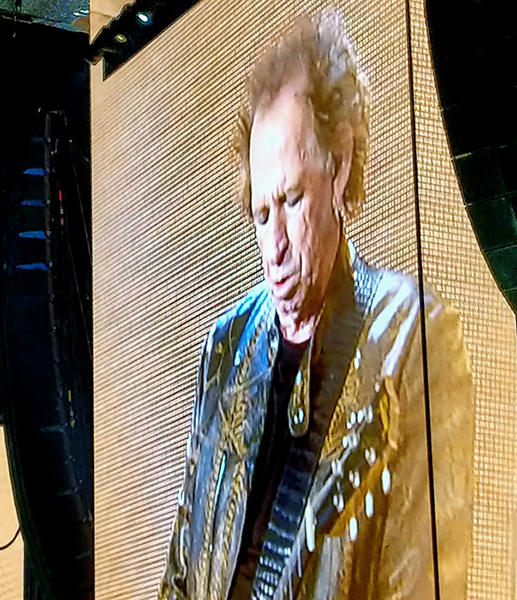
These days I worship Keith even more. The blues. They had really great video screens on the stage. By the way I recently watched Scorsese’s Shine a Light, which is about the best Stones movie out there.

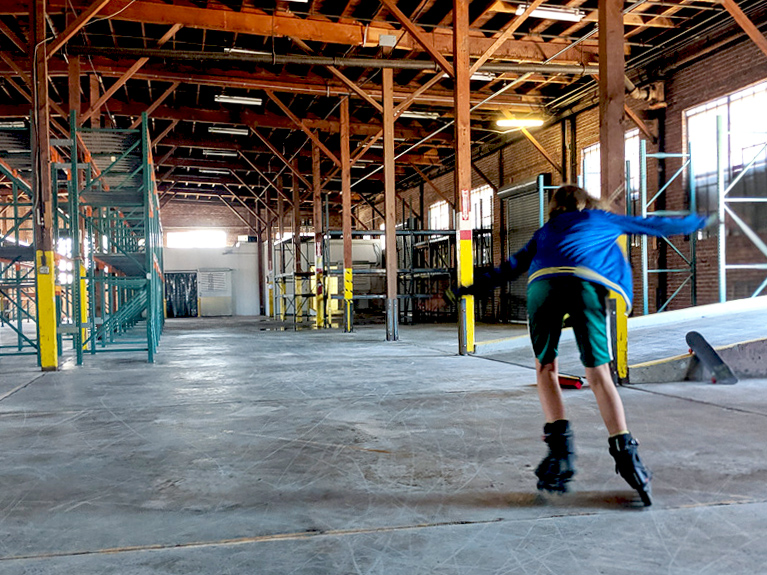
Rudy Jr.’s company Monkeybrains.net has bought an immense warehouse in the Oakland flats for their operations in the East Bay. A really big room with a concrete floor and a timber ceiling. He’s still figuring out how to divide it up. Mainly they want to have their Oakland office there, and storage for a stash of the antennas that Monkeybrains delivers to their customers’ houses.

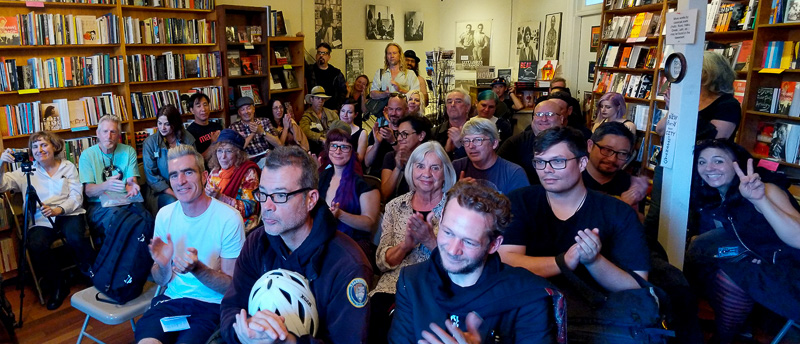
V. Vale and I did a reading in the very chapel of Beat, the upstairs room at City Lights Books in North Beach. He’s promoting a book of his photos, Underground Living. I happened to write the intro for Vale’s book. And ‘m promoting Million Mile Road Trip and my nine new Night Shade Books reprints.

For the show I read most of my subversive story, “Juicy Ghost.”

Our friends Lee and Susie Poague visited…we know them from our days in Geneseo, NY, where I had a job in the State University math department. Lee was in the English department, teaching Film and Journalsm classes. He’d get these huge rolls of film mailed into to show his classes — pre-video — and sometimes we’d watch those in his living-room, which was great. That was 45 years ago.

Before that, Lee and Susie went to San Jose State and actually got married in the campus chapel on the SJSU quad—50 years ago. Below is a shot of them by the chapel.

At Geneseo, Lee and I both knew we were going to be fired—the state university was in a “retrenchment” mode, which basically meant laying off faculty and hiring more administrators. Lee and I were constantly obsessing on the dangling carrot of “tenure”—our wives got tired of hearing about it.

In the end, of course, it was good for us that we left—in the wider world, things worked out pretty well.  And I got tenure at SJSU when I was fifty. In Geneseo, I never imagined I’d end up being a computer scientist in California. Moral? Hang in there. You never know.

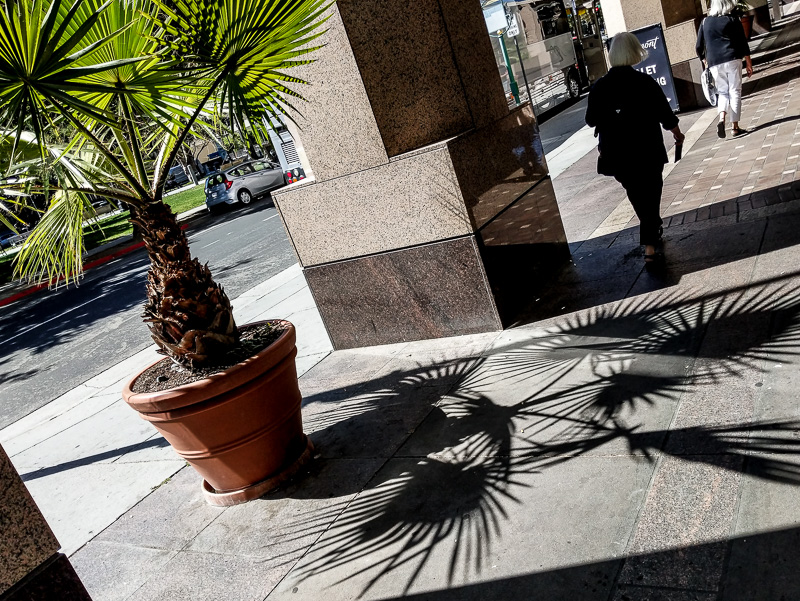
Califor-ni-yay. I love all the palms here, and their shadows. This is by the Fairmont in downtown San Ho where, as usual, the sidewalks are so empty you could fire a cannon down one without hitting anyone.

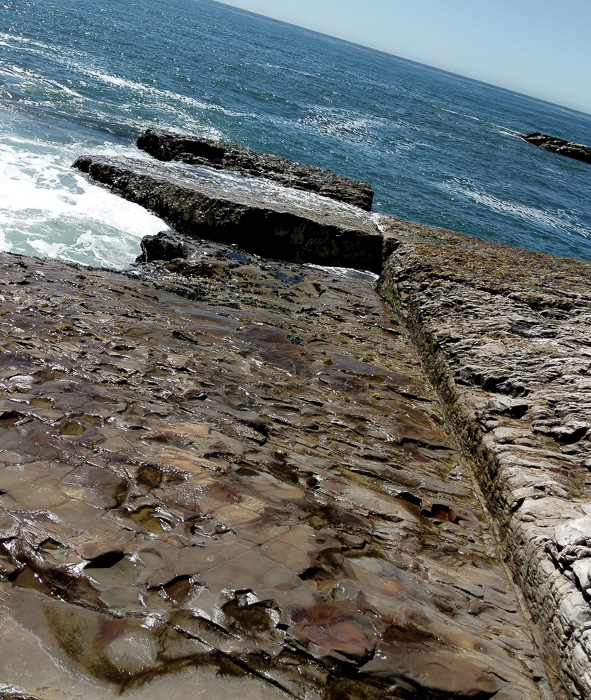
The other day I went out to Three Mile Beach north of Cruz with my friend Jon Pearce. Totally deserted, but in nature that’s a good thing. I think I once read that in Yellowstone park, 95% of the tourists never get more than twenty feet from their car. It’s really nice how deeply into wild nature you can get in the SF Bay Area if you drive about half an hour and walk for fifteen minutes.

Below is a good clear view of one of our state’s numerous faults. I recently read John McPhee’s book Assembling California. Talk about big picture.  Our state piled up from ocean bottom sliding east and mountain range sliding west…about a hundred million years ago.

And meanwhile I’m obsessed with global warming over the next twenty years.  A bit of a disproportion there.  Not that I want to minimize the current crisis.  But the scope of geological deep-time history is kind of staggering. Compared to ten million years, one year is the last millimeter of a timeline that’s ten kilometers long.

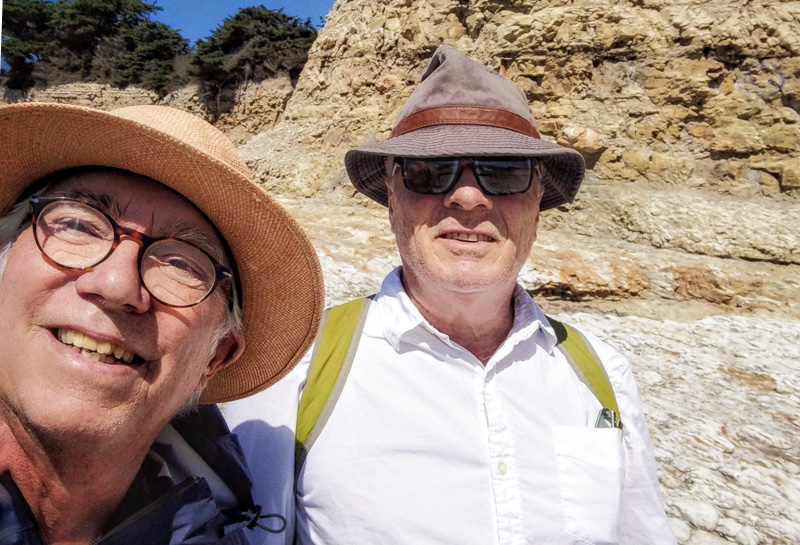
Two old men on the beach, that is, Jon and me. Last week, Sylvia and I went to Jon’s seventieth birthday party in a park in Santa Cruz. My friends and I  never imagined we’d get this old—although staying alive has its rewards. Jon was my office-mate when I was teaching Computer Science at San Jose State. I was there eighteen years, and now it’s been fifteen years since I retired. The older I get, the faster time goes, which is exactly the opposite of what I’d want.

I haven’t been shooting as many photos as usual of late. I think it’s partly because I’ve been focused on writing short stories. First I did “Juicy Ghost” this spring, and I wrote two more in the last two months, “Everything is Everything,” and “The Mean Carrot.” I’m sending them out to magazines, and if all else fails I’ll post them online.

Seems like all of my stories these days are relating to commercial telepathy tech, and to storing backups of your personality in the cloud. This pair of themes feels like an SF trope that’s opening up, with a lot of possible angles. I might stay with it and write more stories in this vein over the coming months.

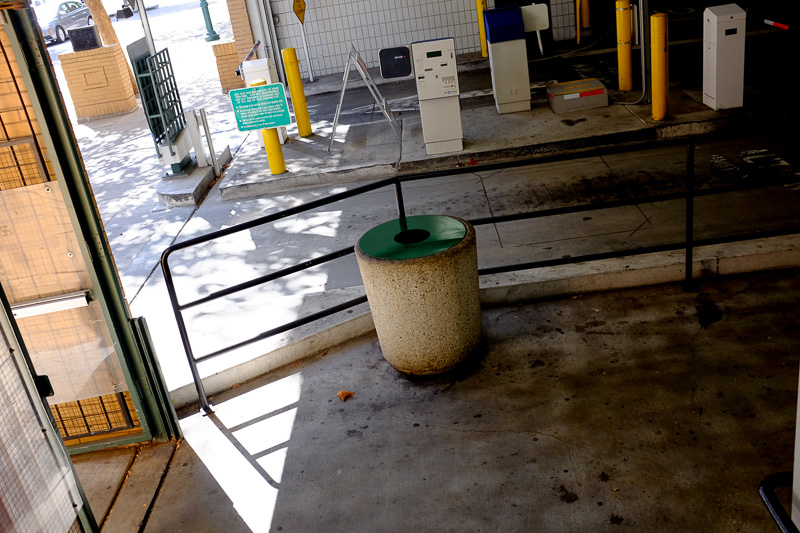
The photo below is in a parking garage in Santa Cruz. I was attracted by the pattern of light and shadow in that triangle at the bottom. But there’s so much else to look at that I didn’t crop it down. Going for more of a wide-angle Winogrand thing, although minus the people. Of course if you’re a hylozoist, like I am, you think that everything is alive, so there’s quite a chatty cround in this pic.

I always feel it’s too obvious to photograph signs, but I liked the light on this truck by that parking arage. Also, as I say, I’ve been away from photography, and if I have my good little Fujifilm X100-T along, it’s like everything I see starts looking like a potential photo. Something I like about carrying a camera: it opens my eyes. “Seeing photos” is a special mental process I’ve learned.

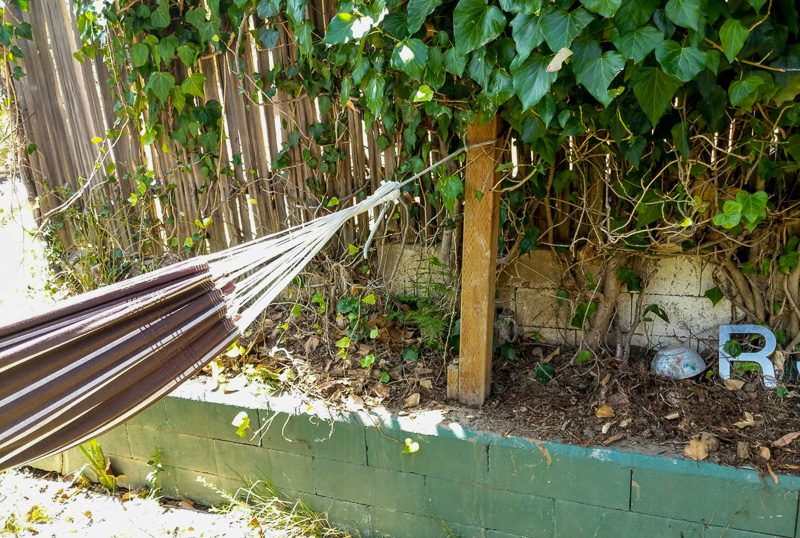
This next photo is more of a trophy than anything else, although I do like the pattern. I have a cloth hammock in the corner of the back yard, with one end tied to a tree, and the other end tied to this 4 x 4 that I embedded in a bag of concrete in a posthole-digger-dug hole twenty years ago.

Slowly it rotted, and recently it expired with a huge crack, the last time Rudy Jr. was in it, not that he’s portly. So I managed to root out the remains of the broken stub and put in a new 4 x 4. For me, accomplishing this kind of home improvement task is a triumph. For me, even knowin the phrase “4 x 4” is quite an accomplishment.

Note that Sylvia and I have a metal R and S from the kids in the underbrush there, but you can’t see the S.

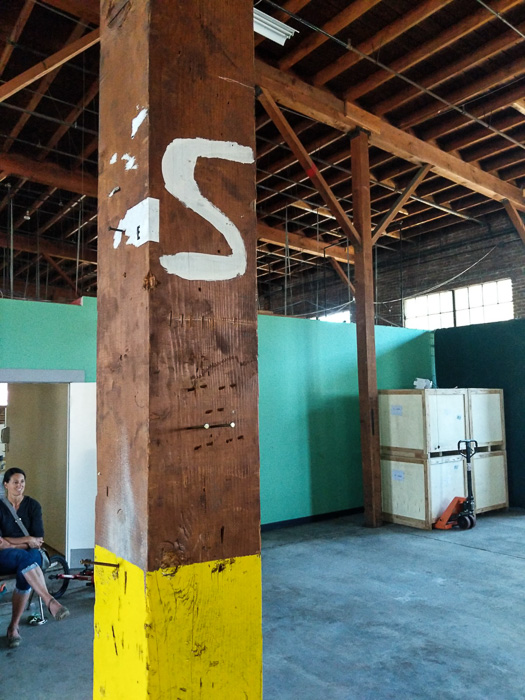
But you can see an S below, a post of a post in Rudy’s new warehouse. I love planes of color, and architectural meshes of posts.

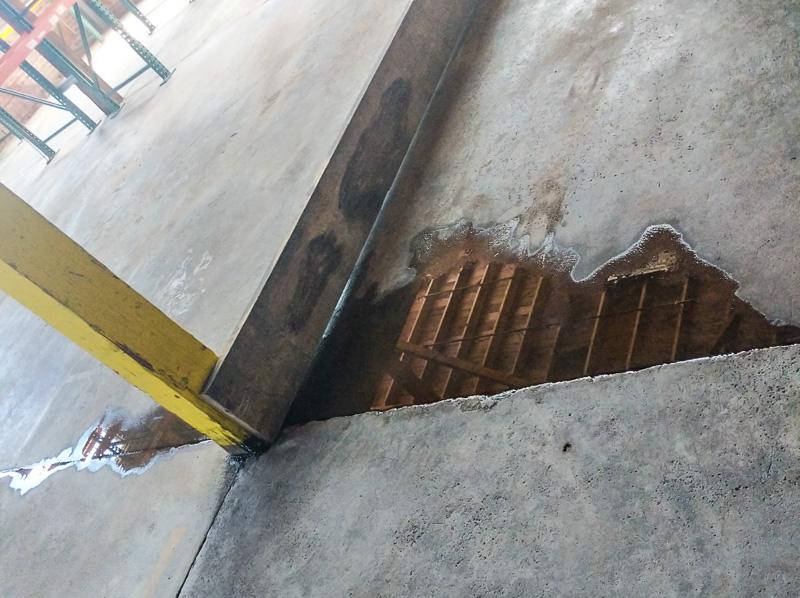
Another abstraction from the warehouse below. That’s a puddle on the floor reflecting the ceiling.

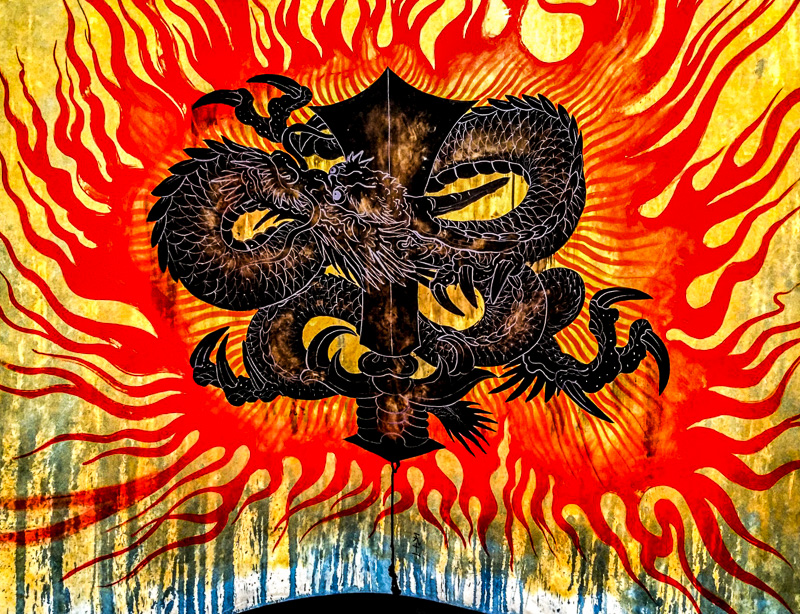
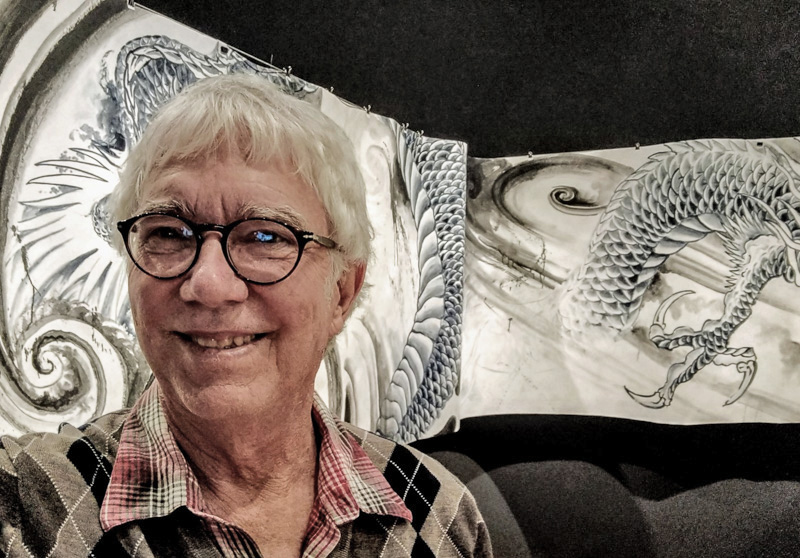
Sylvia and I took the grandkids to the Ed Hardy tattoo show downstairs the DeYoung museum in Golden Gate park. The show was a lot more interesting that I’d expected—the highlight was a 500-foot long by 4-foot high continuous scroll of Tyvek material decorated with two thousand dragons painted on by Ed, in a varying freestyle style, int the year 2000, on this 2000 squae foot scroll. Ed did scads of little dragons as well as the big ones, in order to get the population up. That’s a big one below, near the end of the scroll.

And here’s Pig Elder with one of the larger dragons.

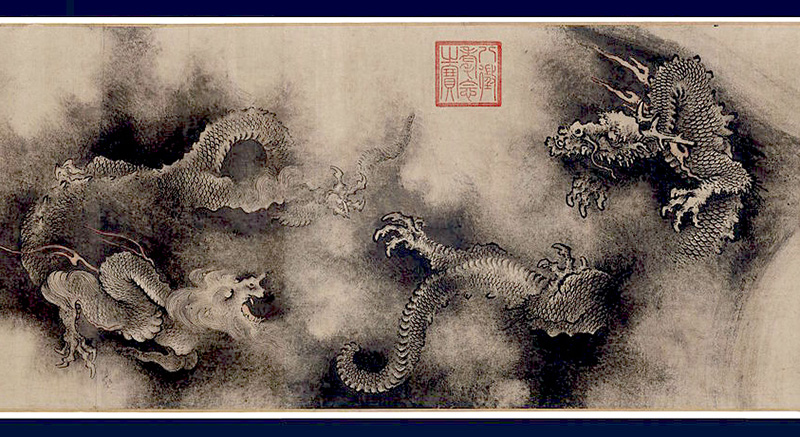
Hardy’s scroll painting was inspired by a 13th Century scroll by Chen Rong called “Nine Dragons.” I have a little section of it below, but I also have a big, zoomable image of the whole scroll online. It’s kind of like that timeline thing. We think we’ve come so far in art in modern times…but look where Chen Rong was nine centuries ago.

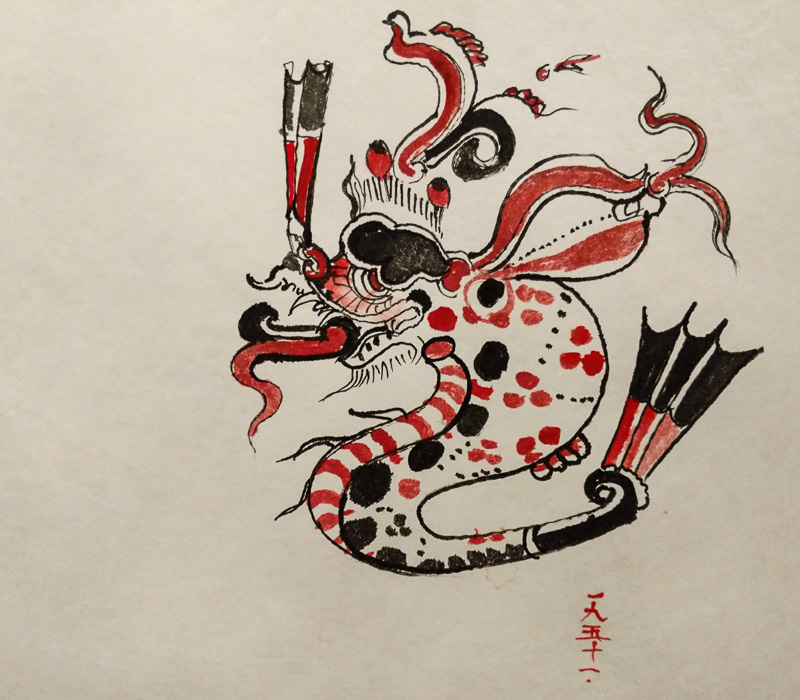
And here’s a tiny cute dragon with polka dots.

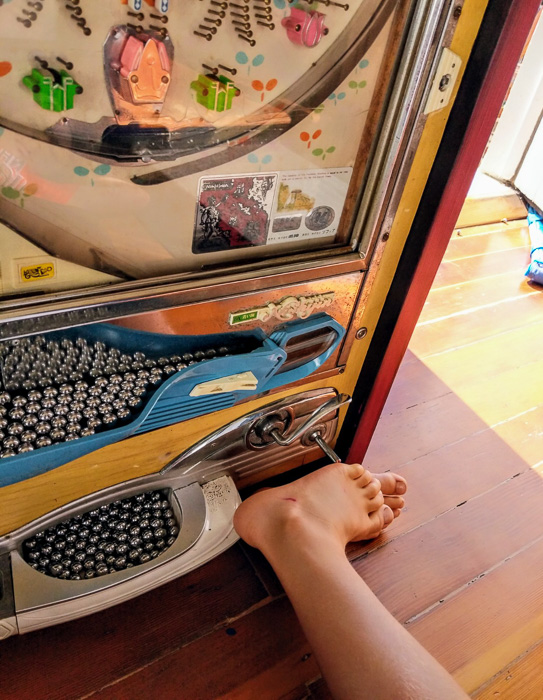
Somehow Rudy got hold of an old non-electric pachinko machine, where you fire little balls up into a grid. A little like a vertical pinball machine, and a little like a slot machine. They’re very big in Japan. If you end up with a large number of balls, you can get money for them, even though cash rewards at pachinko parlors are “illegal.”

The way it works is that in the parlor, when you return your balls, if you have more than you started with, they give you a package of Zippo lighter flints. And then you go down a tiny alley behind the pachinko parlor to a window in the wall, and the woman there exchanges your lighter flints for yen cash. My grandson Calder plays pachinko with his foot. Clever lad.

The city finished building a new arena for the Warriors to play b-ball in, it’s called the Chase Center—and why oh why can’t we have permanent and non-commercial names for the monumental urban structures that we subsidize with our taxes and our attendance fees?

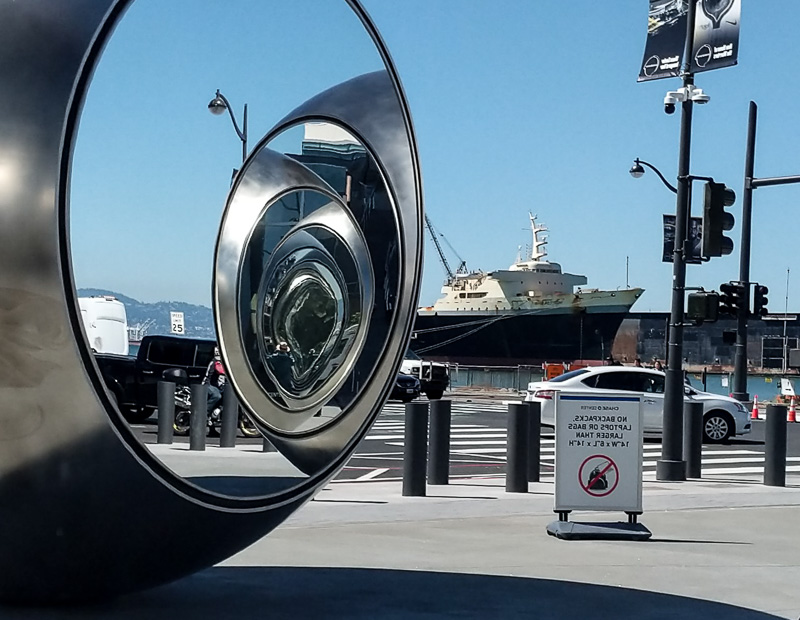
Anyway, there’s very cool sculpture installation by the Danish-Icelandic artist Olafur Eliasson. It’s on the Bay side of the building, consisting of 5 (as in 5 players) spheres (as in basketballs), and each sphere has one side shaved off to make a mirrored plane, and they’re arranged in a pentagon, mirrors facing the center, and you get awesome multiple reflections.

You can see the back of my head (wearing a pale straw hat) five levels in. And to top it off, there’s always ships parked there in the Bay…they have, like, a ship-repair spot there. Note that the sign is mirror-reversed…because I’m pointing my camera into a mirror. Fabuloso.

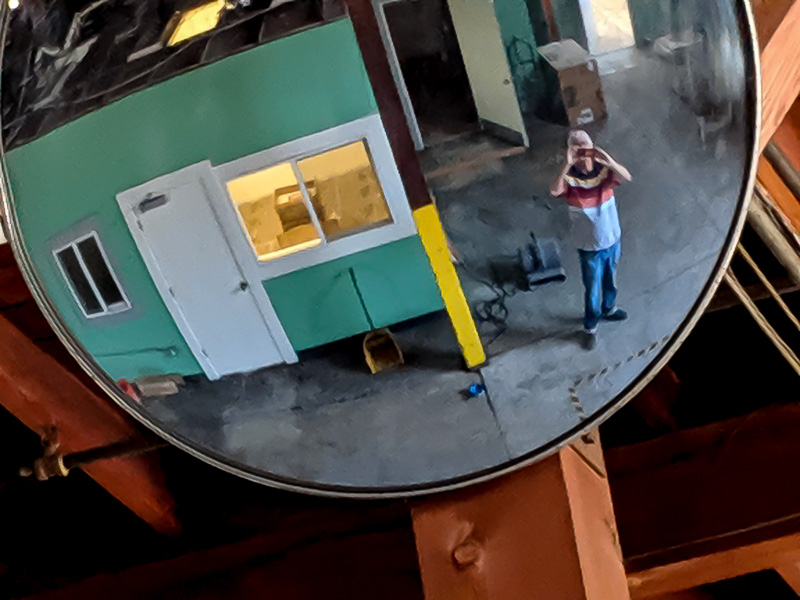
And here’s a traffic mirror in the Monkeybrains warehouse, from when the earlier owners—who provisioned ships—had little fork-lift trucks rolling around. I wear a new striped T-shirt from Gap. I’ve always liked striped T-shirts, first of all because I had a drawer full of them when I was about seven, and also because the holy Saint Andy W. wore them.

I drew the figure below for a story “Surfers at the End of Time” that I wrote with Marc Laidlaw about a year ago, featuring our recurrent transreal characters, the surfers Zep and Del. Time travel can get complicated. I redrew the diagram ten times while Mar and I were working on the story. I was a little surprised how complicated it turned out, but that’s where the logic led.

In the diagram, you’ll notice five names at the top, and these names correspond to the five worldlines below. Gother and Sally are women that Zep and Del meet, and Lars is kind of gnome called a murg. As you can kind of see, Lars has a closed-loop worldline. Just now, I won’t get into explaining any more than, but I will say more when the story comes out, in the Nov-Dec, 2019 issue of Asimov’s SF.

I’m hoping to start another story soon, but today I’ll go out in the back yard and paint.

Anthony Burgess’s Novel of Shakespeare

Sunday, August 18th, 2019

Recently I read Anthony Burgess’s 1964 novel Nothing Like the Sun. It’s a tale of William Shakespeare’s life, largely written in Elizabethan late 1500’s English. At first, starting out the book, it seemed too hard. But, just like when I see a Shakespeare play, I adapted a bit—and lived with the fact that many of the unfamiliar words were unknown to the Oxford Dictionary in my Kindle. Indeed a few of the expressions or words don’t even turn up hits on Google. But I did find definitions for a lot of them, and the remaining ones I could figure out from context, which was kind of fun.

These days I often read books on Kindle—because I can put them into a font size suitable for my old eyes. I do love paper, of course, but font size matters more. Another bennie of using the Kindle is that I can highlight passages that strike my fancy, email the passages to myself, and use them as the text for one of my photoblog posts. So here are my quotes, with some short comments, also photos, mostly from New York and Santa Cruz, plus a couple of my new paintings.

“Gems Diptych” acrylic on canvas, August, 2019, Pair of paintings, each 24” x 30”. Click for a larger version of the painting.

The young Shakespeare has sex with a passionate older woman, who speaks in a ladylike way afterwards, even though, to his shock, “[her speech] in no wise congrued with her lying near-bare against him nor with that horrible steaming-out, some few minutes past of a mouthful apter for a growling leching collier pumping his foul water into some giggling alley-mort up by the darkling wall of a stinking alehouse privy.”

(I did the two paintings above by starting out by brushing in a flowing Art Nouveau grid, as if for a stained-glass window, and then filling in the cells with colors, going to great lengths to have the shading be nice and smooth. The first one took me nearly thirty hours to do. I liked it so much that I did a second, using approximately the same colors, so they make a nice pair, or diptych. The paintings have zero connection with the quote above, but I wanted to put the Gems first in this post because I love them.)

Life in a nutshell: “…the eternal terrible truth of the skull disclosed at the feast’s end.” (This summer will turn to winter…)

Nature writing: “Leaves gold and brown lying like fried fish; birds twittering like rats in branch-companies, ready to leave the sinking ship of summer.” (Photo from a Santa Cruz bluff.)

Ah, the Shakespearean insights. “The play we act in is still busily being written in that dark room behind, the final couplet not yet known even to the cloaked and anonymous writer.” (The picture shows J. P. Morgan’s rare book room in Manhattan.)

A resentful older rival of Shakespeare’s famously applies this description to him in a pamphlet, soon after our Willy the Shake made it into the London theater scene: “An upstart crow, beautified with our feathers.” (Full house at a Broadway performance of Hadesland.)

Shakespeare writes a pamphlet length poem called Venus & Adonis, dedicating it to an earl whose support he needs. “It is not good, but it is as good as many. I cannot waste my whole life in longing for this man’s art and that man’s scope.” (The beauty queen in the photo was on a float. She’s gearing up for a Cuban parade in Manhattan, and she’s checking out a photo her friend took of her practicing a pose.)

Birds really are not our friends. “They were swans, but like the swans that sailed in the barge’s wake, greedy and cold-eyed. And the kites that flew to and from their scavenging in the June air, the ultimate cleansers of the commonwealth, they attested the end of all noble flesh.” (I rode my bicycle along the cliffs between Three Mile Beach and downtown Santa Cruz, and hit on this deserted cove. The driftwood here looks like a an alien slug. Possibly a flesh-eater!)

Burgess really raises his game in Nothing Like The Sun . “It was for lying, he saw hopelessly, that words had been made. In the beginning was the word and the word was with the Father of Lies.” (Not that this innocent and entertaining busker in the photo in Madison Square is the Father of Lies! But his beseeching pose vaguely fits the quote.)

Shakespeare is a father now, and he ponders how strange it is to to have spawned new human lives. “Only from them, the makers [that is, the parent], was hidden the enormous pulse of the engines, whose switch they touched by an alien curse concealed in the fever of rose or apple or mirror.” And looking out at the spreading lives of your offspring, “Yet there was only the one personal burden of being the source of the whole, the centre of the projection of shadows into the real that, bigger and undying, yet moved as oneself moved, in the mock court of an endless sterile reign to truckle and mow [not sure what he means by mow here].” (Rudy Jr. and me in Maine, photo by Embry Rucker III.)

A young writer’s unkind thoughts about his elders in the field. “There are examples enough of other poets and players who sought, when their powers failed for the enactment of sin, to whine to Almighty God of their deep and profound repentance. Yet call time back and they would be staggering anew in their drunkenness and grunting in beastly thrusting at their ragg’d and spotted drabs.” (That’s a full-size car. Sculpture in Manhattan near the midtown boat taxi stop.)

Love this quote. I’d like to start using this all the time. “I have news for thee, snorer.” (Photo in the Met.)

“Then to thy bed, belching in sloth, to lie there, paper unwritten on save by random sprawling greasy greedy fingers, ale-drop jottings, dust settling on the pile.” (At one of our fave restaurants in Manhattan, L’Express on Park Ave at 20th St.)

“WS blinked back to the painful world on a hot morning, openmouthed at the strong mid-morning sunray infested with motes.” I love looking at motes in the sunlight. Each mote a universe. (Cubans getting their outfits on for the parade. Love how cheerful they are. A holiday outing.)

“Five Eggs” acrylic on canvas, August, 2019, 24” x 30”. Click for a larger version of the painting. (This was a third version of the “Gems” paintings, but this time I wanted to put critters into the cells, so they’d be like eggs.)

“…a thrust of opal drops in animal ecstasy unleashed a universe — stars, sun, gods, hell and all.” “Soon, his heart sank to think it, she would be enticed to cornfields to beguile the dullness of a country spring.”

You never really know what you’re doing when you’re writing. All you can do is hope for the best. “…a man’s art and skill grew or languished or merely changed, and all beyond his control.” (The Met. I like to pretend that the crater at the top is the mouth of this being, with the black dot the eye. Sort of a half-fish half-human Bosch/Bruegel critter.)

“Only he himself knew what might be done if the words and craft could descend in a sort of pentecostal dispensation of grace. He saw dimly, a vision lay coyly beyond the tail of his eye. This stuff was play. There was a reality somewhere to be encompassed and, with God’s grimmest irony, it might only be grasped through playing at play, thus catching reality off its guard.” (A shrine to the Blessed Virgin Mary in Los Gatos near a Jesuit Center. Dig the praying saint on the left.)

“For the first time it was made clear to me that language was no vehicle of soothing prettiness to warm cold castles that waited for spring, no ornament for ladies or great lords, chiming, beguiling, but a potency of sharp knives and brutal hammers.” (Some of my recent Night Shade reprints on the shelf in the Barnes & Noble in Union Square in NY. Yes!)


Rudy's Blog is powered by WordPress