



Click covers for info. Copyright (C) Rudy Rucker 2021.


Archive for the ‘Rudy’s Blog’ Category

Rochester Spiritualist Gnarl For Peng Woogies!

Tuesday, April 3rd, 2007

Hello, Mr Chips!

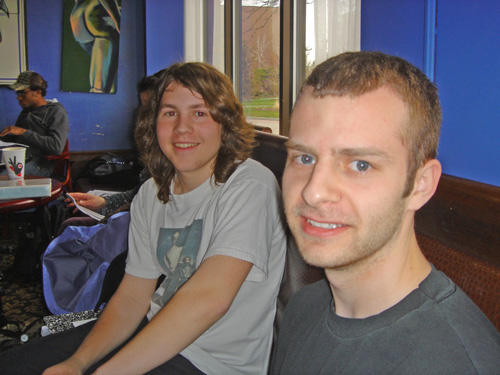
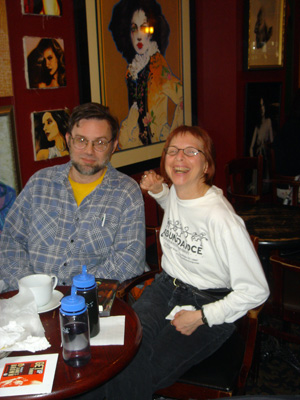
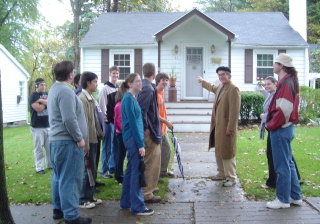
I’m in Rochester, where I worked 30 years ago. I spent this afternoon with two old SUNY Geneseo students of mine: Leander Watts, goth-magic YA novelist extrordinaire, and Amylouise Donnelly, an inveterate scribbler as well.

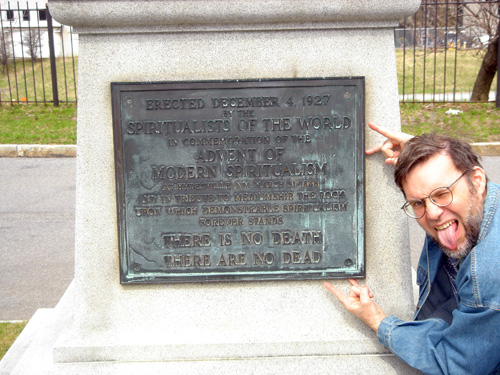
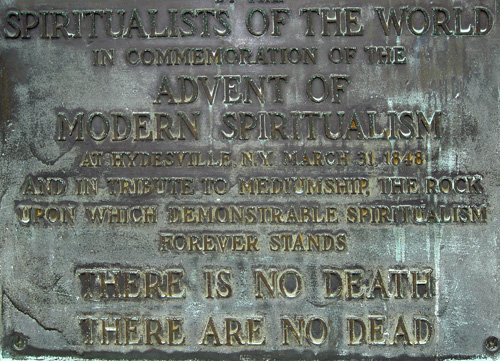
Here is one of Leander’s favorite sites of Hidden Rochester, a memorial in honor of the Fox sisters who were the mediums who got the Spiritualist movement off the ground.

“[Erected by] Spiritualists of the world in commemoration of the advent of modern spiritualism at Hydesville, N.Y., March 31, 1848 [159 years and 3 days ago, hmmm!] and in tribute to mediumship, the rock upon which demonstrable spiritualism forever stands.
THERE IS NO DEATH. THERE ARE NO DEAD”

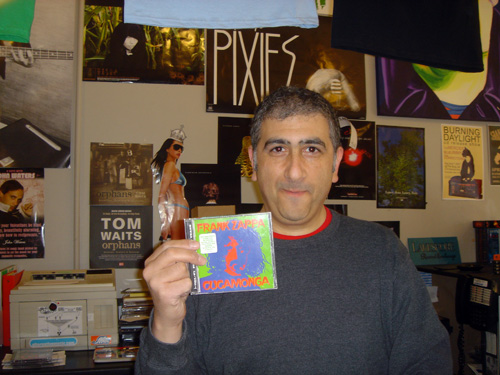
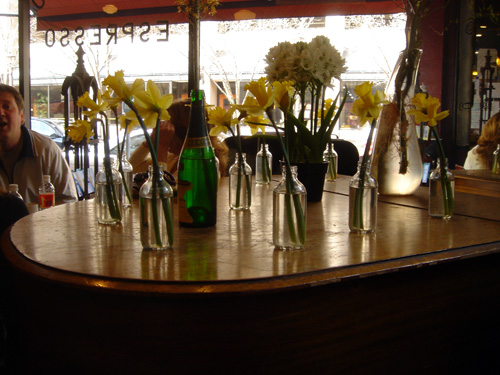
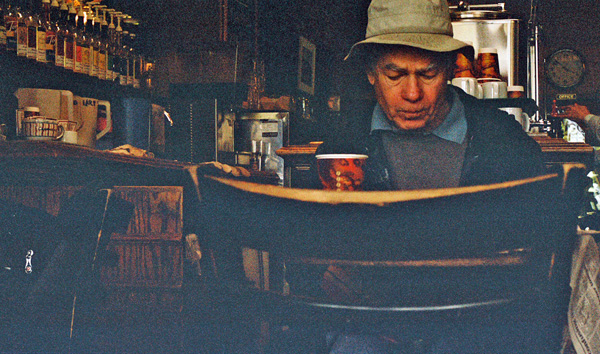
Amylouise led us to two cool coffee shops in Rochester: Java’s and Spot. Java’s is next to the Eastman Music school, with people coming in carrying cellows. Daffodils on the piano.

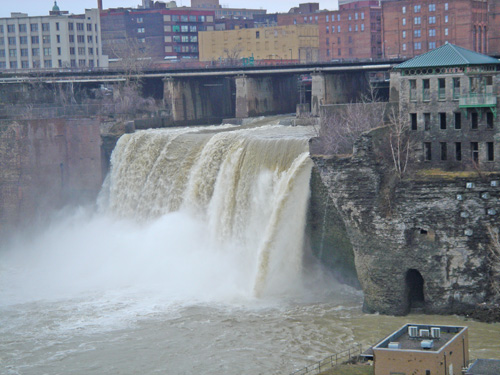
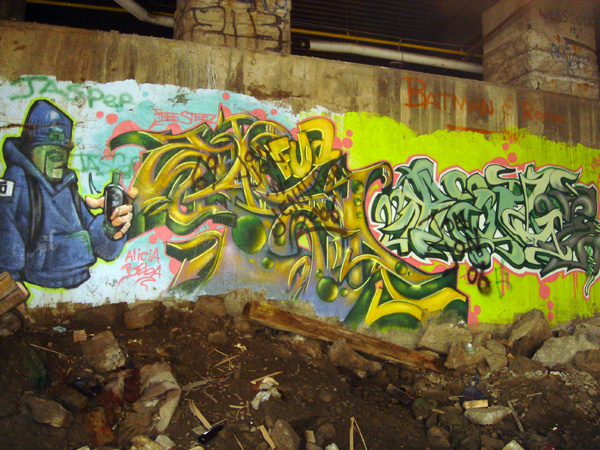
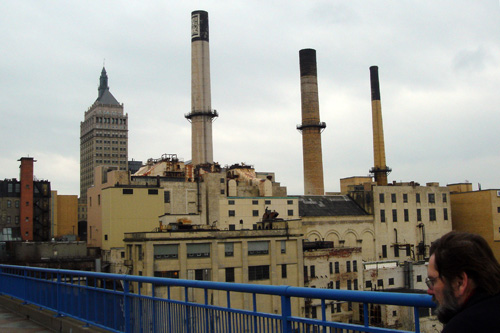
Leander took me into an abandoned subway over the Genesee River and under the Rochester Library where I used to go to Gurdjieff meetings thirty years ago. The subway is full of vibby graffiti.

It was nice to have my old students lead me around. They were both in a class I taught with Bill Edgar of Phil Dept on something like “Unknowability”. For me, this was seeds of my later book Infinity and the Mind.

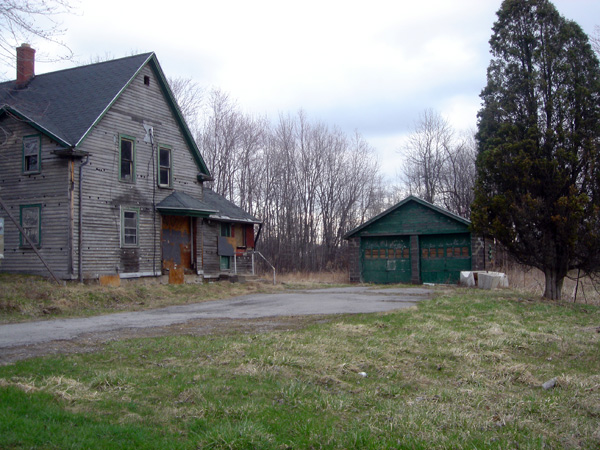
The house where Rudy Rucker wrote White Light is still to be seen in nearby Geneseo.

You’ve been giveng me some good comments on the post before last, that is, “Missing Gnarl. Peng Parasims.” I ‘ve been editing and re-editing my notes on it. So I’m gonna post about the idea some more today. As synchronicity would have it, this morning before seeing Leander Watts I decided to call the (unwilling) Earthside Peng transmitter a “medium.” And I started calling the simulations “woogies” instead of “parasims.”

[Woogie? My old friend Bill Caren? Or “Fred” from Scanner Darkly? Camera trouble…]

So, okay, going over it again, the Peng have an emigration technology that they call woogiecasting. The planetary mind Panpenga is willing to disassemble a subject Peng’s body, extracting the full details of the quantum computation it contains, to clean up the data a bit, and then to transmit this pattern via quantum entanglement to a distant world. The patterns create matter-wave simulations on the distant worlds, and the simulations are physical and very real-seeming Peng called woogies.

The experience of becoming a woogie seems low-tech to the users—they just jump into a certain volcanic hole. And Panpenga does it for free, as she likes the notion of spreading woogies of her denizens across the cosmos. Access to the woogification treatment is, however, expensive. To become a woogie, the Peng in question slides into a certain fissure on planet Pengö. The fissure leads down to some lava. Some wealthy high priests own the hole, and they require all of a Peng’s resources as the price for the favor—and the resources have to be very high. The planetary overmind, Panpenga, converts the body into a vibration that goes out from her north pole. And then subject Peng appears in physical form, memory intact, body in perfect health on some distant world: a woogie.

In order to turn a body into a woogie, the planetary mind Panpenga decodes subject Peng’s wave function into very many terms of a Fourier series—I’ll specify the exact number of terms below. But let me already warn that the Fourier series representation is a very inefficient and computationally wasteful method to represent a body’s wave function. But Panpenga uses it as it’s a brute-force no-brainer approach that always works.

Once Panpenga has the Fourier series representing a subject Peng, she edits the terms of the Fourier series so as to remove any diseases that the subject Peng might have. (I take this notion from Charles Stross’s Glass House, where he describes a somewhat similar procedure being used—for security purposes!—in nanotechnological “assemblers” that arriving teleported immigrants have to pass through.)

And then the Fourier terms are transmitted to a 100 km by 100 km by 100 km volume of matter on another world. This block of slaved quantum-computing matter is called a Peng ranch. For dramatic effect I’m making the volume be big. Each individual atom in the Peng ranch carries out the emulation of one single component of the Fourier series.

The atoms hum together, and their beats converge onto a single vibration of matter waves that is a simulacrum of the woogified Peng. Keep in mind that woogies have mass and physical presence. They’re not just something like holograms or mental images. In imagining how a distributed quantum computation can cause a physical object to emerge, think of a parabolic mirror (or a lens) which focuses a bunch of light waves to a single burning point, or think of a bunch of lasers focusing light waves on a single spot to produce a tiny sun. And now suppose that it’s DeBroglie matter waves instead of light waves.

Let’s crunch some numbers.

Like most emulations, the woogie-generating computation is highly inefficient. A normal Peng’s cubic meter or so of matter computes the Peng in question, and that’s the end of it. But a Peng woogie requires all the mass in the 100 km by 100 km by 100 km volume of a Peng ranch. This is quadrillion cubic meters, so we’ve got a quadrillion-fold inefficiency here—in that we’re using a quadrillion cubic meters to emulate one cubic meter.

In visualizing how the initial woogie emulation can be so incredibly inefficient, think of an immense tangle of machinery that does something very simple like peeling an apple. Or an insanely complex cellular-automata-based construction that generates a tiny little regular pattern such as a binary counter or a listing of the primes. Or a Turing machine that flurbs and skitters up and down light-years of memory tape just too compute a few digits of pi.

I’ll allow one initial mitigation of the inefficiency. As Peng are, after all, somewhat similar to each other, you can piggyback the computations of a few Peng together into a single wave function, end have the Peng ranch support two or three Peng woogies—who are exceedingly tightly linked as they share a single wave function.

One of the threads of the story will involve the Peng trying to achieve greater efficiency in the woogie computation. Another thread involves way of trying to disable a Peng ranch, using a mind-virus called the love-bug. Jayjay knows the name, after all, of every one of those ten tridecillion atoms. (The names are each eight random English words, as I mentioned in the “octillion” post.)

Telepathic Alien Propaganda

Saturday, March 31st, 2007

I’ll be busy for the next two weeks, so there won’t be a fresh blog entry till after April 15. Part of the time I’ll be Amsterdam—check out the Upcoming Events notice in the sidebar. Any readers out there in the Netehrlands who want to get together with me while I”m in Amsterdam? Email me.

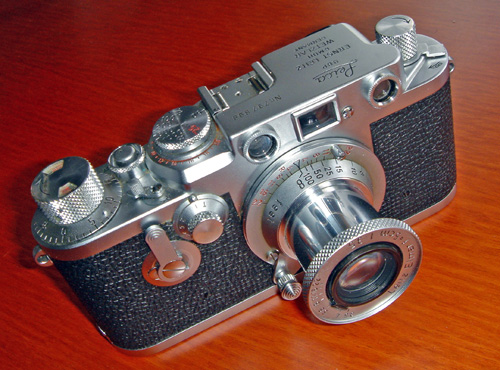
This week a friend sold me a cool old 1955 Leica IIIf camera for a good price. They’re not nearly in the stratospheric level of the M series. The pictures today and most of the pix on March 28 (not the opera house ones) were taken with it. I like pix—that Leica glass. Deep focus. Loading the film is a bitch, but I found this great site Cameraquest that loves this particular model (IIIf RD ST) and even tells how to load it. I think I’ll take it along on the trip.

For today’s topic, I’m gonna view telepathy is a new medium to exploit. So the invading Peng in Hylozoic will be using it to get us to let them move in.

Media Promote Worship: The media get us to worship certain people. These are “stars” and “leaders”. A superficial motive is to get the public to pay to hear more about the stars. A fundamental motive is to get the public to obey the leaders and give them their wealth and the resources of their land. The stars are the content, the leaders are the sponsors.

Media Spread Fear. The media press us to think about a few “issues” at a time, always disturbing ones. The motive is to make us afraid so that we want our leaders to protect us and are willing to cede our autonomy. Fear is the content, the leaders are the sponsors.

Peng Promote Worship. Peng present themselves as cute and interesting. They put a dazzle-aura around themselves. They trail memory sheets of happy family memories and colorful anecdotes. They engage in riveting soap-opera intrigues. They have a big singing contest coming up, and they do sing very well. People root for them like for sports teams. People don’t mind that all of, say, Oakland is de-energized so that the Oaktown Peng can warble and croon. There might as well be a tie-in between the Peng and the Founders reality show that my main characters are in.

Peng Spread Fear. They tell us horror stories about bad other aliens. They tell us about the Hrull starship-engines that are made of squashed humanoids. A whole list of scary aliens. Tentacle monsters. Pinchy beetles. The Wyrms. The Holothurians. The Hoarse Roar from the Dawn of Time. The Leicon—the seemingly innocent appliance that is in fact an alien robot who takes over your life, sending you on endless searches of EBay for more lenses and, drool, M series models…

Missing Gnarl. Peng Parasims.

Wednesday, March 28th, 2007

Here’s today’s idea for Hylozoic, second volume in my forthcoming cyberpunk trilogy. Having written chapter one, I’m reworking the outline. Dig this, dear reader.

The Missing Gnarl. This is where I want to end up: the birdlike alien Peng are siphoning off the gnarly computation from Earth’s matter. As a result, our clouds, waves, fire, wind, plants and minds behave more simply. What are the Peng using the gnarl for, and how are they stealing it?

[Me with my friend Gary on the roof the SF Opera house after he gave us a backstage tour after the ballet on Sunday. Scanning the sky for UFOs.]

The Peng use the missing gnarl to simulate individual Peng that thereby acquire a physical presence on Earth. These “parasims” are much stronger form of emulation than a simulation that lives within a virtual reality. Parasims have mass and physical presence. They’re the output of a heavy-duty distributed quantum computation spanning the decillion or so particles on the parasims’ “ranch.” The parasim Peng fall apart without a steady influx of computation. They’re like ice-sculptures in a blast furnace, being kept together by a zillion gnats with trowels and Slushy cones.

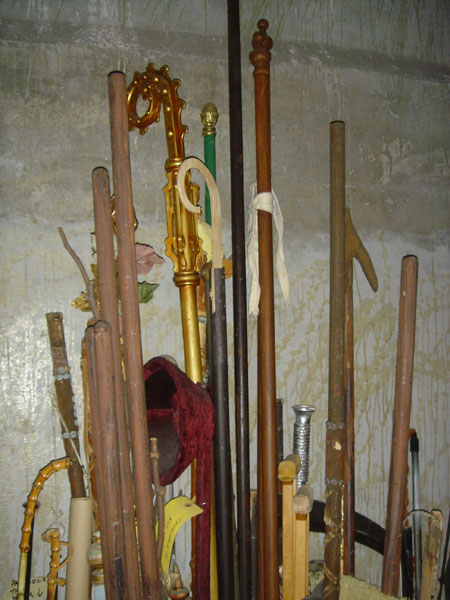
[At the opera there’s a prop area with for instance every kind of staff they might need for staging a show. People use staves a lot in opera-land. Keeping the actorly persona together like a parasim.]

Here’s the kicker. Due to certain inefficiencies of the emulation procedure, maintaining the physical presence of a single Peng family’s parasims requires every bit of the gnarly computation contained within a patch that covers some ten thousand square kilometers of Earth’s surface. That’s a million hectares. Putting it another way, parasimulating a small Peng family requires the resources of Peng ranch which is a square that’s roughly sixty miles on a side, like a large county. And the parasims soak up the computation in a mile of the air above the Peng ranch as well as a mile’s worth of the Earth’s crust below.

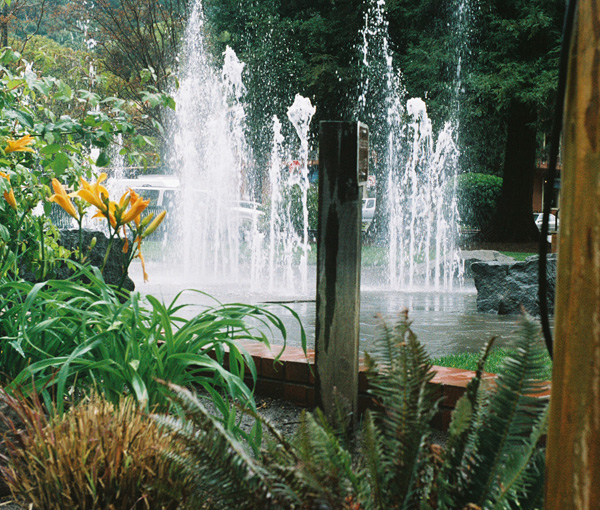
[The Los Gatos fountain wouldn’t look like this anymore. It’d be simple parabolic arcs.]

A Peng has to be very wealthy to become an Earth-based parasim. It’s the final big pay-off for a prosperous Peng life, it’s like immortality. Our Earth is like a heaven for the Peng. Although their planet Penga is forested, it’s a cooled-off, senescent, uninteresting world—like the Peng civilization itself. Earth is a Pengese post-retirement paradise. We marginalized humans are like natives bitterly squinting at a McMansion development that takes up most of our island.

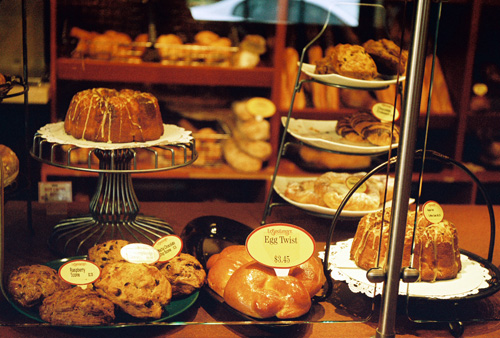
[We’ll still have our bakery, but all the shapes will be perfectly simple and smooth. It’ll be hard to mix things with no chaos or gnarl working for you.]

Talk about conspicuous consumption! Huge areas of Earth are to be drained of interest to support a few smelly, pecking Peng. There’s just the one dot of bright, happy Peng gnarly amid a million hectares of dullness.

How many Peng does Earth have room for? Suppose the Peng want to live on land, not water. Earth’s surface has 150 million square kilometers of land, that is, 1.5 * 10^8 square kilometers. And I’m supposing that a Peng (or a small Peng family) requires the computational resources of a land area that’s a hundred kilometers by a hundred kilometers, a Peng ranch of, once again, 10^4 square kilometers. Doing the math, on Earth’s whole land surface we’d have room for some fifteen thousand Peng ranches. Only the cream of Pengese society need apply! Announcing the Wigfalls of West Philadelphia! Assuming the Peng won’t be moving into the intrinsically dull zones, Earth’s developers will only have room for maybe five to ten thousand Peng ranches.

Wow. I’m thinking of some great possibilities here. Peng realtors! Sell-out Earth developers!

Dot Patterns for Birthday Cards

Friday, March 23rd, 2007

So yesterday was my 61st birthday. I had some fun getting out the trusty old ruler and compass and making a Pythagorean-style pattern with 61 dots. Note that it consists of six “tetractys” patterns whirling around a central dot. Tetractys was what the Pythagoreans called the familiar bowling-alley pattern of 1+2+3+4. One can also speak of 61 as a hexagonal number.

I figured all this stuff out in 1985 and 1986; that is, how to represent many of the “birthday numbers” (from 1 – 100) as nice patterns of dots. I uploaded a very useful file about this for the world today:

Dot Patterns for Birthday Cards

[The file is the Adobe Reader PDF format; I found that with my latest version of Firefox, I needed to install the new free Adobe Reader 8.0.]

The material is drawn from my book MIND TOOLS: The Five Levels of Mathematical Reality (Houghton Mifflin, Boston 1987). Twenty years ago! I think it’s out of print but there’s used copies on Amazon.

For the last twenty years, I’ve been putting these dot patterns on almost every birthday card I’ve signed—and now you can do it too!

By the way, you’ll notice that some numbers don’t seem to have any nice dot patterns. For these difficult birthdays (or anniversaries), I turn to Plan B:

David Wells, The Penguin Dictionary of Curious and Interesting Numbers.

(I always get a chuckle out the picture on the cover because the guy looks like such a complete pinhead.)

This valuable, nay, indispensable book has an entry for—well, not all—but lots of numbers. Though, let it be said, many of the entries describe properties that are not exactly box-office gold. Like, “1/61 has decimal period 60 which includes 6 occurrences of each of the digits 0 to 9, the smallest reciprocal whose period has this property.”

The Mathematician Godfather makes you an offer you can’t understand… The virtue of my Dot Patterns for Birthday Cards is that most of them are visual patterns you can readily fasten onto. Patterns for a cheerful, uncomplicated Birthday Pig.

By the way, I first heard about Wells’s book from the mathematician Richard Guy when I jokingly asked him what, in his opinion, was the first uninteresting number. He said it would the first number I would not find in the Penguin Dictionary of Curious and Interesting Numbers.

The reason my question wasn’t entirely serious is that asking about the first uninteresting number poses a paradox (related to the Berry Paradox in the philosophy of mathematics). For the first uninteresting number is, hmm, kind of interesting.

Wells, too, is aware of the paradox, and he lists 51 as being the first number with no interesting properties, and duly notes that this makes it interesting.

The first number so truly dull that Wells doesn’t even list it all is—drum roll—54. But if you’re 54, don’t despair. It’s meta-interesting!


Rudy's Blog is powered by WordPress