Click covers for info. Copyright (C) Rudy Rucker 2021.


Archive for the ‘Rudy’s Blog’ Category

My College Studies

Thursday, October 30th, 2008

First a couple of links. I recently met a San Jose photographer called Gary Parker, who does some interesting work, including portraits of people with their pets and photos of little people.

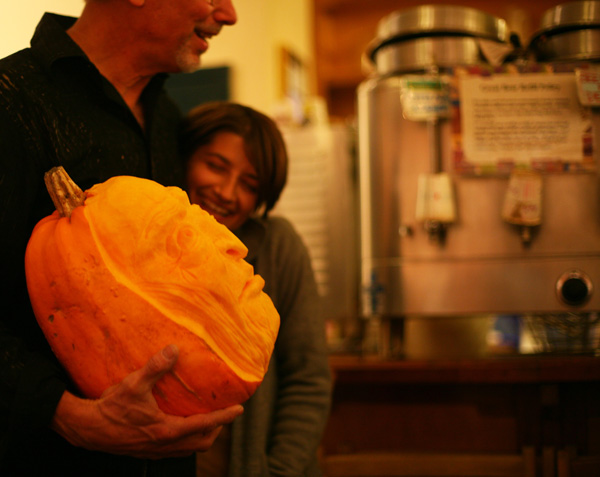
Gary has a show of his photos at the Bear Coffee shop on Santa Cruz Avenue, in Los Gatos, with an opening last night, and some of his friends came by, including a master pumpkin-carver.
My guru-like friend Ralph Abraham has been working on his website, posting some thoughts about chaos and the stock market crash, and making all of his past articles available, including an intriguing paper called “Mathematics and the Psychedelic Revolution,” which exposes some of the hidden history of Silicon Valley. Far from being a herd of nerds, a very large number of computer graphics pioneers were ecstatic stoners.
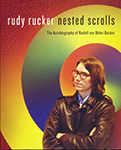
And now for another excerpt from my memoir-in-progress, Nested Scrolls.

When I started Swarthmore College in 1963, I’d been planning to major in philosophy or in literature, even though Pop kept urging me to study something more technical. “You can read all those books on your own,” he insisted. “Read those books, of course, but learn some science too. Be a Renaissance man!”

Although my natural bent was to disagree with Pop, after a couple of semesters, I decided he was right. I wasn’t getting much out of the philosophy and literature courses that I was taking. I asked my philosophy professor about the meaning of life, and he deluged me with double-talk. And the English lit professor wanted us to read unbearable stuff like Pamela or Vanity Fair. I found these books so dull that, try as I might, I couldn’t even read their summaries in our library’s treasured resource: Masterplots, a twelve volume set with the plot stories of the world’s finest literature.

Before long, I found it too much trouble to even read the summaries in Masterplots, but by then it had became a running joke among the other introductory literature students always to check out the Masterplots volumes under the name Rudy Rucker.
At least in science you didn’t have to read a whole lot of crap. I had a vague notion of majoring in physics and inventing an antigravity machine, but physics turned out not be my strong suit either. After a grueling semester of Mechanics and Wave Motion—in which I tried unsuccessfully to make a hologram with a laser—I was off the physics track for good.

And so I majored in math. I had some difficulties with my initial calculus course, some basic issues in understanding what we were even talking about. But then I got a fellow student named Arnie to help me. He explained the mysterious “chain rule” to me, talked about the infinitesimal quantities dx, dy and dz in a relaxed, cozy tone, as if were discussing the doings of some little gnomes that lived beneath is floor. From then on, math came more easily for me. I liked that there were so amazingly few brute facts to memorize. Given that everything followed logically from a few basic assumptions, there wasn’t all that much you had to learn.
What else did I learn? A little bit about modern art. And I took a German literature class where we read Kafka’s Metamorphosis in the original German, which allowed me to understand that Kafka had meant for his stories to be in some sense funny. But other than that, most of what I learned was from the other students.

I liked talking to my friends, socializing with the girls, walking around the grassy campus, and exploring the nearby Crum woods. I was in with the in-crowd of our class, and I reveled in that. In grade school and high school I’d been more of an outsider.

With my steady stream of C grades being mailed home semester after semester, Pop sensed how little work I was doing. “It’s like you’re sitting at a lavish banquet table, Rudy. And all you’re doing is eating a sandwich that you brought in your pocket.”

Concerned as he was, Pop even paid me a surprise visit one day—appearing in my dorm room in the fall of my senior year. It ended up being the best day together that we ever had. He was accepting and non-judgmental. We walked around the campus talking about the meaning of life. I even took him down to the Crum woods and showed him the impressively high train trestle that crossed the creek.

We boys liked to walk out to the middle of the trestle—it had two tracks so that, in principle, even if a train came by, you could go to the other side, and if, by some horrible fluke, two trains came at once, you could lie down flat and hold the ties, not that anyone I knew had ever executed this drastic maneuver, although we talked about it a lot, worrying that the train might have a dangling chain that hung to within millimeters of the ties.
Pop was being such a sport on our big day together that he even walked onto the trestle with me. For those few hours, it was like we were fellow college boys. He really didn’t care much about proprieties or appearances. He just wanted me to be okay. He didn’t want me to fall off the edge.

“Romeo and Juliet”

Monday, October 27th, 2008

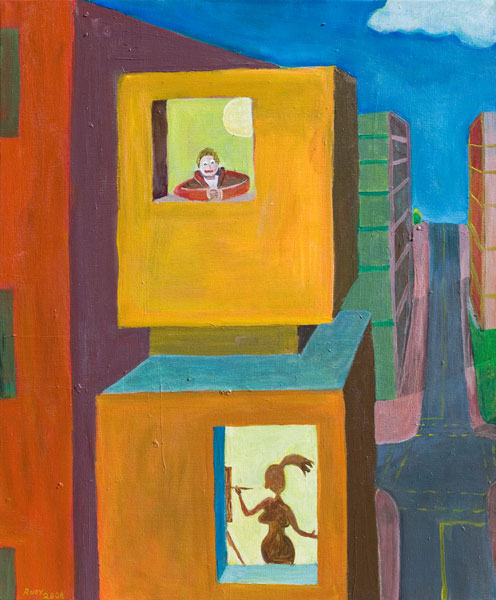
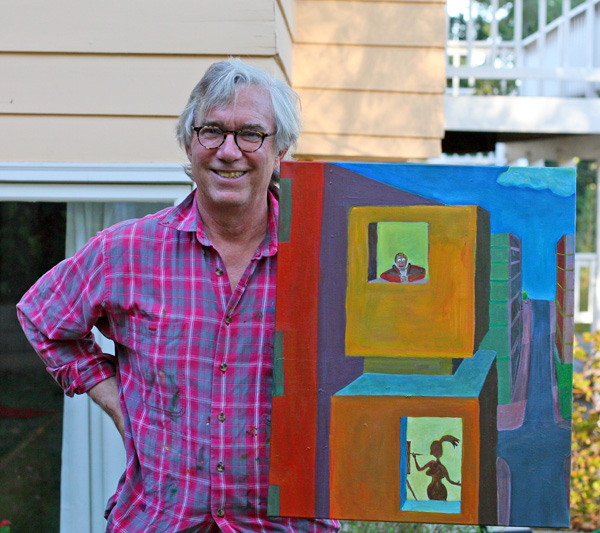
I finished a new painting yesterday, “Romeo and Juliet.” It has kind of a New Yorker cover look to it. It emerged from a starting pattern of abstract squares that I painted to use up the paint left over from “Owl Creek.”

For I think the first time, I did the whole one-point perspective thing, drawing lines to the vanishing point, so as to determine the lines of the buildings’ edges. Unless you have buildings or streets or other man-made structures, you can get along pretty well without formal perspective most of the time.

Dig how Romeo has the Moon inside his room!

The composition is inspired by Wayne Thiebaud’s street scenes of the 1980s, not that I’d care to compare our work side to side! Something very cool about Thiebaud is that he goes beyond Renaissance perspective and uses multiperspective, that is, he has different parts of his paintings be converging in on totally different vanishing points.

My friend Jon Pearce came over to paint with me…he’s new to the game, but he had fun. He called his picture “Encroaching Weirdness,” picking that phrase from something I said.

On a different front, here’s a video segment of Bill Gosper giving a computer-animated talk on some of his discoveries on topics such as pi, the Pythagorean theorem, and cosmically large simulations of the Game of Life. The sound quality totally eats it—failing to capture the cracked, manic energy of the G-man’s voice—but the graphics are lovely.

Gosper, by the way, was the very first person to be giving talks like this, all the way back in the early to mid 1980s. At that time nobody but him had the ability to throw mathematical graphics onto the big screen. He used to use a computer projector called Light Valve, which painted its pictures with jets of dyed spermaceti whale oil inside a tube illuminated by an arc-light…I kid you not.

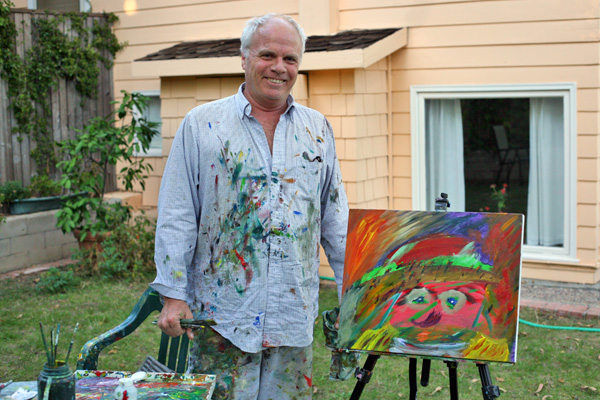
I really enjoy getting away from the computer and just smearing the paint around. Jon took this picture of me, note that it’s a slightly earlier version of the painting.

One more link: Fellow computerist and artist Robert X. Cadena turned me onto his image-rich blog.

Beatnik SF Writer

Saturday, October 25th, 2008

[My blog posts these days are largely drawn from my current writing project, the first draft of my memoir: Nested Scrolls.]

1960 was my brother Embry’s last summer at home before college. To be further from my parents’ scrutiny, he’d moved his dwelling into the basement of our house. He had shelves of hot-rod magazines, copies of Dig magazine, a set of bongo drums, and dozens of back issues of Evergreen Review. My friend Niles and I began spending time in Embry’s lair, even when he was there.

Niles thought the hot-rod magazines were absurd. “Look at this ramshackle jalopy,” he said, dismissively tapping the picture of a championship dragster. “What a piece of crap.”

“That car goes a hundred and sixty miles an hour,” Embry testily responded.

“Sure,” jeered Niles. “Off a cliff.”

When I realized that the Evergreen Review magazines had curse words in them, I began combing through them when I was home alone—looking for pornography. But that wasn’t exactly what I found. Instead I found a career.

One particular excerpt of William Burroughs’s Naked Lunch utterly blew my mind, it was about junkies and hangings and weird sex, written in a hilariously in-your-face dead-pan tone, utterly contemptuous of any notion of bourgeois propriety. Burroughs was a banner to salute, an anthem to march to, a master to emulate.

Embry’s Evergreen Review stash was a treasure trove—I found poems by Allen Ginsberg, writings by Kerouac and, somehow the most heartening, story after story by beat unknowns. Men and women writing about their daily routines as if life itself were strange and ecstatic.

Niles and I found an anthology in the library called The Beat Generation and the Angry Young Men, and this was where we first saw Ginsberg’s Howl. We read that amazing poem out loud to each other, reveling in the bad language and bad attitude, staggered by the sense of liberation.

And from here it was a short hop to Jack Kerouac’s On the Road. This book spoke to me like none I’d read before. To be out in the world, free as a bird, drinking, smoking, meeting women and yakking all night about God—yes!

At the same time, Niles found a book on Zen Buddhism by Allan Watts and, in a slightly different vein, he discovered Edwin Abbott’s Flatland.

“It’s this weird flat world where the people are lines and triangles and other shapes. The main character is this guy called A Square.”

“How does it rain?”

“The rain is like a band of water that slides across the world. Never mind that. The neat part is that A Square travels up into our space. And then he comes back and tries to teach the Flatlanders about the mysterious third dimension, and the High Priest throws him in jail.”

I didn’t see how to fit all my new literary influences together until, when I was in the hospital after rupturing my spleen, my mother brought me a paperback copy of Untouched By Human Hands, a collection of science-fiction tales by Robert Sheckley.

Somewhere Vladimir Nabokov writes about the “initial push that sets the heavy ball rolling down the corridors of years,” and for me the push was Sheckley’s book. I thought it was the coolest thing I’d ever seen. Not only was Sheckley’s work masterful in terms of plot and form, and it had a jokey edge that—to my mind—set it above the more straightforward work of the other SF writers. There was something about his style that gave me a sense that I could do it myself. He wrote like I thought.

From then on, I knew in my heart of hearts that my greatest ambition was to become a beatnik science fiction writer.

The Quarry in Louisville

Thursday, October 23rd, 2008

When I was a boy, my friend Niles and I spent a lot of time on Saturdays exploring the new houses under construction in our neighborhood. The workmen took Saturdays off, so we had the houses to ourselves.

We’d search for the metal slugs that punched out of the electrical boxes, hoping to pass them off as nickels in Coke machines. We’d feed discarded lunches to Muffin until she threw up. We’d pee on the blueprints. We’d climb around the giant mounds of dirt from the basement excavations, and throw clods at each other.

Once we climbed a long ladder to the half-shingled roof of a new house. I went second at the top, I somehow managed to kick backwards against the ladder. It teetered and toppled to the ground. Niles and I were stranded and the sun was going down.

A neighborhood kid we called Danny Dogbutt chanced past.

“Push up the ladder, Dogbutt,” called Niles. “We’re stuck.”

Danny offered no response whatsoever. He stared at us as if he were deaf, the sun glinting off his thick glasses.

A little later my father appeared, walking down the road in his shirtsleeves. Dogbutt ha squealed to him. But Pop thought our predicament was amusing. He pushed up the ladder, gently admonished us not to climb on roofs again, and led me home.

We were glad it wasn’t Niles’s father whom Danny had fetched. He was a little stricter than my dad.


[My friend Jon Pearce.]

Once Niles’s father got quite worked up when he found Niles looking at picture of naked women in his attic. He burned the pictures in the furnace, even though it was summertime. I’d loved one of those pictures in particular, of a long-haired naked woman holding a violin.

Niles and I had found the pictures at a quarry that was a couple of miles from our house. This was a fascinating place, with sheer limestone walls over a hundred feet tall. It wasn’t much in use, so we could poke around there as much as we liked, particularly on weekends. There was a good path to the quarry along a stream that ran through the Keiths’ pasture.

When we were at the quarry, Niles loved to sit on the bulldozers and cranes and pretend he was driving them. He’d slam around the gearshift levers and make motor noises with his mouth.

The dirty magazines on the site had been left there by the workers, it may have been that they were tearing out pages for toilet paper. Niles and I salvaged a few dozen good photos. I was scared to bring any of the pictures home, as my Mom knew every square inch of our house at all times. But Niles, whose mother was equally observant, had taken the reckless chance of keeping the precious documents in his attic.

One day, coming back from the quarry, Niles and I made our way up one of the cliffs and found a new way home. We passed through an amazing, spooky zone that we never managed to revisit again—as it was so difficult to get there.

In this curious region, the limestone had been irregularly eroded so that we were walking as if in a labyrinth, the smoothly worn walls reaching up to our chests or even over our heads, the passageways branching and merging.

“This is so cool,” I told Niles. “It’s like science fiction.”


Rudy's Blog is powered by WordPress