



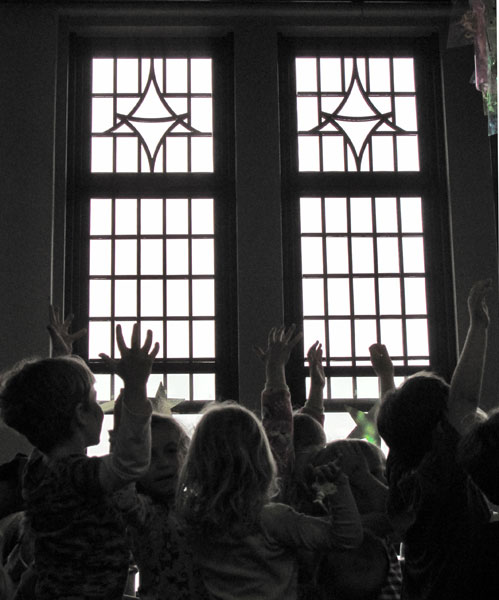
I’m just back from visiting my daughter Georgia and her family in Wisconsin. It was fun. We went to a school carnival with a humorous-songs guy, and the kids were cheering.
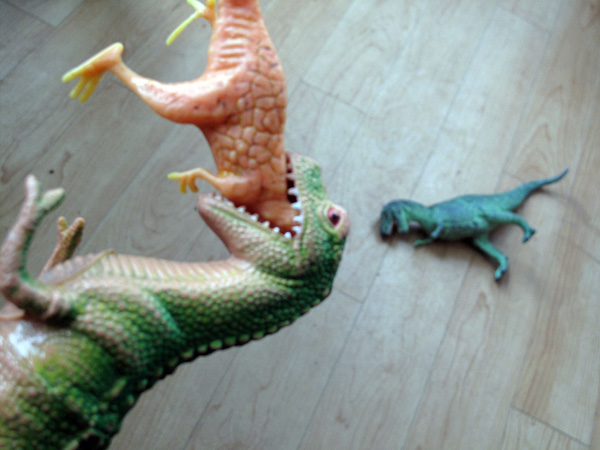
My granddaughter and I had some fun playing with plastic dinosaurs.
She has a set of paints with a nice traditional picture of a fantasy castle printed on the lid. Schylling products are Made in China. Isn’t that the grooviest picture you’ve ever seen? I like trumpet shapes a lot, their surfaces are made of negatively curved space.
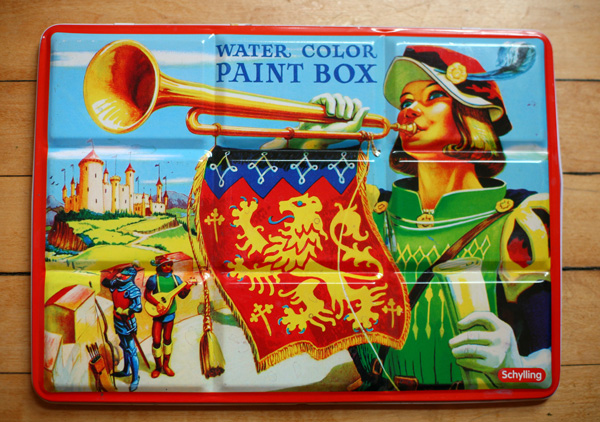
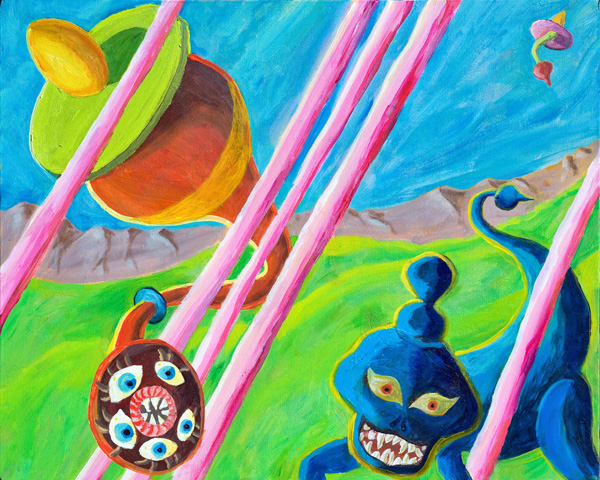
This picture helps me with my plans for the next chapter of Jim and the Flims, I was thinking about it on the plane. Jim and his young companion Durkle are about to set off for the castle of the King of Flimsy.
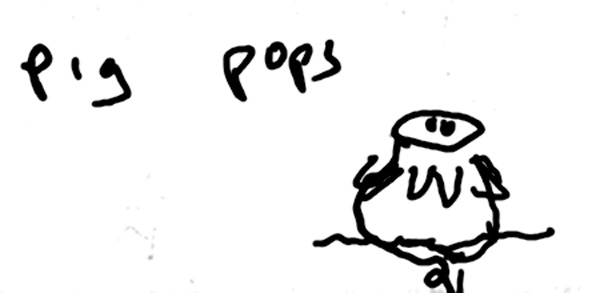
They eat pigpops as a snack—these are meatballs that grow in the ground, with pig snouts on top, and a ruffle of ears all around and no eyes, and root that’s a curly pig tail. Maybe we have some waffle cactuses too, like prickly pears. Cold fire flickers across the rocks like lichen.
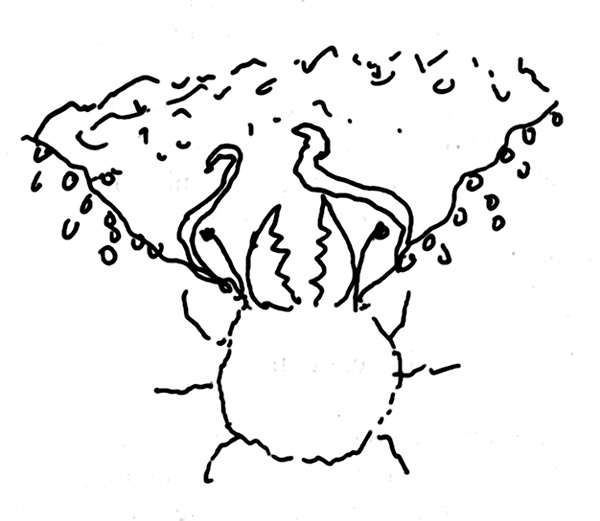
They come across a cone-shaped hole in the ground with walls of cinders. Durkle gets them to sled down it, as if they were snowboarding. Ginnie makes them zickzack boards for sliding. It’s dangerous, but the resident jivas living in our heroes don’t object. The jivas are young and irresponsible, and apparently it’s sort of a rush for a jiva to be in someone when they die.
While they’re bowl-surfing, they see a skull in the cone’s cinders. Oh oh, there’s a giant ant lion at the bottom, with tentacles and mandibles, they barely escape. They escape by Jim having his jiva make them a hamster-ball of zickzack around themselves.
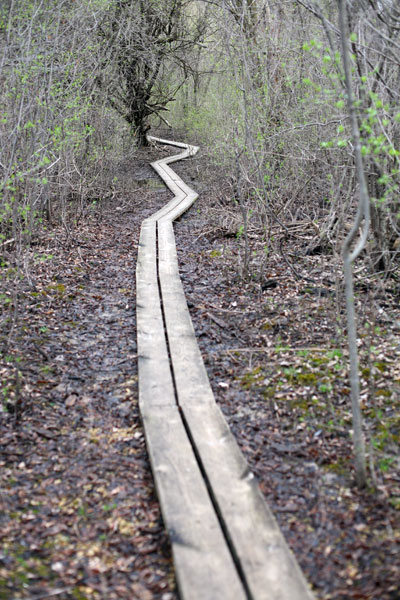
They have the jivas turn gravity around, so their ball rolls out to the top of the pit. They’re on the wrong side of the ant lion’s pit for easily walking towards the castle. They’re near a swamp.
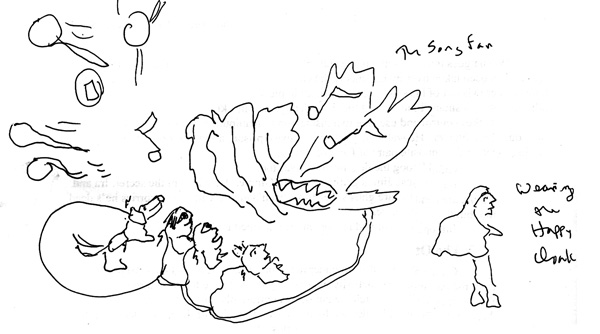
They could just hop to the castle now, but Durkle wants to look at a song fan—he’s heard about them, but has never seen one. Quickly they find one. It’s an animated plant, fan-shaped, like a peacock’s tail, playing shimmering exquisite music like a Theremin or a musical saw, a song that’s in part made up of sampled shrieks from the song fan’s previous victims.
The jivas can’t stand the sound, they’re worried the song fan will eat them, jivas being a song fan’s favorite food, so the jivas jump out of our heroes and flee—the jivas are the beet-shaped things moving off to the left in my drawing. Note also in the drawing that the song fan has stealthy tendrils growing out to plug into the necks of our heroes Droog the dog, Ginnie the dead surfer, Jim, and young Durkle.
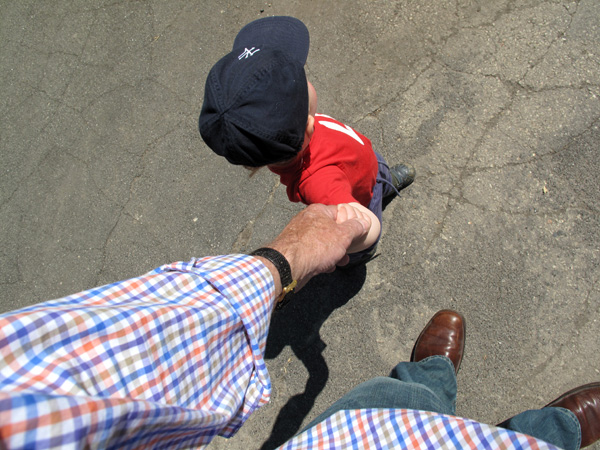
Without his jiva, Jim is old again, as old as a grandpa walking his grandson in a zoo…just like me! Its not so bad to be old.
And Jim is going to escape the song fan, you bet. Maybe he can wrap a piece of the song fan around himself and be…wearing the Happy Cloak!