
Click covers for info. Copyright (C) Rudy Rucker 2021.


Author Archive

Four Dimensional Portals to Other Worlds

Saturday, March 30th, 2013

Today’s post is about the fourth dimension and about the nature of portals between parallel worlds.

As it happens, in Mach, 2013, there were not one but two classes being taught on the subject of the fourth dimension of space. And I was invited to give guest lectures at both these classes.

People sometimes dismiss the notion of the fourth dimension by saying, “Oh, that’s just time.” But mathematicians and SF writers are interested in a more bizarre kind of fourth dimension—an actual direction of space or, more properly speaking, a direction in hyperspace.

First, as I mentioned in my post of March 11, 2013, I gave a talk at Alan Weinstein’s mathematics of the fourth dimension class at Berkeley. They were using my very first book as a text, Geometry, Relativity, and the Fourth Dimension, by Rudolf v. B. Rucker. And then I gave a talk at Thomas Banchoff’s freshman level class on the fourth dimension at the University of San Francisco.

I recorded my talk at Banchoff’s class, talking about the fourth dimension of space, Edwin Abbott’s Flatland, and ideas about portals to parallel worlds. The podcast ends with a reading of the second half of my story, “Message Found In A Copy of Flatland,” which you can read online. You can find the recording of the talk at the link below, and I’ll say a bit more about the talk further down.

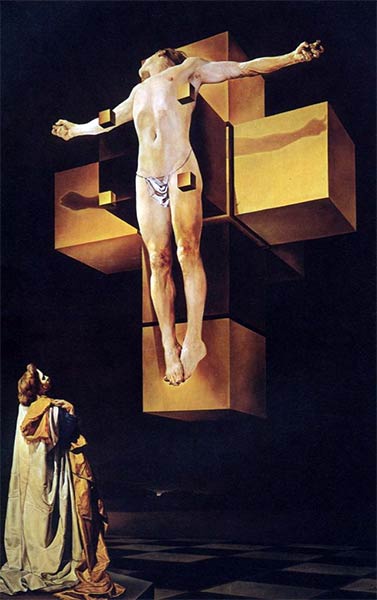
Banchoff has consulted with the artist Salvador Dali about his work. Dali famously included an unfolded hypercube in his painting Christus Hypercubicus, shown below. You can find a video of a full-length lecture by Banchoff on “The Four-Dimensional Geometry and Theology of Salvador Dali” online. Tom is giving a new version of this talk at University of San Francisco on April 18, 2013 at 11:45 am.

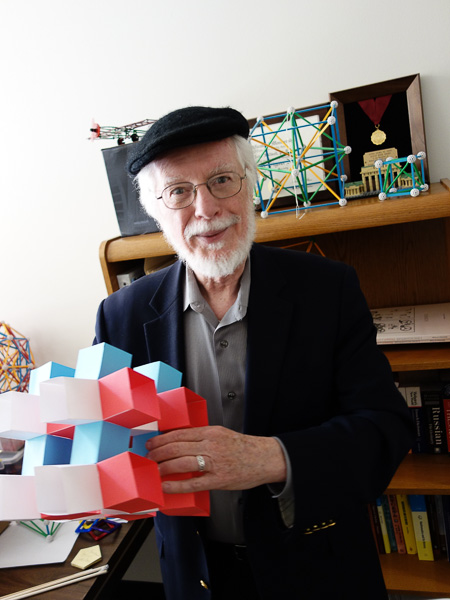
Banchoff invented that paper model of the hypercube shown in Dali’s painting. I was discussing this with him at lunch, and he said, “I have a paper model of a six-dimensional hyperhypercube folded up in my suitcase.” So we went to his office where he had the “suitcase” in which he keeps his lecture supplies.

Tom explained this model to me—bascially you use the three extra dimensions (4, 5, and 6) for bending the model around to glue together each of its opposite sides. If I didn’t grasp this as clearly as he did, that’s because he wrote his Ph.D. thesis on the model.

“I thought if it while I was folding shirts onto cardboards,” Tom told me. “I made the model and took it to my thesis advisor. He said, ”˜You’ve found a gold mine.’”

Such a mathematician-style talk. Looking at that cardboard honeycomb and saying it’s a six-dimensional gold mine.

My talk depended on a timeworn analogy. 4:3 as 3:2. That is, in thinking about the mysterious fourth dimension, it helps to imagine a flat two-dimensional creature trying to imagine a third dimension. The flat creatures we usually talk about are Edwin Abbott’s Flatlanders.

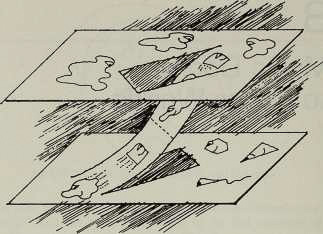
The drawings I’m showing here were done by my artist friend David Povilaitis for my book, The Fourth Dimension, which is currently available in used editions only, but which is due to be reprinted in a new edition in 2014 or 2015. I’m sorry about the small size of the images I’m showing here today, but these are old scans, I didn’t want to rescan them.

One of the specific things I talked about was the nature of a portal to a parallel world. This is a commonplace in fantasy and SF movies—a magic door to another world. Dropping down to Flatland, we can think of the two worlds as being parallel “sheets” of space. The Flatlanders live on the lower world and some other flat creatures—let’s call them Globbers—live in the upper world.

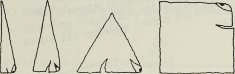
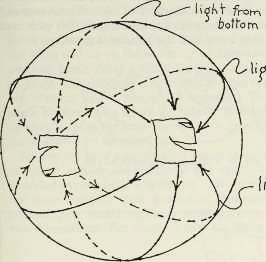
If we want to make the simplest kind of path between the worlds, we fold up a tab from the lower world and glue it to a tab from the upper world. This is what a door-like portal to another world is like. One problem here is that you need to be very careful not to slide off the edges of the path between the world. Or you might dissolve into Nothingness.

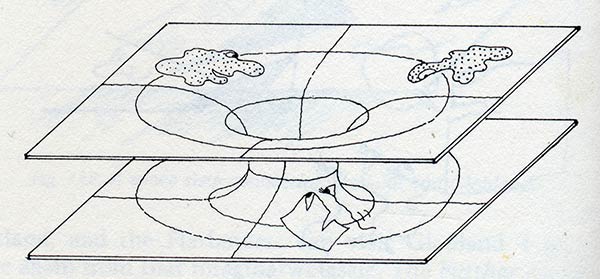
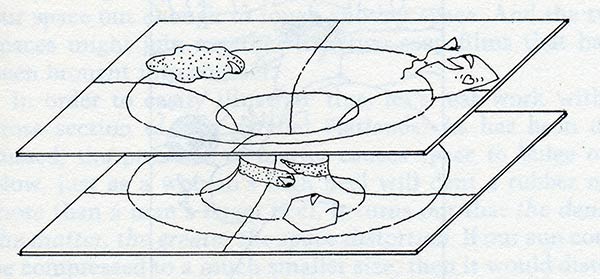
The right way to do it is to use what’s called an Einstein-Rosen bridge. You make a wormhole or throat that runs smoothly from one sheet of space to the other. In seeing this picture, people often worry that the Flatlanders who slide through the throat to the alternate world will end up on the “underside” of that space’s sheet. But you want to think of these sheets as having no thickness so that being on one side of the sheet is the same as being as the other. Or think of the sheets as soap-films with the Flatlanders and Globbers as being like colored patterns in the soap.

Moving up to an Einstein-Rosen bridge between two 3D universes, we can think of our 3D spaces as floating in a 4D hyperspace, and having a “bent” region that connects the spaces. And our 3D spaces have no essential 4D hyperthickness.

In The Fourth Dimension, my character A Square wants to go off to a private place with a Flatland woman called Una. She’s married a jealous Hexagon. In the two images above, we see Square and Una hesitating at the mouth of the ER Bridge. And in the second image, they’ve slid through the portal in the land of the Globbers, and a helpful Globber has wrapped himself around the throat of the ER bridge so that A Hexagon can’t see through.

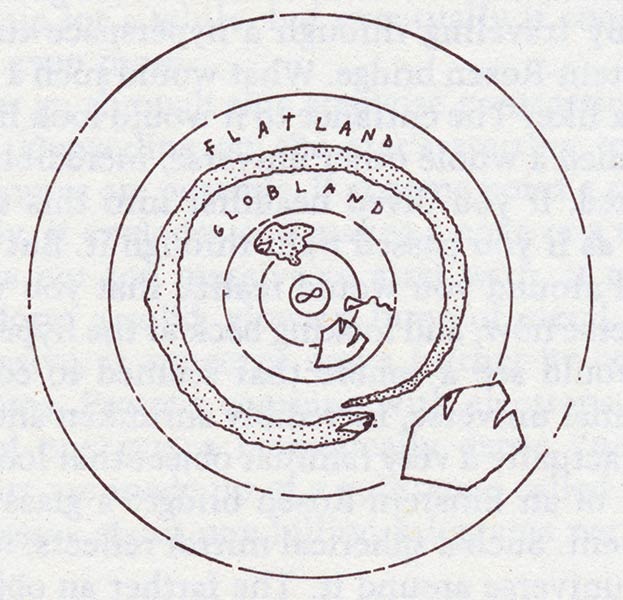
The image above shows how the situation looks to the 2D Hexagon. He views the mouth of the portal as a circle [in our version we’d see a sphere]. Globland lies within the circle, Flatland lies outside. And the point at infinity lies at the seeming center of the ball—that is, a whole endless world fits into the ball with everything getting smaller and smaller as it approaches the center.

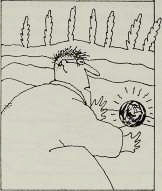
In terms of our space, we can visualize an Einstein-Rosen bridge as resembling a shiny Christmas ornament ball, a sphere within which you seem to see whole world. There are two kickers if the “ball” is the mouth of an ER bridge to another world. (a) The world you see inside the ball isn’t the same as our world. (b) The ball doesn’t have a solid surface, it’s zone that you can walk or crawl through.

I describe an ER bridge in my story “The Last Einstein-Rosen Bridge,” which is also online as part of my Complete Stories. In the story, my character finds the portal lying in an asparagus field near Heidelberg, Germany.

I also describe an Einstein-Rosen bridge in my novel Realware, which is now in print as part of the four-volume The Ware Tetralogy, including Software, Wetware, Freeware, and Realware.

I’ll reprint a scene from Realware where my character Phil goes through an ER bridge, which he calls a “powerball.” In Phil’s case, what’s on the other side of the bridge is a small hyperspherical world, which is why he sees images of himself at the very end.

The powerball came in across the water, low down at Phil’s level, flying straight at him. Phil braced himself, wrapping his arms tight around his knees. The powerball looked like a big, glowing crystal ball, reflecting and refracting light, though not so smooth as a glass ball, perhaps a bit more like a drop of water.

As it drew closer there was an odd effect on the rest of the world: things seemed to melt and warp, distorting themselves away from the magic ball.

Closer and closer it came, yet taking an oddly long time to actually arrive. It was as if the space between Phil and the ball were stretching nearly as fast as the ball could approach. The ball was like a hole opening up in the world. Everything was being pushed aside by it; the sky and waves were being squeezed out along its edges.

Phil looked back over his shoulder; there was still a little zone of normality behind him—the nearest section of the rocky cliff s looked much the same. But so strong was the space warping of the powerball that the beach to the left and right seemed to bend away from him and, as Phil watched, this effect grew more pronounced. In a few moments it was as if Phil stood out on the tip of a little finger of reality, with the glowing powerball’s hyperspace squeezing in on every side. Back there at the other end of the finger, back in the world, Wubwub and Shimmer were peeking out of their cave entrance watching him, the cowards. He fought down an urge to run at them, and forced himself to turn back to face the engulfing ball. What could he see within the ball? Nothing but funhouse mirror reflections of himself: jiggling pink patches of his skin against a blue background filled with moons and stars—his shirt.

And then, like a mighty wave breaking, the warped zone moved over Phil. He felt a deep shock of pain throughout his body, as if something were pulling and stretching at his insides. His lungs, his stomach, his muscles, his brain—every tissue burned with agony.

“Phil! Phil!”

Phil didn’t dare turn; he felt as if the slightest motion might tear his innards in two. But, peering from his pain-wracked eyes, he realized there was no need to turn, for with the powerball centered on him, his view of the world had changed. The entire world was squeezed into a tiny ball that seemed to float a few feet away from him like a spherical mirror the size of a dinner plate. And there in the little toy world, like animated figurines, were Cobb and Yoke. Running toward him. Phil instinctively reached out towards them but—swish—something flashed past his fingers like an invisible scythe. And then—pop—the little bubble that had been the normal world winked out of view, and Phil was alone in the hypersphere of the powerball.

Phil’s guts snapped back to normal; the pain and its afterimage faded. He found himself comfortably floating within an empty, well-lit space that contained glowing air, his body and seemingly nothing else.

See you on the other side!

Added November 2, 2016:

I used an Einstein Rosen bridge again in my novel Million Mile Road Trip. I write about it in a June, 2016 post.

Anselm Hollo, 1934 – 2013

Friday, March 22nd, 2013


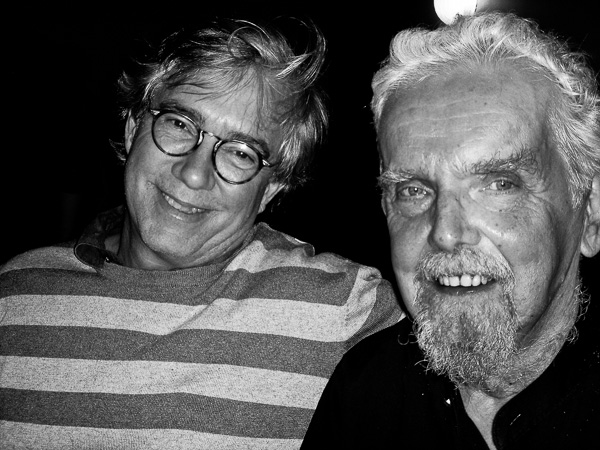
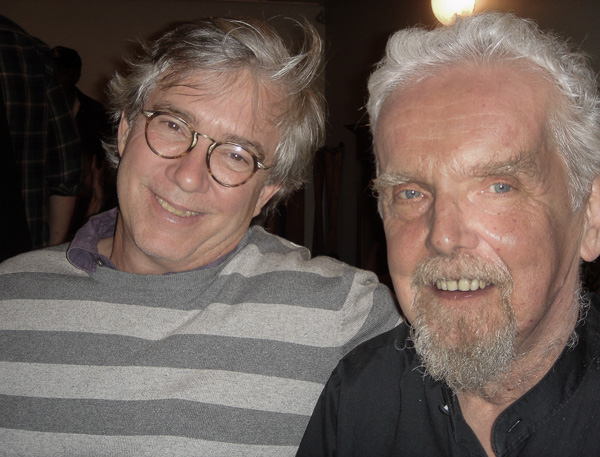
[Photo with Anselm Hollo, Boulder, Colorado, June, 2004. ]

As of year 2023, you can buy Anselm’s thousand-page
Collected Poems

And here’s my March 22, 2013, obit.

I just learned that my dear friend and mentor, the poet Anselm Hollo died on January 29, 2013. He’d been ill for nearly a year.

I think of a poem of Anselm’s in which he describes a dream of his dead father. He had the dream three months after his father died. The poem, untitled, appeared in his slim and epic 1972 collection, Sensation, and the poem is reprinted in his tellingly titled autobiographical essay, “Anselm Hollo, 1934-,” which in turn appears in his later collection Caws and Causeries. I’ll quote the last half of the poem here.

…I knew where he lay
went on & entered
the room light & bare
no curtains no books
his head on the pillow
hand moving outward
the gesture “be seated”
i started talking, saw myself from the back
leaned forward, talked to his face
intent, bushy-browed
eyes straining to see
into mine
“a question i wanted to ask you”
would never know what it was
but stood there & was
so happy to see him
that twenty-sixth day of april
three months after his death

“& was / so happy to see him”
Sigh.

I took this photo across from the legendary beat Caffe Trieste in North Beach where my wife and I had coffee with Anselm and Jane Dalrymple some twenty years ago. Anselm not there today.

I first heard of Anselm Hollo in 1972 when my writer friend Gregory Gibson mailed me a copy of that pamphlet-like book or chapbook, Sensation , published by a group calling themselves the Institute of Further Studies, in Gloucester, Massachusetts, traditional home of outrider poets such as Greg himself and of course Charles Olson. Not that Anselm was living in Gloucester. Born and to some extent raised in Finland, he was at this point drifting around the US from one visiting-poet gig to the next.

I read Sensation over and over, fascinated by its colloquial style and by Hollo’s trick of putting more than one twist into each poem—later when I met him he once remarked of some other poet’s work, “Just has one twist at the end, that’s not enough.”

Anselm’s poems are nicely musicked, yet elliptical and hard to pin down. What do they mean? No matter, never mind.

Here’s another poem from Sensation, also untitled. The saying that Anselm attributes to his father has stuck with me for all these years.

it is a well-lit afternoon
and the heart with pleasure fills
flowing through town in warm things

yes what do you know
it’s winter again
but the days are well-lit
what’s more
they’re beginning to stay that way longer

that is a fact
and I am moving
through a town
in a fur hat
the third one in my life
or is it only the second?

the expeditionary force
will have to check up on that
back there in the previous frames

while I move forward
steadily, stealthily
like a feather

I am a father
bearded and warm
and listen to words coming through
the fur hat off a page
in the Finnish language
“when there’s nothing else to do
there’s always work to do”

my father said that
in one of his notebooks
and it’s true

I walk through a town
and up some steps
and through a door

it closes

now you can’t see me anymore

but the lights go on, and you know I’m there
right inside, working out

Naturally you’ll want to read more of Anselm’s poems. At present, the most complete collection of Anselm’s poems is Notes on the Possibilities and Attractions of Existence: Selected Poems 1965-2000 (Coffee House Press, 2001). You can preview the first 60 or so pages of this book via Google Books. But certainly you should buy it, or get it from your library.

I met Anselm in person in the summer of 1984. My family and I lived in Lynchburg, Virginia, at this point. Some of our new Lynchburg friends invented a semi-imaginary society called the Lynchburg Yacht Club. In the summer of 1984 they organized a big party at the boathouse at Sweetbriar College, about fifteen miles north of Lynchburg.

Sylvia and I were excited about the event, and she even sewed me a new Hawaiian shirt, traffic-yellow with fans and cerise designs, billowing and lovely. At the party we danced to a live jazz band, jabbered, drank and flirted. Some of us rowed in the lake, some jumped in naked.


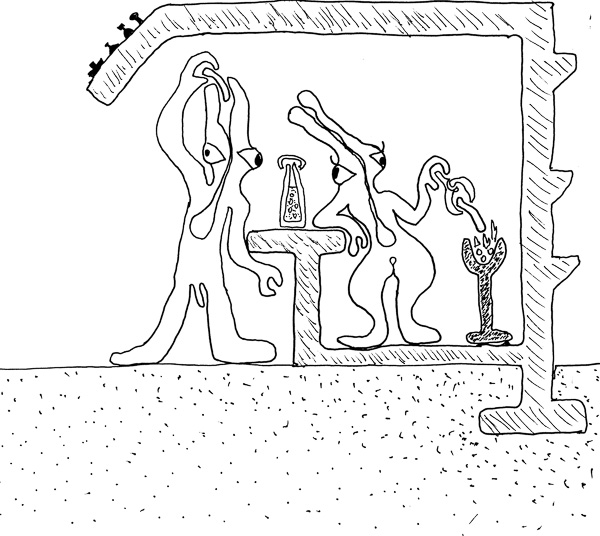
[Anselm and a woman in a two-dimensional world.]

Kind fate brought Anselm Hollo to the Yacht Club party too. He was in Sweetbriar as a writer-in-residence that year. Although he was a dozen years older than me, we immediately recognized each other as kindred spirits. Fellow beatnik writers. And he’d even read my first couple of SF novels.

Anselm had an encyclopedic knowledge of world literature, and an exquisite mastery of the spoken word. He was wonderfully serious about writing. Whenever I was with him, I felt like I was talking to a sage on Mount Olympus, not that there was anything solemn about him. He’d often break into wheezing laughter while we were batting the ideas around. He had a cosmopolitan accent, having grown up Finnish. Anselm once remarked that every Finn deserved to have a biography written. But Anselm’s short, pungent poems are the most accurate memoirs of all, like X-ray snapshots of instantaneous mental states.

We hung out with Anselm quite a bit over the months to come. Anselm and I enjoyed drinking heavily together and talking about art and reality—and ringing strange changes on the words we heard or used. I remember us taking special delight from a line in Rene Daumal’s book, A Night of Serious Drinking: “I have forgotten to mention that the only word which can be said by carp is art.” Inspired by Anselm’s companionship I self-published a book of my poems called Light Fuse and Get Away, saying it was from Carp Press. [This was a 50-copy Xerox edition, later reprinted in my 1991 omnibus, Transreal!.]


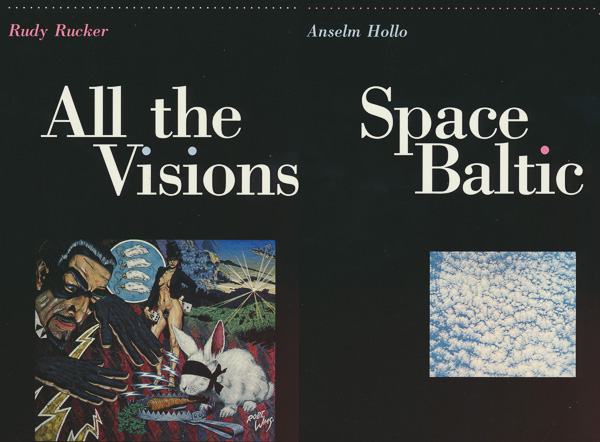
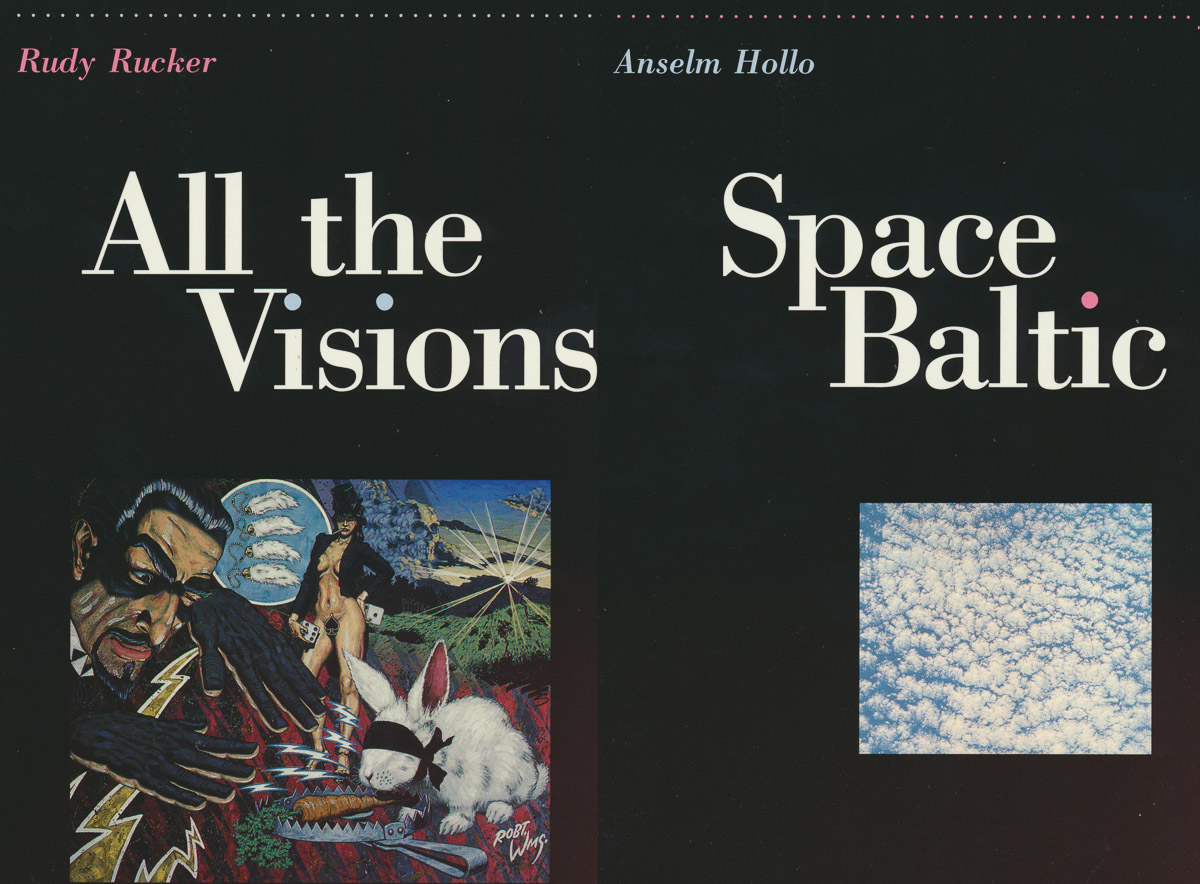
Covers of Rudy and Anselm’s paperback double. Click for a larger version of the image.

When we moved to California in 1986, we saw Anselm a few times. I think he was living in Baltimore part of the time, and then in Salt Lake City. I’d written a scroll-type memoir in the style of Jack Kerouac’s On The Road. Ninety feet long. No big publishers would touch it, but I met a poet called Lee Ballentine who ran a small press called Ocean View.

Lee agreed to publish my memoir—it was called All the Visions—back to back with a collection of Anselm’s “science fiction poems” that he called Space Baltic. It came out in a nice “sixty-nine” style format, that is, with the two books bound together upside down relative to each other, so both sides of the book function as a “front cover.” The illo above shows the two covers.

To increase the joy of this event, we got the ultra cool hot-rod underground artist Robert Williams to let us use one of his images as the cover of my half. All the Visions/Space Baltic is out of print, but you can find various editions for sale online, new or used, softcover or hardback. (My own press, Transreal Books, is likely to reprint my half in a new edition this year or the next.)

We saw Anselm for the last time when I was a guest teacher at the Naropa Institute (a.k.a. The Jack Kerouac School of Disembodied Poetics) in Boulder, Colorado, in June, 2004.

We’d been to Naropa years earlier, around 1980, and that time we’d had a chance to hang around a bit with Burroughs, Ginsberg, and Corso. Of course by 2004, the school was less chaotic. But they were keeping it real with Anselm on the permanent faculty/ Anselm was now settled there with his wonderful wife Jane Dalrymple.

The class I taught was about “Transreal SF Writing,” and while teaching the course, I wrote a transreal SF story called “MS Found in a Minidrive”—funny, gnarly, heavy. I worked in transreal stuff about my nostalgia for the days of Burroughs. The storys narrator, is a would-be-writer who’s attending a Naropa writing workshop. You can find the story online as part of my Complete Stories..

I got to read the story at the end of my Naropa week, back to back with Anselm reading some of his latest poems. We had crowd of about 300 people, it was a wonderful night, the best reading I’ve ever been part of, unforgettable. Rocking it with the Master.

On June 12, 2004, I said my last farewell to dear Anselm. We hugged goodbye and he gave me a sharp, sad, knowing look, perhaps the same look I was giving him, both of us aware that one of us might die before we could meet again. He was seventy, and he’d had a quadruple bypass. But he got over that and went on for eight or nine more years. But now it’s over. As Anselm wrote after the death of Allen Ginsberg:

brave old lion
gone out of reach now
through the one door
awaits us all

One more book of Anselm’s to mention, a book of essays and reminiscences, Caws & Causeries, (La Alameda Press, 1999). Anselm is good at stirring up the old “ontological wonder-sickness,” as the philosopher William James termed it. Why does anything exist at all? Why Anselm, why me?

I’ll close with a poem I found reprinted in Caws & Causeries; it’s originally from Anselm’s 1974 poetry collection, Black Book (Walker’s Pond Press). The poem is a remembrance of Anselm living for a few years with his ninety-year-old grandfather Paul Walden in the south of Germany when Anselm was in his early twenties. Walden was an academic chemist with an interest in the history of science.

THE WALDEN VARIATIONS (for Robert Creeley)

White hair
fine fringes
under the brim

old sunshine on twigs

grandpa
a sturdy
alchemist

old sunshine on twigs

*
old sunshine on twigs

& on the pigs
we ate
together
he & i

deaf alchemist
loud grandson

*
ate together

teeth fell out

& died

old sun


Adios, King.

Podcast #70. Talk & Reading. The Fourth Dimension & “Message Found in a Copy of Flatland”.

Tuesday, March 19th, 2013

March 19, 2013. Teaching a guest class for mathematician Thomas Banchoff at University of San Francisco, discussing concepts of the fourth dimension of space, Abbott’s FLATLAND, and ideas about portals to parallel worlds. Podcast ends with a reading of the second half of the story, “Message Found In A Copy of Flatland.”

Play

Subscribe to Rudy Rucker Podcasts.


“The Two Gods,” 4D, Networked Matter

Monday, March 11th, 2013

I’ve been writing a lot lately, working on my novel The Big Aha, and on a short story called “Apricot Lane.” I also gave a guest lecture at UC Berkeley and participated in a workshop at the Institute for the Future in Palo Alto. In today’s post, I’ll catch up on some of this.

In The Big Aha I have these two mysterious spheres kicking around, about the size of softballs. They’re called the oddball and the dollshead, although their actual names might be Alef and Zeee.

They’re otherworldly beings of some kind, and in the books’ final chapters they’ll transfer one or two of my characters to a higher world for some extra adventures. This is a standard move from the Monomyth or Hero’s Journey pattern, which was famously described in Joseph Campbell’s The Hero With A Thousand Faces. (Note that, with a few tweaks, you can get a variation on the pattern that works for a Heroine’s Journey as well.)

As I sometimes do when I’m stalled or unsure in a novel, I did a painting of these two beings, and I call it The Two Gods.


“The Two Gods,” oil on canvas, March, 2013, 24” x 324”. Click for a larger version of the image.

They’re like lizards, a little bit, with long tails going off into the beyond. I posted a little about my plans for the oddball before on February 5, 2013, in “The Bogosity Generator Tool in Science Fiction,” and when I wrote that post I was thinking about trying to basing my painting “The Two Gods,” on the start sequence seen in Warner Brothers cartoons of the Merrie Melodies or Loony Toons ilk.

On the art front, my show is still hanging at Borderlands Café on Valencia Street in San Francisco. It’ll be up until March 27, 2013, and I have a video of the show below. I marked the prices of my paintings way down for the show, and I’ve sold four in the last month. More info on my Paintings Page.

Rolling back to earlier this month, as I mentioned, I gave a talk on the fourth dimension at Alan Weinstein’s math class at UC Berkeley. The class is using my very first book as their text, Geometry, Relativity and the Fourth Dimension (Dover Publications, 1977). Incredibly this little book is in its seventeenth printing, with over a hundred thousand copies sold.

Above is a scan of one of my older copies. For the class I got into some illos from my novel on the fourth dimension, that is, Spaceland, which was inspired by Edwin Abbott’s 1884 novel Flatland .

Flatland describes higher dimensions in terms of a two dimensional square being, A Square, shown above in my painting of the square and his wife, who is a line segment. In the novel Flatland, A Square is lifted into the third dimension, and gets a view of our world as seen from a higher dimension. There’s a few issues that come up here. If you tug A Square up into 3D space, do his innards spill out? And how can his flat eye with its 1D retina see much of anything in 3D?

I got into these issues in my novel Spaceland. My solution was that, before a 4D being tugs my hero Joe Cube up into 4D space, Joe is “augmented,” that is, he’s given a bit of a 4D hyperthickness, his upper “side” is sealed off with new skin, and he grows himself a hyperdimensional extra eye that projects out into hyperspace from the center of his brain.

The rather complex image shown above depicts these moves in terms of A Square, up in the higher (3D) space looking down at his father, who is a triangle. If the Square tries to use his normal eye, he only sees a 1D cross section of his father. He needs that higher-D eye to get full 2D images on his retina so he can form mental images of 3D objects.

In the same sense, if you try and use your normal eye to see in 4D space, you’ll only see 2D cross sections of things. And what you want is to have a 4D eye with a 3D retina, so you can look at, like a person, and see all of their inner organs at once. Like the way you see your house in your mind, with every closet and drawer open to your inspection.

A little more fun with the higher-dimensional eye. Suppose that the Flatland creatures aren’t simple squares, but are more like organisms with bones and a stomach. Suppose that “Dad” here has been augmented with some thickness and with a higher dimensional eye. So he can see that flat “Mom” is hiding a knife behind her back.

Mom makes her move, but Dad bulges his belly out into a higher dimension!

I always go check out Telegraph Avenue when I’m in Berzerkistan. Been doing that for forty years. These days the Ave is at a bit of a low ebb. The epic Cody’s bookstore is gone, indeed all four corners of that block are deserted, and, at least on the day I visited, the street denizens seemed to have arranged a pair of trucks so as wall off access to People’s Park. Note the edited street sign.

At least Rasputin’s and Amoeba record stores are still there, not that they’re very flush. All kinds of media stores are fading away…books, CDs, DVDs…all dissolved in the digital torrent.

I’m a bit of a connoisseur of images of the Pig Chef—that traitorous being who delights in slaughtering, cooking and devouring his peers—and I saw this well-executed Pig Chef on a truck by People’s Park. If you’ve never read it, do check out my Pig Chef story, “The Men in the Back Room at the Country Club” in my online Complete Stories. Not to give too much away, in my tale, the Pig Chef is a Sta-Hi-type character who ends up BBQ-ing people and feeding them to alien preying mantises…

Another thing I did recently was to attend Institute For The Future workshop on the theme of objects joining the internet. See the IFTF post on “The Coming Age of Networked Matter.” My host was David Pescovitz, who also does some work at IFTF.

IFTF has commissioned me to write a short SF story on networked matter, the story to appear for free on Boing Boing and in other spots—it’ll be Creative Commons licensed. Madeline Ashby, Cory Doctorow, Warren Ellis will be writing stories as well. For now I’m calling my story “Apricot Lane,” and that’s what I’m working on right now.

I wrote about a rather enjoyable world with tagged and even “living” objects in my novels Postsingular and its sequel Hylozoic. And note that a free CC version of Postsingular exists.

But this time around, for the purposes of “Apricot Lane,” I’m thinking that it wouldn’t necessarily be pleasant if the objects around you could talk to you or exchange information with you.

Thinking along these lines, I remembered the “dogsh*t day” scene in Phil Dick’s novel A Scanner Darkly. Bob Arctor’s car has malfunctioned. He’s pulled over at the side of a freeway with his freaky and possibly evil friend Barris. He’s hallucinating that his engine block is smeared with dog crap, and Barris somehow knows this and is teasing Arctor, smiling at him from behind his mirrorshades. And then Arctor starts to hear the parts of the engine talking to him and he throws up.

He felt, in his head, loud voices singing: terrible, as if the reality around him had gone sour. … The smell of Barris still smiling overpowered Bob Arctor, and he heaved onto the dashboard of his own car. A thousand little voices tinkled up at him, shining at him, and the smell receded finally. A thousand little voices crying out their strangeness; he did not understand them, but at least he could see, and the smell was going away.

Good old Phil.


Rudy's Blog is powered by WordPress