Click covers for info. Copyright (C) Rudy Rucker 2021.


Author Archive

Alan Turing

Monday, October 2nd, 2006

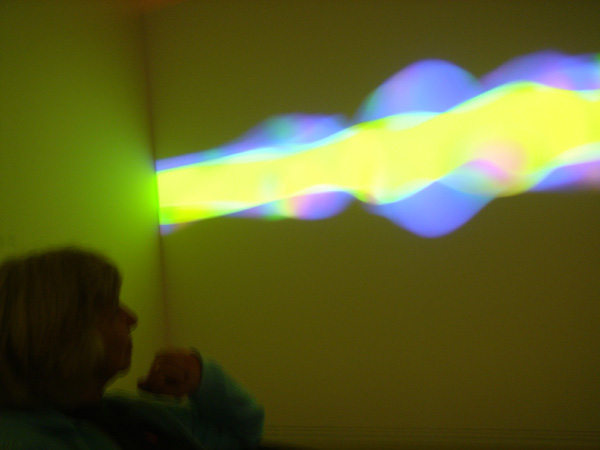
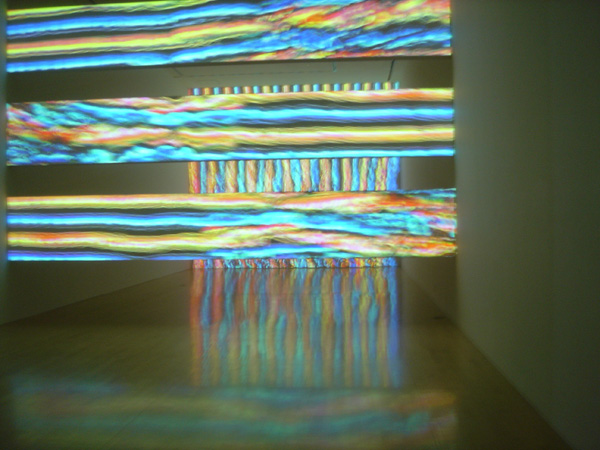
Yesterday we saw a good show by video installation artist Jennifer Steinkamp at the museum downtown in San Jose.

I read a review of Greil Marcus, The Shape of Things To Come, in the NY Times Book Review section yesterday, containing a good quote about analog vs. digital computation in the context of Otis Spann improvising a blues song about M. L. King’s assassination. [My italics.]

“The piano strikes back at the verse as if every word it holds is a lie, because if words cannot tell the whole truth, words like, and words can never tell the whole truth, only sound can do that, sound that is not made by men and women but by Nature’s God, sound that is not made but found.”
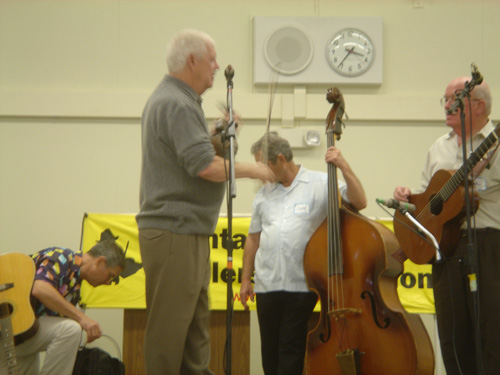
We also stopped by the cute monthly Fiddler’s Jamboree, sponsored by the Santa Clara Valley Fiddlers’ Association.

I just finished reading David Leavitt, Man Who Knew Too Much (W. W. Norton, 2006). This is a short biography of Alan Turing (1912 – 1954) in the same Norton series that published that book by David Foster Wallace on Georg Cantor, but never mind about that. Leavitt’s book seemed a little weak in spots, but it reads well, and I wanted to read about Turing this week and couldn’t immediately get hold of the longer and canonical bio, Alan Turing: The Enigma by Alan Hodges. (That is, it was sitting on my office bookshelf but I was temporarily unable to see it, knowing that it is so long and in such small print). Leavitt's book is better for a quick overview.
A lot of interesting facts in Leavitt’s book. Not only Turing but Kurt Godel were inordinately fond of the Disney cartoon Snow White and the Seven Dwarfs (1938). Turing is believed to have committed suicide by biting an apple that he’d painted with cyanide, and was found dead in his bed on June 8, 1954. Turing was said to have enjoyed the scene where the Wicked Queen dips the apple in her poisonous brew and he even memorized her song and chanted it after seeing the movie:

“Dip the apple in the brew, / Let the sleeping death seep through. / [A skull icon appears in the skin.] A symbol of what lies within. / Now turn red to tempt Snow White, / To make her hunger for a bite. / When she breaks the tender peel, / To taste the apple from my hand, / Her breath will still, her blood congeal, / Then I’ll be the fairest in the land!”
One interesting thing about Leavitt’s book is that he places a lot of emphasis on Turing’s homosexuality, and dares to hint — with, unfortunately, no corroboration — that Turing may have been murdered by the British secret service: “…none of Turing’s friends ever seems to have considered, at least in writing, a third possibility (one, admittedly, for which there is no evidence, at present anyway): namely, that the suicide was staged; that the man … had become — like the hero of Alfred Hitchcock’s 1934 film — a man who knew too much.”

This said, it really does seem possible that Turing killed himself. Like the other logicians Godel and Cantor, he seems to have been somewhat nuts. Funny how many logicians are crazy and irrational. A paradox.

I'd always thought that what may have put Turing over the edge was the estrogen treatments he was sentenced to after telling the police about a gay sex encounter he’d had. But actually the mandatory estrogen treatment ended a year before Turing killed himself. Turing never saw anything wrong with homosexuality by the way; in the terms of his famed “Imitation Game,” there really was no difference between the sexes. Anyone can emulate anyone else.

In his last days, while working with a therapist, he began writing a short story about a man picking up a younger man for sex while doing his Christmas shopping. For me, as an SF writer, the exciting part is that in this transreal tale, Turing describes “himself” as Alec Pryce, a scientist interested in interplanetary travel! Here’s a link to images of these pages in the Turing Archive; note that to access these pages you have to click through a screen accepting the terms of use.

“Alec had been working rather hard two or three weeks before. It was about interplanetary travel. Alec had always been rather keen on such crackpot problems, but although he rather liked to let himself go rather wildly by appearing on the Third Programme when he got the chance, when he wrote for technically trained readers his work was quite sound, or had been when he was younger. This latest paper was real good stuff, better than he’d done since his mid twenties when he had introduced the idea which is now commonly know as ‘Pryce’s buoy.’ He always felt a glow of pride when the phrase was said.”
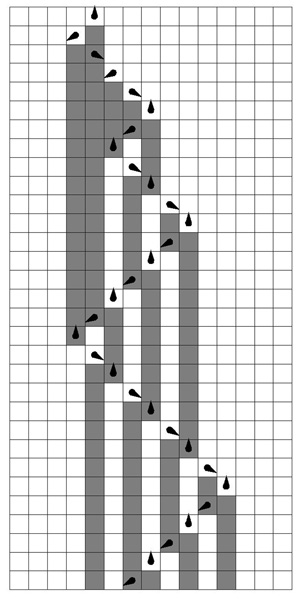
Pryce’s buoy is an objective correlative for the Turing machine, and the pun on “boy” is deliberate, as Turing goes on to make clear in his unfinished tale. What might Pryce’s buoy be? I’m thinking of the space end of a space elevator.

Another fascinating tidbit from Leavitt’s book. In his last days, Turing wrote his logician friend Robin Gandy a series of four postcards, the last three on March 8, 10, and 13 of 1954. The first card is missing. The cards were inspired by Arthur Stanley Eddington’s Fundamental Theory, which the two men were reading. Images of these cards are online at the Turing Archive as well, and the images are Copyright (c) P.N. Furbank. I’m going to take the liberty of reproducing them here (at slightly reduced size), although if the King’s College guys object I’ll take them down.
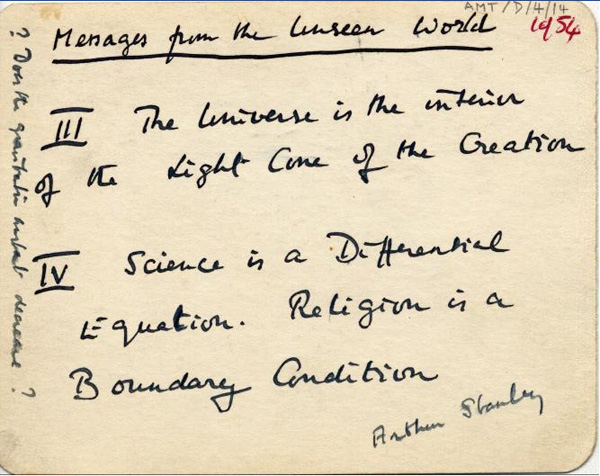
Messages from the Unseen World

III The Universe is the interior of a Light Cone of the Creation

IV Science is a Differential Equation.

Religion is a Boundary Condition

[Signed “Arthur Stanley” and with a post script “? Does the gravitation constant decrease?”]
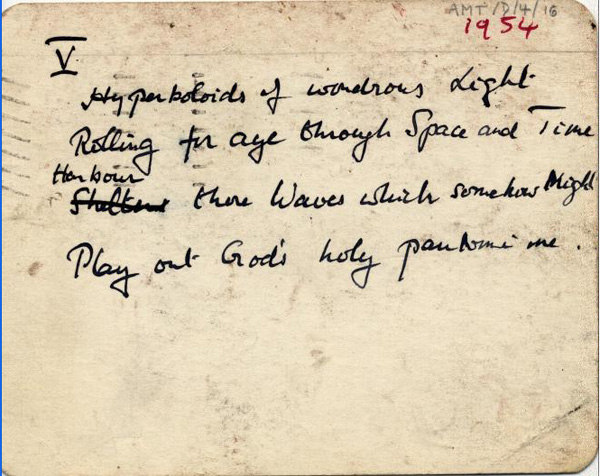
V Hyperboloids of wondrous Light

Rolling for aye through Space and Time

[Shelter] Harbour there Waves which somehow Might

Play out God’s holy pantomime.
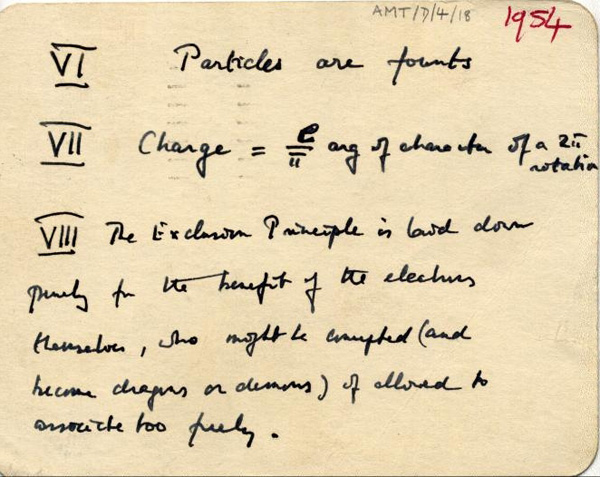
VI Particles are founts

VII Charge = e / π arg of character of a 2π rotation

VIII The Exclusion Principle is laid down purely for the benefit of the electrons themselves, who might be corrupted (and become dragons or demons) if allowed to associate too freely.
This is all pure gold, to my way of thinking.

In what might have been an even later letter to Robin Gandy (at the same link), Turing writes out some calculus formulae and says, “Can do the rainbow problem successfully for sound, but total failure for electricity.”

Hmmm.

Turing in a letter about his trial. “Whilst in custody with the other criminals I had a very agreeable sense of irresponsibility, rather like being back at school.”
Having written this post, I now discover Andrew Hodges, Alan Turing: The Enigma on my bookcase beside my desk, and read the long last chapter. Herewith some more notes.

Turing was lonely and conscious of his self-consciousness. Once, when in a pub with a friend, a boring logician appeared through one doorway, and Turing disappeared through another. As a boy, his favorite parts of the book Pilgrim’s Progress were Doubting Castle and Giant Despair. Mathematics has always protected him from the world.

He had a Norwegian boyfriend called Kjell; possibly the authorities somehow stymied Kjell from visiting him. His estrogen treatment ended in April 1953. He never abandoned his homosexuality.

“Went down to Sherborne to lecture to some boys on computers. Really quite a treat in many ways. They were so luscious, and so well mannered, with a little dash of pertness, and Sherborne itself quite unspoilt.”

In mid-May, 1954, Alan went with the family of his psychiatrist Greenbaum to a kind of boardwalk in Blackpool, and Alan went in to the Gypsy Queen fortune-teller, and came out white as a sheet and said nothing more on the way home to Manchester.
He died in the evening of June 7, 1954, just short of age 42. There was hardly an inquest, and his body was cremated.

Turing’s work on decryption during the war was so secret that it was totally unknown to the public. In a sense, his knowledge was even more highly classified than atomic secrets. There was something of a frenzy about atomic security in the mid 50s, also a worry about the riskiness of homosexuals having access to secret info. Turing’s unpredictability and lack of control would have alarmed the spooks. It’s conceivable that they were privately threatening him with more prosecutions.
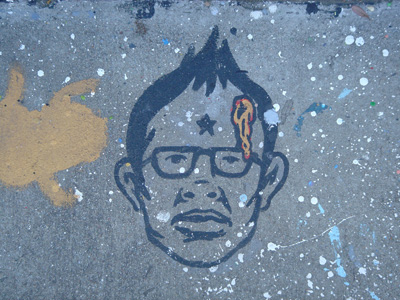
Once convicted, Turing would have been unable to visit the United States due to a criminal record of moral turpitude. Hodges calls him an “intellectual beatnik.”

Turing was a soft machine.

Reading at City Lights

Friday, September 29th, 2006

Sylvia and I were up in SF yesterday. I love the air there. And the fog returning in the late afternoon.

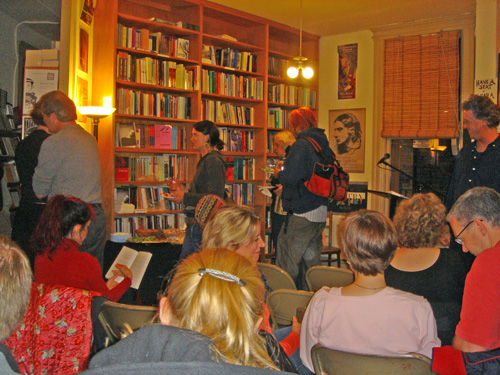
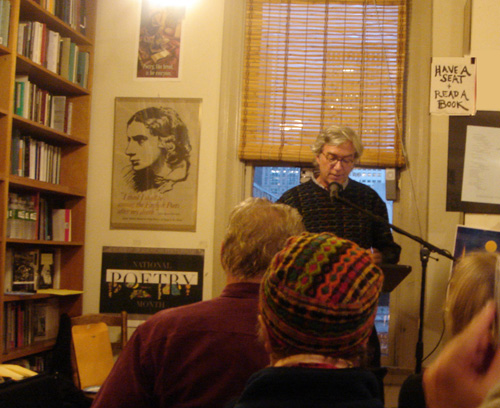
The Paraspheres reading of “New Wave Fabulist” writers was upstairs at City Lights, in the room where they have the poetry and the Beat books.

I read a version of my story “The Jack Kerouac Disembodied School of Poetics” — I’d abridged in the sense that I edited it down so as to be able to read it in under fifteen minutes. I kind of like the short edit. I forgot to tape the reading, so I’m posting a PDF of my abridged Kerouac story. But for the whole story and all the others, you need to buy Paraspheres!

It was great to be reading about Jack in this room; like being in a shrine to the man. With Jack Kerouac Alley right out the back window.

The other readers were really good too. I got a picture of Rikki Ducornet, she has a cool new book out.

And here’s a picture of SF culture hero Charlie Anders, who’s also in Paraspheres.

I didn’t get pix of Laura Moriarty, Stephen Shugart, Mark Wallace, and William Luvaas, but they were there in full force as well. A great evening of literary art.

Makes me feel like could get a bit further out of the SF box.

Rudy at City Lights

Wednesday, September 27th, 2006

On Thursday, September 28 I'll be participating in a group reading for the contributors to Paraspheres anthology of New Wave Fabulist writers.

CITY LIGHTS BOOKSTORE, San Francisco

Reading Coordinator: Peter Maravelis

261 Columbus Avenue (near Broadway)

Reading scheduled at 6:30. Readers (10-15 minutes each): Charlie Anders, Rikki Ducornet, Laura Moriarty, Rudy Rucker, Stephen Shugart, Mark Wallace, William Luvaas. I think I'll be reading early in the lineup, so show up by 7 if you want to be sure and catch me.

Bruce Sterling in SF

Wednesday, September 27th, 2006

Bruce Sterling, who these days mostly lives in Belgrade, Serbia, with his wife Jasmina Testanovic, is in the U. S. for a month or more tour of lecture and conference gigs. Bruce and Jasmina travel a lot together; fittingly they were married near the LAX airport in LA.

The two of them spent last night at our house, and today they went up to SF for a futurist consulting gig he had at the Global Business Network (GBN) and for a talk “Design and Futurism” that he gave at the California College of the Arts (CCA). I came along and spent the day with them, catching the train back home to San Jose — which is what I’m doing as I write these notes on the laptop that I lugged around in my backpack all day.

Jasmina loves the Internet, everywhere we went, she’d say, “Do you think they have free wireless here?” It got to be a joke over the day; I started saying it all the time.

At one point she was checking her blog for comments in the SONY demo store inside the Metreon at Yerba Buena gardens, standing there, Power Book in midair. She worries about pugnacious right-wing Serbians posting comments on her blog; she feels she has to immediately respond, and spends a certain amount of energy on these flame-war comment threads. I’m fortunate not to have many comments like that on my blog; in part it’s because I mostly stay away from discussing politics, preferring to get into more esoteric stuff that’s less frequently discussed.

Bruce was nice to me all day; he was happy to have me there helping them find their way around SF, and to be sharing the experiences. He said it was like having a body guard. I’m kind of an older brother figure to him — eight years difference in our age. In the past I’ve sometimes envied his perhaps greater worldly success in the writing profession. But really, I can be big enough to let go of my crazy skulking resentments — at least for a little while, now and then.

Even now, I’m still grateful to him for welcoming me into the cyberpunk fold, back in early 1980s, when I was an isolated nut writer in Lynchburg, Virginia.

In the car on the drive up we had a good talk about this story “Hormiga Canyon” that we’re thinking of writing; it would involve giant ants, which theme is an SF power-chord long dear to my heart. We’ve done three stories together before, all were good, though the most recent collaboration was a little hard. When we communicate by email rather than in person, Bruce can get under my skin. But now that we had this good day of face-to-face contact it’ll be, I think, easier to work with him again. When we meet in person I can see his vulnerable, touching, and endearing human qualities; and, I assume, vice-versa. He does know a lot about writing stories, and it’s not a bad idea for me to listen to him.

The whole day was fun, just hanging around, letting events unfurl at their own pace. Turns out the Global Business Netowork has their offices in a building near the ferry end of Market Street and the building happens to be a Federal Reserve Bank. At first I didn’t get what that meant. But the security cop in the entrance hall was behind bullet-proof glass, mounted next to him on the wall were a submachine gun and a large caliber shotgun, and once someone came down from GBN to escort us in, we had to go through airport metal detectors to get inside. After Bruce’s gig we went down to the basement and managed to find a place to peer into a room where four or five employees were using machines to process and package hundreds of millions of dollars in paper currency. Running bills through a hulking hi-tech counterfeit detector, physically washing bunches of bills, packaging them in plastic shrink wrap, piling the wrapped bricks onto heavy carts. I tried to take surreptitious pictures, but I was uneasy about them seeing my camera and possibly scolding me, and I blew the shots.

We walked up Market Street to the MOMA, then back to where we’d garaged the car at the Embarcadero. It was a fine day, with interesting foot traffic. We saw a homeless guy wearing pajama pants decorated with Happy Face men wearing Uncle Sam hats. Bruce figured it was his considered mode of self-expession.

We drove to California College of the Arts early and hung in their café; its off the beaten track in an industrial zone near China Basin, 3rd St., and the stadium parking lots. Bruce wrote out a lot of his speech in advance; he say she talks at 100 words a minute, so 6,000 words fills an hour. When not typing, he explained Web 2.0 to me. It’s not about a new technology so much as it’s about collaborative use of active web pages that use programming tools like Ajax or Ruby on Rails (new since I retired from teaching CS).

The Flickr picture site is a good example. Social networking. Getting the users to do the work. They can explicitly tag content-topics that they notice in pictures or videos they look at, and if you track their click stream you can enhance, say, an image’s “dogginess” if users who recently looked at a dog-tagged item look at the image. So the info in the explicit tags diffuses out via the click streams.

Bruce’s talk was on “Design and Futurism,” where he meant “futurism” not in the sense of the early 20th C art movement, but in the sense of the profession of consulting with businesses about their futures — he remarked that generally, the businesses who actually call in futurists are the ones that are in considerable danger of soon falling under the karmic hammer. You don’t call the doctor unless you’re sick.

He explained a popular “four-scenarios” form of futurism; the idea is to divide up the space of possible futures along two perpendicular axes; he said usually these axes correspond to the fear vs. the greed of the business that calls in a futurist. And you form some employees into four teams who are tasked to describe a scenario that fits one of the four possible quadrants of the possibility space (++, -+, –, and +-). He remarked that in a successful futurist consultation you are like a psychiatrist who is empowering people to say what they already know about their situation but have been afraid to articulate. It’s usually the middle managers who are the most emotionally invested in continuing business as usual.

He segued into his concluding rap from his futurist book Tomorrow Today, about how futurism is something we do in the present, and that it in fact bears little connection to the real future. We live in time and our futures are unknowable. As Updike once wrote, time is our medium, not some mistaken invader. It’s the air we fly in, the water we swim in, the earth we walk upon, the fire in our veins. All the people of the Middle Ages are dead, all their craft techniques are obsolete. Same for the nineteenth century, matter of fact, and, before long, for us. It’s the way things are, there’s no need to grieve. Futurism is just a game we play in the present. A pastime.

Nevertheless, the game matters. We owe it to our descendants to allow them as wide a range of options as we’ve enjoyed. We should think in terms of making sustainability seem modern and fun instead of finger-wagging and dull. And that one way to do this is, as he suggests in his MIT mini-tome Shaping Things, to individualize objects, possibly with what he calls arphids. “Arphid” is Bruce’s word for RFIDs or “radio frequency ID tags.” I heard him talking about arphids when he visited last year, and I ended up repurposing or one-upping or aping his notion for my ubiquitous position-aware dog-smart quantum-computing-molecular-nanomachine entanglement-linked “orphids” in Postsingular. He uses the word “spime” to refer to an enhanced object that carries with it an individualized link to online info about how it was made, where it’s been, user-evaluations, online instructions for regular and hackeristic use, how the object might be repurposed, and more. Every object is now part of the Web. Worn-out or discarded-but-still-good things might become “smart garbage.”

Most of us have things in our basements or closets that we’d be, in principle, willing to give away. I discussed this idea a bit in the “Big Pig Posse” chapter of Postsingular. You’d give them or at least lend them to a friend or relative for free. Skis, power saws, clothes, old computers, old clothes, surfboard. One catch here is that you wouldn’t necessarily give or lend these things to a stranger. Not if, say, the stranger were simply planning to sell them for cash on eBay. Not if the stranger were possibly going to ruin your nail-gun by failing to oil it, and would then return it to you broken. But maybe, at some point you could learn not to care. If, after all, everyone could get junk for free from their neighbor’s attics, there might not actually be much traffic on eBay. And maybe you could have a reliability rating that would be ruined by trashing someone’s tools — and hey, even if your rarely used tool did get trashed, so what you could borrow another one. Maybe you’d even get an improved reliability rating as a “reward” for having suffered a loss to the system.

Hanging with Bruce and Jasmina, it was kind of fun the way there was no social stigma about breaking out the laptop; like being a stoner among other heavy users.

After his talk we had a nice dinner at a place just a block away from the Cal Train station with a couple of the CCA faculty, Brenda Laurel of VR fame and the graphic designer called Stuart McKee — I think he just handed over the leadership of the CCA grad design program to Brenda. The waitress was odd-looking yet cute, very animated, almost like a Dr. Seuss character. She told Stuart she’d just moved to San Francisco. Everyone very friendly. I had to leave early to catch the last train down to the South Bay, and got my food to go.

Nice to be out of my hermit’s cave, out in the marketplace today.


Rudy's Blog is powered by WordPress