


Click covers for info. Copyright (C) Rudy Rucker 2021.


Author Archive

Religion in a Parallel World

Tuesday, September 4th, 2007

When I was writing Postsingular, I thought it would be interesting to have the dominant Western religion of the Hibrane be slightly different from Christianity. So I wrote:

“We like to eat them [cuttlefish],” said Azaroth. “I thought you knew that. Thanks to teeping and omnividence, we fished our own cuttles extinct. Since then, the planetary mind has taught us to be more careful. In any case, our people especially dig eating the Lobrane cuttles since they’re so dense and chewy. I should also mention that cuttlefish symbolize a certain holy cuttlefisherman of ancient times. He rose from death on the triangle to found one of our great world religions.”
***
Relative to little Thuy, the single-story shops and houses were as tall as office buildings. The buildings looked to be assembled from naturally grown components as well. Overhead, shells and shiny seedpods hung upon lines stretched across the street; they’d been crafted into representational forms: a star, a candy cane, a cuttlefish holding a triangle—Thuy recalled Azaroth’s mentioning that the cuttlefish was a symbol for a Hibrane religious figure. Perhaps these were ornaments to celebrate a holiday.
***
“What!” exclaimed Gladax, taking the bait. “I told those flowers they have to stay red right through to the end of the Cuttlemas holidays.”

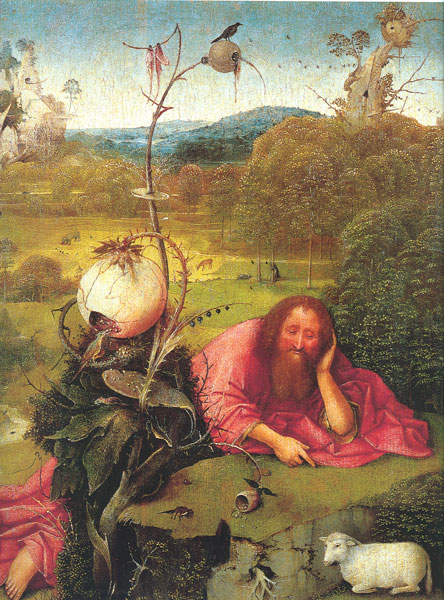
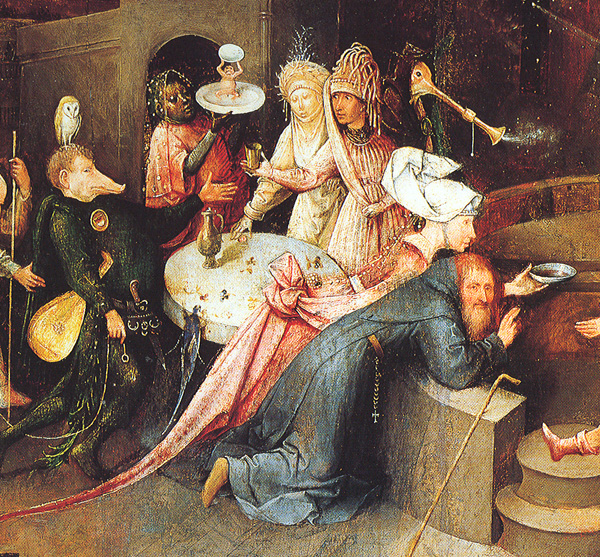
This change seemed cute and funny at the time, but now it’s coming back to haunt me. Because Hieronymus Bosch’s art is loaded with Christian iconography, and the time he lived in was dominated by the Roman Catholic church.

So I need to think of a Hibrane religion that fits with the cuttlefish/triangle thing and is close enough to Christianity so that my envisioning of Bosch can be comfortably close to my goal, which is our own historical Bosch.

First of all, as a fabulist (and setting aside whatever my realworld religious beliefs might or might not be), I find it interesting to suppose that our religions were indeed founded by otherworldly beings—and I take this class to be a very broad one, extending to higher dimensions as well as to divinities.

In this case, the appearance of Christ wouldn’t simply be an inevitable historical stage, on a par with the emergence of the alphabet. It would, rather, a somewhat arbitrary and unpredictable irruption of a higher reality in our mundane world. On a par, if you will, with the three-dimensional A Sphere choosing to manifest himself to flat A Square in Flatland.

Or, closer to my novel Hylozoic, it might be that some aktualized higher being like the harp or the pitchfork made an appearance as a religious savior in human form, with motives that might be altruistic and benevolent, although the motives might instead be arcane and obscure.

If we take Christ’s life as being the unpredictable intervention of a higher being into human history, then there’s no absolute necessity for a Christ to have appeared in an otherwise identical parallel Earth. Things very much like puffballs and oak trees must evolve, but a monotheistic religion based upon the Beatitudes and clinched with the prophet’s execution and resurrection—maybe that’s not inevitable.

This said, if some higher being is motivated to meddle with our timeline, the same kinds of reasons might drive the being to poke into the parallel line as well. But they might happen to do it a bit differently there. So we can suppose that the Hibrane has something like Christianity, only different.

In other words, I’m supposing that the harp or the pitchfork or some other aktualized higher being did in fact incarnate themselves as a Lord and Savior and founder of a world religion in the Hibrane. Maybe at some point the aktuals will in fact tell us about this.

And, on the evidence of Postsingular, I know that this avatar was a man who was a cuttlefisherman, and who was executed on a wooden triangle.

What was the Hibrane savior’s name?

Jude Christ. According to an online Catholic Encyclopedia, Jesus had four “brothers,” although the orthodox view is that these were in fact cousins. Their names were Joseph, James, Simon, and Jude. I think I’ll use Jude because of the dissonance caused by the echo of Judas the Betrayer, and the positive energies of the Beatles, “Hey Jude,” Hardy’s Jude the Obscure, and my deceased Mondo 2000 friend St. Jude Milhon, “The Saint of Hopeless Causes, Dubious Cases, and Children’s Aspirin.”


How exactly was Jude Christ executed on a triangle?

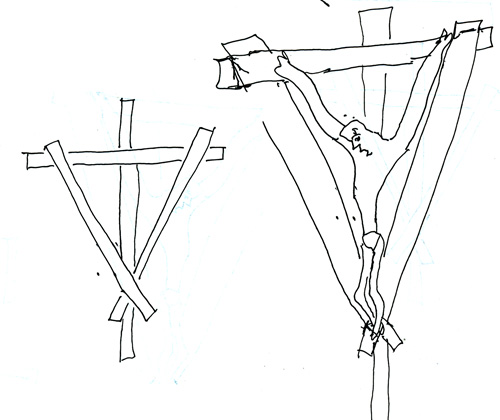
It’s similar to crucifixion. They nailed together three boards to make an isoceles triangle with its narrow vertex down. Possibly the construction was backed by a cross—indeed many crucifixes have slanting props. In the Hibrane, people just happened to focus on the triangle.

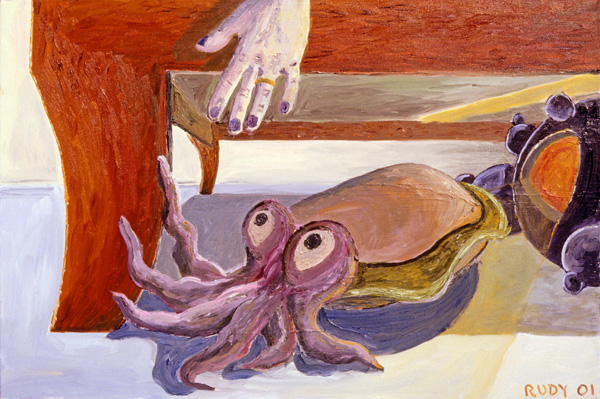
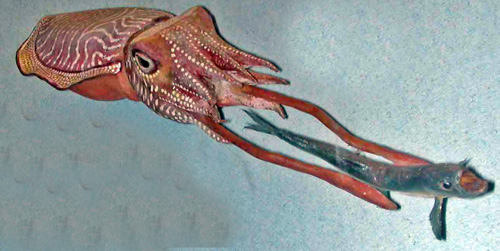
[Photo of a model of the Common European Cuttlefish Sepia Officinalis, to be found in the Mediterranean off the Holy Land.]

How can cuttlefish be made a warm and fuzzy religious symbol like the lamb?

He embraces everyone. He reaches out.

Oh, that’s too scary a picture, I’m just kidding with that. 🙂
I have this thing for cuttlefish…

Click the picture for more about Postsingular!

Jayjay, Thuy and the Pitchfork in 1496

Sunday, September 2nd, 2007

We visited Rudy, Penny, and the twins in Berkeley yesterday, and I caught a few street images for today’s illos, ending with a paparazzi pair of me trying to get my camera back from Rudy.

Hylozoic is going pretty good these days. I got a contract for it from Tor Books, which is encouraging. I’m always grateful that I can get novels published.

Here’s a draft passage of Jayjay, Thuy, and the not-so-evil-after-all hillbilly pitchfork arriving in the Hibrane. It’s our man Hieronymus Bosch’s home town, 1496, and everything in the Hibrane is six times as big as it is here.

Jayjay took Thuy by the hand, remembering the tower of loops that the pitchfork had taught him. The scale links were still in place: a helix spiraling from below the subbies to beyond the galaxy. Feeling light and nimble, Jayjay revolved the helix to aim its axis in the direction they flew. He reached through his heart to that one particular cell and carbon atom; he reached up past humanity to the Earth and the sky. He and Thuy sped forward as if in a particle accelerator.

And touched down upon a stone street in a town with no lights or teep. The mild, damp night air bore the smell of human waste.

A gentle thump sounded at their side: the pitchfork. Somewhere nearby, men were roaring a slow, deep-voiced song. A fat full moon hung low above the stair-stepped gables, the buildings oddly tall.

Looking up past the walls to the panoply of stars, Jayjay saw familiar constellations. He used the north star to find the points of the compass, noted that the low moon was in the west, recalled that a full moon sets near dawn, and drew the conclusion.

“It’s about 4 a. m.” he told Thuy.

“There’s no teep to check that,” said Thuy fretfully. “This place isn’t right. Last time, the Hibrane was almost like our San Francisco, and they had lazy eight. But this is some kind of primitive backwater with no silps. Everything’s mute. How do people live this way?”

“We’re free,” said Jayjay relishing the bucolic air. Already he was learning to ignore the bad smells. “It’s great here. No Peng, no voices in our heads, no realtime video shows of our lives.”

Dogs barked in courtyards nearby, perhaps annoyed by the pitchfork. He stood beside Jayjay, balancing on his handle, vibrating his prongs at an ultrasonic rate. Now he slid down a few octaves, sculpting his reverberant tones into a voice.

“I got a powerful belief my harp’s somewheres near,” said the aktual. “She’ll answer when she hears me. I know it’s gonna work out. We’ve done all this before.”

“We have?”

“The harp and me are manifesting as time loops. ”˜Cept we’re outta synch. Seems like God and the Devil could manage to show up the same scale, place and time—but that harp, she always takes a wrong turn.”

“You’re really saying she’s God?” asked Jayjay.

“Oh, I’m God now,” said the pitchfork. “And the harp’s the Devil. We swap places all the time.”

“Like yin and yang?” said Thuy.

“Out the yinyang for true,” said the pitchfork and went hopping down the street, his handle rapping smartly on the stones. Someone lit a lantern in one of the great houses, the window impossibly high above the ground.

A slow, draggy squeal issued from a faintly visible alley. Horn-shod feet clattered on the stones; a massive bulk was shambling their way. The high window swung open, and the lantern light illumined a muddy hairy beast the size of a an old-style moving van.

“Run, Thuy!” cried Jayjay, and turned to flee. The cobblestones were inordinately broad and high-crowned, with gaping cracks between them. At his very first step, Jayjay, clumsy with exhaustion, caught his foot in a gap and fell.

The monstrous creature was coming closer, slow but ineluctable, snuffling his way through the fetid night.

“Help me, Thuy!” Jayjay moaned. “My foot’s stuck.”

A red-faced man in a nightgown was yelling from the window, but his speech was doubly incomprehensible. The voice was warped like a screwed audio clip, and the words weren’t in any language Jayjay knew. German? Old English?

“Poor Jayjay,” said Thuy, helping him to his feet. In the faint, jiggly light, Jayjay could see that she was smiling. “I’m happy because now I can tell this really is the Hibrane,” she explained. “That means we have an advantage here. It’s like we’re one foot tall, dense as steel, and faster than weasels. I’m gonna kick that hog’s butt.”

And she proceeded to do just this. Thuy trotted towards the giant animal—who was, yes, a twenty foot tall boar. She leapt into the air and gave the charging swine a smack on the snout with her fist. The boar veered ever so slowly to one side. Thuy ran around behind him and planted a volley of sharp kicks, dimpling his muddy hams. Bellowing like drunken molasses, the giant pig bucked his way past Jayjay and further up the street.

“We’re super-gnomes,” said Thuy.

“Or demons,” added Jayjay. “These people are bound to be superstitious.”

—quoted from Rudy Rucker, Hylozoic, draft of a novel in progress.

Painting of Lexington Reservoir

Friday, August 31st, 2007

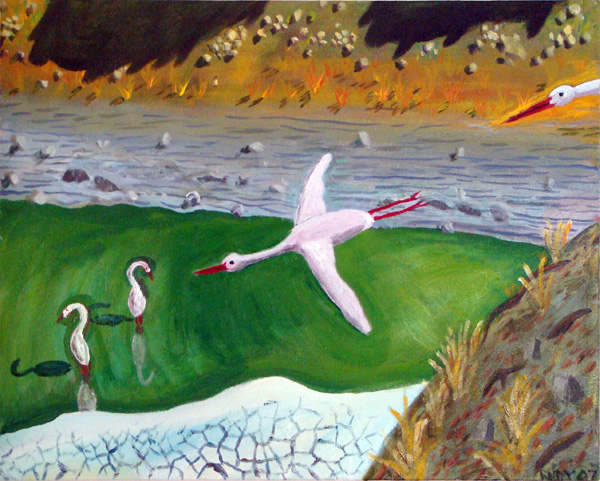
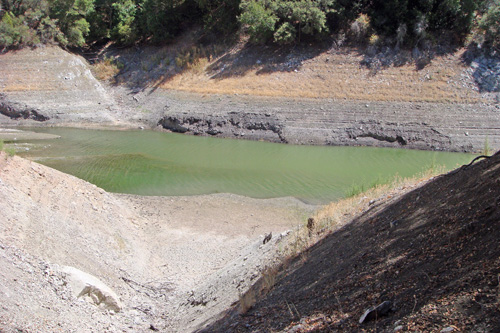
Last week I scrambled down to an inlet of the Lexington Reservoir near Los Gatos with my friend Vernon and we painted a little. We were looking for some ambient water. It was so hot and sunny that we had to go up into a shady gully to one side. We saw some egrets landing. I’ve gone back to the picture four times, and I think it’s done now.

I had to focus down on just part of the scene to get a picture. The two things I liked best were the wavy shoreline and the cracked mud.

I always think of math when I see things like this…

Aether Vortices and The Hollow Earth

Wednesday, August 29th, 2007

This is a model of an atom, I believe.

I got the image in an interesting email from a fringe science site devoted to John Worrell Keely’s “Vibratory Physics” of the 19th century. Matter as aether vortices with, I think, seven kinds of aether in seven dimensions! Sounds like how people get aktualized in Hylozoic

My artist friend Hal Robins sent me a nice print of a classic Hollow Earth picture. It’s been a while since I did a Google search on the Hollow Earth; a rich haul.

My favorite link (as of 2007, although in 2010 the link was no longer active) describes how a man named Steve Currey was organizing a “Voyage to Our Hollow Earth” charter trip aboard the Russian nuclear-powered icebreaker Yamal—the plan was to nose around for the opening to the Inner World which is surely somewhere near the North Pole. The planned itinerary bears the caveat, “Please note that if we are unable to find the Polar opening, we will be returning via the New Siberian Islands to visit skeleton remains of exotic animals thought to originate from Inner Earth.” The trip was to take place this summer, but sadly the organizer died—and perhaps not many people signed up—so the trip didn’t take place. Another site indicates that a new organizer hopes to reschedule it.

David Standish recently wrote a very nice historical survey called Hollow Earth literature, with kind words about my own novel The Hollow Earth. [For some reason, the Amazon link for buying my book The Hollow Earth has the wrong cover image; the correct image of my novel’s new edition is below.]

The dream lives on! I myself dream of voyaging in 2008 with my brother to look for the entrance to the Inner World in the vicinity of Triton Bay in the Fak Fak Regency in the West Papua district of Indonesia, getting in some great diving while I’m at it. See Yung Yip’s image of a Triton Bay sea slug below from the always fascinating Sea Slug Forum.

Get back to your novel, Rudy, you’re wasting time!

Oh well. As William Craddock wrote: “Time? How can you waste time?”


Rudy's Blog is powered by WordPress