Click covers for info. Copyright (C) Rudy Rucker 2021.


Author Archive

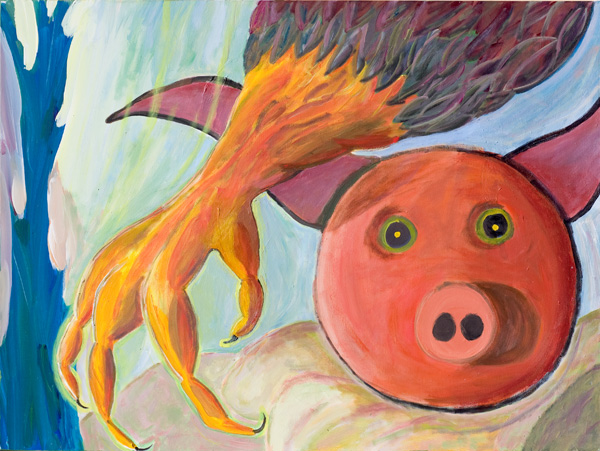
“Pig Surprise.” Plastic Man.

Monday, March 30th, 2009

I finished a new painting today, “Pig Surprise,” 40 inches by 30, acrylic on canvas. Or maybe the title should be Tax Time!

I started out with random blotches of paints, and then I started seeing some images. At first I had the picture rotated 180 degrees from this, and the yellow stuff was fire, and the red disk was a setting sun. But that looked dull. So I turned it the other way, got a claw…and added pig snout and ears. Pig Surprise! Poor pig.

Actually I got the title for this picture because when I went to Big Sur last week, my daughter Isabel was teasing me, and said I was going to Pig Sur. A real pig sur prize…

As always you can find more info about my paintings at my Paintings page…prints, note cards, originals, and a book of the paintings are all for sale.

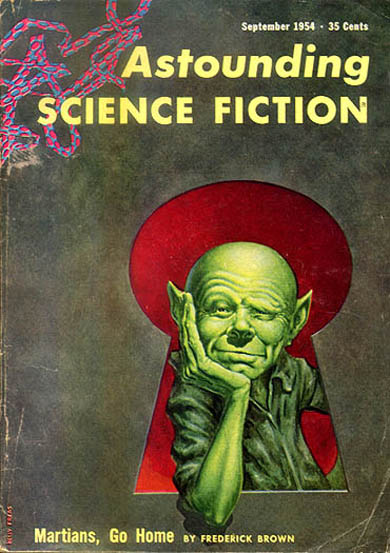
As I mentioned in a post the other day, I’m thinking about having a little green goblin in Header’s skull in Chapter Four. I want to have a creature living in his head and controlling him, but a green goblin seems too much of a default choice, that is, too much like a golden age Kelly Freas image of a Martian. Not that I don’t love those images…

But I had some ideas for making it a little new.

First of all, don’t call it a goblin, call it a voor. Somehow I’ll need a way for the voor to take physical residence inside people’s heads. I’ll mention that the body of the voor’s previous host has no brain at all. He’s not exploded or anything, but his skull is empty.

Second , suppose that I do want a little green man with a gnome look—this makes sense, as a gnome resembles a bald old person, and old age is one of the subtextual themes of this novel. I have a vision of my voors in armies and in underground cities like in, yes, Lord of the Rings. But just to warp it a little, suppose I give each voor an extra pair of arms to suggest a six-legged ant-like quality.

Third of all, I’ll give the voors a superpower that’s along the lines of the implicit biotech in my existing menagerie of space-bending jivas and colony-organism shapeshifting yuels.

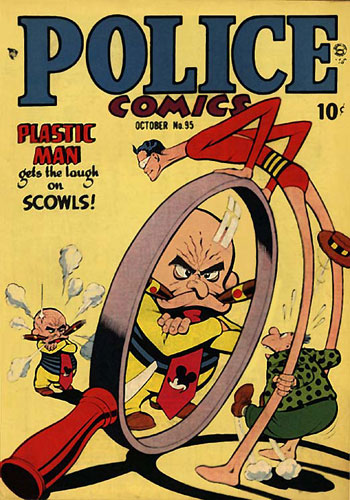
To wit, I’ll suppose that a voor is like the Plastic Man cartoon character, who can change his body shape. Unlike the yuels, who are colony organisms, the voors can’t completely change their shape and color, it’s more that they can change the sizes of their parts. They do this via a jiva-like technique of space manipulation. Note that, by the way, jivas can change their own size via space manipulation, so the skills of the voors and the jivas are similar. Perhaps voors are dark-side jivas—comparable to how devils are sometimes regarded as fallen angels.

I’m thinking of the 1940s comic Plastic Man by Jack Cole, by the way. Art Spiegelman and Chip Kidd co-edited an interesting art book about this strip, Jack Cole and Plastic Man: Forms Stretched to Their Limits .

And the character is mentioned (as Plasticman) in Thomas Pynchon’s Gravity’s Rainbow:

“Four-color Plasticman goes oozing out of a keyhole, around a corner and up through piping that leads to a sink in the mad Nazi scientist’s lab, out of whose faucet Plas’ head now, blank carapaced eyes and unplastic jaw, is just emerging. ”˜Yeah. Who’re you, Ace?’” (p.206)

And later in Pynchon’s novel, in the gloomy twilight of the tale, “Plasticman will lose his way among the Imipolex [plastic]chains, and topologists all over the Zone will run out and stop payments on his honorarium checks” (p.752)

The topologists are upset, you understand, if Plastic Man becomes no longer “perfectly deformable.”

The Rhetorics of Fantasy. Jim and the Flims.

Wednesday, March 25th, 2009

After a lifetime of being an SF writer and rejader—and somewhat skittish about fantasy, I’m slowly coming to accept that my new novel, Jim and the Flims, is closer than ever to fantasy. [As of 2016, you browse a free online edition of Jim and the Flims via the book’s page.]

I’m attracted to fantasy just now as I’m tired of making up scientific explanations of things. I just want to go straight for the surrealism without having to incant the by-now-rather-stale rhetoric of quantum-this and dark-matter-that.

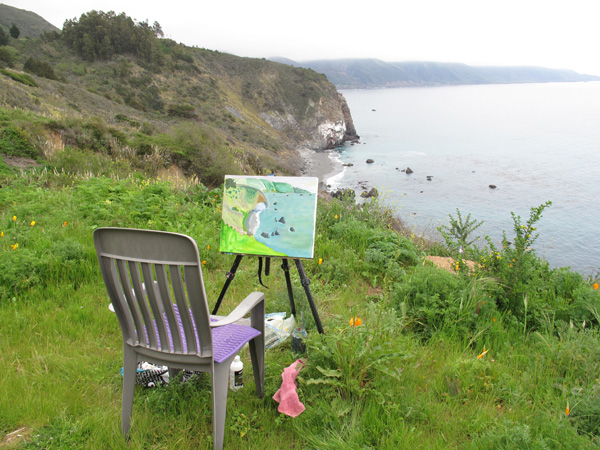
So now I’m getting interested in theories about what fantasy literature is and can become. (By the way, today’s illos are still from my trip to Big Sur last weekend.)

I just read a really interesting essay by my friend Farah Mendelsohn (as of 2016, it’s no longer free online), it’s the introduction to her critical volume Rhetorics of Fantasy, which I then proceeded to order a copy of from Amazon. So without having read the book yet, I’ll irresponsibly start outgassing about Farah’s ideas based on what I gleaned from the intro. She distinguishes several modes of fantasy:

Portal-quest. There’s a magic door to another word. The main characters go through, learn about the other world, get to know it well enough to achieve something, and then come back. Things from the other world don’t come through the portal to our world.

Immersive and Intrusive. In the immersive mode, the book simply starts out and is set in some fantastic other world. In the intrusive mode, creatures from another world appear in ours. The mood for intrusive fantasy is one of shock and amazement, what Farah Mendelsohn calls an “awestruck or skeptical tone.” She points out that it’s an effort to keep up this tone of surprise, and to this end, the oddness of the intruders often escalates over the book.

Liminal. Like the intrusive fantasy, the liminal fantasy is set in our world, but there the fantastic elements are fleeting, barely glimpsed. Maybe you see an elf in your back yard, rather than a giant were-pig rampaging down Wall Street. Or a little birdie talks to you. Mendelsohn suggests that in the liminal fantasy tales, the characters don’t get all worked up about the odd things, they take them as a normal part of life. This would set liminal fantasy apart from to intrusive fantasy.

It always surprises me to find such simple archetypal forms underlying such seemingly open-ended forms as fiction in general and fantasy and science fiction in particular. We stick to a few patterns that work—patterns perhaps suggested by basic aspects of our innate psychology.

How do Farah’s modes apply to my plans for Jim and the Flims?
I found I was almost viscerally compelled to put a portal into Jim and the Flims. I was floundering, and the notion of the portal was like a life-preserver to grab.

With a portal, you’re setting several things in play. One is that you have an alternate world. A second is that there will be limited access to the portal, that is, only a few characters can go through it. A third is that finding the homeward portal from the other world may take some effort. A fourth is that the portal can lead aliens to our world as well as leading us to theirs.

In Postsingular and Hylozoic, I had an alternate world, but here the “portal” wasn’t a specific location, but rather a certain meditative technique—akin to a magic spell. And in Mathematicians in Love, I had a certain device that would turn some region of space into a portal. You might think of it as a mechanized spell-caster.
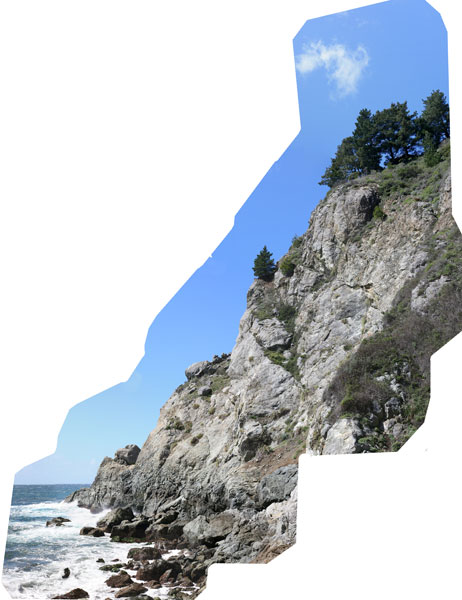

[Merged panorama of a cliff at the end of a little-known and unmarked public path to the sea near milepost 38 and Partington Creek in Big Sur, a little north of Pfeiffer-Burns park. The entrance looks like a gated fire road.]

Of course SF is rife with portals—that’s often what faster-than-light travel devices look like: magic doors. But even a ship that you get inside and then get out of is a kind of portal, particularly if the ship makes a long trip very rapidly. The animated UFO that Frek rides in Frek and the Elixir serves as a portal.

The same portal issues arise with these variations: limited access to the portal, the difficulty of getting back home, and the two-way connection that the portal involves.
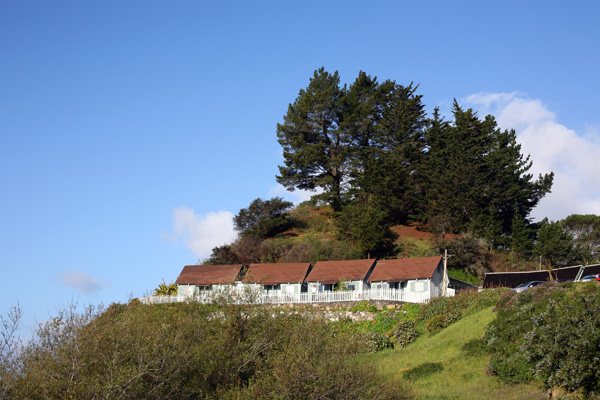

[Lucia Lodge, my favorite spot to stay in Big Sur, located some 30 miles south of the “town” of Big Sur.]

A far-future SF novel has the quality of an immersive fantasy novel—you’re in some place where everything is different, and you’re seeing through the eyes of a native, and slowly you get your bearings. The SF equivalent of intrusive fantasy is to introduce have the strange things intrude via a new invention. Or they might arrive as alien invaders.

Jim and the Flims is set in our present time, and it takes the form of an intrusive fantasy. That is, we start out in our familiar world, and the fantastic elements trickle in. Yes, there is a portal, but we first become aware of the portal because of some fantastic beings who’ve used the portal to intrude into our world.

Rather than continuing to escalate the oddity of the intruders, I plan to go the whole hog and have my characters go through the portal to the alternate world themselves. They get used to it pretty quickly, so we get more into the immersive than the intrusive mode, and they don’t have to act awestruck all the time.

Regarding liminal fantasy, I’ve often thought about a notion that there are other beings around us all the time, things we glimpse from the corners of our eyes. I guess this is a liminal fantasy concept. I like the notion that the world is full of living beings or spirits of place, akin to gnomes, elves and fairies. The story I wrote with Paul DiFilippo, “Elves of the Subdimensions,” is a liminal fantasy that turns intrusive, with, come to think of it, a kind of portal.

When starting Jim and the Flims I was thinking along these lines, imagining an alternate world the overlays and is wholly contiguous with ours. But now it seems less likely I’ll use that mode—probably it’s enough to be using the portal-quest and intrusive fantasy modes.

At least now, thanks to Farah, I have a clearer notion of what it is that I’m up to! Now I have to actually read some more of her book…


As mentioned above, as of 2016, you buy an ebook or paperback — or browse a free online edition — of Jim and the Flims via the book’s page. In the end, I backed off from total fantasy and ended up inventing SF-style “explanations” for all the bizarro surreal stuff in the book. But in any case, thinking in terms of fantasy was liberating. Visions first, explanations later!


First Reading from “Jim and the Flims”

Tuesday, March 24th, 2009

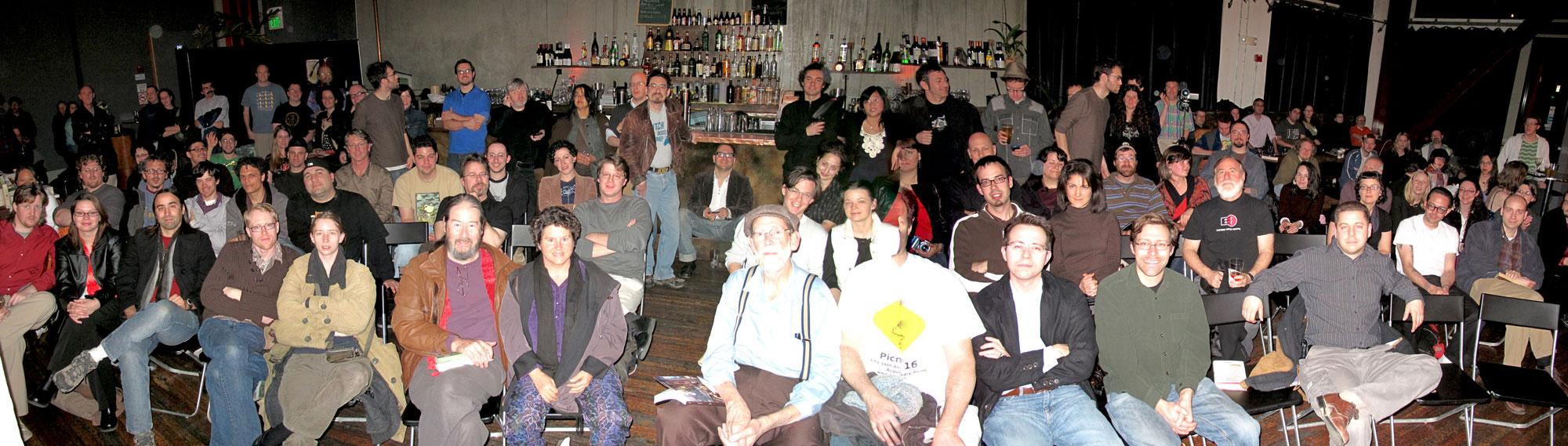
I did my reading for the EFF benfit in San Francisco, Monday night. It was a really nice event in a good space—the 111 Minna Gallery—with Charlie Jane Anders, Annalee Newitz, and Cory Doctorow reading as well. Here’s a picture of the audience. You can click on the picture to see a bigger image.

And I made a podcast of what I read, which is the first chapter of my novel-in-progress Jim and the Flims. You can click on the icon below to access the podcast via Rudy Rucker Podcasts.

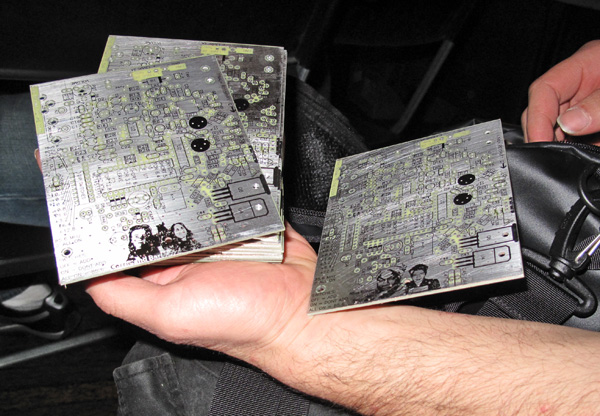
While mingling with the crowd I ran into a lot of old hacker friends. One of the guys I met is selling what are basically pirate radio station kits, available from Armstrong Radio. Each of the “radio station cards” has a handsome image of a former freedom fighter etched into the circuitry!

Big Sur. Jim and Flims.

Monday, March 23rd, 2009

My wife and I spent a couple of nights in Big Sur this weekend—a getaway for my birthday. Today I’ll post some of the pictures I took, interleaving them with material excerpted from my latest notes towards my novel-in-progress, Jim and the Flims.

I put in a bit about Jim carrying a digital camera and taking pictures. Actually I did it to justify his knowing the concept of “clipping” in a computer graphical sense, so as to apply this word to his mental state when very high. But then I was thinking that, since I myself carry around a camera a lot, it might be interesting for me to have a chance to write about taking pictures. And I had the sense that it could be a useful plot hook later on if Jim has a lot of digital photos of these weird things he sees.

I was even thinking that, over in the other word—called Flimsy—his conceptions about photography might enable him to come up to a solution to some problem they have there. I was thinking in terms of his using photography as a metaphor of a psychic version of the Windows Restore function or the Mac Time Machine facility, that is, the ability to restore your system (computer here, brain over there) to a prior state, after is becomes encrufted with junk (bad upgrades and drivers here, bad teep thoughts over there).

I’m thinking that the tunnel between worlds is actually a “border snail.” You travel though the snail’s alimentary tract. The snail is in the basement of a whipped old Victorian house which is in fact the shell of the border snail. I’m putting in a routine about smaller and smaller rooms (like the chambers in a nautilus shell).

Crawling through a snail’s guts seems kind of . . . slimy. So I think I’ll have the tunnel be big and cozy, with quilting on the walls. A spacewarp makes it roomier. Negatively curved space! You stretch the space with zickzack hyperdimensional origami.

My character Jim needs to start being proactive, otherwise he’s not heroic. I always need to remind myself to do this—it’s such a classic writing error to have your main character be passive and acted-upon. This is a common mistake that beginning writers make, and yet I still make it.

Here’s a cool scene I wrote:

Just then the screaming upstairs peaked, and we heard the nightmarish thud of that axe hitting home. I held back from teeping the details. Shrieks and gurgles sounded. Ginnie bust into sobs. More thuds, staggering footsteps, and—the window of Ira’s room burst outwards in a shower of fragments. A heavyset man tumbled through, landing on the lawn with a sodden thump. He was wearing a blood-soaked terry bathrobe. Two of the jivas drifted out in his wake, checking things out.

The man was flabby and belly-white, with a gory wound in his chest, surely dead. The top of his skull had been split wide open. But now—how strange—the halves of his skull pulsed, quivered—and gaped apart like opening halves of a clamshell.

Ginnie put her hands over her face and groaned. By the light of the hovering jivas, I could something green wriggling inside the ruined skull. And now a lithe green figure emerged, as if from an egg, a tiny naked humanoid with pointed ears, a being no more than six inches tall. My dog yelped and backed away.

So a goblin can hollow out a living human’s head and move inside it. How does the goblin get into a body? By slicing open the skull and suturing it with zickzack, but nevertheless leaving a scar. And of course the goblin eats the old brain. The old ways are the best ways.

We might use the word “rind” to refer to the hollow body that the goblin was driving around.

Birthday thought: Jim swallows a jiva—which is like a flying turnip with a long slender tail with root hairs. Jivas can make this matter-like stuff called zickzack out of folded mpty space. This can make Jim younger in various ways. It gives him a zickzack face lift akin to what they call a “ribbon lift” with a length of the tail pulling taut his wattles. Zickzack tendrils merge into his muscles and tendons making them tauter, zickzack lining fixes his hip joints, the overall effect of having the jiva linked to his nervous system would sharpen his mind.

Maybe later in the book, when Jim comes back home from Flimsy, sob, the rejuvenation wears off, and Jim is old again.

Suppose we think of the “tunnel” as spacetime links between door-opening events in the two timelines. The notion of synch is somewhat meaningless when discussing parallel times. You just pick two events and link them. Okay, fine. So we need people to man a number of opening events.

Why does the border snail only open its operculum for certain people? Simplest answer: the border snail is as a god, weaving the patterns of the worlds.


Rudy's Blog is powered by WordPress