Click covers for info. Copyright (C) Rudy Rucker 2021.


Author Archive

Hylozoic is Coming

Monday, May 11th, 2009

I’ll be leaving the Rudy’s Blog planet for the last two weeks of May—

—because I’m going to be a guest blogger on BoingBoing from Monday, May 18, 2009 to Saturday, May 31, 2009. I’ll try for one or two posts a day over there.

It would be nice to have some cool links, so do email suggestions to me, preferably with a subject line of “boing link.” I figure that regular readers of Rudy’s Blog might have a notion of what kinds of links interest me…

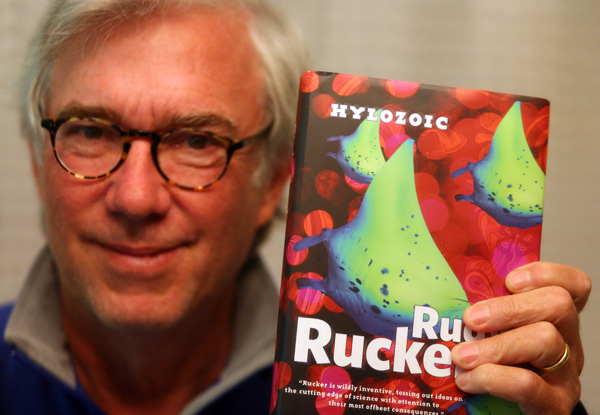
The guest blog stint is mainly to promote my new novel Hylozoic, which is already printed and goes on sale May 24, 2009. I’d like to get some good sales for this book in order to help me continue getting published by a strong mainstream press like Tor.

I’ll be doing a few readings for Hylozoic around the SF Bay Area in early June, you can check a list of the readings on my publisher’s site.

I already got a couple of good reviews for the book, by the way:

Rucker’s yarn of a future where everything—animals, rocks, the planet Earth—is conscious, telepathic and often irrepressibly chatty. Rucker’s approach takes a high-comic trajectory with a satirical edge… Serious, uproarious fun, with brain-teasers and brilliant ideas tossed about like confetti.
— Kirkus Reviews.

Bristling with cool ideas, bizarre but witty formulations and neologisms, Carrollian mathematical/logic puzzles, gnarly tech applications and gonzo speculations, wicked satire, hot sex, nasty aliens, anarchic plots, and psi powers … Rucker juggles the disparate elements of his plot with the zany aplomb of the Flying Karamazov Brothers. His vision of the future is a hopeful and inclusive one—and one hell of a party.
— Locus

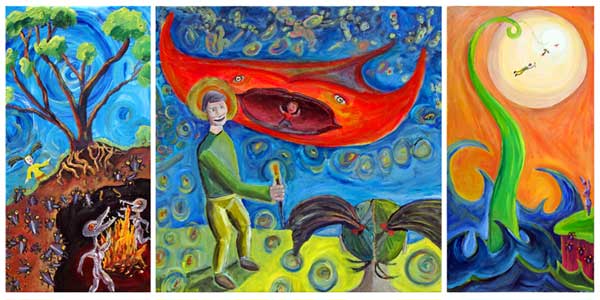
Long time readers of this blog will remember that I painted a triptych to help gear up for writing Hylozoic, as shown in the image below. On the left, that ‘s Thuy Nguyen with the pigtails, catching sight of the nasty, subdimensoinal subbies. In the middle, that’s an alien flying manta ray called a Hrull, about to swallow Hieronymus Bosch. On the right, that’s Thuy and Jayjay flying towards the top of a transfinite beanstalk. (I’ll be posting a bigger version of this image over at BoingBoing next week.)

Clearly any reasonable person would want to order a copy of Hylozoic today!

Eaton SF Con on Verne and Steampunk

Monday, May 4th, 2009

This weekend, we flew to John Wayne Airport in Orange County and rented a car to drive 40 miles bumper to bumper to Riverside, CA, for the Eaton SF Conference, a series of mostly academic talks and panels about science fiction, held at the University of California at Riverside.

[Today’s pictures are still from Wisconsin, as my camera battery was dead in Riverside.]

The conference is organized by the charming Melissa Conway and other members of the Special Collections department of UC Riverside—they have the world’s premier collection of SF novels, fanzines, and writers’ literary archives—this is the Eaton Collection.

I’m thinking of giving my own papers to the Eaton Collection one of these days. My writer friend Gregory Benford has his stuff there, so I went and looked at it. Benford and his identical twin brother Jim were hauling in fresh boxes of stuff. Boxes of papers on shelves in a windowless room. Just stuff, after all. I had a moment of wondering why it seemed important to me to have my papers in a library. Kind of the feeling you get shopping for a grave plot…
It was really fun seeing Greg Benford in the company of his twin. Although I like Greg a lot, he can be a little overwhelming. And his twin Jim seems to have a somewhat similar personality. But when you’re dealing with the two of them at the same time, they kind of buffer each other, like a atoms which are very reactive in isolation, but comfortable in pairs.

Another nice thing at the con was a videotaped talk by Frederik Pohl, whose health kept him from attending in person. Pohl may be ninety, but he’s sharp and witty. Saintly almost.
The con theme was Junes Verne, and I was on a panel about “steampunk.” My novel The Hollow Earth can be called steampunk, in that (a) I’m a cyberpunk, and (b) the book was written in the late 1980s, and (c) it’s set in the 1800s, and (d) the book has fantastic elements. But, in that my The Hollow Earth is set in Virginia, I deviate from the generally Anglophile/Victorian slant of steampunk as it’s popularly imagined, and thus I tend not to be mentioned in some discussions of the genre.

Sometimes I worry that I’m invisible to the eyes of casual SF scholars—from some articles, you’d get the impression that I’m not a cyberpunk, not a steampunk, not a slipstreamer, etc. Wheenk, wheenk, wheenk! I get the feeling that some SF scholars have done their research by reading one or two best-sellers and watching a lot of Star Trek—although a lot of them have indeed dug much deeper.

I did hear some interesting talks at the con, one was by David Wittenberg, about the notion that time travel stories arose because early 19th C writers wanted to write about utopian alternate worlds—and that once the notion of evolution became popular, they assumed these cool worlds would be in the future, you you needed time travel to get there. Initially they’d do a one way trip via suspended animation—the whole thing of round trips and time paradoxes really took hold after Einstein.
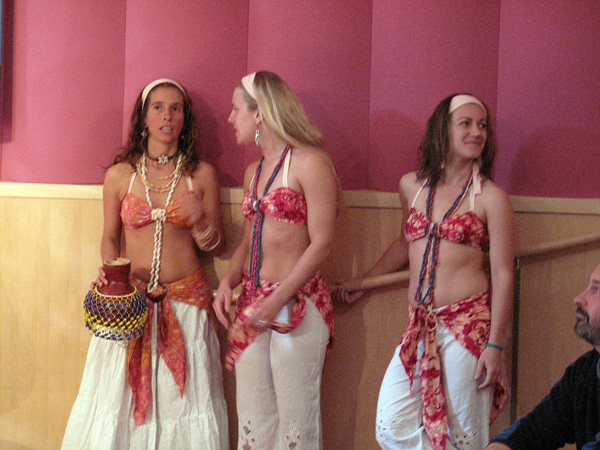
Historically, the “steampunk” word arose as something of a marketing move to ride on the cyberpunk wave, akin to DiFilippo’s use of the word “ribofunk” for his bio-sci-based stories. K. W. Jeter coined the word to describe himself, James Blaylock, and Tim Powers. And I think the word took deeper hold when cyberpunks William Gibson and Bruce Sterling wrote their novel The Difference Engine about Victorian steam-powered computers.

A writer like the aboriginal steampunk Tim Powers is more interested in fantastic elaboration of incident and character than in any political stance. Powers was at the con, it was great talking to him, he’s like a white hole of ideas, gushing with story gimmicks and plot twists. He even gave me some suggestions for the book I’m working on.

Lately, for some reason, the word steampunk became popular again, but this time more in connection with clothes fashions, so far as I can tell. I will say that hearing about big brass machines at the Eaton con kind of made me sort of want to write about them.
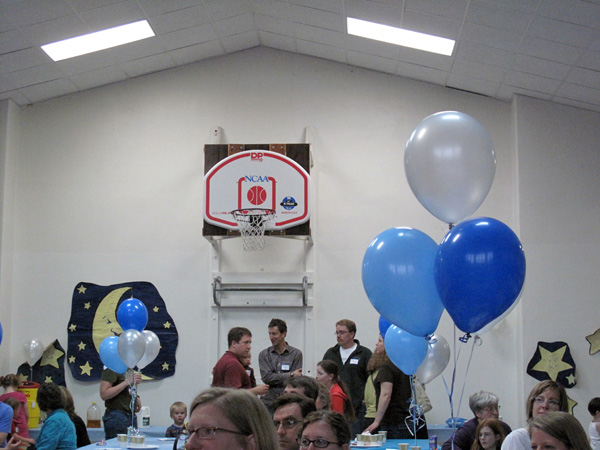
Other SF writers presentat the con included Greg Benford , Sheila Finch, Howard Hendrix, Greg Bear , Tim Powers, and Kathleen Goonan.

Although I relish talking to other writers, I do tend to feel uncomfortable at cons. I’m somewhat shy and socially awkward. Douglas Coupland has a good passage about this in his novel, JPod. The character talking here is a programmer who, according to his girlfriend, has mild autism:

What I don’t like is being exposed to unfiltered social contact, like at parties or meetings, when just anyone can talk to you with no other reason than that you happen to be there.

Southern California near LA is really Car Land. The Inland Empire they call it. I’ve never seen such traffic, and the sky was this weird grayish-white color. The locals claimed it wasn’t smog, just dust or the weather or haze. An orange grove was down the block on a vacant field by the freeway and behind our motel parking lot.

I noticed an awesome old street rod car parked in the motel lot, and I asked the long-haired owner about it. He directed us to a car event on the streets of downtown Riverside, the “Show and Go” show.

Talk about steampunk! My favorite car was the so-called Metronator, which is 1956 Nash Metropolitan with a two thousand horsepower engine that sticks up outta the hood like on a Big Daddy Roth dragster.
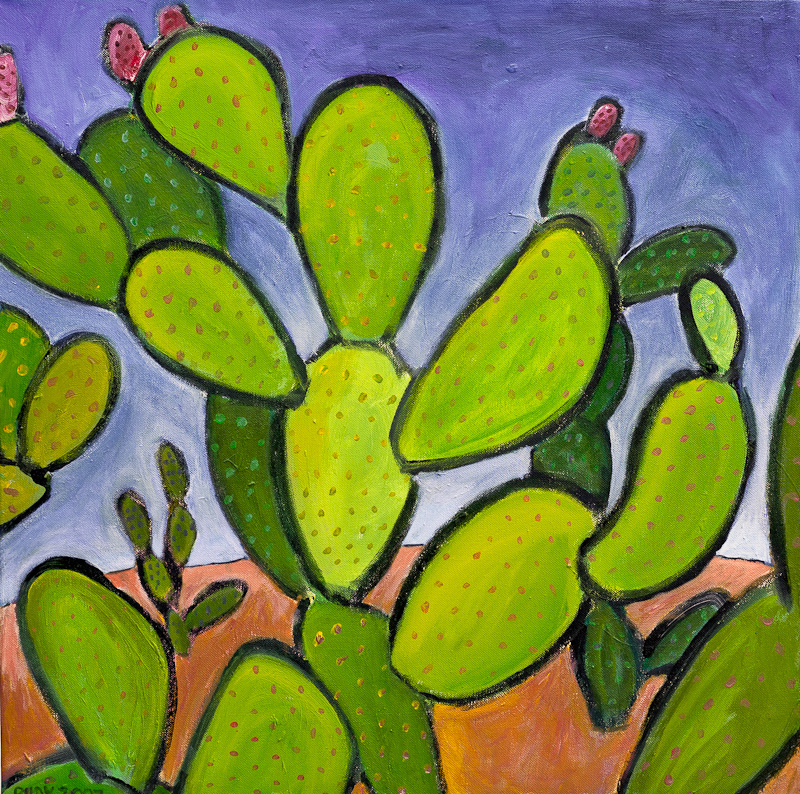
I toured the UC Riverside cactus garden with Jim Benford, he told me that cactuses are, evolutionarily speaking, the most recent plants to appear. They emerged in response to the drying of Central America and the our Southwest.

On the way back to the airport, I sort of wanted to visit the Richard Nixon Library and Birthplace in Yorba Linda—they have his house and his helicopter and, I think, Trisha Nixon’s Inaugural Ball Gown.
In connection with donating papers, there’s an interesting connection here. It used to be that an author could deduct the “fair market value” for his or her papers when donating them to a library. But this law was repealed in 1969, largely because too many politicians were getting huge deductions. And good old Tricky Dick, backdated the donation of his papers so he could take a half-million-dollar deduction in 1970.
What does Yorba Linda mean, anyway? “Linda” means beautiful, but what’s a “yorba”? Ah, Google tells me that in 1809, Jose Yorba, got a land grant to start the town…

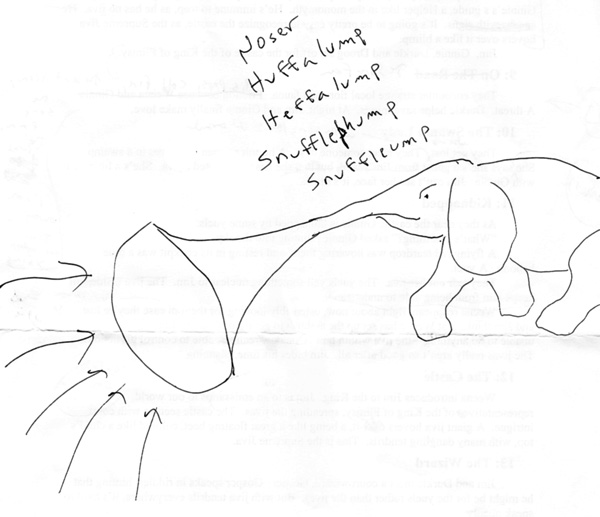
I was going to call the creature shown above a heffalump, after Winnie the Pooh, but maybe it’s a yorbafump!

Yorba Linda here I come, right back where I started from?

Well, we didn’t end up going to the Nixon museum on Sunday afternoon. Sylvia put down her pied, and we went to Newport Beach and caught some sun, and it was stokin’.


The Song Fan

Tuesday, April 28th, 2009

I’m just back from visiting my daughter Georgia and her family in Wisconsin. It was fun. We went to a school carnival with a humorous-songs guy, and the kids were cheering.

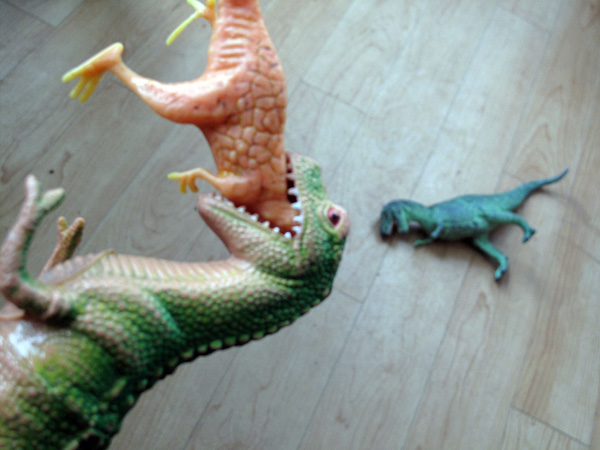
My granddaughter and I had some fun playing with plastic dinosaurs.

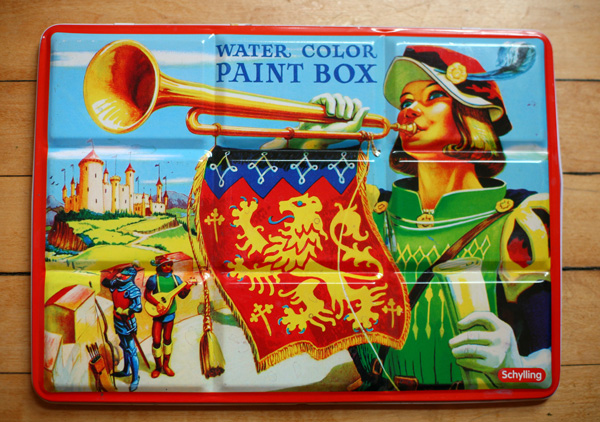
She has a set of paints with a nice traditional picture of a fantasy castle printed on the lid. Schylling products are Made in China. Isn’t that the grooviest picture you’ve ever seen? I like trumpet shapes a lot, their surfaces are made of negatively curved space.

This picture helps me with my plans for the next chapter of Jim and the Flims, I was thinking about it on the plane. Jim and his young companion Durkle are about to set off for the castle of the King of Flimsy.

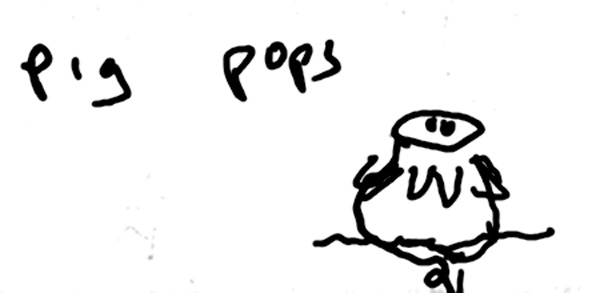
They eat pigpops as a snack—these are meatballs that grow in the ground, with pig snouts on top, and a ruffle of ears all around and no eyes, and root that’s a curly pig tail. Maybe we have some waffle cactuses too, like prickly pears. Cold fire flickers across the rocks like lichen.

They come across a cone-shaped hole in the ground with walls of cinders. Durkle gets them to sled down it, as if they were snowboarding. Ginnie makes them zickzack boards for sliding. It’s dangerous, but the resident jivas living in our heroes don’t object. The jivas are young and irresponsible, and apparently it’s sort of a rush for a jiva to be in someone when they die.

While they’re bowl-surfing, they see a skull in the cone’s cinders. Oh oh, there’s a giant ant lion at the bottom, with tentacles and mandibles, they barely escape. They escape by Jim having his jiva make them a hamster-ball of zickzack around themselves.

They have the jivas turn gravity around, so their ball rolls out to the top of the pit. They’re on the wrong side of the ant lion’s pit for easily walking towards the castle. They’re near a swamp.

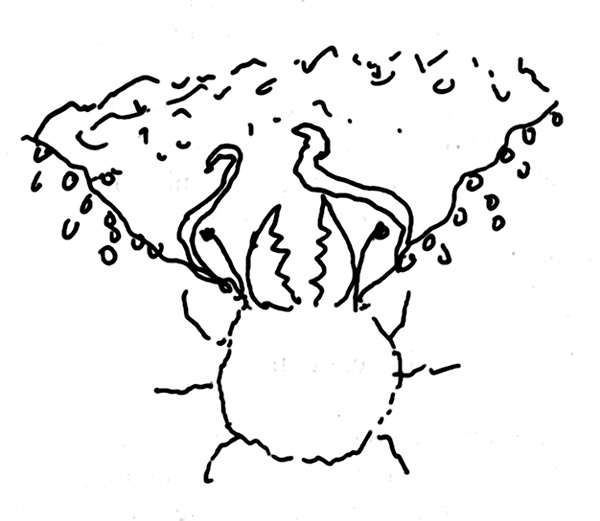
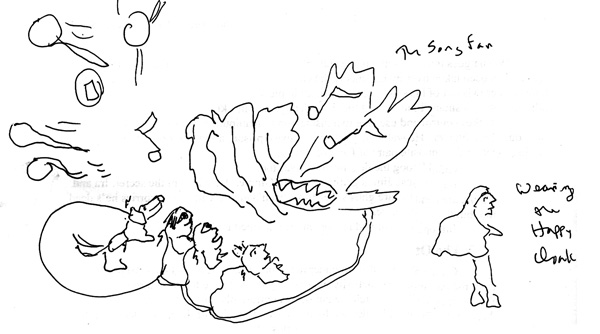
They could just hop to the castle now, but Durkle wants to look at a song fan—he’s heard about them, but has never seen one. Quickly they find one. It’s an animated plant, fan-shaped, like a peacock’s tail, playing shimmering exquisite music like a Theremin or a musical saw, a song that’s in part made up of sampled shrieks from the song fan’s previous victims.

The jivas can’t stand the sound, they’re worried the song fan will eat them, jivas being a song fan’s favorite food, so the jivas jump out of our heroes and flee—the jivas are the beet-shaped things moving off to the left in my drawing. Note also in the drawing that the song fan has stealthy tendrils growing out to plug into the necks of our heroes Droog the dog, Ginnie the dead surfer, Jim, and young Durkle.

Without his jiva, Jim is old again, as old as a grandpa walking his grandson in a zoo…just like me! Its not so bad to be old.

And Jim is going to escape the song fan, you bet. Maybe he can wrap a piece of the song fan around himself and be…wearing the Happy Cloak!

Garden Painting for “Jim and the Flims”

Monday, April 20th, 2009


“The Baby Garden.” Acrylic on canvas. 24″ by 18″. April, 2009. Click the picture to see a slightly larger image. More info at my paintings page.

For the last month or so of working on Jim and the Flims, I’ve been nibbling away at a painting of how it’s gonna look when Jim and his new ghost girlfriend Ginnie make it over to the other side, that is, the land of Flimsy, which is both a parallel world with its own natives, as well as being a place where the spirits of some people from our world go after death (as newly decided in the previous post, and thanks again, by the way, for all the supportive comments).

As I’ve mentioned before, these days, when I’m stuck for story images, I like to paint instead of just thinking. I’ve always done little drawings of my scenes before writing them, but now I enjoy the more heavy-duty process of breaking out my kit of acrylic paints. The painting takes longer, and I get more deeply into it than into a drawing.

My inspiration for the motif (art term for the subject of a painting) was van Gogh’s The Sower—a man sowing seeds into a field. In my story the sower’s name is Monin. And I’ve got two people greeting him, they just came out of that interdimensional tunnel visible in the door of a house that’s a limp Brussels Atomium made of lavender spheres. These two are Jim and Ginnie.

The kicker in the picture is that the sower is casting baby-seeds into the field, and we see human heads—and the head of one green alien—sprouting up. I probably won’t have the green alien in this scene in the novel, nor do Jim and Ginnie necessarily look exactly like this—my book paintings are more like dreams or premonitions about my stories than being totally accurate illustrations.


[The helpful, prancing dog of the right brain retrieves the ball. Arf!]

In the morning the seeds in the garden will have grown—they’ll be human-like bodies, with their legs rooted in the ground, and with no intelligence, like blank-slate clones. All of them look like copies of Monin, the sower. Some jivas come and sting the bodies, implanting larvae. The jiva larvae eat up the bodies and burst forth as new jivas.

That’s the practical reason why I need this garden, see. I want the jivas to be savage parasitic flesh-eaters—like wasps who lay their eggs in the flesh of paralyzed hosts (I love the use of the word “host” in this context). But I don’t want the jivas’ flesh-eating to be a problem for the locals in Flimsy, so we have these “jiva gardens” full of clones for the jivas to grow inside of.

And later, Jim can grow a clone of his own body, and put a yuel inside the clone’s skull to produce a zombie fake Jim who can perhaps join the merry roller-derby surf zombies of Santa Cruz…


Rudy's Blog is powered by WordPress