![]() |
![]() |
![]() |
![]() |
![]() |
![]() |
![]() |
![]() |
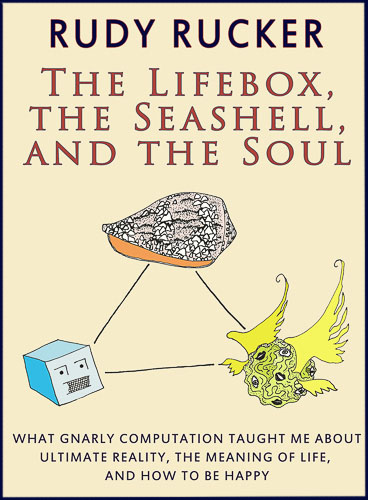
The Lifebox, the Seashell, and the Soul:
What Gnarly Computation Taught Me About
Ultimate Reality, the Meaning Of Life , and How To Be Happy
by Rudy Rucker
Basic Books, Paperback, $19, 2006
560 pp, 148 illustrations, with drawings by Isabel Rucker
ISBN 978-1560258988
On sale at Amazon.
Sample the Book Online!
Click this link "Online Version" to view the entire book online as the 4 Meg file lifboxsample_full.pdf.
Summary
We're presently in the midst of a third intellectual revolution. The first came with Newton: the planets obey physical laws. The second came with Darwin: biology obeys genetic laws. In today’s third revolution, were coming to realize that even minds and societies emerge from interacting laws that can be regarded as computations. Everything is a computation.
Does this, then, mean that the world is dull? Far from it. The naturally occurring computations that surround us are richly complex. A tree's growth, the changes in the weather, the flow of daily news, a person's ever-changing moods --- all of these computations share the crucial property of being gnarly. Although lawlike and deterministic, gnarly computations are --- and this is a key point --- inherently unpredictable. The world's mystery is preserved.
"universal automatism." His analysis reveals startling aspects of the everyday world, touching upon such topics as chaos, the internet, fame, free will, and the pursuit of happiness. More than a popular science book, The Lifebox, the Seashell, and the Soul is a philosophical entertainment that teaches us how to enjoy our daily lives to the fullest possible extent.
Preface
As a teenager in 1961, I imagined that I'd like to become a philosopher. I recall agreeing with my best friend Niles Schoening that what we'd most like to do would be to get college degrees in philosophy and spend the rest of our lives as bums, talking about the meaning of life.
As it turned out, I ended up getting a Ph.D. in mathematical logic. And instead of becoming a bum, I found work as a professor and as a writer of popular science and science-fiction. I did keep talking about the meaning of life, though, to the point of publishing three somewhat philosophical books about mathematics: The Fourth Dimension, Infinity and the Mind, and Mind Tools.
In the mid 1980s I sensed something new in the air. Computers were ushering in a new era of experimental mathematics. Fractals, chaos, cellular automata, artificial life! And when I interviewed Stephen Wolfram for a magazine article, my fate was sealed. I moved to Silicon Valley, retooled, let the chip into my heart, and became a computer science professor at San Jose State University, also doing some work as a programmer for the computer graphics company Autodesk.
Back when I was contemplating my big switch to computer science, my old friend Gregory Gibson said something encouraging. "Imagine if William Blake had worked in a textile factory. What might he have written then?"
Initially, I thought this might be a quick foray. Get in, figure out what's happening, get out, and write my book on computers and reality. But somewhere along the way I went native on the story. I all but forgot my mission.
--- Rudy Rucker, Los Gatos, California, March 22, 2004
"Rudy Rucker is an outstanding prophet of what will probably be the greatest intellectual revolution of our times. This book tells the ever-surprising story of his transformation as he discovers the wonders of the computational universe, and grapples with their implications for humanity's oldest questions. For people who thrive on new ideas, this book will be a classic."
--- Stephen Wolfram, author of A New Kind of Science.
"This is the Big Book I wish everyone would do. Audacious and simply inimitable. You are inside Rudy Rucker by the end. Nobody takes the late-night idea that the universe is a computer as seriously (or with as much fun) as this book does. What I love about it: it's part biography, part far-out science fiction speculation, part best course-in-computation-ever-taught, part romp through the intellectual frontiers of mathematics and philosophy, part sage wisdom, part blog, part graduate student thesis, part genius. What it might become: a new Gödel, Escher, Rucker."
--- Kevin Kelly, Wired editor, author of Fast, Cheap and Out of Control and The Technium, publisher of Cool Tools.
"Computation, pattern, and information are hot topics these days as they find increasing applications in science, pure mathematics, computing, and even philosophy. Dr. Rudy Rucker, long at the center of this cyclone, has produced a truly stunning survey of their manifold consequences. No one should pass up the experience of stepping through the portals of this beautiful book into fantastic new worlds --- and topics ranging from brains and robots to hive minds and quantum souls."
--- Cliff Pickover, author of A Passion for Mathematics.
All the world's a computation,
And all the men and women (and everything else) merely operands.
With the soul of a poet and the insight of a logician, Rudy Rucker dramatizes the story of one of the most transforming ideas in modern science: that of computation. Interpreting the notion oh so broadly, Rucker calls on his impressive background in computer science and science fiction to clarify, amplify, and vivify a whole complex of seminal concepts. And the book's fun to read too!
--- John Allen Paulos, author of Innumeracy and Once Upon a Number
How did a universe composed of just a few kinds of absolutely identical particles, starting from a state of almost complete uniformity, evolve in an ever ascending chain of complexity to produce galaxies, stars, planets, life, intelligence, and culture? In this fascinating book, Rudy Rucker explores how structures in nature, human consciousness, and society may actually be computations, showing how extremely simple computer programs manifest complex emergent behavior which mimics natural phenomena, suggesting that computer science may become part of the foundation of the sciences of the twenty-first century.
--- John Walker, co-founder of Autodesk, Inc.
In this immense and ambitious work, former computer science professor Rucker (The Fourth Dimension) speculates that life is a computation. He offers examples of everyday activities that are computational processes-speech, agriculture, hunting-as well as instances of computations found in nature and attempts to model those computations using cellular automata. He applies this view of life as computation to problems in physics and biology (e.g., DNA and genetic reproduction) and goes on to explore artificial intelligence and the application of computation to questions of society. The "lifebox" in the title is a digital copy of a person's memory that would be hyperlinked and "give a reasonably good impression of having a conversation with you." Though Rucker ultimately sees the world as beyond computation, he convincingly argues that the computational view can shed perspective on reality. Including many examples from the history of computing, this dense and challenging read is recommended for science collections in larger public and academic libraries.
--- Library Journal (Garrett Eastman, Rowland Inst. at Harvard Univ.)
A key debate of the computer revolution concerns Stephen Wolfram's argument that everything is equivalent to computation; this book explores the implications of that thought. Rucker (As Above, So Below, 2003, etc.), a computer scientist and science fiction writer, examines Wolfram's dictum as it applies to questions ranging from the trivial to the existential. The word "gnarly" plays an important role here; Rucker uses it to suggest a kind of pattern characteristic of living beings, somewhere between simple symmetry and total chaos. Wolfram builds many of his insights from cellular automata (CA), simle programs that generate surprisingly complex and ever-changing patterns on a computer display; on e of the best know is the program "Life." Such gnarly outputs suggest that the full complexity of the laws of physics or biology could be embodied in a sufficiently sophisticated computation. Rucker relies particularly on two promises implicit in Wolfram's work: computational equivalence (everything is ultimately a computation) and computational unpredictability (the results of complex natural computations are inherently impossible to foresee from the data). In the book's central section, "Enjoying your Mind," Rucker takes the reader from elementary CA patterns to the physiology of the brain, always on the lookout for links between the simple (neurons) and the complex (consciousness). Each chapter is preceded by a short story suggesting its larger themes. Rucker also provides a wealth of illustrations, from rough computer schematics to photographs of natural objects that resemble CA outputs, and links to his own web pages, where curious readers can further explore the subject. In the final chapter, "Reality Upgrade," Rucker modifies Wolfram's basic premises to apply to everyday experience --- ending with a half-dozen practical rules for attaining happiness.
Charmingly written and thought-provoking.
--- Kirkus Reviews
"Lifebox" is valuable in the same way a wide-ranging philosophical classic like "The Republic" is valuable. To read it is to peer through a conceptual lens with its own unique focal length -- an act that allows us to see the world in a way we never glimpsed it before. ... Rucker's stylistic approach, featuring bite-size sci-fi stories that illustrate
his points, is so innovative that even non-techies will find themselves enjoying
the ride.
--- San Francisco Chronicle
Rucker ... is reaching as high as he can to try to use available computer science and math metaphors to create a new, comprehensive, multidisciplinary sensibility. The Ruckerian future is one in which new guiding explanatory ideas will connect all areas of intellectual curiosity.
--- Jaron Lanier in American Scientist
I have a number of lectures on the book available online as slides, and as audio MP3 files. For the audio, go to my podcast station on Gigadial, and flip back to the pages holding my podcasts from around 2005.
Monday, October 31, 2005, 4 PM. Talk on Gnarly Computatoion at The Media Lab, MIT. Here's my Powerpoint (in PDF form) for the talk.
Guest reader on Ann Arbor's UNBEDTIME STORIES every in October and November 2005 from on KFJC radio. The audios are online.

September 26, 2005, Monday, 4 -7, Future Commons event at the Institute for the Future in Palo Alto. "Gnarly Computation". Powerpoint of the IFF Talk. See also www.rudyrucker.com/pdf/historyofgnarl.pdf. And I've posted an audio as well.

I have Lifebox-related article called "Adventures in Gnarly Compuatation" in the October/November, 2005, issue of Asimov's Science Fiction magazine.
March, 18, 2005, PowerPoint talk on the book at the International Conference on the Fantastic in the Arts in Fort Lauderdale, Florida.
In fall, 2005, Rucker taught a course based on the book in the Philosophy department at San Jose State University: Philosophy 115: Computers and Philosophy. Many of the class lectures are online as audio files.

April 19, 2006. Talk on "Gnarly Computation" at the Mathematics Department of Fresno State University. PowerPoint Slides. Podcast also available online as audio.

May 18, 2006. Talk on "Gnarly Compuation" at LucasFilm, San Francisco. Blog entry is here. Also online are the PowerPoint Slides. Podcast available.
Contents
Preface Thought Experiment One: Lucky Number Chapter One: Computation Everywhere Thought Experiment Two: The Million Chakras Chapter Two: Our Rich World |
Thought Experiment Four: Terry's Talker Chapter Four: Enjoying Your Mind Thought Experiment Five: The Kind Rain Chapter Five: The Human Hive Thought Experiment Six: Hello Infinity Chapter Six: Reality Upgrade Technical Appendix |
![]() |
![]() |
![]() |
![]() |
![]() |
![]() |
![]() |
![]() |