Rudy’s Blog

Buy Rudy's books! Click covers for info.                 Blog text and images copyright (C) Rudy Rucker 2012.


Archive for March, 2011

Spring Haikus

Sunday, March 27th, 2011
Share

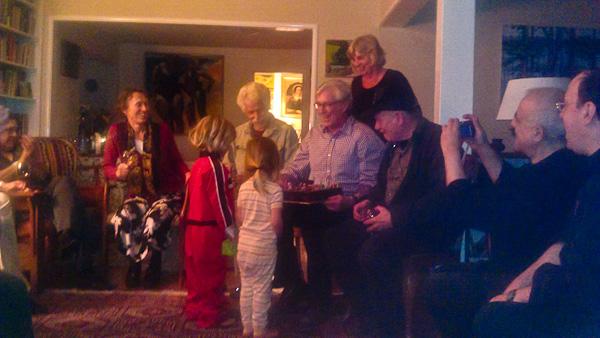
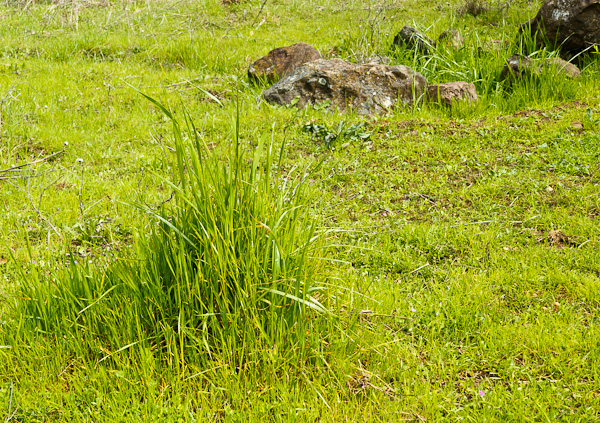
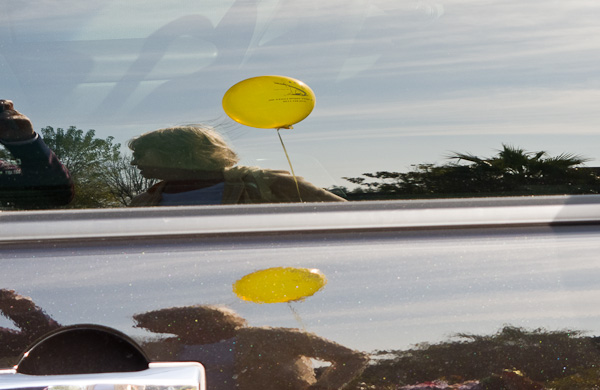
Sylvia got some of our friends and family to write haikus for my 65th birthday. Here are most of them, along with some random photos from the last few weeks. Cake-cutting photo by Emilio Rojas.

I think I’m going to take most of April off from blogging and tweeting. If you get bored with waiting for new posts, maybe add some haikus of your own as comments here! Any topic is okay, they don’t have to be about me or my birthday. Happy spring!

By the way, what is a haiku exactly? Well, there’s a precise Japanese formula, but in English it’s a little vague. Generally you’re talking about a three-line poem with seventeen or so syllables, distributed in a pattern of 5 syllables, 7 syllables, and 5 syllables. But the rules aren’t crucial, you can have plus or minus a syllable or two here or there. It’s all about the twist, the insight, the zap, the aha.

Rudy paints the sea
A giant mutant lobster
Shooting laser beams
    —Vernon Head

Hey babe let’s go out tonight
Under the full moon
It’s raining cherry blossoms
    —Sylvia Rucker

on a 4 D trip
o life is a flabber gas
wave on ye old tree
    —Georgia Rucker

Odd cephalopod
Alien contacts on Earth
Rudy knew it first
     —Penny Thomas

We miss Rudy’s bash
Many friends brave winter storm
Let them eat cake, yes!
    —R.U. Sirius and Eve

chicken chicken chick
chicken chicken chicken chick
chicken chicken hen
     —Rudy Rucker, Jr.

Live long and prosper
Another trip ‘round the sun
Spring day, snowy hair
     —Nathaniel Hellerstein

O legendary
SF dude, scroll down, log off.
Young pups scratch at door.
     —Terry Bisson

He likes to meld (a lot!)
in the Grand Garden of hot
Heliogenic Breath
    —Henny Nijland

Wielding his brush and pen
the silver-haired patriarch
portrays strange worlds.
    —Michael Beeson

The fog lifts. Morning!
Rudy gazes out away,
Twinkling at the door.
    —Hilary Gordon

A violin plays
Celebrate, dance and jig
The family circles
    —Courtney Lasseter

new piles of spam
turn to a pineapple ham
real life always sweet
    —Georgia Rucker

Photographer extraordinaire
To you
Heureux Anniversaire
    —Zan Thomas

sixty-five, a number,
nothing more:
and, to be quite clear,
nothing less
    —Frank Thomas

Floods, landslides, tsunamis reign
Water abounding
One diamond drop, hovering
    —Helen Han

Gnarly nature flows
Gnarly writer wiser grows
Rudy 65, wow!
    —Emilio Rojas

Hot damn, it’s overflowing
March waterfall
Gnarly and pseudorandom
    —Sylvia Rucker

Rudy pleasure birthday
Number of rational
No, number of real!
    —Nick Herbert

frogs croak and rumble
rudy rucker ruminating
stochastic flesh is love
    —Michael Blumlein

I’m in Mendocino with Nancy on a little vacation.
I’m sorry I couldn’t make it to your party.
(Wait, how many syllables is that?)
    —Jon Pearce

Share

Overflow, or, Three Regimes of Fluid Flow

Friday, March 25th, 2011
Share

I live near the Lexington Reservoir, which is next to Highway 17 near Los Gatos, CA. It’s very rare for the Lex to overflow—the last time I clearly remember it happening was nearly twenty years ago, late in 1992, shortly after Bill Clinton had won his first Presidential election.

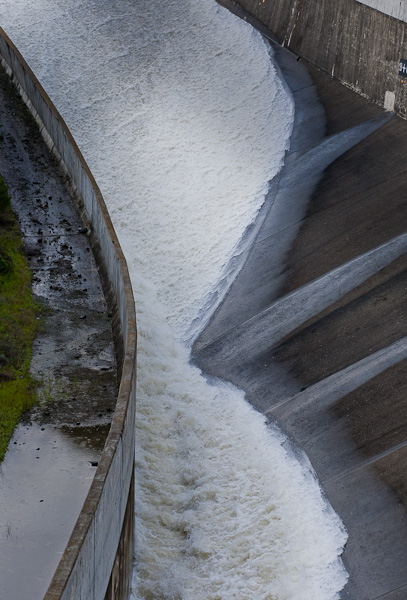
Today the Lex finally overflowed again. I’d been tracking the progress via drive-bys and an online gauge page. Sylvia and I drove over just now to check it out in person.

When I see water in these dramatic states, I’m sometimes a little amazed at how calmly the water does its thing. No resistance. Go with the flow. Remain restless.

Further down the flume, of course, things get hyper. Yet even here, the bits of water are computing their way along continuous trajectories.

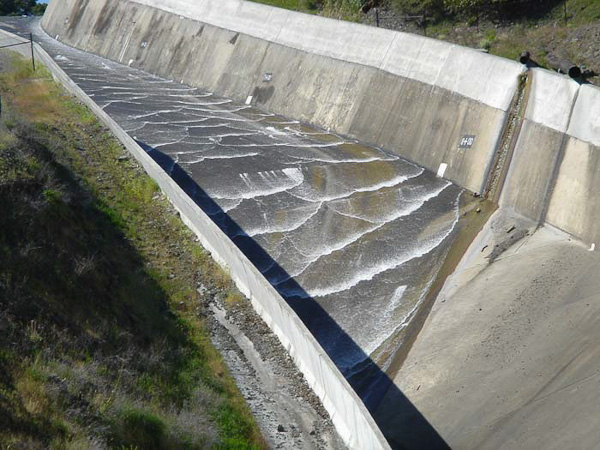
I often think about the theory of computation when looking at fluid flow, as in the photo above (taken in a gutter near my house during yesterday’s rainstorm). One reason fluids in motion are so fascinating is that make a huge amount of physical computation visible.

As the early chaoticians and the later computer scientists such as Stephen Wolfram and myself have pointed out (see for instance my Lifebox tome, readable online), computations fall into roughly three classes, which we might term the Dull, the Gnarly, and the Pseudorandom—you can see these three modes from the top to bottom in the photo above.

Before the waterfall it’s Dull, in the waterfall it’s Gnarly, in the crash zone at the bottom it’s Pseudorandom.

Sorting it through, in the Dull, low-end category, nothing much is happening—you’re getting phenomena like the smooth laminar flow of a non-turbulent stream.

In the wild, high-end Pseudorandom, messy zone, you get patterns that are very hard to decipher. Computer scientists say pseudorandom rather than random because, if physics were in fact to be fully deterministic (as it actually may be, despite the smoke and mirrors of quantum mechanics), then nothing is “random” in the sense of “utterly arbitrary.” Everything emerges from a prior cause—only it’s (even in principle) impossible for our smallish minds ever to trace the full webs of natural cause and effect.

Computationally speaking, the in-between Gnarly zone is where the action is, as in the photo above. Living organisms or minds aren’t Dull computations, nor are they Pseudorandom. They’re Gnarly. That is, on the one hand, they’re somewhat orderly, allowing one to adapt to them. And, on the other hand, they’re not fubar, that is, f*cked-up-beyond-all-recognition.

Am I a stump amid the flow? Well, no, I am flow. Dull, gnarly, and pseudorandom, depending on my mood…

By the way, if you could see the air currents, they’d be equally fascinating—now and then, when it’s misty or foggy, you can in fact begin to appreciate the dancing vortices of the air. I wish I had some special glasses that would let me see the air.

That’s about enough for today, but I’ll throw in two more watery photos. First a shot I got of a “Weedy Seadragon” at the Monterey Aquarium on my birthday earlier this week. Gnarly, dude.

And in closing, an awe-inspiring and slightly scary picture of the vast sea and sky off Moss Landing. Come on in. The water’s fine.

Share

Flurb #11

Tuesday, March 22nd, 2011
Share

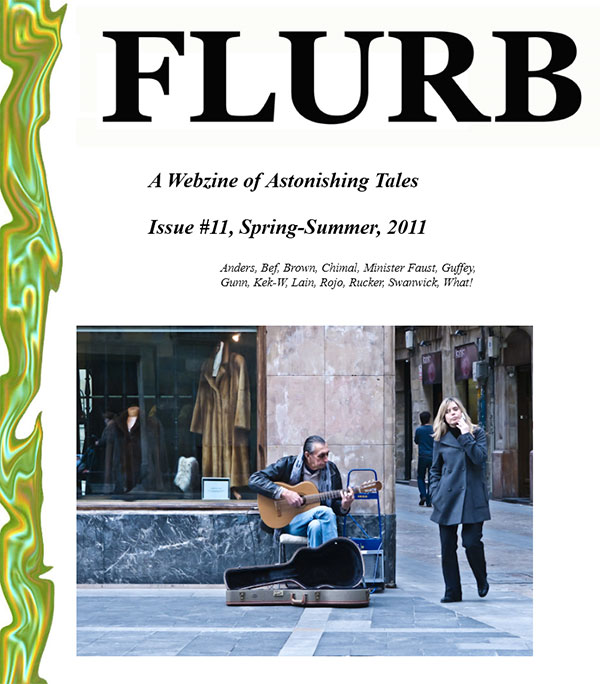
Issue #11 of Flurb is out, guest-edited by the redoubtable Eileen Gunn, and with astonishing tales by twelve wonderful writers: Anders, Bef, Brown, Chimal, Minister Faust, Guffey, Kek-W, Lain, Rojo, Rucker, Swanwick, and What!

A first: three of our stories are from Mexico, and appear in both English and Spanish.

Enough talk! Go to www.flurb.net and be among the first of the sixty or seventy thousand people who’ll be checking out our new issue over the coming six months!

When you’re done, come back here and post something encouraging in the comments. Our authors need your support.

One more thing—today’s my 65th birthday! I’m grateful, at my age, to still be a part of the literary scene. I’ll take the gold watch later.

Share

Excerpts of: William Burroughs, “The Western Lands”

Thursday, March 17th, 2011
Share

Today’s long post consists mostly of excerpt from William Burroughs’s novel, The Western Lands, 1987, which is the final part of a trilogy, preceded by The Cities of the Red Night, 1981, and The Place of Dead Roads, 1984.

I realized that I hadn’t carefully read these three books—I’d read parts of them thirty years ago when they came out, but I’m not sure I ever read them through. So I decided to read The Western Lands fairly closely. I marked passages that seem in some way relevant to my current novel project, The Turing Chronicles, which will include a version of Burroughs as a character—Alan Turing’s lover.

Listen up with your fancy ear!

Some notes on the book’s contents.
(1) The “Western Lands” of the book’s title come from Egyptian mythology about the afterlife. Supposedly, beyond the Land of the Dead, lies a heavenly Elysium: the Western Lands.
(2) Burroughs often goes off on these great riffs like you’d find at the start of a story or novel—such as a detective story, or a science fiction tale, or an exotic adventure novel about explorers in the jungle. He slips smoothly into the genre conventions, but then begins warping them, and ultimately he drops the riff once he’s gotten all the juice from it that he wants. He just about never bothers to really wrap up a sequence or bring it to a full conclusion. I especially noticed a lot of great science-fiction twists.

(3) He has this wistful obsession with beautiful young boys—he’s always returning to them like a hungry man describing food, or a pauper describing treasure.
(4) Bill loves weapons and violence, but in a kind of twelve-year-old-boy way. His scenes of dismemberment and destruction are like scenes a schoolboy might draw on the flyleaf of his Algebra book. Schematic, energetic, more about the flow of action than about actual pain.
(5) He has great timing, and is often very funny.
(6) Much of the book mingles dreams and reminiscences—an old man is fingering the fabric of his life.
So here are some choice excerpts from The Western Lands. Page references are to the US Penguin paperback edition of 1988.

1. The old writer lived in a boxcar by the river. … Often in the morning he would lie in bed and watch grids of typewritten words in front of his eyes that moved and shifted as he tried to read the words, but he never could. He thought if he could just copy these words down, which were not his own words, he might be able to put together another book and then…yes, and then what?

7. Can any soul survive the searing fireball of an atomic blast? If human and animal souls are seen as electromagnetic force fields, such fields could e totally disrupted by a nuclear explosion. The mummy’s nightmare: disintegration of souls, and this is precisely the ultrasecret and supersensitive function of the atom bomb: a Soul Killer, to alleviate an escalating soul glut.

23. Allerton was a thin, blond man with an air of arrested age. He seemed to float a few inches above the ground, wafted here and there, a specialized organism at once torpid and predatory.

27. …the same ancient guild—tinkers, smiths, masters of fire…Loki, Anubis and the Mayan God Kak U Pacat, He who works in fire. Masters of number and measurement…technicians. With the advent of modern technology, the guild gravitated toward physics, mathematics, computers, electronics and photography.

30. Joe the Dead belongs to a select breed of outlaws known as the NOs, natural outlaws dedicated to breaking the so-called natural laws of the universe foisted upon us by physicists, chemists, mathematicians, biologists, and, above all, the monumental fraud of cause and effect, to be replaced by the more pregnant concept of synchronicity.

42. Outside a Palm Beach bungalow waiting for a taxi to the airport. My mother’s kind, unhappy face, last time I ever saw her. Really a blessing. She had been ill for a long time. My father’s dead face in the crematorium. “Too late. Over from Cobblestone Gardens.”

46. A rule that is almost always valid: never refute or answer a critic, no matter how preposterous the criticism may be. Do not let the critic teach you the cloth, as they say in bullfighting circles. Never charge the cloth, even if the critic resorts to actual misquotation.

58. And you know the difference between the difference between the air before August 6, 1945 [the atomic bombing Hiroshima] and after that date: a certain security. No one is going to explode the atoms you are made of…with a little strength an skill one could outlive himself…but now…

59. Joe is tracking down the Venusian agents of a conspiracy… It is antimagical, authoritarian, dogmatic, the deadly enemy of those who are committed to the magical universe, spontaneous, unpredictable, alive. The universe they are imposing is controlled, predictable, dead.

60. Produce the first all-virus rat, it’s more efficient—instead of all these elaborate organs we have just cells, an undifferentiated structure … If he can become Death, he cannot die.

98. [In this scenario, some people worship these hideous huge man-eating centipedes that the call ‘pedes for short.] The spectators are completely naked, except for exquisite centipede necklaces … eyes dilated to shiny black mirrors reflecting a vile idiot hunger. “We feed with the ‘pede.” La jeunesse dorée of Pedeville, obviously.

100. In Picture Puzzle scripts, the glyphs are incorporated into the big picture: an eye, a phallus, water, birds, animals spell out the story. At first it’s just a picture with a special look, then glyphs swim out of clouds and water, pop out of swift lizards…

101. These were troubled times. There was war in the heavens, as the One God attempted to exterminate or neutralize the Many Gods and establish a seat of absolute power.

104. Neferti knows the arts of telepathic blocking and misdirection. You can’t make your mind a blank, for that would be detected at once. You must present a cover mind which the Pharaoh can tune into, and which is completely harmless: “For me the Pharaoh is a God.” You can’t lay it on too thick.

115. It started in the sensational press … “Ancient Egyptian Papyrus Demonstrates That Life After Death Is Within The Reach Of Everyman.” … soon the Papyrus starts unrolling very precise instructions fo reaching the Land of the Dead. The message falls on … the parched deserts of mid-America, dead hopeless wastes of despair, a glimmer of light and hope on a darkening earth.

119. [A young man makes an illegal deal with an old shopkeeper.] The old man’s face relaxes into contented depravity. “Of course one must always take the Big Picture…Yes, I have what you need.”

120. The road to the Western Lands is by definition the most dangerous road in the world, for it is a journey beyond Death, beyond the basic God standard of Fear and Danger. It is the most heavily guarded road in the world, for it gives access to the gift that supersedes all other gifts: Immortality. Every man starts the course. One in a million finishes.

132. Horus Neferti turned aside into a Jump Joint, where your dreams come true. Yeah, sometimes. They work like this: you got a scenario in your mind, usually made up of dreams. Sophisticated electronic equipment makes the dream solid. Or rather there are infinite nuances of solidity.

138. Film sequentially presented…now, imagine that you are dead and see your whole life spread out in a spatial panorama, a vast maze of rooms, streets, landscapes, not sequential but arranged in shifting associational patterns. Your attic room in St. Louis opens into a New York loft, from which you step into a Tangier street. Everyone you have ever known is there. This happens in dreams of course.

139. So I levitate fifty feet in the air just for jolly, wouldn’t you?

170. …the old sets are brittle, falling off the page, waves dash against sea walls, old photos curl and shred. The Veiled Prophet Parade [in St. Louis] floats in the hot summer night…yellow glow of lights, giant leaves, eating pink cake, the cardboard around the edges blowing away in the rising wind, piers crumbling into the sea’s waves, wrecked house, rain, gray sky.

175. There comes that moment in a blinding flash of bullshit when he suddenly sees everything, and the way it all fits together as part of the great whole. He is everything and everything is him, and there is no aloneness, no separation, just endless love. He knows all the questions and all the answers, and there is only one answer so he wrote “Nature Boy” and got cured [meaning got rich]: “The greatest thing you’ll ever learn / Is just to love and be loved in return.”

177. Operation Clipper: Space sailcraft propelled by the blast that reduces planet Earth and its inhabitants to a smoldering cinder. It isn’t good PR, not good at all.

179. The house on Pershing Avenue [Burroughs’s boyhood home] is well back from the cobblestone street, worn smooth by centuries on the march. He finds his key. The lock turns. Inside he stumbles over a heap of toys…one Christmas after another in layers…a .30-.30 rifle at the top with a box of shells. A crust of broken ornaments crunches underfoot like snow.
186. [After a circus riot, a storm.] On this scene fell a sudden chill, as the temperature dropped fifteen degrees…freezing sweat, and the sky turned bright green around the rim and…the rubes fled the stricken field, screaming down the Midway as the hail pelted down big as hens’ eggs, knocking holes in the tents. The elephants trumpeted frantically, and then the sound: like a low-flying jet, as the boxcars were tossed about like matchboxes …with snakes and freaks and the great tents whipping into the sky…bleachers and seats and rifle ranges, Kewpie dolls and screaming railway cars, caught in a black whirlpool and pulled up into the sky.

188. [Boy explaining why he killed his friend with a shotgun.] …it was as if, just as I pulled the trigger, making absolutely sure the pellets wouldn’t hit Greg…something moved my arm

200. (A leader advises his agents.) This future may not happen, if you all strike at the right time in the right places. So we have a human lifetime with a few moments of meaning and purpose scattered here and there… It is fleeting: if you see something beautiful, don’t cling to it… However obtained, the glimpses are rare, so how do we live through the dreary years of deadwood, lumbering our aging flesh from here to there? By knowing that you are my agent

221. Since music is registered with the whole body it can serve as a means of communication between one organism and another. … Agent attends a concert and receives his instructions. Information and directives in and out through street singers, musical broadcasts, jukeboxes, records, high school bands…

231. [He describes a Valley with a priestly sect called the Corners because they eat a radioactive blue corn.] …at the age of puberty, the mark of the Corner can be perceived: a look of dreamy despair, the look of a hungry ghosts in time of famine, but a noble resignation that transcends the hunger.

234. [Great crank SF idea.] A photo has no light of its own, but it takes light to be seen. Every time anyone takes a picture, there is that much less light in circulation. Slowly at first, the gathering darkness on the margin of vision…the mutters of voices at the edge of hearing.

236. [Dream narrative] …a restaurant/hotel/station area, where one is always in doubt about this room reservation and rarely able to find his way back to his room if he leaves it in search of breakfast, which is always difficult to locate.

242. The visions, the glimpses of the Western Lands, exist in space, not time, a different medium and a different light, with no temporal coordinates or recurrences. The medium bears some relation to holograms.
245. [Recurrent dream] He…carried a huge covered basket. He was taking the basket somewhere, but he could not find the place to leave it. An din the dream tehre was a peculiar horror i wandering on and on through the crowd, and not knowing where to lay down the basket he had carried in his arms so long. … A child is dying in the basket. [Perhaps this is Bill’s son Billy.] And there is no help here…

251. [A man describes visiting an old writer like Burroughs.] I went to see Bill. He told me he’d found a cat… I heard a … mewling noise, but I couldn’t see anything . Then I realized Bill was making the sound without opening his lips … He opened a can of cat food, all the time making that sound … he gets down on all four and rubs himself against invisible legs, purring … Straightens up and put the plate of cat food on the floor. Next thing he gets down on all fours and eats it.

257. [A rain of old memories.] Back in the 1920s, looking for an apartment in the Village. I am wearing a cape and hold a [newly puchased antique] sword in my hand, a straight sword three feet long in a carved wooden sheath wih a brass clip.

257. A tree like black lace against a gray sky. A flash of joy.

258. [The last page.] The old writer couldn’t write anymore because he had reached the end of words, the end of what can be done with words. … “Hurry up, please. It’s time.”
Share

Writing Advice. Turing Rap. Interview. 3D CAs!

Saturday, March 12th, 2011
Share

The writer Nisi Shawl emailed me today, asking for the best and worst writing advice I ever received, with an eye to using my answer in the Clarion West’s spring newsletter. Here’s what I said.

The Best Advice on writing I ever read — and I don’t remember who said it, perhaps it was John Varley — was something to the effect that: “If you get a completely crazy idea for a twist on a scene, an idea you don’t think you dare use…go with it!”

The Worst Advice, which came from any number of boilerplate how-to-write articles is this: “Don’t think of starting work on the novel until you have a complete and detailed outline, and then stick to the outline!”

Of course it’s useful to have an outline, but it’s folly to imagine you can really know how things are going to end up once you’re five or ten chapters in. I revise my outline constantly as I go along. As for sticking to an outline, see the Best Advice!


[I bought two big tubes of my fave oil-paint colors yesterday, Cadmium Red Deep, and Cadmium Yellow Deep. You’re looking at $100 of paint. Cadmium is expensive.]

I’m working on The Turing Chronicles, and it’s going well. I’m leading up to the big scene that I painted in “A Skugger’s Point Of View” last week.

I don’t want the cops to know that Alan is making a run for Los Alamos in hopes of getting hold of an H-bomb, so I took out an earlier passage where he tells his companions Judy and Ned what he’s up to. I’m kind of sorry to see this conversation go, as I thought it was funny. But I saved it into my “Notes for the Turing Chronicles” document, and maybe I can use some of it later. For now, though, here it is.


[One can never match Edward Weston’s photos of calla lilies , but it’s fun to shoot them anyway.]

“Me, I’m hip to the master plan, too,” bragged Vassar. “I picked up on it when were doing skugger conjugation. Uhn, uhn, uhn. Alan wants to blow himself up with a hydrogen bomb from Los Alamos. Talk about your clear-channel radio! Shedding his light.”

“That’s something of a caricature,” said Alan with a sigh. “And I would request that everyone does their best to hide this kind information from anyone outside our circle.”

“An atomic bomb?” said Judy, laughing. She took this for a joke. “In Los Alamos? I’d love to tape the sounds.”

“And be sure to get Alan’s last words,” said Vassar. “Th-th-th-that’s all folks! Quaaaaaaak!”

“Don’t always be a dumb-ass,” said Ned. “This is real. An H-bomb’s flash could spray skug vibes into everyone in the country. We’d be home free after that.”

“You guys believe in the skugs that much?” said Judy, changing tack. “I keep thinking this is more like—I don’t know—a virus that I caught, and I’ll be well by the time I’m in California.”

Back in January 15, 2011, I signed fan Ron Corral’s Kindle because he had The Ware Tetralogy inside it! This was at an “SF in SF” event where I read from my forthcoming memoir, Nested Scrolls: A Writer’s Life.

The reliable Rick Kleffel made a nice podcast of both my reading, and an interview with me before my reading, he just posted the interview on his blog “The Agony Column.” You can also get to the podcast via my Feedburner podcast station, click the icon below.

(Note that Feedburner only shows my most recent podcasts. For older audio files, see my archive on Gigadial, which runs back to 2005.)

Today’s big, late-breaking, news is that my former San Jose State University computer science student Harry Fu has gotten his three-dimensional Belousov-Zhabotinsky-scroll cellular automata (3D BZ CAs for short) working again. I posted about this a few years ago, but link-rot set in, and now it’s all good again.

Way to go, Harry. Nobody’s ever seen three-dimensional CAs before except on supercomputers or using special hardware, especially not 3D BZ CAs, and our man Fu has these mofos working as a Java applet running Open GL!!!

Note the spontaneously forming scrolls. The first 3D BZ CA picture shows a 3D version of the Hodgepodge Rule, and this one is the 3D Winfree Rule.

Gnarly much? Live mushrooms, vortices, jellyfish.

So how can you, too, run Fu’s applet? Go to Fu’s Welcome to CA 3D page for an overview.

And then proceed to o Fu’s CA3D download page, which walks you through three steps for your Mac or Windows machine.

(1) Make sure you have the latest and greatest version of Java, this would be version 6 today. Anyway, go and get the JRE (Runtime Environment) for your Mac or Windows system. You don't need the full developer’s kit, just the JRE. (2) Get JOGL (Java bindings for Open GL). (3) Run Fu’s application locally, as ca3D.jar or run it in your browser at Fu’s 3D CA Simulation page (Caveat, right now the online version runs in Internet Explorer 8 for me, and in Firefox 3.6, but not in the current Firefox 4 RC1 release, although this prob may go away in the final Firefox 4. Harry says it runs in Safari on the Mac as well.). And in any case, it runs locally from the jar file.

Geekin’ OUT! And lovin’ it. You realize, of course, that your brain is a 3D BZ CA?

Share

Panther Beach

Saturday, March 5th, 2011
Share

Today I went to a beach in Santa Cruz that I hardly ever get to, Panther Beach and its connected Hole in the Wall Beach. I myself like to call the whole spot Magic Door Beach because there’s an arch in the rock that leads from the one beach to the other. When the tide’s high, it can be hard to get through the door, but it’s worth it.


[The Magic Door]

Like many of the beaches north of Cruz, you do see a few nude people there, particularly in the summer, but it’s not totally what I’d call a nude beach. I don’t get to this beach as often as I’d like to, as the climb down from the highway is a little dicey. I took all but the last one of today’s photos there.

Part of what I did at the beach was to start marking up a printout of a draft of the next chapter of my 1950s alien-invasion beatnik-sf novel, The Turing Chronicles. I’ve been away from the book for nearly a month—what with that trip to Spain, and the revisions and copy-edits for my memoir, Nested Scrolls: A Writer’s Life, and for my fantasy/SF novel of the afterlife, Jim and the Flims, both due out in 2011.

When I’m away from a novel for this long, I begin to think I won’t ever get back. And I become almost scared to try, or perhaps it’s more that I feel queasy at the amount of inner work it’ll take to get plugged back into it again. The hardest part about writing is getting your head in the right place to do it.


[My old pal Jon Pearce came to the beach with me; his friend Nancy took this picture.]

I helped get myself cranked up for The Turing Chronicles again by finishing my painting of an upcoming scene yesterday, “A Skugger’s Point of View,” which I already posted about. I forgot to mention that those inchoate yellowish shapes at the borders of the painting are what I’m calling gazaks.

Gazaks are a type of soul or ghost, based on some subtle form of energy. You can kind of see them at the edges of your field of vision. Perhaps they use exotic microtuble structures in the air, little vortex filaments that link together into a mesh, and the nodes of the mesh might be exotic particles that are quantum-mechanically entangled with the neighboring nodes.

At the beach, I was telling Jon that, because I’m now shooting in 16-bit RAW mode, and editing my image files in Lightroom, it almost doesn’t matter what settings I put on my camera or exactly where I point it. The only two things you really need to do is to hold the camera still while you shoot, and to focus on part of the scene that you want to be sharpest. I can fix the rest of it at home.

What I’m coming to understand, in other words, is that settings you use on your camera (like White Balance or ISO or even exposure time) don’t really affect the image data that much. The settings are more like a filter for extracting the image you want to see from the underlying data. In effect, you can set you camera after you take the picture. And, espeically, if you’re in 16-bit mode, there’s enough data so you can coax out subtle colors and shades. This picture looked totally ordinary before I processed it—the sky was a uniform dull white, the rocks were black silhouettes, the spray was a smear, and the ocean was gray. Some kind of lesson here…about beauty being present beneath the surface…

After the beach I went off alone in Cruz. It was a nice warm day, and I spent an hour and a half working on The Turing Chronicles at a table on the porch of the Cafe Pergola in Santa Cruz, looking down on the very spot where I’d depicted my characters Jim and Weena as meeting up with the chracters Chang, Header, Ira, and Ginnie in Jim and the Flims. I was just revising that passage last week. So sitting there, looking at the spot, writing, I felt a nice moiré overlap of the trans and the real.

Share

“A Skugger’s Point of View”. Squeak Carnwath. Stanley Goldstein.

Friday, March 4th, 2011
Share

I finished a new painting today. In this painting, “A Skugger’s Point of View,” I wanted to render an extreme first-person point of view…in which we see the dim zone around a person’s actual visual field. The person in question is the Alan Turing character in my novel-in-progress The Turing Chronicles. He has become a mutant known as a “skugger,” and he has the ability to stretch his limbs like the cartoon character Plastic Man. He is traveling across the West with two friends, a man and a woman.

79. “A Skugger’s Point Of View”. Oil on canvas. 40″ by 30″. March, 2011. click to see larger version!

In this scene, Turing’s cohort is being attacked by secret police, one of whom bears a flame-thrower. Turing is responding by sticking his fingers into their heads, perhaps to kill them, or perhaps to convert them into skuggers as well. We can see Turing’s arms extending from the bottom edge of his visual field. Even though it’s not quite logical, I painted in his eyes as well because they make the composition better. As always, more info on my Paintings Page.

Tonight, my painter friend Vernon Head and I went to an art opening at the Triton Museum in Santa Clara. They had a show by Squeak Carnwath and a show by Stanley Goldstein.

The painting above is “Gone” by Squeak Carnwath, oil and alkyd on canvas, 2005. I liked this one a lot. Vernon and I got a chance to talk to Squeak—she lives in Oakland—a very pleasant and intelligent woman, at one time an art teacher at UC Berkeley, recently retired. She said “Gone” was to some extent in memory of seven artist friends of hers who had died, and the Etruscan style heads at the bottom could be viewed either as mourners or as the mourned.

Vernon and I were particularly impressed by Squeak’s color sense, her ability to mix such wonderfully mild and harmonious shades. In some of her paintings she goes ahead and sticks in a color wheel, just for fun. She says that color sense is her one great gift.

The other show was by Stanley Goldstein, who mostly paints domestic scenes or images from his daily life, almost like painted snapshots. He has terrific ability with color and shape. This one painting, “Francis Dancing By The TV” acrylic on panel, 1997, really jumps off the wall. Seen in the gallery, the blue of the TV is amazingly intense, in counterpoint to the rich orange-red of the quilt.

Share

Rudy’s Blog is powered by WordPress