






Click covers for info. Copyright (C) Rudy Rucker 2021.


Archive for January, 2010

The “Orpheus and Eurydice” Pattern

Saturday, January 16th, 2010

I’m revising my novel Jim and the Flims this month, getting ready for a final push to the end. I haven’t taken any new pictures since last week, so I’ll just recycle some images from 2009.
In my novel, Jim is in the afterworld (called Flimsy), and he may or may not bring his dead wife Val back to life on Earth. It’s a take on the Orpheus and Eurydice legend, but I’m considering a happy ending, although I keep wondering if a “happily ever after” ending is best.

I gather that, in romance novels, the HEA ending (as they call it) is more or less mandatory. As the romance novel writer Janet Dean says on the writing-advice website Seekerville: Escape from Unpubbed Island: “What I love about romance novels is the guarantee of a happy ending. That’s why I read and write them.” But should I be following writing advice from such a source?

[Speaking of “unpubbed island,” I keep thinking about the stories of how the Inuit supposedly dispose of aged family members who become a burden. Eventually the same fate overtakes older writers. The editors put you on an ice floe with a hunk of blubber. “We’ll be in touch.”]


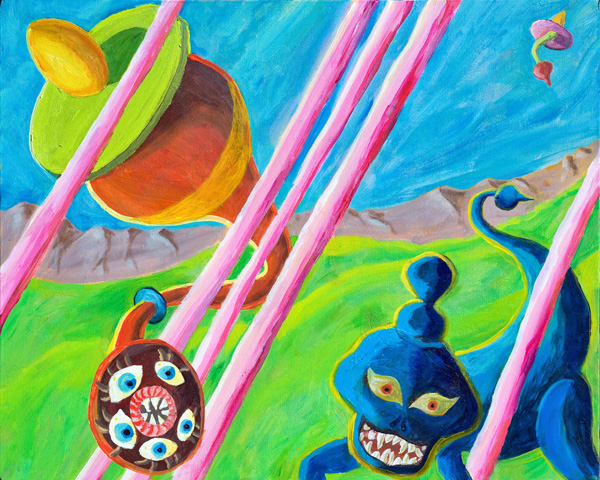
[Two alien flims: a jiva and a yuel, left to right.]

Back to my plot. What if my character Jim doesn’t in fact get his wife, Val, back at the end of the Jim and the Flims?

At a deep level, Jim and the Flims is about a man coming to terms with his grief over his wife’s death. So it might be a cop-out for Jim to get Val back. Maybe it’s enough if he travels through the whole process, and at the end he’s rounded off a grief cycle. Nobody ever comes back from the dead. You can’t ever go back to the happy person you used to be.

I’d guess that the grief process is the transreal theme of the Orpheus and Eurydice myth in the first place. Here’s a link to Vergil’s version in the Georgics, and here’s a link to the story in Ovid’s Metamorphoses.

Eurydice is bitten by a poisonous snake soon after her marriage to Orpheus. Orpheus goes down to the underworld and plays his lyre and garners some sympathy. He’s like, “It was unjust, it was too soon.” Pluto, the god of the underworld, gives him Eurydice and tells him to lead her out of the underworld, but not to look back. And, when Orpheus is almost out of the cave entrance, he looks back at his beloved, perhaps worried that she wasn’t following, and now she breathes the world, “Farewell,” and fades like smoke in the air. He never sees her again, and the keepers of the underworld won’t let him come back and try again.

Vergil says Orpheus was soon torn to shreds at a wild Bacchanal, and that his severed head floated down the river to the underworld, the head still calling out for Eurydice. Ovid says that Orpheus “was the first of the Thracian people to transfer his love to young boys, and enjoy their brief springtime, and early flowering, this side of manhood.”

In other words, our bereaved poet/singer turns alkie or gay! Gotta love it.

So what about Jim and the Flims? As a half-measure, I’d been entertaining the notion that Jim does in fact get Val back to Earth at the end—but then she frikkin’ divorces him! I was thinking of that as a post-modern twist.

Or maybe it’s heavier if Jim somehow can’t get Val to come back at all. It’s not so much that she wants to come and that he mistakenly he looks at her—like in the Orpheus an Eurydice myth. I think it’s rather that Val wants to go through the zero and start again. I’d need to prefigure this kind of predilection on Val’s part, or show her growing into this mind-set during her stay in Flimsy.

All this said, I might be outsmarting myself if I don’t just do the comfortable, reader-friendly thing and let Jim bring Val back. HEA! What I can do is make this a little hard for him. Like, Val initially doesn’t want to come, and maybe he has to talk her into it. Perhaps the scary ghost of Amenhotep’s mummy shows up near Flimsy’s core and, like, scares Val into Jim’s arms.


Edge Question 2010

Saturday, January 9th, 2010

Every year the literary agent John Brockman poses a question and gets people who have worked with him to supply answers. This year’s question was:
HOW IS THE INTERNET CHANGING THE WAY YOU THINK?

All the answers can be found at the Edge site. I’ll reprint my answer below, along with some pictures I took in Vasona Park in Los Gatos today.

Search and Emergence

Twenty or thirty years ago, people dreamed of a global mind that knew everything and could answer any question. In those early times, we imagined that we’d need a huge breakthrough in artificial intelligence to make the global mind work—we thought of it as resembling an extremely smart person. The conventional Hollywood image for the global mind’s interface was a talking head on a wall-sized screen.

And now, in 2010, we have the global mind. Search-engines, user-curated encyclopedias, images of everything under the sun, clever apps to carry out simple computations—it’s all happening. But old-school artificial intelligence is barely involved at all.

As it happens, data, and not algorithms, is where it’s at. Put enough information into the planetary information cloud, crank up a search engine, and you’ve got an all-knowing global mind. The answers emerge.

Initially people resisted understanding this simple fact. Perhaps this was because the task of posting a planet’s worth of data seemed so intractable. There were hopes that some magically simple AI program might be able to extrapolate a full set of information from a few well-chosen basic facts—just a person can figure out another person on the basis of a brief conversation.

At this point, it looks like there aren’t going to be any incredibly concise aha-type AI programs for emulating how we think. The good news is that this doesn’t matter. Given enough data, a computer network can fake intelligence. And—radical notion—maybe that’s what our wetware brains are doing, too. Faking it with search and emergence. Searching a huge data base for patterns.

The seemingly insurmountable task of digitizing the world has been accomplished by ordinary people. This results from the happy miracle that the internet is that it’s unmoderated and cheap to use. Practically anyone can post information onto the web, whether as comments, photos, or full-blown web pages. We’re like worker ants in a global colony, dragging little chunks of data this way and that. We do it for free; it’s something we like to do.

Note that the internet wouldn’t work as a global mind if it were a completely flat and undistinguished sea of data. We need a way to locate the regions that are most desirable in terms of accuracy and elegance. An early, now-discarded, notion was that we would need some kind of information czar or committee to rank the data. But, here again, the anthill does the work for free.

By now it seems obvious that the only feasible way to rank the internet’s offerings is to track the online behaviors of individual users. By now it’s hard to remember how radical and rickety such a dependence upon emergence used to seem. No control! What a crazy idea. But it works. No centralized system could ever keep pace.

An even more surprising success is found in user-curated encyclopedias. When I first heard of this notion, I was sure it wouldn’t work. I assumed that trolls and zealots would infect all the posts. But the internet has a more powerful protection system than I’d realized. Individual users are the primary defenders.

We might compare the internet to a biological system in which new antibodies emerge to combat new pathogens. Malware is forever changing, but our defenses are forever evolving as well.

I am a novelist, and the task of creating a coherent and fresh novel always seems in some sense impossible. What I’ve learned over the course of my career is that I need to trust in emergence—also known as the muse. I assemble a notes document filled with speculations, overheard conversations, story ideas, and flashy phrases. Day after day, I comb through my material, integrating it into my mental net, forging links and ranks. And, fairly reliably, the scenes and chapters of my novel emerge. It’s how my creative process works.

In our highest mental tasks, any dream of an orderly process is a will-o’-the wisp. And there’s no need to feel remorseful about this. Search and emergence are good enough for the global mind—and they’re good enough for us.

My Photo Prints

Thursday, January 7th, 2010

This post responds to a friendly comment made the other day by a regular reader called Womansvoice, suggesting I make my photos available as prints. Alex and Neatmouse, among others, have suggested this in the past as well.

For illos today, I’ll just use a few golden oldies.

I tried marketing prints of my photos a year or two ago, but then I dropped it. But now I’m giving it another shot, this time with a little more organization and push. What I’m doing is to amass a Photos gallery of my favorites at the online art site Imagekind. My Imagekind page is rudy.imagekind.com, and you can see the Photos and Paintings print galleries there.

For now I have the markup set very low on the photos—call it a Grand Opening Sale. That mushrooms picture that Womansvoice liked, for instance, is available in a 16″ by 19″ print for about $15.

While I’m at it, I’m also posting the majority of these same favorite photos (most of them seen on this blog in a 600 pixel resolution) into a photostream on Flickr. The link for my Flickr photostream is www.flickr.com/rudytheelder.

I like using the Slide Show view to look at Flickr photostreams, as the images are bigger.

I realize, of course, that one can (a) do a screen capture of a large-seeming Flickr slide show image, then (b) create a file in, say, Photoshop, and paste the screen capture into the new file, and then (c) print the file on one’s home color printer.

And who am I to say no to that! Go ahead and brighten up your office or refrigerator for free!

I would, however, point out that, ahem, if you want a really nice print, the pixel count of the Imagekind-printed image is generally going to be five to twenty times that of the photostream slide show screen captures. And of course Imagekind is going to be using a better printer and paper combination than most of us have at home.

Womansvoice and the others have also suggested I make a coffee-table book of my photos. Eventually I might do this, probably self-publishing it via Lulu. One slight snag is that the most on-line photo-book-making programs will brutally crop all photos to fit certain arbitrary standard aspect rations, such as the sacred (to some) 4 by 3 rectangle.

The only way I presently know for designing a photobook with no robo-crops is to make the book myself in Microsoft Word…and then to save the file off as a high-resolution Acrobat PDF file which I upload to the electronic publisher.

Some of you will remember that I used this technique to make a book of my paintings, Better Worlds, which currently sells for $32 via Lulu —and you can also find it listed for the same price on Amazon. From time to time I add more images and rebuild the book at a longer length, and the price goes up a bit.

Really, it’s more like you self-publish an art or a photo book for yourself—and as a gift for friends, or possibly as a promo tool to give gallery owners when you want to get a show. I guess I don’t currently feel a pressing need for the photo book. As it stands, I haven’t sold more than a couple dozen copies of Better Worlds to people other than myself.

One final remark: it is possible to buy my original paintings no matter where you live—last year I sold one to a person in Virginia, and another to someone in Germany. I pack ”˜em up and give ”˜em to Fed Ex. More info about buying original paintings is on my personal paintings site.

Avatar

Wednesday, January 6th, 2010

I saw Avatar in 3D last night. What a thrill. It made me think of the early days of cinema, back in the early 1900s, when they showed a movie of a train speeding towards the audience and everyone jumped to their feet. The 3D and the computer graphics really come together in Avatar, and you get the feeling that a new medium is being born.

One of the effects I liked especially were these little critters like thistledown, who were beating their fronds like jellyfish. Air-jellies. And the native characters were so soulful and beautiful—it was kind of thrill to be identifying with beings so strange. In this respect, Avatar is slightly like this summer’s District 9, which is also a film where we’re encouraged to root for the aliens in the course of their encounter with the human race.

When I attended Swarthmore College in the 1960s, my roommate for the first three years was Kenneth Turan, now a film critic at the L. A. Times. Nobody could tell the story of a movie like Kenny.

Back in 1997, Turan had the temerity to write a negative review of Titanic, which was the director James Cameron’s movie previous to Avatar. Turan’s point was that the script of Titanic was weak and corny, and that Cameron should have hired a professional writer instead of writing the script himself.

So now, twelve years later, in a 2009 profile of Cameron in the New Yorker, Cameron reveals that he’s still angry about this. Speaking of Kenneth Turan (and any other critics), Cameron, said, “So, f*ck them. F*ck ’em all.” Turan’s bemused reaction in an email to me: “Talk about a slow burn!”

Naturally I was curious to hear if my old pal would like the new film. Turan’s favorable review of Avatar makes the point I mentioned above, that Avatar represents a new kind of film making—Turan compares it to advent of sound in the movies.

What about the script for Avatar ? It’s fairly strong. Cameron does have a solid sense of how to tell a dramatic story—after all, this is the man who wrote and directed the classic Terminator movie.

There were many things I liked about Avatar. The rebellious woman pilot was great, with her classic line yelled at a male antagonist: “I’ve got guns too, bitch!” Having the hero be wheelchair-bound in real life worked for me, it got me into the mindspace of being disabled, but without feeling like I was being lectured to.

And how about the shot of the evil coffee-sipping colonel ordering a missile attack against—a giant redwood-like tree! Wonderfully iconic. Attacking a tree! How insane. And yet…it’s happening all the time.

The SF in the film is comfortably professional. The notion of a literal planetary mind is a classic theme. The notion of a soul tree also feels comfortable, as does the idea of cross-loading a dying person’s “software” to a new wetware platform. And using avatars for exploration is vintage SF as well.

I suppose one might quibble about the time-latency problem of running a remote body over a network—I mean, it’s hard enough to leap onto the back of a giant flying bird even when your vision isn’t a hundredth of a second out of synch with your movements! But, hey, this is SF, so we might as well assume they have a zero-temporal-lag quantum-entanglement hook-up between the avatars and their controllers in the plastic coffins.

The whole image of the avatar controllers in their boxes has a nice meta quality to it. We, the viewers, with our tech trappings of heavy 3D glasses, are invited to become the remote minds immersing themselves into the lithe blue figures on-screen. It’s a more pleasant trope than the Matrix conceit that there isn’t any actual world out there at all.

The guy sitting next to us at the screening told me the film’s also out on IMAX 3D. Hmmm. Maybe I need to see that.

Easy prediction: there’s gonna be a lot of blue people with putty on their noses at the next few SF Worldcons!


Rudy's Blog is powered by WordPress