

Rudy’s Blog

Support this blog ... buy Rudy's books!

Postsingular, Mathematicians in Love, Mad Professor, The Hollow Earth,
The Lifebox, The Seashell, And the Soul, and Frek and the Elixir!

Original material on this blog is Copyright (C) Rudy Rucker 2007.


Archive for November, 2008

Two Phil Dick Awards

Tuesday, November 25th, 2008

More from my memoir-in-progress, Nested Scrolls.

In March of 1983, I got the Philip K. Dick award for Software. Sylvia and I flew up to New York City for the awards ceremony. Earlier that evening we had dinner with my editor Susan Allison, the editor David Hartwell, a writer friend of Phil’s called Ray Faraday Nelson, and the well-known writer Tom Disch—who was the one who’d initially proposed starting the award. Disch was a good guy, immensely hip and cultured.

Our whole party walked over to Times Square, where we saw Bladerunner, the brand-new movie based on Phil’s novel, Do Androids Dream of Electric Sheep. On the way over, I talked to Ray Nelson—he was such an in-the-moment guy that later in the evening when he had to make a speech, he just went over the things we’d talked about.
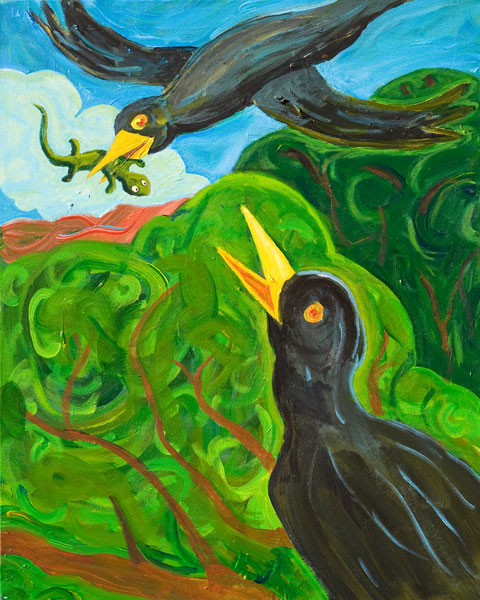

[I finished a new painting this week, it’s called Caw! Crows don’t actually have yellow beaks, but I think they look right. Check out the worried, astounded expression in that poor little lizard’s eyes.]

I liked the Bladerunner movie a lot, particularly the first part, with the blimps bearing electronic billboards, and the cop smoking pot while he interviewed the android, and the dark futuristic city with the neon lights glinting off pavements slick with rain. The last part of the movie seemed too violent, and inappropriately so, given that Phil’s Androids novel had largely been about empathy and peace. But that’s Hollywood.

“Phil would have loved it,” Ray Nelson reassured me. Actually, I’ve always wondered if Phil’s worrying about the movie in progress was what drove him to his fatal stroke—remember that the old phrase for stroke was “apoplectic fit.” (In the past, I’ve blogged about how I imagine Phil as a person .)
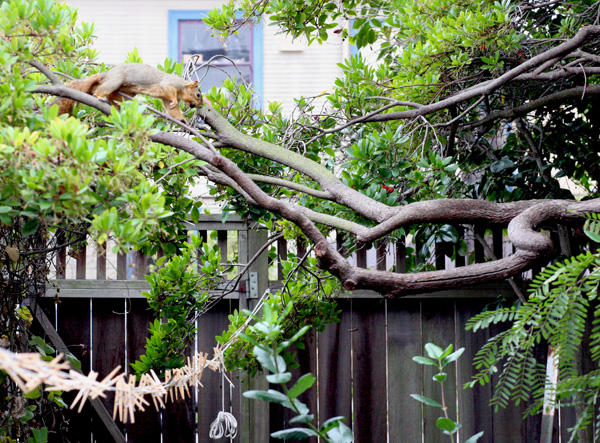

[Note the squirrel on the clothesline!]

The award ceremony was in an artist’s loft, with the hallways covered in reflective silver paint. One of the first people I ran into was my artist friend Barry Feldman from college. Incredibly, he was wearing a suit, and he looked more like Chico Marx than ever. He seemed just a bit envious of me getting an award—although he was a great painter, working all day long in his studio, he wasn’t breaking into the gallery scene. On a sudden whim, I told Barry he could pose as me and enjoy the fame.

As I was such an outsider to the SF scene, nobody knew what I looked like, and the substitution worked for about half an hour. Barry stood by the store shaking hands and signing books, twinkling with delight. I stood across the room, drinking and hanging out with Sylvia, Eddie Marritz, his wife Hanna, and Gerard Vanderleun, who’d edited The Fourth Dimension at Houghton-Mifflin. In the end it all got sorted out, and I met the people I needed to meet—among them was Susan Protter, who’d end up being my literary agent for the years to come.
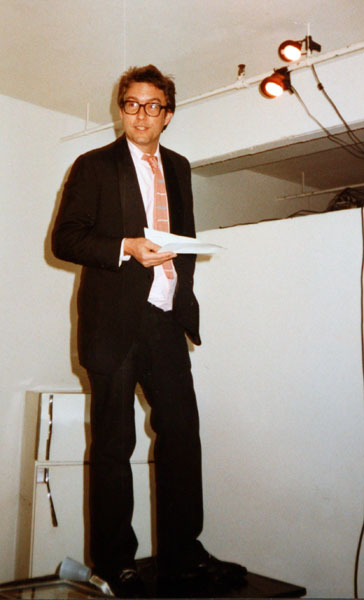
Finally I stood on the bar at one end of the room and delivered a short speech that I’d composed on the plane, thinking about the Garbage King, a guy whom I’d met at Lynchburg party and had imagined to be the ghost of Phil Dick.

“If I say that Phil Dick is not really dead, then this is what I mean: He was such a powerful writer that his works exercise a sort of hypnotic force. Many of us have been Phil Dick for brief flashes, and these flashes will continue as long as there are readers. … I’d like to think that, on some level, Phil and I are just different instances of the same Platonic form—call it the gonzo-philosopher-SF-writer form, if you like. … If it is at all possible for a spirit to return from the dead, I would imagine that Phil would be the one to do it. Let’s keep our eyes open tonight, he may show up.”

The next day we went to visit Barry and his wife at his studio. I’d lifted a bottle of liquor from the awards ceremony to give him. He looked a little embarrassed. It turned out he’d bagged three bottles himself. (I wrote some more about all this in an essay “Haunted by Phil Dick”, which appeared in my collection of essays, Seek!.)
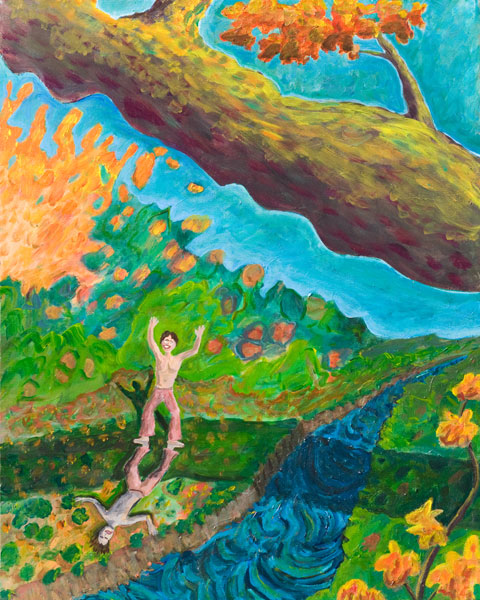

[I changed my earlier painting “Owl Creek” and gave it a new name, “A Fork in Time.” The picture represents more clearly than before the notion of someone going through a moment in time where the universe forks and in one branch they live and in the other they die.]

On Easter Day, 1989, I’d receive my second Philip K. Dick award—my third dick, you might say. It was for Wetware, my sequel to Software, and the ceremony was at a smallish regional SF con in Tacoma, Washington. It wasn’t like the artists’ loft in New York at all. It was in a windowless hotel ballroom with a dinner of rubber ham and mashed potatoes.

By then I was working a day job, and I didn’t have time to write as much as before, which had put me into a depressed state of mind. Winning the award, I felt like some ruined Fitzgerald character lolling on a luxury liner in the rain—his inheritance has finally come through, but it’s too late. He’s a broken man.

In my acceptance speech, I talked about why I’d dedicated Wetware to Phil Dick with a quote from Camus, “One must imagine Sisyphus happy.” I see Sisyphus as the god of writers or, for that matter, artists in general. You labor for months and years, rolling your thoughts and emotions into a great ball, inching it up to the mountain top. You let it go and—wheee! It’s gone. Nobody notices. And then Sisyphus walks down the mountain to start again.

In my speech, I read a little more from Camus’s “The Myth of Sisyphus”:

“Sisyphus, proletarian of the gods, powerless and rebellious, knows the whole extent of his wretched condition: it is what he thinks of during his descent. The lucidity that as to constitute his torture at the same time crowns his victory. There is no fate that cannot be surmounted by scorn.”

As so often happens, nobody got what I was talking about. One of the fans invited me to come to his room and shoot up with ketamine, an offer which I declined. Outside the weather was pearly gray, with uniformed high-school marching bands practicing for something in the empty streets.

But never mind all that ancient gloom! It’s a new world now. Happy Thanksgiving!

Writing WETWARE

Friday, November 21st, 2008

[Another excerpt from my memoir-in-progress, Nested Scrolls.]

Odd as it now seems, it was only in 1986, with Wetware—my thirteenth book—that I started writing on a computer. The previous dozen manuscripts were all typed, with much physical cutting and pasting. Sometimes, if I couldn’t face typing up a fair copy of the marked-up and glued-together final draft, I’d hire a typist.


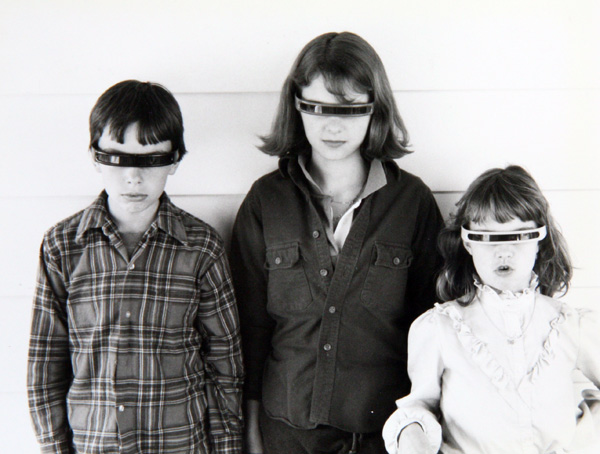
[Our three cyberkids.]

But with Wetware I was ready to change. Sylvia, the kids and I went up to Charlottesville and visited the only computer store in the area. I ended up with what was known as a CP/M machine, made by Epson, with Peachtext word-processing software, and a daisy wheel printer. The system came with a Pac-Man-like computer game called Mouse Trap that the kids loved to play.

Although I knew a lot about the abstract computers discussed in mathematical logic, it would be several more years before I grasped how my kludgy, real-world computer worked—the whole schmear about copying software into system memory was a mystery to me. For the moment, all I knew was that I had to run two or three big floppy disks through the machine just to start it up.

While I was gearing up for Wetware, I’d started what I thought was going to be a short story called “People That Melt,” and I sent the story fragment to William Gibson, hoping that he’d help me finish it, and add some snazzy Gibsonian touches.

He said he was too busy to complete such a project, but he did write a couple of pages for me, and said I was free to fold them into my mix in any fashion I pleased. I think Whitey Mydol’s “ridgeback” Mohawk that extends all the way down his spine was Bill’s idea.

As I continued work on the story, it got good to me, and it ended up as the first chapter of Wetware. As a tip of the hat, I put in a character named Max Yukawa who resembled my notion of Bill Gibson—a reclusive mastermind with a thin, strangely flexible head.

Once I got rolling, I wrote Wetware at white heat. I think the actual keyboarding of the first draft took about six weeks. I made a special effort to give the boppers’ speech the bizarre beat rhythms of Kerouac’s writing—indeed, I’d sometimes look into his great Visions of Cody for inspiration. The book was insane, mind-boggling, a cyberpunk masterpiece. A couple of years later, it would win me a second Philip K. Dick award.

But no matter how fast and well I wrote, the money wasn’t coming in fast enough. I was going to have to leave freelancing and get another teaching job.

Early Days of Cyberpunk

Monday, November 17th, 2008

[Excerpts from my memoir, Nested Scrolls.]

I started getting mail from a younger writer in Texas called Bruce Sterling. He’d written glowing reviews of Spacetime Donuts and White Light in a weekly free newspaper in Austin—he was one of the very first critics to appreciate these books. Soon after this, Bruce began publishing a zine called Cheap Truth.

Bruce loved all things Soviet—it wasn’t that he was a Communist, it was more that he dug the parallel world aspect of a superpower totally different from America. He spoke of Cheap Truth as a samizdat publication, meaning that, rather than printing a lot of copies, he encouraged people to Xerox their copies and pass them from hand to hand.

Reading Bruce’s sporadic mailings of Cheap Truth, I learned there were a number of other disgruntled and radicalized new SF writers like me. The Cheap Truth rants were authored by people with pseudonyms like Sue Denim and Vincent Omniaveritas. I was too out of the loop to try and figure out who was who, but I took note of the authors being hyped: Bruce Sterling, Lew Shiner, William Gibson, Pat Cadigan, John Shirley, and Greg Bear. I couldn’t actually find books by many of these people in Lynchburg, Virginia, although Bruce did mail me a couple of his novels, including Involution Ocean, a delightful take on Moby Dick which features dopers on a sea of sand. This work has some transreal qualities, and I liked it lot, including its unexpectedly maniacal ending…it’s a shame the book is currently so hard to find.

Sterling’s zine, Cheap Truth¸ didn’t have any particular name for the emerging new SF movement—it wouldn’t be until the next year that the cyberpunk label would take hold. I got together with Sterling, William Gibson, and Lew Shiner in September of 1983. We partied together at a world science fiction convention in Baltimore—they’d all read my new novel The Sex Sphere, which had just been published by Ace.

Gibson was an impressive guy from the start. He was tall, with an unusually thin and somewhat flexible-looking head. When I met him at one of the con parties, he said he was high on some SF-sounding substance I’d never heard of. Perfect. He was bright, funny, intense, and with a comfortable Virginia accent.

Back home in Lynchburg, I spent a day at my downtown office as usual and drove home in our black and white Buick, resplendent in the Hawaiian shirt that Sylvia had sewn for me. And there were Gibson, Sterling and Shiner on our front porch, along with Bruce’s wife, Nancy, and Lew’s friend, Edie. They’d decided to drive down after the convention.

These guys were all a bit younger than me—I was thirty-seven by now. To some extent they looked up to me. I was thrilled to join forces with them, it felt like being an early Beat.

I’d meet the other canonical cyberpunk, John Shirley, two years later, when we were both staying with Bruce and Nancy Sterling in Austin, Texas, in town for a science fiction convention that was featuring a panel on cyberpunk. John was a trip. When I woke up on Sterling’s couch in the morning, John was leaning over me, staring at my face.

“I’m trying to analyze the master’s vibes,” he told me.

The antic SF personage Charles Platt was there in spirit, he’d mailed Bruce a primitive Mandelbrot set program that he’d written in Basic. We’d set the program to running on Bruce’s primitive Amiga computer, and a couple of hours later we’d see a new zoom into the bug-shaped fractal—chunky pixels colored in blue, magenta and cyan.,

As we walked around Austin together talking, John had a habit of picking up some random large stone from a lawn, lugging it over to me, and putting it into my hands. Sometimes I’d be so into the conversation that I’d just carry the rock along for a few steps before noticing it.

Naturally we’d get high in the evenings. I recall driving a rented Lincoln around town with John. He was riffing off my book Software, leaning out of our car window to scream at the Texas drivers, “Y’all ever ate any live brains?”

The writers on the Cyberpunk panel were me, Shirley, Sterling, Lew Shiner, Pat Cadigan, and Greg Bear. Gibson couldn’t make it. The moderator—whose name I’ve forgotten or never knew—hadn’t read any of my work, and was bursting with venom against all of us. He represented the population of SF fans who are looking for a security blanket rather than for higher consciousness. For his ilk, cyberpunk was an annoyance or even a threat. He’d slid through the 1970s thinking of himself as with-it, and cyberpunk was yanking his covers.

To my eyes, the audience began taking on the look of a lynch mob. Here I’m finally asked to join a literary movement, and everyone hates me before I can even open my mouth? Enraged by the moderator’s ongoing barrage of insults, John Shirley got up and walked out, followed by Sterling and Shiner. But I stayed up there. I’d traveled a long distance for my moment in the sun.

The Genesis of SOFTWARE

Thursday, November 13th, 2008

[More from my memoir-in-progress Nested Scrolls. By the way, my four Ware novels are out of print now, but I'm working on a way to get them back onto the stands again.]

Mom and Pop completed their divorce—and they never spoke to each other again. Pop and his new woman friend came to visit us in Heidelberg. It was a mournful, uncomfortable encounter. Pop was a mess—he was consumed with guilt about leaving Mom, and he was drinking more heavily than ever before. His woman friend was stiff and brittle with us. She disapproved of me.

After a few long days, I put them on a train for Paris. They were planning to stay in a good hotel and live it up. Poor Pop. He’d done his duty all his life. Now Death was stalking him and he was trying to have some fun. Seeing his train pull away, I stood there sobbing as if my heart would break.

What to do? I started work on another science fiction novel. I figured I’d write a transreal novel as before—but without using myself as a character. I sensed that this move would open up the vibe.

One character, called Cobb Anderson, would be an old man modeled on my father in his current state. To some extent I could project myself into this character too. For all our disagreements over the years, Pop and I never were all that different. Another factor in my writing about Pop was that I was in some sense trying to inoculate myself against ending up like him—besotted, afraid of death, and on the run from my family.

The other character in my novel was a young guy called Sta-Hi Mooney, based on my wild and wacky friend Dennis—the guy who used to turn up in Geneseo to visit his big brother who was teaching there. What I liked about Dennis was that he seemed to have no internal censor. He always said exactly what he was thinking. He was relatively uneducated, but he had a fanciful mind, and a hipster, motor-mouth style of speech.

In the opening scene, Cobb is sitting on a beach in Florida, drinking sherry, and he’s approached by his double. At first I thought I was writing a time-travel novel, but then I hit on the notion that Cobb’s double could in fact be a robot copy of him.

To make this work, I developed the idea that it will become possible to extract a person’s personality from their brain, and that it will then be possible to run the extracted human software on some fresh hardware, for instance on a robot resembling the person’s former body.

Software. In 1979, this was a technical and little-known word—I’d picked it up from an article in the Scientific American. I decided to use it for the title of my book. I finished Software near the end of our stay in Heidelberg, and I had no trouble selling it to Ace Books in the wake of selling them White Light.

My idea of copying a person onto a robot was a fresh concept in those days, and my book gained power from the intensity of its father/son themes and from the colorful anarchism of my robot characters, whom I called “boppers.” Also I had an unforgettable scene where some sleazy biker types are about to cut off the top of Sta-Hi’s skull and eat his brain while he’s still alive. They wanted to extract the software, you understand.

The Genesis of WHITE LIGHT

Monday, November 10th, 2008

I participated in a group Steampunk reading a couple of weeks ago, and Rick Kleffel made a podcast of me reading from The Hollow Earth. You can click on the icon below to access the podcast via my Feedburner podcast station.

And now another excerpt from my memoir-in-progress, Nested Scrolls. Note that you can buy White Light at this link.

In Heidelberg in 1978, I wrote seven short stories—and then White Light, a science fiction novel about infinity. With White Light I got serious about being a novelist.

I began writing the book in longhand one weekend while I was alone with the kids. Sylvia was visiting her relatives in Budapest. I called my novel White Light, in memory of a memorable vision I’d had at Rutgers. And I gave it a subtitle lifted from a paper by Kurt Gödel: What is Cantor’s Continuum Problem?

The main character of White Light was a math professor, closely modeled on me, and the setting was very much like Geneseo. The practice of writing science fiction about real life is what I came to call transrealism. In White Light, my life in Geneseo was the real part, and the trans part was that my character in the novel leaves his body and journeys to a land where Cantor’s infinities are as common as rocks and plants.

White Light was influenced by the Donald Duck and Zap comics that I loved so well one chapter features Donald and his nephews, in another chapter objects start talking, as they sometimes do in R. Crumb strips. I also used the papers by Cantor that I’d been reading—and included the man himself as a character.

Over the years, I’ve often worked by alternating between writing science fiction and writing popular science. So it was fitting that I was working on a popular nonfiction book about infinity at the same time that I was writing White Light. Each endeavor was feeding the other.

I got into a very pleasant and exalted mental state during this period of time. I remember having a magical dream in which I was climbing onto the ridge of a mountain. The stone underfoot was slippery pieces of shale, and among the stones I was finding wonderful polyhedral crystals the size of walnuts or croquet balls. Even within the dream, I knew that these treasures represented my wonderful new ideas.

I finished the manuscript for White Light late in 1979, when I was thirty-three. I tried sending it to a big-time agent—who charged me a couple of hundred bucks to read my manuscript, disliked it, and refused to submit it to any publishers. So I started trying to sell it by myself.

I sent it off to Ace Books, getting their address from the title page of Ian Watson’s Miracle Visitors, a book written on the same wavelength as White Light. While I was waiting for my book to work its way through the Ace slush pile, I went to my first science fiction convention, Seacon in Brightontaking the train and ferry from Heidelberg.

The atmosphere at mathematics conferences had always been rather frosty. There weren’t enough jobs to go around, and newcomers weren’t particularly welcome. But the science-fiction folks were, like, “the more the merrier.” I loved the vibe.

Some well-dressed hippies from London (including Gamma) got me high and introduced me to a hipster called Maxim Jakubowsky. Maxim was editing a new line of books for the Virgin record company. Their first book was going to be about the punk band The Sex Pistols, but they were looking for radical SF novels as well.

I’d brought along a single Xerox of the White Light manuscript, and I handed it to Maxim on the spot. And a few weeks later he made an offer to buy the British rights for the book. A month after that, Ace made an offer for the US rights. I felt like a plant pushing out from the soil into the sun and air.

Wheelie Willie in the Sixties

Thursday, November 6th, 2008

[Back to memoir excerpts. Somehow the Sixties feel very close today!]

In the late 1960s and early 1970s, I was at Rutgers Univeristy learning math. For the first time in my life, I was taking courses that I found difficult in an interesting way: abstract algebra, real analysis, topology, and mathematical logic. And, for the first time since high school, I was attending all the class lectures and doing the homework.


[Boyhood suitcase of magic tricks.]

My wife, Sylvia, was finishing her Master’s degree in French literature. I liked hearing about the wild books she had to read, like medieval plays featuring Eve and Satan, or the poems of Apollinaire. In the evenings, she and I would do homework together in our little living room. It was cozy.

The Rutgers math department was giving me some financial support as a teaching assistant, and I met twice a week with a section of calculus students to show them how to do their homework problems—they got their lectures from a professor in a big hall. Working through the problems on the board, I finally began to understand calculus myself. It made a lot more sense than I’d realized before.

I was undergoing a constant cascade of mathematical revelation, even coming to understand such simple things as why we need zeroes, or why “borrowing” works when you’re doing subtraction. I was learning a new language, and everything was coming into focus.

The mathematical logic course was a particular revelation for me. I liked the notion of mathematics being a formal system of axioms that we made deductions from. And I reveled in the hieroglyphic conciseness of symbolic logic. From the academic point of view, I was beginning to see everything as a mathematical pattern. But in my personal life, everything was love.

Sylvia and I were enjoying the Sixties—we went to the big march on the Pentagon, we had psychedelic posters on our walls, we wore buffalo hide sandals, and we read Zap Comix. I smoked pot rolled in paper flavored like strawberries or wheat straw or bananas. Sylvia bought herself a sewing-machine and started making herself cool dresses.

At the same time, the war in Vietnam was casting a bitter pall. Those who didn’t live through those times tend not to understand how strongly the males of my generation were radicalized against the United States government. Our rulers wanted to send us off to die, and they called us cowards if we wouldn’t go. It broke my heart to see less-fortunate guys my age being slaughtered. My hair was shoulder-length by now, and occasionally strangers would scream at me from cars.

We were friends with a wild math grad student named Jim Carrig, from an Irish family in the Bronx. Jim and his wife, Fran, were huge Rolling Stones fans—they were always talking about the Stones and playing their records. They’d sign up early to get a shot at the tickets to the touring Stones shows. Thanks to them we saw the Stones play a wonderful afternoon show at Madison Square Garden.

“Did y’all get off school today?” asked Mick, strutting back and forth. “We did too.” And then they played “Midnight Rambler” and he whipped the stage with his belt—a trick we took to emulating at parties.

The Carrigs threw great Halloween parties. They lived an apartment on the second floor of a house, and Jim would stand at the head of the stairs like a bouncer, checking up on his guests’ attire. “Get the f*ck outta here!” he’d yell if anyone showed up without a costume. “Go on, we don’t wanna see you!”

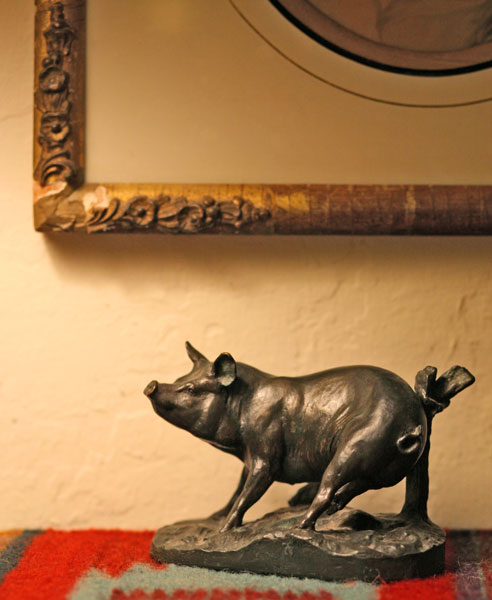
I came to one party as a Non-Fascist Pig. That is, I bought some actual pig ears at the supermarket, punched holes in them, threaded a piece of string through them, and tied them onto my head. I lettered, “F*ck Nixon,” onto my T-shirt. I pinned on a five-pointed Lunchmeat Award of Excellence star that I’d cut from a slice of Lebanon bologna. And I carried a pig-trotter in my pocket to hold out if anyone wanted to shake hands with me.

When Sylvia and I went to see the left-wing movie Joe, the movie theater played the Star Spangled Banner before the film, and there was nearly a fight when a guy two rows ahead of us wouldn’t stand up. Turned out the guy was a Viet vet himself. “That’s why I went to fight,” the vet told the older man harassing him. “To keep this a free country. I don’t have to stand up for no goddamn song.”

I was very nearly drafted, undergoing a physical that classified me 1A. I’d thought that my missing spleen would earn me a medical exemption, but no dice. I still remember the medical officer who told me the bad news. Sidney W… oh, never mind his full name. He seemed to have a chip on his shoulder. Maybe he’d been drafted himself.

I bought some time by faking an asthma attack—and then they switched to a lottery number system for the draft, and I happened to get a comfortably low number. I wasn’t going to Vietnam after all. I was going to keep on learning math, being a newlywed, and having fun.

The tidal wave of underground comix inspired me to get some Rapidograph pens and to start drawing comics on my own. I developed a wacky, left-wing strip called Wheelie Willie that occasionally appeared in the Rutgers campus newspaper, the Targum.

I felt uneasy about my ability to draw arms and legs, so my character Wheelie Willie had a snake-like body that ended in a bicycle wheel. Some of the students must have liked the strip, as a fraternity once went so far as to have a Wheelie Willie party, not that I attended it.

Another close friend was my fellow math grad student Dave H. He was a skinny guy with an odd way of talking—he almost seemed like an old man. He always said “Rug-ters” instead of “Rutgers,” and “pregg-a-nit” instead of “pregnant.”

When Dave arrived for our grad student orientation session, he told me that he’d demonstrated against all three of the current presidential candidates: Humphrey, Nixon, and Wallace. And he’d been arrested in the Chicago convention riots. He was always going off to marches and demonstrations. Once he even roped Sylvia and me into making a trip to give support to the AWOL soldiers in the brig at Fort Dix. The soldiers gave us the finger.

Free At Last!

Wednesday, November 5th, 2008

I remember when the Berlin Wall fell, and suddenly we realized that the dreaded Soviet empire had collapsed. The Soviets were nothing more than a bunch of people, not all that well organized, and not nearly so powerful as we’d feared.

The same thing happened to the right wing of American politics last night. They’re a paper tiger, an artificial threat that’s been propped up too long by the media. Their reign is over.

“Free at last, free at last, thank God Almighty, we are free at last!”

Suddenly African-Americans look a little different—all along they’ve been feeling and thinking the same things as the rest of us, and never mind what anyone thought before. It’s their country too. Our hearts are opening. We’re one weave.

And soon we can get to work fixing things up!

Hallelujah.


Rudy’s Blog is powered by WordPress