





Click covers for info. Copyright (C) Rudy Rucker 2021.


Archive for September, 2005

Biology Lecture, Four Mile Beach

Friday, September 30th, 2005

I posted another of my “Philosophy and Computers” lectures, this one is about the first part of Chapter 3 of my Lifebox book. I talk about self-reproduction, morphogenesis, and ecology in terms of computations.

'GigaDial


I’m trying various MP3 compression settings, and so far I’m always ending up with about 1 Meg per minute, whether its mono or stereo, 128 kbps or 64 kbps, VBR off or on. One student suggested that if I ran it through a low-pass filter to remove high frequencies (hiss), I’d get smaller files. In any case, the sound is decent now, thanks to my clip-on microphone. I have quite a bit of computer demos in this lecture, by the way, so if you want to study it, you might want to get hold of CAPOW. You can download the new build of CAPOW by using the Download Software button on the Lifebox page.
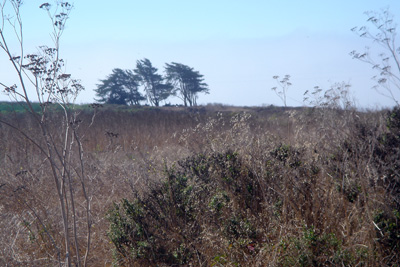
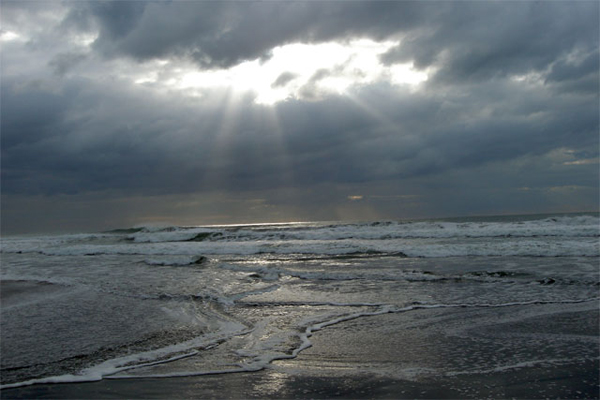
I was out at Four Mile Beach on Route 1 four miles north of Santa Cruz earlier this week. The wild beaches of California are always even better than I remembered.
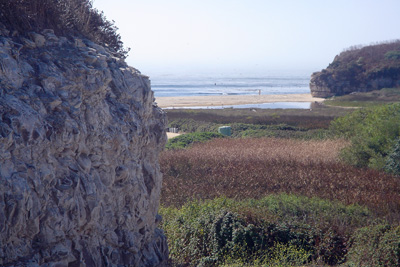
Every time it blows me away.
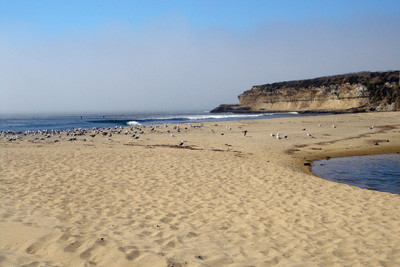
Escape from the machines.

But computation is everywhere. The paths of the birds.

I sat for awhile in this nice cove. Note the fog bank twenty meters offshore.

Now and then a wave would sweep up and a sheet of water would move around a rock and back into the ocean. After a few meters of motion, the edge of the sheet always develops a scalloped edge.

The scallops are always the same, yet always different. These pictures are of two different sheets of water. Unpredictable computations dancing on a strange attractor in phase space. Me too.

Podcast #3. Philosophy and Computers 3: Morphogenesis.

Thursday, September 29th, 2005

Sept 29, 2005. The 3rd recorded lecture in my Philosophy and Computers course, covering the first half of Chapter 3 of The Lifebox, the Seashell, and the Soul, see www.rudyrucker.com/lifebox. I talk about self-reproduction, intelligent design, morphogenesis, and ecology in terms of computations. By the way, my Philosophy class lectures are more or less independent of each other. (44.29MB. 60 min.)

Play

Subscribe to Rudy Rucker Podcasts.


Need Help Understanding Supermind Experience

Wednesday, September 28th, 2005

I need some help with a question for an SF story I want to write. [Illos today are golden oldies from the blog; my stash of images is becoming a kind of visual Tarot.]

So suppose we have a superintelligent web of tiny machines with an enormous net RAM and flop, with tons of data, and with smart agents living inside it. The Web, in other words, but more so. And now suppose that we plug into it and get smarter. How will this feel?

But, wait, let me evade the hard question for a second. Plug in how? I could use my usual “uvvy,” a soft plastic computer you wear on the base of your neck and it reaches into your brain with magnetic vortices. You can take it off, which is important, as no reasonable person wants to be permanently plugged in.

Or some nanomachines called “arphids” get into your hair like lice and can diddle your brainwaves. A different kind of uvvy. But maybe people are initially leery of the uvvy and the arphids.

They could get by with what I call “stunglasses,” glasses with a heads-up display overlaid. These could even be contact lenses. And you could have tiny sensors on your finger joints so you can type in the air, or not even type, just make those cool cyberspace moves like Keanu did in the 1998 movie of Gibson’s story “Johnny Mnemonic.” And we can also suppose the system has speech recognition and you have earphone buds perched in the porches of your ears and a mike taped to your throat. Everyone is mumbling and twitching and wearing flickering contact lenses.

But how does it feel to plug into a system that’s say, a million times as smart as a person. You can have agents for yourself in there doing searches, computing things. Of course if they’re so frikkin’ smart, why would they obey you?

When you plug into the supercomputing web, it’s like you go out of yourself into the seamless web mind, and then you come back. Some thoughts you can’t remember until you’re plugged in. You just remember links. You can speak by exchanging links. But real physical life goes on.

When you unplug and go outside, you’re the same. Having supercomputation around doesn’t really change things much when you’re offline and being yourself. People are still the same as in Bruegel’s time. At least this is the situation I need in order to write a story about these people.

Comments?

Podcast #2. Philosophy & Computers 2: Quantum Mechanics.

Tuesday, September 27th, 2005

Sept 22, 2005. The 2nd lecture from my Philosophy 115 class at SJSU. The lectures are based on my book The Lifebox, the Seashell and the Soul On the book’s page you can download the Cellab and CAPOW software used in the demos being discussed. I didn’t manage to record the three classroom lectures that preceded this meeting of the class. Much of that material appears, however, in my “Gnarly Computation” talk at the Institute for the Future, which I’ve labeled as Philosophy and Computers 1. (56.94MB. 60 min.)

Play

Subscribe to Rudy Rucker Podcasts.


Rudy's Blog is powered by WordPress