






Click covers for info. Copyright (C) Rudy Rucker 2021.


Archive for the ‘Rudy’s Blog’ Category

Free Will

Thursday, December 16th, 2004

Here's an excerpt from section 4.7 of The Lifebox, the Seashell, and the Soul which I was revising yesterday. The book will be out in Fall, 2005.

Consider the following bit of dialectical analysis.

• Universal automatism proposes a thesis:

Your mental processes are a type of deterministic computation.

• Your sense of having a free will entails a seeming antithesis:

Your thoughts and actions aren’t predictable.

• Wolfram advocates a beautifully simple synthesis:

Your mind’s computation is both deterministic and unpredictable.

The synthesis is supported by the following conjecture, implicit in Wolfram's A New Kind of Science.

• Principle of Computational Unpredictability (PCU). Most naturally occurring complex computations are unpredictable.

''

The workings of your mind are unpredictable in the sense that, when presented with a new input of some kind, you’re often quite unable to say in advance how you’ll respond to it.

Someone offers you a new job. Do you want it or not? Right off the bat, there’s no way to say. You have to think over the possibilities, mentally simulate various outcomes, feel out your emotional responses to the proposed change. Someone shows you a painting. Do you like it? Hold on. You have to think about the image, the colors, the mental associations before you decide. Someone hands you a menu. What do you want to eat? Just a minute. You need to look into your current body feelings, your memories of other meals, your expectations about this particular restaurant.

We say a computation is unpredictable if there is no exponentially faster short-cut for finding out in advance what the computation will do with arbitrary inputs. When faced with an unpredictable computation, the only reliable way to find out what the computation does with some input is to go ahead and start up the computation and watch the states that it steps through.

''

Once again, suppose I’m presented with some new input. Since my thoughts are unpredictable, the only way to find out what I’m going to end up thinking about the input, is to go ahead and think until my mind is made up. And this means that, although my conclusion is in fact predetermined by how my mind works, neither I nor anyone else has any way of predicting what my conclusion will be. Therefore my thought process feels like free will.

I seem to be a fluttering leaf.

Mirrors

Tuesday, December 14th, 2004

That Slow Time entry was kind of a downer. So let’s put on a fresh layer of reality paint. Nothing’s going on today, except that I’m revising Lifebox, so, hmm, I’ll reach into the picture archives to find something to post.

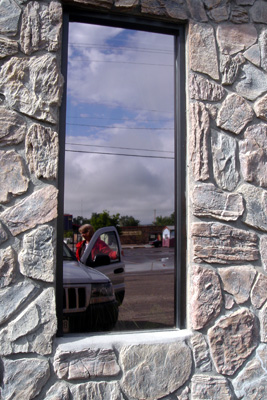
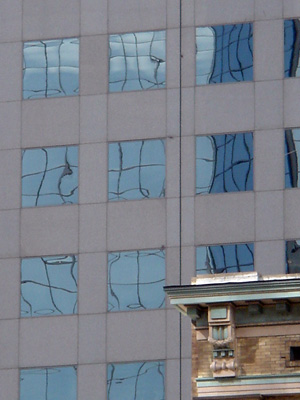
Three pictures of mirrors! The first is a window in a parking lot in Wyoming.

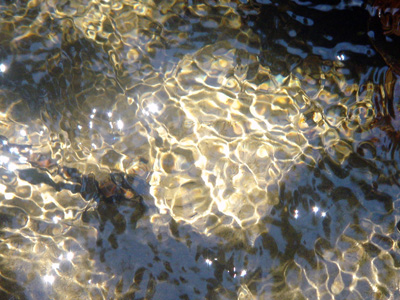
The second is caustics on the surface of a brook in Big Basin in Santa Cruz Country.

A reflections quote, from my journals, this fall.

“I went camping in Big Sur; it was a hot day, and I had the chance to stand in the cool clear flow of the Big Sur River, up to my neck in a big pool that accumulates right before the river flows across a sand bar into the Pacific. Standing there, I closed my eyes to savor the sensation of water and air. My arms were weightless at my sides, my knees were slightly bent, I was at perfect equilibrium. Each time I exhaled, my breath would ripple the water, and reflections of the noon sun would flicker on my eyelids. Exquisite.”

“I was all there, fully conscious, immersed in the river. And I became powerfully aware of a common sense fact that most people will have known all along.”

“'This isn’t a computation. This is water.'”

A third picture, an office building in Denver, erstwhile home of Neal Cassady.

Working with computer graphics has enhanced my appreciation of the natural world. Though I think painting does the same thing.

Here’s a quote along these lines from David Kushner, Masters of Doom, (Random House, 2003) p. 295. Kushner is describing the programmer John Carmack, who developed most of the code for the first-person-shooter computer games Doom and Quake.

“…after so many years immersed in the science of graphics, he [John Carmack] had achieved an almost Zen-like understanding of his craft. In the shower, he would see a few bars of light on the wall and think, Hey, that’s a diffuse specular reflection from the overhead lights reflected off the faucet. Rather than detaching him from the natural world, this viewpoint only made him appreciate it more deeply. ‘These are things I find enchanting and miraculous,’ he said, ‘I don’t have to be at the Grand Canyon to appreciate the way the world works. I can see that in reflections of light in my bathroom.’”

Slow Time

Monday, December 13th, 2004

The other day, I was noticing how slowly time seems to go these days.

In a bad way, I can look ahead at an afternoon or an evening and think, “I’ll never make it through this.” In a good way, I can think, “I’ve got all the time I need. I can relax.”

The other day, I had a feeling of being into a just endlessly expandable kind of mental time. I’d rather think of this as a good thing. After all, the faster you time goes, the sooner you die. My neighbor Rita, who’s in her 80s, was bemoaning this the other day. “You say Christmas is in two weeks? I feel like last Christmas was just two weeks ago. I feel like I’m on a express train to the graveyard.”

My time slowdown is happening — why? I can think of three possible causes.

''

(1) Idleness. I’m not teaching, and don’t have the concomitant mental check-list: do this, do that, do the other thing, etc. I’m still adjusting to retirement.

A job makes time pass because you carry with you a mental check-list that makes the time melt away. Plus there’s the commuting to help kill the day. Even now, when I read, or write, or when I work on my blog, the time melts away. A hobby, like a job, is a “pastime”.

TV is a pastime, too, but to me, watching TV almost always feels like I’m being robbed. I think I’d rather spend my time staring at my shoe.

I do have more empty time than before. I have to fight the capitalist, puritanical fear of empty time. Slow, empty time is a good thing.

(2) Thoughts per second. Another factor in the time slowdown could perhaps be that, thanks to thinking about philosophy so much as I work on my Lifebox book, the world is starting to seem denser and stranger to me. Trippier.

I’ve always thought that the speed at which I perceive time to be flowing might relate to the rate at which I’m having thoughts. So if you’re having a billion thoughts per second, then, yeah, a second seems like a long time. And if you settle in on the zombified gerbil wheel of TV programming, with a thought every five minutes or so, then yeah, the whole evening is gone in a flash.

But I'm not really sure I'm thinking that much more than I ever did.

(3) Isolation. Talking to people passes the time. Now that I'm retird, I’m spending more and more of my time alone.

The idea that conversation speeds up the perceived passage of time doesn’t really dovetail with the “thoughts per second” idea that time goes faster when you have fewer thoughts. Because it seems like you’d be having more thoughts rather than fewer thoughts if you’re having a lively conversation, so it would seem that the conversation should seem to make time go slower rather than faster.

I think the reason conversation speeds time up is that it takes me out of myself. If I’m continually monitoring my personal state, navel-gazing if you will, then the time will seem to go slower because I’ll have a lot of memories of wondering what time it is. Nothing slows time down like looking at your watch every thirty seconds, like when you’re waiting for a work day to be over. Or in the back seat of your parents car asking, “Are we there yet?”

What time is it now? Is that all?

Big Surf in Santa Cruz

Sunday, December 12th, 2004

Elena told us the surf was up. My wife and I drove down to Cruz and went to a beach I call Magic Door beach, it’s about 6.3 miles north of the last traffic light in Cruz on, of course, Rt. 1. Parking area is on the left, high up, flat, long, like a waiter’s tray holding cars, rutted, muddy, you walk across the tracks and down some scree to an ampitheater beach.

Whoomp! I walked up behind the rock where the waves were booming. A peaceful tidepool there.

And in the pool, the aliens dreamed all unaware. Life is calm in La Hampa.

I got real close to the rock to shoot this veil of spray. There’s always a seagull or two just perched somewhere in the scene (not shown here) calmly diggin’ it, happy as a Big Sur cow.

And then we went to the Magic Door at the left end of the beach. And made it through.

There’s a whole ‘nother hidden beach on the other side, this is La Hampa as well. Gray and sandstone rock makes art heroine dreams.

It’s nice to have my dear wife here this time — instead of just my shadow.

I found the shrunken head of that third person you always see in your dreams.

We were reading T. S. Eliot’s The Waste Land to each other on Wednesday, wondering if it had something to do with the Grail Legend. And there’s this creepy passage about the third person you see in your dreams. I want to have this personage show up when, say, two of my characters are walking around in La Hampa.

“Who is the third who walks always beside you?

When I count, there are only you and I together

But when I look ahead up the white road

There is always another one walking beside you

Gliding wrapt in a brown mantle, hooded

I do not know whether a man or a woman

— But who is that on the other side of you?”

And then a little dog came up and ran away with this particular kelp-bulb head.


Rudy's Blog is powered by WordPress