



Click covers for info. Copyright (C) Rudy Rucker 2021.


Archive for the ‘Rudy’s Blog’ Category

Micronesia 13: Nan Midol, the Tiki Palace

Tuesday, March 29th, 2005

[At the risk of boring you to death, I'm going to resume my Micronesia notes. The slide projector humming in the airless gloomy room…]

On our first full day in Pohnpei, we took a tour to these Micronesian ruins called Nan Midol. I'd never heard of them before, not surprising that I'd never heard of Pohnpei. It was a fun day; we went by boat, a smallish motor boat with about seven of us guests, a Pohnpeian man called Bidi at the dual outboard motors, and a Japanese man called Tomo doing the guiding.

First we stopped at a tiny sandbar with a couple of trees on it and went snorkeling. Ah, those fish of the Micronesia. There's one amazing largish fish called the diagonal-barred sweetlips, it's pale yellow with dark stripes on it which break into dots near its belly. This is precisely a reaction-diffusion pattern that I've created many times with my cellular automata using a rule devised by Alan Turing. Computation everywhere. Embry found a little pipefish, which looks like a seahorse without the wings. A bumpy long segmented body and a little horse head, the fish only a few inches long, nosing around in a little algae-grown bowl of coral. I'm particularly fond of some small bluish-green fish that are found schooling in the stag-horn coral, iridescent really, their exact color depends on the light, often they're a pale turquoise like shallow water above sand, other times they're like a tint of the sky, and sometimes they seem to glow as if they're electric. It truly is as if you're swimming around inside the most lavish possible imaginable pet-shop aquarium. But it goes on as far as you can see in every direction, and the currents are flowing through. The coral comes in a wonderful range of shades. There are some rounded heads that are truly that tacky orangish-pink “coral” color beloved by mail-order catalogs, but there's also delicious pale mauve tones. The staghorn corals have amazing lavender tips.

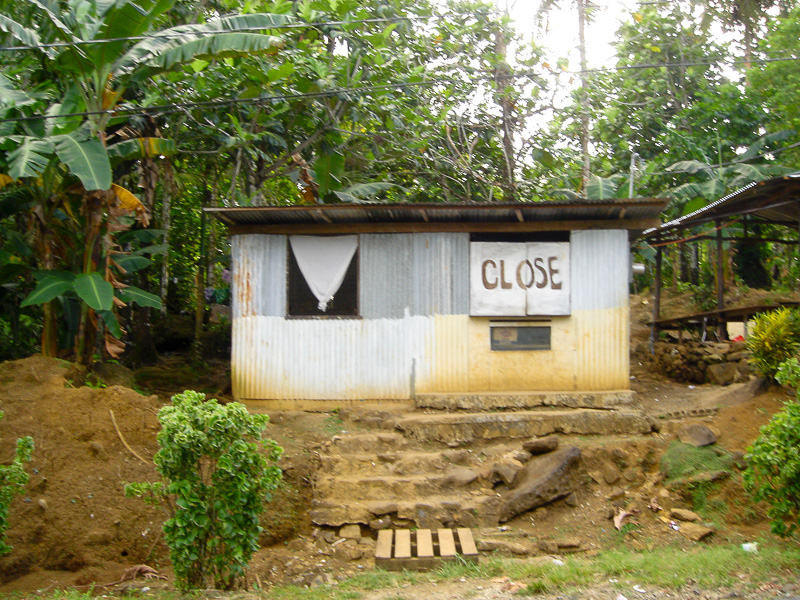
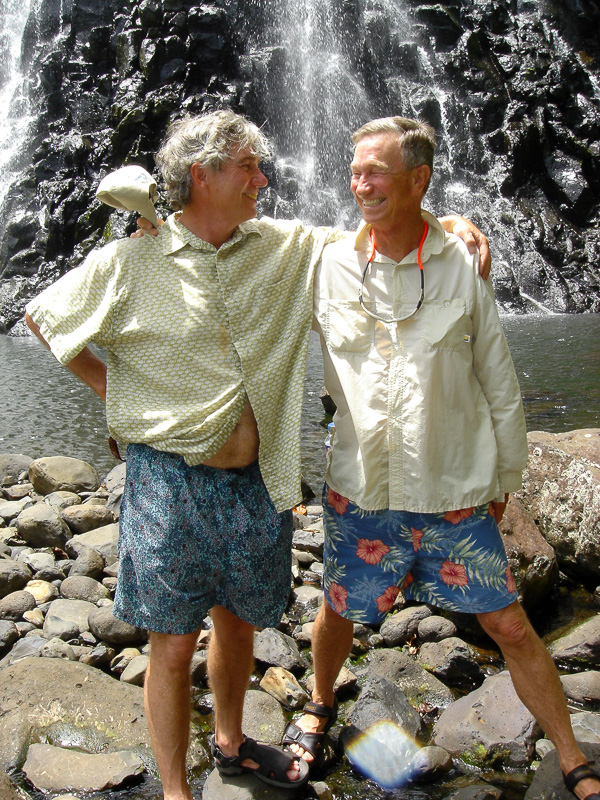
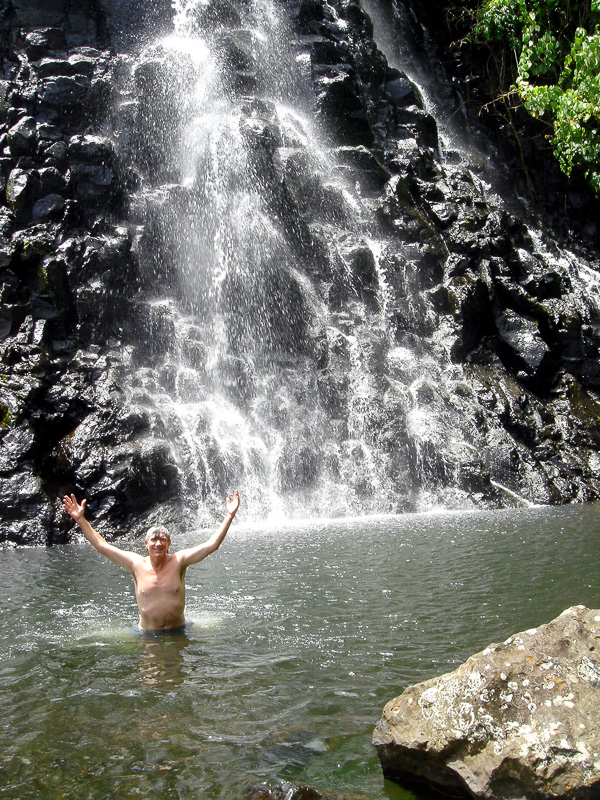
Second we pulled into a Stone Age wharf of, yes, stones, a few shacks of corrugated tin nearby. Debarked and walked up a trail along a stream to a tropical waterfall, white rivulets splashing down a bumpy fifty-foot slope of the smooth dense volcanic rock called basalt. I jumped into the pool, about ten feet deep, and swam around. At first I was the only one swimming. I looked over at our guide Tomo on the shore, and he was making swimming motions with one hand, and then holding his hands very far apart. Big fish? I opened my eyes underwater and saw some medium sized brown fish. Embry beckoned me towards the shore, Tomo had thrown in some bread crumbs, and there eating them was a fresh-water eel four feet long, a really fat guy, with alarming sharp dog-like teeth. I wondered whether it would be wise to touch his tail, I was standing in the water about a foot away from him. “Electric?” I asked Tomo. “I don't think so,” he said. And then the eel swam back into the deep water, not quite touching me. On the walk back down to the boat, Tomo told me that that for the Pohnpeians, an eel is, “Halfway between man and god. Or for some people maybe like a pet. They don't eat eel, but they eat dogs. Dogs not a pet on Pohnpei.” Later, Patti the inn-keeper told me that for kids in Pohnpei the dogs are like pets, and they're often heart-broken when the father of the family decides to butcher Fido for a feast, it's a common trauma. Speaking of dogs, there's two taciturn resident mutts at the Village. As I was moving into my room, they came and slept on my deck for an hour. “A sign of acceptance,” said Patti.

Third we stopped on a small island called Na for lunch. Small island, small name. It was covered with jungle, fairly open, so that you could walk the few hundred feet to the other side. The coconut trees had notches on them, and a lot of husks lay about, apparently the locals come here to harvest the nuts. In the Village restaurant you can get a fresh coconut to drink for a dollar, they chop off the top and stick in a straw, it's slightly sweet, slightly bubbly, fresh and wonderful-tasting. Embry and I had learned by now to usually order “bento” instead of “sandwich” for lunch. Our bentos were wads of rice with grilled tuna and some boiled vegetables, each lunch squeezed into a clever wrapping of banana leaf. This green, conical ice-cream-cone like leaf pack with a flap of leaf folded over; you unwrap it and eat it with chopsticks.

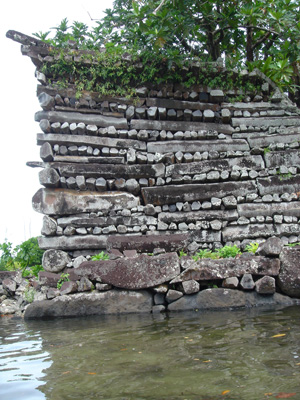
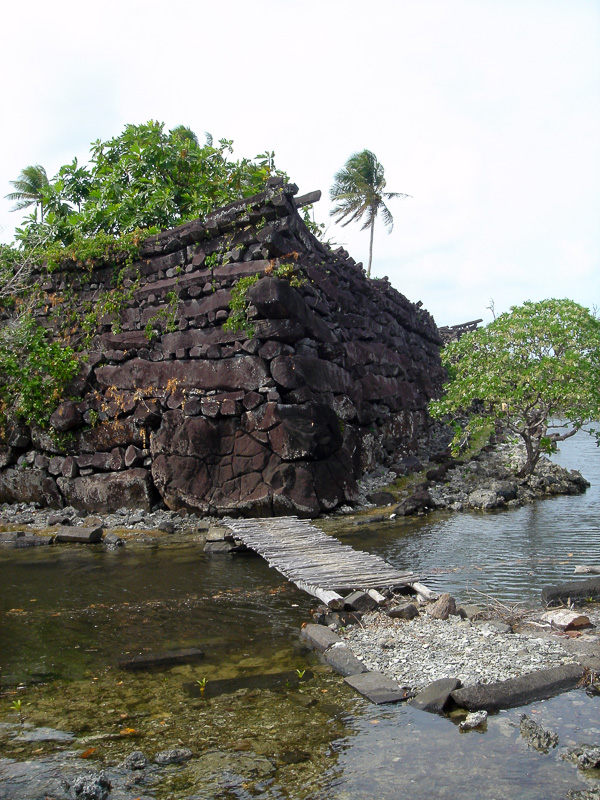
Fourth we reached Nan Midol. This was the home base and capital of the Saudeleurs, a Micronesian group of warriors who ruled Pohnpei from about 500 AD to 1500 AD. Rather than being on land, Nan Midol is a collection of about twenty little artificial islands created by making walls of basalt and filling them in with coral. And sitting on the islands are more structures of basalt megaliths. It's a little Venice.

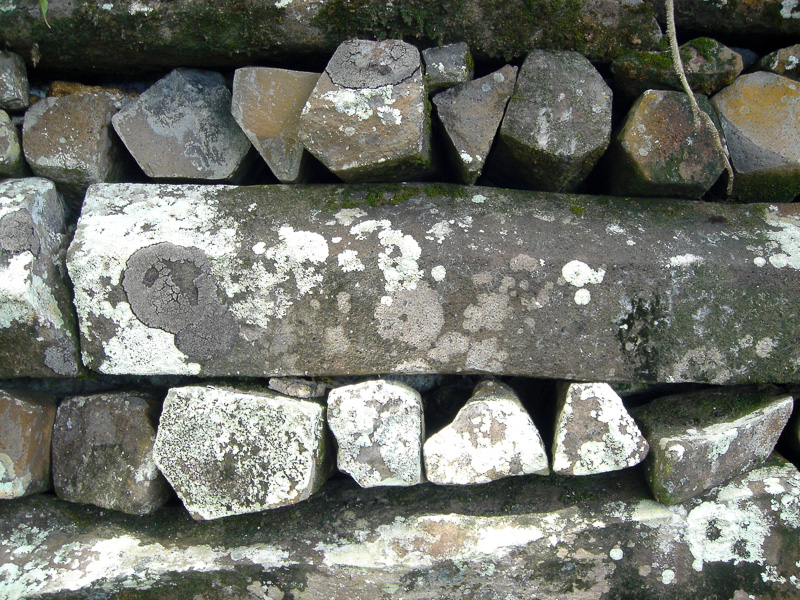
There's this odd feature of volcanic basalt, which is that if it cools slowly, as in the plug of a volcano, it forms long vertical crystals. Technically speaking, these are what chaoticians call Benard convection cells, akin to the networks you see sometimes in the mist on water in the morning, also akin to the depressions found in the sand on a beach. The famous Devil's Tower of South Dakota is a huge bundle of these basaltic frozen Benard convection cells. And Pohnpei has two natural towers like this: one is called Sokehs Rock, the other is called, believe it or not, Chickenshit Mountain (supposedly a mythic rooster dropped this one). If you quarry a big chunk of the basalt from these plugs and heat it over a fire, it quite naturally breaks into log-sized chunks, often hexagonal or pentagonal in cross-sections, but sometimes with triangular or square cross-sections as well. And the “rock logs” can be six or even twelve feet long.

So what the Saudeleurs did for their little city was to float the rock logs, the megaliths, down on bamboo rafts — there's a good current that makes this pretty easy — and then they piled up the rock logs to make structures a bit like log cabins — which must have been hard, maybe they used coral ramps to get the logs up high. Being South Pacific islanders, they didn't make solemn Lincoln-log squares of their walls, no, they bowed them in a bit, and ran them up to jutting pagoda-like points at the corners. Think Tiki Bar.

The boat pulled into one of the old canals, and we got out onto some stone steps, paid a minion of the unseen chief $3 a head, and looked around, nobody else there but our party of seven tourists and two guides.

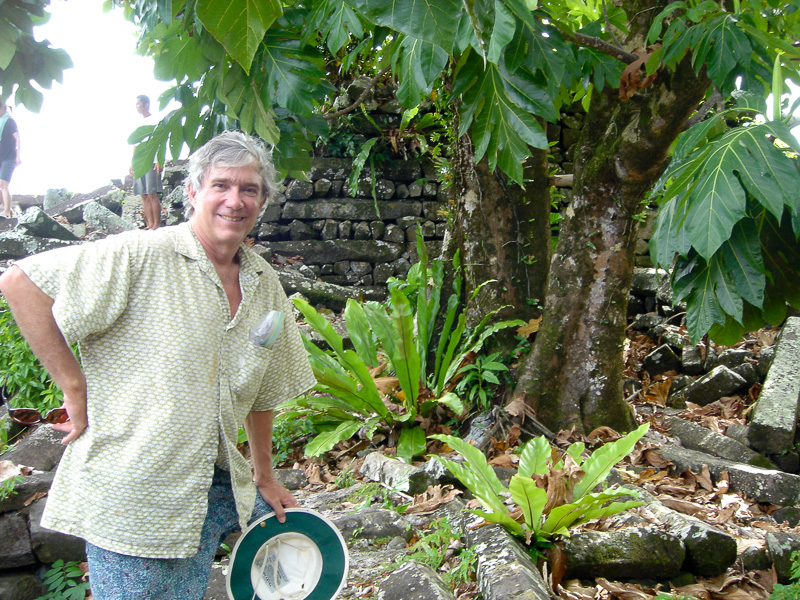
Ah, the romance of stone ruins amidst jungle plants. Breadfruit trees with great oaky leaves were knotting their roots into the ruins, the great oval green breadfruits swaying in the trade winds. I thought of the Greeks, the Romans, the Mayans. Everything was pristine and natural, no trash in sight, no signs, nothing but the ruins, the jungle, the rising tide of the sea, and the single uncommunicative minion of the Micronesian king.

Sanibel Island, FLA

Monday, March 28th, 2005

Back from FLA. “Candy came from Tampa, F-L-A. Thought she was James Dean for a day.”

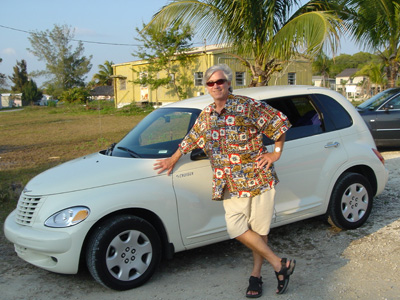
I rented a cool car in the Emerald Isle of National, a PT Cruiser.

Was great when I picked up my better half when she came to meet me at the con, I had a black Cuban shirt with white stripes and my Robert-Williams wheels.

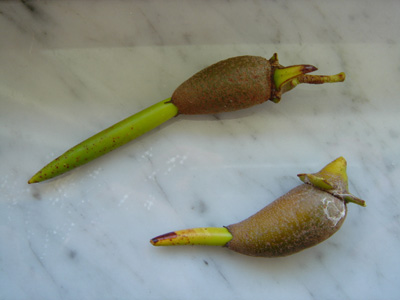
We went on an airboat ride with this real Olde Florida type and then did an eco-kayaking tour of the Everglades out of Everglades City, saw big-mamma gators and baby alligators the size of your finger. Cypresses, mangrove tunnels, Fakahatchee gnarl. Didn’t bring my camera, brought two mangrove seeds back the room, though. Cute things, like mice.

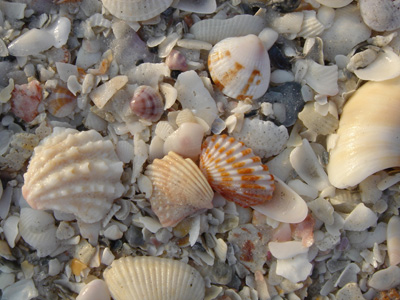
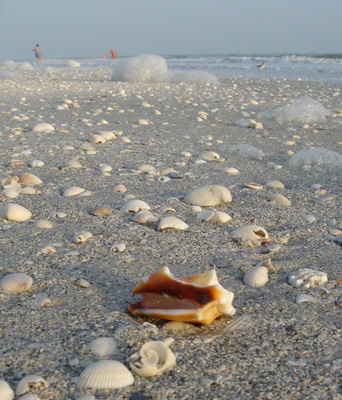
We spent three nights a nice place called the Island Inn on Sanibel Island. Sanibel isn't like it used to be when we where 27 years ago with the three kids, when it was still all those cute 1940s – 1950s kozy kabin motels, it's kind of condo-ed out now, though not like AIA north of Miami, which is like freakin’ computer graphics. The big deal about Sanibel is that great shells wash up on it, I think because the bottom slopes very gradually there.

When we did that Florida trip years ago in 1978 was when I got some of the basic material for my novel Software. And I remember one night in Sanibel sitting up with the wind blowing in off the Gulf, feeling like I was getting the weather inside my head. Tried that again this time, picked up a little more gnarl.

The beach is great for walking, though as it’s so sandy, the water’s pretty turbid. But very warm and swimmable.

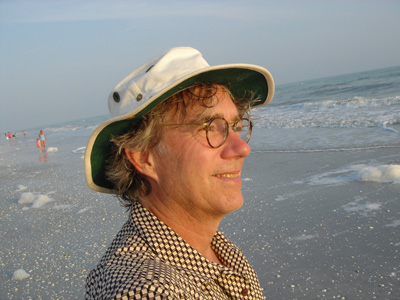
I lost my glasses somewhere on this beach.

Transreal, At Random in Florida

Friday, March 18th, 2005

I'm almost done with the ICFA con, it's a fantasy and SF convention where practically everyone has a Ph. D. in literature. I did my second presentation today, I put links up for them the other day.

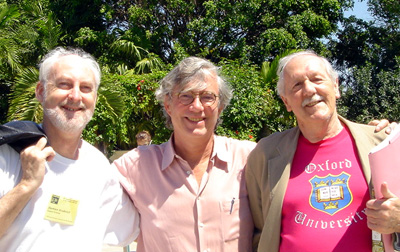
A theme of the con was Transrealism, which was nice. Here's a picture of me with Damien Broderick and Brian Aldiss.

''

The hotel is ruthlessly air-conditioned, and the hotel staff claims it would be illegal in Florida to have rooms with windows that open. Could that possibly be true? It'll be good to get out on the road for a few days; we'll look around FLA a little.

I heard a lot of great praise for my work here. Very touching. And it's been wonderful to meet or re-encounter some writers, including Brian Aldiss, John Kessel, Albert Goldbarth the poet, John Crowley, Peter Straub, Kelly Link, Larissa Lau, John Clute. How really similar our modes of thought are, we writers, despite the subgenre distinctions that we dream up.

I probably won't be blogging much this week. I still have some more Micronesia posts waiting, but there's no rush.

Later.

Micronesia 12: Pohnpei.

Friday, March 18th, 2005

We had an exhausting flight from Palau to Pohnpei, it left at 2 AM, and the trip took about twelve hours. Slept twelve hours that night. The flight from Pohnpei to LA is going to be worse. But now we're here for a week.

Pohnpei is the capital of the FSM (Federated States of Micronesia) which includes Yap, Chuuk (pronounced Chook, and formerly known by Westerners as Truk), Kosrae, and numerous tiny “out islands” as well. Not that the main town looks much like a capital, so far as I've seen it's only a small step up from Yap. The main town on Yap and Pohnpei have almost the same name: Colonia and Kolonia.

Geographically speaking, Palau and its many islands are part of Micronesia as well, but Palau is a separate country of its own. Both Palau and the Federated States of Micronesia have fairly close affiliations with the US, and both use the US dollar as currency, but the FSM's association with the US is a bit closer.

Before World War Two, the Japanese had taken over the islands of Micronesia and were emigrating here in a big way, and rather brutally disenfranchising the native population. After the US won WW II, the Japanese settlers in Micronesia were “repatriated,” that is, sent back to Japan, the Micronesian natives took over again, and the US has been in their good graces ever since.

We've fetched up at a hotel called The Village, it's a collection of palm-thatched cottages built of mangrove wood, and with palm mats for some of the walls. No air conditioning, but its on a ridge with a stead breeze, and three sides of each cottage are permanently open to the breeze. They're screened, although the walls don't quite reach the ceiling, so bugs could in principle come in, but this hasn't been much of a problem. The beds have mosquito nets in any case. For some reason they're water beds, good in a way as they help keep you cool in the night. I'd thought the rocking might be uncomfortable, but I'm sleeping very well. After sharing a room for the five nights in Palau, Embry and I decided to go ahead and get separate rooms again for this last stay.

We're both very forgetful, and when we were rooming together, we had a terrible time with locking the safe and keeping track of our keys — this got to be a running joke: our room as the hotel Alzheimer's ward.

It's definitely good to have Embry along, I really wouldn't want to be doing the whole trip alone. And, even though we sometimes get annoyed with each other — breakfasting together is risky — we're brothers, and I often feel quite tender towards him. That deep organic flesh bond. There's something so mythical and legendary about pairs of brothers, and, come to think of it, they're usually somewhat in conflict with each other. That's just the way it is.

I'm writing this entry on the porch of my jungle cottage, its up on stilts in the midst of an honest-to-god jungle: coconut, breadfruit and ivory nut trees, ferns and orchids growing out of many tree crotches, the warm water of the lagoon visible through the trees, the steady breeze of the trade winds wafting through, the cute water bed with its mosquito net like a canopy. How my wife would love being here, how I'd love to see her delight. I miss her.

But, as I keep telling myself, this is the big trip I get, and I've got less than a week to go, and the only reasonable thing to do is to enjoy every bit of it while it's happening. And some day I'll get her back to South Pacific islands in person. There's plenty more of them to explore!


Rudy's Blog is powered by WordPress