


Click covers for info. Copyright (C) Rudy Rucker 2021.


Archive for the ‘Rudy’s Blog’ Category

Father's Day

Monday, June 20th, 2005

We spent a peaceful Father’s Day in the back yard. Rudy, Penny and Slug came to visit. We ate out there, read the paper, played Scrabble. No machine noise.

Slug chased a cat up our tree.

After awhile, I felt sorry for the cat, she was scared and not all that agile. Her eyes were going back and forth like one of those cat clocks. Eventually she made her way down. Good thing the ground was slanting, and cushioned with lots of dead vines. She galloped off down the street.

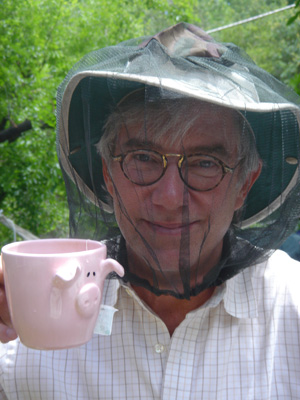
For Father's Day, I got a pig cup and mosquito netting for my hat!

Becoming a father is the best thing I ever did.

Safety Beeper, Noise Pollution

Friday, June 17th, 2005

A few years ago, John Walker moved out of a nice house in Muir Beach because all around him there were construction machines with beepers. You know those beepers, they kick in whenever the machine is in reverse. They're very piercing. I've been beeped all week by a chihuahua of a machine, a little Bobcat that's loading dirt from a neighbor's swimming-pool excavation into dump-trucks.

''

This neighbor has a Hummer, and he washes it on the weekend, taking about an hour, and it would be too quiet and perhaps wimpy to use a hose, so instead he uses a loud, gasoline-powered pump to shoot out a high-pressure stream worthy of his mighty Hornswoggle.

Noise pollution is a modern tragedy. Just as a random for instance, you may notice that these days how airplane flights from the Bay Area to NY are often routed so that the pilot can always say, “You can see Yosemite Park down there,” and everyone is “Oooh.” This means, however, that if you go hiking in Yosemite these days, there is a more-or-less steady stream of planes going by overhead.

''

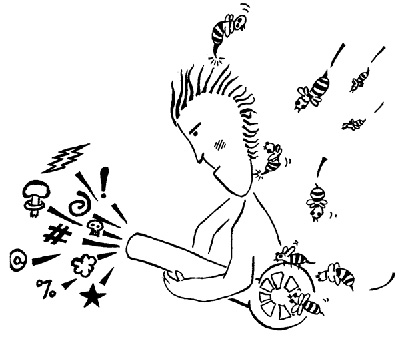
And don't let me get started on leaf-blowers. Oh, well, why not. In Saucer Wisdom I had this idea for noise-attacking bees: Shush Bees. I find the noise begins to drive the rhythms of my thoughts, I begin in effect humming the sound to myself. I find myself waiting, waiting for it to stop. And then another noise polluter helps himself to a piece of the peace-pie. Sometimes I spend a whole Saturday waiting for a moment of calm.

***

''

Up the street is more construction; but a pleasant kind, there's just the irregular and human-scale beat of hammers. The electrican has a nice piece of old-timey clip-art on his sign; these kinds of images always remind me of the hallowed Pamphlet #1 of the Church of the SubGenius which is *wow* viewable in its entirety online, just keep pressing the little forward arrow at the bottom of the page that link takes you to. Or order the dang thing in paper . I'll never forget the impact this pamphlet had on me when I read it in, like, 1983. The world wasn't as noisy back then.

Big Basin, Universal Automatism, Nick Herbert

Thursday, June 16th, 2005

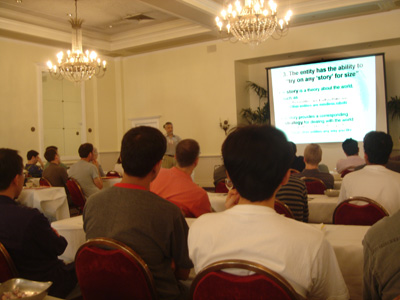
Monday I went to meet my friends Scott Aaronson and Chris Pollett, who were at the IEEE conference on Computational Complexity at a hotel in San Jose.

Gosh I miss academia — not.

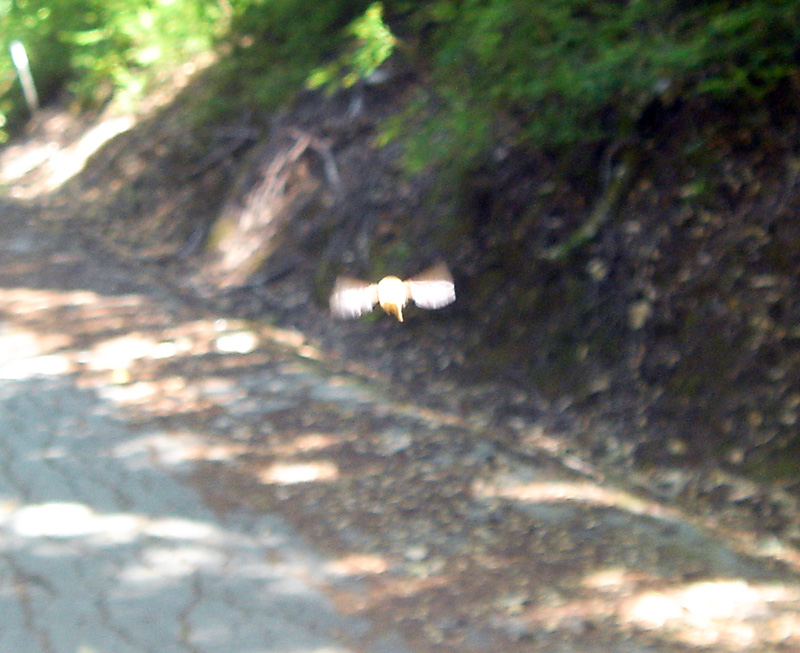
Wednesday I went for a six hour walk in Big Basin park in the Santa Cruz mountains near Boulder Creek. Along the trails were tiny guardian bees.

They hang motionless in the air, each of them defending a few cubic meters of space, and now and then they charge at each other. They’d even charge me, which was cute.

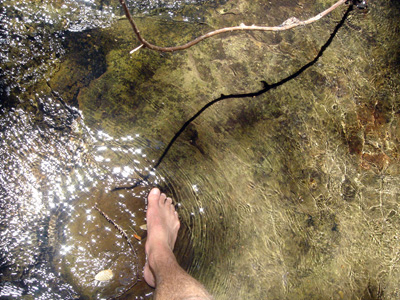
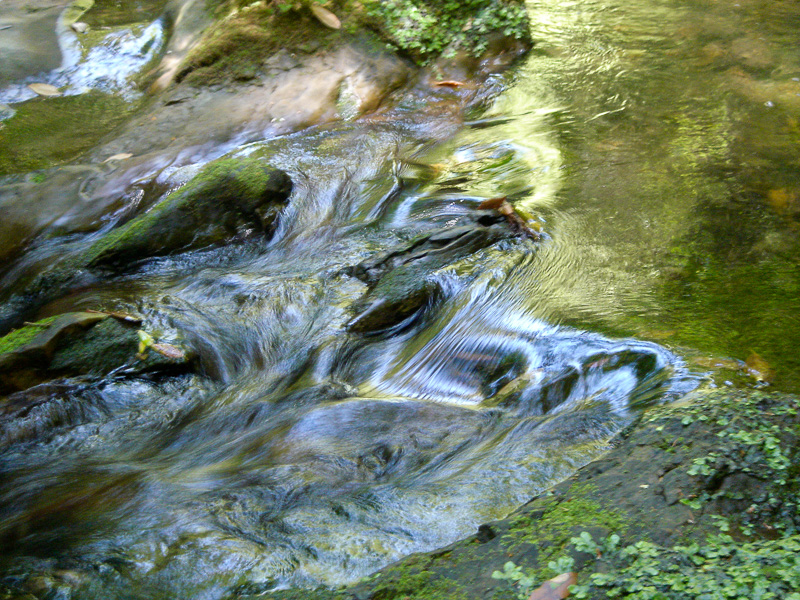
My goal was the Timkins Creek Trail, which is relatively deserted and runs along a nice stream. I found a little stone waterfall and hung out there for an hour.

I love getting my natural-complexity fix. Talk about immersion, there was a newt walking along on the bottom of the stream. That guy’s got it together.

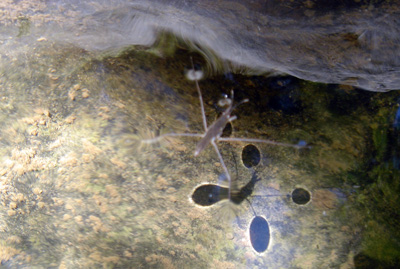
And I love the waterstriders whose hairy feet allow them to skate on the surface. The dimples they make in the surface shed lovely lensed shadows.

Today’s lesson on universal automatism is a 25 Meg movie with my thoughts on the concept, “I seem to be a fluttering leaf.” Click here to view movie. Consider this my off-site presentation for the IEEE Computational Complexity conference 🙂 !

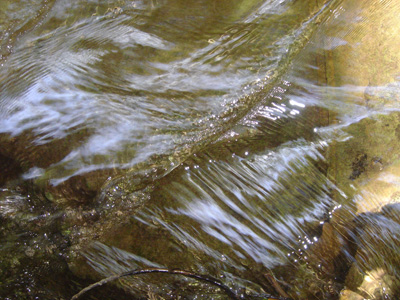
Here’s a particularly nice flow chevron; I have a little 3 Meg movie of this as well(lecture-free). Click here to view movie.

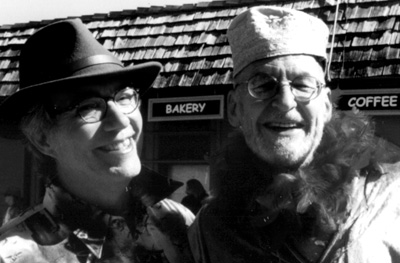
After the woods, I went to visit Nick Herbert. Nick started as a physicist designing hard drives, but these days is more likely to be found holding forth on consciousness. He’s been a big influence on me; he introduced me to Esalen when I first came to California; inspired a character in my short-story about the Mandelbrot Set “As Above, So Below”; inspired the character Frank Shook in my novel Saucer Wisdom; and taught me a lot about quantum mechanics and consciousness. Here’s a picture of Nick and me at an April Fool’s parade in Boulder Creek while I was working on the Lifebox book, like in 2002.

And here’s a quote from a thought-provoking article by Nick called “Quantum Tantra”

“By the high standards of explanation we have come to demand in physics and other sciences, we do not even possess a bad theory of consciousness, let alone a good one.

“Speculations concerning the origin of inner experience in humans and other beings have been few, vague and superficial. They include the notion that mind is an ‘emergent property’ of active neuronal nets, or that mind is the ‘software’ that manages the brain’s unconscious ‘hardware’…

“Half-baked attempts to explain consciousness, such as mind-as-software or mind-as-emergent-property do not take themselves seriously enough to confront the experimental facts, our most intimate data base, namely how mind itself feels from the inside. “

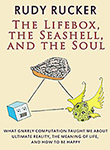
I have a section on this idea in The Lifebox, the Seashell, and the Soul. Quoting from that: Nick proposes that we think of the human mind as a quantum system. Recall that quantum systems are said to change in two ways: when left alone, they undergo a continuous, deterministic transformation though a series of superposed states, but when observed, they undergo abrupt probabilistic transitions into pure, classical states. Nick suggests that we can notice these two kinds of processes in our own minds.

(Coherent) The continuous evolution of quantum superpositions corresponds to the transcendent sensation of being merged with the world, or, putting it less portentously, to the everyday activity of being alert without consciously thinking much of anything. In this mode you aren’t deliberately watching or evaluating your thoughts.

(Decoherent) The abrupt transition from mixed state to pure state can be seen as the act of adopting a specific opinion or plan. Each type of question or measurement of mental state enforces a choice among the question’s own implicit set of possible answers. Even beginning to consider a question initiates a delimiting process.

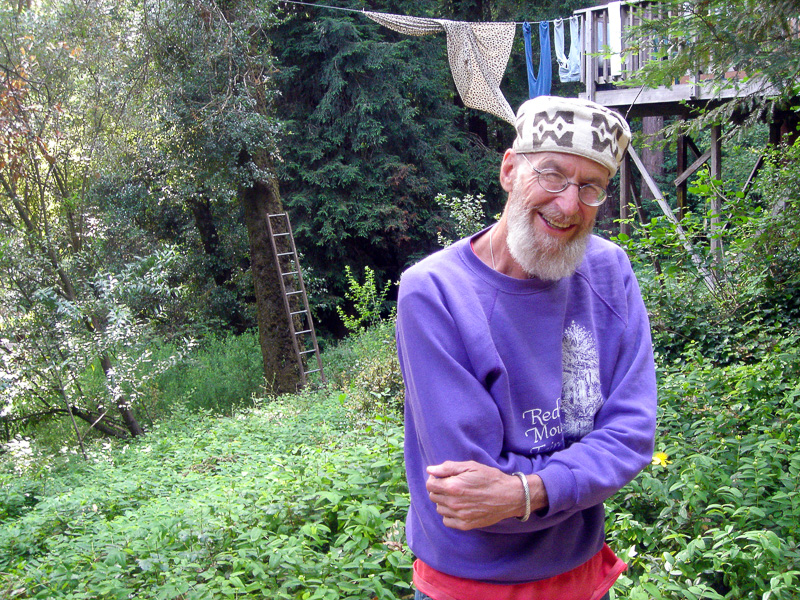
I got a nice picture of Nick yesterday. The wise old hermit. Note the ladder in the background.

David Foster Wallace, Oblivion

Monday, June 13th, 2005

I’ve been reading David Foster Wallace’s book of stories, Oblivion. Amazing, wonderful stuff. He's one of my favorite writers, although I didn’t like his non-fiction book about infinity. (I'm referring to the book “Everything and More” about Georg Cantor, not to the novel Infinite Jest, which I really liked.) Thinking back, “Everything and More” could have been saved if only he'd had better editing and more help with the math. Also the fact that I myself wrote a book on infinity means that I might not be the most objective judge of Wallace's success in this niche. I know well that I'm subject to professional envy and resentments.

[Agitated cow resembling Rudy in a bad mood.]

Nobody can match Wallace for use of different language registers: the vernacular, the clinical, the scientific, the business-speak. As a writer, I can usually see how another writer is achieving their effects, but with Wallace, it's like “How did he do that?” It takes close study to figure it out, but it's hard to stop and do that as you're so swept along by the hypnotic jabber. The page-long sentences. The deep insights.

Wallace does seem to have a problem with ending his stories or novels. He builds up to a frenzy about 3/4 of the way through, and then the piece may just fizzle out. Sometimes this works, the fizzle serves as an appropriate artistic effect, a reminder that life is all of the piece and this piece is just an excavated chunk of the human tundra. Like it worked at the end of his transormative novel Infinite Jest, but sometimes, like in his non-fiction book on infinity, a reader thinks, “Instead of getting so worked up in the middle of the story you should have saved some energy for writing an ending.”

Some critics complain that Wallace is too intelligent. Like that's a pervasive problem to worry about. “Hey, I found this glittery rock and, damn, it's not a rhinestone, it's a diamond!”

Under Wallace's influence that I am today, the rest of this entry will be gnomic.

Wallace doesn’t seem to have an official website, but this Wallace site has a lot of good stuff, including a link to a really interesting essay ‘explaining’ the title story, “Oblivion,” which ends in a very odd and unexpected way (Spoiler warning: don't read the essay before the story. Note also that the 'explanation' could be mistaken, maybe the two people talking at the very end are, say, Hope as a teenager and her father, or even Wallace and his wife, it's all very dream-like and bewildering, and this is a time when the weird ending achieves just the right disorienting and troubling effect.)

[View of Montery Peninsula from Wilder Ranch Park north of Santa Cruz. Objective correlative for “Fata Morgana” image of a vanishing island (or wave) that symbolizes the soul merging into the One.]

One story, “Good Old Neon” is narrated by a guy who killed himself, and has some great philosophizing in it.

“the whole my whole life flashed before me phenomenon at the end is more like being a whitecap on the surface of the ocean, meaning that it’s only at the moment you subside and start sliding back in that you’re really even aware there’s an ocean at all” (p. 152)

[View into baseball stadium in SF. Objective correlative to the “infinitely dense and shifting worlds of stuff inside you every moment of your life.” p. 178.]

Wallace has some intriguing notions about how the dead souls “talk” with each other, the idea being, more or less, that they can communicate a near-endless amount of info at once, like direct telepathic link, or a parallel extremely high-bandwith link (as opposed to the serial bottleneck of spoken or written language) not that he puts it so SFictionally:

“You already know the difference between the size and speed of everything that flashes through you and the tiny inadequate bit of it all you can ever let anywone know. As though inside you is this enormous room full of what seems like everything in the whole universe at one time or another and yet the only parts that get out have to somehow squeeze ou through one of those tiny keyholes you see under the knob in older doors. As if we were all trying to see each other through these tiny keyholes. But it does have a knob, the door can open … you can as they say open the door and be in anyone elses’ room in all your own multiform forms and ideas and facets…” p. 178.

[Seen on a railing behind the baseball stadium in SF. Objective correlative to the experience of death as described by Wallace or to, alternately, a tunnel to La Hampa used to flee the crushing machineries of the Law.]

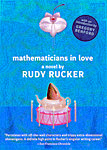
I'm planning a scene for Mathematicians in Love where Bela's band Washer Drop is playing at this stadium, now named Heritiagist Park after the ruling Heritagist party, and Bela is slated for assassination by the Heritagists, for handing out long-lasting bubbles in which you can see the future, giving away the latest high-tech of the PIG. You can't pop these bubbles at all, they just break into two smaller ones, so the stadim steps after the concert are littered with little bubbles showing the scenes that people wanted predictions of. Bela's gonna hampajump off a skateboard ramp to get away, you understand, and jellyfish God will speak to him, and it'll be like … opening a door.

Ffwwwwwwup! Come back and the hitmen are gone. Back to Wallace's Oblivion, if you only read one story, don't miss the last one, “The Suffering Channel,” about a People-magazine-type reporter working on a story about a hick in Indiana who makes sculptures on the order of “The Winged Victory” out of his own poo — without touching it. The sculpting happens within the guy's bowels. All the interns at the magazine are NYC hipster women from elite East Coast colleges. It's devastating and hilarious.


Rudy's Blog is powered by WordPress