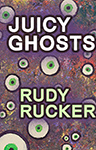
“Juicy Ghost” is a story I couldn’t stop myself from writing. And it seems relevant on this particular 4th of July. You can read this shorter intial version story if you scroll down in this post.
I felt a need to take a stand. Not that I’m urging anyone to follow my character Curtis Winch’s example. But I definitely took satisfaction in crafting his tale.
The writing and revising ran from January to June of 2019, which is a very long time for me to spend on a short story. In April, 2019, I sent my draft to a couple of SF magazines. One editor didn’t feel comfortable with something so topical; another felt the story didn’t win them over.
I turned to the idea of publishing “Juicy Ghost 2019” as a part of a special, all-political issue of my old ezine Flurb. I contacted some of my writer friends. They gave me positive feedback. Marc Laidlaw, John Kessel, John Shirley, Kek-W, Paul Di Filippo, and Brendan Byrne sent fine contributions, and pieces were promised by Eileen Gunn, James Worrad, Christopher Brown, and Cory Doctorow. I’m grateful to them all.
But at the start of June, 2019, I lost heart. Putting together a new Flurb felt like too big a push for me. With embarrassment, and with apologies to my authors, I backed out of the political Flurb.
Even so, I couldn’t stop working on “Juicy Ghost 2019.” I kept at it for the next three weeks, doing rewrite after rewrite. It was like finding my way across a tightrope. By the end of June, 2019, I felt ready to go public.
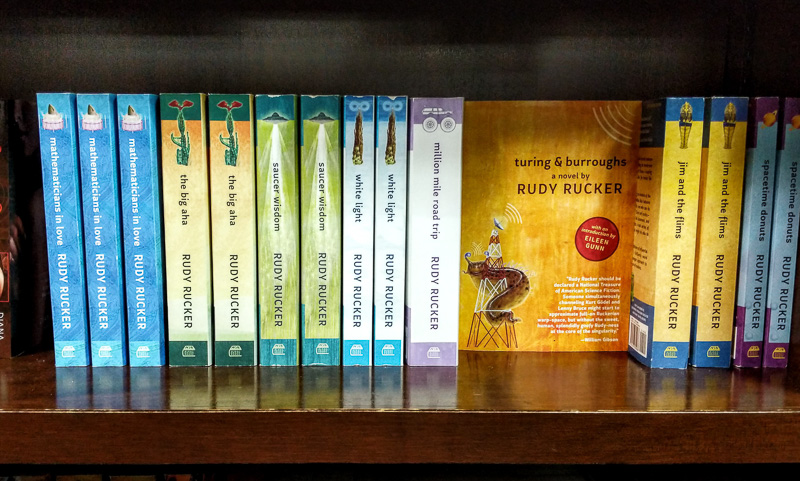
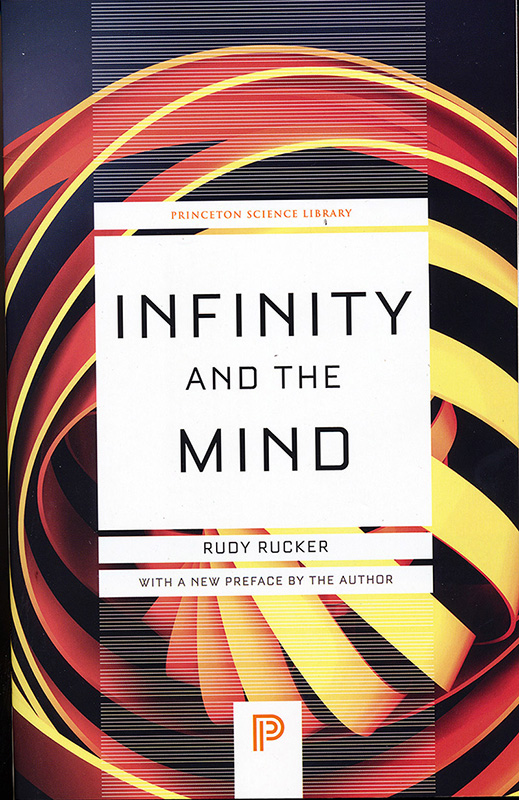
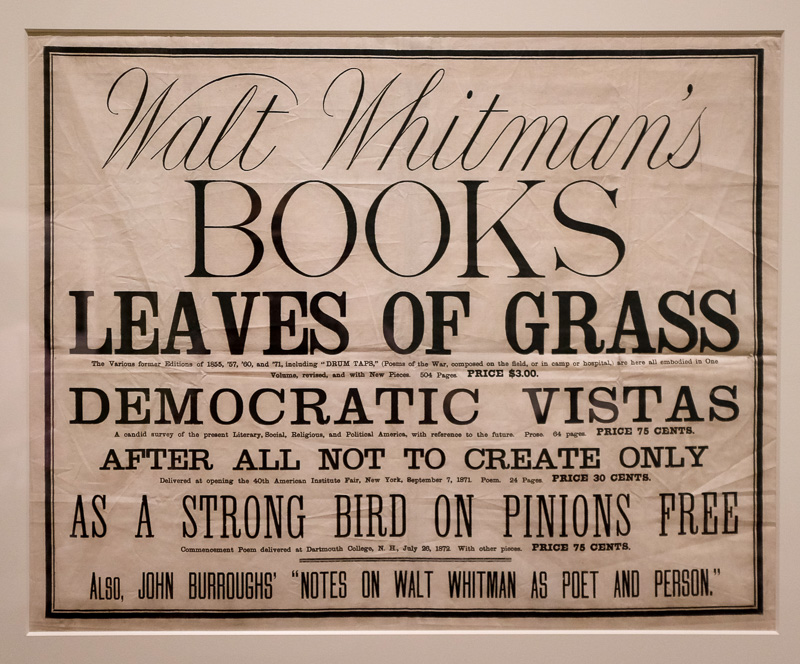
This shorter version “Juicy Ghost” appears in this blog post below, loosely illustrated by whatever photos I had kicking around. You can also read this shorter version of “Juicy Ghost” in issue #13 of the online zine Big Echo.
Or listen to me reading this shorter version as an episode of Rudy Rucker Podcasts.
In September, 2020, with the cataclysmic Presidential election coming on strong, I doubled the length of the story to get a longer version that I also posted on my blog.
And in 2021 I did a Kickstarter campaign to self-publish a full novel version called Juicy Ghosts.
“Juicy Ghost” by Rudy Rucker (2o19 Version)
Copyright © Rudy Rucker 2019.
“A mob of Freals,” says Leeta. “I feel safe. For once.”
She makes a knowing mm-hmm sound, with her gawky mouth pressed shut. She’s not one to think about looks. Lank-haired and fit. A fanatic. I’m a fanatic too. We’re feral freaks, free for real.
Is Leeta my girlfriend? No. I’ve never had a girlfriend or a boyfriend. I don’t get that close to people. My parents and brother and sister died when I was eight. A shoot-out at our house. I don’t talk about it.
It’s nine in the morning on January 20, a cold, blue-sky day in Washington D.C. Inauguration Day for Ross Treadle, that lying sack of shit who’s acting as if he’s been legitimately re-elected. Treadle and his goons have stolen the Presidency for the third time in a row, is what it is.
They outmaneuvered the media, they purged the voter rolls, and supposedly there’s an unswayable block of Treadlers. A stubborn turd in the national punchbowl. Not that I ever see any Treadlers. Admittedly, I live in Oakland, California, not exactly Treadle country, but I personally wonder if the man’s so-called base is a scam, a figment, a fake-news virus within the internet’s chips and wares.
Doesn’t matter now. Treadle’s on his way out. I’m here to assassinate him. And Leeta’s my bodyguard. I’ll die right when I kill Treadle. I’m trying not to care.
I’m Curtis Winch, part of a four-person Freal cell. I’m a gene-tweaker, a bioprogrammer. And we’ve got gung-ho Leeta, our money guy Slammy who might be an agent, and there’s a skinny twitchy web hacker who calls himself Gee Willikers. Gee spends all day with his head in the cloud. He’s crafted me a special device that has my whole personality inside it. Gee calls it a psidot.
We have our base in Oakland, near the port, in a cheap-ass, beige, trashed, 1930s cottage amid pot-grow warehouses and poor people’s squats. I implanted some special eggs in my flesh two weeks ago. Today they’ll hatch out and attack Treadle. And then the Secret Service will gun down my larvae-riddled remains.
Upside: Gee will put a low-end chatbot version of my psidot online as an interactive Paul-Revere-type inspiration. Curtis Winch, martyred hero of the New American Revolution.
“Tell us what it was like to take down Ross Treadle,” the admiring users will say to my memorial chatbot. “And thank you, Curt, thank you!”
Too bad I won’t be around to savor this. From what I’ve seen, dying is like a jump-cut in a movie—except there’s no film on the other side of the jump.
While I’m still alive, I’m continually updating my psidot. The device itself is a wireless antenna and a brainwave transducer. A shiny piezoplastic disk the size of a freckle, on the back of my neck. Like a paste-on beauty mark, except it’s smart and it can crawl around a little bit.
My psidot captures whatever I experience and stores it in the cloud. Works the other way too. My psidot feeds me info. And, better than that, it uses heavy cloud-based processing to munge my data stream, and if I ask, it’ll suggest what I might do next.
Right now the psidot is showing me Gee Willikers. Gee is excited, more than excited. Messianic.
“You’re immortal,” Gee Willikers is telling me. Not that I believe him. They’re shining me on so I’ll do the hit. Gee giggles. He’s not a normal person at all. “With my latest upgrades, you can live inside your psidot, as long as it’s leeched onto a person or an animal or even an insect. As long as you’re leeching, you’re a juicy ghost. My ultimate hack, Curt.” Another giggle. “I’m God.”
“Be quiet, Gee.”
The crowd around the Lincoln Memorial is beyond epic. Bigger than a three-day rock fest with free beer, bigger than a pilgrimage to Mecca, bigger than any protest D.C. has ever seen. More than two million of us.
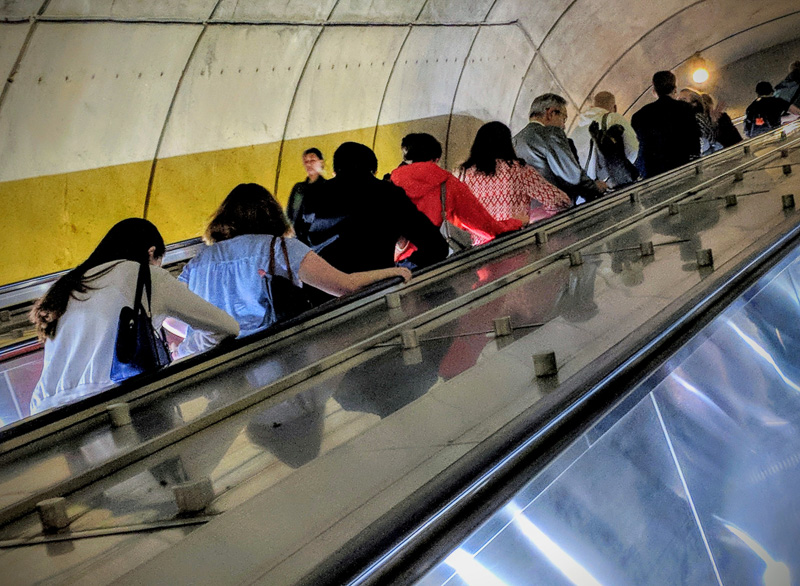
Freals stream in via the Memorial Bridge, down Constitution and Independence Avenues, piling out of the Metro stops, walking in along the side streets and the closed-down highways by the Potomac. Cops and soldiers stand by, but they’re not trying to stop us. They’re working people too. Low-income city folks. By now a lot of them hate Treadle too. Him getting to be President again is like some unacceptable bug in our political system. And the Freals are here to fix it.
Our crowd swirls around stone Abe Lincoln on his stone chair in his stone temple. We mass along the reflecting pool, as far as the Washington Monument—but not yet onto the Mall.
A belt of armed troops blocks us from getting all that close to the Capitol. My psidot is jacked into the media, and it shows me how the Mall is blanketed with actual, for-real Treadlers—deluded, sold out, in thrall to an insane criminal, awaiting the dumbshow of their hero’s noon Inauguration.
What would it take to change their minds?
We Freals are zealous and stoked, filled with end-times fervor and a sense of apocalypse. We’re rarin’ for revolution. Ross Treadle’s opponent Sudah Mareek is standing atop one of Lincoln’s stone toes. She’s shouting and laughing and chanting—wonderfully charismatic. Her voice is balm to my soul, and she’s calming Leeta too. The whole reason we two didn’t go straight to the Capitol steps is because we need to see Sudah get her own Inauguration. The real one.
Sudah Mareek did in fact win the election—both the popular vote, and the House of Electors. But somehow Treadle turned it all around, and his packed Supreme Court took a dive. Treadle says he’ll charge Sudah with treason once he’s sworn in. He says he’ll seek the death penalty.
But the Freals are going to inaugurate Sudah just the same. We have one supporter on the Supreme Court, and she’s here to administer the oath of office. She’s ninety years old, our justice, in her black robe, and she’s brought along Abe Lincoln’s Bible.
We fall silent, drinking it in. The Presidential Oath—short, pure and real. Sudah’s clear voice above the breathless crowd. I’m absorbed in my sensations, The trees against the sky, the cold air in my lungs, the pain in my flesh, the scents of the bodies around me. We’re real. This isn’t a play. It’s the Inauguration of the next President of the United States.
For a moment the knot of fear in my chest is gone. This is going to work. Our country’s going to be free. We cheer ourselves hoarse.
But hatch time is near. Leeta and I need to haul ass to the Capitol steps so I’ll be close enough to terminate Treadle. And everyone else wants to head that way too. The crowd rolls towards the Mall like lava. But there’s the matter of those armed troops at the Washington Monument. They’re in tight formation.
“Let’s skirt around them,” I suggest to Leeta.
The side streets are blocked by troops as well. We’re like a school of fish swimming into a net, which is the U-shaped cordon of soldiers. They have batons, shock-sticks, water-cannons, tear-gas, and rifles with bayonets. Behind them are trucks, armored Humvees, and even some tanks.
At this point, Leeta and I are near the troops along the right edge of the crowd. Armed men and women, all colors. Leeta begins pitching our case.
“Sudah Mareek is our President,” she calls, sweetening her voice. “We just inaugurated her. Did you hear the cheers?”
“Move along,” mutters a woman soldier, not meeting our eyes.
“We’re your friends,” I put in. “Not Treadle. He’s ripping you off. He hates us all.”
Behind me the crowd of Freals is chanting. “We’re you. You’re us. Be free.”
“Be Freal,” echoes Leeta, reaching out to touch the woman soldier’s shoulder. “Put down the gun.”
“Let’s do it,” says the soldier at her side, He throws his bayonet-tipped rifle to the earth. “Yeah. That gun’s too heavy.”
The woman does the same, and so does the guy next to her, and the woman next to him drops her gun too—it’s like a zipper coming undone. A whole row of the soldiers is defecting. Going renegade. Treadle will call us traitors.
A few soldiers stand firm. They spray water cannons, which knocks down Freals and muddies the ground. A handful of teargas shells explode. Some hotheads fire their rifles into the air. But the flurry damps down.
The soldiers aren’t into it. They don’t want to kill us. We’re people like them. This stage of the revolution is a gimmie. Hundreds of thousands of us chant as one.
“We’re you. You’re us. Be free.”
The soldiers whoop and laugh. Grab-assing like they’re off-duty. Some Freals try and the tip over a tank, but it’s too heavy. One of soldiers, some wild hillbilly from Kentucky, he breaks out a crate of magnesium flares. He and his buddies go around prying open the caps on the gas-tanks and shoving in flares. Low thuds as the gas-tanks explode, one after the other. The rising plumes of smoke are totems of freedom.
We cheer our incoming President. “Sudah. Sudah. Sudah. Sudah.”
A pyramid of Freals holds the small woman high in the air. She’s waving and smiling. She’s the one who won. She’s ours. In my head, my psidot shows me the news commentators going ape. Treadle’s faked election, political U-turn, people’s revolution, President Mareek.
Treadles’ strategists strike back. Two banana-shaped gunship choppers converge on the Washington Monument, circling like vengeful furies. Men with massive machineguns stand in the big doors. They lay down withering fusillades, shooting at will into our crowd.
The gunships are painted with Treadle’s personalized Presidential seal. The pilots and crews are from the chief’s palace guard. Dead-enders. Pardoned from death row, recruited from the narco gangs, imported from the Russian mafia.
People are dying on every side. It’s insane. Next to me a man’s head explodes like a pumpkin. Am I next?
“Asymmetric attack on unarmed demonstrators,” mutters Leeta. “Stop screaming. Curt. Use your psidot.”
Good idea. My psidot is overlaying my visual field with images of the bullets’ paths. A hard rain. Simultaneously, the psidot is computing our safest way forward, showing me a glowing, shifting path on the ground. I take Leeta’s hand and lead her.
We come to a cluster of renegade soldiers who’ve salvaged a rocket bazooka from a charred tank. A dark, intent sergeant raises the tube to her shoulder.
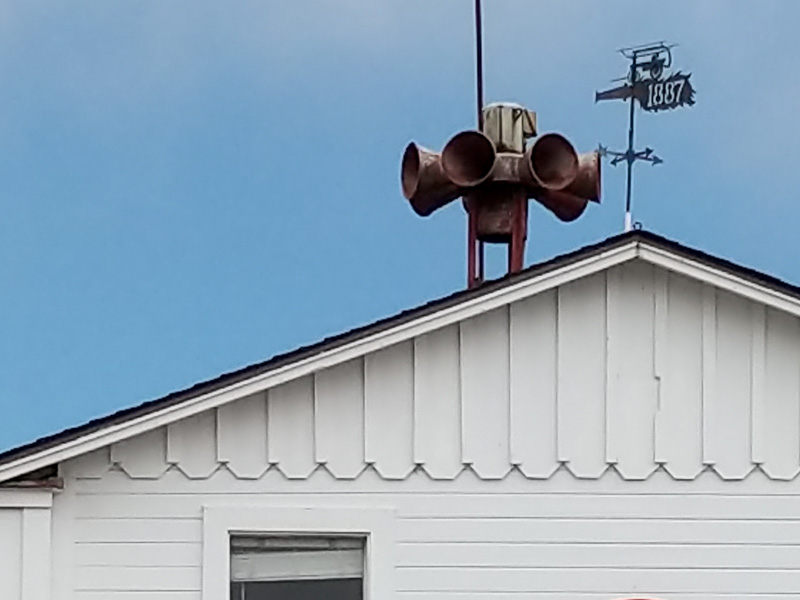
My psidot brings the nearest chopper’s path into focus. I see the dirty bird’s past trajectory as an orange tangle. And I’m seeing its dotted-line future path too. As usual my psidot is using cloud crunch to estimate what’s next.
“There,” I advise the woman soldier, pointing. “Aim there.”
Whoosh!
And, hell yeah, our canny missile twists through the air like live thing, homing in on Treadle’s hired killers.
Fa-tooom!
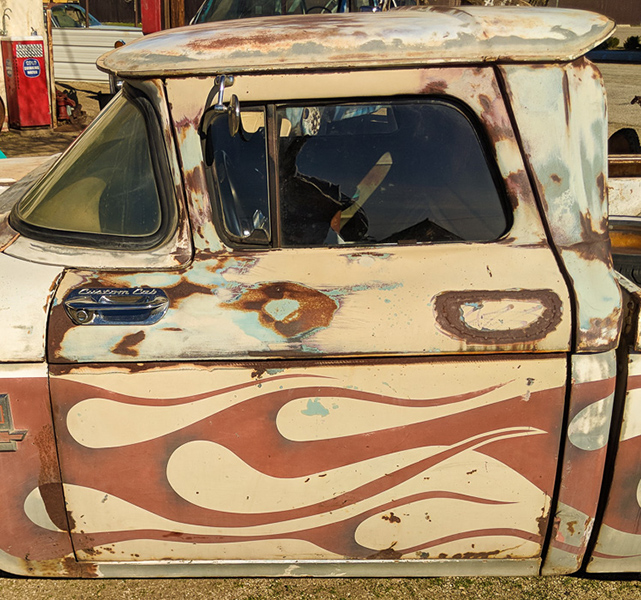
The chopper explodes like a bomb. Shards of of metal pinwheel as if from an airborne grenade. The blazing craft hits the ground with a broken thud I can feel in my feet. The second chopper flees, racketing into a wide loop above the Potomac.
“That there was my vote!” whoops the rocketeer woman, pumping the bazooka in the air. “For President Sudah!”
I feel high. Seeing that chopper go down is like winning a round in a videogame. But this game has a ticking clock. My parasites twist in my flesh, ever closer to my skin. I need to be at the other end of the Mall when Treadle mounts his rostrum.
The blockade of troops has thinned, and many of the Freals fled back toward the river. Those who remain are tending to the casualties on the ground—the gravely wounded amid the dead. Fire trucks and wailing ambulances arrive.
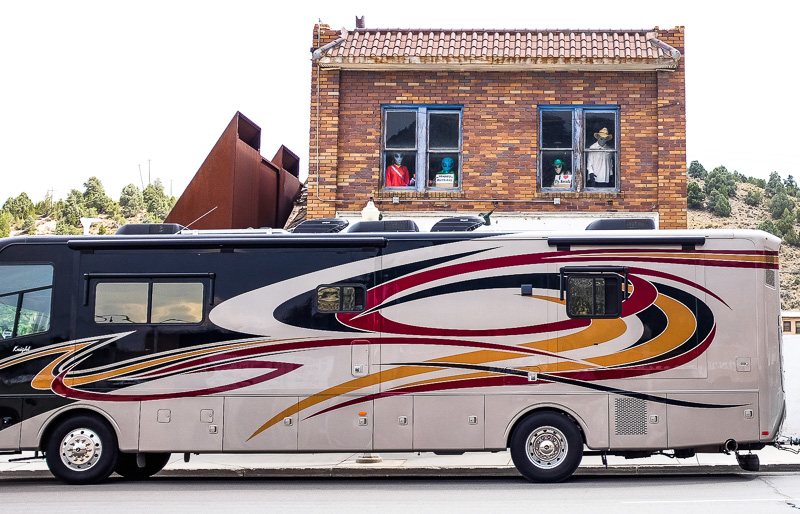
Leeta and I hurry on and filter through the Treadle base. They’re striving to maintain an air of festivity—even after the rush of Freals, the troops’ desertions, the massacre, and the downing of the chopper—even now. Bundled against the cold, they’ve laid out their sadly celebratory picnics. Doing their best to ignore the bitter, embattled Freals, they wave their Treadle signs, and draw their little groups into tighter knots.
Leeta’s good at crowds. She eels forward through the human mass, finding the seams, working her way up the Mall. I follow in her wake. Soon we’re within thirty yards of the the Capitol steps. The dignitaries are still there. The charade is still on. I feel that the Secret Service agents are watching me. Treadle is about to appear.
“I bet dying is easier than you expect,” Leeta whispers to me. Her idea of encouragement.
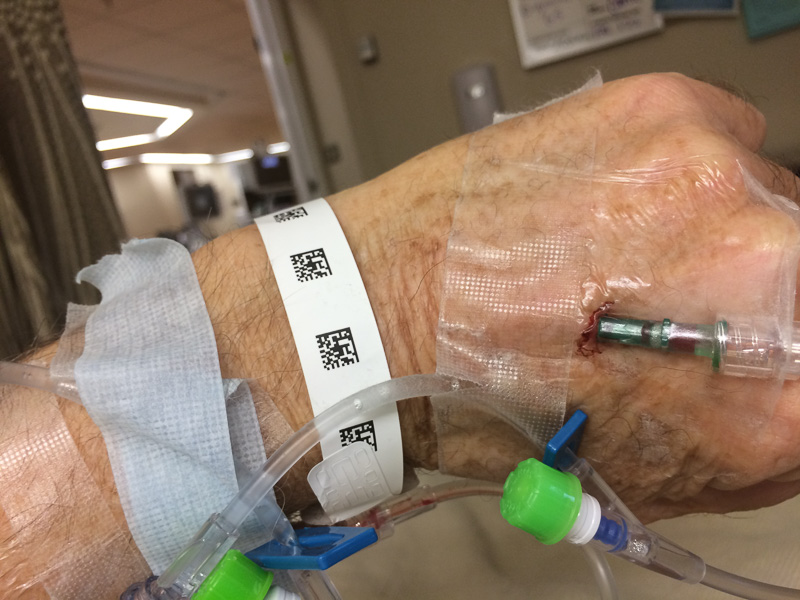
A wave of dizziness passes over me. As if I’m seeing the world through thick glass. Those things in my flesh—they’re leaking chemicals into my system. Steroids, deliriants, psychotomimetics.
“What are we doing?” I moan. “Why?”
“You’ll be a hero,” Leeta murmurs, iron in her voice. “Be glad.” She leans even closer, her whisper is thunderous in my ear. “The Secret Security knows. Mm-hmm.” She nods as if we’re discussing personal gossip. Her bony forehead bumps mine. “They hate Treadle too. It’s all set. They’re actually paying us. Slammy set it up.”
“And I’m your patsy? The fall guy? What if I change my mind?”
“Don’t fuss,” says Leeta. She rolls her eyes toward the strangers pressed around us. To make it all the creepier, she’s wearing a prim, plastered-on smile. Her voice is very low. “Be a good boy or they’ll shoot you early. And then Treadle lives. We can’t have that, hmm?”
My psidot is jabbering advice that I can’t understand. Mad, skinny Gee Willikers is in my head too. As usual he’s unable to say three sentences without bursting into giggles. I hate him and I hate Leeta and I hate my psidot.
Fresh insect hormones rush through me. My disorientation grows. They critters inside me are splitting out of their pupas and preparing to take wing. Sixteen of them.

Treadle takes his oath. It’s like, “Ha ha, I’m President again, so fuck you.” And then he’s into his Inauguration speech, in full throat, hitting his stride, spewing lies and fear and hate.
“Well?” nudges Leeta.
“It is a far, far better thing I do than I have ever done,” I intone, quoting Dickens. I know I’m going to kill Treadle, but I’m trying to rise above the seamy details of our conspiracy. “It is a far, far better rest I go to than I have ever known.”
“You got that right.”
Weird how my whole life has led up to this point. “There’s this thing about time,” I tell Leeta. “You think something will never happen. And then it happens. And then it’s over.” I pause and peek inside my shirt. Bumps and welts shift beneath my skin.
“Trigger then now!” hisses Leeta.
“Whoa!” interrupts a Treadler at my side. A mild-eyed old man with his leathery, white-haired wife. He’s staring at a wriggly lump on my neck. “Are you okay? Do you need help?”
“Allergy,” I wheeze. “Overexcited. It’ll work out pretty—”
I’m interrupted by a shrieking clatter. It’s that second chopper, attacking the Freals and renegades and EMTs who are helping the fallen around the Washington Monument. We all turn and stare as the whirlybird stitches gunfire into the ragged band.
“Done at my command,” intones Treadle, raising his heavy arm to point. “I keep my promises.” He juts his chin. “We’re gunning for Sudah Mareek. A traitor. She meets justice today.”
Hoarse, savage cheering from the Treadlers. Terrible to see Americans act this ugly. They’re mirroring Treadle. I have to kill him. But, wait, wait, wait, I want to see how the scene at the Monument plays out.
The cheering dims—and I hear what I’m hoping for.
Whoosh!
Yes. The rebel soldiers have launched another rocket.
Fa-tooom!
The blasted second chopper corkscrews along a weirdly purposeful arc. Like it’s remotely controlled. The hulk smashes against a face of the Washington Monument. My psidot feeds me close-up images.
“Bonus points,” goes Gee Willikers in my head. He giggles. Sick gamer that he is. “Part of the plot,” he continues. “We pin this on Treadle.”
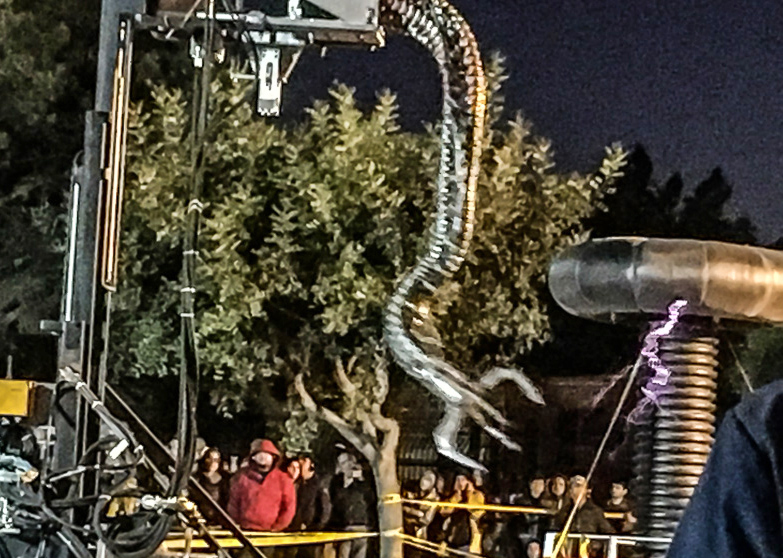
Gee hacked into the falling chopper’s controls? Wheels within wheels. The plot is a web around me. It’s time to act but—I can’t stop watching.
Cracks branch across the great obelisk’s surface, running and forking. Bits of marble skitter down the pitiless slope. The Monument’s tip sways, vast and slow. People are scattering. The upper part of the great plinth moves irrevocably out of plumb. It tilts and gains speed, the bottom slow, the top fast, as in an optical illusion.
The impact is a long explosion—followed by thin, high screams. A veil of dust. A beat of silence. I feel sick with guilt. And weary of being human.
Leeta is screaming into my face. “Do your job, god damn you! Now!”
“Get Treadle,” I finally say. The trigger phrase. I don’t say it very loud, but it’s loud enough to matter.
Within my flesh, the hymenoptera hear. Ragged slits open on my neck, my chest, my my belly, my arms. The pain is off the scale. I shed my coat and my shirt. The bloody, freshly-fledged, bio-tweaked wasps emerge. All sixteen them.
For a moment they balance on their dainty, multijointed legs, hastily preening their antennae, unkinking their iridescent wings. They have handsome, curved abdomens like motorcycle gas-tanks. They feature prominent stingers and bejeweled, zillion-lensed eyes. They’re large, and preternaturally alert.
Leeta slithers off through the crowd. The cuts in my flesh pump bright blood. The Treadlers around me point and shout. The wasps race up my torso, across my face, and onto the crown of my head—a wobbly mob. They rise in flight.
My job is done.
Or maybe not. Gee Willikers is hollering inside my head. “Your psidot! Put it on a wasp!” I can see an image of my psidot on the back of my neck. And I note a single laggard wasp on my shoulder. My mind projects a target spot onto the wasp’s wing.
Though faint from loss of blood, I manage to get the psidot off the back of my neck. It’s easy. The smart, piezoplastic psidot hops onto the tip of my finger. And when I bring my hand near the wing of the target wasp, the psidot springs into place.
The wasp is pissed off. She stings my finger. Numbness flows up my arm and toward my heart. The wasp venom contains curare, you understand, plus conotoxin. A custom cocktail for Treadle.
My vision is dark. I’m an empty husk, a ruptured piñata—poisoned and bleeding. And if all this wasn’t bad enough, there’s the matter of the Secret Service. They’re good shots. Yes, they might want Treadle out, but right now they’ve got to do their thing. For the sake of appearances. For an orderly transition. I go down in a hail of bullets. It fits.
Last thought? I hope the wasps will sting Treadle. And then I’m dead.
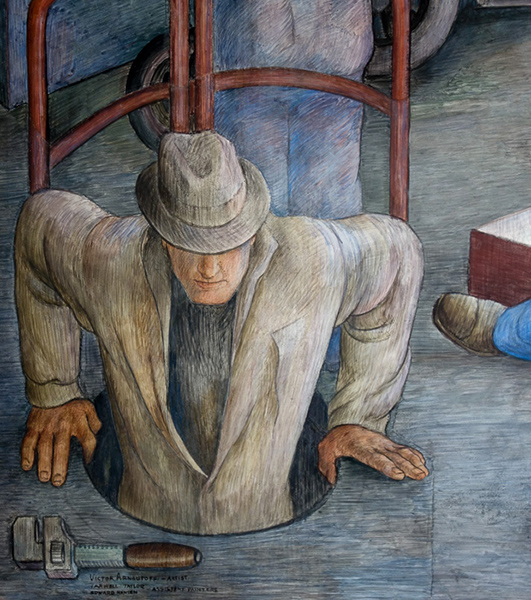
At this point my narrative has a glitch. Remember the jump-cut thing I was talking about? Well, it turns out that, for me, there is some film on the other side of the jump. Granted, the all-meat Curt Winch is terminally inoperative. But—
I wake, confused. I look down into myself. I’ve got my same old white-light soul. My sense of me watching me watching the world. I’m hallucinating a little bit. I feel like I’m in a huge, crumbling old Vic mansion with junk in the rooms, and with paintings leaning on the walls, and doors that don’t properly close. The furniture of my mind. Somebody’s in here with me. A jittery silhouette against the light. Gee Willikers.
“You’re a juicy ghost, Curt! A Gee Willikers psidot. Play it right, and you keep going for centuries” His compulsive giggle. “Def cool, Mr. Guinea Pig.”
I try to form words. “Where…”
“Your psidot is a parasite, dude. Like I’ve been telling you. It hitches onto a bio host’s nervous system. Gloms onto the axons and retarded potentials. Sponges mysto quantum steam and all that other good shit.”
“Host?”
“You’re riding a wasp, der. The one you stuck the psidot on, doink.” Gee makes a trumpeting sound. “Juicy ghost!”
“You were wrong to topple the Monument,” I tell him. No response. What now?

The junked, phantasmal mansion around me—that’s my operating system and my data base. In the cloud. I look for a way to hook into my host wasp’s nervous system. Deep into this as I am, I want to be part of the final attack.
“Over there,” goes Gee. “See the smelly rope? Like a tasseled curtain-pull in a Gold Rush saloon? All thick and twisted and dank?”
I fixate on it and, just like that, I’ve jacked myself into the wasp’s nervous system. I’m seeing through her eyes. I am the wasp.
I join the swarm. They’re eddying around Treadle. He’s bellowing, dancing around, slapping himself. He’s fighting for his life. He has foam on his lips like a rabid dog. My fellow wasps are landing on his face, his fat neck, his wattles. But Treadle is swatting them before they sting. He’s killed eight.
His roars are taking on a tone of triumph. I can’t let him win. His shirt is untucked. A button is loose. I spy a patch of skin.
I arrow into the opening, and land on the man’s bare chest, very near his heart. I sting—I sting, sting, sting. His voice changes, as if his tongue is turning stiff. His volume fades. He’s wobbly on his pins. He totters backwards. Falls. A groan. Silence.
It’s done.
With trembling wings, I escape Treadle’s shirt and spiral high into the air. Hovering with the seven other wasps, a hundred feet up.
The Freals and soldiers are leading Sudah Mareek forward through the discombobulated crowd. She’s going to be President. Everyone knows it. In the whiplash intensity of the moment, the Treadlers convert to Sudah’s cause. Sobs turn to hysterical cheers.
Mounting the dias, Sudah swears the oath again. The massed politicians applaud. Treadle’s proposed Vice-President has lost his nerve. He’s bowing out. Sudah’s Vice-President emerges from the Capitol, just in time. They swear her in. Our coup is more organized than I knew. I was in the dark.
Gee Willikers is ecstatic. “Secret Service on our side, dude. Army on board. Congress is down with it. Done deal.”
I feel a shifting sensation. A doubleness of vision. A group of Freals is carrying my bloody, broken form up the Capitol steps. They hold my remains high, heedless of the dripping gore. Wave after wave of applause. Sudah Mareek and her Veep salute my remains.
“Curtis Winch, martyred saint of the New American Revolution!”
“Do I have to keep being a wasp?” I ask Gee.
“Glue your psidot wherever you want,” he says.
“Another host?”
“How about somebody in this crowd,” suggests Gee. “That Treadler babe in the trucker hat?”
“Idiot. Can you get the fuck out of my head?”
“Sure,” says Gee.
“Oh, and don’t forget to post the toy chatbot version of me for the Curtis Winch memorial.”
“Online now,” Gee assures me. “Slightly redacted. Your memorial’s up to twenty million hits. Viral flash mob, Curt. User tsunami.”
“And obfuscate the living shit out of this psidot I’m living on, okay? Hide the links. I want to go dark.”
“To hear is to obey, Saint Curt. I’ll run you a global SHA-512 scramble.” Gee makes a wiggly hand gesture—and he’s gone.
Beating my wings, I leave the swarm and buzz on beyond the Capitol. On my own, feeling good, savoring the quantum soul of my insect host.
My compound eyes watch for hungry birds, but there’s none around. I make my way into the residential neighborhood northeast of the Capitol. I fly until it shades from gentrified to tumbledown. I spy a mutt on a cushion on a back porch. A collie-beagle mix. Yes.
Gently, gently I land on the side of the sleeping dog’s head. I preen my wings, detach my psidot with my mandibles, and nestle it onto a bare patch of skin deep inside the dog’s floppy ear. The dot takes hold—and I’m in.
I stand, shake my body, and bark.
Joyful. Free.
In closing, let me repeat that, although Curtis Winch’s tale is a rousing fantasia, voting out our oppressors is a far better path for change. And if we can’t vote them out immediately, we’ll wait them out, keeping our ideals alive, and making our presence felt. History is on our side.