Click covers for info. Copyright (C) Rudy Rucker 2021.


Archive for the ‘Rudy’s Blog’ Category

Back Country Skiing in Hope Valley; Natural Highs.

Wednesday, January 25th, 2006

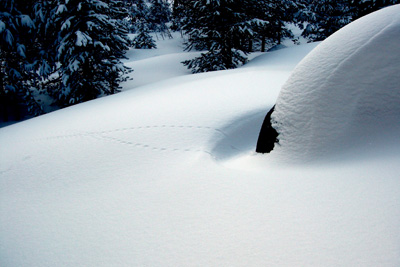
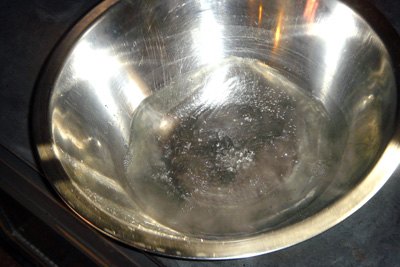
My wife and I spent a week in a cute log cabin at Sorenson’s Resort in Hope Valley in Alpine County, CA, altitude 7,000 feet, about twenty miles south of Lake Tahoe, near Carson Pass. There was a big snow storm the night we came up, very dramatic, very hard to drive, the windshield freezing over. The cabin has a wood stove that we have fun stoking. Once we put a bowl of water on the stove to boil, and it started dancing in a hexagonal oscillation.
We went out to play in the snow every day; I rented some back-country-style cross-country skis — they have metal edges that make it easier to negotiate turns, although I still tend to fall down when I get going too fast and feel that I’m losing control. Mostly I’m slogging uphill anyway. Seems like the Gravity God pays back less than s/he takes in.
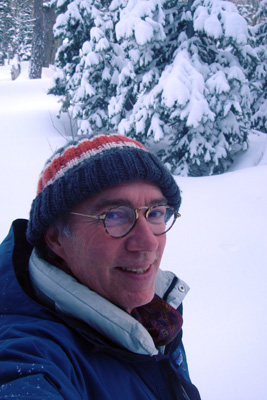
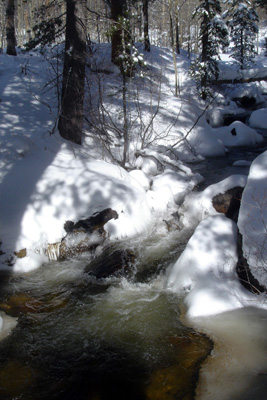
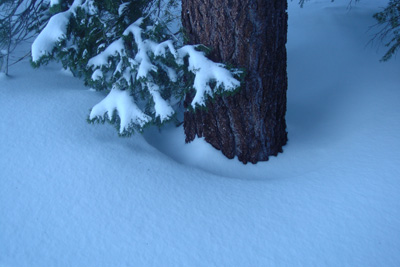
I relish the peace of the woods, the intensely blue sky, the thin, icy air, the deep breathing and steady muscular work, the solitude, the low-level problem-solving of routing, the views of the white Sierra peaks, the boulders capped with snow, the reddish-barked pines with icicles dangling from their branch-tips.
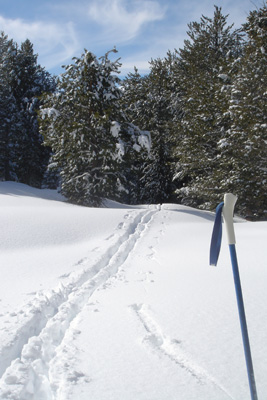
I like it best when I’m in virgin snow, cutting my own trail — a nice physical metaphor for how I conduct my intellectual life. On my fourth day of skiing, I angled up some the very deeply besnowed western slopes of the Sierras above Red Lake near Carson Pass. Exquisite.
And at the same time I had the customary nosegay of small worries in the back of my mind and I was thinking, “Too bad I can’t be fully single-pointed and mindful about soaking up these quite exceptionally beautiful surroundings; too bad I waste energy running tape loops of the usual concerns.” The snow slope angled down at nearly forty-five degrees to my left, with lone piñon pines projecting here and there, the slanting snow horizon cutting nicely across the field of view, with a range of whipped-cream peaks beyond, and the sun blazing down from the absolutely clear high-altitude sky.
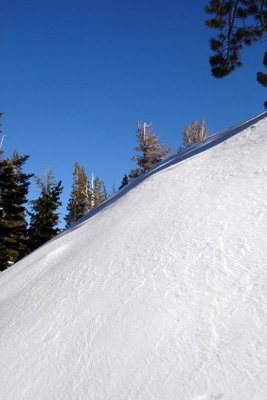
And then I was thinking, “My usual petty concerns are part of me, better to accept them than to bemoan them, as worrying about imperfection only adds an additional worry, let the worries play, but don’t care about them too much, they’re part of you, like the bark on the trees.” And then for awhile I’d forget myself in the physical effort, in the breath, in the beauty, also remembering to think, from time to time, “Thank you, God,” prayer always being a sure-fire way to amplify a natural high — I once heard an intelligent though rough-spoken biker talking about how to get the most of one's occasional drug-free pleasure rushes: “And if you start saying, ‘Thank you, God,’ that’s a good way to milk the rush a little more, stretch it out another few seconds.” I love that practical, canny, addict way of looking at transcendence. Milk it for all it’s worth.
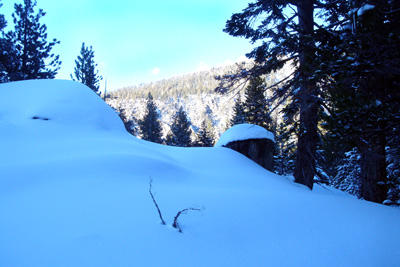
Coming back down from what must have been 8,500 feet, I had a couple of long rides across pristine snow fields. With these latest-generation back-country skis, I’m staying up longer than ever before. Ripping through the deep powder, ah. I felt like a knife cutting through whipped cream, like a joyous gnat glutting himself upon an ice-cream sundae. I was way past worrying about anything now, the natural beauty and the exercise-endorphins doing their thing. I even did a face-plant into the snow when my tips dug into the deep snow crossing a buried brook, my face literally the first part of my body hitting the powder. I didn’t mind. I was glad I hadn’t hurt myself. I was glad I knew how to get up outta the whipped cream.
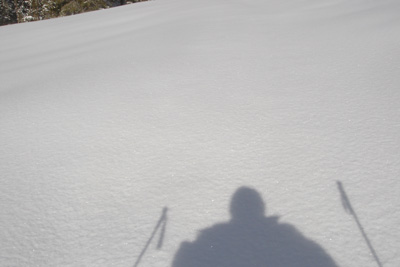
Another day I wanted to ascend the steep Indian Head trail right behind our cabin. I asked the ski rental woman to give me some skis that are very good at climbing but as it happened, she gave me skis that were very poor at climbing, and I was slipping back on nearly every step of the 2,000 foot ascent, even when doing herringbone. These skis were shorter, so that I’d have an easier time carving turns on the descent, but they had a very short and feeble “fish scale” pattern embossed on the bottoms. IMHO, Fischer brand back country skis suck; the Rossignols I tried were much nicer.
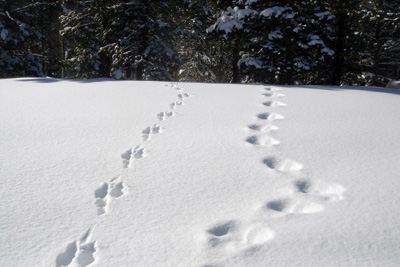
So I spent a lot of the climb grumbling to myself about the skis. Lord, it was exhausting. After the top things got better. I found a bare rock I could do yoga on, and did that for about half an hour, squeezing all the pain and tension out of my sobbing back and leg muscles. What pleasure. As I worked on my body and breath, my mind emptied out and I could really savor my surroundings, the single huge gray snow-capped boulder beside me with the pointed trunk of a dead piñon pine sticking up from it, Abbot and Costello, yin and yang.
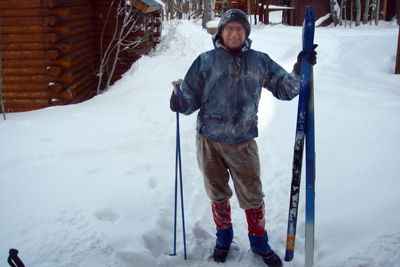
The descent was fantastic. The trail I’d come up was a snowshoe trail, quite icy and narrow, and, seeing a lovely whipped-cream slope to the side, I said, “F*ck the trail,” and went down the mountain direct. The shortness of the skis really helped here; I was making turns like crazy, and hardly falling down at all. The skis didn’t quite float like they did up at Red Lake, but it was good. Especially exciting to be threading my way through trees, bushes, rocks — really a rather dense hillside forest. Periodically I’d recross the switchbacks of the snowshoe trail I’d ascended and, over and over, I’d ditch the trail and take another short-cut; some of them excitingly steep and hairy.
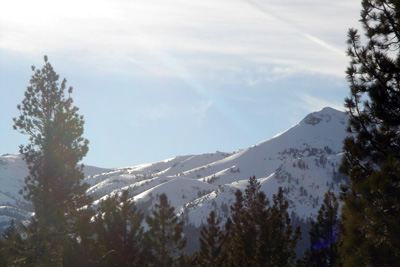
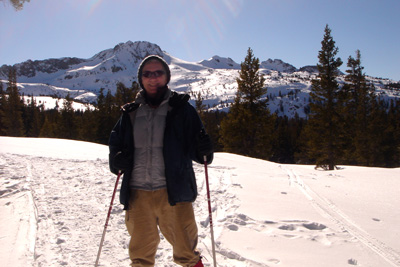
I feel fortunate not to have racked myself up in these six days of winter fun. Today, our last here, I did some snowshoeing with my wife.

We were up on the Winnemuca trail at Carson Pass, starting at 8,500 feet and mostly horizontal. The landscape seemed cartoon-like; all the shapes were smooth mounds of snow. The trees of course weren’t simple; they were gorgeous pines. We came to a meadow looking out at a range of whpped-cream mountains, like the picture you see on the top of a box of Swiss chocolates.
It was a real vacation.


High IQ. Kiqqies.

Monday, January 16th, 2006

The other day we went to downtown San Jose and it was so boring there. Poor old San Jose. No matter what improvements the city tries, you can look down two, three, four blocks of sidewalk ahead and see nobody on it whatsoever.

I decided fuhgeddaboutit being a loyal San Jose booster and featuring it in my Postsingular novel. I was gonna set it in SJ, but, come on, I’m changing it to be in San Francisco where there’s some action.

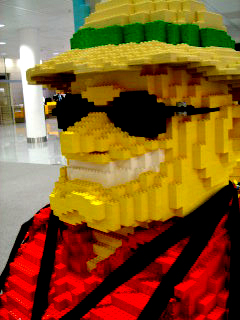
[Sculpture in SJ Museum by someone living in Los Gatos.]

I read an article in the New Yorker about some kid in, like, Nebraska. His parents fell into the orbit of a “gifted children” counsellor (whom the article seems to depict as something of a con-woman) who told them their son had an IQ of 182 — although apparently the numbers don’t mean much when you get past 170.

And the parents flipped out over that number, and didn’t let him go to school with other kids, feeling it would be too “slow” for him, as if school were about learning facts instead of being about socialization and getting the hell out from under your parents’ eyes. And the poor kid got depressed and killed himself. Not that the suicide is necessarily the parents fault; it might well have happened no matter what they did. Brain chemistry gone awry. A sad story.

The relevance for my novel is that the article quotes some people nattering on about how very strange and different it is to have an unusually high IQ.

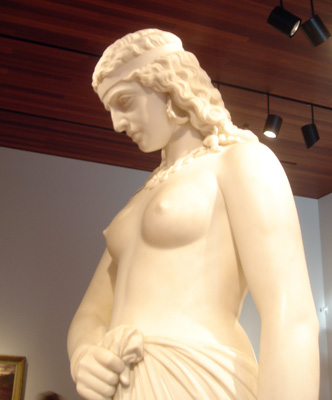
[Sculpture of “Dalilah” [sic] in the new SF De Young museum.]

My programmer friend John Walker suggests that IQ might more likely be proportional to the log of one’s brute processing power rather than being a linear function of it. So a thousandfold increase in processor power would make you only three times as smart.

That sounds right; just think of a desktop machines. A gigaflop machine isn’t a thousand times as good as a megaflop, it’s more like three times as good. So it would take a hundred-thousand-fold increase in brain power to get to five times as high an IQ, that is, to jump from a high end of IQ 200 to a high end of a thousand.

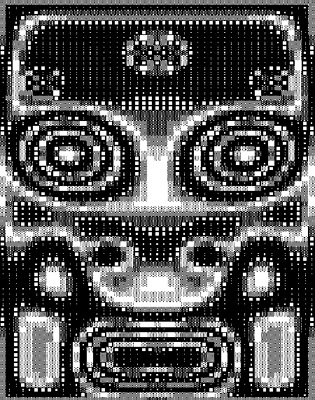
[Toon-like 20th C African mask in the new SF De Young museum.]

I’ll call the kiloIQ people “kiqqies”. I love the word kiqqie, it’s “kiddie” with some letters upside down. The kiqqie kiddies. Wow, Mom.

In my novel, I peg an individual human at the exa or 10^18 flop-and-byte level and the entire orphidnet at the ubba or 10^36 level. If IQ goes up as the log of the flop-and-byte, that’s an eighteen-fold amplification of normal IQ, which turns the usual IQ range of 100 to 200 into a range of 1800 to 3600. Two or three thousand for the IQ, in other words.

[Mexican ceramic of chihuahas mating, dated 300 BC to 300 AD in the SF De Young museum. Mexicans and chihuahuas go way back! I gotta put a chihuahua in my book to hang out with the Big Pig posse.]

So the beezies and the fully netted-in people are at the kiqqie level, and the Big Pig is just a few notches higher. I guess that makes sense. When I go to a guru, I’m wanting to see a guy only a few notches higher than me. Unless you're already a kiqqie, the Big Pig gonna seem too starkly incomprehensible.

[More two-thousand-year-old chihuahas. Such marvelous intelligence shows in this work. We imagine we've advanced so much in 2000 years, but really so little has changed.]

I need to put some effort into codifying what it is that makes a high IQ person different from others, so that I can do some analogies to push out to imagine life for the superintelligent AI beezies or for the enhanced humans plugged into the orphidnet.

This is a topic that people totally want to read about. An itchy fascination with what it is you might be missing. Lifestyles of the Rich and Famous. Mindscapes of the Kiqqies.

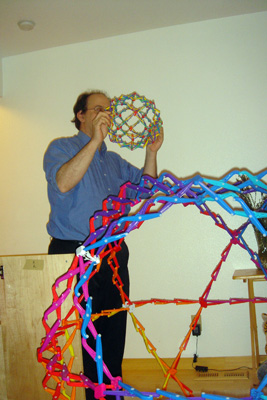
[My fellow mathemagician Nathaniel Hellerstein at home with his daughter’s toys.]

Certainly having serenity and feeling content has nothing to do with high IQ. Serenity is all about valving down the logical machinations and the memory accesses. So that baseline feeling will be the same even for the kiloIQ and megaIQ people. Just sensing your breath.

Yet, part of the meditative slack feeling is being open to inputs from all over the body or all the senses. And this would be richer for the kiqqies

Parallel trains of thought and extra associations would be kiqqie. Extra branches in the thought tree. Anticipating ideas. Modeling behaviors. Drawing conclusions.

A Visit to the Mirrorbrane (in Santa Cruz)

Wednesday, January 11th, 2006

Walking down the street, I was thinking, “What really do hypothetical thousand-times-as-capacious brain-like systems have that I don't have, walking down this street looking at the trees?” They can look at the trees from more angles at once, they can analyze the motions in more depth.

By the same token, what do I have in my perception of a scene that’s all that much richer than the perception of a crow perched in the tree? Assume for the sake of argument the crow sees in color and has good visual acuity — actually I think birds do see very well, so as to be able to swoop down on bugs and other small prey. Pushing it further, might not a colony of ants on a tree also have a very rich model of the world? (Note that I speak of the colony and not of an individual ant, as the ant-mind is indeed a distributed intelligence.)

And then I saw the entrance to the Mirrorbrane.

I found some cheap Mirrorcalifornia real estate, with a starter car included.

I moved right in.

Nice thing is, in Mirrorbrane, something’s always on the braneware TV.

The sand is filled with gnomes, the flames with salamanders, the wood with dryads, the ocean with undines, the air with sylpyhs, the dogs with dog. Each uses the bulk-space’s Higgs field for memory storage.

Although my Mirrorbrane superpartner appears human to our eyes, he is made of superpartner particles: squarks, selectrons, photinos. Earth, air, fire, water are replaced by wood, cuttlefish, mathematics, and dog.

My Mirrorbrane house burns down with Mirror-me inside it, the sylphs scatter my superpartner’s ashes.

Eadem mutata resurgo;

The same, yet altered, I rearise.

Flying into the sun.

Left for the gnomes is the mesh of plumbing that was my Mirrobrane meat body for lo unto sixty years in sixty minutes. And now I am a little child.

Helping Gaia Wake Up

Tuesday, January 10th, 2006

I’ve been having some email with John Walker about his article, “Computation, Memory, Nature, and Life,” which I discussed on my blog yesterday.

And I realized that my goal in my novel(?)-in-progress is to have wind, leaves, water, clouds really be computing conscious mind stuff. I want to migrate the beezies to nature instead of doing the opposite. I have this anti-extropian bent, you see, my goal is to sort of deflate the Singularity which is in many ways hype and a category mistake. I want the computers to shrivel away. And I want Nature to wake up.

QUESTION: How SFictionally can I tweak nature to achieve this?

Walker’s suggested obstacle to doing this is, again, that even if a fluttering leaf is capable of class-four universal computation, it doesn’t seem like it gets all that far, as, after all, we don’t see vast innovations coming from the leaves. He feels they don’t get that far because they don’t have reliable long-term memory. The leaf doesn’t “remember” what it was fluttering yesterday or even ten minumtes ago. Even when in a continuous flutter mode, past states are lost to friction and averaging.

So let’s find all-purpose RAM to plug into any old thing. Where to find it? I figure in a parallel brane, or in the subdimensional network architecture of pre-geometry. A little supersymmetric 11-dimensional brane patch, hey?

I’m finding some possible tools for this in a new popular science book by Harvard/MIT professor Lisa Randall.


Rudy's Blog is powered by WordPress